A duke does not beg. He commands. He buys. He turns a blind eye.
Theodore Ashdown, the Duke of Westmore, had perfected the art of the blind eye. That remained true until a freezing Tuesday in November, when he paraded his flawless new betrothed through the biting London wind. That was the day his meticulously curated world violently fractured. There, shivering in the mud and wearing threadbare wool, was his discarded ex-wife.
She was heavily, unmistakably pregnant. The frost that morning did not simply settle. It bit. It clamped down on the cobblestones of Mayfair with teeth of iron.
Theodore Ashdown, His Grace the Duke of Westmore, felt nothing of the cold. His greatcoat was lined with heavy wool. His boots were bespoke calfskin, thick enough to march through a battlefield. In this case, they carried him through a congested stretch of Piccadilly. A coal wagon had thrown a wheel at the intersection, spilling a sea of black rock and soot across the road.
The resulting carriage jam stretched for a quarter of a mile. “We shall walk, Beatrice,” Theo said, his voice flat. He did not wait for an answer. He opened the carriage door and stepped out into the biting wind. Lady Beatrice Fairfax hesitated on the velvet-lined step.
She was a vision in ivory and fox fur, a porcelain doll bred for drawing rooms and polite, bloodless conversation. She was exactly the sort of woman a duke was supposed to marry. She was uncomplicated, flawless, and entirely devoid of the rough, unpredictable edges that could draw blood. “Theo, it is terribly dirty out there,” she murmured. Her gloved hand hovered in the air.
He took it. He assisted her down. “It is London, Beatrice. The dirt is part of the architecture.” He offered his arm.
She took it, leaning her weight against him. They began to navigate the pedestrian walkway, skirting the edges of the frozen sludge. Theo stared straight ahead. He possessed a striking, angular face, carved from aristocratic boredom and quiet, unrelenting cynicism. He was thirty-two years old and felt eighty.
Exactly eight months had passed since the ink dried on the ecclesiastical papers dissolving his marriage to Josephine. Josephine. Just the silent thought of her name in his own mind felt like swallowing glass. She had been his rebellion. The daughter of a minor baron, lacking a massive dowry, lacking the perfect pedigree, but possessing a fierce, grounding intelligence that had cut through his world of sycophants.
He had married her against the vehement protests of his mother, the Dowager Duchess. He had loved her completely and foolishly. And then, a year into their marriage, the scandal broke. Josephine’s father was caught embezzling from the Crown’s naval funds. It meant treason and ruin.
The Dowager Duchess had moved with the swift, merciless precision of a guillotine. She presented Josephine with a choice: annul the marriage on the grounds of non-consummation, a blatant, humiliating lie, and quietly disappear. In return, the Ashdown wealth would quietly pay off the stolen funds, saving her father from the gallows. If she refused, the Duke of Westmore would publicly denounce her family, and her father would hang. Theo had not known the truth then.
He had only seen Josephine walk into his study pale as a ghost and hand him the signed papers. She told him she had never loved him. She told him she had only wanted the title and now that her family was ruined she could not bear the shame of remaining. She had looked him dead in the eye, her jaw set, and severed his heart from his chest with surgical precision. He had let her go.
His pride, wounded and bleeding, had demanded it. Now he was marrying Beatrice. It was a transaction, an alliance of estates. “That man is staring at me, Theo,” Beatrice whispered, pressing closer to his arm. Theo blinked, pulled back to the present.
They had walked further than he intended, veering off the main thoroughfare to bypass the worst of the carriage jam. They were nearing Covent Garden. The air here smelled different. Gone was the faint scent of expensive pipe tobacco and hothouse flowers. Here, the air was thick with the smell of roasting chestnuts, damp wool, raw Thames water, and desperation.
“Keep your eyes forward,” Theo advised, his tone detached. “They are merely hungry. Fur is a rarity on this street.” He wanted to turn back. He hated this part of the city.
It reminded him too much of the reality he spent thousands of pounds a year to ignore. But the street behind them was now blocked by a shouting match between two draymen. They had to push forward through the market square. The noise was a physical weight. Costermongers shouted prices for bruised apples and wilted winter greens.
Wooden barrows scraped against stone. A chimney sweep’s boy cried out. Theo kept his grip on Beatrice tight, steering her like a ship through a treacherous reef. “We will turn up Southampton Street,” he said, scanning the crowd. “There is a hackney stand near—” He stopped.
He didn’t slow down. He didn’t pause. He froze entirely, like a clockwork mechanism stripped of its mainspring. “Theo?” Beatrice tugged at his arm.
“Theo, what is it? You are hurting my wrist.” He didn’t hear her. The roar of the market faded into a dull, rushing hum in his ears. His vision narrowed, tunneling through the throng of gray and brown bodies, locking onto a single figure standing by a cheap vegetable stall twenty yards away.
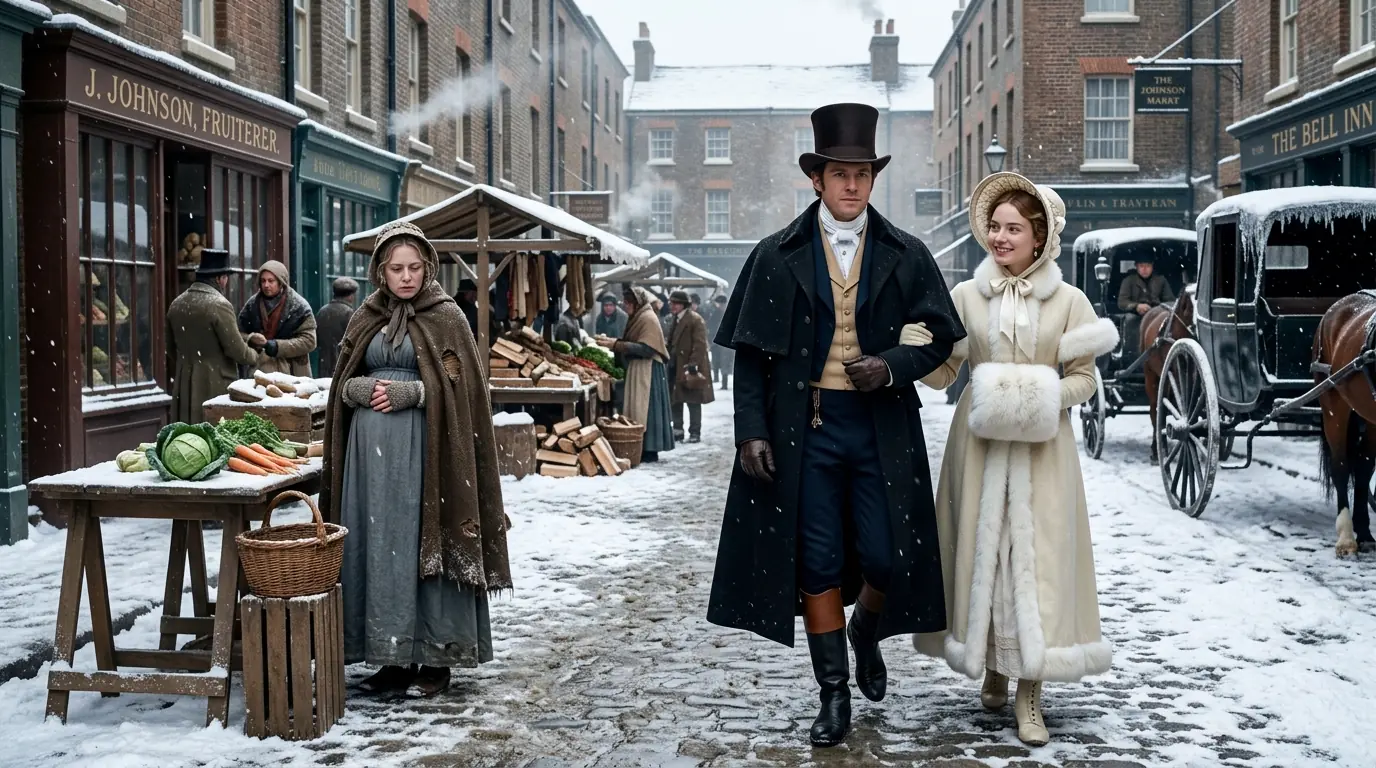
She was haggling over a cabbage. It was a bruised, pathetic thing, half-frozen and limp. She held it in hands that were raw, chapped red by the biting wind. She wore no gloves. She wore a dress of coarse, slate gray cotton hemmed with mud.
Over her shoulders was a thin, heavily darned woolen shawl that offered as much protection from the cold as a cobweb. Her dark hair, once curled and pinned with pearls by his own valet, was shoved hastily under a plain working-class bonnet. It was Josephine. Theo’s breath hitched in his throat. A sharp, physical pain slammed into his ribs.
It was her. The tilt of her chin, the proud, stubborn line of her neck, the way she shifted her weight when she was arguing. He hadn’t seen her in eight months. He had assumed, when he bothered to allow himself to think of her, that she had retreated to some quiet, modest country cottage. He had sent his solicitor to offer her a pension.
The solicitor had returned with the envelope unopened, stamped with a simple return to sender. He thought it was pride. He thought she had funds hidden away. He had never, in his darkest nightmares, imagined her standing in the freezing sludge of Covent Garden fighting over rotting vegetables. “Theo, you are scaring me,” Beatrice said.
Her voice was shrill, cutting through the static in his head. He ignored her. He took a step forward. Just as his boot hit the cobblestone, Josephine turned slightly to hand a copper coin to the vendor. The wind caught her thin shawl, blowing it back from her frame.
Theo stopped breathing. Beneath the cheap, heavy apron she wore, her stomach was swollen. It was a heavy, undeniable mound. She was pregnant. The world tilted on its axis.
The sky, gray and heavy with snow, seemed to press down on his shoulders. He stared at the curve of her belly. Six months, maybe seven. Seven months. The arithmetic fired through his brain with the cold, lethal speed of a bullet.
Eight months ago, she had signed the papers. The night before she walked into his study and broke him, they had shared a bed. She had held him in the dark, her face buried in his chest. It was his. The child she was carrying in the freezing mud, wearing rags, buying garbage to eat, it was his heir, his blood, his child.
A wave of nausea hit him so hard he swayed. At that exact moment, as if sensing the absolute collapse of the man standing twenty yards away, Josephine looked up. Her gaze swept over the crowd and landed on him. Time stopped. For a full, agonizing second, they simply looked at each other across the divide of the market.
Theo saw her eyes widen. He saw the flash of shock, the immediate, instinctive flinch. Her hand flew to her stomach, resting protectively on the crest of her unborn child. He expected her to look ashamed. He expected her to weep.
He expected her to run. She did none of those things. The shock left her face, replaced by a cold, hardened mask of absolute defiance. She pulled her shoulders back. She lifted her chin.
She looked at his heavy wool coat. She looked at the diamond pin in his cravat. She looked at Beatrice, clinging to his arm in ivory fox fur. Theo felt a sickening surge of self-loathing. He realized exactly what he looked like, the wealthy, untouched duke parading his pristine new bride, while the woman he had sworn to protect froze in the gutter with his child.
He opened his mouth to say what? He didn’t know. Her name? A plea? A command?
Josephine didn’t wait to find out. She took her bruised cabbage, dropped it into a cheap wicker basket, turned her back on him, and began to walk away. She moved heavily, her gait altered by the weight of the pregnancy, disappearing into the crush of bodies heading toward the narrow, lightless alleys of the rookeries. “Josie!” he choked out. The name scraped against his throat.
He ripped his arm away from Beatrice. “Theodore!” Beatrice shrieked, finally realizing he was moving towards the filth. “What are you doing? You cannot leave me here!”
“Wait here.” he barked, not looking at her. He shoved forward. He hit a costermonger’s cart, knocking a pile of turnips into the street. A man yelled.
Theo threw a gold sovereign at him without looking and kept moving. “Josie!” he roared. The crowd was too thick. A herd of sheep being driven to Smithfield Market suddenly clogged the junction, a moving wall of dirty wool and bleating bodies. Theo shoved through them, his bespoke boots sinking into animal muck.
He reached the vegetable stall. He looked down the alley where she had vanished. Empty. Shadows and damp brick. She was gone.
Theo stood at the mouth of the alley. The cold wind howled down the narrow passage, biting at his exposed face. His chest heaved. He dragged a trembling hand over his mouth. He had to find her.
He had to tear these streets apart brick by brick. He took three frantic steps into the gloom before a hand clamped onto the sleeve of his greatcoat. He spun around, ready to strike whoever dared touch him. It was a street urchin, no older than ten. His face smeared with soot.
The boy pointed back towards the square. “The flash lady is having a fit, governor,”. The boy mumbled, eyeing Theo’s gold watch chain. Theo looked back. Beatrice was backed against a brick wall, surrounded by a few curious onlookers, looking as though she was about to faint from the sheer indignity of her surroundings.
She was sobbing. A high, thin sound that grated on Theo’s raw nerves. Duty. The heavy, suffocating chain of aristocratic duty. He could not leave a peer’s daughter alone in Covent Garden.