He didn't marry her for love. He married her because her brother died bleeding out in his arms on a muddy battlefield, extracting a final, desperate promise. Harriet was twenty-eight, entirely penniless, and weeks away from the dreary, humiliating life of a paid companion. Sebastian was a duke who hadn't felt a single human emotion in three years.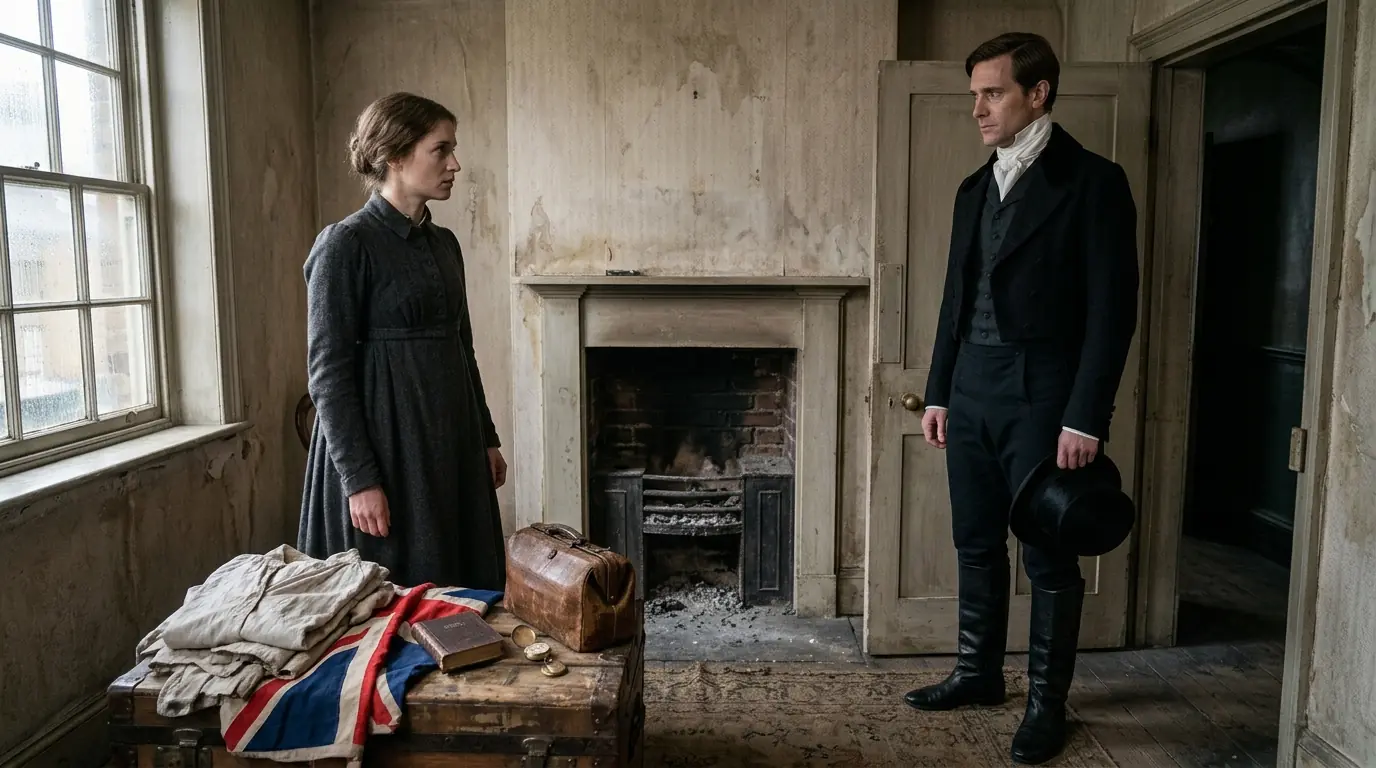
It was supposed to be a transaction, a roof in exchange for a cleared conscience. But guilt is a terrible foundation for a marriage, and proximity is a dangerous thing. The smell of boiled cabbage and damp wool was suffocating. Harriet Cavendish stood in the center of the cramped London sitting room, a stack of worn woolen shirts in her arms, Edward's shirts.
She pressed her face into the fabric. They didn't smell like him anymore. They just smelled like the cheap lye soap the landlady used. Edward was dead. The phrase still felt like a stone she had to swallow every morning.
He had been gone for six months, cut down at Waterloo, leaving Harriet with nothing but a folded flag, a rusted pocket watch, and a mountain of boarding house debt. At twenty-eight, Harriet was practically ancient in the eyes of society. She had never possessed the sort of startling beauty that made men overlook a lack of dowry. Her hair was a sensible dishwater brown. Her jaw was a little too sharp, her eyes a little too assessing.
She was a spinster. The word didn't sting anymore. It was merely a fact of her geography, like the relentless rain streaking the warped glass of her window. A sharp rap at the door shattered the quiet. Harriet didn't move.
"Mrs. Higgins, I told you I will have the rent on Tuesday. I am selling the silver candlesticks tomorrow." The door opened. It wasn't the landlady. Sebastian Ashcroft, the Duke of Whitmore, had to duck his head to clear the low door frame.
He looked entirely absurd in the dingy room. His dark wool coat was immaculately tailored, absorbing the meager light. His boots were polished to a mirror shine, tracking a single offending leaf onto the threadbare rug. Harriet dropped the shirts onto a trunk. "Your Grace."
Sebastian didn't offer a bow. He just stared at her. He looked exhausted. There were deep, bruised shadows beneath his eyes, and the harsh line of his mouth suggested a man who spent his days clenching his teeth against a persistent ache. He was Edward's commanding officer, Edward's best friend, and according to the letters Edward used to send, the man who had held him as he took his last breath.
"Miss Cavendish." His voice was gravel, low and scraped raw. "Pack your things." Harriet blinked. "I beg your pardon?"
"Your lease here is terminated. The arrears have been paid. My carriage is waiting downstairs. You will come with me to Whitmore House." She let out a dry, incredulous laugh.
She crossed her arms, anchoring her feet to the floorboards. "I most certainly will not. I appreciate your charity, Your Grace, but I do not require a guardian. I have secured a position in Bath as a companion to an elderly dowager. I leave next week."
"You are not going to Bath to fetch a deaf woman's lapdog." Sebastian said flatly. He stepped further into the room. The space felt instantly smaller. Edward asked me to look after you.
“Edward is dead.” The words cracked like a whip. She hadn't meant to sound so vicious, but the grief was a live wire. Sebastian flinched. It was a minuscule movement, just a tightening of the skin around his eyes, but she saw it.
“I am aware,” he said softly. “I buried him.” But before he closed his eyes, I gave him my word. I told him you would never want for anything. I don't want for anything now.
I have a plan. A plan to live in servitude. Sebastian closed the distance between them. He smelled of rain, expensive leather, and something metallic. Fear, maybe.
Or exhaustion. “Marry me, Harriet.” The silence in the room became absolute. A carriage rattled past on the cobblestones outside. “You are out of your mind,” she whispered.
“I am remarkably lucid.” He didn't drop his gaze. I need a wife. The peerage demands an heir, and my aunts are circling like vultures, waving debutantes in my face at every turn. I have no interest in courtship.
I have no interest in love. I want a quiet life. You need a home, financial security, and protection from a world that is exceptionally cruel to unmarried women without means. It was the most unromantic proposal in the history of England. Harriet respected him for it.
“A transaction,” she said. “A partnership.” I am not a beauty, your grace. Nor am I docile. If you want a quiet life, you are knocking on the wrong door.
“I don't want a porcelain doll,” Sebastian countered, his voice losing a fraction of its iron control. “I want Edward's sister. I want to know that I kept the only promise that matters to me anymore." Harriet looked at him. Really looked at him.
Pride told her to point him to the door. Pride told her to pack her single valise, go to Bath, and read Bible verses to an old woman until she died of boredom. But Harriet was cold. She was so terribly bone-deep cold. And she had been hungry for three days.
She looked at the peeling wallpaper. She looked at the Duke's heavy wool coat. "I will not be a ghost in your house," she said quietly. "You will be the Duchess of Whitmore," he replied. "You will answer to no one."
She held his gaze for a long moment. She didn't offer her hand. She didn't smile. "Fine. Give me five minutes to pack."
They were married three days later in a cavernous empty church in Mayfair. The vicar rushed through the liturgy, clearly offended by the lack of flowers, music, and guests. Harriet wore a dark blue traveling gown, the nicest thing she owned, though the hem was frayed. Sebastian wore stark black. He looked less like a groom and more like a man facing a firing squad.
When he slid the heavy gold band onto her finger, his skin was ice cold. He didn't kiss her. The vicar did not suggest it. Within an hour of the I dos, they were in a carriage heading north to his sprawling estate in Derbyshire. The journey took four days.
They spoke perhaps a hundred words in total. “Are you warm enough?” Yes, thank you. We will stop at the next inn for dinner. Very well.
It was excruciating. Harriet spent the hours staring out the window at the passing countryside, watching the green hills blur into gray rain. She felt entirely unmoored. Harriet Cavendish, the pragmatic spinster, had vanished into the ether, replaced by her grace, the Duchess of Whitmore. A title that felt as heavy and unwieldy as a stolen crown.
When they finally turned onto the miles-long gravel drive of Ashcroft Hall, Harriet felt a heavy weight drop into her stomach. The house was not a home. It was a fortress, vast, imposing, built of dark, weathered stone that seemed to drink the meager afternoon light. Dozens of windows stared out like empty eyes. As the carriage pulled to a halt, a small army of servants filed out the grand double doors, lining up with military precision.
Sebastian stepped out first, offering her his hand. She took it. His grip was firm, impersonal. "Welcome to Ashcroft Hall," he said, his voice flat. He led her up the stone steps.
The housekeeper, a severe woman with a ring of heavy iron keys at her waist, curtsied deeply. "Your grace, welcome home. And welcome, your grace." The woman's eyes darted over Harriet's plain blue dress, taking in the lack of a maid, the single scuffed trunk the footman was hauling from the boot, Harriet lifted her chin. She knew what they saw.
A charity case. A bizarre misstep by their stoic master. "Show my wife to her chambers." Sebastian ordered, not looking at Harriet. "I will be in my study.
I'm not to be disturbed." Without another word, he turned and walked down a long, echoing corridor. The sound of his boots on the marble floor faded into the shadows. Harriet was led up a sweeping, grand staircase to the Duchess's suite. The rooms were staggering.
High ceilings plastered with intricate gold leaf, walls lined in pale green silk, a fireplace large enough to roast a pig, and a bed draped in heavy velvet. It was beautiful. It was terrifying. She stood in the center of the vast carpet, clutching her small reticule. The silence of the house pressed against her eardrums.
She had traded the noisy, cramped poverty of London for an absolute, gilded isolation. That evening, they dined at opposite ends of a table that could comfortably seat thirty. The distance between them was comical. A massive silver candelabra sat dead center, obscuring Sebastian's face. Harriet could only see his hands as he methodically cut his meat.
The footmen hovered like ghosts, silently replacing plates and refilling crystal goblets. The clink of silver against porcelain was deafening. Harriet chewed a piece of roasted pheasant. It tasted like ash. She swallowed hard, pushing her plate away.
She couldn't do this. She could not live forty years in a mausoleum, pantomiming a marriage with a man who couldn't bear to look at her. "Is the food not to your liking? Sebastian's voice floated down from the other end of the mahogany expanse. The food is fine, Harriet said, projecting her voice so it carried.
“The geography is the problem.” Sebastian leaned slightly to the left, peering around the silver candelabra. “Excuse me?” “I said, the geography. You are practically in Scotland, Sebastian.
If you want me to pass the salt, I should have to hire a postboy.” He stared at her. It was the first time she had used his Christian name. It felt strange on her tongue, intimate and sharp. This is how my parents dined, he said stiffly.
Well, your parents must have had very good lungs, Harriet replied, picking up her wine glass and standing. She ignored the panicked look of the footmen who rushed to pull out her heavy chair. She walked down the length of the table, heels clicking on the hardwood floor, until she reached the chair directly to Sebastian's right. She sat down, placing her glass on the linen cloth. Sebastian went completely rigid.
He looked at her as if she had just placed a live grenade next to his dinner plate. “There,” Harriet said, smoothing her napkin over her lap. “Now we do not have to shout.” Do you actually manage this entire estate yourself, or do you have a steward who does the real work? For a long moment, Sebastian said nothing.
His jaw worked. He looked down at his plate, then back at her. Slowly, the tight lines around his mouth relaxed just a fraction. “I have a steward,” he murmured, “but he is incompetent.” I do most of it myself.
“Good,” Harriet said. I like ledgers. You can show me tomorrow." Sebastian blinked. "Ledgers?
You want to look at the estate ledgers?" "I managed a boarding house budget for three years, your grace. I am quite capable of doing arithmetic, and I refuse to spend my days doing needlepoint while waiting to die." A strange expression crossed Sebastian's face. It was gone before Harriet could categorize it.
He took a slow sip of his wine. "Very well, Harriet. Tomorrow we will look at the ledgers." It was a tiny victory, but as Harriet lay awake that night in the cavernous cold bed, listening to the wind howl around the stone turrets of Ashcroft Hall, she knew ledgers wouldn't be enough. She was living with a phantom, and she didn't know how to exorcise him.
Three weeks passed. They settled into a bizarre, sterile routine. Harriet woke early, breakfasted alone, and then marched into the estate office. True to her word, she took over the household accounts. She found them in a state of chaotic neglect.
Sebastian paid his bills, but he bled money out of sheer apathy. Harriet ruthlessly cut costs on luxury imports they didn't consume, and raised the wages of the tenant farmers, a move that made the estate steward turn purple, but which Sebastian authorized with a careless wave of his hand. "Do what you want," he had said, not looking up from a snifter of brandy. It was barely noon. That was the problem.
Sebastian drank. He didn't become violent or loud. He became a stone. He drank to numb the edges, pouring dark amber liquid into his glass in the library, staring into the hearth fire for hours on end. Harriet tried to ignore it.
She told herself it wasn't her business. Their arrangement was financial. She had a warm bed, excellent food, and purpose in managing the house. She had no right to demand his emotional sobriety, but Edward's ghost was a heavy third occupant in the house. It came to a head on a rainy Tuesday afternoon.
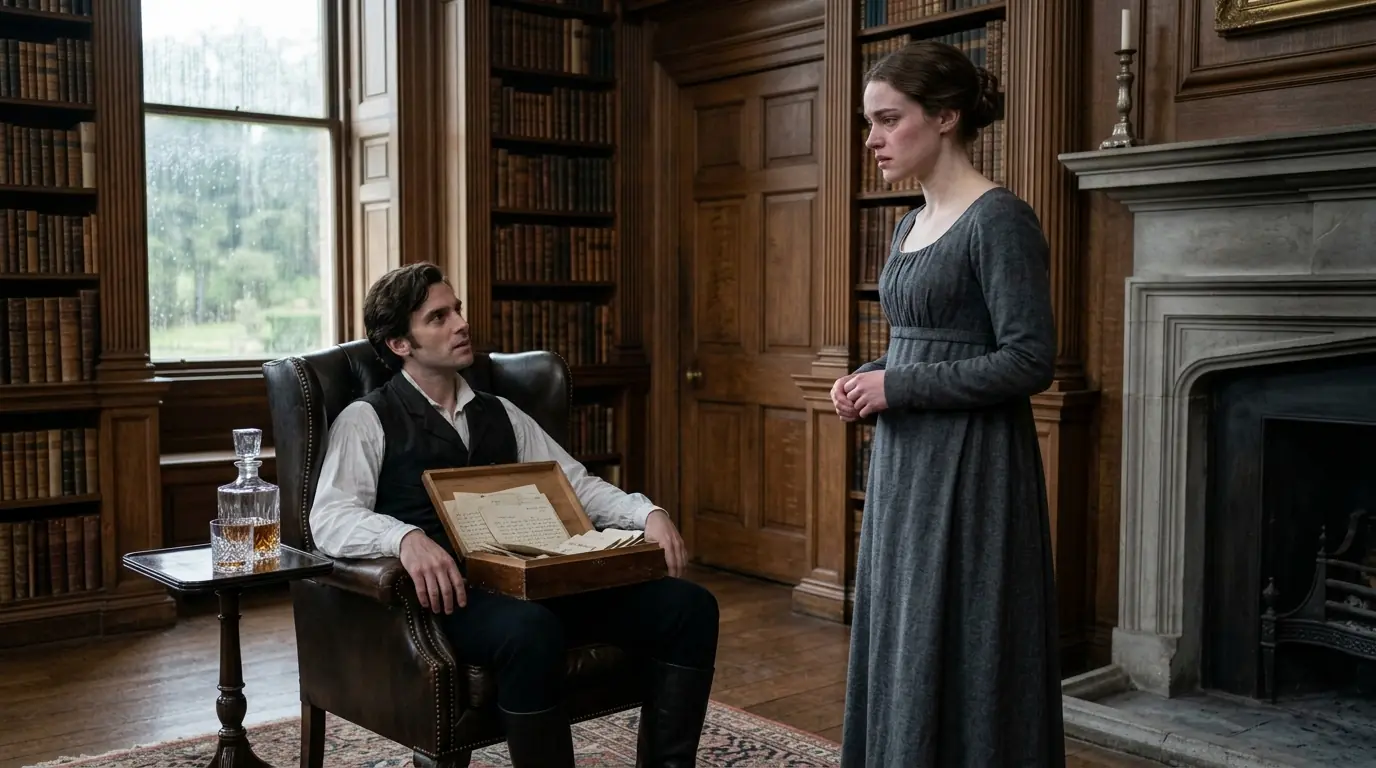
Harriet was in the library hunting for a specific book on crop rotation. The room was dark, smelling intensely of old paper, leather, and stale alcohol. She found Sebastian sitting in a wingback chair by the unlit fireplace. He was asleep, his head resting against the high back of the chair. A half-empty decanter of whiskey sat on the table beside him.
In his lap, loosely gripped in one hand, was a small, familiar wooden box. Harriet stopped breathing. It was Edward's cigar box, the one he used to keep his letters in. Drawn by an invisible string, Harriet stepped closer. Sebastian looked younger in sleep, the harsh, cynical lines of his waking face smoothed out.
But even unconscious, he looked troubled. His brow was furrowed, his breathing shallow and rapid. Harriet looked down at the box. The lid was open. Inside were a stack of letters.
She recognized her own handwriting on some, Edward's frantic scrawling script on others. She reached out, intending only to close the lid. Sebastian's hand snapped out like a viper. He gripped her wrist. Hard.
Harriet gasped, her heart leaping into her throat. Sebastian's eyes flew open. They were wild, unfocused, dark with some ancient terror. He stared at her, but he wasn't seeing her. He was seeing smoke and blood.
"Don't," he rasped, his voice ragged. “Don't leave him.” Sebastian, Harriet said clearly, forcing her voice to remain steady despite the bruising grip on her arm. “It is Harriet.” “You are in Derbyshire.”
“You are home.” He blinked. Once, twice. The wildness slowly drained from his eyes, replaced by a sudden, sharp realization. He looked at his hand wrapped around her wrist, and he let go, as if her skin burned him.
He scrambled back in the chair, running a trembling hand over his face. God, I apologize. I I was dreaming. Harriet rubbed her wrist. It throbbed, but she didn't step back.
She looked at the wooden box. You read his letters. Sebastian wouldn't look at her. He stared at the floorboards. “Sometimes.”
“Why?” “Because it is all I have left of him.” “It's not all you have left,” Harriet said softly. “You have me.” Sebastian let out a harsh, bitter laugh.
He finally looked up, and the self-loathing in his eyes was staggering. Yes, I have you. The living reminder of my failure. Every time I look at you across that dining table, Harriet, I see his eyes. I see the sister he begged me to protect while he bled out in the mud.
The words hit her like a physical blow. She had known it, of course. She had known she was a penance. But hearing it spoken aloud stripped away the thin veneer of civility they had built. Anger, hot and sudden, flared in Harriet's chest.
She was done being accommodating. She was done being the good, quiet spinster. “How dare you?” She whispered. Sebastian stiffened.
“Harriet—” “No, how dare you?” She took a step toward him, her hands balling into fists at her sides. "Do you think you have a monopoly on grief? Do you think you are the only one who lost him? I was his commander.
It was my job to bring him home." "He was my brother." Harriet's voice cracked, echoing loudly in the cavernous library. "He was my brother. He was the only family I had left in this miserable world.
He was my whole life. You lost a friend and a soldier. I lost my future." Sebastian stared at her, stunned into silence. Harriet was breathing heavily, tears finally pricking the corners of her eyes, but she refused to let them fall.
"I did not agree to this marriage to be your daily flagellation," she snapped, stepping closer, forcing him to look at her, really look at her. "I am not a ghost, Sebastian. I am a living, breathing woman. I am sitting at your table. I am fixing your ruined ledgers.
I am trying to make a life in this tomb you call a home." She pointed a shaking finger at the wooden box. "You want to drown yourself in whiskey and guilt? Fine. Drink yourself into an early grave, but do not use my brother's memory as your excuse.
Edward loved life. He would despise what you are doing to yourself. And he would despise how you are treating me." Sebastian's face was ashen. He opened his mouth, but nothing came out.
Harriet turned on her heel. "Keep the letters," she threw over her shoulder. "They are dead paper. I am going for a walk." She stormed out of the library, the heavy oak door slamming shut behind her with a finality that rattled the windows.
Left alone in the quiet, smelling of dust and whiskey, Sebastian looked down at his trembling hands. For the first time in three years, the fog of his grief had parted, pierced by a very sharp, very real anger from a woman he had assumed would just quietly fade into his wallpaper. He looked at the empty doorway. His chest felt strangely tight. Not with guilt this time, but with something alarmingly like awe.
Harriet expected the carriage to be waiting for her the next morning. She had yelled at a duke. She had desecrated the sacred shrine of his grief. By all the laws of their unbalanced transactional marriage, she expected to be banished to a remote dower house on the Scottish border. Instead, when she descended the grand staircase at eight o'clock, she found Sebastian standing in the foyer.
He was not holding a snifter of brandy. He was wearing riding leathers, a heavy wool coat, and boots caked in fresh mud. The shadows under his eyes were still there, stark against his pale skin, but his jaw was not locked in its usual rigid line. He looked at her as she reached the bottom step. "The west fields are failing," he said.
It was not a greeting. It was a statement of fact. Harriet paused, her hand resting on the carved mahogany banister. "I noticed that in the ledgers. The yield has dropped by thirty percent over the last two years.
My steward blames the soil. The tenants blame the steward. I am going to ride out and look at the drainage trenches." He slapped his riding crop against his thigh, a sharp, rhythmic sound in the quiet hall. "You cut the import budget yesterday by half to buy new iron plows.
If you are going to spend my money, you should see the mud you are investing it in. It was a challenge, a clumsy, abrasive olive branch. “I don't have a riding habit,” Harriet said. “Wear whatever you have. I don't care about fashion.
Just wear thick boots.” An hour later, Harriet found herself gripping the pommel of a sidesaddle perched atop a massive gray mare that felt roughly the size of a warship. She had lied by omission. She hadn't just lacked a riding habit. She hadn't ridden a horse since she was twelve years old, and her father's vicarage had boasted nothing more fearsome than an arthritic pony.
Sebastian rode a black gelding with effortless, irritating grace. He watched her white-knuckled grip on the reins. “You look terrified,” he noted. “I am merely calculating the distance between my skull and the ground,” Harriet shot back, refusing to look at him. She stared fixedly at the mare's ears.
“If I fall and die, Sebastian, you will have to find another spinster to balance your ledgers.” A strange sound emanated from Sebastian's throat. It was a harsh, choking noise. It took Harriet a full three seconds to realize it was a laugh. It was a rusty, unused sound startled out of him before he could suppress it.
She turned her head, surprised. For a fraction of a second, the heavy, suffocating mantle of the Duke of Whitmore vanished, and she saw the man her brother had described in his letters. He was the sharp-witted, cynical captain who could find grim humor in the bleakest of situations. Sebastian cleared his throat, his expression instantly shattering. “Keep your heels down and let the reins go slack.
She knows the way.” They rode for two hours under a gunmetal sky. The Derbyshire wind was vicious, biting through Harriet's wool cloak and stinging her cheeks. They surveyed the flooded trenches of the west fields. Harriet listened as Sebastian ruthlessly interrogated a terrified tenant farmer, his questions precise, demanding, but devoid of the cruel arrogance she had expected from a peer of the realm.
He didn't care about deference. He cared about the water table. As they turned back toward the estate, a sudden, violent downpour broke over the hills. The rain was freezing, coming down in sheets that instantly soaked through Harriet's thin gown where the cloak parted. Her mare spooked at a crack of thunder, dancing sideways into the slick mud.
Harriet had lost her stirrup. She slid, crying out as gravity dragged her toward the ground. She didn't hit the mud. Sebastian had spurred his gelding forward, his arm shooting out. He caught her by the waist, his grip like a vice, hauling her up and half dragging her across the saddle of his own horse before she could fully fall.
The breath was knocked out of her. She found herself crushed against his chest, the harsh wool of his coat scratching her cheek, the smell of rain, leather, and horse filling her nose. "Are you hurt?" His voice rumbled deep in his chest, vibrating against her. Harriet gasped for air, her hands clutching at his lapels.
"No, no, I am fine. You can let me down." He didn't let her down. He kicked his boot out, catching the trailing reins of her mare, and wrapped his other arm firmly around Harriet's waist, locking her against him. "Do not be a fool," he said roughly, spurring his horse into a canter.
“You are freezing. You will ride with me.” The ride back was silent save for the thundering hooves and the driving rain. Harriet sat rigidly, acutely aware of the hard muscle of his thigh against hers, the heat of his body radiating through his wet clothes. It was entirely improper.
It was deeply uncomfortable. And yet, as he pulled his heavy cloak around her trembling shoulders to shield her from the wind, Harriet felt a sudden, treacherous flutter in her stomach. When they finally clattered into the stable yard, grooms rushed out with lanterns. Sebastian slid down first, turning to reach up for her. Harriet placed her hands on his shoulders.
He gripped her waist and lifted her down. For a moment, her boots hit the ground, but he didn't step back. They stood toe-to-toe in the rain, breathless. His hands lingered heavily on her waist. The shadows under his eyes were replaced by a dark, focused intensity.
He looked at her mouth. Harriet's breath caught. Then, the stable master cleared his throat loudly. Sebastian dropped his hands as if she had scolded him. He stepped back, the mask of the stoic duke slamming back into place.
"Go inside, Harriet. Have Mrs. Higgins draw you a hot bath. “I will see you at dinner.” He turned and strode away into the driving rain, leaving Harriet standing in the mud, her heart hammering a frantic, confused rhythm against her ribs. The fragile unspoken truce they had built over the next two weeks was shattered by the arrival of a gilded carriage bearing the Ashcroft crest.
Harriet was in the library, a ledger balanced on her knees, when the double doors were thrown open. "Sebastian, my poor tragic boy." The voice was shrill enough to curdle milk. Harriet looked up to see a woman in her late fifties bearing down on the room, draped in layers of violet silk and smelling aggressively of lavender water. Trailing behind her was a young man with a weak chin and an impeccably tied cravat.
Sebastian, who had been standing by the window reviewing a surveyor's map, went perfectly still. Aunt Josephine, Lady Josephine Ashcroft, did not wait for an invitation. She swept into the room, pulling Sebastian into a brief theatrical embrace. “We came as soon as we heard the scandalous news. Married?
In secret? Without a single word to your family?” She stepped back, pressing a lace handkerchief to her chest. “And to a—well, where is she? Where is the little London charity case?”
Harriet stood up. The heavy ledger hit the floor with a resounding thud. Lady Josephine pivoted, her eyes narrowing as they swept over Harriet. She took in Harriet's sensible gray day dress, the lack of jewels, the simple twist of her brown hair. The older woman's lip curled in a barely concealed sneer.
"Oh," Josephine said. It was a single syllable dripping with venom. “You must be Edward's sister, the spinster.” “Harriet,” Harriet corrected evenly, refusing to break eye contact. “I am Harriet, the Duchess of Whitmore.”
Josephine let out a trilling condescending laugh. “Yes, well, titles can be bought and sold, but breeding always tells, doesn't it? This is my nephew, Simon. He is next in line for the dukedom should Sebastian's condition persist.” It was a blatant insult, an insinuation about Sebastian's mental state and his ability to sire an heir.
Harriet felt a spike of hot fury, not for herself, but for the man standing rigidly by the window. She opened her mouth to eviscerate the woman, but Sebastian moved first. He crossed the room in three long strides. He didn't look at his aunt. He walked directly to Harriet.
He stopped beside her, so close that their shoulders brushed. Slowly, deliberately, he placed his large hand on the small of her back. His grip was warm and fiercely protective. “Josephine,” Sebastian said. His voice was soft, but it carried the chilling metallic edge of a drawn blade.
“You will address my wife with the respect her title demands.” “You will not refer to her as a charity case. You will not discuss my private affairs.” Josephine's mouth opened and closed like a landed trout. “Sebastian, I only meant—” “I know exactly what you meant.”
He cut her off, his hand pressing firmer against Harriet's spine. Harriet is the Duchess of Whitmore. She is the mistress of this house. If her presence offends you, you are welcome to order your carriage brought back around immediately. Silence crashed over the library.
Simon took a nervous step backward, suddenly very interested in the pattern of the Persian rug. Harriet looked up at Sebastian. His jaw was clenched, his profile carved from granite. But the hand on her back was a steady, grounding anchor. He was defending her, openly, aggressively.
“We have traveled for three days,” Josephine finally sputtered, her face flushed with ugly, mottled color. “Surely you are not throwing your own blood out into the rain.” “You may stay for dinner,” Sebastian said, his tone utterly devoid of warmth. “Then you will leave in the morning. Harriet, my dear, would you be so kind as to ring for tea?
My aunt looks fatigued.” "My dear," the endearment was forced, a weapon forged for the benefit of his horrific relatives, but it sent a shockwave straight down Harriet's spine. Dinner was a battlefield masquerading as a meal. Josephine, realizing frontal assaults were dangerous, resorted to guerrilla warfare. She talked incessantly about the glittering London season, about the beautiful, wealthy debutantes Sebastian could have married.
She pointedly asked Harriet about her father's vicarage, feigning polite horror at the concept of darning one's own stockings. Harriet ate her roasted mutton with methodical precision. She didn't rise to the bait. She answered Josephine's barbs with dry, factual statements that left the older woman flailing for purchase. "And do you play the pianoforte, your grace?"
Simon asked, attempting to join the fray. "No," Harriet said, taking a sip of wine. "I find it frivolous. I prefer double-entry bookkeeping." Simon looked at her as if she had just confessed to eating children.
Through it all, Sebastian sat at the head of the table, his dark eyes locked on Harriet. He didn't drink a drop of whiskey. Every time Josephine tried to corner Harriet, Sebastian neatly intervened, steering the conversation into brutal, impenetrable silence. When the agonizing meal finally ended, Josephine and Simon practically fled to their guest chambers. Harriet stood in the quiet drawing room, staring at the embers in the fireplace.
She felt exhausted, hollowed out by the sheer effort of keeping her armor strapped on tight. She heard the heavy tread of boots on the rug behind her. “I apologize,” Sebastian said quietly. “My family is a nest of vipers.” Harriet didn't turn around.
She watched a spark fly up the chimney. "She is right, you know. You could have married an heiress, someone beautiful. Someone who knows how to hold a teacup without looking like she's assessing its auction value." Sebastian stepped closer.
The heat of him banked against her back. “I didn't want an heiress.” “You wanted a penance, I remember.” “I was an idiot,” he said softly. Harriet turned, startled by the raw admission.
He was standing inches away. The mask was gone. He looked exhausted. "Yes." But the deadness in his eyes had been burned away by a slow smoldering heat.
He reached out. Not to grab her wrist, not to defend her from his aunt. He reached out and gently brushed a stray lock of hair behind her ear. His fingers lingered on her jawline. His skin was rough, calloused from the reins and the sword, but his touch was agonizingly gentle.
“You terrified them tonight,” he murmured, a faint, genuine smile touching the corners of his mouth. “You didn't need my protection at all. You were magnificent.” Harriet's throat went tight. She couldn't breathe.
She couldn't think. The transactional walls of their marriage were crumbling, and she had no idea how to navigate the rubble. “Sebastian—” “Go to sleep, Harriet,” he whispered, dropping his hand, though his eyes never left her face. “Before I forget that I have no right to ask anything else of you.” He turned and walked out of the room, leaving Harriet burning in the cold house.
The morning after Josephine and Simon's hasty departure, Ashcroft Hall felt entirely different. The oppressive ghostly silence that usually clung to the stone walls had been replaced by a heavy crackling tension. It was the atmospheric pressure before a thunderstorm. Harriet couldn't focus on the ledgers. The numbers blurred.
Every time she heard a door open, every time a boot scuffed the floorboards down the hall, her pulse jumped. She was angry with herself. She was a twenty-eight-year-old spinster. She was practical. She understood the brutal mechanics of the world.
She had agreed to this marriage for a roof and a full stomach. She had explicitly told herself not to expect a fairy tale. But when Sebastian had touched her face, she shoved the ledger away, standing up so violently her chair scraped against the wood floor. She needed air. It was raining again, a relentless gray Derbyshire drizzle.
Harriet wrapped a thick shawl over her shoulders and walked out into the gardens. The air smelled of wet earth and crushed rosemary. She walked blindly, trying to cool the sudden inexplicable fever in her blood. She found him in the old glass house. It was a decaying structure at the edge of the property.
Its panes opaque with grime, choked with overgrown vines. Sebastian was standing in the center of the damp, green-smelling space in his shirt sleeves. He was violently hacking away at a dead, twisted briar bush with a heavy pair of iron shears. He didn't hear her approach. Harriet watched him.
He was striking the dead wood with unnecessary force, his jaw tight, his broad shoulders bunching and flexing under the white linen. He wasn't gardening. He was fighting. You are going to break the shears. Sebastian froze.
He lowered the heavy iron blades, his chest heaving as he turned to face her. His hair was damp with sweat and rain, falling into his eyes. He looked wild, dangerous, human. "What are you doing out here?" He asked, his voice harsh.
"It's freezing." "I could ask you the same question." Harriet stepped into the glasshouse. The air inside was warm, thick with humidity, and the smell of bruised leaves. Sebastian threw the shears onto a wooden bench.
They hit with a loud clatter. "I needed to hit something. The briar seemed a better candidate than my steward." "Because of Josephine?" "Because of everything."
He ran a hand through his damp hair, pacing a short line in the dirt. He stopped, glaring at the broken branches. "I brought you here to keep you safe, to honor him. I told myself it was a clean arrangement. I would provide the funds, you would live in comfort, and we would leave each other in peace."
"And?" Harriet prompted, her heart beginning that frantic hammering rhythm again. Sebastian turned his head. His eyes met hers, and the intensity in them pinned her to the spot. "And then you sat at my table and yelled at me.
You fixed my books. You sat on a horse looking like you were going to vomit. But you didn't complain once. You tore my aunt to shreds with nothing but a wine glass and a blank stare." He took a step toward her.
"You are loud, Harriet. You are demanding. You refuse to let me rot in peace." He took another step. The distance between them was vanishing.
"Edward told me you were practical. He He me you were sensible. He never told me you were going to tear my life down to the studs. Harriet lifted her chin. She refused to retreat.
If you want a quiet ghost, Sebastian, you can send me away. I have enough money saved from the household accounts to buy a cottage. I don't want you to leave, he said. The words were a low, desperate growl. He crossed the remaining distance.
He didn't hesitate this time. He didn't apologize. Sebastian reached out and gripped her face in both of his large, dirt-streaked hands. Harriet gasped, her hands flying up to grip his wrists. His skin was blazing hot.
He looked down at her, his eyes searching hers, looking for permission, looking for a rejection that wasn't there. He saw the way her breath hitched. He saw the dark flush creeping up her neck. Sebastian ducked his head and kissed her. It was not a polite aristocratic kiss.
It was a collision. It was three years of repressed grief, guilt, and sudden, blinding hunger all channeled into a single point of contact. His mouth was hard and demanding against hers. Harriet's initial shock vanished in a heartbeat, replaced by a surge of pure, answering fire. She didn't push him away.
She leaned in, her hands sliding from his wrists up his forearms, clutching at the damp linen of his sleeves. A groan rumbled deep in his throat. He shifted his grip, one hand sliding to the back of her neck, tangling in her hair, pulling her flush against his chest. She could feel the heavy, erratic thud of his heart against her own. He tasted of rain and desperation.
Harriet kissed him back with all the suppressed passion of a woman who had been told her entire life to be small, to be quiet, to be invisible. She opened her mouth to him, letting him deepen the kiss, letting the sheer force of him wash over her. When they finally broke apart, they were both gasping for air. Sebastian rested his forehead against hers. His eyes were closed, his chest rising and falling heavily.
He didn't let her go. His arms were locked tightly around her waist, anchoring her to him in the damp, overgrown glasshouse. "I have no right," he whispered, his voice jagged. "I have no right to want you this much." Harriet opened her eyes.
She reached up, running a trembling hand over his rough cheek. She felt a fundamental shift in the universe. The guilt that had bound them together was gone, burned away by the heat between them. "You are my husband," she said quietly, her voice steadier than she felt. "You have every right."
Sebastian opened his eyes. The darkness was entirely gone, replaced by a fierce, possessive clarity. He didn't say another word. He just kissed her again, silencing the ghosts once and for all. They did not speak as they walked back to the main house.
They didn't need to. Sebastian's hand remained firmly wrapped around Harriet's wrist, a physical tether pulling her through the rain. The servants in the corridors stopped and stared as the Duke of Whitmore half dragged his soaked, shivering Duchess up the grand staircase, his face a mask of terrifying resolve. He didn't take her to her opulent green silk chambers. He pulled her down the east wing, kicking open the heavy oak door to his own private suite.
The room was spartan, dark wood, a massive four-poster bed devoid of decorative hangings, and a fire blazing in the hearth. It smelled of him. Cedar, horse, and sharp soap. He shut the door. The heavy click of the iron latch was the loudest sound in the world.
Sebastian turned to her. The manic, desperate energy of the glass house had settled into something much heavier. He reached out and unfastened the soaked wool shawl from her shoulders, letting it drop to the floor. His hands moved to the top button of her ruined day dress. His knuckles were raw, his fingers trembling slightly.
"I am terrified,” he said. The admission was dragged out of him, his voice barely a rasp. Harriet covered his hands with hers. "So am I." It wasn't a fairy tale.
It was clumsy, cold, and desperate. Harriet had no experience, no practiced grace, and Sebastian was fighting three years of self-imposed starvation. When he finally laid her back on the mattress, the sheets were cool against her bare skin. He was covered in old scars, pale, jagged lines across his ribs and shoulder, a brutal road map of the war he had survived. She traced them with her fingertips.
He flinched, not from pain, but from the intimacy. "Don't,” he whispered, turning his face into her neck. "I am hideous." "You are alive,” she answered, her voice fierce. She pulled him down.
When it happened, it wasn't a poetic merging of souls. It was sharp, heavy, and grounding. It was the desperate friction of two lonely people proving to themselves they still had pulses. Sebastian clung to her as if she were the only solid object in a collapsing world, burying his face in her hair, his breath tearing out of his lungs in ragged gasps. For the first time since Edward died, the crushing weight in his chest broke apart.
But peace is a fragile, fleeting thing. Harriet woke just before dawn. The fire had died down to a dull orange glow. The bed was warm, heavy with the scent of sex and sleep. She reached across the mattress.
It was empty. She sat up, pulling the heavy quilt to her chin. The door to his dressing room was open. Sebastian was standing by the window, fully dressed in his riding clothes, staring out at the pitch-black grounds. “Sebastian?”
He went rigid. He didn't turn around. You should go back to your own rooms, Harriet, before the servants are fully awake. The coldness in his voice felt like a physical slap. The fragile, beautiful thing they had built in the dark shattered instantly.
Harriet swung her legs over the edge of the bed, her bare feet hitting the freezing floorboards. She grabbed her discarded shawl and wrapped it tightly around her nakedness. "Look at me," she demanded. He turned. The dim light from the embers caught his face.
The open, vulnerable man from the night before was dead and gone. The stoic, haunted duke was back, his eyes flat and dead. "It was a mistake," he said. His voice was completely hollow. "I took advantage of the situation.
I lost my mind. It won't happen again." Harriet stared at him. She felt the sharp sting of tears, but she ruthlessly swallowed them down. "A mistake?
We are married, Sebastian. We are a transaction, he snapped, his control finally cracking. He took a step toward her, his face twisted in agony. You are Edward's sister. I promised him I would keep you safe.
And instead, I dragged you into my bed like a feral animal. I looked at your face on the pillow, Harriet. I looked at your jaw, your eyes, and I saw him. I saw the man who died because I ordered him to hold the line. He turned away, pressing the heels of his hands into his eyes.
I am using you to replace the family I lost. It is sick. It is a betrayal. I cannot do it. Harriet stood perfectly still.
The cold of the room was seeping into her bones. She understood now. He wasn't rejecting her out of disgust. He was rejecting her because he felt he didn't deserve the comfort she provided. The survivor's guilt was a poison, and he was choosing to swallow it rather than let her heal him.
“You're a coward,” Harriet said quietly. Sebastian's hands dropped. He looked at her, shocked by the venom in her tone. You would rather live with a ghost than a wife, she continued, her voice gaining strength, echoing in the cavernous room. You would rather be miserable and noble than happy and human.
Fine. Keep your guilt. Drown in it. I am done trying to pull you out. She didn't run.
She walked past him, her head held high, despite the fact that she was wearing nothing but a woolen shawl, and left him alone in the dark. Harriet did not cry. She returned to her room, washed in icy water, and put on her stiffest, heaviest bombazine gown. It was black. She pinned her hair back so tightly her scalp ached.
She marched down to the dining room at exactly eight o'clock. Sebastian did not appear. She went to the estate office and spent three hours ruthlessly auditing the grain stores. She approved the eviction of a tenant who had been drinking his wages away for two years. She felt cold, efficient, and entirely hollow.
At noon, a footman nervously informed her that His Grace was in the library and had requested that no one disturb him. Harriet closed the ledger. "Thank you, Thomas." She stood up and walked directly to the library. She didn't knock.
She threw the double doors open. Sebastian was sitting behind his massive mahogany desk. The crystal decanter was out. It was already a quarter empty. The wooden cigar box sat open in front of him.
He looked up, his eyes bloodshot and hostile. "I said I was not to be disturbed. I am the Duchess. I do not take orders from footmen." Harriet walked across the Persian rug.
Her footsteps were heavy, deliberate. She stopped in front of the desk. She looked at the whiskey. She looked at the box. "Get out, Harriet," he warned, his voice low and dangerous.
Harriet reached across the desk. She didn't grab the decanter. She grabbed the cigar box. Sebastian leaped up, his chair crashing backwards to the floor. "Put that down!"
Harriet backed away, holding the box to her chest. "No. We are going to settle this right now. Harriet, I swear to God, if you drop those" "They are paper, Sebastian. They are dried ink and old paper."
She retreated toward the massive stone fireplace. A heavy fire was roaring on the grate, fighting the damp Derbyshire chill. “Edward is dead. He has been dead for a year.” He is rotting in the ground in Belgium.
Sebastian flinched violently as if she had struck him with a whip. He came around the desk, his hands out, his eyes panicked. “Stop it. Give them to me.” “Why?
So you can read them again?” So you can remind yourself of exactly what he sounded like? Tell me, Sebastian. What does this letter say? She pulled a folded parchment from the top of the pile.
It was stained with mud and something dark and brown. Blood. “Don't read it,” he begged. The anger was gone, replaced by a naked, horrifying vulnerability. He stopped ten feet from her, trembling.
Harriet unfolded the stiff paper. Her hands shook, but her voice was a whip crack in the quiet room. Sebastian, if I do not make it through tomorrow, do not let my sister go to the poorhouse. Harriet is too smart for her own good and too proud to ask for help. Give her an allowance and for God's sake, do not spend the rest of your life brooding.
Drink a pint for me. Marry someone who makes you laugh and live long enough to get fat and boring. Harriet stopped. The silence in the library was absolute, broken only by the crackle of the fire. She looked up.
Sebastian was staring at her. Tears finally spilling over his lower lashes, cutting clean tracks through the dust and exhaustion on his face. He wasn't a duke. He was just a broken soldier. “He told you to live,” Harriet whispered.
He told you to live and you came home and built a tomb for the both of you. I am the one who ordered him forward, Sebastian choked out, his voice shattering. He told me the line wouldn't hold. I told him to hold it anyway. He died following my order.
How am I supposed to live with that? “By living!” Harriet screamed, the raw emotion finally tearing out of her throat. By surviving! You think you are honoring him by starving yourself to death in this house?
You think he wants you miserable? He loved you. You were his brother. She looked at the letter in her hand. She looked at the fire.
Harriet, please. “He's dead,” Harriet said softly. “But we are not.” She tossed the letter into the flames. No!
Sebastian lunged forward. Harriet grabbed his shoulders, throwing her entire body weight against his chest, stopping him from reaching into the grate. He crashed into her and they both went down hard on the edge of the hearth rug. Sebastian scrambled, his eyes locked on the fire, but it was too late. The dry parchment caught instantly, curling into black ash.
He stopped fighting. He collapsed against Harriet, his broad shoulders shaking violently. A terrible, agonizing sob ripped out of his chest. It was the sound of a dam breaking, of three years of suffocating guilt finally finding the air. Harriet didn't say a word.
She wrapped her arms tightly around him, pulling his heavy head into her shoulder. She buried her face in his hair and held him while he cried for the boy left in the mud. She held him as the rest of the letters burned, turning from ghosts into smoke and disappearing up the chimney. They sat on the floor for a long time. The fire died down to embers.
When Sebastian finally lifted his head, his eyes were red and swollen, his face exhausted. But the frantic, haunted energy that had plagued him since the day he walked into her boarding house was gone. He looked drained. He looked clear. He looked at the empty cigar box spilled on the rug.
Then he looked at Harriet. "I have nothing left of him." He whispered. Harriet touched his cheek, her thumb wiping away a smudge of soot. "You have his memory.
That doesn't belong in a box, and you have me." Sebastian let out a long, shuddering breath. He leaned into her hand, closing his eyes. "I'm sorry. I'm so sorry."
"I know." Harriet kissed his forehead. "Now, help me up. The floor is ruining my dress, and I need a glass of wine." Six weeks later, the spring thaw hit Derbyshire with a vengeance.
The relentless gray skies finally broke, revealing a brilliant, sharp blue. The mud remained, but the air smelled of green shoots and wet stone. Harriet stood in the stable yard, the hem of her dark blue walking dress already ruined by the muck. She held a clipboard, severely checking off items as a trio of exhausted dray horses were unhitched from a massive wagon. “Four iron plows,” she muttered, tapping her pencil against the paper.
“Six barrels of seed, and they forgot the new harnesses.” “I'm going to write a very strongly worded letter to the smith in Sheffield.” “I pity the smith,” a voice drawled from behind her. Harriet turned. Sebastian was leaning against the stable doorframe.
He wore his heavy work clothes, his boots caked in mud, a smudge of grease across his jaw. He looked healthier. The bruising shadows under his eyes had faded, and he had put on enough weight that his coat no longer hung on him like a shroud. He pushed off the door frame and walked toward her, stepping effortlessly through the mud. "The west fields are draining," he announced, stopping in front of her.
"The new trenches are holding. We might actually have a harvest this year that doesn't rot on the stalk." "It's a miracle what adequate funding and a competent manager can achieve," Harriet said dryly, not looking up from her list. Sebastian reached out and plucked the pencil from her fingers. Harriet scowled.
"I was using that." "You are always using that." He tossed the pencil onto the wagon bed. He looked down at her. There was a quiet, steady heat in his eyes that made Harriet's breath catch in her throat, just as it had every day for the last six weeks.
Since the fire in the library, they had not spoken of Edward. They hadn't needed to. The ghost had been exorcised. They had returned to Sebastian's bedroom that night, and this time there was no panic in the morning. There was only a slow, deliberate rebuilding of a life.
Sebastian took the clipboard from her other hand and placed it on the wagon next to the pencil. He took both of her hands in his. "I received a letter from my aunt Josephine this morning," he said. Harriet stiffened. "Should I prepare the guest rooms or just arm the footman?"
A genuine, startlingly bright smile broke across Sebastian's face. It changed him entirely, stripping away the severe duke and revealing a man who was actually capable of joy. "Neither. She has found a suitable match for Simon, an heiress from York. She gloated about the dowry for three pages.
Good for Simon. He will need the money to pay for his tailored cravats. Sebastian laughed, a warm, rich sound that rolled across the stable yard. He stepped closer, crowding her against the wagon wheel. She also asked if there was any news from Ashcroft Hall regarding an heir.
Harriet felt the heat rise in her cheeks. She looked down at his muddy boots. "And what did you tell her?" Sebastian released her hands. He reached up, cupping her face, his thumbs stroking the sharp line of her jaw.
He forced her to look at him. “I haven't written back yet,” he said softly. The teasing tone was gone, replaced by absolute sincerity. “Because I realized I haven't actually asked you.” Harriet blinked.
“Ask me what? We are already married.” “I forced you into a transaction,” he corrected gently. “I bullied you into a carriage and dragged you to a tomb because I was drowning and I needed an anchor. You saved my life, Harriet.
You dragged me out of the dark by my hair." He leaned his forehead against hers. "I don't want a transaction anymore. I don't want a debt paid. I want a wife.
I want you." He paused, his breath warm against her skin. "I love you. It is entirely inconvenient and I am fairly certain you're going to bankrupt me with your iron plows, but I love you. I want to build a real life here with you, if you will have me."
Harriet closed her eyes. The cynical, guarded spinster she had been in that London boarding house felt like a stranger from a different lifetime. She had fought for this man. She had fought his demons, his family, and his own stubborn pride. And she had won.
She opened her eyes and met his gaze. She didn't offer a demure smile. She grabbed the lapels of his coat and pulled him down. "If you ever let your aunt back in this house," she murmured against his mouth, "I will use the iron plows on her carriage." Sebastian grinned against her lips.
"Agreed." He kissed her right there in the muddy stable yard in front of the grooms and the dray horses and the endless star-bespeckled sky. It wasn't desperate. It wasn't an escape. It was a promise grounded in the earth, rooted in reality, and finally, undeniably alive.