He hadn't looked at her in three years. Not really. So, when the heavy oak doors of his study opened to reveal nothing but a single folded piece of parchment resting on a silver tray, Arthur didn't expect his quiet, predictable life to crack straight down the middle. Arthur Pendleton, the ninth Duke of Rothford, considered his marriage a resounding success.
It was a Tuesday morning in late November. Frost clung to the massive, multi-paned windows of the breakfast room. A fire snapped in the hearth, doing little to warm the cavernous space. Arthur sat at the head of the twenty-foot mahogany table, a crisp copy of The Times folded neatly beside his plate.
He chewed his toast. He reviewed a ledger from his estate manager in Yorkshire. The house was perfectly quiet. To his right, at the very opposite end of the table, sat his wife.
Beatrice was a smudge of pale blue cashmere in the peripheral vision of his life. If pressed, Arthur could have told you she had light brown hair and a quiet disposition. He could have told you they had been married for eight years. He could not have told you the last time she smiled, or what book she was currently reading, or why she had stopped wearing the heavy emerald pendant he had gifted her on their first anniversary. He didn't notice these absences.
He noticed only the peace. Before Beatrice, Arthur's life had been a battlefield of expectations. A domineering father, a mother prone to theatrical hysterics, and a society that demanded his constant, glittering presence. When he married Beatrice, the youngest daughter of a respectable but financially ruined earl, he had wanted exactly one thing: silence. He had wanted a house that ran like a well-oiled machine and a woman who would not demand pieces of his soul when he returned from Parliament exhausted.
Beatrice had delivered. She never shouted. She never threw vases. She never demanded to know why he spent four nights a week at his club, or why he locked himself in his study on Sundays. Arthur turned a page in his ledger.
“The heating grates in the west wing need repairing,” he murmured, not looking up. “Have the housekeeper contact the ironmonger in the village.” “I took care of it on Thursday, Arthur.” Her voice was soft. It lacked the resonant timbre it had possessed when they first met, worn down by years of speaking into empty rooms.
“Excellent,” he replied. He made a small check mark in his book. “Lord Hastings is hosting a dinner on the fourteenth.” “Send our regrets. Tell him I am tied up with the agricultural bill.”
“I will.” He finally glanced up, not at her face, but at her hands. She was holding a fragile porcelain teacup. Her knuckles were white.
The cup rattled, just barely, against the saucer. “Are you cold?” he asked. It was a polite inquiry, the kind a man might ask a stranger waiting for a carriage. “No,” Beatrice said. She set the cup down.
“I am perfectly fine.” Arthur nodded, satisfied, and returned to his numbers. He missed the way her eyes lingered on the top of his head. He missed the slight parting of her lips as if she were gathering the breath to scream or cry or beg. He missed the way she slowly deflated when he didn't look back up, her shoulders slumping beneath the expensive cashmere.
He missed it all because he wasn't looking. Later that afternoon, Arthur stood in the foyer, shrugging into his heavy wool overcoat. His carriage waited outside to take him to London for the week. Bates, his valet, handed him his gloves. Beatrice stood at the bottom of the grand staircase.
She often did this. It was part of their routine. The duke leaves; the duchess waves goodbye. “I shall return on Friday,” Arthur said, adjusting his collar. “Perhaps Saturday, depending on the committee.”
“Arthur.” He paused, his hand on the brass doorknob. He turned. Beatrice had descended the last step. She was looking at him, really looking at him.
He was already calculating the travel time to the city. She opened her mouth. A heavy, suffocating silence stretched between them. The grandfather clock ticked. Bates stared fixedly at a spot on the wall.
Beatrice looked at the polished floorboards, then up at his face. She searched it, looking for a crack in the polite, indifferent mask. She found none. “Drive safely,” she said. Arthur gave her a curt nod.
“Good day, Beatrice.” He walked out the door. He didn't look back. If he had, he would have seen her collapse onto the bottom stair, burying her face in her hands. He would have heard the first jagged sob tear through the silent house.
But Arthur was already in his carriage, opening a folder of parliamentary notes, completely oblivious to the fact that his marriage had just ended. For Beatrice, the decision did not arrive in a flash of dramatic lightning. It was not born of another woman's perfume on his collar or a violent argument in the drawing room. It was born of frostbite. She had spent eight years freezing to death in a grand, empty house.
She had tried in the beginning. She had learned his favorite meals. She had read the political columns so they might have something to discuss. She had worn silk dresses in his favorite shade of crimson. And Arthur had met every effort with a polite, impenetrable wall of civility.
He treated her like a highly valued employee, a manager of his domestic affairs. She realized, sitting on that bottom stair, that if she died tomorrow, Arthur would grieve the disruption to his schedule before he grieved her. She stood up. She wiped her face. The tears stopped.
A strange, terrifying clarity settled over her. She walked upstairs to her chambers. She did not ring for her maid. She pulled a leather valise from the back of her wardrobe and opened it on the bed. Arthur returned to Rothford Manor on Friday evening, irritated.
The agricultural bill had stalled. His carriage had thrown a shoe near Chelmsford, and his head throbbed with a dull, persistent ache. He handed his coat to the footman. The house was quiet. That was normal, but there was a different quality to the silence tonight.
It wasn't the peaceful, ordered quiet he preferred. It felt hollowed out. “Is the Duchess in the drawing room?” Arthur asked, rolling his shoulders to relieve the tension. The footman, a young lad named Thomas, looked panicked.
He swallowed hard. “No, your grace.” “Her chambers, then. Have dinner sent to my study.” Arthur walked down the long corridor to his private sanctuary.
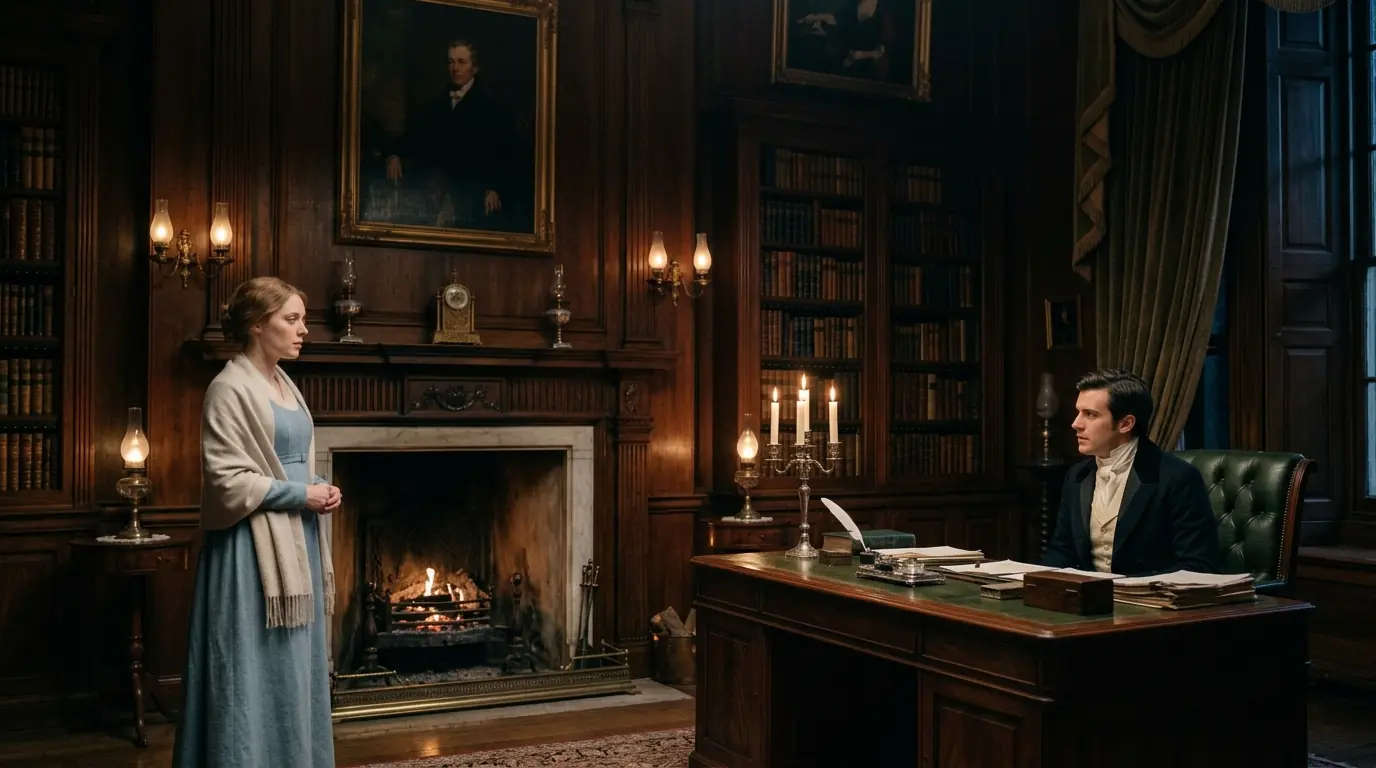
He opened the heavy oak doors. The room was dark, save for a single candelabra burning on his massive desk. Sitting perfectly centered on the green leather blotter was a silver tray. On the tray was a folded piece of heavy parchment. Arthur frowned.
He walked over, picking it up. His name was written on the outside in Beatrice's neat, sloping hand. He broke the wax seal. He expected a list of domestic grievances, a note about a sick horse, a reminder of an impending visit from her dreary aunt. He unfolded the paper.
The letter read: “Arthur, I am gone. I have taken the carriage to the station and will be staying with my sister in Bath for the foreseeable future. Please do not send anyone to fetch me. I am not leaving because I am angry. Anger requires a fire I no longer possess.”
“I am leaving because I am disappearing. I have spent eight years fading into the wallpaper of this house and you have not noticed. You are a decent man, Arthur. You provide, you protect, and you adhere strictly to your duty. But you do not know me.”
“You do not want to know me. You wanted a ghost to keep your house in order and I can no longer play the part. I leave you the silence you love so much. May it keep you warm. Beatrice.”
Arthur read the letter. Then he read it again. He didn't move. He didn't breathe.
His brain, so accustomed to logical deduction, to debates and ledgers and practicalities, simply stalled. “I am gone.” He looked up. The room was empty.
The shadows flickered against the walls. “Bates!” Arthur barked. The sound of his own voice was startlingly loud, harsh, and ugly in the refined space. His valet appeared in the doorway almost instantly.
The man looked pale. “Where is she?” Arthur demanded, thrusting the letter forward. “When did she leave?” “Tuesday afternoon, Your Grace, shortly after you departed for London.”
Arthur stared at him. “Tuesday? It is Friday. Why was I not sent for? Why was a rider not dispatched to my club?”
Bates looked at the floor. “Her Grace gave explicit instructions, sir. She said you were not to be disturbed with domestic trivialities while Parliament was in session. She said you would prefer to read her note upon your scheduled return.” The words hit Arthur like a physical blow.
“Domestic trivialities.” That was how she viewed her own departure. That was how she assumed he would view it. “Get out,” Arthur whispered. Bates vanished, closing the door softly behind him.
Arthur sank heavily into his leather chair. The paper in his hand felt like lead. He looked at the ink. It was slightly smudged near the bottom, right over the word warm. A teardrop or just a careless slip of the hand.
He didn't know. He realized with a sudden, sickening jolt that he didn't know how she held a pen. He stood up abruptly, knocking his chair backward. It crashed onto the carpet. He ignored it.
He walked out of his study and began to climb the stairs. He moved slowly at first, then faster, taking the steps two at a time until he reached the East Wing, her wing. He opened the door to her bedroom. It was immaculate. The bed was made tightly.
The curtains were drawn. It smelled faintly of lavender soap and cold air. Arthur walked to her dressing table. It was stripped bare of her silver brushes. He opened her jewelry box.
It was full. The emerald pendant, the diamond earrings he had purchased in Paris, the sapphire brooch. She had left every single piece of value he had ever given her. He opened her wardrobe. The silk dresses in crimson and deep blue were still there.
The heavy velvets, the expensive furs. Gone were her simple wool day dresses, her sturdy boots. She had taken nothing but what she fundamentally needed to survive. Arthur stumbled back, sitting on the edge of her mattress. The sheer violence of the absence was suffocating.
He reached out, his hand brushing against a small leather-bound book left on the nightstand. He picked it up. It was a household ledger. He opened it expecting lists of linens and pantry inventory. It was a ledger, but in the margins, written in tiny, cramped pencil, were dates and notes.
“October 4: Wore the blue dress. He did not look up from his soup. Fourteen words spoken today. November 12: I asked his opinion on the garden redesign. He said, ‘Do as you please.’ I think he forgot my name for a moment.”
“It rained all afternoon. January 9: I was ill. I stayed in bed for two days. He asked Bates where I was. He did not come upstairs.”
Arthur felt his throat close. The air in the room vanished. He flipped through the pages, hundreds of entries, hundreds of days, a meticulously documented record of a woman starving to death in a banquet hall. He dropped the book.
It hit the floor with a heavy thud. He had thought they were happy. He had thought the quiet meant contentment. He had prided himself on being a modern, rational husband who did not subject his wife to the emotional volatility he had witnessed in his parents' marriage.
He had given her wealth, a title, a home. He had given her absolutely nothing. Arthur buried his face in his hands. The silence of the manor pressed against his eardrums, a physical weight.
It wasn't peaceful anymore. It was deafening. It was a graveyard. He sat there for hours, the cold seeping into his bones, the faint smell of lavender fading away.
He was the Duke of Rothford. He commanded the respect of peers, the fear of his tenants, and the attention of the Crown. And he was utterly, completely alone. Arthur did not sleep that weekend. He remained in his study, the fire dying in the grate, the ledger open on his desk.
He read the margins until the graphite smudged beneath his thumb. He read until the words burned themselves into his retinas. “December 1: I dropped a plate in the hall. It shattered. He merely closed his study door.”
By Monday morning, the Duke of Rothford was a different man. His cravat was improperly tied. His jaw was dark with stubble. When Bates entered with morning tea, Arthur did not look at the silver tray.
“Have the carriage readied,” Arthur commanded. His voice was hoarse. “Pack my trunk for a week. We go to Bath.” Bates paused, the teapot hovering over a porcelain cup.
“Yes, your grace. Shall I send word ahead?” “No.” The journey south was miserable. The roads were thick with November mud.
Cold rain lashed against the carriage windows, blurring the English countryside into a dreary smear of brown and gray. Arthur sat in the swaying cabin, staring at the opposite seat. He tried to construct a logical argument. He was a man of Parliament. He drafted bills.
He negotiated land disputes. He could negotiate a marriage. He would offer her a larger allowance. He would hire a companion for her. He would agree to attend her social functions, perhaps once a month.
But every time he rehearsed these concessions, the phantom weight of her ledger mocked him. “He did not look up from his soup.” You cannot negotiate with a ghost using copper coins; you have to give them blood. They reached Bath on late Wednesday afternoon. The city was a crescent of pale stone smelling faintly of sulfur and wet pavement.
Arthur directed the driver to a modest address on Lansdowne Crescent. It was not a slum, but it was a severe departure from the palatial sprawl of Rothford Manor. It was a narrow terraced townhouse with a blue door. Arthur stepped out of the carriage. He didn't wait for his footman.
He walked up the three stone steps and banged a brass knocker. A maid opened the door. She wore a stained apron and looked harried. “Yes?” “I am the Duke of Rothford,” Arthur said.
The title usually parted crowds. “I am here for my wife.” The maid's eyes widened, but before she could speak, a sharp voice cut through the narrow hallway. “Let him in, Mary. It was only a matter of time before the ledger keeper realized his accounts were short.”
Arthur stepped into the cramped foyer. A woman stood at the top of the stairs. It was Margaret, Beatrice's older sister. She was a widow, famously sharp-tongued, and entirely unimpressed by nobility.
She wore a practical brown bombazine gown and a scowl that could curdle milk. “Lady Margaret,” Arthur said, removing his hat. “Your Grace.” She descended the stairs. She did not offer her hand.
She stood blocking the hallway, her arms crossed. “You took your time. She’s been here a week.” “Parliament,” Arthur said. The excuse, which had always felt like an ironclad shield, suddenly sounded pathetic.
Margaret laughed. It was a harsh, scraping sound. “Of course, the agricultural bill. How are the turnips faring, Arthur? Better than your wife, I presume.”
Arthur tightened his grip on his hat. “I want to see her.” “She is resting. She arrived here looking like a corpse.”
Margaret leaned forward, her voice dropping to a vicious hiss. “You starved her, you pompous fool. Not of food or breath. She was drowning in that mausoleum you call a home.”
“I never raised my hand to her. I never raised my voice. I provided—” “You provided a highly decorated cage and then forgot you owned a bird,” Margaret interrupted. “She doesn’t want your money.”
“She doesn’t want your title. She wants to exist, and she doesn’t exist when you are in the room.” Arthur felt a muscle twitch in his jaw. “That is for her to decide, not you.” Margaret stared at him for a long, calculating moment.
She stepped aside, gesturing toward a closed door at the end of the hall. “The back parlor. Don’t expect the woman you left behind. That woman is dead.” Arthur walked down the narrow hall.
The floorboards creaked. He reached for the brass handle, his palms sweating. He, who had addressed the House of Lords without a tremor, was terrified of opening a parlor door. He turned the knob and stepped inside. The room was small, heated by a robust fire.
The smells of roasting apples and damp wool hung in the air. Sitting in a wingback chair by the window was Beatrice. She was reading a book, a real book, not a household ledger. She wore a simple gray wool dress, devoid of the lace and silk he usually paid for. Her hair was not pinned up in an elaborate severe style.
It was braided loosely down her back. But the most shocking thing was her face. The pale translucent skin he remembered from the staircase was gone. There was color in her cheeks. The washed-out gray eyes were focused, tracking the lines of ink on the page.
She looked up as the door clicked shut. Arthur stopped breathing. He waited for the mask to slip over her features, the polite, distant expression she wore at his breakfast table, the face of the Duchess of Rothford. It didn't appear. Instead, Beatrice looked at him with a calm, terrifying indifference.
“Arthur,” she said. Her voice was steady. It didn't waver. It didn't plead. “Beatrice.”
“You found the letter, then.” She closed her book, marking the page with a ribbon. “I did.” He took a step forward, then stopped. He didn't know what to do with his hands.
“I have brought the carriage. Your trunk can be loaded in ten minutes.” She looked at him. Really looked at him, just as she had on the staircase. But this time she wasn't searching for a crack in his armor.
She was simply observing a stranger. “I am not going back,” she said. “Don't be absurd. You are my wife. You are the Duchess of Rothford.”
“I was the Duchess of Rothford,” she corrected gently. “Now, I am simply Beatrice. It is a much smaller life, Arthur, but it is infinitely louder. Margaret's dog barks, the roof leaks, the maid drops the tea service. It is chaotic.”
She smiled. It was a small, genuine thing, and it hit Arthur like a physical blow. He hadn't seen her smile like that since the year they were married. “I love it. It is entirely improper.”
“The scandal will blow over in a month. Tell them I went mad. Tell them I ran off with a French poet. They will pity you, and you will be left in peace. It is exactly what you have always wanted.”
“It is not what I want.” The words tore out of his throat, raw and loud. Beatrice blinked, surprised by the volume, but she did not flinch. “Isn’t it, Arthur? You haven’t looked at me in three years.”
Arthur stared at her. The parlor suddenly felt oppressively hot. The smell of roasting apples turned sickly sweet in his lungs. “I am looking at you now,” he said.
Beatrice shook her head slowly. “You are looking at a problem to be solved, a misaligned column in your ledger, an unruly tenant who has skipped rent. I am an inconvenience to your schedule, Arthur, not a wife.” He wanted to shout.
He wanted to assert his authority, but the margins of her little leather book flashed behind his eyes. “He forgot my name for a moment.” He walked to the small sofa opposite her chair and sat down heavily. The velvet cushions yielded beneath his weight. He leaned forward, resting his elbows on his knees, destroying the perfect, rigid posture he had maintained since childhood.
“I read it,” he said softly. Beatrice frowned. “Read what?” “Your ledger.” The color drained from her face.
Her hands tightened on the cover of her book. For a second, the calm facade shattered, revealing the fragile, wounded creature beneath. “You had no right.” “I was looking for an explanation. I found a graveyard.”
Arthur swallowed hard. His throat felt like sandpaper. “October 4, you wore the blue dress. I spoke fourteen words.” Beatrice looked away, staring out the window at the rain-slicked street.
Her jaw tightened. “Stop it.” “January 9, you were ill for two days. I did not go upstairs.” “Stop!” she commanded, her voice cracking.
“I thought I was being a good husband,” Arthur confessed to the floorboards. “My father was a monster. He threw plates. He screamed until the veins bulged in his neck. He dragged my mother through hell with his temper.”
“I swore I would never do that. I swore my house would be calm. I thought by giving you peace, I was giving you a good life.” “Peace?” Beatrice turned her head back to him.
Her eyes were flashing now, a spark in the ash. “You didn't give me peace, Arthur. You gave me an airless room. You gave me nothing to push against. No anger, no passion, no interest.”
“Do you know what it is like to scream into a void and hear absolutely nothing bounce back? It makes you think you don't exist.” She stood up, pacing the small space between the chair and the window. “I tried,” she said, her voice trembling with years of suppressed grief. “I wore your favorite colors.”
“I read those dreadful political essays. I learned the names of your hunting dogs. I tried to make you see me, but you only saw the house turning smoothly. As long as there was hot food and quiet hallways, I was entirely replaceable.” “You are not replaceable.”
“Yes, I am,” she fired back. “Hire a housekeeper, Arthur. She will do exactly what I did, and you can pay her a wage. I at least want to be paid in acknowledgement. I want someone to ask me if I'm cold because they actually care if I'm shivering, not because it is the polite thing to say before returning to the Times.”
Arthur stood up. He bridged the gap between them, stopping mere inches from her. She didn't back away. “I didn't know,” he said. The admission cost him everything.
Dukes do not admit ignorance. Dukes do not apologize. “I was blind. I was arrogant. I was terrified of being a monster, and in doing so, I became a stone.”
He slowly reached out. He hesitated, his hand hovering in the air between them. Then, gently, he touched her cheek. Her skin was warm. She stiffened, closing her eyes, a single tear escaping to trace a hot path over his thumb.
“Come home,” he whispered. She opened her eyes. The tear fell, but her gaze was resolute. She stepped back, breaking the contact. The loss of her warmth left his hand feeling frozen.
“No.” Arthur dropped his hand. “I am telling you I will change. I am telling you I see you.” “You see me because I'm missing,” Beatrice said softly.
“It is human nature to notice the empty space on the wall where a painting used to hang. But if I return, the painting goes back on the wall. The crisis is averted. The routine resumes. And in a month or a year, you will stop looking at it again.”
“I swear to you—” “Words, Arthur. Promises made in a panic.” She picked up her book again. The dismissal was devastatingly polite.
“I am tired. It took all the strength I had to leave that house. I do not have the strength to go back and wait for you to forget me a second time.” “Then what do I do?”
The desperation in his voice was raw, entirely unmasked. “Tell me what to do.” Beatrice walked to the parlor door and opened it. The noise of the house drifted in, Margaret barking an order at a servant, a dog barking in the kitchen, the clatter of pans.
It was a symphony of life. “Go back to London,” she said. “Go back to your bills and your ledgers. I am staying in Bath. If you wish to write, you may.”
“If you wish to visit, you may. But I am not your wife, Arthur, not anymore. If you want me, you will have to court me. You will have to convince me that the man I am sitting across from is not a stone.” Arthur looked at her standing in the doorway.
She wasn't a smudge of pale blue cashmere anymore. She was a fortress. She was real. And for the first time in eight years, he realized he was entirely in love with her. He didn't argue.
He picked up his hat from the side table. He walked to the door, stopping just beside her. He looked down into her gray eyes. “I will be back next Thursday,” he said. “I will not speak a word of Parliament, and I will notice exactly what dress you are wearing.”
Beatrice didn't smile, but she didn't close the door, either. “Drive safely, Your Grace,” she said. Arthur walked out into the rain. He left the carriage waiting and walked the whole way back to the inn, the cold water soaking through his boots, feeling for the first time in his life entirely awake. He returned the next Thursday, and the Thursday after that.
Arthur approached the courtship with the same relentless, terrifying focus he usually applied to dismantling opposing arguments in the House of Lords. But there were no briefs here, no precedents. He was a novice navigating a minefield in the dark. His first visit was a disaster. He sat in the cramped parlor, his knees too large for the delicate chair, and stared at Beatrice.
She wore a dark green dress. He pointed this out. She simply nodded. The silence that followed was not the comfortable quiet of Rothford Manor. It was a heavy, suffocating beast.
He tried to speak of the weather, of the dreadful conditions of the roads. Margaret entered twice, loudly dropping a tea tray, and asking if the Duke was lost. Arthur left after an hour, sweating through his heavy wool coat, ashamed—but he came back. In the third week, he brought a book. Not a first edition of Homer, nor expensive French poetry.
He handed her a plain, leather-bound volume on landscape architecture. “You asked my opinion on the garden redesign,” Arthur said, standing awkwardly by the fireplace. “On November 12, I dismissed you. I was wrong. I thought perhaps you might still wish to pursue the project when you return, if you return.”
Beatrice traced the gold lettering on the cover. Her expression was unreadable. “I do not have a garden here.” “No,” he agreed, “but you have a mind, and I would like to know what is in it.” It was a clumsy sentence, but her fingers stopped moving.
She looked up. A tiny, imperceptible softening occurred around her eyes. She thanked him. In February, the frost broke, giving way to a damp, biting chill. They walked in Sydney Gardens.
They were chaperoned by Margaret, who trailed twenty paces behind, complaining loudly about her joints. Arthur offered Beatrice his arm. She hesitated, then took it. The weight of her hand on his sleeve felt like a physical anchor pulling him back to earth. “I was afraid of myself,” Arthur said suddenly, answering a question she hadn't asked.
They were passing a stone pavilion. “When we married, I was terrified I possessed my father's rage. It is a poison, Beatrice. It destroys everything it touches. I thought if I stripped emotion, if I operated entirely on logic and routine, I could protect you from it.”
Beatrice kept her eyes on the gravel path. “You protected me from your rage, but you also protected me from your joy. You locked the monster in the cellar, Arthur, but you locked yourself in with it. I know that now.”
He stopped walking, turning to face her. “I am learning how to open the door. It is difficult.” “I do not expect perfection,” she said quietly. “I expect presence.”
The true breaking point arrived in March. A freak late season snowstorm blanketed the West Country. The roads were practically impassable. Bates begged him to remain in London. Arthur fired him on the spot, hired him back ten minutes later with a raise, and ordered the carriage.
It took two days to reach Bath. A wheel broke near Bristol. Arthur walked the last four miles, leaving the driver to wait for the blacksmith. When he knocked on the blue door of Lansdowne Crescent, he was half frozen. His boots were caked in freezing mud.
His cravat was ruined. Margaret opened the door. Her jaw dropped. “Good God, you look like a vagrant.” “Is she in the parlor?”
Arthur rasped, pushing past the terrifying widow without waiting for an answer. He opened the door. Beatrice was sitting by the fire, mending a pair of woolen gloves. She looked up. Her eyes widened.
She dropped the needle. “Arthur.” He stood in the doorway, shivering violently, a puddle of icy water forming on the floorboards beneath him. He was stripped of all his ducal dignity. He was just a man, cold and exhausted, standing in a terraced house.
“It is Thursday,” he said through chattering teeth. “You wore the gray wool today. I noticed.” Beatrice stared at him. She looked at his ruined boots.
She looked at his blue-tinged lips. And then, finally, the fortress cracked. She stood up. She did not call for a servant. She crossed the room, took his freezing hands in hers, and pulled him toward the fire.
“You are an absolute fool,” she whispered. “I am,” he agreed, letting her press him into the armchair. “I'm a fool who has spent eight years being blind, but I am looking now, Beatrice. I am looking at you.” She knelt before him, unbuttoning his sodden overcoat.
Her hands were warm, her head was bowed, but he saw a tear slip off her eyelashes and land on his wet sleeve. He didn't pull away. He didn't close his eyes. He watched it fall. “It will not be quiet,” she warned him, her voice thick.
“If I come back, I will not fade into the wallpaper. I will argue with you. I will demand your time. I will shatter your peace.” Arthur reached down.
He cupped her face with his cold, muddy hands. “Shatter it,” he said. “Break it into pieces. I want the noise. I want the chaos.”
“I want you.” Beatrice returned to Rothford Manor in the spring. She did not arrive quietly. She arrived with three trunks, Margaret's obnoxiously loud spaniel, and a firm set of demands. The house changed.
The massive mahogany table in the breakfast room was pushed against the wall. A smaller, round table was placed by the window, forcing them to sit close enough to brush knees. On a Tuesday morning in May, sunlight streamed through the multi-paned glass. The spaniel was barking at a squirrel outside. The house was not peaceful.
Arthur sat with his ledger. He was reviewing the Yorkshire accounts. “Arthur.” He stopped. He did not finish his calculation.
He closed the heavy book, laid his pen down, and looked across the small table. Beatrice was wearing a dress the color of crushed plums. She was smiling. “Yes, my love?” he asked. And for the first time in his life, Arthur realized that the only thing better than a perfectly ordered world was a chaotic one where someone finally knew your name.