Ravensmere Hall, Yorkshire, October 1814. The Duke of Ravensmere did not require a housekeeper of any particular description. He required a woman who could manage 43 rooms, 27 servants, and a master who had not raised his voice in 10 years and did not intend to begin now. The London agency had sent six candidates in three weeks. He had dismissed five of them within the quarter hour.
The sixth had not been sent by the agency at all. She walked the 11 miles from the village in a wet coat and a borrowed reference and she sat down in his study before he had decided whether to receive her.
And she said before the door had quite closed behind the footman, "I understand your last housekeeper left because of the coffee."
The Duke of Ravensmere set down his pen. He had been writing a letter to his steward concerning the autumn rents and the pen made a small precise sound against the silver inkstand. And the room went very still in the particular way a room goes still when a man has not been surprised in 11 months and has just against his expectation been surprised. He looked at her. She was perhaps 30.
She was wet from the road. Her gloves were good but mended at the right thumb. Her bonnet had been a respectable bonnet five years ago and was still trying. She sat in the chair across from his desk with her back precisely straight. The way a woman sits who has been receiving difficult rooms since she was 15 and has learned that posture is the cheapest argument.
"You are not from the agency," he said.
"No, Your Grace."
"Then how did you come to be in my study?"
"I asked the under-butler if you needed a housekeeper. He said you needed a miracle."
"I told him I had managed harder houses than this one for less money."
"He said in that case I had better come up the stairs before you sent the next agency woman away because at the rate you were going through them, the kitchen would be on fire by Christmas."
She paused. His exact words, I am not editorializing. The Duke of Ravensmere looked at her. Then he looked at the unfinished letter on his desk. Then he looked back at her.
"My last housekeeper did not leave because of the coffee," he said.
"No, Your Grace. She left because the coffee was bad and you would not say so."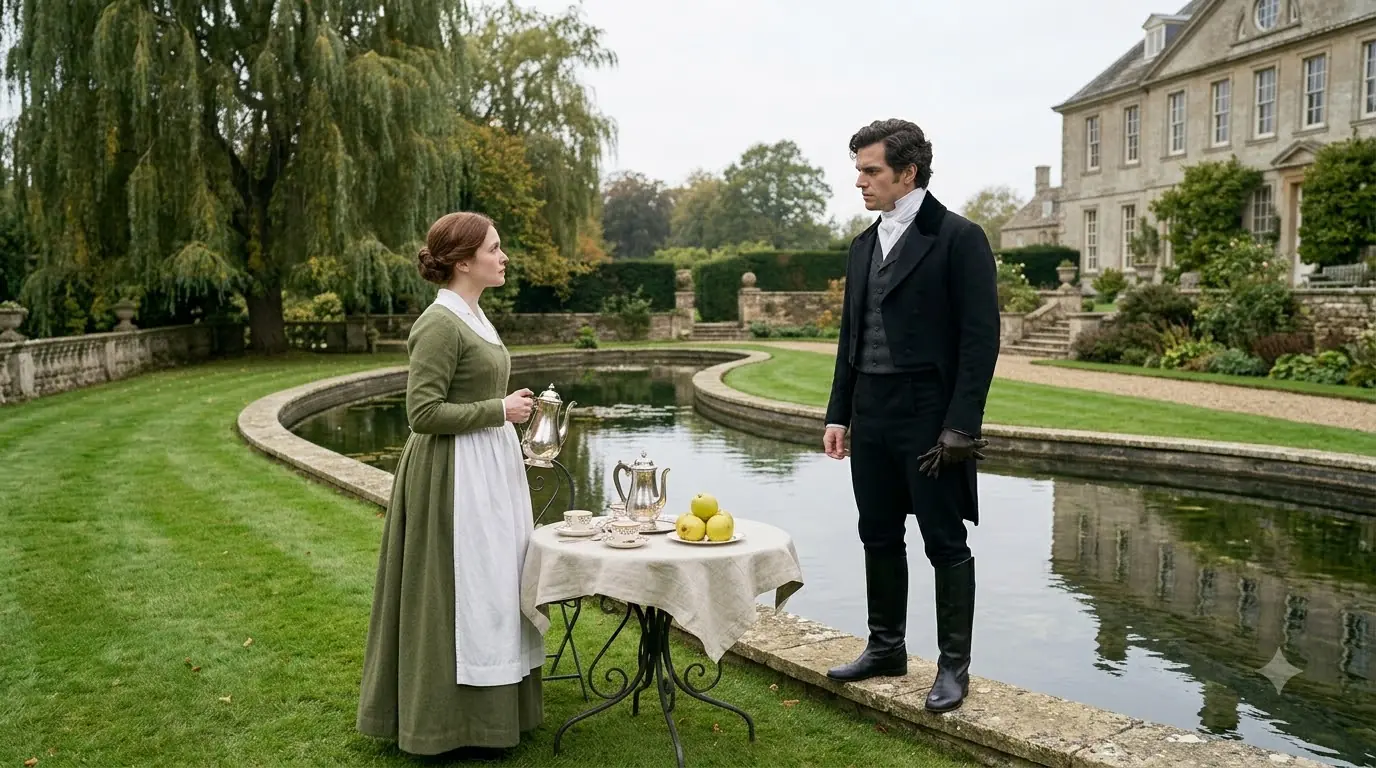
With respect, those are different reasons. The corner of his mouth did something that was not quite anything. He registered it before she did and corrected it and then sat very still in the way a man sits when he has been corrected by his own face and intends to discuss it with himself later in private.
"Your name," he said.
"Beatrice Marlowe."
"Mrs. Marlowe."
"As a courtesy, Your Grace, I am not married. Housekeepers carry the title regardless. I find it useful."
"For what?"
"For not being asked questions about why I am 30 and not married. The world is more comfortable with a quiet widow than with a woman who has chosen her own hours."
He looked at her for a long moment. The rain moved against the tall windows behind her in the slow, patient way of Yorkshire rain in October, which was rain that had decided where it was going and would arrive unhurried. And the house around them ticked and settled with the particular quiet of 43 rooms in which no one was speaking. He had grown used to that quiet. He had built it himself, room by room, year by year.
He had not until this moment registered it as something a person could disturb merely by sitting in a chair.
"My housekeeper manages the household accounts, the kitchen, the servants' hall, the linen, the still room, the gardens insofar as they touch the kitchen, and the entire domestic correspondence."
He listed it as a man listing the conditions of a campaign.
"She speaks to me twice a week unless there is an emergency. She does not speak to me at meals. She does not speak to me in corridors. She does not under any circumstance speak to me about the coffee."
"I understand."
She said.
"Do you?"
"Entirely, Your Grace."
"I will speak to you twice a week. I will not speak to you at meals or in corridors. I will speak to you about the coffee precisely once on the first morning when I bring it myself so that we have agreed in person what coffee in this house is going to be from now on. After that, I will not mention it again and neither will you because it will be correct."
She held his gaze with the composed directness of a woman who had calculated the cost of the sentence before saying it and had concluded the cost was acceptable.
The Duke of Ravensmere said nothing for the duration of perhaps four breaths.
Then he reached for the bell pull on the wall behind him without taking his eyes from her and pulled it once and waited until the under-butler appeared in the doorway with the practiced absence of expression that staff at Ravensmere had perfected over a decade.
"Mrs. Marlowe will require a room."
The Duke said.
"She will begin tomorrow. The terms are 40 pounds a year, half day on Sundays, and the housekeeper's parlor."
The under-butler permitted himself the briefest possible registration of surprise located somewhere in the left eyelid and inclined his head.
"Mrs. Marlowe."
He turned and she rose and gathered her wet coat over her arm with the efficiency of a woman who did not require time to recover from being engaged. At the door she paused.
"Yes."
"The first morning is tomorrow."
"It is."
"I will bring the coffee myself."
"I had assumed."
She left. The door closed. The Duke of Ravensmere sat in the unmoving Yorkshire afternoon and looked at the unfinished letter on his desk and tried to remember the last time a person had walked out of his study with the small satisfied carriage of having concluded business on her own terms. He could remember it precisely. He preferred not to.
The woman in question had been dead for 10 years and 7 months, and he had not spoken her name in any room of this house in nine of them. He picked up the pen. He set it down. He stood.
He walked to the window and watched Beatrice Marlowe cross the courtyard below with the under-butler beside her holding an umbrella over her with the slight excessive politeness of a man who had decided he liked her, and he thought with the precision he brought to all important information, "I have just hired a housekeeper who did not ask me a single question about my requirements and answered every one I did not have the courtesy to put."
He thought, "That was not in the plan."
He returned to the desk. He picked up the pen. He did not finish the letter to his steward that evening, and he could not, when he tried later, say what he had been writing about. The first morning Mrs. Marlowe brought the coffee herself as promised at five minutes past six in the small breakfast room that faced east over the orchards, and she set the silver pot on the sideboard and stood beside it with the composed attention of a woman conducting an interview that her employer believed he was conducting. He had not yet looked up from the morning newspaper.
The fire in the grate was new and behaving well, which he had also not registered as a change. The roses that had been on this sideboard every morning for 9 years were not on it. There were quinces instead, three of them in a low pewter dish, their gold-green skin catching the kitchen light with the particular luminosity of fruit that had been in the bowl perhaps an hour. The room smelled very faintly of beeswax and quince and something else, something he had not smelled in this house since before he had stopped smelling things, and it took him an unsettling moment to identify it as coffee that had been ground that morning by hand by a person who knew that coffee ground the night before tasted by morning like a wet floor. He set down the newspaper.
Mrs. Marlowe, Your Grace. You did not put roses on the sideboard. No, Your Grace. There have been roses on this sideboard every morning for 9 years. There have, Your Grace.
I noticed in the still room. The gardener's boy brings them at half past five whether or not the weather has produced a rose worth bringing.
And last week he was bringing dead ones because he had been told the master required roses.
I told him to bring nothing if there was nothing fit and to bring quinces if the orchard had them and to bring a pine bough in November if the orchard had not.
Have I been served dead roses for some time? For some time, Your Grace. The previous housekeeper was not in the habit of inspecting the sideboard before you came down. He looked at the quinces. He looked at her.
And the coffee, he said.
She poured. She brought the cup. She set it before him with the brief exact precision of a woman setting down a piece of evidence in a court of which she was both prosecutor and clerk. He did not drink. He looked at the color of it, which was darker than he was used to and somehow brighter and at the small unbroken film of oil on the surface, which suggested coffee that had not been boiled.
And he raised the cup and smelled it.
And the smell of it went into his head with the disorienting force of a memory he had not asked for.
Of a particular morning on the continent in 1809 when he had been 26 years old and had not yet had any reason to forbid himself the simple pleasure of a good cup of coffee.
And he set the cup down very carefully on its saucer without drinking and breathed once and put his hand flat on the table beside the saucer and said in the perfectly level voice he had spent 10 years constructing, "How was it made?"
Beans roasted 3 days ago, ground this morning, brewed in the French manner, hot water poured slowly, allowed to bloom, pressed once, served at temperature. Who taught you that? A French cook in a Manchester townhouse, Your Grace, 12 years ago.
He told me that English coffee was a national disgrace, and I have not been in a position to argue with him since.
The Duke of Ravensmere looked at the cup. He drank. He set the cup down. He did not speak. Beatrice Marlowe stood beside the sideboard with the composure of a woman who had been managing rooms since she was 15, and understood the difference between a silence that meant no, and a silence that meant I am not yet prepared to say yes.
She did not move. She did not pour a second cup. She did not ask if it had been satisfactory.
The Yorkshire morning came in slowly through the east window, and the quinces sat in their pewter dish, and the fire moved with the small companionable sound of a fire that had been laid by a person who knew how to lay a fire, and the Duke of Ravensmere sat with his hand still flat on the table beside the saucer, and after a great length of time, he said, without looking up, "Tomorrow."
"Yes, Your Grace."
"Every morning."
"Yes, Your Grace."
"Mrs. Marlowe."
"Your Grace, I had a coffee in Vienna in 1809 that this very nearly resembles."
She inclined her head.
"I will take that as a high compliment, Your Grace, and I will not mention it again."
"Thank you," he said.
And the thank you was so quiet that she might not have heard it had she been a different sort of woman, and she did hear it, and she did not acknowledge it, and she left the room with the small satisfied carriage of a woman who had concluded business on her own terms for the second time in 3 days, and the Duke of Ravensmere sat alone with the cup, and looked at the quinces, and did not that morning finish reading the newspaper. The rules of Ravensmere Hall were not written down. Beatrice Marlowe learned them in the first week, the way a woman of her practice learned the rules of a difficult house, by walking every corridor before breakfast, by listening to the silences in the servants' hall, by watching the under-butler's eyes when she asked a question, by noting which doors were oiled and which were not. The east wing of the house was occupied, used, lit, and warmed. The master's study, the breakfast room, the library, the small dining room, three bedrooms, the housekeeper's parlor.
The west wing was closed. Not abandoned, closed. The shutters were sound, the fires were laid every November against damp, the linen was changed twice a year, and no one entered any of the rooms without a stated reason and the under-butler's prior agreement.
Beatrice walked the west wing on her third morning in the company of Mrs. Heath, the head housemaid, who answered every question with the terseness of a woman who had been answering them for 9 years and was not interested in surprise.
The corner room with the south light, the late duchess's drawing room. The smaller chamber beyond it, her dressing room. The room beyond that, which had a door with new hinges and an old lock. The nursery. Beatrice stood in front of the nursery door for the length of one careful breath.
"Locked, Mrs. Marlowe."
Mrs. Heath said, "The master has the key."
"Has anyone been inside?"
"No, Mrs. Marlowe."
"In how long?"
"10 years come March, Mrs. Marlowe."
Beatrice nodded once. She did not ask anything further. She walked the rest of the wing with the same deliberate pace and noted the date of the linen change in her book and noted the condition of the shutters and noted without writing it down the position of the nursery door in the geography of a house she now understood she had been engaged to manage around rather than through. The master rose at half past five. He rode for an hour in any weather.
He took coffee at six. He read until 10:00. He met with the steward on Wednesdays. He took luncheon in the breakfast room and dinner in the small dining room, and never in nine years had he opened the formal dining room. He did not entertain.
He did not call. He received no callers except his cousin Sir Henry Calverley twice a year and the family solicitor four times.
He spoke to staff only when the staff had failed him or asked a direct question.
He did not ever walk in the west wing.
He had Mrs. Heath added once and never again a portrait of the late Duchess in his bedroom, and he did not permit it to be moved.
Beatrice took all of this and arranged it inside herself with the practiced economy of a woman who had managed the household of a Manchester widower whose wife had died in childbirth and the household of a London barrister whose son had drowned at school and the household of a country squire whose temper was so difficult that two of the maids had given notice in tears in her first month. She had managed grief before. She had managed it as a domestic condition. A thing to be cooked around, swept around, made room for, never argued with directly. She had been very good at it.
She had also been in each case slightly less than herself in the doing of it, and she had told herself in each case that this was the price of a good wage and a clean room and the small sustaining freedom of a woman who had chosen her own hours.
She told herself this again at Ravensmere in the first week.
She believed it for perhaps six days. On the seventh, she was carrying linen along the west corridor at a quarter past seven in the morning, and the door of the late Duchess's drawing room was not closed. It was not open. It was unlatched. The smallest possible failure of a door to seat itself properly in its frame, the kind of failure that meant a maid had been in there, perhaps with the master's permission, perhaps without, and had left in haste and had not pressed the latch.
Beatrice stopped. She stood in the corridor with the linen in her arms and looked at the unclosed door.
She thought, "That is not your business, Mrs. Marlowe."
She thought, "The housekeeper of a house keeps the doors closed that the master keeps closed."
She thought, "And yet."
She set the linen down on the corridor chest. She pushed the door open with two fingers, very gently, and walked into the late Duchess's drawing room. The room was alive. That was the only word she could find for it afterward when she tried to organize the sensation into something she could explain to herself. The shutters were closed against the morning, but the curtains had been drawn back inside the shutters, so that what light entered came in narrow gold strips across a polished floor that had been polished within the past month.
The pianoforte was tuned. She knew it was tuned because the dust cover was a quarter inch off center, the way a dust cover sits when a tuner has lifted it and replaced it the night before. The flowers in the porcelain bowl on the center table were not dead. They were not alive, either. They were dried.
Lavender and rosemary and a small handful of late roses dried with care, replaced perhaps every 6 months by a person who knew that a room kept exactly as it was required attention, not abandonment. There was a work basket on the chair by the window. A piece of embroidery in the basket, half-finished, the needle still threaded, as though the worker had set it down to answer a knock at the door and would return in a moment. The thread on the needle was fresh. Beatrice stood in the center of the room and felt a thing in her chest that was not precisely pity, although pity was in it.
It was more like recognition. A man had loved a woman to the point of preserving the room she had last inhabited and had then locked the room and lost the key in everything but the literal sense and had stood outside it for 10 years ordering a kitchen to roast coffee badly because the woman who had liked the coffee a particular way was not in the room any longer to tell him whether it was right. She heard the footstep in the corridor. She did not turn. She did not need to turn.
She knew the step. She had been in the house 7 days and she had cataloged every step in it and she knew the master's step the way one knows the footfall of any animal one is required to manage without alarming. He stopped in the doorway behind her. The silence in the room changed. It became the silence of two people occupying it instead of one and the second person was the one whose silence the room had been built around.
"Mrs. Marlowe."
He said.
She did not turn. She looked at the embroidery on the chair.
"The door was unlatched, Your Grace."
"Yes."
"A maid this morning."
"She must have come in to refresh the lavender. I will speak to her."
"That will not be necessary."
"It will, Your Grace."
"It is a question of practice."
"If the master keeps a room closed, the door of that room is closed."
"The maid who left it unlatched did not know that I had been told. She will not be reprimanded but she will be reminded."
She heard him take one step into the room. She felt the air of his presence behind her without moving. He smelled very faintly of the morning's ride, of leather and Yorkshire wind and something underneath. The cologne he wore so sparingly she had only identified it by accident. A faint cold green of bergamot and cedar.
"Why are you in here?"
He said.
She turned. He was standing in the doorway with the look she had seen exactly once before in the study.
The moment after she had said the coffee.
The look of a man who had been built to be unsurprisable and had now twice in eight days been surprised by the same woman and who had begun against his will to consider this a fact of the house rather than an aberration.
"I came to close the door."
She said.
"And then I did not."
"Why not?"
"Because I wanted to see her, Your Grace."
The room held very still.
"I have not heard her referred to even obliquely since I arrived."
Beatrice said with the quiet steadiness of a woman who had decided some time ago, perhaps in the corridor with the linen still in her arms, that this conversation was going to occur and was going to occur once and she was not going to flinch through it.
"The staff do not name her. The house does not name her. You do not name her. I came in because I have managed houses of grief before, Your Grace. And grief that does not name what it is grieving becomes eventually a different thing. It becomes a household practice and household practice is my responsibility."
He looked at her. He looked briefly at the embroidery on the chair. He looked back.
"You have been here seven days."
He said.
"I have."
"And you have already concluded that my arrangements here are insufficient."
"I have concluded that they have a name, Your Grace, which you have not used. And that not using it has a cost which is being paid by your kitchen and your roses and the boy who brings the dead ones and by the maid this morning who left the door unlatched because she has not been told the door is to be closed. But instead has been told the room is not spoken of, which is a very different instruction."
She paused.
"The first instruction can be kept. The second cannot."
The Duke of Ravensmere stood in the doorway of the late Duchess's drawing room for a length of time she did not measure.
He said finally, "Her name was Charlotte."
The name in his voice had 10 years in it.
"Yes, Your Grace," Beatrice said softly.
"She died in March of 1804. The child she was carrying died with her. She was 23 years old. The drawing room was hers. She sewed there in the mornings. The piano was hers also. I have been unable, since, to be in this room for longer than the time it takes to cross it. I've been unable to permit it to be altered. I have been unable to permit it to be entered. I have organized a household around an absence and called it discretion. I am aware, Mrs. Marlowe, that the result is what you are describing."
"Your Grace, I am not finished."
She closed her mouth. He looked at her with the full, unmanaged attention she had seen for the first time eight days ago and had begun to understand was not, as she had assumed, an aberration of grief, but the man underneath it asking, room by room, to be permitted to surface.
"The door will remain unlocked from this morning," he said.
"The maid who refreshes the lavender will continue to refresh it. You will determine the schedule. I do not require the room to be open to the household at large. I require it to be a room again, rather than a wound. I'm not certain I know how to arrange that. I will require your assistance."
"You will have it, Mrs. Marlowe."
"Your Grace, you are a very direct woman."
"I am, Your Grace. I had not realized when I engaged you how direct."
"With respect, Your Grace, you had every indication. I told you on the first morning that I would speak to you about the coffee precisely once. I have been holding to that. I have not, until now, spoken to you about anything else. I'm speaking to you now because the door was open and because I understand what an open door is in a house of this kind. After 10 years."
He looked at her for a long moment.
"Yes," he said.
"I think you do."
He did not smile. The corner of his mouth did the thing it had done on the first morning, the small suppressed almost something that lived in the space between what he permitted himself and what was true. She cataloged it. She set it aside. She did not, that morning or for many mornings after, allow herself to consider how often she had begun cataloging it.
She left the drawing room. She picked up the linen. She walked to the linen closet and put the sheets where they belonged, and she returned to the housekeeper's parlor, and she sat at her desk for the length of perhaps three breaths with her hands folded very precisely on the open ledger before she opened the day's accounts and went on with her morning. The change after the drawing room was not a change a stranger would have noticed. The drawing room shutters were opened an hour each morning to air it on Beatrice's instructions and closed again at midday.
The flowers in the porcelain bowl were replaced once a month with a fresh selection from whatever the season offered. The pianoforte was tuned in November on the regular schedule the late tuner had kept, and the embroidery in the workbasket was not touched on Beatrice's instructions because some things were not to be put away by anyone other than the person who had set them down. The room was lived around rather than lived in, but the living around was now active rather than rigid. And on the third Sunday of November, the master walked through the west wing on his way to the breakfast room, which he had not done in 9 years and 7 months, and he did not pause at the drawing room door, and he did not enter, and he did not look in, and he did not, as far as Beatrice could see, do anything at all about it. But he had walked past the door, and the door had been unlocked, and he had not been in any visible way undone by the proximity.
And Beatrice, watching him go from the corridor where she had been pretending to inspect a sconce allowed herself the smallest of acknowledgements. Progress, Mrs. Marlowe noted, do not name it. Keep going. The library was where the second thing happened. The library at Ravensmere was the heart of the master's day, which Beatrice had understood by the second morning and had not interfered with.
He read between 10:00 and 1:00. He read between 4:00 and 7:00. He took dinner alone and then he read again until 11:00. The library fire was Mrs. Heath's responsibility, which Beatrice had already discovered Mrs. Heath did not enjoy because the master did not speak to her during the hours she came in to feed the fire and Mrs. Heath, although competent, was not one of those women who flourished in a room of organized silence. In the second week of November, Mrs. Heath took ill with a winter cough and Beatrice took the fires for two evenings herself.
On the second evening at half past 5:00, with the early Yorkshire dark already pressed against the tall windows and a wind in the eaves that meant snow before morning, the master looked up from his book as she fed the fire and said, "Mrs. Marlowe, Your Grace, why are you doing the fire?"
"Mrs. Heath is unwell."
"There are four other housemaids."
"There are. Mrs. Heath has been doing the library fire for 9 years and the others have not been trained to it. I am training Mary, who will manage it from tomorrow. Tonight the fire required someone who knew the way you preferred it laid and I had been informed."
He looked at her. He looked at the book in his hand.
"Sit," he said.
She straightened from the hearth and looked at him.
"Your Grace."
"Sit, Mrs. Marlowe."
There was a chair. There was a chair that had at some prior arrangement of furniture been nearer the fire and had been pushed back against the bookshelves and Beatrice considered the chair and considered the proposition of sitting in the master's library in the evening, and considered the strict catalog of housekeeping that did not include such an act, and considered finally the man across the hearth whose face had not, in the eight weeks she had known him, asked anything for his own benefit until this moment. She sat. He marked his book.
"You are reading Mansfield Park," she said.
"I am."
"Forgive me. I had not known you read novels."
"I do not generally. I have been in the habit, since the spring, of reading whatever my cousin sends me. He sends novels. I read them slowly. It is, as far as I can tell, his only deliberate kindness, and I have determined to receive it."
"Sir Henry Calverley."
"Yes."
"He is a good man, Your Grace. He is a man who arranges the air in a room without it being apparent he has done so. I have learned over many years to recognize this in him. I have also learned to permit it more often than not. He sent me Pride and Prejudice in March. He sent me Emma. No, I beg your pardon. Mansfield Park is in October. He has been corresponding with my housekeeper as well, I believe."
She held very still.
"I have not—" "Briefly, Mrs. Marlowe, I do not object. He told me last week that he had taken the liberty of writing to ask whether you were settled. He apologized in the letter to me. I told him no apology was necessary, since it was clearly his intention regardless."
He looked at her steadily.
"He likes you. Henry has been arranging me in his slow Calverley way for nine years. He has arrived at the conclusion, I gather, that you are a development he intends to encourage."
She felt heat move along her neck and into her face, and reached the edge of her hair before she had time to forbid it.
"Your Grace, I am only—" "I know what you are, Mrs. Marlowe. You are a housekeeper of considerable practice and excellent judgment who has, in eight weeks, opened a room I was unable to open in 10 years, returned my coffee to a state in which I can drink it, and reminded my household that flowers ought to be alive when they enter a room. Henry's encouragement is, I should think, somewhat behind the evidence."
She looked at the fire. The fire did the small settling thing that fires do when they are well laid and have decided to burn for several hours without further intervention. The library smelled of old leather and wood smoke and the faint distant cold of snow on its way. She did not look up. She could not, at that precise moment, look up.
"I am not kind to you, Your Grace," she said very quietly.
"I want to be clear on that point. I have not been kind, I have been correct. They are different things."
"They are. I am aware of the distinction."
"The previous housekeeper was kind to me. She could not bear the silence in the house, and so she filled it with small attentions, cushions arranged differently, the morning post carried to the library on a different tray, soft inquiries about my health when she thought I would not notice. She meant well. I could not bear it. Kindness in the way she offered it was a request that I be, in return, less injured than I had decided to be, and I was unable to oblige her, and she left. And I am You are a woman who told me on the first morning that the coffee had been bad and I had not said so. You were not asking me to be less injured, you were asking me to drink decent coffee. I could oblige that. I have continued to oblige that. I find, Mrs. Marlowe, that competence asks rather less of me than kindness, and that I am rather more able now to give it."
She lifted her eyes. He was looking at her. The fire was between them, and the long Yorkshire room with its 3,000 books and its tall windows and its November dark, and the careful distance of a hearth in a master's library at 5:30 in the evening between a duke who had spent 10 years learning not to look at women and the woman who had been hired to manage his house, and who had, against her own instructions to herself, begun to understand that he was looking at her now.
"Your Grace—" "You should go to bed, Mrs. Marlowe," he said very gently.
"It is late. The fire will keep. I will not ring for anything further this evening."
"Yes, Your Grace."
She rose. She did not curtsy, although a curtsy would have been correct. The curtsy would have been a small lie of distance, and the distance had failed in this room between his sentence about the coffee and her own about kindness, and she did not see the use of pretending it had not. She inclined her head the way one woman inclines her head to another in a room of something newly understood, and she went to the door.
At the door, he said, "Mrs. Marlowe."
"Your Grace?"
"I have not thanked you for the drawing room."
"You did, Your Grace, on the morning quietly. I heard you."
A pause.
"Good night, Beatrice."
The first time he had used her given name. She stood for the duration of perhaps two breaths with her hand on the doorframe. She did not turn.
She did not, with any visible part of her body, register what he had said.
Inside, very privately, in the place a woman keeps such things, she cataloged it precisely. The name, the lowering of his voice, the absence of Mrs., shall I say the absence of Marlowe, the small permission of a duke who had asked nothing of her since the coffee, and was asking now the smallest possible thing, that she carry her own name through a doorway in his voice into the corridor outside.
"Good night, Your Grace," she said, and went out and closed the library door behind her with the particular quietness of a woman who knew exactly how loud the click of a latch could be in a corridor of a house in which he had begun to be heard.
The trouble began in the second week of December as Beatrice had known it eventually would. Trouble in a house of this kind always began with a guest. Sir Henry Calverley arrived on the 8th, which was earlier than his usual visit, with a smaller traveling case than was warranted, and a traveling cloak that suggested he had decided on the journey rather than planned it. He was a man of 45, slighter than the master, with the same gray eyes and a different mouth. A mouth that had spent its 45 years finding things slightly amusing, often correctly.
He embraced his cousin in the entrance hall with the easy familiarity of a man who had been embracing this cousin in this hall since they were boys, and turned to Beatrice, who had come down to receive him with the under-butler, and bowed slightly more than the situation required. Mrs. Marlowe. Sir Henry. You are exactly as your letters. He smiled, and the smile was the same as the master's almost except it had been allowed to develop.
I've been telling Alister for 2 years that he should have a housekeeper who answered her own correspondence.
I'm reliably informed that he has at last taken my advice.
So you may consider yourself listened to, Henry, the master said dryly.
Briefly, Mrs. Marlowe, dinner at 7:00, please, the small dining room. Henry, the green bedroom is yours, I assume.
I assume, said Sir Henry smiling, and went up the stairs.
Behind his back, the master and Beatrice exchanged a look. It was the look of two people who have already agreed about a third person and are committing the agreement to permanent record. It was not a look that should have happened in a house of this arrangement between a duke and his housekeeper in the entrance hall in front of the under-butler. The under-butler permitted himself the faintest possible blink, located in the right eye, and went away to oversee the unloading of Sir Henry's case. Beatrice went down to the kitchen.
She gave the cook the menu. She gave the under-butler the wine list. She inspected the green bedroom.
She returned to her parlor and she sat at her desk and she put her hands flat on the open ledger and she said to herself very quietly, "Mrs. Marlowe, you are going to have to think about this."
She did not think about it. She rose. She went up to the still room and inspected the linen for the green bedroom and inspected the lavender water and approved the dinner flowers and noted the time and did not at any point in the next 4 hours allow herself to recall the look in the entrance hall.
Although it had begun to live somewhat insistently in the center of her chest like a small bright object placed there by a person who had not asked her permission and would not, she suspected, retrieve it.
Sir Henry stayed 3 days. On the second evening he found her in the housekeeper's parlor after the master had retired on the pretext of asking about the schedule for the Christmas hampers and stayed for 40 minutes and asked four questions about the kitchen and 17 about her and went away with the satisfied carriage of a man who had gathered what he had come for. On the third morning before he left, he took the master into the study and closed the door. The conversation lasted 11 minutes.
Beatrice, who happened to be passing in the corridor on the way to the linen closet at the moment Sir Henry emerged, heard the master's voice from inside the study say something she did not catch and Sir Henry's voice quite clear say in reply, "Then you had better do something about it before the county does it for you, Alister."
The door closed. Sir Henry walked past her in the corridor with the polite unsurprised face of a man who had not seen her and went out to his carriage and was gone. That evening at dinner, the master was quieter than usual. He read until 9:00, which was earlier than his habit. He went up to his rooms, and the house went quiet around her with the ordinary quiet of a winter night in Yorkshire, and Beatrice went down at half past 10:00 to check the kitchen door was bolted, and on the way back to her parlor, she heard from the corridor outside the master's study the very small sound of a man pacing.
She paused at the foot of the stairs. She did not climb. She went to her own door, and she went into her own parlor.
And she sat at her desk for the second time that month with her hands folded on the closed ledger, and she said to herself, with the quiet honesty of a woman who had been managing rooms since she was 15 and knew when a room had become more than she could manage on her current terms, "Mrs. Marlowe, you are going to have to leave, or you are going to have to stay, and there is no third arrangement."
The trouble that Sir Henry had named, the trouble the county had begun to do something about, arrived on the morning of the 11th of December in the form of a letter. It was brought up by the under-butler at the usual hour, and laid on the master's tray with the morning post, and the master read it before the coffee, which was the first indication that something was wrong, because the master did not, on any morning, read the post before the coffee. He set it down. He drank the coffee. He set the cup down.
He said, "Mrs. Marlowe."
She had been by the sideboard. She came forward.
"Your Grace, there is a letter from Lady Ashbrook."
"Yes, Your Grace."
"You know who Lady Ashbrook is?"
"I do, Your Grace. The mother of the late Duchess. She lives in Harrogate. She has not visited Ravensmere in 9 years."
"She visits on Friday."
A small, precise silence.
"Yes, Your Grace."
"She writes to inform me that she will be staying 4 days, and that she takes a particular interest on her arrival in meeting the housekeeper, of whose recent appointment she has been informed by friends in the county."
Beatrice took this in without moving. I see, Your Grace. Mrs. Marlowe. Your Grace. Sit, please.
She sat. She had sat in this room twice now. The chair was beginning to be familiar. The master looked at the letter on the table. He did not pick it up.
Lady Ashbrook, he said, is a woman of considerable presence and longer memory.
She took her daughter's death exactly as you would expect, and has spent the subsequent decade arranging the world around an unaltered version of it. She has not approved of any change in this house since 1804. She does not know that the door of the drawing room has been unlocked, that the flowers in this room are quinces, or that the coffee has been corrected. She is going to find out within 10 minutes of her arrival, because she will walk the west wing within the first hour, and the housemaid on duty will not have been instructed to lie. No, Your Grace.
You understand what she is coming to do.
I understand what she suspects, Beatrice said quietly.
She suspects that her daughter's house has been altered, and she has been told by a friend in the county that the alterations correspond with the engagement of a new housekeeper, and she is coming to determine for herself whether the housekeeper is the cause, and whether she should be removed. Yes, Your Grace. He looked at her. He looked briefly out the east window at the orchard, at the bare quince trees in the December morning, and back. I'm going to ask you a question, Mrs. Marlowe.
I'm going to ask it as honestly as I am able, and I'm going to ask you to answer me as honestly as you are able, and I'm going to make my decisions for the next four days entirely on the basis of your answer. She did not speak. Do you wish to stay? The silence in the breakfast room held for the length of perhaps three breaths. Yes, Your Grace.
On what terms? On the terms of my engagement, Your Grace. I was hired to manage your household. I have managed it. I will continue to manage it for as long as I am useful and not before.
That is not the answer to the question I asked.
She looked at him. She had spent 11 weeks in this house and had watched a man revise an entire decade in stages so small they had been almost invisible.
And she had told herself every step of the way that she was a housekeeper and the man was a duke and that the small bright object in her chest was an inconvenience she would manage when the engagement ended as such engagements did.
She had told herself she did not have permission and she had told herself she did not require it.
And she had told herself she was 30 years old and she was not married and she had chosen her own hours and the arrangement was sufficient.
She looked at him and she found that she could not this morning with a letter from Lady Ashbrook on the table between them continue to tell herself any of those things and remain a person she recognized.
"Your Grace," she said carefully, "I'm not going to leave because Lady Ashbrook arrives. I'm also not going to pretend while she is here that this household is what it was in March. The drawing room is open. The flowers are alive. The coffee is correct. I am not going to undo any of those things and I am not going to apologize for any of them. And if Lady Ashbrook finds the housekeeper to be the cause of the alterations, she will not be wrong. And if she requires your dismissal, that Your Grace is your decision, not mine."
He looked at her for a very long moment.
"It is not," he said quietly, "my decision."
He stood. She rose with him automatically the way a housekeeper rose when a master rose and he put a hand briefly on the back of her chair in the small practical gesture of a man steadying it as she rose and the back of his hand brushed her arm through the wool of her sleeve, and neither of them moved for the space of one breath, in which the entire arrangement of the breakfast room and the 11 weeks behind it and the four days ahead of them consolidated itself into a single, very plain piece of information that they had both known separately for some time, and were now obliged to know together. He stepped back. Mrs. Marlowe, Your Grace, Lady Ashbrook will be received as a guest of this house with every courtesy that the house is capable of, and when she is gone, you and I are going to have a conversation which we have been postponing, and which I do not, after this morning, propose to postpone any further. Are we agreed?
Yes, Your Grace. Beatrice. William. She caught herself. Your Grace.
I beg your pardon. I do not know. It is Alister. Alister.
She had said his name.
She had not given herself permission to say his name. He looked at her with the expression that had nothing of management in it, the one that had been arriving in the room for several weeks in increments so careful neither of them had been forced to acknowledge it on any prior day.
Friday, then, he said.
Friday, Your Grace. He went to the door of the breakfast room, and at the door he paused. Beatrice. Yes. I have not There has been no woman in this house since I know.
I am aware that I am asking you to remain in a house in which the late duchess's mother is about to arrive in order to pass judgment on you, as I have permitted her for 10 years to pass judgment on every other thing in this house. You are It is not a reasonable thing to ask. No, Your Grace, it is not. Will you stay? Yes.
He looked at her for one more moment. He went out. Beatrice stood at the breakfast room window for perhaps a quarter of a minute, looking at the orchard in the December light, at the bare quince trees against the gray sky, and she did not allow herself to consider, in any organized way, what she had just agreed to. She rang for the under-butler. She gave instructions for the green bedroom.
She gave instructions for the wines. She inspected the dining room. She inspected the library fire. She wrote in the housekeeper's parlor a note to the cook concerning Friday's menu.
And at the bottom of the note, before she sealed it, she wrote and crossed out, "We are going to do this properly."
And replaced it with The soup at half past seven, which was the same thing in another voice, and went on with her day. Lady Ashbrook arrived at 3:00 on Friday afternoon in a carriage that had been polished within an inch of its life, and a traveling coat the precise color of authority. She was 64. She was straight as a candle. And she had the particular quality of a woman whose displeasure had been for 40 years the operative force in any room she entered.
She was received in the entrance hall by the master, by Beatrice, and by the under-butler in the formal arrangement of a house preparing to be examined. She permitted the master to kiss her hand. She did not embrace him. She turned to Beatrice. Mrs. Marlowe.
My lady. Lady Ashbrook looked at Beatrice with the comprehensive attention of a woman conducting a survey. And Beatrice held the look with the composed directness of a woman who had spent 11 weeks managing her own rooms.
And at the end of perhaps 4 seconds, Lady Ashbrook said, "You are younger than I had been informed."
I am 30, my lady. You have been here 3 months. 11 weeks, my lady.
And in those 11 weeks you have, I am told, made certain changes.
Yes, my lady. I should like to discuss them after tea in my room. Of course, my lady. The master beside did not move. He did not intervene.
He did not, as he had done with Lord Ashby in another house in another season, place himself between his guest and his housekeeper.
He had told Beatrice on the Wednesday evening before that he would not.
Lady Ashbrook is not Lord Ashby. She is the mother of my dead wife. She has more right to ask the question than I have to forbid it. You will manage her, Beatrice, as you have managed every other room in this house, and I will not undermine you by intervening. I will be available if you ask me to be.
You will not, I think, ask. She had thought about that on the Thursday all day. She had concluded he had been correct. Tea was served in the drawing room, the formal one on the east side of the house, which was not the late Duchess's drawing room and so could be used. Beatrice withdrew at half past four.
Lady Ashbrook went up to her room. At a quarter to six, Beatrice was sent for. She walked up the great staircase with her ledger in her hand. She had been managing rooms since she was 15, and she had managed them in Manchester boardrooms and London drawing rooms and country squire's studies, and she had been in this house 11 weeks, and she walked up the stairs to be examined by a woman whose grief had built and locked the rooms Beatrice had spent 11 weeks unbuilding and unlocking, and she went up the stairs without hurrying. Lady Ashbrook was sitting by the window of the green bedroom in a high-backed chair.
"Sit, Mrs. Marlowe."
Beatrice sat.
"I have walked the west wing," Lady Ashbrook said.
"I assumed you would, my lady."
"The drawing room is not as it was."
"It is as it was, my lady. The shutters are opened in the mornings. The flowers are replaced. The pianoforte is tuned. The embroidery has not been touched. The furniture has not been moved. It is being aired."
"It is, my lady."
"My daughter's drawing room is being aired."
"Yes, my lady."
On whose instructions? Beatrice held the older woman's gaze. On mine, my lady. With His Grace's permission given on the morning of the 2nd of November in the doorway of the drawing room itself. When he and I had a conversation about the cost to a household of a closed room that is not spoken of.
Lady Ashbrook did not move. You spoke to him about it. I did, my lady. After 8 days? After 7, my lady.
Mrs. Marlowe. My lady. In the 11 years I have known the Duke of Ravensmere, I have not on any occasion addressed him concerning my daughter's rooms.
I have not asked him to open them.
I have not asked him to alter them.
I have not asked him a single question about her since the funeral.
Because I have understood that he was unable to answer. And because I am a woman of practice. And I do not ask questions whose answers will not be given. You have known him 11 weeks.
You have asked the question.
He has answered.
The drawing room is being aired. She paused. Tell me, Mrs. Marlowe, why I should permit this to continue. Beatrice felt something rise in her which was not anger and was not precisely courage.
It was the quiet, settled clarity of a woman who had been waiting without knowing it to be asked this question by exactly this person.
And who had already known the answer the moment she opened the unlatched door 11 weeks ago.
My lady, she said very quietly.
I cannot tell you why you should permit it. That is not my place.
I will tell you what I have observed and you may make your own decision.
Speak. Your daughter's drawing room was preserved as a mausoleum. Your son-in-law lived next to it for 9 years and did not enter it and could not pass it without losing the day. The household was instructed not to name your daughter. And so the household stopped naming her and stopped airing her rooms and stopped tuning her piano and stopped in any meaningful sense including her in itself.
She had become, I am sorry to say it plainly, a wound that the house was treating with silence and the silence was not healing the wound. It was preserving it.
She paused just long enough to be certain the older woman was listening and continued, "I unlocked the door, my lady, because His Grace permitted me to. I did not unlock it on my own initiative. I asked him by entering the room when it was unlatched to consider whether the closure had become his policy or his prison."
He answered me.
He answered with her name, which he had not said in 9 years.
He named her. He named the year. He named the child.
He told me in a dry voice what had happened.
He has not since that morning walked past the drawing room door without acknowledging it. He walks past it. He has been able to walk past it. The flowers are alive. The piano is tuned.
The embroidery is precisely where she set it down. And His Grace is, as far as I'm able to determine, beginning very slowly to be in the same house with her again instead of in the same house with the closure of her. Lady Ashbrook did not speak. Beatrice held her gaze.
"My lady, I will be removed from this house tonight if you require it and I will not protest because the decision is yours and his to make and not mine. I will say only that if I am removed, the door of that drawing room will, I think, be locked again within a week and the flowers will be dead within a fortnight and the silence around your daughter's name will close back over the house like a door that has been waiting to find itself again. And that will not be a thing I have done, my lady. It will be a thing the house has done in my absence because the house has had 9 years of practice and only 11 weeks of correction."
The room was very still. Lady Ashbrook looked at Beatrice for what felt like a great length of time. She looked at the window. She looked at her own folded hands, which were the hands of a woman who had buried her daughter on a March morning 10 years ago, and had not since permitted herself a softer position than upright.
Charlotte, she said very softly, was a woman who hated a closed room.
Yes, my lady. She would have been the first person to open her own drawing room. I had supposed so, my lady. Lady Ashbrook did not weep. She did not, Beatrice suspected, weep in front of any other person, and had not done so for 10 years, but her hands moved very slightly in her lap, the way the hands of a woman moved when she had been holding something in for a great length of time, and had found a place this evening to set it down.
You are an impertinent woman, Mrs. Marlowe. I am, my lady. You will, I imagine, be spoken of in the county before Christmas. I imagine I will be, my lady. To you, I am not afraid of that.
My lady, I have been spoken of in county since I was 15. The county speaks of housekeepers who arrive in wet coats from village walks, and it speaks of housekeepers who correct the coffee, and it speaks of housekeepers who outlast Lady Ashbrook's first Friday. Whatever it says, it will be inaccurate, and I will continue to do my work. The corner of Lady Ashbrook's mouth, the precise corner in the precise way, did the small suppressed almost something Beatrice had seen on the master in another room in another season.
You will continue, Lady Ashbrook said.
My lady, as housekeeper of Ravensmere, I do not undertake to undo what has been done in the west wing. I will visit my daughter's drawing room before I leave. I will, I think, sit in it for some time. I have not sat in it for 10 years.
I had not realized until you told me that the alternative to a locked drawing room was not an emptied one.
She paused. Charlotte was not a wound, she was a person. I had been treating her as a wound for a long time. I'm too old, Mrs. Marlowe, to manage a wound any longer. I am not, I find, too old to manage a memory.
She looked at her hands. You will say nothing of this conversation to His Grace. No, my lady. He will discover, in his own time, that I have approved of the alterations. He will be, I expect, somewhat embarrassed by it.
I will permit him a year to recover. Yes, my lady. You may go. Beatrice rose. She inclined her head.
At the door, Lady Ashbrook said, Mrs. Marlowe, my lady, he has not, in the 11 years I have known him, he has not looked at any woman in this house the way he looks at you when he believes himself unobserved.
A small, precise silence. I have not, my lady, encouraged it. I am aware. That is what makes it intolerable, and also, I think, correct. Good night, Mrs. Marlowe.
Good night, my lady. Beatrice went out. She walked down the great staircase with her ledger pressed against her chest, and crossed the entrance hall, and did not, on the way, look up to the gallery where the portrait of the late Duchess had been moved, in March of 1804, to its present position. And she went into her parlor, and she set the ledger on her desk, and she sat down. And she put her hands flat on the closed cover, and she said to herself, with the perfect honesty of a woman who had managed exactly the room she had been given, and was going to manage exactly what came next, Beatrice Marlowe, you did your work.
Now you are going to have to do the other thing. She sat there for the length of perhaps 10 minutes. Then she went to the kitchen, and gave the cook the orders for breakfast, and went up to bed. Lady Ashbrook left on the Tuesday morning. She had spent 2 hours on the Sunday afternoon in her daughter's drawing room.
She had rearranged nothing. She had requested on the way out that one of the dried roses from the bowl be wrapped for her in tissue and had taken it with her in her traveling case and had not in the four days said another word to Beatrice about the alterations, although she had on the Monday evening complimented the soup with a particular emphasis.
And Beatrice, who understood the emphasis precisely, had inclined her head and not replied.
The carriage went down the drive. The master and Beatrice and the under-butler stood in the entrance hall and watched it go.
When it had cleared the gates, the master turned to the under-butler and said, "Thank you, that will be all."
In the voice of a man who had been holding his breath for four days and had on the fifth decided it was finally permissible to exhale, the under-butler, who understood the voice, withdrew. The master and Beatrice were alone in the entrance hall. It was 8:00 in the morning. The December light came in through the tall front windows in a slow, pale way and the house ticked and settled with the ordinary morning sound of a house that had survived a guest.
And the master looked at Beatrice for the length of perhaps a breath and said, "The kitchen, please."
"Your Grace."
"The kitchen."
"Now."
She looked at him.
"So you are coming down to the kitchen?"
She said, "I am."
"In the morning?"
"I am."
"Why?"
"Because I'm going to take the coffee from your hand."
He said, "and I'm going to drink it standing in the kitchen and then I'm going to ask you a question I should have asked you on the 2nd of November and which I have been postponing for 40 days and which I am not going to postpone any further. Will you come?"
"Yes."
She went. She walked down the back stairs ahead of him with the under stair lamp in her hand, although it was morning and she did not need it because she had picked it up from the entrance hall table without thinking and she was going to think about that later and at present she was going to walk down the back stairs of the house in which she had been engaged 11 weeks and 4 days and she was going to do it with her Duke walking behind her on the steps in the way a man walked who was permitting a woman to lead him to a room he had not been in for 10 years and which she knew the geography of better than he did. The kitchen was warm. The cook had gone up for her morning rest. The maid had laid the fire.
The kettle was on. The morning's bread was rising under a cloth on the long deal table and the air was the specific beloved air of a kitchen at half past six which was flour and yeast and butter and the small sustaining domestic certainty that whatever else was going on in the world, breakfast was going to be served. The master stopped in the doorway. He looked at the kitchen. He looked at it the way a man looked at a country he had not been to since the war.
"I have not."
He said, "Been in this room since I was 11 years old."
"I thought as much, Your Grace."
"My mother brought me down to teach the cook to make a particular jam. It was the year before she died. The cook is no longer here. The kitchen is essentially as it was."
Yes, he came into the room. He walked slowly the length of the long deal table with his hand running along the edge of it the way a man's hand runs along a railing of a ship he had been told he was not to board and on which he is now against all his previous understanding of his own life standing. He stopped at the range. The kettle began on cue to sing. Beatrice took it off.
She poured the water into the tall ceramic jug she had brought down on her first morning in which she had been brewing his coffee in the French manner for 80 days and she ground the beans with the small brass mill that lived on the dresser and she let the bloom come up and she pressed it once and she poured the cup. She took the cup in her hand and she turned to him. He came across the kitchen. He stopped in front of her. Beatrice.
Alister. He took the cup from her hand. The handle was warm and he held it for a moment without raising it, looking at the coffee in it, the dark surface, the small unbroken film of oil. He looked at her. He drank.
He set the cup down on the deal table.
For 10 years, he said, I have not I know.
For 10 years, I have arranged this house and the staff and the coffee and the closed door and the silence around the conviction that I had been built for one woman and would not be built for another. And that the most honest thing I could do with my remaining life was to refuse to ask anyone else to live inside my refusal. I believed this. I believed it with the full authority of my position and my grief and my decade of practice. I believed it on the morning of the 2nd of October when the agency sent me their sixth candidate.
And I believed it when I walked into my study at 11 and saw a woman in a wet coat who had not been sent by anyone at all. And I believed it, I will say, until perhaps the second cup of coffee on the third morning. He paused. Beatrice. Yes.
I have been wrong for 10 years. You have. I am not asking you to forgive that. No. I am asking you whether I am too late to be right.
She looked at him. She thought about the 11 miles she had walked from the village in October in the wet coat with the borrowed reference. She thought about the under-butler at the foot of the stairs telling her she had better come up. She thought about the moment in the study when she had looked at him and decided against her professional judgment to say the coffee because the coffee was the small true thing on the surface and the larger true thing underneath it had been visible to her in the second of his face. And she had decided she was going to walk into the larger true thing without permission, the way she had walked the 11 miles and accept the cost.
She thought about the open door of the drawing room, about the embroidery, about Charlotte. She thought about the library with the fire and good night, Beatrice. She thought about Lady Ashbrook's hands moving in her lap. She thought about every careful 11-week step the house had taken toward the morning in which a duke would come down to his own kitchen at half past six and ask a question for which there was no rule in any housekeeping manual she had ever been trained on.
She thought with the precision she had brought to every decision of her 30 years, "Mrs. Marlowe, you knew this in October."
She did not curtsy. The kitchen was no place for a curtsy and they were past the use of one between them in any case. She took the cup from the deal table. She put it back into his hand. She closed his fingers around it with her own.
She did not let go.
"You are not too late," she said.
He looked at her. He did then the thing he had not done in 10 years. It was not large. He had not been a man given to large smiles before March of 1804 and he was not now. The corner of his mouth, which she had cataloged on every previous morning, did the small almost something and then this time did the rest of it.
The smile arrived. It reached his eyes. It stayed there. It was the first complete smile in the kitchen of Ravensmere Hall in 10 years and 9 months and the kitchen, which had been flour and yeast and butter, took it with the ordinary sustaining domestic certainty with which it took everything else and added it to the morning. He set the cup down again very carefully.
"Beatrice, yes, I am going to kiss you in this kitchen in approximately 12 seconds and I am giving you the 12 seconds because this is, by my count, the first kitchen I have stood in since I was 11. And I would not like the kiss to be the most unprecedented thing in the room."
"It will not be," she said.
"I'm drinking the coffee with you when you are finished. That will be more unprecedented."
"Yes, 12 seconds, Your Grace."
"Alister."
"Alister."
He used 11 of them. The kiss was not tentative. It had the honesty of a man who had been revising his position for 11 weeks and had arrived at a conclusion he was prepared to act on. She kissed him back with the same precision she had brought to the first morning's coffee and to every cleanly latched door and to every true thing she had ever decided and the kitchen was warm and the bread was rising under its cloth and the December morning was outside the windows and none of it required any further management. When they separated, she kept her hand on his.
"There is going to be another cup," she said.
"For me."
"Yes, and we are going to drink it sitting at this table in this kitchen with the cook walking in within the half hour and the news being all over the servants' hall by 9:00 and the county by Sunday."
"Yes?"
"You are aware that this is not a manageable arrangement, Your Grace."
"Alister. Alister, you are aware."
"I am. I have noticed recently that my arrangements have been performing poorly in this house. I had been considering a wholesale revision."
"You had been performing them very badly."
"Yes."
"I am the new arrangement," she said.
"I imagine."
"Beatrice."
"You have been the new arrangement since the morning of the 2nd of October. The coffee was a useful pretext."
She looked at him. The smile was still there. It had stayed. She poured the second cup. She brought it to the deal table.
She sat down across from him in the chair the cook used for the household accounts and he sat across from her in the chair the under-butler used for the bread, and they drank the coffee together in the warm kitchen of Ravensmere Hall on the morning Lady Ashbrook's carriage cleared the gates. And the cook came down at five minutes past seven and stopped in the doorway and looked at them and decided, with the wisdom of 40 years in service, to back out of the doorway and go round the long way to the still room and pretend until the master and the housekeeper were ready to be seen that she had not seen anything at all. The under-butler, when informed an hour later, permitted himself a registration of expression located in both eyebrows.
Sir Henry Calverley, when informed by letter, replied within the week from London with three sentences.
I had been writing to her for 2 months. I have, I find, slightly outpaced you. Welcome to it, Alister.
Lady Ashbrook, when informed by letter, replied with one sentence.
"The roses on the sideboard, when she becomes the Duchess of Ravensmere, are to be alive every morning. I will be inspecting."
They were married in the village church on the boundary of the estate in March of 1815.
On the 11th anniversary, almost to the day, of the morning Charlotte had been buried, because Beatrice had said, when they discussed the date, that some days could be allowed to mean two things.
And Alister had looked at her for a long moment and said, "Yes."
And the smile by then was no longer unprecedented. She wore green because she always wore green. She did not curtsy at the altar because the curtsy had been used elsewhere in this story for other purposes, and because she had said, in the housekeeper's parlor the night before, that she was not going to make a curtsy at the moment she was making a vow.
And Alister had said, "I had not expected you to."
The kitchen at Ravensmere served coffee that morning at 6:30, brewed in the French manner. And there were quinces on the sideboard in the breakfast room, and the door of the late Duchess's drawing room was open and the lavender in the porcelain bowl was fresh and the house around them was entirely completely finally itself. By March of 1815, he was smiling on most mornings. By June, he was smiling occasionally before the coffee. His wife, who had been managing rooms since she was 15, had no comment to make on this development except in a letter to Sir Henry Calverley in the second week of summer.
"He is not yet kind. He is, however, learning. I find I prefer the order."
B. Sir Henry Calverley in the same week wrote in his own diary in London.
"Alister has been against the run of evidence saved by coffee of all things. I shall have to revise my view of breakfast."
He underlined the sentence. He left it to be discovered in the fullness of time by anyone who cared to look.