The banns were read for the first time on the tenth of May. It was done in the church at Wrencroft by a curate who did not know what he was doing to the woman in the third pew. “I publish the banns of marriage between Ralph Wickford of this parish, bachelor, and Linnet Mott of this parish, spinster. If any of you know cause or just impediment why these two persons should not be joined together in holy matrimony, ye are to declare it. This is the first time of asking.”
Linnet Mott was twenty-three years old. Nobody had asked her anything. The word spinster meant only unmarried. It was a form of words.
It was the rest of the sentence that had been decided in a room she had not been in. She sat very still while the parish turned round to look at her. There were fifty-three people in that church, and she could have told you the name of everyone. Mrs. Purdy at the end of the second pew, who had laid out her mother.
Her sister Hannah beside her, seventeen years old, gripping the prayer book with both hands as though it might get away. Behind them, across the aisle, her uncle Simon Mott looked straight ahead at the east window and did not turn round at all. She understood then that he had known she would not know. That was the design of it. Banns are read three Sundays running, and a woman who intends to object is expected to object at once, out loud, in front of her neighbors.
He had chosen the one form of announcement that made silence look like consent. Linnet did not stand up. Afterwards, she would be asked why by people who had never had to weigh anything heavier than a dinner invitation. The answer was in the pew beside her, holding a prayer book with white knuckles. If she cried out in church, the county would have it by Tuesday.
It would not be a story about a will or a guardian. It would be a story about a girl who made a scene, and it would follow Hannah into every drawing room in the country for the next ten years. So, she sat, and she let the curate finish. And she sang the last hymn in a clear voice with the rest of them. That was the tenth of May.
She had three weeks. Outside, the churchyard was full of a light green wind, the kind that comes after rain in the second week of May. The yews dripped. Mr. Wickford was waiting by the gate with his hat in his hand. He was a solid, wide man of forty-four with a good farm on the other side of the water meadow, and a very high opinion of his own reasonableness.
He had buried one wife. He was not cruel. That was the difficulty with all of them. Not one of them was cruel. “Miss Mott,” he said, “I hope you were not startled.”
“You might have written to me,” said Linnet. “Your uncle thought it better done in the usual way.” He turned the hat round in his hands. “I am not a young man. I do not expect to be sighed over, but you will find me steady, and you will have the running of the house, which is more than some get.”
“Mr. Wickford.” She kept her voice low and pleasant because there were people behind her pretending not to listen. I have refused you twice. You refused me to my face. He agreed.
That is not the same as refusing your uncle. He said it without spite. That was the worst of it. He said it the way a man reads out the price of wheat. Her uncle came down the path with his hat already on.
Simon Mott was fifty-two. Her father's younger brother. A lean man with a long careful jaw. And the manner of somebody adding a column of figures under a conversation. He had three daughters of his own.
Kitty, Nan, and Fanny. Nineteen, seventeen, and fifteen. All of them fond of Linnet. None of them with sixty pounds behind her. Well, he said.
That is done. You had my name read out in church. She said. I had the banns published. Said her uncle.
It is what people do. Without telling me. I told you in March that I should be looking about for you. You did not choose to hear it. He drew on one glove.
Then the other. Linnet, be sensible in the open air. When nobody can hear us. And then we need not quarrel indoors. I will not marry him.
Said Linnet. You will not marry him at 25. Said her uncle. At twenty-five you may do as you please. You have twenty months to go.
And in those twenty months you are in my hands. And Wrencroft is in my hands. And your sister is in my house. I am not threatening you. I am telling you the shape of the thing.
Hannah had come up behind them and stopped close enough to hear. Too far to be included. Their uncle saw her and his face did something complicated and human. He was fond of Hannah. He had carried her on his shoulders round the orchard when she was small.
He looked at her now the way a man looks at a debt he means to pay. “Second time of asking is the 17th,” he said. “Think between now and then.” He walked away up the lane with his daughters gathering behind him like starlings. To understand why a man could read a woman's name out in church against her will you have to go back to a parlor at Wrencroft in the November of 1815 to a dying man who was trying to be careful.
Thomas Mott was not a great landowner. Wrencroft was four hundred and ten acres of good red country on the Herefordshire side of the hills. Two farms, a mill let on a long lease an avenue of oaks his own father had planted and a square brick house with a west parlor that got the evening light. It was not a fortune. It was enough that a woman who owned it would never have to be grateful to anybody.
He had one horror and he named it in the last month of his life to his attorney, Mr. Gedge of Marchfield. His horror was that his daughter would be married for the land. So the will he signed on the ninth of November provided that Wrencroft should pass to Linnet absolutely on her twenty-fifth birthday. Until that day the estate was to be managed by his brother Simon as her guardian. And if she married before twenty-five without her guardian's consent given in writing, the estate should go over to Simon Mott and his heirs.
She should have four hundred pounds and nothing else. He read it through twice before he signed. He said it was a fence to keep the wolves off her. He was thinking of a certain kind of man. He was not thinking of his own brother because there was no wickedness in Simon Mott in 1815.
There was a modest property, three little girls, and a good harvest in the barn. Then came the summer of 1816 when it rained from May to September and the hay went black in the fields. And men who had never worried in their lives learned how to lie awake. Her father did not live to see it. He died in the December in the west parlor with the fire in and the shutters open on the snow.
On his last night, he asked for the music. Her mother had been dead four years by then. Charlotte Mott had come out of a family of small Bath merchants with more music in them than money. She had played every evening of her married life on the square pianoforte in the west parlor. Among the things she played was one that was hers.
“If I write it down, it will be a piece of paper,” her mother said. “Then anybody may have it. This way, it lives in the two of us. Play it when I am not here, and I shall be in the room.” She died of a fever the following spring, in nine days, in the March of 1812.
So, on the last night of his life, Thomas Mott asked, and his daughter went to the pianoforte and played her mother's air with the shutters open. And her father lay listening with his eyes shut. He said one thing afterwards, and she carried it for the next three years like a stone in a pocket. He said, “Nobody can take that off you.” Everything else, it turned out, was on paper.
She knew the estate without ever having studied it, by having lived inside it. She knew the two farms. She knew which of the nine cottages had a bad roof, and which had a bad tenant. But she did not keep the books. Her uncle kept the books as the will required.
And Linnet Mott's competence was of another kind altogether, and the county did not know she had it. She played, never in company. Not once in the six years since her mother died, had she played before anybody outside that house. She had a reputation in that country for having no accomplishments, and it suited her exactly. The truth was that she played most nights in the west parlor, alone with one candle.
Her mother's air, some Corelli, and a good deal that she was making up as she went. It was the one hour of the day in which nothing was decided by anybody else. In the first week of April, a man came from Marchfield with a scribing iron and marked the oaks. She met him at the top of the avenue. He was perfectly civil.
He told her he was Mr. Beddow's man, the timber merchant, and that he had marked ninety-one trees, and that the bark peelers would be along about midsummer while the sap was up. The avenue was one hundred and thirty years old. The trees stood in two rows from the lane to the front of the house. And in October, the light came down through them the color of weak beer. Every one of them now had a fresh white scar cut into the bark at the height of a man's chest.
She walked down the whole avenue counting because she did not believe it. Ninety-one. Her uncle was in the estate room when she came in with her boots wet. You have sold the avenue. I have sold ninety-one trees that are ripe and will be past their best in ten years.
He said without looking up. Oak is at a price I have not seen since the war. It would be a piece of sentiment to leave them standing. And sentiment is not what I am here for. They are not yours.
They are not yours, either. Not for twenty months. He put down his pen then and did look up. And there was something in his face that was almost an appeal. Linnet, I am the manager of this property.
If I do nothing with it, I am a bad manager. Timber is a crop. Your grandfather thought so, or he would not have planted them in rows. She had no answer to that on the ground he had chosen. She never had.
He always chose the ground where the words were with him. And the money? She said. Goes to the estate. Which you hold.
Which I hold, he agreed. For you. And picked up his pen again. She wrote to Mr. Gedge at Marchfield that same week, and had his answer four days later, and read it standing up in the hall. Mr. Gedge was seventy, had drawn the will himself, and was as honest as the day.
He wrote that the consent clause was, he regretted to say, perfectly good, and that no court would compel a guardian to consent. As to the timber, a guardian was entitled to manage. He could not advise a young lady to begin such a proceeding without funds, which she had not got. He ended, being fond of her, with a sentence that was not law at all. Wait, my dear, if you can.
Twenty months is not forever, and paper is patient. She wrote next to her mother's cousin, Mrs. Yardley in Bath, a widow of sixty with a narrow house in Lansdown, and an income of two hundred pounds a year, who had held her at the font. Mrs. Yardley wrote back by return, in a hand like a bird's feet. Come to me. I have a bed and a fire, and no fortune whatever, and nobody in this town cares who your uncle is.
That letter was in Linnet's pocket on the 17th of May, when the banns were called the second time and she sat through them with her chin up. It was still in her pocket on the 21st when Mr. Wickford's attorney came out from Marchfield in a gig with a settlement in his bag and sat two hours in the estate room and left again after dinner. Her uncle found her afterwards in the west parlor. “The second of June,” he said. “In the morning Mrs. Purdy will help you with your gown.”
“I have not agreed.” “No,” he said. He stood in the doorway, a thin man in the last of the light. He looked tired and for a moment she thought he was going to say something true. “Kitty is nineteen,” he said instead.
“There is nothing behind her. Not sixty pounds. Wickford will settle four hundred pounds on each of my girls and I have not been able to sleep for three years for thinking what becomes of them if I go off suddenly. You will have a good house and a steady man and my girls will not be governesses in Bristol. If you can show me the wickedness in that arithmetic show it to me.”
“The wickedness,” said Linnet, “is that you did not ask me. You had me read out in church like a notice of a stray horse.” He flinched. She saw it.
“You would have said no,” he said. “Yes,” she said. “I would have said no. That is what asking is for.” He shut the door quietly when he went.
He always did. There was never a slammed door in that house. Never a raised voice. Never a mark on anybody. The whole thing was done quietly and at a normal pitch by a man who wanted to be able to think well of himself afterwards.
She sat down at the pianoforte and did not play. Then she went upstairs and packed a bandbox. She left at nine o’clock that night by the kitchen door with the bandbox in one hand and her mother's shawl over her head. And she walked the seven miles to Marchfield in the rain. It was not a heroic walk.
It was a bad road with ruts full of water and by the third mile her shoes had given up any pretense and she had time to think of every reason to turn round. She thought of Hannah asleep in her uncle's house. She thought of Mrs. Yardley's letter which she had read so often it had gone soft at the folds. She thought of ninety-one white scars in the bark. She kept walking.
Her plan was thin and she knew it was thin. The night mail through Marchfield went down at ten o’clock and joined the Bath Road at Gloucester. She had four pounds and eleven shillings which was every coin she owned in the world and a letter from a woman in Lansdown who would take her in. She came into the yard of the Feathers at twenty minutes past ten and the mail had gone at ten o’clock exactly and the next public coach was the seven o’clock coach in the morning. The yard was under lamps and full of the smell of wet horses.
The landlord's daughter looked at her once at the wet hem and the bandbox and the hair coming down and looked away again with a decision in it. Linnet stood by the mounting block and made herself think. She could not sit in the public room until 7:00 in the morning. A woman alone at an inn all night is a story before breakfast. She could not go back.
She could not go to Mr. Gedge's door at eleven o’clock at night without ruining a good old man's peace and being sent home in his gig by noon. Then a horse came in under the arch at a trot. And she knew the horse before she knew the man because it was her uncle's gray. Watts, the groom, swung down with a lantern in his fist and began asking the ostlers in a carrying voice whether a young lady had taken a place on the down mail. There was a traveling chaise standing on the far side of the arch with its lamps lit and the fresh pair being put to.
She did not decide to do it. She was simply on the dark side of that carriage with her hand on the door. Then she was inside it on the floor between the seats with the bandbox pushed under and a carriage rug pulled over her shoulders. Her heart went like a bird in a box. The floor smelled of straw and boot leather.
She lay with her cheek against the boards and listened to the yard. Boots. A short exchange about the leaders. The rattle of a chain, then the door on the near side opened and somebody got in. She heard him settle and put something down on the seat.
He let out the breath of a man who has been on the road a long time and does not expect to speak to anybody again that night. Then he stopped. She knew he had seen the rug or the corner of the bandbox or the shape of a person where no person should be. The silence changed its quality entirely. “Whatever you are,” he said, “you may come out.”
Linnet lifted her head. He was sitting with his hat still on, one glove off, looking down at her with no more alarm than if she had been a badly stowed valise. The lamp outside the glass gave her a young man of about thirty, tall, with his knees folded up short against the seat opposite, ash-brown hair pushed back off his forehead, and eyes of a light tawny brown, the color of tea held up to a window. He did not shout. He did not reach for the door.
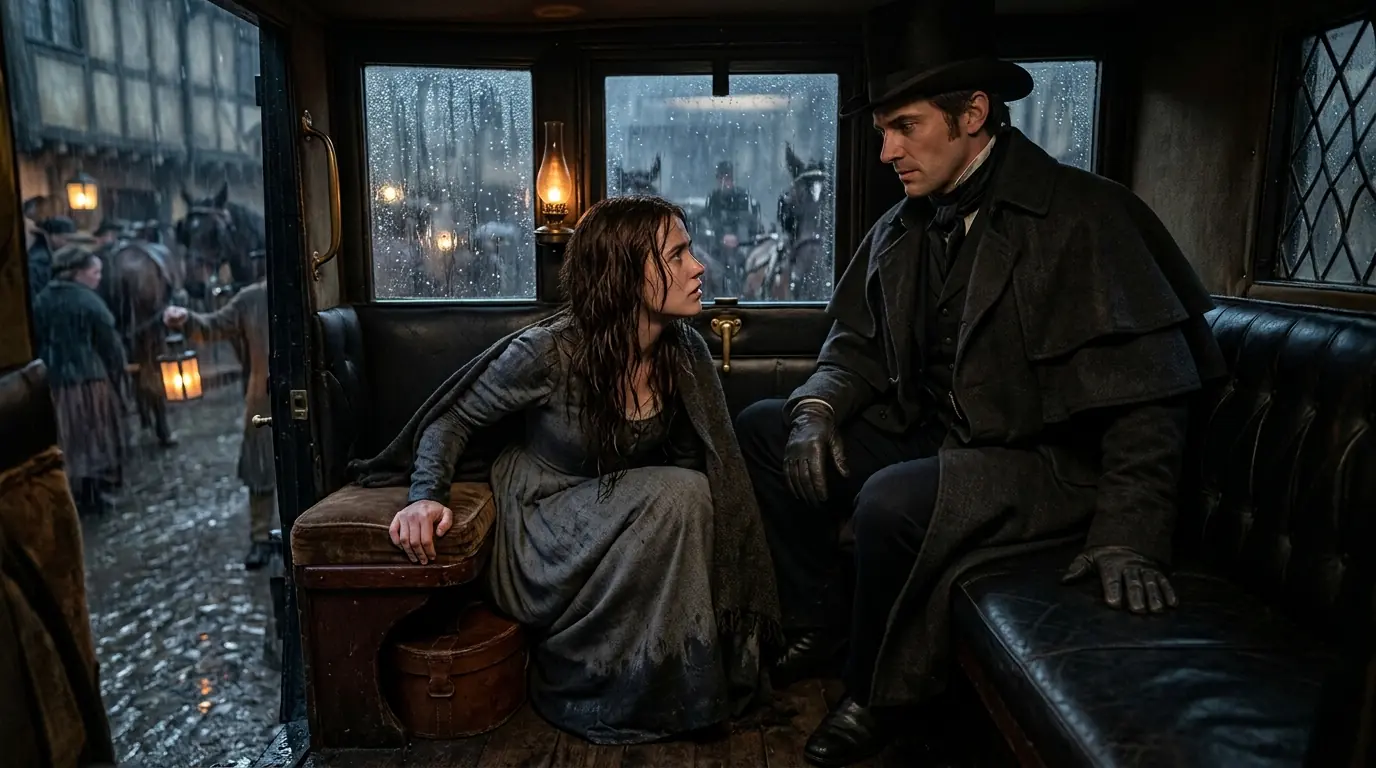
He looked at her, and she could see him counting up possibilities, and none of them were good for her. Outside, a lantern swung across the yard towards them, and Watts's voice said, quite close, “Then who's the chaise for at this hour?” Linnet put her hand on the edge of the seat and looked up at the stranger and said the only thing there was, “Pretend I'm your wife.” she whispered. “And drive on.” One second.
Two seconds. Three. She would think about those three seconds for the rest of her life and never once be able to say what happened in them. Then he leaned across her, let down the glass, and spoke out of the window in a flat, bored, carrying voice, “Is that lantern necessary? My wife is asleep.”
The lantern stopped. There was a scramble of apology out there in the wet. The landlord's voice dropped two ranks in a moment. Begging your grace's pardon. Saying he had not known the chaise was your grace's.
Then now you do? We go on? He put up the glass. The shares rocked. A post boy called something.
And they came out from under the arch into the dark. And the rain with the whole yard watching. Linnet got up off the floor and sat on the seat opposite him. Because to stay on the floor was worse. She was soaked through.
Her hair was down her back. She had four pounds and eleven shillings and a bandbox. And no character left at all. And she was in a closed carriage at eleven o’clock at night with a man whose name she did not know. Your grace, she said.
Ashmore. He said it flatly. As a man gives his name to a turnpike keeper. He had not moved. You have about six miles to tell me who you are before the first change.
I would use them. My name is Linnet Mott. My father was Thomas Mott of Wrencroft in Herefordshire. He died three years ago. And you are running away?
Yes. From a husband? He said. From the law? No, said Linnet.
Neither. He looked at her for a moment. From a man who has a legal right to fetch you back, he said. That was the question. And he had found it in three tries.
And she thought. He's done this before. Or something like it. My uncle is my guardian until I am twenty-five. She said.
He has had my banns called to a man of forty-four. I have refused twice. The third calling is a week on Sunday. The wedding is fixed for the second of June. I have not consented to any part of it, and my consent is not required.
The chaise went over something in the road, and they both put a hand out. “Say the rest,” he said. So, she said the rest in the dark to a stranger, plainly and without decorating it, because there was nothing else left to do with it. She told him the terms of the will. The estate at 25, the guardian's written consent before then, the forfeiture if she married without it.
She told him about Kitty, Nan, and Fanny, and about a man who was not wicked, but was frightened. She told him about the ninety-one oaks. He listened without a single sound of sympathy. She found she preferred it. “And where were you going?”
“To my mother's cousin in Bath, Mrs. Yardley. She has 200 a year and a spare bed, and she wrote to me by return. You would have been taken up at Gloucester by a man with a description of you and a horse under him. Perhaps.” “Certainly.”
He turned his head to the black window. “You have not asked me for anything. I asked you to drive on. You did. I have not decided what I am going to do with you,” he said.
“So, I would not thank me yet.” They changed horses at Coldbourne at half past one in the morning at a house called The Three Compasses, and that was where the thing got out of the box for good. The postboys had gone ahead with the word as postboys always do. The landlady of the three compasses came out into the rain in a shawl with a lamp held high curtsying before she was properly through her own door.
Would her grace take something hot after such a road? Linnet sat very still in the corner of the seat with the rug over her lap. The duke of Ashmore did not look at her. He said that her grace would take nothing.
That they went on directly. And that the woman had better see to the horses. Then the door shut and they were moving again. And the rain had stopped. And neither of them said anything for four miles.
“That was the second time,” Linnet said at last. “I am aware of the number.” “You could have said I was your sister.” “I have no sister. And every soul between here and Marchfield will know it by Friday.”
His voice did not rise. “You chose the word. I only went on using it. Which is what I am obliged to do now for at least a fortnight. Unless I care to be a man who was seen at midnight with a young woman he then denied.”
“I did not think that far.” “No,” he said. “People never do. That is what makes the first hour so expensive.” She looked out at the dark going by.
“Where are we going?” “Ashwood. My house. Twenty-six miles the wrong way for Bath. Which is inconvenient for you and cannot be helped at this hour.”
A pause. “There is a lady living in it, my father's sister, who is seventy-two and has buried two bishops. You will be under her roof by four o’clock and under her authority by five o’clock. And I would rather face the county than her.”
“I will not take money from you.” “You have not been offered any.” “I only wished to say it first.” Something moved at the corner of his mouth.
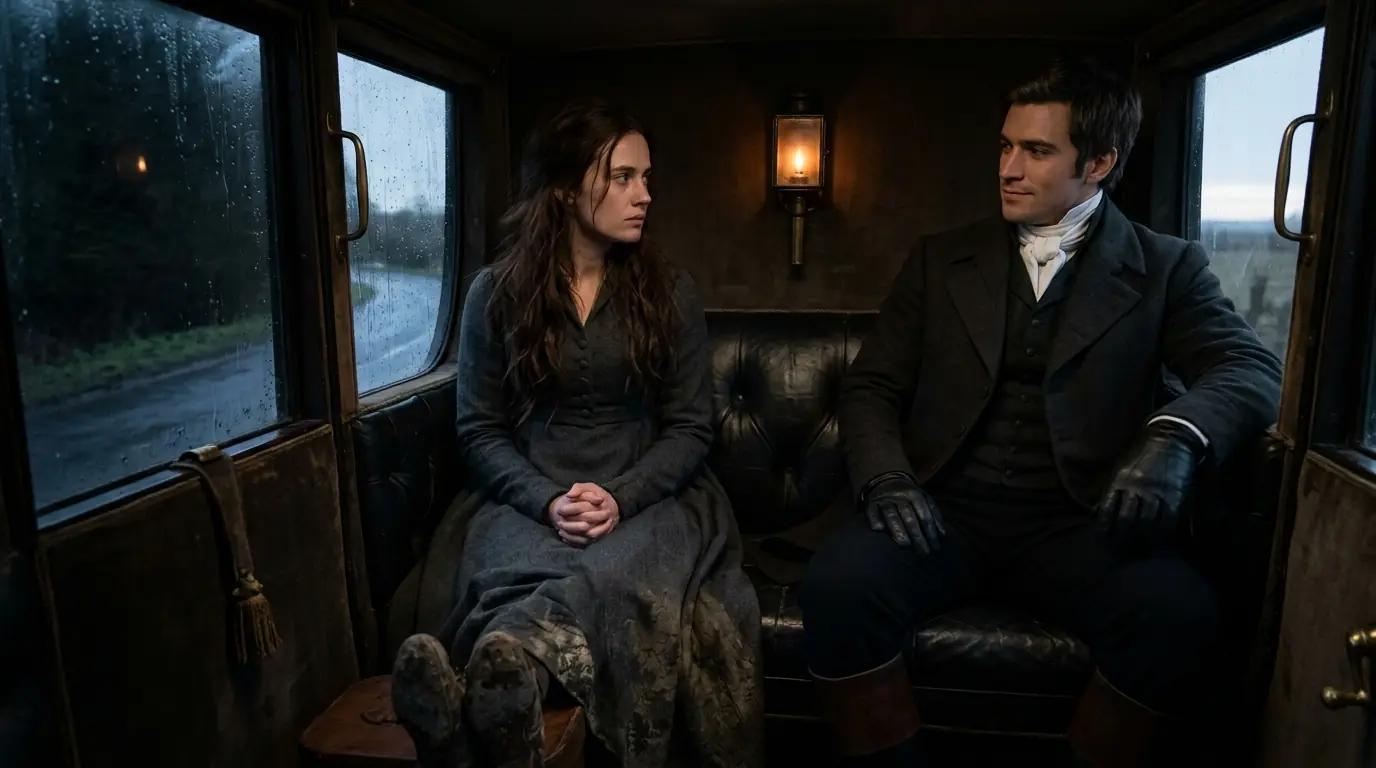
Not a smile. The almost. She did not sleep. She sat with her hands in her lap and watched the window go from black to gray to the strange rinsed color that comes before a fine morning after rain.
She thought about what she had done and could not make it come out any other way. There was no quiet ending to this now. There was only forward. The lodge gates at Ashwood opened at four o’clock in the morning onto an avenue of limes. Linnet Mott sat up very straight in a gown that had dried stiff on her and watched the limes go by.
Not one of them had a mark on it anywhere. And that was what brought her father's avenue up in front of her with no warning at all. The house was long and low and gray, three stories with a plain front standing at the end of the limes with a stone basin in front of it that had no water in it. It was not what she had expected. She had expected pillars.
The door was opened before the chaise stopped by a housekeeper in a shawl over her nightgown with a smell of coffee already coming up from somewhere downstairs. That was the moment Linnet understood what a duke is. Not a coronet on a panel. Fourteen people getting out of bed at four o’clock in the morning because a carriage came up the drive. “Mrs. Ridout,” said the duke of Ashmore, going up the steps.
“This is Miss Mott. She has been on the road since nine o’clock last night, and she has no luggage but that box. She will have the blue room and a fire in it, and everything else can wait till the world is awake.” Mrs. Ridout was a square woman of fifty with a face that gave away nothing whatever. She looked at Linnet's hem, and at her hair, and at her hands.
“Yes, your grace.” “And Mrs. Ridout.” He was already half through the hall. “You will hear a thing said in this house before breakfast. Say nothing back until my aunt has spoken to me.”
“I never do, your grace,” said Mrs. Ridout. Linnet slept four hours under a ceiling with a plaster wreath in the middle of it, and woke at nine o’clock to a housemaid drawing the curtains and calling her ma’am in a voice with a question hidden in it. Her own gown had been taken away and cleaned as far as it could be cleaned. She dressed herself.
She had never in her life been dressed by anybody else, and she did not intend to begin in a strange house. At eleven o’clock, she was taken down to a small square room at the southeast corner where an old woman sat by an open window with a work table beside her and no work on it. Lady Rosalind Dartwell was seventy-two. She had a straight back, a lace cap of the same shape she had worn since the year the king went mad, and a face like a good, clean knife. She had never married, and had buried, as her nephew said, two bishops.
“Sit down,” she said. “Not there. There, where I can see your face. Now, my nephew has told me everything he knows, which took four minutes, so I shall assume he knows nothing. You will tell me the rest, and you will not decorate it.”
Linnet sat where she was told, and told it from the banns to the lantern in the inn yard. Lady Rosalind listened with her hands folded. She interrupted twice, both times about money. Four pounds and eleven shillings, she repeated.
“You walked seven miles in the rain with four pounds and eleven shillings, and when he offered you money in the carriage, you said you would not take it.” He had not offered. “You said it first.” “Yes.”
“He told me that part twice, which is how I knew it mattered to him.” The old woman's eyes went over her once more. “Now attend, because I'm going to tell you what you have done, and then we are going to decide what is to be told.” “I know what I have done.”
“You do not, or you would be greener than you are.” Lady Rosalind counted it off on her fingers. “The landlord at Marchfield heard a duke call you his wife. The landlady of the three compasses came out in the rain to curtsy to your grace, which she will be telling for a year. Six of my own servants saw you come into this house at four o’clock in the morning in a wet gown with no boxes.”
“Yes.” So, the truth is now of no use to anybody. Understand me. I do not mean it is unfashionable.
I mean it will not work. If we say tomorrow that you are a runaway young woman my nephew found under a rug in his carriage and brought here out of Christian charity, every soul in three counties will say the same thing. And it will not be Christian charity. It is what happened. It is what happened.
Lady Rosalind agreed. It is also, put in a sentence, ruin. Yours entirely and his by a quarter, which he can afford and you cannot. What did you say to him in the carriage? The exact words.
I said, “Pretend I'm your wife and drive on.” The old woman sat back. Well, she said, “It is a pity you were not born a man. You would have done something in the Peninsula.” She tapped the arm of her chair twice.
“Wife will not do. A wife is a thing with a register, a parish, a date. Any attorney in England may go and look at it. We shall not build on ground that can be dug up. We shall say betrothed.”
“Betrothed?” Linnet repeated. You are the daughter of Thomas Mott of Wrencroft, a gentleman with four hundred acres, which is not nothing. My nephew met you last autumn at Where were you last autumn?
At home. Then he met you at the Hereford Music Meeting, which happens every three years and which nobody can prove you did not attend. The attachment was formed in the winter. Your guardian opposed it, having a candidate of his own, and was so far unwise as to have banns called against your will, whereupon my nephew fetched you away. She spread her hands.
Every word of that is nearly true, which is the only kind of lie that lives past Christmas. And when it ends, said Linnet. She had not meant to ask it so soon. Ah, said Lady Rosalind, pleased. You look at the far end.
Good. Most girls of your age look at the wedding clothes. Betrothals end in two ways. If he ends it, I am a woman a duke thought better of. If I end it, If you end it in my drawing-room before witnesses of my choosing, you are the young woman who refused the duke of Ashmore.
The old woman smiled, and it was not a kind smile. It was a general's. Nobody has ever pitied such a woman in the history of England. They will hate you a little and respect you entirely. And in eighteen months, when you come into your property, you may live in it as you please, and nobody will call you a runaway.
That is the exit. Take it in the autumn. He must agree to all this. He agreed at four o’clock this morning, when he said your name to Mrs. Ridout instead of putting you into an inn. Lady Rosalind picked up a small bell and did not ring it yet.
Now the terms, and I shall be blunt, because I would rather offend you today than bury you in October. You will not be alone with him in a shut room. You will not go out of this park without me here or a servant. You will take what is put on your back. And you will not thank anybody more than once.
Because gratitude in a young woman is what the world eats for supper. Have you anything to say? “Yes,” said Linnet. “I will keep an account.” “An account?”
“Of everything spent on me. Gowns, thread, shoe leather, letters, the post boys from Marchfield to this house. I will not have it said afterwards by anyone that I was kept. I shall pay it back out of the estate when I have it or out of what I can earn if I never have it.” Lady Rosalind looked at her for a long moment.
Then she rang the bell. “Bring the ledger from the still room cupboard,” she said to the maid who came. “The narrow one with the green tape. Miss Mott is going to want it.” He sent for her that afternoon.
Or rather, he sent a message that he would be in the library at four o’clock if she wished to speak to him. It was not the same thing and she noticed it. The library at Ashwood ran the whole west side of the house. It smelled of dust and cold ash and old leather. He was standing at the far end with his coat off and his sleeves turned back going through a box of papers on a table.
And he did not stop when she came in. “My aunt has told you the plan,” he said. “She has told me the plan.” “Do you object to any part of it?” “I object to being at the Hereford music meeting,” said Linnet.
“I have never been to it in my life. Nor have I. That is why it will hold. He sat down a paper. Miss Mott, I want you to understand your position exactly because I do not think anybody has ever told you the whole of it.”
“And half a truth about the law is worse than none. Sit down. She sat. You are 23. You are of full age.”
“Your uncle cannot make you marry anybody. And if he sent four men to carry you into a church tomorrow, the marriage would be nothing, and the men would be at the assizes. Do you know that? I know it. Say it back to me.”
“He cannot compel me, she said. He can only ruin me. Yes. He looked at her then properly for the first time since the carriage. He holds three things.”
“He holds your sister who lives in his house and has no money. He holds your land for twenty months, and he may sell every stick of timber on it, and you will get an account you cannot check and no more. And he holds the clause. Marry before your birthday without his written consent, and Wrencroft goes to him and his heirs forever. Your father wrote a fence, and your uncle is sitting on the gate.”
“Then I am to do nothing for twenty months. You are to do nothing that he can use, said the duke. That is not the same thing at all. He came round the table and stood at the window with his back to the room. And the light showed her the tiredness in him that the night before had hidden.”
“The engagement buys you three things,” he said. “It buys you time. Nobody will marry you to Mr. Wickford while you are promised elsewhere. It buys you a roof he cannot take you out of without making a public quarrel with me, which he will not do because men of his sort are terrified of anything public. And it takes away his best weapon, which was the story he would have told about you in every drawing-room in the county.”
“He cannot now say you ran off. You did not run off. You were fetched away by your intended husband, which is a thing everyone finds romantic and nobody finds shameful.” “You have thought about this a great deal since four o’clock this morning.” “I was two years at Lincoln's Inn before my brother died,” he said.
“I have not been permitted to be useful since. It appears I have not forgotten how.” That was the first crack in the flat surface of him, and it closed again at once. “There is one thing more,” he said. “You will want to write to your uncle.”
“I have written to him already. It went by the 11:00 post.” He turned round. “You have written to him? What did you say?”
“I said where I was and under whose roof and that I was not hiding and that I was engaged to be married to you.” She kept her hands still in her lap. “If I let him find it out from another mouth, he will always be able to say I skulked. I will not give him that. I would rather he had it from me in my own hand with the date on it.”
The duke of Ashmore was quiet for a moment. “You put the date on it,” he said. “Of course I put the date on it.” “Miss Mott,” he said, “I begin to think your uncle has no idea at all what he has been living with.”
And he went back to the table. And that was the whole of the conversation. Her uncle's answer came on Friday. It was three lines.
“You have made yourself a matter of talk from here to Ledbury. I do not believe one word of this engagement, and I do not think the county will believe it either after the first fortnight. Come home before Sunday, and the arrangement with Mr. W shall go on as though nothing had occurred, and nothing shall be said in this house or out of it. Your affectionate uncle, S. Mott.”
There was a postscript, and the postscript was the part that kept her awake. Your sister is well. She asks to write to you, and I have not thought it proper yet. The county came on Thursday in three carriages, one after another, the way rooks come down on a new plowed field.
Linnet received them in the yellow drawing-room with Lady Rosalind on her right hand in a gown of somebody else's let out at the seam by a maid working till midnight. She answered every question that was asked, and about nine that were not. She learned a great deal in two hours, that the ladies of that country had been arranging the duke of Ashmore's marriage among themselves for six years as other people arrange flowers. That being looked at is a physical thing, and leaves you tired in the shoulders.
And from a large, kind woman called Mrs. Whitfoot, who had no malice in her at all, that everybody already knew about the inn yard. “They do say,” said Mrs. Whitfoot comfortably over the second cup, “that his grace carried you off out of the very yard at Marchfield with your uncle's man not 10 ft away. Is it true, my dear? Do say it is true. Nothing has happened in this county since the flood.”
Lady Rosalind's teaspoon did not falter. “It is entirely true,” said Linnet, “except that his grace did not carry me off. I got into the carriage myself.” There was a small silence, and then Mrs. Whitfoot laughed until she had to be given water, and the story went out of that house at half past five and was in Ledbury by Saturday in a form Linnet could not have improved upon.
“That,” said Lady Rosalind afterwards, was either very stupid or the cleverest thing I have seen done in a drawing room in thirty years, and I have not yet decided which.“ The life at Ashwood had a shape, and the shape had been made for a man who did not want to be spoken to before noon. He rode at seven o’clock before anybody was down. His steward came at ten o’clock. There were letters until one o’clock.”
“In the afternoon, he was out on the land or shut in the library, and at half past six they dined, the three of them, at a table long enough for twenty-four. The first week, the length of that table nearly beat her. The second week, Lady Rosalind put down her spoon and spoke to the butler at her elbow. We shall dine at this end from tomorrow.”
“Take out four leaves. My hearing is not what it was, and I am tired of shouting at my own family. Her hearing was excellent. The next evening, the table was shorter and stayed shorter. She learned the house as she had learned Wrencroft by walking it and asking servants sensible questions.”
“Twelve thousand acres, most of it let. A home farm that had lost money six years running. Three hundred and six standing items in the household accounts, one of which was a piano tuner from Hereford, twice a year, four shillings and the road money. That interested her because the instrument was in the saloon under a Holland cover, and nobody had touched it in nine years. She asked Mrs. Ridout about it.”
“He comes at Lady Day and at Michaelmas, ma'am. It has never been left off. Her grace, that was his grace's mother, gave the order, and the order has never been changed. And I do not go about changing the orders of the dead. Does nobody play it?”
“Nobody in this house has played anything since the year '15, said Mrs. Ridout, and went to see about the linen. Linnet took the cover off on the 4th of June and looked at the keys and put the cover back on. That night, she could not sleep, which had become usual, and at a quarter past one, she went down in her wrapper with a candle because a house at one o’clock in the morning belongs to whoever is awake in it. She played very quietly at first with the soft pedal down. It was in tune.”
“Of course it was in tune. Kept so by a standing order for nine years at four shillings a visit for nobody. She thought that was the saddest line in the whole 306. And then she stopped thinking because she had begun to play her mother's air. And when she played that she was not anywhere.”
“She did not hear the door. When she came to the end and lifted her hands the duke of Ashmore was standing just inside the room with a candle in his hand still dressed looking as though he had been struck across the face with something. Linnet stood up so fast that the stool went over. I beg your pardon. Lady Rosalind said nothing about the saloon.”
“But I should not have What was that? It is only a thing my mother made. Made? He repeated. She made it up.”
“Over yours. It has no name. She bent and set the stool on its feet to have something to do with her hands. She never wrote it down. Why not?”
“I asked her that. I was 12 and I thought everything ought to be written down. Linnet looked at the keys instead of at him. She said that if she wrote it down it would be a piece of paper and then anybody might have it. She said this way it lived in the two of us.”
“He came a little further into the room and set his candle on the top of the instrument. Then where does it live now?” he said. “In me. Nowhere else.” She heard how it sounded, and added, because the plain fact seemed safer than the feeling.
“There is no copy. My father is dead, and my mother is dead, and my sister has no ear, and never could hold it. If I am run over by a wagon tomorrow, it is gone out of the world entirely.” The duke of Ashmore stood there for what felt like a long time. “Nine years,” he said at last.
“I have paid a man four shillings twice a year to keep that instrument in tune, and I could not have told you why. I thought it was one of those charges that go on because nobody stops them. Perhaps it was. Perhaps.” He picked up his candle again.
“Play it once more if you are not too tired. You may sit down if you like,” said Linnet. “But I shall stop if you look at me.” He sat down in the dark at the end of the room where she could not see his face. She played it again, and then two other things, and then a slow air out of the north that her mother had had from a Scotch nurse.
Neither of them said good night. He went out while she was still playing, and she heard the door go. She sat a while with her hands in her lap in a strange house at 2:00 in the morning, and felt for the first time since the tenth of May that she was not being carried. They had gone to church at Ashwood every Sunday since she came, all three of them, because Lady Rosalind said that a betrothal not seen in a pew is not believed in a parish. The first two Sundays, Linnet had kept her eyes on her book because a hundred faces were turned on her, and she did not mean to give them anything to read.
On the 7th of June, she looked up. She saw the tablet on the north wall while the rector was giving out the notices. White marble, quite new, plain lettering. Sacred to the memory of Jared John Dartwell, 6th Duke of Ashmore, who died on the 21st day of May, 1815, in the 30th year of his age. He was hasty, and he was loved.
She read it twice. He was hasty, and he was loved. Somebody had fought for that line. You could see it in the spacing. Then she did the arithmetic and sat quite still through the whole of the second lesson.
The 21st of May. She had climbed into that carriage on the night of the 21st of May. A man does not travel post at eleven o’clock at night in May with no servant and no explanation. He had been coming from somewhere on that road on that night alone every year. And she had got into the middle of it with a bandbox and a whispered lie.
She said nothing about it for ten days. Lady Letitia Kelbridge came to dinner on the twelfth of June with her brother the Earl and a party of six. Linnet had heard the name by then from Mrs. Whitfoot, from a maid, from Lady Rosalind's silence when the Kelbridge card was brought in. Kelbridge Court was eight miles off. Lady Letitia was twenty-six.
There had never been an engagement. Never a word spoken by anybody who had the right to speak it. And the county had nevertheless been perfectly certain for six years. And so Linnet understood at once, had Lady Letitia. She came into the yellow drawing room in dark green, gave Lady Rosalind exactly the right degree of courtesy, and took both of Linnet's hands.
Miss Mott, I am so very glad. We have all been wanting somebody to be glad about. She was handsome in the way of a woman who has been told so since she was 15. And her manners were flawless. And she never once said an unkind thing that could be written down.
Her weapon was accuracy. You will have to teach her about the East Lodge, Jasper. She said at dinner, laughing down the table. Miss Mott, he will tell you the lodge is habitable. It has never been habitable.
In the year 12, I put my foot through the floor of it. And his brother laughed so much he could not open the gate for us. She turned to Linnet with her chin on her hand. Did he tell you about Gerard? He tells nobody about Gerard.
It is the great fault in him. He has not, said Linnet. No. He would not. A small pause, sweet as sugar.
He takes chocolate at breakfast, not coffee, which nobody ever remembers because he does not care enough to say so. His birthday is the 9th of March. His mother's name was Winifred, and she was terrified of thunder. Lady Letitia smiled around the table. You see, I have known him since I was nine years old.
Miss Mott must forgive me. I am the last person in this county who is allowed to be tiresome about him. “You are not the last.” said Lady Rosalind from the end of the table. “You are merely the loudest. Take some more of the veal.”
Afterwards, in the drawing room, Lady Letitia asked her to play. The whole room turned. Linnet felt the shape of the trap and admired it. As you can admire a snare with your foot already in it. Play badly and she was a nobody.
Refuse and she was proud. Play well and she was a woman who had hidden an accomplishment, which in that county was as good as hiding a husband. “I do not play in company.” said Linnet. “Not at all?” “Not at all.”
“How very restful for you,” said Lady Letitia kindly. “I have always thought it a shame that the rest of us were made to learn.” Afterwards, when the carriages had gone, Lady Rosalind sat down heavily and said, “Well, she has six years in her and no place to put them. Do not hate her. She will be ridiculous in ten years and she knows it, which is the whole of her cruelty.”
“I do not hate her.” said Linnet. “No.” said Lady Rosalind. “That is what will finish her.” She had written to Bath on her second morning at Ashwood before anything else because a woman who has offered you her only spare bed is owed the truth with a date on it. Mrs. Yardley answered by return.
“So you are not coming and you are engaged to a duke. And you have known him two days. My dear, I keep the bed aired from habit. Write me the word, and it is yours the same night. And no questions asked of you in this house, then or ever.”
Linnet kept that letter in the pocket with the first one. It was not a plan. It was a door with a bolt left back. And she found she could think better for knowing where it was.
The letters from Wrencroft came in that same fortnight. And they were not from her uncle. Mrs. Purdy wrote first in a hand like a hedge to say that the mistress was not to fret. That everything in the house was as she left it. And that Miss Hannah was well, and cried on the Wednesdays.
Then, on the seventeenth of June, four lines from old Purdy, who had been carting on that estate for forty years, and whose letter Linnet read standing on the stairs, and then read again sitting down. “Miss, the fellers come in at midsummer for the avenue. And Beddow's carts are ordered for the week after. They have took forty-one already out of the long coppice since the spring, which was never spoke of. I say no more, but I thought you should know it from me.”
She sat on the stairs of a duke's house and did the only sum that mattered. An estate that would be hers in nineteen months sold off by a man who would render her an account she had no means on earth to check. That night she went down to the saloon at one o’clock, and he came in at half past. He did not pretend to have come by accident this time. He shut the door and stood with his back against it, which he had never done.
And after a while he said, “You have been looking at me for a fortnight as though you had found something out.” “I read the tablet in the church.” “Ah, the 21st of May.” said Linnet. “I got into your carriage on the night of the 21st of May.” He crossed the room and sat on the arm of a chair and looked at the shut cover of the instrument and told her.
He told it badly, which she thought afterwards was the only way it could have been true. He had been a second son with nothing to inherit and no wish to inherit it. And he had been good at the law. In the April of 1815, his brother wrote asking him to come home. The estate was in a muddle and Gerald hated paper as some men hate water.
“I wrote back that I would come at the end of term,” he said. “Four weeks. I had an examination. I wrote a very reasonable letter. I have often thought since that it was the most reasonable letter ever written by anybody.”
“He drove himself.” said Linnet. “He drove himself to London to fetch me at night because he did the whole of his life at night and at a gallop. He went off the road at the Coldbourne bend, which is a bad bend and which he had taken at that pace 200 times.” He was looking at the floor.
He was nine hours dying and I was ninety miles away being reasonable. The candle guttered. Neither of them touched it. “So, every year,” she said.
“Every year, I drive that road on the 21st from the bend to the house at night, alone. Not for him. He's past minding. I do it because a man ought to be made to look at the exact place.”
He rubbed his hand once across his mouth. “And this year, at the change at Marchfield, I got into my carriage and there was a wet young woman on the floor of it telling me to pretend she was my wife,” Linnet said nothing. There was a thing she might have said and she could feel the shape of it. That it was not his fault.
That four weeks was reasonable. It would have been kind and it would also have been an answer to a question he had not asked. And she had been given enough of those since her father died to last her. So, she did not say it. She turned round on the stool and lifted the lid and played her mother's air which was the only true thing she owned.
When it was finished, he was standing by the window with his back to her. “Thank you,” he said. “Jasper,” said Linnet. It was the first time. She had not planned it and she heard it go out of her mouth and could not get it back.
And she saw his shoulders change. “Yes,” he said to the window. “Well, that has taken six weeks. My aunt will be pleased. She says the servants notice nothing so quickly as a Christian name.”
But, he did not turn round and he did not say her name back. She understood that he was keeping to the terms as carefully as a man walking a beam, and that the terms had begun to cost him something. Her uncle came to Ashwood on the 24th of June in a hired gig, in his good coat. Lady Rosaleen received him because Lady Rosaleen received everybody, and because she said afterwards that she would not have missed it for a bishop.
He was shown into the yellow drawing room at noon. Linnet came down with her hands perfectly steady, and her heart going like the walk to Marchfield. He had brought a leather case, and he put it on his knees. He was polite to the old woman for four full minutes about the road, the weather, the state of the wheat. Then he said, “I should like a word with my niece, if her ladyship permits.”
“She does not,” said Lady Rosaleen. “But I am deaf, and I shall look at the garden.” She turned her chair to the window, and did not look at the garden at all. “Well, Linnet,” said her uncle. “Well, uncle.”
“You are in health. That is something.” He opened the case, and took out a folded paper, and did not unfold it. “A copy of your father's will. I have read it 40 times these last weeks.”
“You had better hear it out of my mouth when nobody can pretend I was sly about it. I know what it says. You know what it says. I am not sure you have counted the cost of it.” He set the paper on the little table between them, and put one finger on it gently, the way you might hold down a page in a wind.
If you marry this gentleman before your 25th birthday without my consent in writing Wrencroft goes to me and my heirs the same hour and you take four hundred pounds and there is no relief in any court in England because your father meant there to be none. He was warned by Gedge that the clause was hard. He said he wanted it hard. Yes. So you may have your duke or you may have your land.
Her uncle sat back. If he marries you in August you come to him with nothing at all every soul in three counties will say the duke of Ashmore was so far gone as to take a girl out of an inn yard with four hundred pounds which he may bear very well. It is you who will hear it at every dinner for thirty years. Linnet sat with her hands in her lap. And if I come home?
If you come home before Sunday I consent to Mr. Wickford you keep Wrencroft entire and in nineteen months you are mistress of it with a steady husband four hundred acres and no talk at all. He spread his hands. I have not come to bully you. There is a piece of arithmetic here that you are being encouraged not to do and I am the only man left who is obliged to make you do it. It was the most terrible ten minutes of her life because he was not lying.
Every word was true. He had built a room with two doors and shut them both on her. And Hannah? She said Ah He looked down at his gloves. Your sister is very well.
We are retrenching a little. You have made me a laughingstock in this county, Linnet. And a man who is laughed at pays more for everything. Their mother's sister at Bristol has offered to take Hannah for a year as a companion. It is a respectable house.
She would have her keep and no wages, which is the usual thing. There it was, said in the tone of a man discussing the price of coals. When? Michaelmas, if things stand as they are. He rose and picked up his hat.
The fellows come in on Monday for the avenue. I would not have you hear that from a servant, either. At the door, he stopped. And for one moment, he was her father's brother again. The man who had carried Hannah around the orchard on his shoulders.
You were always the clever one, he said. It is a very great pity you were not a boy. I should have had somebody to leave it all to, and none of us would be in this room. Then he went out to the hired gig, and Lady Rosalind turned round from the window and said, “Well, now I have seen it. It is the reasonable ones who do the worst harm in this world, because they never once have to raise their voices.”
The duke found her at four o’clock at the far end of the terrace, where the balustrade is broken and nobody goes. “My aunt has told me. Then you know it all. I know that we are to be married by license in Hereford the day after tomorrow,” he said. You will come to me with four hundred pounds and no land and I do not care in the smallest degree.
Ashwood is twelve thousand acres. It has swallowed three bad harvests and it will swallow this. Let the man have his oaks and be damned to him. He said it quickly for him. Like a man who had been rehearsing on the stairs.
Linnet looked out at the park. At the limes going all the way down to the lodge. And found that her eyes were hot. And her voice was perfectly level. “No,” she said.
Linnet. Listen to me because I shall only be able to say it once. She turned around. In May a man decided what should become of me because he had the whip hand. And he told himself it was for my good.
And he was kind about it. And he never once asked. If I marry you on Thursday because your name is bigger than his. Then the whole of my life has been decided by two men in eight weeks. The only difference is that the second one has better manners and a nicer house.
That is not what this is. It is what it would become. She put her hand flat on the broken stone. Wrencroft is not sentiment. It is four hundred acres, two farms and a mill.
And it is the only thing in the world that would let me stand in a room. And not be grateful to anybody. My father made a fence to keep the wolves off me. I will not walk out of the gate of it. Because a man I have known for six weeks is standing there with his hat in his hand.
However much I She stopped. Say the rest. He said. It was the same three words he had used in the carriage. However much I should like to, said Linnet.
He was very still. Then, what do you mean to do? I mean to go home, she said, and count. The assembly at Marchfield was on the twenty-seventh, and there was no possibility of staying away. The whole county had spent six weeks deciding whether to believe in her.
She wore gray. Lady Rosalind, who had wanted the blue, looked at her once in the hall and said, Ah, you have decided something, and asked no questions, and took her arm going up the stairs. For two hours it went well. She danced twice. She was looked at and stood it.
Mrs. Whitfoot told the inn-yard story three times within her hearing, improving it at each telling. And by the third, Linnet had come down a rope. At eleven o’clock, she went to find the card room, and heard her own name through a door that was not quite shut. Lady Letitia Kelbridge stood by the fire with a cup in her hand, and four women round her. Her voice was pleasant and unhurried, and every word was a fact.
Which would be charming if any part of it were true. Ask her what she wore at the Hereford music meeting. Ashmore was not at it. I was. There were no mots in that town, and no Ashmore either.
A small laugh, entirely without malice, which made it worse. The post boys at the Feathers say the lady got into the chaise out of the dark, and his grace did not know her name until they were past the turnpike. I only think it is hard on him. And I think somebody in this county ought to have the courage to say so. There was the particular silence of a room that has been given permission.
Linnet pushed the door and went in. Afterwards, people said different things about how she looked. What she remembered was the fire too hot on her left side and thinking quite clearly, He cannot say this himself and his aunt would have to fight it for the rest of her life. And I can end it in a minute. You have it very nearly right, she said.
May I finish it? Nobody spoke. There was no Hereford music meeting. I had never seen the duke of Ashmore in my life until the night of the 21st of May. Her voice carried.
She had a singer's lungs and had never used them in a room like this. My uncle had my banns called to a man of forty-four without telling me. I walked seven miles in the rain to take the mail and I missed it. My uncle's groom came into the yard with a lantern and I got into the first carriage that stood ready and hid on the floor of it. It was his grace's.
I asked him to say I was his wife and to drive on and he did it. And he has been paying for that piece of civility every day for six weeks. Somebody's cup went down on a saucer. There is no engagement, said Linnet. There was never an engagement.
Lady Rosalind Dartwell took a girl with wet shoes into her house and put a decent name on her which is the kindest thing anybody has done for me since my mother died. I will not have her called a liar in a card room by people who have eaten her dinners. So, it is finished now. And you may all say what you like about me, and I shall be at Wrencroft, where I am going in the morning. She looked at Lady Letitia.
“You were right,” she said. “It is hard on him.” “That is the truest thing anybody has said in this room tonight.” Then she went out and found Lady Rosalind, who had come to the door somewhere in the middle of it, and who took her arm and said only, “The carriage. Now, before they recover.”
In the passage by the stairs, Lady Letitia caught her sleeve. She had lost her color. Up close, she was not a general at all. She was a woman of twenty-six who had just watched six years go into a fire, and who had done it herself with her own hand in front of witnesses. “I have been waiting since I was twenty,” she said.
“You have been here six weeks.” “I know.” “He never asked me, not once in all those years. Do you know what that is like? To be certain, in front of everybody, of a thing nobody has ever said to you?”
“Yes,” said Linnet. “I do, rather. Mine was read out in church.” Lady Letitia let go of her sleeve.
She did not apologize then or ever. But at Christmas, she sent a plain civil note about a matter of charity subscriptions, and it was answered plainly and civilly. The two of them got through the next thirty years in that county without once making a scene, which in that country counts as a friendship. Linnet went home to Wrencroft on the twenty-eighth of June by the public coach with her bandbox and the narrow account book with the green tape.
Lady Rosalind came to the gate with her. “You will write to me,” said the old woman. “Not gratefully, weekly.” “Yes, ma'am.”
“He is in the library and he will not come out because I told him that if he stood in your way this morning, I should stop his coffee.” She held Linnet's chin for a moment in her dry hand. “Go and count, then. Count very carefully. I have known three men ruined by their own accounts and every one of them thought himself as safe as the bank.”
The avenue at Wrencroft was still standing. That was the first thing she saw from the top of the lane and she had to stop and hold the gate. The fellows had come in on the Monday as promised. There was a hut at the top and a stack of tools and two great trees down at the near end with their crowns spread all over the grass like something shot.
Two of the ninety-one. Her uncle had gone to Hereford for the Assizes week. She had until Saturday. She slept in her own bed that night in a shut house with Mrs. Purdy scandalized and delighted in the kitchen.
In the morning, she began in the order old Gedge would have used because she had sat in that room year after year while her father talked to his attorney. Old Purdy came up before six o’clock and sat on the edge of a chair with his hat between his knees and gave her the days, the loads, the names of the carters. By Tuesday noon, she had thirteen dates, and not one of them was worth a farthing because every word was in her own hand and could be denied. She needed paper that was not hers. It was Mrs. Purdy bringing out a cloth who gave it to her without knowing.
“The carts went through the Marchfield gate, miss. Mrs. Sennett keeps the book and she do grumble at it for the gate money on timber is by the load and she must write down everyone.” Linnet walked the seven miles on the Wednesday and sat three hours in that little front room with the toll book open and a borrowed pen. She copied every entry since the fourteenth of March in which oak timber had gone down from Wrencroft to Beddow's yard. Twelve wagons in March and April.
Eight more since. Dated, numbered in a stranger's hand, in a book belonging to the trustees of the turnpike. Mrs. Sennett signed the copy as a true copy and would not take the shilling. “Your mother sat in that chair the week my first was born,” she said. “I would not take a shilling off you if I was starving.”
On the Thursday, she went to Beddow, the timber merchant, who had never in his life done anything against the law and who went the color of the sawdust when she gave her name. In nineteen months, I shall own Wrencroft. Every tree you have bought off that estate you bought from a man who holds it for me. I have come to see the contract. And I shall see it now in your counting house or in nine months in a court in London with an order behind me.
It is entirely as you please. He showed her the contract. And then, sweating, the book. The long coppice, forty-one trees sold on the fourteenth of March for three hundred and forty pounds. The avenue, ninety-one trees sold on the second of April for 610.
Nine hundred and fifty pounds in all, a third paid, the rest on felling. And in the column at the side, in his clerk's hand, the way the money had gone, three drafts, everyone made payable not to the estate of Thomas Mott, deceased, but to Simon Mott, Esquire. Linnet looked at that column for a long time. “I shall want a copy,” she said, “a very exact one.” Mr. Gedge read the whole of it on the Friday morning in his office over the saddler's with his spectacles pushed up and his tea going cold.
“It is not stealing,” he said at last. “I will not have you go into that room thinking it is. A guardian may sell ripe timber, but he must sell it for the estate and account for it to the estate and pay it into the estate. And drafts payable to Simon Mott, Esquire, are not that. There is a name for it in equity, and the name is breach of trust.”
“What would it cost me to prove?” “two hundred pounds and eighteen months, and you would win,” said old Gedge. And there is not two hundred pounds in the world that belongs to you until you are twenty-five, as your uncle knows better than I do. He took off his spectacles.
But he does not have to be beaten in court, my dear. He only has to know that he could be. Do you understand the difference? Yes, said Linnet.
Then I shall draw you the paper you asked for. And I shall put it in the strongest form I know. And God forgive me, I have wanted to do this since the ninth of November, 1815. Simon Mott came into the dining room at Wrencroft on the second of July and found his niece at the head of his table with four papers laid out in front of her.
He looked at the papers before he looked at her. She had counted on that. Sit down, uncle. You may sit where you please. I have four things to show you.
And then you may talk as long as you like. You have no business in this house. I have nineteen months of business in this house. She turned the first paper round to face him. The toll book at Marchfield certified twenty wagons of oak off this estate since the fourteenth of March.
She turned the second. Beddow's contract, ninety-one trees in the avenue, forty-one in the long coppice, nine hundred and fifty pounds. She turned the third slowly because she had learned something at Ashwood about how a room is held. The column showing where the money went. Three drafts, every one payable to Simon Mott, Esquire.
Not one to the estate of Thomas Mott, deceased. Her uncle's face had gone a color she had never seen on it, and she found it gave her no pleasure at all. And that is a letter from Mr. Gedge, who has read the other three. He is a country attorney. He is a country attorney who has written the words breach of trust in his own hand and put his name under them.
Simon Mott sank down at last in the middle of his own table, which was neither end of it. “You would ruin me,” he said, “for some trees.” “No, I am going to tell you what I want, and it is not that.” She had written it out the night before, and she said it without the paper. The fellows were to be stopped by noon the next day, and the avenue was to stand.
The nine hundred and fifty pounds was to go back into the estate by Lady Day with interest, and Gedge was to have the receipts. And her consent to marry was to be given in writing, free and unconditional, signed this week before two witnesses. And in return, nothing is said. Not to the county, not to Lady Rosalind, not to a court. No proceeding now or when I come of age.
She paused. “And when this estate is mine, I shall pay Kitty and Nan and Fanny four hundred pounds apiece out of it on their marriage, as though you had put it by yourself, which is what you were about to tell me you were doing.” He stared at her. “I have three daughters,” he said, and his voice broke on it, and she saw that it was the whole of his case, and that he knew it was not enough. “So had my father,” said Linnet.
“And he did not sell her.” He signed on the Thursday in Gedge's office with the saddler and the saddler's boy as witnesses, and he did not look at her once. She found she did not need it. Mr. Wickford wrote to her that same week. It was half a page, civil throughout, withdrawing his offer and hoping she would not think hardly of him since he had understood all along that the matter was settled between gentlemen.
She read it twice and could find nothing in it to hate. He married a widow from Bosbury at Michaelmas, and for thirty years afterward he and Linnet said good morning to one another in that churchyard without either of them once looking at the gate. Then she walked out to the avenue alone and stood under the fourth oak from the gate with her hand flat on the bark and stayed a long while. The chaise came up the drive at six o’clock in the evening. It was the same chaise.
She knew the near wheel by its rim, and she was standing in the middle of the drive in her old gray gown with her sleeves pushed up when it stopped. The duke of Ashmore got down and came no nearer. “Gedge wrote to me,” he said. “He is a great deal fonder of you than he is of the law.” “He is not.”
“No,” said Jasper. “But it was a near thing.” They stood with twelve feet of gravel between them. Behind him, the carriage door hung open on the dark inside of it. “I have the consent,” said Linnet.
“It is free. Nobody can say it was bought or frightened out of him or given for a title. It is worth nothing to me except that it is mine. I know what it is worth. Then hear me say this in daylight, standing up on my own land with nothing hanging over me.”
Her voice steadied itself. “There is no bargain in it now and no scandal and no carriage to hide in. I’m not being carried anywhere.” “No,” he said.
“Ask me.” He asked her. It was not a long speech and it was not a graceful one. And twice he began again. “Yes,” said Linnet Mott.
Then she got into the carriage in the open in front of her uncle's windows and the whole of Mrs. Purdy's kitchen. And she sat on the seat this time and not on the floor. Jasper got in after her and shut the door. “Drive on,” she said. They were married at Wrencroft the following spring and the banns were read on the tenth of May.
She stood up in the third pew to hear it which nobody in that parish had ever seen done and the curate lost his place and had to begin again. The avenue was standing, ninety-one oaks in leaf. Mrs. Yardley came up from Bath for the wedding and sat where the family sits and said afterwards that she had never in her life been so pleased to keep a bed empty. The narrow account book with the green tape was closed in the January she came of age. It came to twenty-six pounds, four shillings, and sixpence and she sent a draft for the whole of it to Ashwood with a letter that was not grateful in any part of it.
Lady Rosalind wrote back one line. “Received and entered against you. It is the best money I ever laid out.” There was music at Ashwood that summer. And once in company with the doors open and thirty people in the room and Lady Rosalind sitting bolt upright daring anybody to speak.
Linnet played her mother's air aloud for the first time in her life. It has never been written down. It is not going to be. There are things a paper can take from a woman and things it cannot reach. And she had learned early and exactly which was which.