She stood in the shadows of the grand ballroom, her fingers trembling against the silk of her gown, and listened to the man she had married six months ago announce to everyone that the performance about to begin was merely a pleasant distraction. Merely a pleasant distraction. The words carved themselves into her chest like cold steel. She was not merely a pleasant distraction.
She was his wife, the Duchess of Ashworth. Yet he had introduced her to his guests as though she were nothing more than a hired musician called upon to fill an empty hour before supper. Lady Alara Blackwood had been raised to expect a marriage of convenience. Her mother had told her plainly on the morning of her wedding that love was a luxury for women who did not need roofs over their heads or food upon their tables.
Alara had nodded and understood. She had been grateful, even when the Duke of Ashworth chose her from the sea of eligible young ladies paraded before him during that miserable London season. He had been cold and distant, yes, but he had also been fair. He had promised her a comfortable home, a respectable title, and complete freedom to manage the household as she saw fit.
In return, she would provide him with an heir and never embarrass him in public. It had seemed like a reasonable arrangement until she discovered what it truly meant to live in a house where no one looked at her. Meals were taken in silence. Her husband passed her in the corridors without a word, his gaze sliding over her as though she were a piece of furniture that had always been there and required no acknowledgment.
She had tried at first. She had attempted conversation at dinner, only to be met with monosyllabic replies. She had arranged small gatherings, hoping to draw him into the warmth of society, only to watch him retreat to his study the moment his duties as host permitted. She had even dared once to touch his arm as they walked through the garden, and he had flinched as though burned.
After that, she stopped trying. Tonight was the first time in weeks she had allowed herself to hope. The Duke had requested that she play the pianoforte for his guests. Not demanded, but requested. He had come to her sitting room himself, something he never did, and stood in the doorway with that impassive expression she had come to know so well.
“There will be a gathering on Friday evening,” he had said. “I would be grateful if you would provide some music.” She had nearly wept at the simple kindness of the word grateful. Now she understood. He had not been asking her to play because he valued her talent.
He had been asking because he needed entertainment for his guests, and hiring a professional musician would have required effort and expense. His wife was already there. His wife could be used. She watched him now, standing near the fireplace with a glass of brandy in his hand, speaking to Lord Whitmore about something she could not hear.
Alexander Blackwood, the Duke of Ashworth, was handsome. She had noticed that immediately on their wedding day. He was tall and broad-shouldered, with dark hair that caught the candlelight and gray eyes that never seemed to warm. His jaw was sharp, his mouth often set in a firm line, and he carried himself with the easy authority of a man who had never once doubted his place in the world.
He owned half of Yorkshire and a quarter of the hearts in London. Yet he had never once looked at his wife and seen anything worth noticing. Alara turned away from the sight of him and walked toward the pianoforte. The instrument was beautiful, rosewood and ivory, placed near the tall windows that overlooked the moonlit garden.
She had spent hours at this keyboard since arriving at Ashworth Manor. She had poured her loneliness into the keys until her fingers ached and her eyes burned with unshed tears. Music was the only thing that understood her now. She sat down on the bench and arranged her skirts, aware of the guests turning to watch her.
There were perhaps forty people in the room, members of the local gentry and a few visitors from London. They had been drinking, laughing, and gossiping for the better part of an hour. Now they were curious to see what the new duchess could do. She had prepared a waltz, a simple, elegant piece that would not challenge anyone’s ears or demand anyone’s attention.
That was what he had asked for, after all. A pleasant distraction. But as she placed her fingers on the keys, something shifted inside her. She looked up and found the Duke watching her from across the room.
His expression was unreadable. Polite, perhaps. Indifferent, certainly. He raised his glass slightly, a gesture that might have been encouragement or dismissal. She could not tell.
She could never tell with him. In that moment, something broke. She was so tired of being invisible. She was tired of being pleasant, agreeable, and convenient. She was tired of playing the simple waltz when everything inside her was screaming for something more.
Her fingers found the opening chords of Beethoven’s Pathetique. Not the slow, mournful introduction, but the second movement, the Adagio Cantabile, the piece her mother had forbidden her from playing in company because it was too emotional, too revealing, and too likely to make gentlemen uncomfortable. Alara had learned it in secret when she was sixteen. She had sneaked into the music room after midnight and pressed the keys so softly no one would hear.
She had played it for herself on the night before her wedding, weeping into the keyboard until her tears spotted the ivory. Now she played it for him. The first notes drifted through the ballroom like a sigh. She closed her eyes and let the music take her.
Her fingers moved with a confidence that surprised her. She had not played this piece in years, but her hands remembered. They knew where to go, how much pressure to apply, when to linger, and when to rush. The music swelled around her, filling the room and pressing against the walls like a living thing.
She forgot about the guests. She forgot about the Duke. She forgot about everything except the ache in her chest that had no name and no cure. The Adagio built toward its central climax, and she let herself feel every note. The frustration of wanting something she could not name, the grief of loving someone who would not see her, and the desperate, foolish hope that maybe if she played loud enough, long enough, or well enough, he would finally turn his head and look at her the way she had always dreamed of being seen.
She opened her eyes. The Duke was no longer standing by the fireplace. He had moved closer. He stood near the edge of the pianoforte, his glass forgotten in his hand, his gray eyes fixed on her face with an intensity she had never seen before.
The polite indifference was gone. Something else had taken its place, something she could not name. She held his gaze and played on. The music rose toward its final resolution, the longing giving way to something softer, almost like acceptance. She was not playing for him anymore.
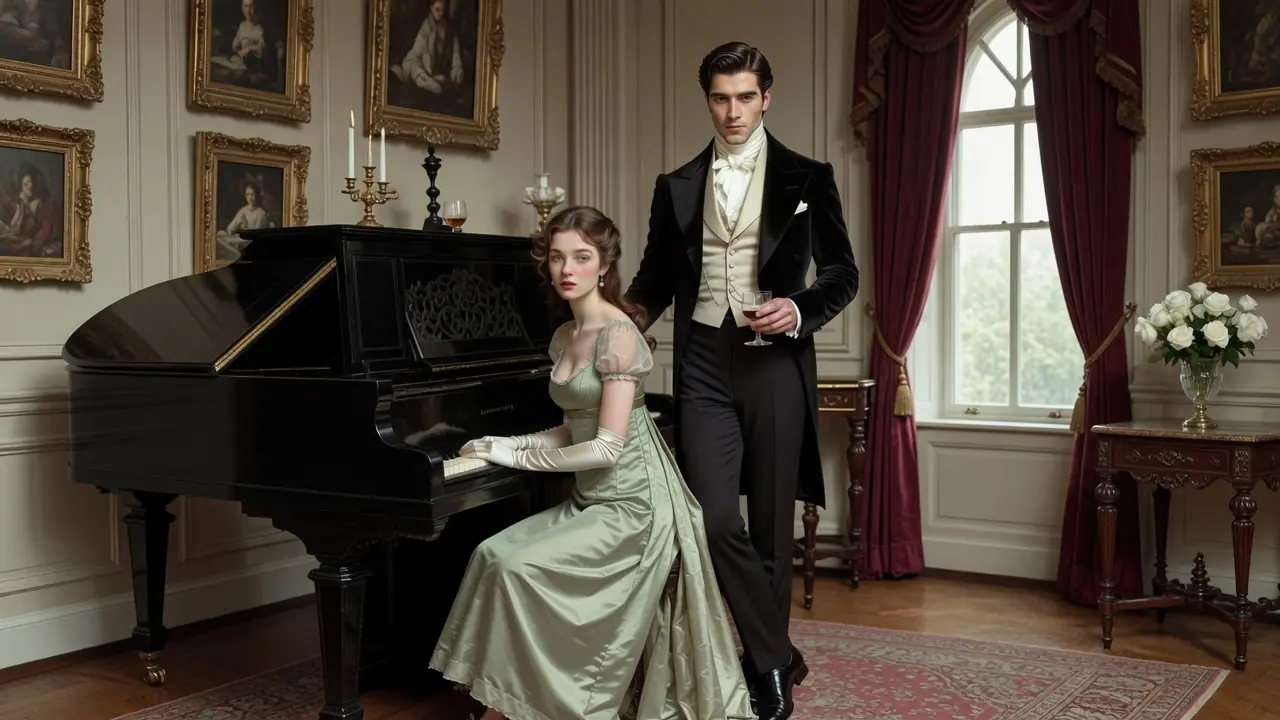
She was playing for herself. She was playing for the girl she had been and the woman she was becoming. She was playing for all the nights she had sat alone in this cold house, wondering if she would ever feel anything again. The last chord faded into silence.
No one moved. For one long moment, the ballroom was utterly still. The guests stared at her with expressions ranging from surprise to admiration to something that looked almost like pity. She did not care.
She was looking only at the Duke, waiting for some sign, some word, some flicker of recognition that she existed. He said nothing. He simply stood there, his chest rising and falling as though he had been running, his eyes never leaving her face. Then, without a word, he turned and walked out of the ballroom.
The door closed behind him with a soft click. Alara sat alone at the pianoforte, her heart pounding, her fingers still resting on the keys. She had given him everything she had. She had laid herself bare in front of forty people, and he had walked away.
She felt the first tear slip down her cheek and quickly wiped it away. She would not cry there. She would not give anyone the satisfaction of seeing her break. The guests began to murmur among themselves.
Someone applauded, then someone else, and soon the room was filled with the sound of polite approval. It meant nothing. It was all meaningless. Alara rose from the bench, curtsied to no one in particular, and walked toward the door.
The corridor was empty and cold. She walked without knowing where she was going. Her feet carried her past the grand staircase, past the portraits of the Duke’s ancestors, and past the tall windows that looked out onto the darkened garden. She did not stop until she reached the small sitting room at the end of the hall, the room she had claimed as her own in those first lonely weeks after the wedding.
She closed the door behind her and leaned against it, pressing her forehead to the cool wood. What had she expected? That he would rush to her side and declare his undying love? That a single piece of music would undo six months of silence and indifference?
She was not a fool. She had known from the beginning that this marriage would never be a love match. She had accepted that. She had made peace with it. But she had not expected to feel so alone.
A soft knock startled her. She straightened quickly, wiping her eyes with the back of her hand. “Yes?” The door opened a crack, and Lady Margaret Ashworth appeared. The Duke’s aunt was a sharp-featured woman in her sixties who had been the mistress of Ashworth Manor before Alara’s arrival and had never quite forgiven the universe for demoting her.
“That was quite a performance,” Lady Margaret said, stepping into the room. Her tone was cool and assessing. “Not at all what my nephew requested, I believe.” Alara said nothing. She had learned that arguing with Lady Margaret was like arguing with a stone wall, pointless and exhausting.
“You have a remarkable talent,” the older woman continued, circling the room with the slow deliberation of a hawk surveying its prey. “I had no idea you played so well. Alexander certainly never mentioned it.” “He has never heard me play before tonight.” Lady Margaret’s eyebrows rose.
“Is that so? Six months of marriage, and he has never once asked you to play for him?” “He has never asked me for anything.” Something flickered across the older woman’s face, perhaps sympathy or curiosity. It was difficult to tell.
“My nephew is a difficult man,” Lady Margaret said after a moment. “I have known him since he was a boy, and I have never once seen him reveal his heart to anyone, not even to those he loves.” “Does he love anyone?” Lady Margaret was quiet for a long moment. “I believe he loved his mother before she died, and I believe he loved his dog, a wretched creature that followed him everywhere until it passed away two years ago. Beyond that, he is the Duke of Ashworth. He was not raised to love. He was raised to rule.”
Alara turned toward the window, watching moonlight spill across the garden. “I did not marry him expecting love.” “No, you married him for the same reason everyone marries a duke. Security, status, and a comfortable life.” Lady Margaret’s voice softened slightly. “But that does not mean you deserve to be invisible, child. No one deserves that.”
The word child stung. Alara was twenty-three years old. She had been managing her father’s household since she was seventeen. She had buried her mother and nursed her father through his final illness. She was not a child.
Yet standing in that cold manor, married to a man who could not be bothered to speak to her, she felt like one. “What would you have me do?” she asked quietly. Lady Margaret moved to stand beside her at the window. “I would have you stop waiting for him to notice you. He will not, not because you are unworthy of notice, but because he has trained himself not to see anyone.”
She paused, then added, “His father was the same way. Cold, distant, more interested in ledgers than in people. My brother was not a happy man, and neither, I fear, is my nephew.” “Then what hope is there?” Alara asked. “There is always hope,” Lady Margaret said. “But it will not come from waiting. It will come from living, from becoming so fully yourself that he cannot help but see you.”
Lady Margaret touched her arm lightly, a rare gesture of affection. “You played beautifully tonight. Do not stop playing. Do not stop being exactly who you are. If he is blind to that, the loss is his.” Then she left the room as quietly as she had entered.
Alara stood at the window for a long time, watching the moon trace its slow path across the sky. The conversation had not comforted her exactly, but it had given her something she had been lacking for six months. Clarity. She would not wait for the Duke to love her.
She would not waste another moment hoping for his attention or approval. She would live her life. She would fill her days with music, purpose, and whatever small joys she could find. If he never noticed her, so be it. She had survived worse than indifference.
The days that followed settled into a new rhythm. Alara stopped eating breakfast in the dining room, where the Duke would sometimes appear and sometimes not, leaving her to sit alone at the enormous table with nothing but the clink of silverware for company. She began taking her meals in her sitting room. A tray was brought up by the servants, and she used the extra time to practice.
She played for hours each day. Not the simple pieces she had learned as a girl, but the complicated ones, the demanding ones, the sonatas, concertos, and nocturnes that required every ounce of concentration and skill. She played Bach, Mozart, Chopin, Scarlatti, Haydn, and Schubert. She played until her fingers blistered, her back ached, and the music became a part of her blood.
She also began walking in the village. The villagers had been wary of her at first, uncertain how to treat the new duchess, but Alara had always been good with people. She had learned from her mother, who had been beloved by everyone who knew her. She stopped to speak with the baker’s wife, asked after the blacksmith’s sick child, and complimented the miller on his garden.
Slowly and cautiously, the villagers began to warm to her. She started a small fund for the local school, using her own allowance to purchase books and supplies. She visited the elderly, bringing baskets of food and sitting with them while they talked about their younger days. She organized a weekly gathering in the village hall where anyone could come to listen to music and share news.
The Duke said nothing about any of this. He continued to pass her in the corridors without a word. He continued to take his meals in his study when she was not in the dining room. He continued to treat her as though she were a ghost who happened to live in his house.
But Alara no longer minded, or rather, she had stopped allowing herself to mind. She told herself that his indifference did not matter. She told herself that she had accepted this marriage for what it was, a transaction, and that expecting more would only lead to disappointment. She told herself that she was happy, or at least content, and that was enough.
She almost believed it. Three weeks after the ballroom performance, a letter arrived. Alara was in her sitting room, working on a new piece by Mendelssohn, when the butler knocked and handed her a sealed envelope. The handwriting on the front was unfamiliar, bold, and slightly careless, as though the writer had been in a hurry.
She opened it and read. The letter was from Julian Cross, a composer who had been present at Ashworth Manor three weeks earlier. He wrote that he had heard her play and had not been able to forget the experience. Her performance of Beethoven’s Pathetique, he said, was the most extraordinary thing he had heard in years.
There was a quality to her playing that he could not name. Something beyond technical skill. Something that reached into the listener and did not let go. He had heard of her work in the village, her support of the school and the elderly, and he wished to discuss a proposal that might benefit the people there and perhaps bring her the recognition she deserved.
Alara read the letter twice, then a third time. Julian Cross. She had heard the name before, though she could not remember where. He was not one of the great masters, not someone whose music filled the concert halls of London, but he had written something, perhaps a collection of songs or a small opera performed at a private theater.
She folded the letter carefully and set it aside. She should refuse, of course. She was a married woman, a duchess. Receiving visits from unknown gentlemen without her husband’s knowledge could be improper, even scandalous.
And yet she had spent six months being proper. Six months of silence, submission, and careful politeness. Six months of disappearing so completely that she had almost forgotten who she was. Perhaps it was time to be improper.
She wrote back that afternoon, accepting Mr. Cross’s proposal and inviting him to call on her at his convenience. He arrived ten days later. Julian Cross was not what she expected. She had imagined someone older or more reserved.
Instead, he was young, perhaps thirty, with dark curly hair and bright blue eyes that seemed to find everything amusing. He was handsome in a careless way, his clothes slightly rumpled, his cravat tied with more enthusiasm than skill. He bowed when he entered her sitting room, then straightened and looked around with obvious curiosity. “This is lovely,” he said. “Much warmer than the rest of the house.”
Alara smiled despite herself. “You have noticed the temperature of the rest of the house?” “I have noticed that the rest of the house feels like a mausoleum,” he said. “This room feels like a home.” He gestured to the pianoforte. “May I?”
He crossed to the instrument and ran his fingers lightly over the keys, not playing so much as greeting. “Beautiful instrument. Well maintained. You take good care of it.” “I take good care of everything that matters to me.” He looked at her then, his expression shifting from amusement to something more serious.
“I believe you do,” he said. “I have heard about your work in the village, the school, the elderly, the weekly gatherings. You are rather famous in the local area, Your Grace, though I suspect you do not know it.” Alara felt heat rise to her cheeks. “I am only doing what anyone would do.”
“No,” Julian said. “You are doing what almost no one does. You are using your position to help others rather than simply enjoy your own comfort.” He moved away from the pianoforte and sat in the chair across from her. “That is why I wrote to you. I have a proposal.”
“I am listening,” she said. Julian leaned forward, his elbows on his knees and his blue eyes intense. He was working on a concerto for pianoforte and small orchestra, based on folk songs from the region. They were melodies passed down for generations but slowly being forgotten.
He wanted to premiere it in the village, with Alara as the soloist. She stared at him. “That is impossible.” “Why?” he asked. “I am a duchess. I cannot perform in public like a common musician.”
“Why not?” She opened her mouth to answer, then closed it again. Why not indeed? Because society would frown upon it. Because her husband would disapprove. Because it was not what duchesses did.
But Julian Cross was looking at her with an expression that said none of those reasons were good enough. “The villagers would love it,” he said softly. “They would love you for it. And you would be preserving something precious, something that is slipping away.” Alara looked down at her hands.
They were shaking slightly, not with fear, but with something terribly like hope. “I would need to practice,” she said slowly. “The piece would be demanding. I would need to spend hours at the keyboard every day.” “Of course,” Julian said. “I would need to work with you often. Rehearsals, discussions, revisions. I would expect nothing less.”
She looked up at him. “And what would the Duke say?” Julian’s expression flickered. “I cannot speak for the Duke, but I can tell you this. A man who ignores his wife for six months has forfeited the right to dictate how she spends her time.”
It was bold, perhaps too bold, but it was also true. Alara took a breath. “When do we begin?” The rehearsals started the following week. Julian Cross arrived at Ashworth Manor every morning at ten and stayed until the afternoon.
They worked in Alara’s sitting room, with the pianoforte between them and sheets of music spread across every available surface. The piece was difficult, more difficult than anything she had ever attempted. It had rapid passages and complicated rhythms that demanded every ounce of her concentration. But she loved it.
She loved the way the melodies wove together. She loved the way the folk songs emerged from the complexity like flowers pushing through snow. She loved the challenge of it and the way it pushed her beyond what she thought she could do. She loved the hours she spent at the keyboard, lost in the music, her fingers dancing across the keys as though they had finally found their purpose.
She loved Julian Cross too, though not in the way she had once hoped to love her husband. That was a different kind of feeling, quieter and more desperate. Her feelings for Julian were simpler and easier. He was kind, funny, endlessly patient, and he looked at her as though she were remarkable rather than invisible.
He noticed things about her that no one else ever had. The way she tilted her head when she concentrated. The way she bit her lower lip when she was unsure of a passage. The way she smiled when she finally got something right, a genuine smile that lit her whole face.
“You are extraordinary,” he told her one afternoon after she played a difficult section flawlessly. “I have worked with many musicians. None of them understood my music the way you do.” “I understand it because it feels true,” she said. “You are not writing to impress anyone. You are writing because you have something to say.”
He looked at her for a long moment, his blue eyes soft. “You understand me better than most people who have known me for years.” Something passed between them then, something Alara chose to ignore. She was married. She was a duchess.
She would not allow herself to feel anything inappropriate for this man, no matter how kind he was or how much he seemed to see her. But she did not stop the rehearsals either. The Duke noticed. Of course he noticed.
Alexander Blackwood noticed everything that happened in his house, even the things he pretended to ignore. For weeks now, a strange man had been arriving every morning, spending hours alone with his wife in her sitting room, leaving each afternoon with a smile on his face. Alexander told himself he did not care. His marriage to Lady Alara had never been about love.
It had been about duty, producing an heir, and securing the future of his line. He had chosen her because she was quiet, sensible, and unlikely to cause trouble. She had seemed content with the arrangement, or at least resigned to it. But that was before.
Before she played that damned Beethoven piece and shattered something inside him he had not known was there. Before she started spending her days with a handsome composer who made her laugh. Before she began to change, to bloom, to become someone he did not recognize. He watched her now from the doorway of her sitting room, hidden in the shadows where she could not see him.
She was playing something new, something he had not heard before. Julian Cross stood beside her, his hand on the back of her chair, his face close to hers as he pointed to something on the sheet music. She laughed at something he said, a real laugh, warm and unguarded. Alexander’s hands clenched at his sides.
He had never heard her laugh like that. He had never seen her smile like that. He had never once, in six months of marriage, made her look at him the way she was looking at Julian Cross. It was his own fault.
He had known it for weeks, ever since that night in the ballroom when she played her heart out and he walked away without a word. He had wanted to stay. He had wanted to go to her and tell her that her playing had moved him more than anything else in his life. But he had not known how.
His father had taught him many things. He had learned how to manage an estate, navigate Parliament, and present a stoic face to the world no matter what he felt inside. But his father had never taught him how to love. He had never shown him that love was something worth learning.
Now his wife was laughing with another man, and Alexander felt something he had never felt before. Jealousy. It burned through him like fire, hot, sharp, and utterly foreign. He wanted to stride into that room and pull Julian Cross away from her.
He wanted to tell the man never to come near her again. He wanted to demand that she look at him the way she looked at that composer. But he did none of those things. He stood in the shadows, watching, and said nothing.
Three days later, Lady Margaret found him in his study. She did not knock. She never knocked. “Your wife is planning a public performance,” she said without preamble. “In the village, with that composer who has been visiting.”
Alexander looked up slowly. “A public performance?” “A concerto based on local folk songs. She is to be the soloist.” Lady Margaret’s expression was unreadable. “The villagers are already talking about it. They are quite excited.”
“She did not mention it to me,” Alexander said. “No, I imagine she did not. Why would she? You have made it abundantly clear that her activities are of no interest to you.” He flinched.
“I have not.” “You have,” Lady Margaret said. “You have ignored her for six months. You have treated her as though she were invisible. You have given her every reason to believe that you do not care what she does or who she does it with.”
She stepped closer, her sharp eyes boring into his. “Now you are surprised that she has found someone who does care.” “Julian Cross is a musician. Nothing more.” “Is he?” she asked. “I have seen the way he looks at her. Have you?”
Alexander said nothing. Lady Margaret’s voice lowered. “She deserves better than this. She deserves a husband who sees her, hears her, and values her for the extraordinary woman she is. If you cannot be that husband, you should release her.”
The words hit him like a physical blow. Release her. Let her go. The thought made his chest ache with something he could not name. He did not want to release her.
He did not want to let her go. He wanted her to look at him the way she looked at Julian Cross. “I will speak with her,” he said finally. Lady Margaret studied him. “See that you do. And Alexander?” “Yes?” “Do not speak to her as though she were a servant. Speak to her as though she were your wife, as though she mattered.”
He found Alara in the garden late that afternoon. She sat on a stone bench near the rose bushes, a book open in her lap, though she was not reading. She stared at the horizon with a distant expression, as if she were somewhere else entirely. She did not look up when he approached.
“Alara,” he said. She started slightly and turned toward him. For a moment, she looked surprised to see him, then her expression smoothed into careful politeness. “Your Grace.”
The formality stung. She had called him Alexander once in the early days of their marriage, and he had corrected her. He had told her that in private she should address him as Your Grace. He had been trying to maintain distance, to keep their relationship clearly defined. Now the title sounded like an accusation.
“I have heard about the performance you are planning,” he said. She closed her book slowly. “Have you?” “In the village, with Julian Cross.” “Yes,” she said, meeting his eyes. For the first time in months, he saw something other than resignation there.
There was defiance in her gaze, quiet and steady. “I am to be the soloist in a concerto he has written,” she said. “It is based on local folk songs. The villagers are looking forward to it.” “You did not ask my permission.”
“No, I did not.” She rose from the bench, standing a few feet away from him with her hands clasped in front of her. “Should I have?” “Would you have given it?” He opened his mouth to say yes, of course, but the words would not come.
They were not true. He would not have given his permission. He would have told her that a duchess did not perform in public like a common musician. He would have forbidden it, and she would have resented him for it.
“I am not trying to embarrass you,” she said quietly. “I am not trying to bring shame upon your name. I am simply trying to live. I am trying to do something that matters, to be something other than the invisible woman who sits alone in this house while her husband passes her in the corridors without a word.”
Each sentence was a blade, and he felt every one. “I have not.” “You have.” Her voice cracked slightly, the first sign of emotion she was struggling to control. “You have ignored me for six months. You have treated me as though I were a piece of furniture. You have made me feel so small, so invisible, that I have sometimes wondered if I even exist at all.”
Alexander felt his throat tighten. “That was never my intention.” “Then what was your intention?” she asked. “To marry me and forget me? To produce an heir and never speak to me again?”
She stepped closer, her eyes bright with unshed tears. “I did not marry you expecting love. I was never that naive. But I did expect basic human decency. I did expect to be treated as though I mattered, even a little.”
He wanted to reach for her. He wanted to take her in his arms and tell her that she did matter, that she had always mattered, that he was simply too broken to know how to show it. But his hands remained at his sides, frozen by years of habit and fear. “The performance will happen,” she said, stepping back.
“With or without your blessing, I hope you will attend. But I will not stop living just because you cannot see me.” She walked away, her skirts brushing against the rose bushes, and left him standing alone in the fading light. The night of the performance arrived faster than Alexander was prepared for.
He had not spoken to Alara since that afternoon in the garden. He had wanted to. He had lain awake night after night, rehearsing conversations in his head, trying to find words that would bridge the distance between them. But every time he approached her door, every time he raised his hand to knock, something stopped him.
Fear. He was afraid of what she would say. Afraid of what she would ask of him. Afraid that he would not be able to give her what she needed because he did not know how.
So he said nothing. Now she was walking onto a makeshift stage in the village hall. Her green gown caught the candlelight, and her hair was pinned up in a style he had never seen before. She looked beautiful.
She looked nervous. She looked like someone about to do something terrifying and magnificent. Julian Cross stood at the front of the small orchestra, his violin in his hands, his eyes fixed on Alara. He smiled at her, a private smile that made Alexander’s blood burn, and she smiled back.
The concerto began. It started softly, a single melody played by the strings, simple and haunting. Alexander recognized it immediately. It was a folk song he had heard as a child, one his mother used to hum while she worked in the garden.
He had not thought of it in years. Then the pianoforte entered, and Alara’s fingers moved across the keys with a grace that took his breath away. She was not merely playing notes. She was telling a story.
She poured herself into the music. Every longing, every heartbreak, every moment of loneliness she had endured over the past six months seemed to flow through her hands. The audience sat in rapt silence. Alexander could not look away from her.
He had never seen her like this. He had never seen anyone like this. She was transformed, luminous, and utterly present in a way she had never been inside Ashworth Manor. The music seemed to flow through her and become her.
He understood suddenly that this was who she truly was. This was the woman he had married, and he had never bothered to know her. The concerto built toward its climax, the folk melodies weaving together into something complex, beautiful, and heartbreaking. Alara’s hands flew across the keys, her face flushed with effort and emotion, and Alexander felt tears prick at the corners of his eyes.
He had not cried since his mother’s funeral. The final chord faded into silence. No one moved. Then the village hall erupted.
People were on their feet, applauding, cheering, and calling out her name. The Duchess, their Duchess, the woman who visited their sick, funded their school, and now gave them a gift they would remember for the rest of their lives. Alara rose from the pianoforte and curtsied, her cheeks wet with tears. Julian Cross stood beside her, his hand on her elbow, guiding her forward to receive the applause.
She looked overwhelmed. She looked happy. She looked like someone who had finally found her place in the world. Alexander watched from the back of the hall, unseen.
He should go to her. He should push through the crowd, take her in his arms, and tell her that she was magnificent. He should tell her he was sorry, that he wanted to spend the rest of his life trying to be worthy of her. But he did not move.
He watched as Julian Cross leaned close to her and whispered something in her ear. He watched as she laughed that warm, unguarded laugh he had heard from the doorway of her sitting room. He watched as she looked at the composer with something that looked terribly like affection. Then Alexander turned and walked out into the night.
He was in the garden when she found him. The performance was over. The villagers had dispersed, still buzzing with excitement, and the village hall had gone dark. Alara had searched for him among the crowd, hoping he had come and dreading that he had not.
He sat on the stone bench near the rose bushes, his head bowed and his hands clasped between his knees. “Your Grace,” she said. He looked up. His eyes were red, though she could not tell if it was from tears or exhaustion. “You were magnificent.”
The words caught her off guard. She had expected silence, indifference, the same cold distance she had grown accustomed to. Not this. Not him sitting in the dark, telling her she was magnificent. “Thank you,” she said carefully. “I did not think you would come.”
“I almost did not,” he said. He stood, moving toward her slowly, as though she might startle. “But I could not stay away. I have not been able to stay away for weeks. Not since that night in the ballroom.”
Alara’s heart began to beat faster. “What are you saying?” He stopped a few feet from her, close enough to touch but not touching. “I am saying that I have been a fool. I have treated you with cruelty without even realizing it. I have spent six months pushing you away because I was afraid.”
“Afraid of what?” she asked. “Of this,” he said, gesturing between them. “Of feeling something for you. Of needing you. Of losing the control I have spent my entire life building.”
His voice cracked. “My father was a cold man. He taught me that emotion was weakness, that love was a liability, and that the only way to survive was to feel nothing.” “But you do feel something.” “Yes,” he said. He took a breath, wrestling with the admission. “I feel everything.”
“I felt it that night in the ballroom when you played Beethoven. I felt it when I saw you laughing with Julian Cross. I felt it tonight watching you on that stage, knowing that you had become something beautiful without any help from me.” Alara’s throat tightened. “You never gave me the chance to become anything with you.”
“I know,” he said. He reached for her then, his hands hovering just above her arms as though asking permission. “I know, and I am sorry. I am more sorry than I can say. I have wasted six months I will never get back.”
“Six months of watching you disappear when I should have been watching you bloom.” She should have pulled away. She should have told him that sorry was not enough. Words could not undo months of silence and indifference. But she did not move.
She stood perfectly still, her heart pounding, waiting. “I do not expect you to forgive me,” he said quietly. “I do not expect you to love me. I have given you no reason to love me. But I want you to know that I see you now.”
He looked at her with raw honesty. “I see you, Alara. I see the woman who plays the pianoforte like an angel. I see the woman who visits the sick, funds the school, and brings music to a village that had forgotten what joy sounded like. I see you, and I am in awe of you.”
The tears she had been holding back spilled down her cheeks. “Alexander.” He pulled her into his arms. It was the first time he had ever held her, the first time he had ever touched her with anything other than cold formality. His arms wrapped around her, strong and warm, and something frozen inside her began slowly to thaw.
“I want to try,” he whispered against her hair. “I want to try to be the husband you deserve. I do not know if I can. I do not know if I know how, but I want to try if you will let me.” She pulled back slightly, looking up at his face.
In the moonlight, he looked younger somehow, more vulnerable. The cold mask was gone, replaced by something raw, real, and utterly terrifying. “I am afraid,” she admitted. “So am I,” he said.
“Julian Cross is nothing,” she said softly. His jaw tightened. “He is nothing compared to you. He may have seen your talent, but he has not lived with your loneliness. He has not watched you grow quiet and sad in a house that should have been your home. He does not know you the way I am beginning to know you.”
Alara reached up and touched his face, her fingers tracing the line of his jaw. He closed his eyes and leaned into her touch as though it were the only thing keeping him standing. “I will not promise to love you tomorrow,” she said softly. “I cannot. I have been hurt too deeply for that. But I will promise to try to let you in, to give you the chance you are asking for.”
He opened his eyes, bright with something that looked like hope. “That is all I ask.” She did not return to the village hall the next day. Julian Cross came to Ashworth Manor, as he had every day for weeks, expecting to rehearse.
Instead, he found Alara in her sitting room, her hands folded in her lap and her expression calm. “I will not be able to continue the rehearsals,” she said gently. He stared at her. “What? Why? The performance was only the beginning. There is so much more we could do together. Other pieces, other villages, other—”
“My husband has asked me to stay.” Julian’s face flickered through several emotions: surprise, confusion, and finally disappointment. “The Duke? The man who ignored you for six months?” “He is trying to change.” “And you believe him?”
Alara thought about the night before, about the way Alexander held her, the way his voice cracked when he apologized, and the way he looked at her as though she were the most precious thing in the world. “Yes,” she said. “I believe him.” Julian was silent for a long moment.
Then he sighed and ran a hand through his curly hair. “I cannot pretend to understand, but I respect your decision.” He picked up his coat from the back of the chair. “If you ever change your mind, you know where to find me.” She walked him to the door.
At the threshold, he turned and looked at her one last time. “He is a lucky man, the Duke. I hope he knows it.” “He is beginning to,” she said. Julian nodded, smiled sadly, and walked away.
Alara watched him go, feeling a small pain of loss. He had been kind to her when no one else was. He had seen her talent and given her a gift she would treasure forever. But he was not her future.
He never had been. Her future was standing in the doorway of her sitting room, watching her with gray eyes that were finally, finally beginning to warm. “Was that difficult?” Alexander asked. “Yes,” she admitted. “But it was necessary.”
He crossed the room and took her hands in his. “Thank you for choosing me, for giving me a chance I do not deserve.” “Prove that you deserve it,” she said. “That is all I ask.” He lifted her hands to his lips and kissed them one after the other with a tenderness that made her heart ache.
“I will,” he said. “Every day for the rest of my life.” Three months later, the village hall was full again. This time, the performance was different. Alara sat at the pianoforte, her fingers resting lightly on the keys, and looked out at the audience.
The villagers were there, of course. Lady Margaret was there, dabbing at her eyes with a handkerchief before the music had even begun. Alexander was there too, sitting in the front row, his gray eyes fixed on Alara with an expression she had come to recognize. Love.
It had taken time. Months of quiet conversations, awkward silences, and small, tentative gestures. Months of learning to trust again, to let down her guard, and to believe that this man was truly trying to be different. Somewhere along the way, she had fallen in love with him.
Not the cold, distant Duke she had married, but the man beneath. The man who was afraid of his own heart but trying anyway. The man who brought her tea in the mornings, asked about her day, and sometimes smiled at her when he thought she was not looking with a softness that made her want to weep. The concerto she was about to play was not Julian Cross’s.
It was her own. She had written it in secret over the past two months, working late into the night while Alexander slept. It was not perfect. It was not polished. But it was hers.
Every note came from somewhere deep inside her, from all the pain, hope, and longing of the past year. She began to play. The melody was simple at first, a single line of notes that seemed to wander, uncertain where it was going. That was how she had felt when she first came to Ashworth Manor.
Lost, adrift, searching for something she could not name. The music grew more complex. Harmonies layered over one another, rhythms shifting and changing. That was the middle of her journey, the discovery of her own strength, the friendships she built in the village, and the music that saved her when nothing else could.
Then slowly, the melody began to resolve. The dissonance faded, replaced by something warmer, something that felt like home. That was Alexander. Not perfect, not easy, but present and trying.
The final chords were soft, almost whispered, like a promise made in the dark. She lifted her hands from the keys. The silence that followed was different from the silence after her first performance. That silence had been shocked and surprised.
This silence was reverent. The audience had understood something, even if they could not name it. Alexander rose from his seat and walked toward her. He did not clap. He did not speak.
He simply stood beside the pianoforte, looking down at her with those gray eyes, and held out his hand. She took it. He pulled her to her feet and, in front of the villagers, his aunt, and the entire world, kissed her. It was not a passionate kiss.
It was not showy. It was soft, tender, and achingly sweet, a kiss that said everything he had not known how to say for all those months. When he pulled back, his forehead resting against hers, she saw that his eyes were wet. “I love you,” he whispered so quietly that only she could hear. “I love you, and I am sorry it took me so long to say it.”
She smiled, her own tears falling freely. “I love you too,” she said. “And I would have waited forever.” The villagers began to applaud, but Alara barely heard them. She was lost in the warmth of her husband’s arms, in the music still echoing in her chest, and in the beautiful, terrifying truth that she was no longer invisible.
She was seen. She was loved. She was home.