The ballroom at Ashcombe Hall had never looked so bright. Hundreds of candles burned in the great chandeliers, throwing gold light across the marble floor. Servants moved quietly along the walls, carrying trays of wine and small cakes. Outside, carriages arrived one after another, and ladies in silk gowns stepped down, each one hoping to become the next Duchess of Ashcombe. Duke Julian Ashworth stood near the tall windows, watching the guests arrive.
He was a tall man with dark hair and a serious face that rarely smiled. For three years, since he had become Duke, women had chased him. They smiled at him in every drawing room. They laughed at jokes he had not even made. They praised his eyes, his voice, his manners, his fortune.
But none of it felt real to him. He had grown tired of flattery. He wanted something true. That was why, a month earlier, he had made his strange announcement. Every unmarried lady of good family in the county was invited to a grand ball.
At the end of the evening, each lady would be given paper, ink, and a quiet room. She would write him a letter. Not a poem copied from a book, not clever words borrowed from a poet, a real letter from her own heart, telling him why she might care for him.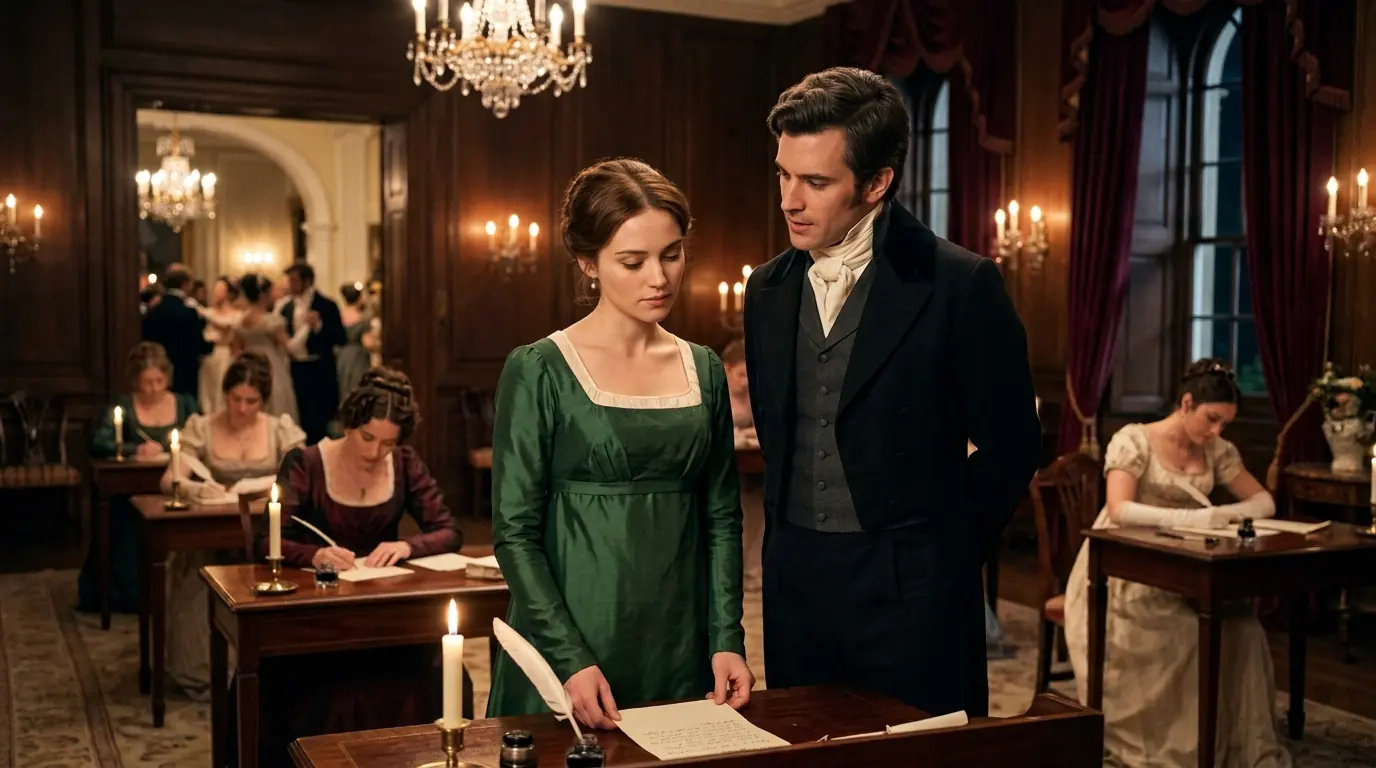
"Whoever wrote the most honest letter would become his wife," he said.
Many people thought the plan was foolish. His aunt, Lady Margaret, had warned him more than once.
"Julian, you cannot judge a woman's heart by her handwriting," she had said, shaking her head.
"Perhaps not, but I can judge it by her honesty," he had answered.
"Words show more than people think."
Now, as he watched the ballroom fill with color and laughter, he wondered if he had made a mistake. Every lady who greeted him tonight already seemed to know exactly what to say. Their words were polished, their smiles rehearsed, as if they had practiced in front of a mirror for hours. Miss Arabella Finch curtsied deeply before him, her blond curls perfectly arranged.
"Your Grace, I have been reading poetry all week, hoping to find the right words for tonight," she said.
"I do believe love is best expressed through verse."
Julian gave her a polite nod but said nothing. He had heard this kind of talk many times before. Later, Lady Constance Vale approached him with a proud smile.
"I have hired a poet to help me write my letter," she said, not even trying to hide it.
"He is very skilled."
"I am certain my letter will be the most beautiful one you receive tonight."
Julian thanked her, but inside he felt his hope sinking. If every lady brought borrowed words, how would he ever find someone real? The evening moved forward with music and dancing. The orchestra played warm, lively tunes and couples spun across the floor. Julian danced when it was expected of him, spoke when he had to, and smiled only when he could not avoid it.
His mind was elsewhere, wondering if his plan would fail completely. Near the edge of the room, away from the dancing, stood a young woman named Eleanor Hartley. She wore a simple green gown, far less grand than the gowns of the other ladies. Her brown hair was pinned neatly but without decoration. She was not poor, but her family had little money compared to most of the guests in that room.
She had only come because her aunt, Mrs. Whitfield, had insisted.
"You must come, Eleanor," her aunt had said.
"It is not every day a duke opens his home to every young lady in the county."
"Who knows what might happen?"
Eleanor had sighed but agreed, mostly to please her aunt. She had no real interest in becoming a duchess. She found the whole idea of writing a love letter to a stranger a little ridiculous. She had barely spoken to the duke in her life, perhaps exchanging a few polite words once at a garden party two years ago. How could she write to him about love when she felt nothing but curiosity and a little bit of doubt?
As the night went on, she watched the other ladies whisper excitedly about their letters. Some had written drafts at home and brought them, planning to copy them out neatly when the time came. Others discussed which words sounded most romantic. Eleanor found it strange. If a letter was supposed to come from the heart, why were they all preparing it like a school assignment?
At last, the moment arrived. A servant announced that it was time for the letters to be written. Each lady was led, one at a time, to a small private room near the library, where a desk, paper, ink, and a candle waited. They were given fifteen minutes alone to write. One by one, the ladies entered and left the room.
Miss Finch came out glowing with pride, certain her poetic lines would win the Duke's heart. Lady Constance came out looking equally confident, her letter carefully copied in her best handwriting. Every word chosen by the poet she had hired. Eleanor's turn came near the end of the line. She walked into the small room and sat down at the desk.
The candle flickered gently, casting soft shadows on the wall. She looked at the blank paper in front of her, and then at the pen resting beside the inkpot. She picked up the pen. She dipped it in the ink. She held it above the paper.
But nothing came. She thought about what she might write.
"Your Grace, from the moment I saw you, my heart..."
No, that was not true. She had barely thought of him at all before tonight. She tried again.
"I have always admired your kindness and wisdom."
But she did not know if he was kind or wise. She knew almost nothing about him, only what people said in gossip, which was often wrong. She sat there for several minutes, the candle burning lower, her paper still empty. She could hear her own heartbeat in the quiet room. Outside, she could imagine the other ladies laughing and talking, confident in their carefully written words.
But Eleanor could not bring herself to write a single false line.
"To write I love you to a man she barely knew felt wrong to her."
It felt like a lie dressed up in pretty handwriting. She respected the Duke too much, and herself too much, to write something that was not true. When the servant knocked gently on the door to say her time was over, Eleanor looked down at the paper one last time. It was still completely blank. She folded it anyway, sealed it as the others had done, and walked out to hand it to the waiting attendant.
She did not think much of it. She assumed her blank page would simply be tossed aside, unread, forgotten among dozens of others. Later that night, in his private study, Duke Julian sat behind his large wooden desk, a tall stack of sealed letters in front of him. He had asked to be left alone to read them. One by one, he opened the envelopes and read the words inside.
Miss Finch had written three pages of poetic lines, comparing his eyes to stars and his voice to music. Lady Constance's letter, written in the poet's elegant style, spoke of destiny and everlasting devotion. Letter after letter said similar things, grand promises of love, admiration, and forever. At first, Julian read carefully, hoping to find some spark of honesty hidden among the flowery words. But as he continued, his heart grew heavier.
Every letter sounded almost the same. Different handwriting, different names, but the same borrowed phrases, the same practiced emotion. None of it felt real. He rubbed his tired eyes and reached for the next letter in the pile. He broke the seal, unfolded the paper, and stopped.
It was blank. He turned it over, thinking perhaps the writing was on the other side.
"Nothing."
He held it up to the candlelight, searching for even a single faded word. Still nothing. He checked the name on the outer envelope. Miss Eleanor Hartley. He frowned, confused.
Had she simply forgotten to write anything? Had she run out of time?
"Or was this some kind of joke, a way of mocking his entire plan?"
He set the blank page aside and finished reading the rest of the letters. But his mind kept returning to it. Something about that empty page bothered him, not in anger, but in curiosity. Every other lady in that ballroom had found something to write, even if none of it felt true. Yet this one woman had written nothing at all.
The next morning, Julian could not stop thinking about the blank letter. He asked his housekeeper about Eleanor Hartley and learned she was the niece of Mrs. Whitfield, a respectable but not wealthy family living a few miles from the estate. He decided he would visit, not as a duke seeking a bride, but simply as a man seeking an answer. He rode to the Whitfield house that afternoon. When he arrived, Mrs. Whitfield nearly fainted with excitement at the sight of a duke at her door, but Julian asked only to speak with Eleanor.
Eleanor came into the sitting room, surprised and a little nervous. She had not expected to see him again so soon, and certainly not at her own home.
"Your Grace, this is unexpected," she said, curtsying.
"Miss Hartley, I received this last night," Julian said, holding up the folded blank paper.
"I believe it was yours."
Eleanor's cheeks turned pink.
"Yes, Your Grace."
"I am sorry if it displeased you."
"I could not think of anything to write."
"You could not think of anything, Julian repeated slowly, or you chose not to write anything false."
Eleanor looked at him carefully, surprised that he understood so quickly. She took a breath and decided to be honest, just as she had been the night before.
"Your Grace, I barely know you," she said.
"We have spoken perhaps a dozen words to each other in our entire lives."
"I could not write that I loved you because it would not be true, and I did not wish to write pretty lies simply to please you, or to win a title I do not truly want."
Julian studied her face. There was no fear in her eyes, no attempt to charm him, only calm honesty.
"Most ladies would have written something, even something small," he said.
"Perhaps, but I would rather give you an honest blank page than a beautiful lie," Eleanor said.
For the first time in many months, Julian felt something shift inside him. Here, finally, was a person who had not tried to impress him. She had simply told the truth, even when it might have cost her the chance he offered.
"I think that your blank page told me more than every other letter combined," he said slowly.
Eleanor did not know how to respond to that, so she said nothing and simply waited. Over the following weeks, Julian found reasons to visit the Whitfield house again.
"At first," he told himself it was only curiosity.
He wanted to understand this unusual young woman who refused to pretend, but soon his visits became more frequent and his reasons less clear even to himself. He and Eleanor took walks through the gardens, discussing books, ideas, and the small events of daily life. Eleanor was clever and often disagreed with him, which surprised him since most people simply agreed with whatever a duke said. She teased him gently about his seriousness and slowly he found himself smiling more often than he had in years.
"You do not treat me like a duke," he said to her one afternoon as they walked along a path lined with roses.
"Should I?"
Eleanor asked, raising an eyebrow. Most people do.
"I am not most people," she said simply and continued walking.
He laughed, a real laugh, not the polite kind he gave in ballrooms. It felt strange and wonderful at the same time, but not everyone was happy about this growing friendship. Lady Constance, who had been certain her poetic letter would win the duke's heart, grew jealous when she heard rumors of his visits to the Whitfield house. She began spreading unkind gossip, suggesting that Eleanor was secretly clever and scheming, that her blank letter had been a clever trick to gain the duke's attention by seeming different from the rest. The gossip spread through the county quickly as gossip often does.
Some ladies whispered behind their fans at parties, saying Eleanor had planned the whole thing from the start. Others said she was simply strange, unable to feel real emotion, which was why she could not write a proper letter. Eleanor heard these whispers, too, and they hurt her more than she wanted to admit. She began to doubt herself.
"Perhaps the duke's attention was only curiosity, nothing more."
"Perhaps, once his interest faded, she would be left as the subject of gossip and laughter, a foolish girl who dared to draw the attention of a duke without any real hope of keeping it."
She considered ending their walks and visits altogether, believing it would be easier to protect her heart before she cared too much. One evening when Julian arrived at her home as usual, she met him at the door with a serious expression.
"Your Grace, I think perhaps it would be best if you did not visit so often," she said carefully.
Julian frowned.
"Why do you say that?"
"People are talking," Eleanor said.
"They say cruel things, and I fear that you visit only out of curiosity, and that once your curiosity fades, I will be left with nothing but gossip and embarrassment."
Julian was quiet for a moment, considering her words carefully. Then he spoke, his voice gentle but firm.
"Eleanor, when I read letter after letter that night, filled with false and empty words, I felt nothing but disappointment."
"Your blank page was the only honest thing in that entire pile."
"Since then, every conversation we have shared has felt more real to me than anything I have known in years."
"I do not visit out of simple curiosity."
"I visit because I want to."
Eleanor's eyes filled with unexpected tears, though she tried to blink them away.
"But what if people continue to talk?"
"What if they never believe my honesty was real?"
"Then let them talk," Julian said.
"I have spent my whole life listening to people who say what they think I wish to hear."
"I would rather spend the rest of it listening to someone who tells me the truth, even when it is difficult."
"A few weeks later, Julian held a second, smaller gathering at Ashcombe Hall, this time with only a few close friends and family members present."
"Near the end of the evening," he asked Eleanor to step aside with him into the same small library where the letters had once been written.
He placed a fresh sheet of paper on the desk, along with pen and ink.
"Will you write for me again?" He asked.
"But this time with feeling, if you have any to give."
Eleanor's hands trembled slightly as she sat down. She thought for a long moment, remembering that blank page from months before, and how much had changed since then. Finally, she picked up the pen and began to write, slowly and carefully. She did not write flowery poems or grand promises. She wrote only a few honest lines saying that she had not expected to care for him, that she had certainly not planned it, but that somewhere between their quiet walks and honest conversations, her heart had changed without her permission.
She wrote that she would rather offer him this small true confession than a hundred beautiful lies. She folded the paper and handed it to him with shaking hands. Julian read it slowly and when he looked up, his eyes were warm with emotion he rarely allowed others to see.
"Eleanor, I must confess something to you," he said.
"I kept your first letter, the blank one."
Eleanor blinked in surprise.
"You kept it?"
"Why would you keep an empty page?"
"Because it was the only true thing I received that night," Julian said.
"I had it framed."
"It sits in my study where I see it every morning."
"It reminds me what real honesty looks like."
Eleanor did not know whether to laugh or cry, so she did a little of both. Julian knelt down slowly before her, still holding her new letter in his hand.
"I am not asking you to write beautiful words to me for the rest of our lives," he said.
"I am only asking you to keep writing me the truth, whatever it may be."
"Will you marry me, Eleanor?"
Eleanor looked into his eyes, seeing not a duke, but simply a man who had grown tired of pretty lies and had finally found something real.
"Yes," she said softly.
"Yes, I will."
Their wedding took place that autumn in the small chapel near Ashcombe Hall. It was not the grandest wedding the county had ever seen, but it was filled with genuine warmth and laughter. Even Lady Constance attended, having finally given up her jealousy once she saw how happy the couple truly were together. During the wedding breakfast, one of the guests asked Julian, half joking, what had truly won his heart that night among so many letters filled with poetry and promises. Julian smiled, glancing at Eleanor across the room, who was laughing gently at something his aunt had said.
"It was not what she wrote," he answered simply.
"It was what she refused to write."
"She gave me the one thing everyone else was too afraid to offer, the truth."
And so, the story of the Duke who asked every lady for a love letter, and the one who gave him a blank page instead, became a favorite tale told throughout the county for years to come. People said it proved that honesty, however small or simple, could speak louder than the most beautiful words ever written.