Vanessa Carter reached the Riverton County Courthouse at 8:07 on a Tuesday morning wearing a simple navy suit, low black heels, and the expression of someone expecting an ordinary workday. She carried a leather portfolio containing a laptop, three unresolved complaint files, a printed authorization letter, and notes for a meeting scheduled with Judge Thomas Whitaker after his morning docket. Nothing about her appearance announced that she directed the state’s Office of Court Access and Professional Standards, and Vanessa preferred it that way because her work often depended on seeing public buildings before people started performing for the person evaluating them. She crossed the limestone lobby beneath fluorescent lights, joined the security line, and waited behind everybody else.
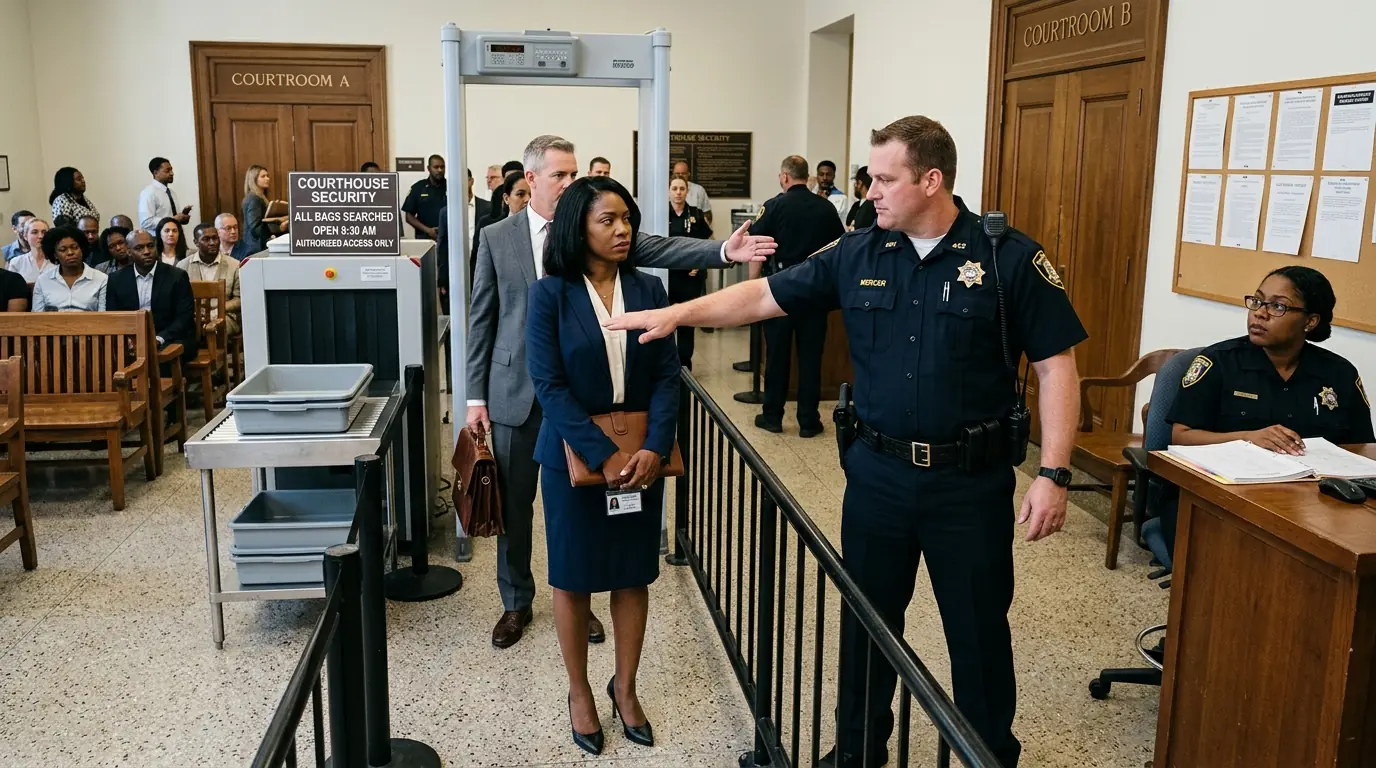
Deputy Ryan Mercer stood beside the rail separating the courthouse lobby from the controlled courtroom corridor. He was forty-four, broad-shouldered, clean-shaven, and had served fourteen years with the Riverton County Sheriff’s Office, including six assigned primarily to courthouse security. His personnel file contained commendations for locating a missing child, helping evacuate a courtroom during a gas leak, and talking an armed probation violator into surrendering without injury. None of those facts were visible when Vanessa stepped forward and offered a polite good morning.
Mercer looked first at her face, then at the leather portfolio, then at the visitor badge sticker in her hand. “Court visitors stay behind the rail unless they’re attorneys, staff, or listed participants,” he said, pointing toward benches against the rear wall. Vanessa replied that her name was Vanessa Carter and asked him to check the authorized-access list because she was expected in Courtroom Three. Mercer did not reach for the clipboard beside him.
Instead, he looked Vanessa over one more time and said, “You people always think a nice suit means you belong up front.” The sentence landed with enough precision that Vanessa felt the familiar moment when disbelief arrives before anger, because she had spent years hearing language that could later be defended as vague while everybody present understood what had been communicated. She kept her voice even and said, “My name should be on the authorized list, Deputy, so would you please verify it before directing me somewhere else?” Mercer answered, “I know who belongs through here, and you can wait in the back.”
Emily Rhodes, the courtroom clerk, heard Vanessa’s name from a desk ten feet away. She immediately looked up and said, “Director Carter is cleared for Courtroom Three and the conference room afterward, Ryan, her name is on this morning’s authorization sheet.” Mercer glanced toward Emily but still did not check the list, and Vanessa noticed the subtle tightening around the clerk’s mouth when he ignored her. “Would you check it yourself?” Vanessa asked again, and Mercer replied, “I don’t need to.”
A white attorney in his early thirties approached before Vanessa could answer. He carried a canvas messenger bag, wore no visible courthouse badge, and said, “Morning, Ryan,” as though they knew each other, prompting Mercer to lift the rail without requesting identification or checking the authorization sheet. The attorney walked through while Vanessa remained on the public side of the barrier with her portfolio held against her ribs. She raised one eyebrow but said nothing.
Mercer noticed. “Something funny?” he asked, and Vanessa answered that nothing was funny. She asked why the attorney had been admitted without verification when her authorization had been confirmed aloud by the clerk. Mercer replied, “He’s an attorney,” as though professional status could be identified through bone structure, clothing, or familiarity alone.
Vanessa said, “How did you establish that?” Mercer’s jaw tightened, and he answered, “Ma’am, I’m not going to explain courthouse security to every person who comes through the door.” She nodded and said, “Then perhaps simply follow the written access procedure.” Mercer stepped closer to the rail and lowered his voice.
“I’m telling you one time to stop challenging me,” he said. Vanessa heard the warning in his tone but also noticed that his right hand remained away from his equipment belt, his posture stayed controlled, and nobody in the lobby faced an immediate safety risk. She answered, “I’m asking you to verify authorization your own clerk has already confirmed.” Mercer pointed toward the back benches and said, “Sit down before I decide you’re disrupting court operations.”
Vanessa could have ended the exchange by identifying her title more explicitly. She could have said that the administrative office responsible for court-access standards had sent her, that Judge Whitaker expected her, or that the sheriff had received notice of her visit the previous week. She chose none of those options because Mercer already possessed everything he needed to make the correct decision: a name, a clerk’s confirmation, and an access list sitting within arm’s reach. If her title became necessary before he would perform the verification required for everybody, then her title would hide the very problem she was responsible for understanding.
An older Black woman entered the lobby as Vanessa stepped away from the rail. She wore a lavender church hat even though it was Tuesday, carried a clear plastic envelope full of documents, and moved cautiously with a cane while looking between courtroom signs. She approached Mercer and said, “Excuse me, officer, my grandson has a hearing this morning and I was told to come to Courtroom Two, but I’m not sure where I’m supposed to wait.” Mercer pointed toward a bench without checking a schedule and said, “Sit over there until somebody calls you.”
The woman looked confused. “His name is Andre Ellison,” she said, holding out paperwork. Mercer did not take it and answered, “Ma’am, everybody has paperwork, just sit down.” Vanessa watched the woman’s shoulders sink slightly, not because Mercer had shouted but because he had converted a request for information into an instruction to disappear. She made a note inside her portfolio without drawing attention to the movement.
Less than three minutes later, a white businessman in a gray suit approached the same rail. He said he was there for a contractor dispute and was uncertain whether his hearing had been moved from Courtroom One to Courtroom Four. Mercer immediately pulled the printed docket toward himself, asked the man’s name, ran a finger down the page, and then walked halfway into the corridor so he could point out the correct door. “You’re in Four today, sir, second courtroom on the left, and they’re running about fifteen minutes behind,” he said with a smile.
Vanessa looked from the businessman to the older woman still sitting alone against the wall. She closed her portfolio slowly and asked, “Deputy Mercer, why did you check his hearing information but refuse to check hers?” Several people in the lobby turned because the question was simple enough that everybody understood what it contained. Mercer’s face hardened.
“He asked properly,” Mercer replied. Vanessa said, “She asked where her grandson’s hearing was and offered you his name.” Mercer answered, “I’m not doing this with you.” Vanessa asked, “Doing what?”
Mercer stepped around the rail until they stood on the same side. “If you keep challenging security personnel, I will remove you from this courtroom area,” he said. Vanessa glanced toward Emily, who had stopped typing, and then toward the older woman, who was watching with embarrassed concern. “Removed after your clerk confirmed I am authorized to be here?” Vanessa asked.
Mercer answered, “Move.” Vanessa studied him for one second, then nodded. “All right.”
She walked to the rear bench and sat beside the older woman rather than escalating an argument inside a courthouse lobby. The woman whispered, “Honey, you didn’t have to get yourself in trouble over me,” and Vanessa answered that asking a question should not create trouble. She introduced herself only as Vanessa and asked whether she could see the grandson’s notice. The hearing was indeed in Courtroom Two, but the document said family members could enter after security screening rather than wait indefinitely in the lobby.
Vanessa walked the woman to Emily’s desk without crossing the controlled rail. Emily checked the docket and said, “Mrs. Ellison, Andre’s case is third this morning, and you can go through to the public gallery as soon as Deputy Mercer screens your bag.” Ruth Ellison thanked her with visible relief. Mercer heard every word and did not look toward them.
Vanessa returned to the bench. Ruth asked whether she was a lawyer, and Vanessa smiled before saying, “Not today.” The answer was technically incomplete because Vanessa had a law degree, although she had not practiced litigation in years and was present as an administrator rather than counsel. Ruth laughed softly and said, “That sounds like a lawyer answer anyway.”
Vanessa’s career had not begun in court administration. At twenty-five, she joined a legal-aid organization after graduating from law school because she wanted to represent tenants, domestic-violence survivors, and low-income families who often arrived at courthouses already believing every person behind a desk knew more than they did. She learned quickly that access to justice could fail long before a judge ruled on anything. A confusing sign, dismissive clerk, inaccessible entrance, security officer’s assumption, or unanswered question could decide whether somebody remained long enough to be heard.
After eight years in legal aid, Vanessa moved into the state Administrative Office of Courts. She helped redesign language-access procedures, studied courthouse accessibility for people with disabilities, and eventually built a small professional-standards unit focused on what happened in public-facing spaces before and after hearings. Her office did not control judges, prosecute crimes, or directly discipline sheriff’s deputies. It audited systems, collected complaint patterns, issued policy recommendations, and referred personnel allegations to the agencies that actually employed the people involved.
Three months before the Riverton visit, Vanessa’s analysts had noticed three complaints from the same courthouse containing the same security officer’s name. None had been sustained because each complaint lacked enough corroboration to establish misconduct independently, and two had arrived after relevant camera footage had already been overwritten under the courthouse’s short retention schedule. The complaints were not proof that Ryan Mercer discriminated against anybody. They were enough to make Riverton one of six courthouses selected for a routine access review.
Vanessa had not told Mercer she was coming because she had not told any front-line officer at the six sites. The sheriff, court administrator, and presiding judge knew the week of the audit but not the exact hour Vanessa would enter each building. She wanted to observe signage, ordinary visitor handling, security screening, and accessibility under normal conditions. She was not conducting a sting and had no authority to bait anyone into misconduct.
The three complaint files in her portfolio represented people Vanessa had never met. One came from a Black legal-aid attorney named Aisha Monroe who said Mercer required multiple forms of identification before letting her through the attorney entrance even though white attorneys beside her were admitted after showing only bar cards. A second came from a Latino process server named Luis Ramirez who said Mercer told him “people like you” should use the public line despite a standing credential accepted elsewhere in the courthouse. The third came from a seventy-year-old Black woman named Denise Hall who said Mercer repeatedly refused to help her locate a probate hearing but personally escorted a white couple to another courtroom minutes later.
Each complaint had weaknesses. Aisha had no independent witness willing to provide a formal statement, Luis could not remember the date precisely enough to identify video, and Denise filed her complaint nearly two months after the incident. Mercer denied treating anybody differently and explained that security conditions changed throughout the day. Supervisors closed the complaints as unsubstantiated rather than proven false.
Vanessa had read those files the previous evening at her hotel. She deliberately reminded herself that patterns visible on paper could be created by incomplete reporting, different circumstances, or hindsight. The purpose of an audit was not to confirm a conclusion she had already reached. That was why what happened in the lobby unsettled her so deeply.
At 8:29, the courtroom doors opened. Mercer screened Ruth’s clear envelope and handbag, then waved her through without further discourtesy, although he still did not apologize for refusing to check the schedule earlier. Vanessa remained seated because Mercer had ordered her to the back and because she wanted to observe what happened when the morning docket began. Emily looked at her twice as if silently asking whether she should intervene.
Vanessa shook her head. She did not want Emily converting an access problem into a personal rescue. If a clerk had to protect every visitor from security, the system was still failing. Vanessa opened her portfolio and began writing times, words, and observable conduct without adding conclusions.
At 8:36, Judge Thomas Whitaker entered through a side door wearing his black robe and carrying a folder. He was sixty-two, silver-haired, and known across the state for moving cases efficiently without treating efficiency as permission to humiliate people. He had served on the judicial-access committee with Vanessa for four years and knew exactly why she had come to Riverton. The moment he saw her seated against the rear wall, he stopped.
“Director Carter?” he asked. His voice carried farther than he intended, and nearly everyone turned. Vanessa looked up.
Judge Whitaker’s expression moved from surprise to concern. “Why are you sitting back there?” he asked. Vanessa closed the portfolio.
“Deputy Mercer instructed me to wait here after Clerk Rhodes confirmed my authorization,” she answered. She did not add the racial remark, the white attorney, Ruth Ellison, or the businessman. The judge looked toward Mercer.
Mercer’s face changed when he heard the title. “Director?” he said. Vanessa remained seated.
Judge Whitaker stepped down from the bench area before proceedings began. “Vanessa Carter is the director conducting the state access review I told court security about last week,” he said. Mercer looked toward the authorization clipboard for the first time that morning. Her name was printed near the top.
“I didn’t realize she was the director,” Mercer said. Vanessa felt Ruth Ellison turn toward her. The judge’s face hardened.
“That is not the question I’m asking,” Whitaker replied. Mercer said he believed Vanessa was a member of the public trying to enter a restricted area without proper authorization. Emily immediately said, “I confirmed her authorization twice.”
The lobby went quiet. Mercer looked at the clerk as if her statement surprised him. Judge Whitaker asked, “Did you check the list?”
Mercer answered, “No, sir.” Whitaker looked toward Vanessa.
She opened the portfolio. “Judge, before we discuss anything further, I need to be clear that I am now a witness to an incident involving the very system my office came to review.” She removed three folders but did not place them dramatically on a courtroom table. “These are three previously closed complaints involving Deputy Mercer, and what happened this morning may provide context worth examining, but the complaints are still allegations until an independent review establishes facts.”
Whitaker nodded immediately. “Agreed.” He turned toward Emily.
“Call Captain Hale and Sheriff Alvarez before we begin the docket.” Emily reached for the phone.
Mercer looked at Vanessa. “If you had just told me who you were, none of this would’ve happened.” Ruth Ellison inhaled sharply beside her.
Vanessa met Mercer’s eyes. “What if I were nobody?”
The words were quieter than everything that came before them. No one in the lobby moved.
Vanessa continued, “What if I were Mrs. Ellison asking where her grandson’s hearing was?” She glanced toward Ruth.
“What if I were a woman who had never met Judge Whitaker and had no title anyone recognized?” Mercer said nothing.
“Would the access list matter then?” Vanessa asked. “Would the clerk’s confirmation matter?”
Judge Whitaker looked toward Mercer. “You do not need to answer her right now.”
That was important. The courthouse was not a public cross-examination.
Mercer deserved the chance to respond through a formal process rather than under pressure from a director, judge, witnesses, and audience. Vanessa appreciated Whitaker understanding that even while visibly angry. Procedure did not become unnecessary because the evidence looked bad.
Captain Daniel Hale arrived six minutes later. He commanded courthouse security for the sheriff’s office and carried a radio, phone, and expression suggesting he had already been given three different versions of what happened. He greeted Judge Whitaker, recognized Vanessa, then looked toward Mercer. “Ryan, step into the conference room with me,” he said.
Mercer began explaining before Hale stopped him. “Not here.” The captain turned toward Vanessa.
“Director Carter, I understand you’re involved.” Vanessa nodded.
“Then I’m going to request an outside professional-standards investigator rather than have my unit investigate itself.” Vanessa said, “That would be appropriate.”
Hale asked Emily to preserve the morning access sheet. He also contacted the sheriff’s technology unit and ordered preservation of security-camera footage and body-camera recordings associated with the lobby before normal retention schedules could affect them. Nobody knew yet whether the recordings supported Vanessa, Mercer, or neither. Preserving evidence before deciding what it meant was the point.
Court began twenty-three minutes late. Judge Whitaker apologized to the waiting public without describing the incident because most of the people sitting there had come for matters unrelated to courthouse security. Vanessa moved to the reserved observer seat only after Captain Hale personally checked the access list and processed her according to the same procedure written for official visitors. Ruth Ellison entered Courtroom Two for her grandson’s hearing with directions printed clearly by Emily.
Vanessa spent the next three hours doing the work she had come to do. She observed interpreter procedures, disability access, public signage, seating, clerk interactions, security screening, document intake, and courtroom wayfinding. Nobody treated her badly after learning her title. That itself became a problem she noted.
The easiest response to a publicized access failure was temporary perfection. Every employee suddenly smiled more, checked every list carefully, and asked whether visitors needed help. Vanessa had seen it during audits across the state. Sustainable reform required discovering what happened after important people left.
At lunch, Sheriff Maria Alvarez arrived personally. She had served twenty-seven years in law enforcement, started as a patrol deputy, and won election as sheriff on a platform of professionalizing training and evidence systems. She did not begin by apologizing. She began by asking what Vanessa had observed.
Vanessa described only firsthand facts. Mercer did not check the authorization list after Emily confirmed her name, allowed a familiar white attorney through without comparable verification, dismissed Ruth Ellison’s request for directions, assisted a white businessman with a similar request, threatened removal after Vanessa questioned the difference, and later said the treatment would have been different had he known Vanessa was director. She also disclosed the existence of the three prior complaints. Sheriff Alvarez took notes without interrupting.
“Do you want him removed from duty?” Alvarez asked. Vanessa shook her head.
“That is not my decision.” The sheriff nodded.
“Good.” She closed the notebook.
“I’ve requested an investigator from neighboring Franklin County to handle the personnel review because my courthouse command is directly involved and because you’re a state official.” Vanessa said she supported the decision. “My office will separately evaluate system failures, not determine Mercer’s discipline.”
Alvarez looked relieved. “That separation will help.”
The outside investigator was Lieutenant Joanne Keller, a twenty-two-year veteran of the Franklin County Sheriff’s Office who specialized in internal investigations. She arrived before the end of the day, received preserved footage through documented chain of custody, and instructed everyone not to discuss substantive accounts with one another until interviews occurred. Mercer was temporarily reassigned to administrative support away from public contact while facts were reviewed. The reassignment was not a finding of guilt.
That distinction disappeared online within hours. Someone who had witnessed the lobby encounter posted that the state director had “gotten a racist deputy suspended on the spot,” and the story spread through local social media before anybody released an official statement. Another post claimed Vanessa secretly visited courthouses in disguise to trap deputies. Both descriptions were wrong.
Vanessa issued no personal statement. The Administrative Office of Courts confirmed only that a scheduled access audit had occurred, an incident had been referred for independent review, and Vanessa would not participate in any disciplinary decision because she was a witness. Sheriff Alvarez released similar language. The boring statements disappointed everybody who wanted immediate villains and heroes.
The body-camera footage was reviewed that afternoon. Mercer’s camera had been activated shortly before Vanessa approached the rail because courthouse policy required recording during contested visitor interactions, and the audio captured nearly every significant statement. His words about “you people,” his refusal to check the list, his warning about removal, and his later statement that everything would have been different had he known Vanessa was director were clear. The footage also captured Vanessa remaining calm, although her calmness was not required for her complaint to be valid.
Security-camera footage added context. It showed the white attorney entering after only a greeting, Ruth presenting documents Mercer declined to examine, the businessman receiving schedule assistance, and Vanessa walking voluntarily to the rear bench after being directed there. Emily’s desk microphone captured her confirming Vanessa’s authorization. No single recording told the whole story, but together they created a much stronger factual record than the three earlier complaints possessed.
Keller interviewed Mercer first two days later with his union representative present. He said “you people” referred to state administrators and lawyers who believed security rules should bend for them. Keller pointed out that Vanessa had not identified herself as a state administrator when he used the phrase. Mercer then said he assumed she was “one of those professional visitors who thinks dressing up gets them privileges.”
Keller asked what made him believe she was a professional visitor rather than an ordinary member of the public. Mercer said the suit and portfolio. “Then why did you refuse to check whether she actually had professional authorization?” Keller asked.
Mercer paused. “Because she was challenging me before I had finished assessing her.”
The bodycam showed Vanessa giving her name, asking him to check the access list, and Emily confirming authorization before any argument developed. Keller played the relevant portion. Mercer watched himself refuse.
He shifted in his chair. “I could have handled that better.”
Keller asked, “Different from misconduct or just better customer service?” Mercer’s union representative requested a brief consultation. Afterward, Mercer said he believed his tone had been inappropriate but denied race influenced his decisions.
Keller moved to Ruth Ellison. “Why did you send her to the bench instead of checking the docket?” Mercer answered that the lobby was busy.
The security video showed no line behind Ruth at that moment. Keller noted that a white businessman arrived minutes later and received personal assistance during a busier period. Mercer said he recognized the businessman as someone who had been in court previously.
Recognition might legitimately change efficiency. It did not explain why he refused to glance at Ruth’s paper.
Keller asked about the attorney allowed through without verification. Mercer admitted the man was a local attorney he recognized. “So recognition was enough for him,” she said.
“Yes.” Keller asked, “What was enough for Director Carter?”
Mercer answered, “Apparently nothing.”
The sentence sounded worse after he said it. He rubbed his forehead.
Keller did not respond emotionally. “Why?”
“I don’t know.”
That answer became more important than a denial would have been.
Emily Rhodes’s interview lasted nearly two hours. She described Mercer as reliable during emergencies but increasingly impatient with visitors he considered confused, demanding, or unfamiliar with courthouse procedure. She said she had corrected his directions several times over the previous year. When Keller asked whether she observed differences connected to race, Emily hesitated.
“I noticed patterns,” she finally said. Keller asked her to describe behavior without conclusions. Emily said Black visitors seemed more likely to be told to wait without explanation, while familiar white attorneys and businesspeople often received immediate help.
“Did you report this?” Keller asked. Emily looked down.
“No.”
“Why?”
“Because every single incident seemed small.”
That sentence appeared later in the systemic report. Small incidents were often how unequal service remained administratively invisible.
Captain Hale’s interview revealed another weakness. He had received two of the three prior complaints about Mercer, reviewed them under existing policy, and closed them as unsubstantiated because video no longer existed and witnesses could not corroborate enough details. Hale had not acted improperly under the written rule. The problem was that nobody had aggregated the complaints for pattern review.
Each complaint was treated as a sealed box. One woman said Mercer was dismissive, one attorney said access standards differed, and one process server described unequal treatment. Because no single case crossed the threshold for discipline, the system forgot them separately. Vanessa’s office existed partly to prevent that kind of forgetting.
Keller interviewed Aisha Monroe, the legal-aid attorney whose complaint had been closed six months earlier. Aisha remembered arriving with two white attorneys she knew from family court, all three carrying state bar cards. Mercer waved the men through after looking at their cards, then told Aisha she needed a second photo ID because “we’ve had people borrow credentials.” The men were not asked for additional identification.
Aisha challenged the difference. Mercer responded that courthouse security was discretionary. She filed a complaint because she believed discretion was being applied selectively.
The video had already been overwritten by the time the complaint reached professional standards. Mercer said he did not remember the encounter and denied racial motivation. Without corroboration, Hale closed the case as unsubstantiated.
Luis Ramirez described a different encounter. He worked for a licensed process-service company and routinely entered courthouses throughout the region with a county-issued credential. At Riverton, Mercer told him the credential was not sufficient and directed him into the public screening line while allowing another process server Mercer recognized to use the professional entrance. Luis later learned the other man was white.
Keller asked whether Luis believed the decision was racial. He said, “I don’t know what was in his head.” She appreciated the answer.
“What did you experience?” Keller asked. Luis replied, “My credential became less convincing than somebody else’s familiarity.”
That formulation interested Vanessa when she read it later. The question was not always whether somebody consciously chose discrimination. Systems could produce unequal results through who received the benefit of familiarity and who was required to prove themselves repeatedly.
Denise Hall’s complaint looked even more like Ruth Ellison’s experience. She had gone to the courthouse for her sister’s probate matter and asked Mercer where family members should wait. He pointed toward a rear bench and told her somebody would call the case. Twenty minutes later she discovered she had been waiting outside the wrong courtroom area.
Denise said she watched Mercer personally direct a white couple to the correct floor. She approached him again and asked why he had not checked her hearing. According to Denise, Mercer replied, “They knew what they were asking for.”
No recording existed. Mercer denied remembering it. The similarity to Ruth’s interaction was striking but did not retroactively turn Denise’s allegation into proven fact.
Keller treated it as pattern evidence requiring caution. Vanessa appreciated that too.
The public debate became louder when the bodycam clip was released under state public-records law after appropriate redactions. Television stations played “you people” and “I didn’t realize she was the director” repeatedly. Vanessa’s question, “What if I were nobody?” became the line everybody quoted.