They Laughed at His Rusted Tractor in the Showroom — A Month Later, It Pulled Farther Than Every $80,000 Machine
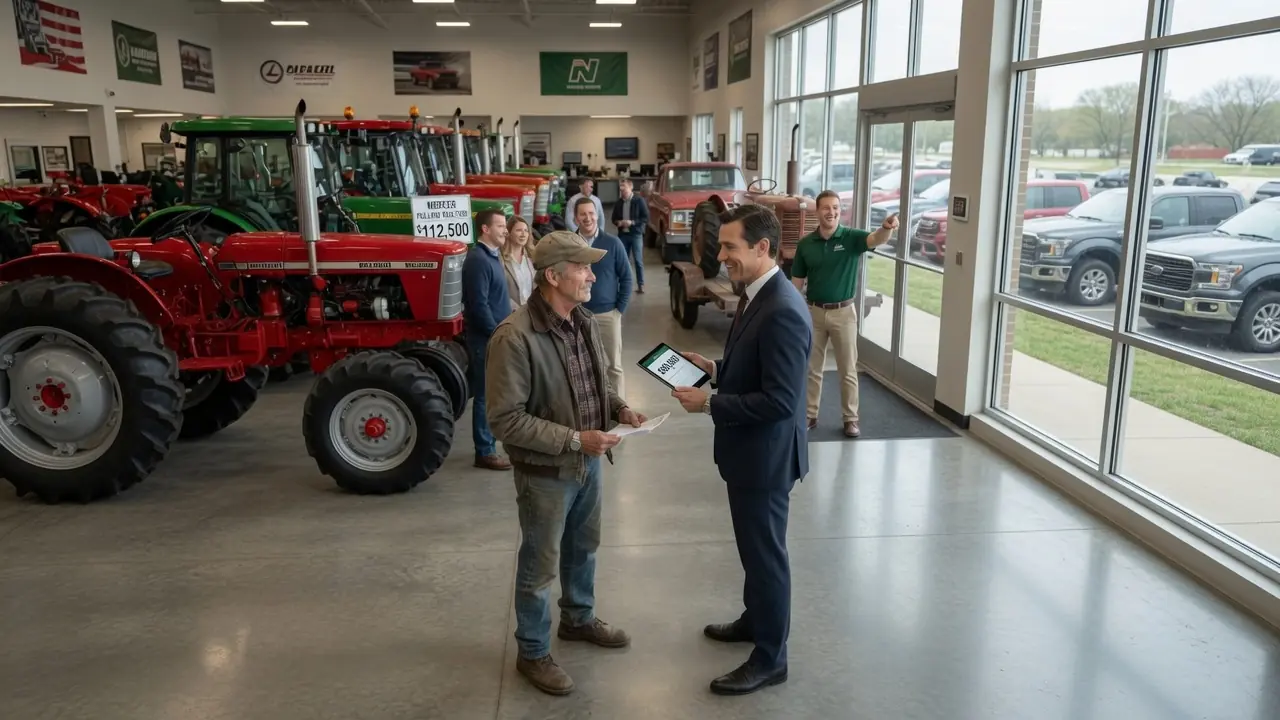
The tractor dealership was crowded that afternoon.
Customers moved between spotless machines arranged beneath bright showroom lights. Salesmen discussed horsepower, financing plans, and delivery schedules while a coffee machine hummed beside the glass entrance.
Every tractor looked expensive even while standing still.
Then Ethan Miller walked through the door.
He was fifty-eight, lean and weathered, with dust on his boots, grease along the cuffs of his work shirt, and hands that looked as though they had repaired more things than they had ever purchased.
Nobody stopped talking when he entered.
But several people looked at him.
A salesman near the front desk glanced at Ethan’s clothes, then toward the parking lot outside.
Behind Ethan’s aging pickup sat a flatbed trailer carrying an old red tractor.
Its paint had faded unevenly beneath years of sun. Rust marked the edges of the rear fenders. The hood carried dents from work no polished showroom machine had ever known.
No manufacturer emblem remained on either side.
The tractor looked tired.
Ethan did not.
He walked toward the nearest sales desk.
“I’m here to ask about your competition pulling model.”
The corporate sales manager, Bradley Sloan, stepped forward with a tablet tucked beneath one arm.
Bradley was in his early forties, clean-shaven, sharply dressed, and accustomed to recognizing customers who could afford what he sold.
He looked Ethan over once.
“That model starts at eighty thousand dollars.”
He said the number loudly enough for the surrounding customers to hear.
A couple examining a utility tractor paused.
Ethan nodded.
“What about the basic version?”
Bradley smiled politely.
“We don’t really sell basic versions for serious competition.”
A salesman standing near the glass window pointed outside.
“Is that your tractor on the trailer?”
Several customers turned.
One man leaned closer to the window.
“That thing?”
A soft laugh moved through the showroom.
Another customer shook his head.
“It wouldn’t move the sled ten feet.”
Bradley glanced outside, then back at Ethan.
“With respect, Mr.—”
“Miller.”
“Mr. Miller, this isn’t a restoration shop.”
He gestured toward the gleaming machines behind him.
“We build equipment that wins.”
The room became quiet.
Not completely silent.
The coffee machine still hummed.
A printer clicked behind the sales counter.
But everyone close enough to hear was waiting for Ethan’s reaction.
He looked around the showroom.
At polished floors that reflected overhead lights.
At thick tires that had never touched a field.
At machines covered in decals, chrome, and corporate confidence.
Then he looked through the window at the old tractor on his trailer.
He did not appear angry.
He did not look embarrassed.
He smiled.
“Good.”
Bradley frowned.
Ethan turned toward the door.
Before stepping outside, he looked back.
“Now, when I beat you, it won’t be with your name on the hood.”
The glass door closed behind him.
For a second, the showroom remained still.
Then someone laughed.
Bradley shook his head and returned to his tablet.
Within minutes, conversation resumed.
Horsepower.
Financing.
Delivery dates.
No one inside believed Ethan Miller would matter again.
Outside, wind pushed dust across the parking lot.
Ethan stood beside the trailer.
The old tractor rested above him with its faded red hood warming beneath the afternoon sun.
He ran one hand across the metal.
“Eighty thousand,” he murmured.
The number itself did not bother him.
Good machinery cost money.
Engineering deserved respect.
What bothered him was the certainty in Bradley Sloan’s voice.
We build equipment that wins.
As though price had already decided the result.
As though someone in worn boots could know nothing about power because he could not afford to buy it new.
Ethan climbed into his pickup.
He started the engine and pulled away from the dealership.
But he did not drive home.
Instead, he took County Road Nine toward the fairgrounds.
The Mason Ridge Pulling Championship was scheduled there in four weeks.
Workers were already preparing the arena.
Sponsor banners hung along the outer fence. Fresh dirt had been spread across the track. Photographs of past champions decorated signs near the entrance.
Ethan parked across the road.
He remained inside the pickup, studying the track.
The previous year, he had entered with the same old tractor.
He had not won.
He had not embarrassed himself either.
The machine made a respectable run before losing traction halfway down the track.
Most spectators blamed insufficient horsepower.
Ethan did not.
He had watched the winning tractors carefully.
Their engines were louder than his, but noise was not the important difference.
Their power arrived cleanly.
Their front ends rose only enough to shift useful weight backward without wasting motion.
The best tractors did not attack the sled wildly.
They carried it.
That was not only horsepower.
It was balance.
Timing.
Traction.
Understanding where force went after the engine produced it.
Ethan looked through the rear window at the old tractor.
The dealership had seen rust.
He saw unfinished potential.
He drove home as the sun began falling behind the Nebraska fields.
The Miller farm was not large.
One hundred sixty acres of corn, soybeans, and hay surrounded a modest white farmhouse. A weathered barn stood north of the yard. Behind the house sat a narrow metal workshop built by Ethan and his father during the early 1980s.
No expensive equipment lined the drive.
No new combines.
No oversized grain bins.
Most machines on the farm had been purchased used and kept alive by patience.
Ethan backed the trailer into the workshop.
He shut off the truck.
Silence settled around him.
Then he opened the shop door and switched on a single hanging bulb.
Dust floated through the light.
Tools remained arranged along the walls exactly where he had kept them for years.
He rolled the tractor inside, closed the door, and locked it.
Not because anyone planned to steal it.
Because he did not want visitors.
He did not need advice from men who believed improvement meant ordering the most expensive part in a catalog.
Ethan took an old notebook from the workbench.
He opened to a blank page.
At the top, he wrote:
BEAT THEM WITH WHAT THEY CANNOT BUY.
He underlined the sentence once.
Then he sat on a stool.
For the next three hours, he did not remove a single bolt.
He studied.
Measured.
Listened.
He checked the frame alignment.
Measured the wheelbase.
Examined the rear hitch position.
Recorded tire diameter and pressure.
Placed scales beneath each wheel and wrote down the weight carried at all four corners.
He rotated the drivetrain by hand and measured play.
By midnight, he had identified three inefficiencies.
None looked important.
A slight difference in rear tire loading.
A hitch mounted less than an inch farther back than ideal.
A clutch engagement that delivered torque too abruptly during launch.
Small problems.
But tractor pulling was a contest in which small losses accumulated until the sled stopped moving.
Ethan stood several feet from the machine.
“You’re not scrap,” he said quietly.
“You’re unfinished.”
Outside, the wind strengthened.
Across town, the dealership continued processing contracts for factory-sponsored pulling tractors.
No one there thought about Ethan.
Inside the small workshop, he finally picked up a wrench.
The next morning, he did not begin with the engine.
That was what most competitors expected.
Larger turbocharger.
More fuel.
Higher engine speed.
Louder exhaust.
Horsepower was the easiest number to advertise because it sounded decisive.
Ethan started with weight.
He rolled individual scales beneath the tires again.
The tractor carried too much fixed weight near the front.
That kept the nose low but reduced the useful load over the rear tires during the pull.
He removed several front weights.
Not all.
Too little front weight could cause an uncontrolled rise and force the driver to reduce throttle.
He calculated the sled chain angle and imagined the first twenty feet of the launch.
Most pulls were already being lost before spectators realized what they were seeing.
A tractor lifted too quickly.
Spun too early.
Burned its strongest torque while the sled was still light.
Ethan did not plan to overpower the factory machines.
He planned to remain efficient after they began wasting energy.
By noon, parts covered the workshop floor.
The hood rested against one wall.
Side panels lay across wooden blocks.
The clutch housing stood open.
The rear hitch assembly had been removed.
Ethan measured before every modification.
Then measured again afterward.
In town, word spread about the encounter at the dealership.
Some versions became more dramatic with each retelling.
An old farmer tried to purchase a competition tractor.
The dealership refused to sell to him.
He threatened the manager.
He claimed his junk tractor would win the county championship.
At the diner, men laughed.
“Effort doesn’t replace engineering,” one said.
At the dealership, Bradley Sloan repeated a cleaner version.
“We tried to explain that serious pulling requires specialized equipment.”
A salesman asked whether Ethan had truly said he would beat them.
Bradley smiled.
“People say strange things when pride gets involved.”
Back in the workshop, Ethan removed the old clutch plate.
A new high-performance competition clutch would cost more than two thousand dollars.
He had five hundred dollars available for the entire rebuild.
So he modified what he owned.
He changed the friction surface.
Adjusted spring pressure.
Reworked the engagement mechanism to deliver torque more progressively.
Then he removed the flywheel.
He did not simply lighten it.
A flywheel stored rotating energy. Remove too much mass and the engine would lose momentum when the sled became heavy.
Leave too much and the tractor would respond slowly.
Ethan machined only what was necessary.
Then he balanced the flywheel with tools older than Bradley Sloan.
He added no expensive electronics.
No computer-controlled launch system.
He relied on marks, measurements, and years spent feeling engines through steering wheels and floorboards.
Every alteration appeared insignificant alone.
Together, they began changing the machine’s behavior.
On the third evening, Ethan rebuilt the rear hitch.
Competition rules limited height and distance from the rear axle.
Within those limits, millimeters mattered.
The original hitch flexed slightly under load.
That flex changed the pull angle at the exact moment traction became critical.
Ethan reinforced the assembly using steel left from an old cultivator frame.
He moved the mounting point forward by less than half an inch.
Then he tested it with a hydraulic jack and a load chain.
The hitch held.
On the fifth day, he finally addressed the engine.
The tractor had once been an International Harvester 986, though years of repairs and replacement panels had made its origins difficult to recognize.
Its six-cylinder diesel remained strong.
Ethan did not chase maximum horsepower.
He corrected fuel delivery.
Adjusted injection timing.
Cleaned the intake path.
Smoothed the throttle linkage.
Rebuilt the turbocharger wastegate using a spring adapted from industrial equipment.
He wanted torque to rise predictably rather than arrive in a violent surge.
More power was useless if the tires converted it into smoke and flying dirt.
After the first test run, the engine sounded nearly the same.
After the third, Ethan noticed the difference.
The throttle responded without hesitation.
The clutch engaged firmly but smoothly.
The engine recovered under load instead of falling abruptly below its useful range.
A week passed.
Then two.
From the outside, the tractor looked no better.
The faded paint remained.
The fenders were still rusted.
Fresh scratches appeared where Ethan had removed and replaced panels.
He refused to spend money on appearance.
The track would not care.
Late one night, he drove the tractor behind the barn and attached it to a weighted drag made from an old steel platform.
He loaded concrete blocks onto the platform.
Then added more.
The tractor pulled slowly across the field.
Ethan listened.
The engine did not scream.
It worked.
The rear tires dug evenly.
The front wheels rose several inches, held steady, then returned gently when he reduced throttle.
He made another pass.
Then another.
On the final test, the drag stopped in soft ground.
The tractor’s tires began to slip.
Ethan adjusted the throttle by a fraction.
The engine remained inside its strongest torque range.
The machine moved again.
He stopped near the workshop.
The tractor idled beneath the dim yard light.
Its sound was not aggressive.
It was controlled.
Ethan stepped down and wiped his hands on a rag.
“You don’t need their name,” he said.
“You need your moment.”
Across town, the dealership announced its championship entries.
Three factory-sponsored machines would compete.
Each carried a custom engine package, reinforced drivetrain, professional tuning, and matching company paint.
One was driven by last year’s runner-up.
Another belonged to a former state champion.
The flagship tractor, called the Titan XR, would be operated by dealership mechanic Jason Cole.
Advertisements appeared in newspapers and on local radio.
People debated which sponsored tractor would win.
No one mentioned Ethan’s old machine.
They assumed he had disappeared.
Then registration opened.
Near the bottom of the entry list appeared a name without a sponsor.
ETHAN MILLER
MACHINE: UNBRANDED MODIFIED FARM TRACTOR
The official handling registration recognized him.
“You entered this thing last year.”
“Yes.”
“It didn’t finish near the leaders.”
“No.”
“What changed?”
Ethan placed the form on the desk.
“I did.”
On championship morning, the fairgrounds were already loud before sunrise.
Trailers backed into the pit area.
Engines started and stopped.
Teams unloaded polished tractors beneath branded canopies.
Sponsors installed flags along the fence.
Chrome reflected the morning sun.
Fresh paint gleamed.
Mechanics in matching shirts connected laptops and pressure gauges.
Then Ethan’s pickup entered the lot.
The old trailer rattled behind it.
The faded red tractor sat above the axles.
No crew.
No sponsor tent.
No spare engine.
No dramatic arrival.
Only a steady old pickup moving toward the far end of the pits.
Several drivers recognized him.
“That’s the showroom guy.”
A mechanic laughed.
“He actually came.”
“Maybe he thinks this is the antique class.”
Ethan parked.
He checked the trailer chains.
Lowered the ramps.
Started the tractor.
Its diesel engine settled into a deep, even rhythm.
People turned toward the sound.
It was not the loudest machine in the lot.
But it sounded deliberate.
Ethan unloaded slowly.
The technical inspector approached.
He walked around the tractor with a clipboard.
“Hitch height?”
“Measured this morning.”
The inspector checked.
Legal.
“Wheelbase?”
Legal.
“Engine containment?”
Ethan pointed toward the reinforced panels.
Approved.
“Throttle return?”
Working.
“Emergency shutoff?”
Working.
The inspector looked beneath the hood.
Then at the faded exterior.
“This machine may not survive three rounds.”
Ethan climbed into the seat.
“It only needs to survive longer than the others.”
The opening round began shortly after noon.
Competitors drew numbers for running order.
Ethan would pull near the end.
The first tractors produced respectable distances.
Engines roared.
Front ends rose.
Black smoke poured above the track.
The crowd cheered each time the sled crossed one hundred feet.
Then the dealership’s first sponsored machine entered.
Its launch was violent.
The front tires climbed high.
The driver corrected quickly.
It reached 121 feet.
The second factory tractor pulled 128.
Then the Titan XR rolled onto the track.
Bradley Sloan stood beside the fence wearing a dealership jacket.
The announcer praised the machine’s custom engineering and premium competition package.
Jason Cole tightened the sled chain.
The flag dropped.
The Titan launched hard.
Its engine thundered.
The rear tires threw dirt beyond the barriers.
It reached 136 feet before losing momentum.
The announcer raised his voice.
“That is the distance to beat! That is what factory engineering looks like!”
Applause rolled through the arena.
Bradley smiled.
Then Ethan’s name was called.
The old tractor moved from the staging area.
Some spectators laughed when they saw the faded hood.
Others remembered the dealership story and leaned forward.
Ethan aligned carefully with the sled.
He checked the chain through the mirror.
The official raised the green flag.
Ethan did not slam the throttle.
He increased power smoothly.
The clutch engaged.
The tractor began moving.
Ten feet.
Twenty.
Thirty.
The front wheels rose slightly.
Not wildly.
Exactly enough to transfer weight toward the rear tires.
At forty feet, the tractor settled into its pull.
No uncontrolled smoke.
No sudden tire spin.
At seventy feet, the crowd grew quieter.
At one hundred, people stood.
The Titan’s mark waited at 136.
Ethan’s tractor crossed 120 without losing rhythm.
Then 130.
The sled grew heavier.
Its weight box reached the forward end.
The tractor slowed.
But it did not stop.
The rear tires continued turning with controlled bite.
The distance marker passed 136.
The announcer hesitated.
“He has taken the lead.”
The tractor reached 143 feet before the sled finally brought it to a halt.
For one second, the arena went silent.
Then applause rose.
Not thunderous yet.
Surprised.
Uneasy.
People looked toward the scoreboard.
ETHAN MILLER — 143.4 FEET
First place.
Ethan reduced the throttle and returned to the pit area.
He did not wave.
Did not raise his arms.
He parked beside the trailer and climbed down.
Bradley Sloan approached almost immediately.
“Who tuned that engine?”
Ethan removed his gloves.
“I did.”
“That’s not the same setup you brought last year.”
“Same tractor.”
“Not factory.”
“No.”
Ethan looked toward the Titan.
“That seems to be helping.”
Bradley’s smile disappeared.
“The first round doesn’t decide the championship.”
“I know.”
The second round used a heavier sled configuration.
Officials also watered and packed part of the track, reducing available grip.
Factory teams adjusted tire pressures.
Mechanics changed ballast positions.
Some connected laptops and reviewed engine data.
Ethan sat on the edge of his trailer.
He watched the track crew.
The right side of the lane held slightly more moisture.
The center appeared firmer.
He walked to the starting line and pressed the dirt with the heel of his boot.
Then he returned to the tractor.
He moved one small weight six inches toward the left side.
That was all.
The second round began.
Several tractors lost distance.
One powerful machine lifted too quickly and forced its driver to reduce throttle.
Another spun its tires before reaching ninety feet.
The Titan XR performed well again, reaching 132 feet.
Then Ethan returned.
This time, no one laughed.
The chain tightened.
The flag dropped.
Ethan launched slightly harder than before.
The tractor moved cleanly.
The front wheels rose and remained only inches above the dirt.
The machine tracked straight through the firmest section of the lane.
At eighty feet, the sled began resisting heavily.
At one hundred, the engine tone deepened.
Ethan did not chase engine speed.
He held the throttle where torque remained strongest.
The tires continued biting.
One hundred twenty.
One hundred thirty.
The Titan’s mark disappeared behind him.
The old tractor reached 151.2 feet.
The crowd erupted.
Now it was not surprise.
The first pull had not been luck.
Ethan had extended his lead under more difficult conditions.
Back in the pit area, sponsored drivers gathered near his tractor.
Some examined the hitch.
Others stared beneath the hood.
One mechanic asked, “What turbo are you running?”
Ethan answered honestly.
“The original housing.”
“What fuel pump?”
“Modified stock.”
“How much horsepower?”
“I don’t know.”
The mechanic laughed.
“You didn’t dyno it?”
“No.”
“How do you know what it makes?”
Ethan pointed toward the track.
“That was the measurement I needed.”
For the final round, the pull order was reversed.
The leader would compete last.
Every remaining driver would know the distance they needed to beat.
The sun had begun sinking when the championship pull started.
Dust hung above the arena.
The track surface had become rougher.
Tires from earlier rounds carved uneven channels into the lane.
One by one, the sponsored machines attacked the sled.
The first spun out at 139 feet.
The second reached 146.
The Titan XR entered next.
Bradley stood beside the starting line.
Jason launched aggressively.
The tractor surged forward.
Its engine produced enormous power.
For the first hundred feet, the run looked unbeatable.
Then the front end rose too high.
Jason reduced throttle for less than a second.
That interruption was enough.
The sled’s resistance increased.
The Titan lost momentum.
It stopped at 148.7 feet.
Strong.
But short of Ethan’s second-round distance.
The crowd turned toward the staging area.
The announcer’s voice changed.
“And now, returning to the track, the machine no one expected to see leading this championship.”
Ethan drove forward.
No sponsor logos.
No crew.
No fresh paint.
The old tractor rolled beneath the lights with dust on its tires and scars across its hood.
He aligned with the sled.
The official connected the chain.
Ethan studied the track.
The strongest competitors had created two deep ruts near the center.
The left rut contained loose dirt.
The right offered better support but risked pulling the tractor toward the barrier.
He positioned the machine slightly right of center.
The green flag rose.
Ethan took one breath.
Then opened the throttle.
The tractor launched.
Faster than before.
Still controlled.
The front tires lifted.
The rear tires drove into the track without excessive spin.
At fifty feet, Ethan made a tiny steering correction.
At ninety, the sled weight moved forward.
The engine settled into the exact tone he had worked weeks to create.
At 130 feet, the tractor slowed.
The crowd stood.
At 145, it reached the Titan’s mark.
At 150, the engine labored.
Ethan held steady.
He did not overfuel.
Did not panic.
The tractor continued.
One hundred sixty feet.
Then 165.
The sled finally stopped it at 169.8.
The distance appeared on the scoreboard.
For a moment, Ethan remained seated.
The arena exploded around him.
People shouted.
Stood.
Clapped.
Some spectators who had laughed in the first round now pushed toward the fence to photograph the tractor.
Ethan turned the machine around and drove slowly toward the pits.
The announcer repeated the result.
“A new Mason Ridge championship record in this division!”
Ethan shut off the engine beside the trailer.
The sudden silence around him felt almost peaceful.
Bradley Sloan approached.
He no longer carried a tablet.
The dealership jacket remained zipped tightly across his chest.
“That was impressive,” he said.
Ethan climbed down.
“Thank you.”
“You ever considered factory support?”
“No.”
Bradley glanced toward the tractor.
“With our name and resources, that machine could become something serious.”
Ethan wiped dirt from his hands.
“It already is.”
“We could sponsor you.”
“No.”
“New engine program. Custom bodywork. Professional crew.”
Ethan looked toward him.
“You told me where I belonged.”
Bradley lowered his voice.
“That was a misunderstanding.”
“No.”
Ethan glanced toward the dealership machines.
“That was clarity.”
He walked toward the trophy table.
The championship trophy was not large.
A polished metal tractor mounted on a wooden base.
When the official handed it to Ethan, the applause returned.
He did not lift it above his head.
He carried it back to the old machine and placed it gently on the faded hood.
The contrast drew dozens of cameras.
Polished trophy.
Peeling paint.
Bradley watched from several yards away.
Later, after most spectators had left, he returned.
This time, he came alone.
“We want to make you an offer.”
Ethan was fastening a chain over the tractor.
“For what?”
“The design.”
“What design?”
“The weight distribution. Hitch system. Clutch changes. Engine setup.”
Bradley spoke more quickly now.
“We can analyze it, reproduce it, perhaps build a lower-cost competition line.”
Ethan tightened the chain.
“You can reproduce parts.”
“Yes.”
“You cannot reproduce the reason I built them.”
Bradley hesitated.
“We can pay well.”
“How well?”
“More than five hundred dollars.”
Ethan smiled faintly.
Someone had apparently learned how little he spent.
Bradley continued.
“Possibly a licensing agreement. A branded model. Your name could be attached to it.”
Ethan looked toward the dealership banners being removed from the fence.
“You don’t want my name.”
“We do now.”
“You want the winning distance.”
Bradley did not deny it.
Ethan finished securing the tractor.
Then he looked toward the emptying arena.
“What do you want?” Bradley asked.
The question sounded genuine.
Ethan considered before answering.
“A space.”
“What kind of space?”
“In your showroom.”
Bradley frowned.
“For this tractor?”
“For tractors like it.”
“I don’t understand.”
“Used machines. Rebuilt properly. Competition-capable. Affordable to farmers who cannot spend eighty thousand dollars.”
Bradley shook his head.
“That isn’t our market.”
Ethan pointed toward the crowd still surrounding the old tractor.
“It is now.”
“Used machinery margins are smaller.”
“So are the customers’ bank accounts.”
“We sell premium equipment.”
“You sell possibility.”
Bradley folded his arms.
“Customers expect our name to represent quality.”
“Then prove quality does not require new paint.”
Silence stretched between them.
Bradley looked toward Ethan’s tractor.
Drivers continued studying it.
Young mechanics photographed the hitch.
Several fathers lifted children high enough to see beneath the hood.
The old machine attracted more attention than the entire sponsored pit row.
“What exactly are you proposing?” Bradley asked.
“A rebuilt competition section.”
“Managed by you?”
“Designed with me.”
“And what would you provide?”
“Methods.”
“Specifications?”
“Training.”
Ethan looked directly at him.
“And one rule.”
“What?”
“No laughing at boots.”
Bradley’s expression changed.
The sentence struck more deeply than an insult would have.
He glanced toward the showroom employees standing near the dealership trailer.
“You’d help us select machines?”
“Yes.”
“Train mechanics?”
“If they’re willing to measure before replacing parts.”
“Would your tractor carry our logo?”
“No.”
Bradley almost smiled.
“I assumed not.”
He extended his hand.
Ethan did not take it immediately.
He let the manager stand there for several seconds.
Not to humiliate him.
To ensure the handshake did not feel like permission granted from one man above another.
Then Ethan accepted.
They shook as equals.
Three months later, the dealership looked different.
The polished floors remained.
New tractors still stood beneath bright lights.
Salespeople continued offering financing packages and premium models.
But along the rear wall, a new section had appeared.
The sign above it was simple.
BUILT TO COMPETE
Beneath it stood three used tractors.
None carried perfect paint.
One had faded blue fenders.
Another showed surface rust near the rear axle.
The third was an older green machine with a mismatched hood.
Every one had been inspected, rebuilt, balanced, and prepared for pulling.
The first sold within two days.
The second sold before the end of the week.
By the end of the month, twelve farmers had joined a waiting list.
Some wanted to compete.
Others simply wanted dependable tractors rebuilt by mechanics who understood why parts failed rather than merely how to replace them.
Customers began walking past the newest models to examine the rebuilt section first.
They asked about hitch geometry.
Torque curves.
Weight placement.
Clutch engagement.
Questions the sales team had rarely heard before.
Price no longer ended the discussion.
It began a different one.
What could be done with what a farmer already owned?
Ethan did not accept an office.
He refused branded jackets.
He never stood behind a sales counter.
He worked in a small repair shop added behind the dealership.
There, he taught younger mechanics to study whole machines.
“Do not start by asking what part to buy,” he told them.
“Start by asking where the power is being lost.”
One apprentice, nineteen-year-old Lucas Reed, wanted to replace the turbocharger on every tractor that lacked performance.
Ethan stopped him.
“What does the tractor do under load?”
“It falls off.”
“That isn’t a part.”
“It needs more air.”
“Maybe.”
“What else?”
“Fuel.”
“What else?”
Lucas frowned.
Ethan pointed toward the rear tires.
“Traction.”
Then toward the clutch housing.
“Delivery.”
Then toward the hitch.
“Geometry.”
Lucas eventually became the dealership’s best competition technician.
Not because he installed the most expensive parts.
Because he learned to ask more questions before opening a catalog.
The following pulling season, the effect became visible.
More independent farmers entered.
Older tractors appeared beside factory machines.
Some performed poorly.
Not every rebuild became a winner.
Ethan emphasized that constantly.
Skill did not transform every machine into a champion.
But farmers who once believed competition belonged only to wealthy teams now had a realistic path onto the track.
At the first event of the season, three of the top five tractors had been prepared inside Ethan’s workshop.
One belonged to a twenty-six-year-old dairy farmer who spent less than four thousand dollars on the entire build.
Another was driven by a woman who rebuilt most of the transmission herself.
The premium factory tractors still competed.
They still won rounds.
But now they had to prove their value on the track rather than rely on their prices.
Standards shifted.
The dealership noticed sales in both sections increase.
Customers did not stop buying new equipment.
They trusted the company more because it no longer treated affordability as ignorance.
One evening after closing, Bradley entered the workshop.
Ethan was leaning over an open gearbox.
“I was wrong,” Bradley said.
Ethan looked up.
“Yes.”
Bradley waited.
No lecture followed.
No graceful attempt to reduce the discomfort.
Only agreement.
“I thought price was power,” Bradley continued.
Ethan wiped his hands on a rag.
“Price buys parts.”
“And power?”
Ethan looked toward the young mechanics working at the far bench.
“Power comes from people who understand where to put those parts.”
Bradley nodded.
“I also judged you by how you walked into the showroom.”
“Yes.”
“I’ve changed the sales training.”
“That’s paperwork.”
Bradley looked surprised.
Ethan continued.
“Training matters when someone walks through the door.”
Bradley accepted the correction.
The real test arrived several weeks later.
A young farmer entered wearing stained overalls and asked about a used competition machine.
The new salesman nearly directed him toward the bargain lot.
Then stopped.
He asked what the farmer planned to pull.
How much experience he had.
What tractor he already owned.
What he could afford without endangering his farm.
The conversation lasted forty minutes.
No one laughed.
Ethan heard about it from Lucas.
He smiled.
“That is training.”
Ethan continued competing for four more years.
He never repainted the old red tractor.
Rust remained along the fenders.
The dents stayed.
He placed no dealership logo on the hood.
A small metal plate beneath the steering wheel carried only one sentence:
BEAT THEM WITH WHAT THEY CANNOT BUY.
He won other events.
Lost some.
Broke a rear axle during one final.
Spun out before halfway during a muddy pull.
People occasionally expected him to dominate forever because they preferred legends without ordinary defeats.
Ethan corrected them.
“One good build doesn’t make the track owe you anything.”
The losses strengthened his lesson.
Preparation improved odds.
It did not purchase certainty.
When Ethan finally stopped competing, the dealership placed his tractor inside the showroom for one week.
Bradley wanted polished barriers around it.
Ethan refused.
“Let people touch it.”
“They may scratch the paint.”
Ethan looked toward the faded hood.
“That danger has passed.”
Children climbed onto the seat.
Farmers examined the modifications.
Older mechanics recognized salvaged parts adapted into new purposes.
Beside the tractor stood the original championship trophy.
The display included no exaggerated description.
Only a short sign:
THIS TRACTOR WAS NOT THE MOST POWERFUL MACHINE ON THE TRACK.
IT WASTED THE LEAST POWER.
On the final day, Bradley asked whether the machine could remain permanently.
Ethan shook his head.
“It belongs in my barn.”
“It could inspire people here.”
“It inspired them by working.”
He loaded the tractor onto the same old trailer and drove home.
Years later, the dealership’s rebuilt-equipment section became one of its strongest divisions.
Other companies copied the idea.
Some used flashy names and advertisements promising inexpensive champions.
Ethan disliked those.
No machine guaranteed victory.
But the broader change remained.
Young competitors entered with older equipment.
Independent mechanics gained respect.
Pulling teams focused more carefully on balance, traction, and efficiency instead of pursuing horsepower without control.
The sport did not become cheap.
Nothing involving engines, steel, and competition stayed cheap for long.
But it became less closed.
Ethan returned to the dealership occasionally.
Usually through the workshop entrance.
Never the showroom.
On one visit, he saw an elderly farmer standing near the front desk wearing muddy boots.
A salesman listened while the man explained a problem with a forty-year-old tractor.
Nobody glanced at the dirt on the floor.
Nobody looked through the window and laughed at the trailer.
Ethan stood near the back wall.
Bradley approached beside him.
“You changed this place,” he said.
Ethan watched the salesman take notes.
“No.”
“What would you call it?”
“A reminder.”
“Of what?”
“That people used to repair machines before they learned to sell them.”
Bradley smiled.
“That sounds like an insult.”
“It’s only an insult if you forget again.”
When Ethan turned seventy, Lucas Reed took over the rebuilding program.
The dealership held a small retirement dinner.
Ethan almost refused to attend.
Bradley persuaded him by promising no speeches longer than three minutes.
Bradley broke that promise.
At the end, Lucas presented Ethan with a framed page from the old notebook.
BEAT THEM WITH WHAT THEY CANNOT BUY.
Beneath it were photographs of dozens of tractors built through the program.
Not only winners.
Every machine.
Some finished first.
Some last.
Each belonged to a farmer who received an honest chance.
Ethan studied the photographs.
“This is too nice for my shop.”
“That’s why it’s framed.”
He hung it there anyway.
The old tractor remained on the Miller farm.
Ethan used it occasionally to pull a wagon or move equipment.
Its competition engine was detuned slightly for reliability.
The reinforced hitch stayed.
So did the modified clutch.
The championship trophy rested on a shelf above the workbench, usually covered in dust.
Visitors sometimes asked why he did not clean it.
Ethan would look toward the old red tractor.
“The part that mattered is still working.”
People retold the story in a simpler way.
A poor farmer entered a luxury tractor dealership.
Employees mocked his appearance.
He challenged them.
Built a winning machine with five hundred dollars.
Defeated every expensive tractor.
Then forced the company to respect him.
The truth was more useful.
Ethan was not poor because his clothes were dirty.
The dealership was not foolish because it sold costly machines.
The old tractor did not win because age contained magic.
It won because one man understood its limitations closely enough to stop wasting what it already possessed.
He did not reject engineering.
He practiced it.
Without glossy brochures.
Without a factory team.
Without confusing price with knowledge.
The showroom manager believed power could be packaged, branded, and sold.
Ethan knew power was only the beginning.
It still had to travel through a clutch.
Across a drivetrain.
Into an axle.
Through tires.
Against dirt.
Every unnecessary movement stole from it.
Every badly placed pound weakened it.
Every impatient throttle adjustment shortened the pull.
The machine that appeared weakest became competitive because Ethan made each part work toward the same purpose.
That was true of the partnership too.
The dealership provided tools, space, inventory, and access.
Ethan provided experience the company had ignored.
Neither would have changed the market alone.
Years after his final competition, Ethan drove past the fairgrounds during another championship.
The parking lot overflowed with trailers.
Factory-sponsored tractors remained near the main gate.
Farther back stood independent teams with rebuilt machines.
Young drivers studied the track.
Older mechanics checked tire pressures.
Families leaned across fences.
Ethan parked across the road in the same place where he had sat after leaving the showroom.
He listened as the engines started.
Some were loud.
Some were smoother.
Then one faded blue tractor rolled onto the track.
The announcer explained that it had been built in the affordable competition program Ethan helped create.
The driver launched carefully.
The front end rose.
The tires gripped.
The machine pulled past one hundred fifty feet.
Not enough to win.
Enough to prove it belonged.
Ethan smiled.
That had always been the larger victory.
Not making expensive tractors worthless.
Making opportunity less expensive.
He continued home.
The old red tractor waited inside the barn.
Same scratches.
Same dents.
Same faded paint.
He had never polished away the evidence of what people once believed about it.
Rust had not been the real problem.
Neither had age.
The problem was certainty.
The certainty that new meant superior.
That expensive meant capable.
That clean clothes meant knowledge.
That a man who could not afford an eighty-thousand-dollar tractor had nothing worth teaching the company selling it.
On the day Ethan entered the showroom, Bradley Sloan told him they built machines that won.
Years later, that statement had finally become true.
The dealership still built and sold powerful equipment.
But it had also learned how to recognize power when it arrived on an old trailer behind a dusty pickup.
Ethan parked beside the barn and shut off the engine.
The evening air became quiet.
He entered the workshop and switched on the single hanging bulb.
His notebook remained on the bench.
He opened it to the first page.
BEAT THEM WITH WHAT THEY CANNOT BUY.
He read the sentence again.
Then added one line beneath it.
TEACH THEM WHAT THEY WERE TOO PROUD TO ASK.
Ethan closed the notebook.
Outside, the old tractor rested in the fading light.
It no longer needed to prove where it belonged.
Neither did he.