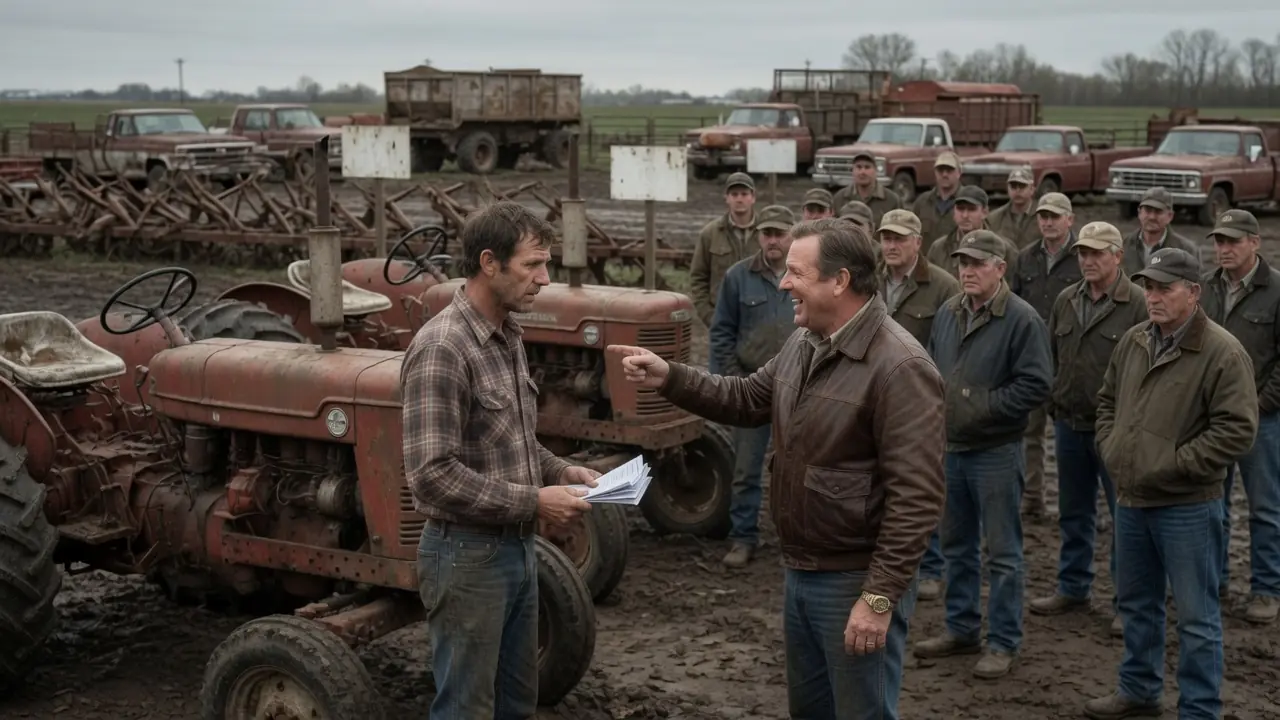
The laughter began before Raymond Cooper had even finished signing his name. It was April of 1979, and the auction yard outside Decatur, Illinois, was still soft from spring rain, with mud clinging to boots and tractor tires like heavy brown paste. Two old red Farmall tractors sat near the back fence, their paint faded, their fenders rusted, and their hoods dented from years of hard fieldwork. To most men in that crowd, they looked like relics from another age.
Raymond stood beside them with the auction paperwork folded in his hand. He was thirty-one years old, tall and lean from eight years of construction work, wearing a plaid flannel shirt, faded jeans, and boots that had already survived more mud than most city men would ever see. Three weeks earlier, his uncle Theodore had died and left him 190 acres of central Illinois farmland. The land was free and clear, but it came with no tractors, no implements, and no easy beginning.
His uncle had once farmed that ground himself, but after a stroke, he had leased it out and sold nearly everything to pay medical bills. Raymond had inherited land, but not the machinery needed to work it. What he did have was twelve thousand dollars, saved carefully from overtime shifts, weekend jobs, skipped vacations, and years of living cheaply. To Raymond, that money was not just savings; it was eight years of sweat turned into one chance.
Two days before the auction, Raymond had walked into Anderson’s John Deere dealership. The showroom had gleaming green tractors under bright lights, polished concrete floors, and the rich smell of new rubber, hydraulic oil, and fresh paint. Jim Anderson, the owner, had greeted him with a confident smile and a hand on his shoulder. Jim was in his mid-fifties, thick around the middle, wearing a nice watch and the satisfied expression of a man used to being trusted.
“Raymond, I heard about your uncle,” Jim had said. “Theodore was a good man.” Then, without missing a beat, he had turned toward the showroom floor. “But 190 acres is a blessing. You need to get set up right.”
Jim showed him a new John Deere 4240 first. The tractor looked powerful, modern, and ready to make a man feel important just by climbing into it. Raymond admired the machine honestly, but when he saw the price tag, his stomach tightened. Thirty-eight thousand dollars was more than three times what he had saved.
Jim explained financing as if it were not debt, but wisdom. Ten percent down, seven years, twelve percent interest, and a monthly payment that would follow Raymond like a second shadow. Raymond did the math in his head and felt the number settle heavily in his chest. By the end, he would pay more in interest than he had saved in eight years.
“I need equipment,” Raymond had said quietly. “But I need something I can afford.”
Jim’s smile had tightened. “You can’t farm competitively with old junk, Raymond.”
That sentence followed Raymond all the way to the auction yard on Saturday morning. It followed him while he inspected the 1954 Farmall Super MTA diesel, checking the oil, the hydraulic lines, the tires, and the engine. It followed him while he climbed onto the 1960 Farmall 560 and tested the clutch pedal, feeling immediately that something was wrong. It followed him while Earl Thompson, an older neighbor, told him the tractors were plain but honest machines.
“If you want to impress people, don’t buy them,” Earl said. “If you want to work and stay out of debt, they might be exactly right.”
The tractor sold to him without a fight.
The 560 came next. It was rougher, and the clutch would need work, but Raymond could see that the bones were good. He bid nine hundred dollars, and the laughter from the crowd grew louder. A man near the fence muttered, “What’s he going to do with that junk?”
Raymond paid twenty-two hundred dollars total after the buyer’s premium. He still had nearly ten thousand dollars left, and for the first time that week, he felt like he could breathe. The tractors were old, yes, but they were his. No bank owned them, no dealer held the title, and no monthly payment would come looking for him after a bad crop.
Then Jim Anderson appeared behind him.
“That’s a hell of a gamble you just made,” Jim said, arms crossed over his expensive leather jacket.
Raymond turned slowly. “Didn’t know you came to auctions.”
“I like to see what desperate farmers are buying.” Jim looked at the two red tractors and laughed. “Those are junk, Raymond. You wasted your money.”
“They run,” Raymond said. “They’ll work.”
“For how long?” Jim asked. “A month? A season? You’ll spend more time fixing them than farming with them. When they break down, and they will, come see me. I might give you trade-in credit for scrap.”
Some farmers nearby chuckled. Raymond felt his face heat, but he did not look away. He folded the papers once more and held them tighter. “They’re old, Jim,” he said. “But they don’t own me.”
Jim laughed again and walked away shaking his head.
That afternoon, Earl Thompson helped Raymond haul the tractors home on a borrowed trailer. The old farmstead looked lonely when they arrived, with Uncle Theodore’s barn leaning slightly and the house standing quiet under bare maple trees. Raymond parked the tractors in the barn and stood between them for a long time. He knew the whole county might be right about him, but he also knew one thing clearly: if he had signed for that new John Deere, he would already be afraid before planting a single seed.
The next six weeks became Raymond’s first real education as a farmer. He worked daylight hours preparing the ground and nights repairing the tractors. The Super MTA needed hydraulic seals, filters, oil, and a cracked fuel tank welded carefully after it was drained. The 560 needed a clutch, which meant splitting the tractor in the barn with borrowed stands and more patience than confidence.
His hands were bruised and cut by the end of May. He ate sandwiches standing beside open engine compartments and fell asleep some nights still smelling of diesel and grease. Every repair took longer than he expected, but every finished job gave him something financing never could. He understood his machines because he had taken them apart himself.
By early June, both Farmalls were running. They smoked a little at start-up, shook harder than modern tractors, and offered no comfort beyond a metal seat and a good view of the field. But they moved, pulled, lifted, hauled, and worked. That was enough.
Raymond planted eighty acres of corn and eighty acres of soybeans that first year. Earl lent him a four-row planter, and Raymond paid him back with labor during wheat harvest. The Super MTA handled the heavier work, while the 560 pulled lighter implements and wagons. They were slow, but Raymond did not owe anyone speed.
His neighbors with new tractors could plant in three days. Raymond took nearly two weeks. Men at the co-op shook their heads and predicted disaster before July. Some said he would come crawling to Jim Anderson by fall. Raymond heard it all and kept working.
That fall, his harvest was not spectacular, but it was decent. The corn yielded enough, the beans sold at a fair price, and after expenses, Raymond had money left. He was not rich. He was not modern. But he had finished his first year without borrowing a dollar.
Jim heard about it, of course. Small counties carry numbers faster than newspapers. When someone told him Raymond had made it through the season with the two old Farmalls, Jim only shrugged and said, “One year doesn’t prove anything.” Then he added, “Let’s see year two.”
Year two came with temptation. Grain prices were rising, land values were climbing, and every salesman, banker, and farm magazine seemed to preach the same message. Expand. Upgrade. Borrow now while times are good. Farmers were told that debt was not danger, but opportunity.
Jim Anderson visited Raymond’s farm in June of 1980. He arrived in a new Suburban, wearing sunglasses and a John Deere polo shirt, while Raymond changed oil in the Super MTA. Jim praised him first, saying he respected the way Raymond had survived his first year. Then he leaned against the barn doorway and offered him a barely used 4240 for thirty-two thousand dollars.
“Two thousand down,” Jim said. “Easy financing.”
Raymond kept wiping his hands with a rag. “No.”
Jim frowned. “You didn’t even ask the monthly payment.”
“I don’t need to.”
“You’re leaving money on the table,” Jim insisted. “You could lease more ground, farm faster, compete with bigger operators. Everyone is growing right now.”
Raymond looked out toward his fields. “That’s what worries me.”
Jim gave a short laugh. “Success worries you?”
“No,” Raymond said. “Crowds do.”
Jim shook his head with the same pity he had shown at the auction. He told Raymond he was missing the greatest opportunity agriculture had seen in decades. He named neighbors buying new tractors, combines, grain bins, and extra acreage. He said they were building futures while Raymond was clinging to the past.
“Maybe,” Raymond said. “Or maybe they’re building payments they can’t survive.”
Jim left frustrated, and Raymond went back to work. That evening, he drove the 560 along the bean rows, listening to the old engine labor under the setting sun. Part of him wondered if Jim was right. Another part of him knew that being called cautious was better than being called by a banker.
Then the 1980s arrived like a storm no one wanted to name.
Interest rates climbed with frightening speed. Loans that had seemed manageable when grain prices were high became crushing when payments renewed at higher rates. Corn prices fell, soybean prices dropped, and export markets weakened. The boom that had made debt look smart turned into a trap.
Raymond watched it happen first through conversations at the co-op. Men who used to brag about horsepower began talking in low voices about operating loans. Men who had laughed at Raymond’s Farmalls now asked if he knew anyone buying used equipment. The same machines once called investments were suddenly worth far less than the balances owed on them.
Dale Patterson, Raymond’s neighbor to the south, was one of the first to fall. Dale was a good farmer, careful with crops and kind with neighbors, but in 1980 he had traded his paid-off tractor for a new John Deere 4440. The payment had seemed manageable then. By 1983, with higher interest and lower grain income, it became impossible.
Dale tried refinancing. He borrowed to plant, borrowed to catch up, borrowed from family, and cut household spending until there was almost nothing left to cut. But debt does not care how good a man is. It only asks for payment. In 1985, the bank foreclosed.
Raymond went to Dale’s auction on a hot Saturday in July. The yard was full of people, but nobody seemed comfortable. Dale stood off to one side with his wife Mary, both of them looking older than their years. Their children stayed close to the house, quiet and confused.
The 4440 that had once represented Dale’s future sold for far less than he still owed. The auctioneer moved through equipment, tools, furniture, and household goods like he was dismantling a life piece by piece. Raymond bought Dale’s older Farmall 450 because he could afford it and because he knew Dale had cared for it. When the sale ended, Raymond found Dale near the barn.
“I’m sorry,” Raymond said.
Dale nodded, eyes fixed on the ground. For a long time, neither man spoke. Then Dale looked toward the old 450 on Raymond’s trailer. “You’ll take care of it.”
“I will.”
Dale swallowed hard. “Jim Anderson laughed at you when you bought those two old Farmalls.”
Raymond nodded. “I remember.”
“He called them junk,” Dale said. “Said you’d fail.” His voice cracked slightly. “Turns out I’m the one who listened to the wrong people.”
Raymond wanted to say Dale could not have known. He wanted to say many men had made the same choice. But Dale already knew all that, and none of it changed the auction yard, the sold farm, or the truck waiting to take his family to town. So Raymond said only, “You were a good farmer, Dale.”
Dale looked at him then. “Being good didn’t save me from bad debt.”
Those words stayed with Raymond for years.
The crisis kept spreading. Tom Miller lost his place. Bob Anderson sold out. The Hendricks brothers split their operation and still could not save it. Within a few miles of Raymond’s farm, men who had once looked secure were suddenly working at grain elevators, machine shops, and factories in town.
And then Jim Anderson’s dealership closed.
It happened in 1986. New equipment no longer moved, used equipment was worth too little, and farmers who might have bought from him were either broke or terrified of borrowing. The polished showroom Raymond remembered went dark, and the building later became storage space. The man who had mocked paid-for old tractors had built his business on financed new ones, and when the debt machine broke, his business broke with it.
Through all of it, Raymond kept farming. Some years were bad, and one year his income dropped so low that he lived almost entirely on garden vegetables, beans, and meat from a freezer. But he had no equipment payments. He had no mortgage. The Farmalls needed repairs, but salvage yard parts and his own labor were cheaper than bank interest.
The Super MTA remained his main tractor. The 560 still handled chores. Dale’s 450 became the helper machine for wagons, light tillage, and odd jobs. They were old, loud, uncomfortable, and slow, but they started when Raymond needed them, and more importantly, they never sent him a bill.
By 1990, Raymond had not become a big farmer, but he had become a secure one. He still lived modestly in Uncle Theodore’s old farmhouse, still repaired his own machines, and still saved money whenever crops gave him anything extra. When the Morrison farm next to his east property line came up for sale, Raymond considered expansion for the first time. Eighty acres of good ground, close enough to work efficiently, and priced fairly after the crisis had beaten land values down.
He did not rush. He waited until the bank holding the property wanted a cash buyer more than a perfect price. With savings, a small family loan from his father, and careful timing, Raymond bought the eighty acres free and clear. For the first time since inheriting the farm, he grew from 190 acres to 270.
People noticed, but they did not laugh anymore.
Some asked how he had done it. Raymond never gave speeches. He simply said, “I waited until I could afford it.”
Five years later, another opportunity came: 120 acres north of his place. This time, the price was higher, and Raymond did take a loan, but he structured it carefully. He put down a large payment, kept the note manageable, and made sure there was no penalty for early payoff. He knew debt was a tool only when the borrower controlled it.
He paid that loan off years early.
By 2004, Raymond Cooper owned 390 acres free and clear. His equipment was still mostly old, used, repaired, and paid for. The two original Farmalls were still on the property, still part of the working fleet after decades of service. The tractors everyone had called junk had become the foundation of a life.
In 2009, Raymond received a phone call from a number he did not recognize. The voice on the other end was older, softer, and less certain than he remembered. “Raymond, this is Jim Anderson.”
Raymond sat down at the kitchen table.
“I remember you,” he said.
There was silence, then a quiet breath. “I was hoping you’d forgotten some of it.”
“Hard to forget being laughed at in front of a crowd.”
Jim did not defend himself. He apologized. He said he had been wrong about the Farmalls, wrong about Raymond, and wrong about pushing debt as if it were the only road to success. He admitted that many men had trusted him when he told them to upgrade, finance, expand, and keep up. Many of those men had lost everything.
“I’ve carried that for years,” Jim said. “You survived because you didn’t listen to me.”
Raymond looked out the kitchen window toward the barn where the Super MTA sat under cover. “I survived because I could afford to have a bad year,” he said. “That’s all.”
“No,” Jim replied. “You survived because you understood something I didn’t. Those old Farmalls weren’t junk. They were freedom.”
The words stayed with Raymond long after the call ended.
Jim died a few years later, and Raymond went to the funeral. He stood quietly in the back, paid his respects, and forgave him fully. Not because the laughter had never hurt, but because apology mattered. Men do not always get the chance to admit they were wrong, and Jim had taken his.
Raymond retired from active farming in 2018. He leased his 390 acres to a young farmer on fair terms, the kind of terms he wished someone had offered him when he was starting out. He still helped with repairs when asked and never charged for advice. He told the young man to avoid payments that made him afraid of weather.
The 1954 Super MTA still sits on Raymond’s property. He keeps it running for light work, moving wagons, pulling things around the yard, and reminding himself what freedom sounded like through an old diesel engine. The 1960 560 is still there too, partly restored now, its faded red paint slowly being brought back by a man who owes it more respect than any new machine he ever saw. Raymond has rebuilt engines, replaced clutches, patched fuel lines, and repaired nearly every system on those tractors, but he never once regretted buying them.
When a young agricultural journalist came to interview him, she asked what he would tell young farmers starting today. Raymond thought carefully before answering. He did not say old equipment was always better. He did not say new equipment was foolish.
He said ownership beats payments.
“Modern equipment is comfortable,” Raymond told her. “It’s efficient, and sometimes it makes sense. But if the payment can take your farm in a bad year, then it isn’t helping you. It’s standing between you and survival.”
The journalist asked if he would change anything about 1979.
Raymond smiled. “Not one thing. I’d buy those same two Farmalls again. I’d let them laugh again. And I’d still rather be laughed at with paid-for tractors than admired with equipment the bank can take.”
He paused and looked toward the barn.
“In the end, the best tractor isn’t always the newest one,” he said. “Sometimes the best tractor is the one that lets you sleep at night.”
That was the truth Raymond Cooper learned the hard and quiet way. The crowd had chased polish, horsepower, and borrowed confidence. Raymond had chosen rust, patience, and ownership. The crowd had laughed at him in the mud.
Fifteen years later, most of them were gone from farming.
But Raymond still had his land.
He still had his name on the deed.
And behind his barn, two old Farmalls still stood as proof that freedom does not always shine when you first buy it. Sometimes it sits faded and dented in the back of an auction yard, waiting for one stubborn man to see what everyone else missed.