The microphone squealed across the demonstration field just as Grant Holloway leaned over the edge of the equipment trailer and looked down at Walter Briggs like he was inspecting something left behind after an auction.
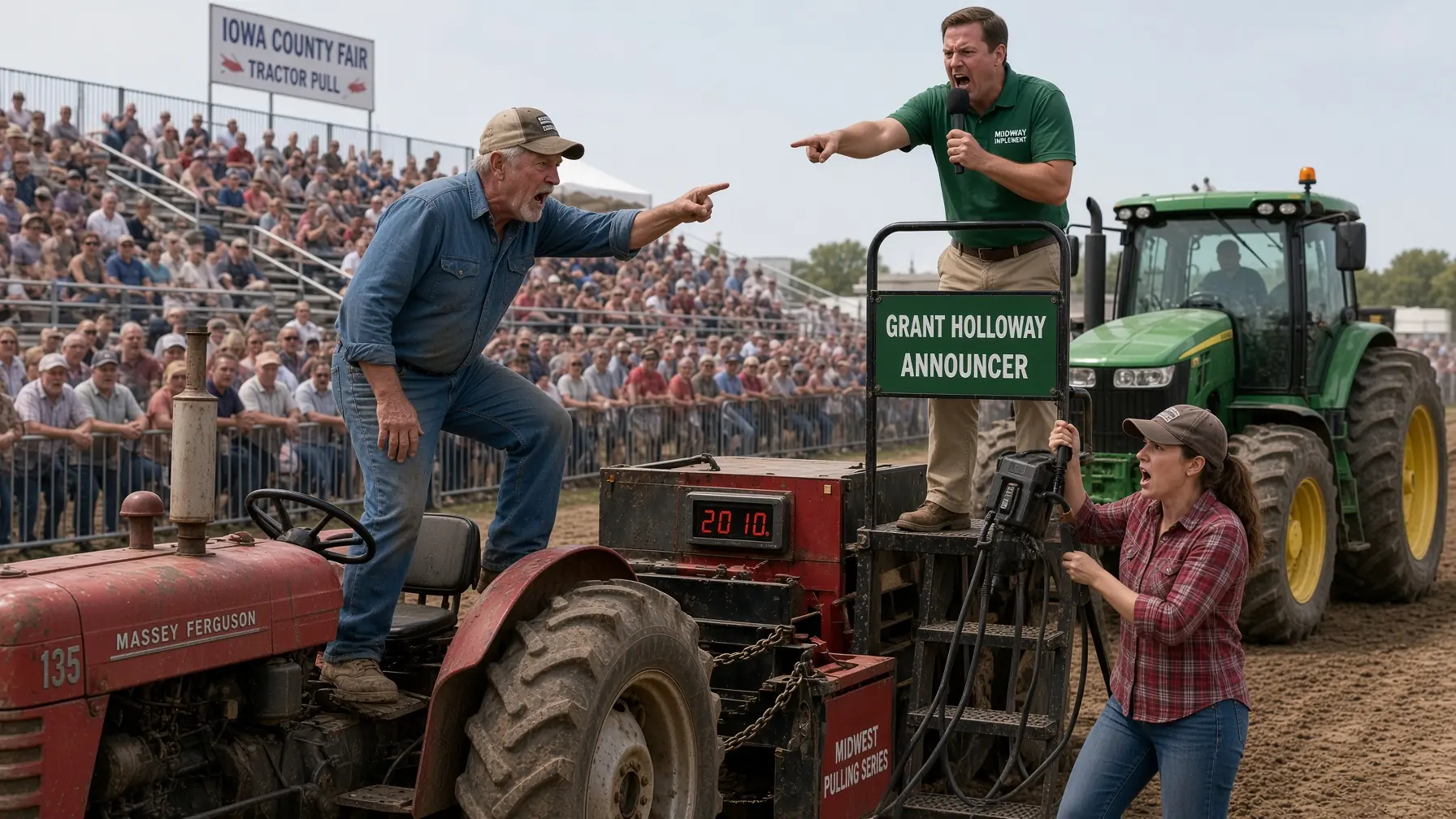
Behind Grant stood a brand-new green tractor with polished yellow wheels, spotless glass, and enough fresh wax on the hood to reflect the afternoon sun. Holloway Agricultural Equipment had brought it to the county machinery day as the centerpiece of its spring sales event, and nearly two hundred farmers had gathered around the roped pulling lane to watch Grant demonstrate what he repeatedly called “the future of serious farming.”
Walter had not come to compete.
He had come to listen.
That was what made Grant’s first sentence so irritating.
“Let me save you the embarrassment, old man,” Grant said into the microphone. “No Massey Ferguson you own is pulling that load.”
A few people laughed.
Walter remained beside the rope with his arms folded across a faded blue work shirt.
At sixty-two, he had the lean build of a man who still climbed out of tractor cabs instead of using exercise equipment to stay in shape. His gray hair disappeared beneath a tan farm cap rubbed pale along the brim, and his hands carried the dark lines of grease that never completely left after forty years around machinery.
He looked toward Grant’s tractor.
Then toward the sled.
Then back at Grant.
“Hook it up,” Walter said.
Grant smiled.
The microphone carried his answer across the field.
“What was that?”
Walter stepped closer.
“I said hook it up and quit talking.”
The laughter changed.
Several farmers who had been joking stopped smiling.
Grant lowered the microphone slightly.
Walter continued.
“I didn’t drive thirty miles to hear a salesman explain tractors to men who use them.”
A murmur moved through the crowd.
Grant’s smile tightened.
He was forty years old, polished, successful, and very good at appearing comfortable in places where other people worked.
His father had built Holloway Agricultural Equipment from a small dealership into the largest machinery operation in that part of western Iowa. Grant inherited it eight years earlier and expanded aggressively, adding financing, used-equipment sales, repair contracts, and agricultural consulting.
People admitted he knew business.
Walter simply did not believe business knowledge and farming knowledge were the same thing.
Grant lifted the microphone again.
“You fail in front of everybody here, don’t blame me when your pride snaps before the hitch does.”
Walter raised his chin.
“Drop the chain, son.”
The word son landed harder than Grant expected.
Walter pointed toward the sled.
“In thirty seconds these people can decide which one of us understands a tractor.”
The crowd became quiet.
Grant stared down at him.
Near the far edge of the field, beside an old flatbed trailer, stood Walter’s daughter Emily.
She was thirty-one, wore dark work jeans and steel-toed boots, and had rolled the sleeves of her red plaid shirt above both elbows. Her dark blond hair was tied at the back of her neck, and a small laptop rested open on the hood of Walter’s support truck.
She was watching Grant.
Not the tractor.
Grant did not seem to notice her.
That was his first mistake.
Walter’s Massey Ferguson sat on the trailer behind her.
It was twenty-eight years old.
The red paint had faded almost pink along the hood. A dent remained on the right fender from the afternoon Walter backed into a gatepost fifteen years earlier, and the cab door carried a scratch long enough to make most dealers recommend repainting it.
Walter never had.
The rear tires were expensive but not new. Mud had dried in the deep treads from work earlier that week.
Nothing about the machine looked impressive sitting near Grant’s polished display.
That was exactly why Grant had chosen it.
He had been giving a speech about modern horsepower, electronic management, dealer-supported technology, and the high cost of keeping “obsolete iron” alive when he spotted Walter beside the rope.
Grant knew the tractor.
Everybody in the county did.
Walter had owned it for nearly twenty years.
Grant smiled from the stage and pointed toward him.
“Walter Briggs is standing right there with one of those old Masseys I’m talking about.”
Walter did not respond.
Grant continued.
“Maybe Walter wants to show us how thirty-year-old technology handles a modern workload.”
Farmers turned.
Emily’s head lifted.
Walter remained still.
Grant had expected that to be enough. Humiliation works best when the victim cooperates with it.
Walter did not.
“What load?” he asked.
Grant pointed toward the sled.
The reinforced steel pulling sled carried concrete blocks, scrap iron, and two large water tanks. Holloway employees claimed it weighed more than forty thousand pounds, though Walter had not seen an independent scale ticket.
Grant’s new tractor had pulled it roughly sixty feet before losing traction in loose dirt.
Grant had turned the incomplete pull into a sales demonstration.
Walter studied the lane.
Then he looked toward Emily.
She gave him a small shake of her head.
Not yet.
Walter understood.
He looked back toward Grant.
“You offering the same load?”
Grant laughed.
“Same sled.”
“That wasn’t my question.”
A few farmers nodded.
Grant’s expression changed slightly.
Walter said, “Same load, same lane, same connection, same settings?”
For the first time, Grant hesitated.
It lasted less than a second.
“Of course.”
Walter turned toward the trailer.
“All right.”
The crowd reacted immediately.
Men who had been standing beneath dealership tents moved toward the pulling lane.
Phones came out.
Someone called, “Walter, don’t break that poor thing.”
Another farmer laughed.
Walter kept walking.
Emily met him beside the trailer.
“You didn’t have to accept.”
“I know.”
“You think he’s doing this because of the tractor?”
Walter looked toward Grant.
“No.”
Emily lowered her voice.
“Neither do I.”
Walter touched the old Massey’s fender.
Three months earlier, Grant Holloway had sat at Walter’s kitchen table with a real-estate offer.
Briggs Family Farm bordered the eastern edge of a proposed grain-storage and transportation development. Grant described the project as an opportunity for the entire county, though Walter noticed Grant spent most of the meeting explaining what would happen if Walter sold rather than what would happen if he refused.
Holloway Land Holdings wanted thirty-seven acres from the Briggs property.
The land included a narrow strip connecting the proposed development to the highway.
Without it, the project would require a far more expensive access route.
Grant offered Walter what he called a generous price.
Walter had already paid for an independent appraisal.
The offer was barely more than half the appraised value.
“No,” Walter said.
Grant smiled.
“You should think about it.”
“I did.”
“This could be the best offer you get.”
Walter folded the document.
“Then it’ll be the best offer I turn down.”
Grant’s smile disappeared.
The next morning Holloway Agricultural Equipment closed Walter’s long-standing parts account.
Grant claimed it was part of a routine credit review.
A regional supplier that had delivered to Briggs Farm for years suddenly said Walter’s address was outside its preferred route.
Then Walter’s bank called.
His operating line, previously renewed almost automatically, would now require a new land valuation.
The recommended appraiser happened to do regular work for companies connected to Grant.
None of it proved anything.
Walter documented everything anyway.
That was how Briggs men handled trouble.
His father used to say, “Anger has a bad memory. Paper doesn’t.”
So Walter saved every email.
Every invoice.
Every voicemail.
Every change.
Emily helped him organize it.
She also helped with the tractor.
The old Massey had been losing power under heavy load during the previous winter. Walter initially assumed age had finally reached something too expensive to justify.
Emily disagreed.
She worked as an agricultural engineer in Des Moines and returned to the farm most weekends, where she still behaved around machinery exactly as she had at sixteen.
She measured before replacing.
Tested before guessing.
And refused to accept “old” as a diagnosis.
Together, she and Walter rebuilt the fuel system, corrected worn hydraulic controls, replaced several compromised components, and recalibrated the tractor around specifications she had spent weeks verifying.
The machine was not secretly transformed into a racing tractor.
It remained a working Massey Ferguson.
Just one whose tired parts had been properly repaired instead of being dismissed because of age.
Grant knew none of that.
He saw faded paint.
Walter suspected Grant made similar assumptions about people.
Emily climbed into the Massey and started it.
The diesel settled into a deep, steady idle.
Heads turned.
Walter walked beside the tractor as Emily reversed it carefully down the trailer ramps.
Grant’s voice came across the speakers.
“Everybody stand back. We don’t want pieces flying when that museum exhibit comes apart.”
Several Holloway employees laughed.
The farmers mostly did not.
Samuel Price stood near the front rope.
Samuel was seventy, grew corn and soybeans on nearly five hundred acres, and had participated in tractor pulls longer than Grant had been alive.
He watched the old Massey approach.
Then he looked at the sled.
Walter noticed.
Samuel had seen something too.
Emily drove the tractor toward the hitching area.
Walter climbed onto the lower step.
“How does she feel?”
Emily watched the gauges.
“Temperatures good.”
“Hydraulics?”
“Stable.”
“Rear pressure?”
“Exactly where we set it.”
Walter nodded.
Emily looked toward Grant.
“He wants you embarrassed.”