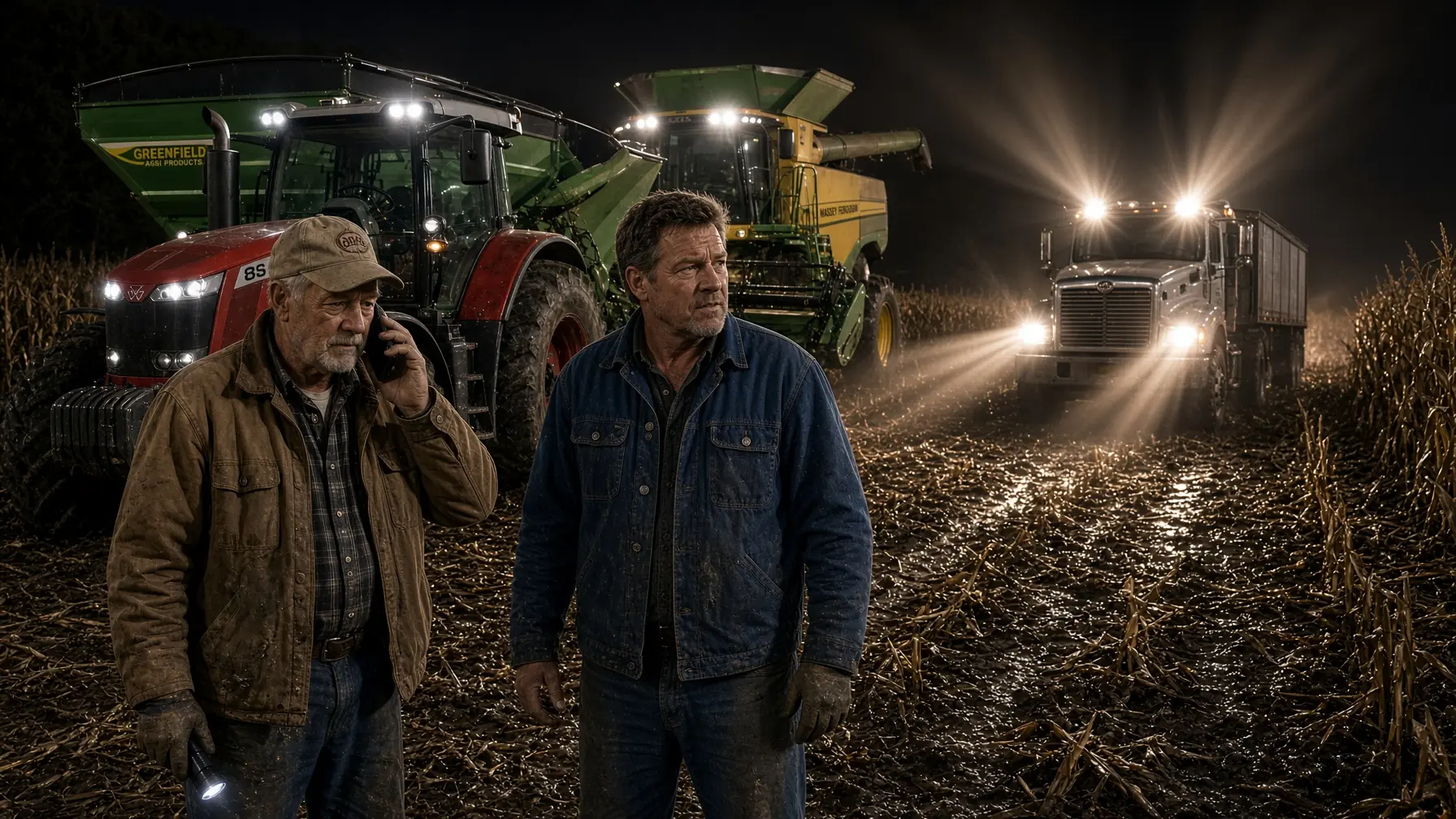
At 9:43 on a Wednesday night in October, Earl Mossman felt something change through the steering wheel of his Massey Ferguson 8S 265.
Four minutes later, he made a phone call he had been waiting two years to test.
Not to a service hotline.
Not to an answering machine.
Not to some corporate number that would tell him the dealership opened again at eight.
Earl called the personal cell phone of Scott Harlan, the man who owned the dealership.
Scott had given him the number the day Earl bought the tractor.
“If you have a problem during harvest, call this number first.”
Earl had written those words down.
He wrote nearly everything down.
Oil changes.
Hours.
Repairs.
Fuel use.
Weather.
Parts.
Failures.
And promises.
Especially promises.
Because Earl had been farming long enough to know that promises made across a dealership desk in February sometimes sounded very different when a machine stopped moving at ten o’clock on an October night.
The phone rang once.
Twice.
Then:
“Harlan.”
Earl looked across his dark cornfield.
His combine sat motionless in the distance.
A full grain cart waited behind him.
Rain was seventy-two hours away.
“Scott. Earl Mossman.”
“What broke?”
That was the first thing Scott asked.
Not why Earl was calling.
Not whether it could wait until morning.
What broke?
Earl crouched beside the tractor with his flashlight.
“Lost hydraulic pressure. Cart connection. Looks like the fitting failed at the ferrule.”
Scott asked two questions.
Earl answered both.
Then Scott said:
“I’ll have somebody there inside ninety minutes.”
Earl looked at his watch.
9:49.
“You have the part?”
“I’m going to the dealership now.”
Earl paused.
Scott had already ended the call.
For the first time that night, Earl smiled.
Now they were going to find out whether the sentence in his notebook had been advertising—
or a promise.
Earl Mossman was sixty-eight years old and had spent forty of those years farming corn and soybeans in Pettis County, Missouri.
His operation covered roughly 2,400 acres.
Large enough that every hour mattered.
Not large enough that breakdowns became somebody else’s problem.
If something failed at midnight, Earl knew about it.
If rain was coming, Earl knew the hour.
If a repair had been made three years earlier, there was a good chance he knew the date and part number.
His hired man, Tom Keller, had worked beside him for eleven years.
Tom once said Earl kept records the way some men kept photographs.
Earl disagreed.
“Photographs don't tell you why a bearing failed.”
Tom had laughed.
Earl had not.
He was only partly joking.
Above the workbench in Earl’s machinery shed sat a row of notebooks.
Black covers.
Grease marks.
Bent corners.
Every major machine had one.
When the 8S 265 arrived two years earlier, Earl opened a fresh book and wrote the serial number on the first page.
Then the purchase price.
Delivery date.
Starting hours.
Recommended service intervals.
And one unusual sentence:
If you have a problem during harvest, call this number first. — Scott Harlan
Below it, Earl wrote Scott’s cell number.
He had never done that with another dealer.
Because no other dealer had ever said anything quite like it.
Scott Harlan had owned Harlan Farm Equipment in Sedalia for fourteen years.
Before buying the dealership, he spent twelve years in agricultural equipment service.
Those years shaped him.
He had watched farms lose entire days because nobody answered a phone.
He had watched machines sit overnight because a fitting worth less than a dinner bill was locked behind the parts-room door.
He had watched customers spend hundreds of thousands of dollars on equipment and then discover that “support” meant:
We’ll put you on tomorrow’s schedule.
Scott hated that.
A harvest failure at two in the afternoon and the same failure at ten at night were mechanically identical.
Financially, they were not.
During planting and harvest, weather controlled the calendar.
A machine did not care.
Rain did not care.
Scott believed the dealership had to.
So during six weeks of peak harvest, he maintained an on-call technician rotation.
Someone was always available.
For his larger farm accounts, Scott gave out his personal number.
Most customers never called.
That was the ideal outcome.
Earl had never called.
Until October 19.
The night had started almost perfectly.
Dry air.
Firm ground.
Corn ready.
The combine had been moving steadily since afternoon.
Semis waited along the north field road.
Earl ran grain cart duty with the 8S 265.
Back and forth.
Combine to truck.
Truck to combine.
Again.
Again.
The five-day forecast mattered more than anything else.
A heavy front was predicted to arrive Sunday.
If it came as forecast, the remaining fields might become inaccessible for several days.
Earl wanted the corn out by Saturday afternoon.
Then, at 9:43, the steering response changed.
Not much.
A slight heaviness.
But Earl had thousands of hours in machinery.
His hands noticed before his eyes did.
Then the hydraulic pressure display dropped.
The warning light appeared.
Earl stopped.
Immediately.
Tom came across the radio.
“What happened?”
“Hydraulics.”
“How bad?”
“Don't know yet.”
Earl shut down.
Climbed out.
Flashlight on.
Oil glistened near the cart connection.
He traced it.
Found the failed fitting.
Tom arrived from the combine.
He crouched beside Earl.
“That all?”
“Looks like it.”
“Good.”