The fire crackled in the stone hearth, casting dancing shadows across the worn wooden walls of the New Mexico cabin. Outside, December wind howled through the pines. But warmth held back the cold like a memory refusing to fade.
Ethan Walker, seventy years old with silver hair and eyes the color of winter sky, sat in his father’s old chair. His granddaughter Sarah perched on the ottoman before him, wrapped in a quilted blanket, her face illuminated by firelight and curiosity.
“Grandpa,” she said, her voice soft in the quiet room. “You’ve spent your whole life fighting for indigenous land rights, fifty years as a lawyer, but you never told me the whole story. Why you started?”
Ethan reached into the drawer of the side table. His weathered fingers, still steady despite their age, withdrew something wrapped in faded cloth. He unfolded it slowly, revealing a piece of leather no bigger than a playing card. The surface was worn smooth by decades of handling, but the symbol burned into it remained clear. A crescent moon with eagle wings spreading from its curves.
“This,” Ethan said, his voice carrying the weight of years and memory, “is called the Moonwing, the sacred mark of the Churikawa Apache. And this is the story your great-grandfather Jesse Walker never wanted told because he thought himself no hero, just a man paying a debt.”
Sarah leaned forward, firelight catching in her eyes.
Ethan closed his own eyes, and when he spoke again, his voice transformed—younger, harder. The voice of a man who’d heard this story from his father’s own lips on a similar winter night, forty years gone.
“August 1884, Arizona territory. My father was twenty-nine years old. His heart was dying. His pockets held thirty-one dollars. Everything he’d ever built had turned to dust. And he just decided to spend every cent of that money to repay a debt twenty-one years old.”
The firelight seemed to flicker and shift. And in the dance of flame and shadow, the past awakened.
The desert stretched in every direction like an ocean of fire. August sun hammered down from a sky bleached white with heat. One hundred eight degrees, maybe more. The kind of heat that killed men and horses with equal indifference.
Jesse Walker rode alone. His horse, an Appaloosa named Smoke, picked its way across the cracked red earth with the careful steps of an animal that understood survival. Jesse sat loose in the saddle, his body moving with the horse’s rhythm in a way that spoke of decades spent riding. But his hand rested on his chest, feeling the irregular thump beneath his ribs. The shrapnel, six years lodged next to his heart, too close to remove. A gift from the Apache wars he’d deserted.
Every doctor said the same thing. Two years, maybe three. Then the metal would shift, pierce something vital, and Jesse Walker would die in the middle of whatever he was doing. Probably alone, probably in pain.
He’d made peace with that.
What he hadn’t made peace with was the emptiness. Catherine, his wife, dead five years from consumption. His son Ethan, nine years old, living with Catherine’s parents in Texas. The boy wouldn’t speak to Jesse. Couldn’t forgive his father for all the absences, all the times Jesse had chosen anywhere else over home. The ranch in New Mexico lost to drought and debt. Three hundred seventeen acres that Jesse had built with his own hands sold for eight hundred dollars to cover what he owed.
Thirty-one dollars remained. Enough for a meal and a bottle. Enough for six bullets and an end.
Jesse reached into his vest pocket without looking. His fingers found what they always found. A piece of leather four inches by three, edges worn soft. He didn’t need to look at it. He’d memorized every line of the symbol burned into its surface. The Moonwing. Crescent moon with eagle wings.
A voice whispered through his memory. Deep, calm, accented with the rhythms of Apache speech.
“Remember, white boy. A man’s worth is measured by his choices when no one is watching.”
Jesse was eight years old again. Dying in the desert, tongue swollen, arrow wound festering in his shoulder. His parents’ wagon train destroyed by Comanche raiders. Three days crawling through sand and stone, too young to know the proper way to die.
Then hands. Brown hands, calloused and strong, lifting a water skin to his cracked lips.
Chief Silverhawk of the Churikawa Apache, thirty-eight years old then, hair already streaked with gray. Eyes that saw through skin and bone, straight into the truth of things.
Silverhawk had saved him, fed him, tended his wounds for three weeks in a hidden cave while his own people hunted white soldiers. And when Jesse was strong enough to travel, the chief had given him this piece of leather.
“If you ever see this mark again,” Silverhawk had said, “you will know they are family to the man who gave you a second life.”
For twenty-one years, Jesse had carried it. Through marriage and war and loss and the slow erosion of everything that made life worth living.
He was about to put it back in his pocket when gunfire cracked across the desert. Three shots, rifle reports echoing off distant rock. Then two more pistol shots, different pitch.
Smoke stamped and tossed his head.
Jesse’s hand went to his Colt by reflex, but he didn’t draw. Not his business. This territory was full of violence. Men killed each other over land, over water, over old grudges and new opportunities. A smart man kept riding.
Jesse started to do exactly that, but Smoke wouldn’t move. The horse stood planted, ears forward, as if listening to something Jesse couldn’t hear.
The leather charm slipped from Jesse’s fingers. Fell onto the saddle. The Moonwing symbol faced upward, catching the brutal sunlight.
Silverhawk’s voice again. Stronger now, almost real.
“A man’s worth is measured by his choices when no one is watching.”
“Damn it,” Jesse said to the empty air, to the ghost of a chief twenty-eight years dead. “You never did let me rest easy.”
He turned Smoke toward the gunfire and kicked the horse into a gallop.
Eight hundred yards out, Jesse saw them through the shimmering heat. Three men, white, dirty clothes, unshaven faces, the look of bounty hunters or worse, armed with Winchesters and belt guns. They were dismounted, walking slowly forward, rifles ready.
Their target ran ahead of them. A woman. Apache, no question. Dark hair in a single braid down her back, buckskin dress with traditional beading. She was wounded. Blood darkened her left shoulder. She was out of arrows, her quiver empty. Only a knife remained in her hand.
“Stop running, squaw,” one of the hunters shouted. He was thirty-ish, heavy-set with a scar across his face that looked like it came from a knife years ago. “Boss Crane pays two hundred dollars for Black Feather blood brought in alive.”
The woman stumbled but didn’t fall. When she spoke, her voice carried clearly despite her exhaustion.
“Ya,” the Apache words were sharp as broken glass. Then in English, accent thick but understandable. “I am daughter of Silverhawk. I do not kneel.”
Jesse’s heart, that damaged and failing organ, suddenly beat so hard it hurt.
“Daughter of Silverhawk,” the second hunter, younger and thinner, laughed. “Don’t care whose daughter you are. You’re merchandise now. Crane’s got plans for you and your sisters.”
Jesse was already moving. Smoke ate up the ground in powerful strides, hooves throwing up clouds of red dust.
Jesse reined in forty feet away. Smoke danced sideways, fighting the bit, but Jesse held him steady with his knees. His hand rested on the butt of his Colt, not drawing yet, but ready.
“Three grown men chasing one wounded woman,” Jesse said. His voice was quiet, but it carried the flatness of a man who’d killed before and would do it again if necessary. “Real brave.”
The scarred hunter spat tobacco juice.
“Ain’t your business, stranger.”
“Right now it is. Just made it my business. The lady’s under my protection now.”
The younger hunter grinned, showing teeth stained brown.
“Your protection? Who the hell are you?”
Jesse’s eyes, pale and flat as weathered stone, moved from face to face.
“Someone who doesn’t like cowards.”
The scarred hunter’s hand tightened on his rifle.
Jesse moved first. His draw was smooth, practiced, the result of twenty years carrying a gun. The Colt came up and fired in one motion. The first shot took the scarred hunter in his right shoulder, spinning him around and dropping the rifle from his hands. The man screamed and went down.
The second hunter fired his Winchester, but he rushed the shot. The bullet whined past Jesse’s ear close enough to feel the heat.
Jesse’s second shot caught the man in his left thigh. He collapsed, howling.
The third hunter, younger than the others, tried to flank left.
A knife flew through the air and buried itself in his right thigh. He screamed and stumbled. The Apache woman had thrown it. Even wounded, even exhausted, her aim was true.
All three hunters were down and bleeding.
The young one managed to crawl to his horse and pull himself into the saddle. The other two followed, clutching their wounds. They rode off at a hard gallop, leaving a trail of blood and curses.
Jesse didn’t pursue. He never killed unless he had to. He’d seen enough death to last several lifetimes.
He dismounted and walked to where the Apache woman had collapsed. She was conscious but fading. Her face pale beneath the sun-darkened bronze of her skin. The wound on her shoulder was bleeding freely. Dehydration hollowed her cheeks and darkened her eyes.
Jesse knelt beside her. He opened his canteen and held it to her lips.
She grabbed his wrist with surprising strength. Her eyes, dark as obsidian and just as hard, fixed on his face with suspicion and exhaustion in equal measure.
“Why?” Her voice was barely a whisper. “Why you help? White soldiers killed my people.”
“Not all white men are soldiers,” Jesse said. “Drink.”
She drank slowly, her eyes never leaving his face.
Jesse used the water to clean her wound, then tore a strip from his shirt to bind it. The shoulder wound was a graze, painful and bleeding, but not fatal.
As he worked, he noticed something. A scar on her left shoulder, partially hidden by the blood, shaped like a crescent moon.
Jesse’s hands froze.
The woman saw his reaction.
“It is mark of my bloodline. Chief’s family. Why you stare?”
Jesse reached into his vest with shaking hands, drew out the leather charm, held it where she could see. The Moonwing symbol identical to her scar.
“Because,” Jesse said, his voice rough with emotion he couldn’t name, “twenty-one years ago, a Churikawa chief saved an eight-year-old boy lost in this desert. Before he left, he gave the boy this. Said if I ever saw this mark again, I’d know they were family.”
The woman’s eyes went wide. Her hand, still bloody, reached up to touch the tattoo on her right wrist. The same symbol inked in traditional Apache style.
“The symbol of Moonwing,” she breathed. “My father spoke of you. The white boy with blue eyes who survived alone three days. He said you had warrior spirit in wrong-colored skin.”
Jesse felt something crack open in his chest. Not his heart, though that ached too. Something deeper.
“Your father,” he said. “Chief Silverhawk. Where is he?”
Her face hardened. Pain flashed in her eyes, but also rage carefully controlled.
“Dead. Murdered three months ago by a land thief named Silus Crane. And Crane did not stop with killing my father. He took my five sisters, sold them like cattle. I have hunted three months and found nothing but lies and cold trails.”
Jesse looked at her, really looked. She was younger than he’d first thought. Maybe twenty-six, twenty-seven. Beautiful in the way of an Apache woman with high cheekbones and a mouth that looked like it knew how to laugh, even though it was set in a hard line now. Strong despite her injuries. Her father’s daughter in every way that mattered.
“What’s your name?” Jesse asked.
“Nala. Nala Silverhawk.”
“Jesse Walker. And I owe your father everything. What do you need?”
Nala’s eyes narrowed.
“What?”
“What do you need to get your sisters back? Your father gave me my life when I had no right to it. I owe that debt. So tell me what you need.”
Nala studied him for a long moment. Jesse had the distinct feeling she was seeing past his skin, past his words, straight down to the truth of him, just like her father had all those years ago.
Finally, she spoke.
“I need guns. I need someone who knows white man’s ways. I need a warrior who will not run when blood is shed.”
Jesse stood and offered her his hand.
“I’m not a hero, Nala. I’m a broken-down cowboy with a bad heart and a worse past. But I keep my debts.”
She took his hand. Her grip was iron.
“Then we have deal, Jesse Walker. But know this. I lead. You follow. This is Apache fight.”
Jesse actually smiled. The first real smile in months.
“Fair enough.”
They made camp under a cluster of mesquite trees as the sun died in the west. Jesse started a small fire and cooked a jackrabbit he’d shot earlier. Nala sat with her back against a rock, drinking water slowly, letting her body recover.
“Tell me,” Jesse said as he turned the rabbit on its spit. “Tell me about your sisters, about Crane.”
Nala’s face became a mask, but she spoke.
“My father, Chief Silverhawk, owned twenty-four hundred acres near the Gila River in New Mexico territory. Good land, water rights, registered in 1868 under the Homestead Act. Worth twelve thousand dollars, maybe more.”
Jesse whistled low. That was serious money.
“Railroad companies want it.”
“Yes. But the land is legally ours. Papers filed, signed, witnessed. Crane cannot steal it unless there are no legal heirs to challenge the claim.”
Nala nodded.
“Exactly. So three months ago, Crane came to our village. He had forty men. They attacked at dawn. My father tried to stop them. Crane shot him in the back while he was trying to negotiate.”
Her voice didn’t waver, but Jesse saw her hands clench.
“Before my father died, he gave us the Moonwing tattoos. All six daughters. He told us someone would see the mark and remember. Someone who owed a debt.”
She looked at Jesse.
“He meant you.”
Jesse felt the weight of that settle on his shoulders. Silverhawk had planned this. Even dying, the old chief had been thinking three moves ahead.
“Your sisters,” Jesse said. “Where are they now?”
“Separated. Crane is smart. Kiona, my eldest sister, she is twenty. With her is Yazi, youngest at twelve. They are held at Crane’s ranch in a place called Devil’s Rim, forty miles northeast of here. Two guards on them always. Fifteen men total in the camp. And the others. Winona is eighteen, Ayana is sixteen. They were sold to Mexican slavers three weeks ago, taken south to Sonora. Chenoa is fourteen. Crane is holding her in Tucson. He plans to sell her at auction on September third. Nine days from now.”
Jesse poked the fire with a stick, thinking.
Three locations. Five women. Crane had scattered them like seeds to make rescue impossible.
“What does Crane get out of this?” Jesse asked.
“Besides the land, he has a deal with the railroad companies. They will pay him fifty thousand dollars for our land, but only if the title is clean. No heirs to challenge, no legal claims. So he kills our father, kidnaps all six daughters, sells or kills them, then files false documents claiming the land was legally transferred.”
“Yes. And he has connections. The sheriff in Tucson works for him. Judges in Santa Fe. Even some army officers.”
Jesse was quiet for a moment. Then he said,
“There’s something else you’re not telling me.”
Nala looked at him sharply.
“What makes you say that?”
“Because Crane could have just killed all of you. Simpler. But he’s keeping you alive. Selling you. Why?”
Nala’s jaw tightened.
“Because Crane is building something worse than land theft. He takes Apache children young, eight, nine, ten years old. Raises them himself. Trains them as soldiers loyal only to him. Fifteen children over ten years. Three of them are from my father’s own tribe. He turned them against their families.”
Jesse felt cold despite the fire.
“He uses them to attack other Apache tribes. Make it look like tribal warfare. Then the army comes in, pacifies everyone, and the land is declared abandoned. Legal seizure. Crane has been doing this for years. Our land is just the biggest prize yet.”
Jesse stared into the fire.
Silus Crane wasn’t just a land thief. He was a monster. A smart monster with resources and a long-term plan.
“Tomorrow,” Jesse said, “we go to Red Mesa Trading Post. Gather information. Find out exactly where Devil’s Rim is and how to get in. Then we get Kiona and Yazi out first.”
“What about Winona and Ayana in Mexico? What about Chenoa?”
“One step at a time. We save who we can save when we can save them. Otherwise, we save nobody.”
Nala looked at him for a long moment.
“You have done this before. Rescued people.”
It wasn’t a question, but Jesse answered anyway.
“Not people. Soldiers. Different kind of rescue.” He paused. “I was cavalry for twelve years. Did things I’m not proud of. Saw things that still wake me at night. Your people suffered because of men like me. I can’t change that. But maybe I can balance the scales a little. This is why you help. Guilt.”
“Guilt. Debt. Does it matter? Your father saved my life. I’m here to repay that. Everything else is just details.”
They sat in silence for a while. The fire crackled. The desert night grew cold.
Finally, Nala spoke again.
“Jesse Walker, you should know something. My father told me about you every year on the anniversary of saving you. May third, he would sit by the fire and tell us about the white boy who could have chosen hate, but chose gratitude instead. He said you were proof that some bridges can be built between our peoples.”
Jesse felt his throat tighten.
“Your father was a better man than me.”
“Perhaps. But you are the man who came today. That is what matters.”
Red Mesa Trading Post squatted in the desert like a collection of broken teeth. Twelve buildings, all wood, all weathered gray by sun and wind. Population maybe eighty souls. Most of them white ranchers, a handful of Mexican laborers, a few Apache servants who kept their eyes down and their mouths shut.
Jesse and Nala rode in at dawn. She wore his spare shirt over her buckskin dress, but her features were unmistakably Apache. People stared. Jesse ignored them.
They stopped at the saloon. The Dusty Rose.
Jesse tied Smoke to the hitching post and told Nala to wait.
“Why do I wait?” she asked, voice sharp.
“Because white men in that saloon won’t talk if Apache is present. You know this.”
She did know it, but that didn’t mean she liked it.
Jesse pushed through the batwing doors.
The saloon smelled of whiskey and sweat and tobacco smoke. Fifteen men drinking at ten in the morning.
Jesse walked to the bar. The bartender was old, maybe sixty, with three fingers missing from his left hand. An accident with farm equipment years ago from the look of it. He studied Jesse with the careful neutrality of a man who’d learned to read strangers fast.
“What can I get you?”
Jesse laid a five-dollar silver piece on the bar. More than the price of any drink.
“Information about Apache girls sold recently.”
The bartender’s eyes flicked to the silver, then back to Jesse’s face.
“That’s dangerous talk, friend.”
“I pay for dangerous information.”
The bartender swept the coin into his palm with practiced speed. His voice dropped low.
“Crane took six Black Feather sisters three months back. Two he’s holding at Devil’s Rim. Two got sold to Mexican slavers headed down Sonora way. One he’s keeping in Tucson for some kind of auction. The sixth one I heard she escaped. Bounty hunters have been looking for her ever since.”
Jesse’s jaw tightened. The escaped one was Nala, which meant five were still captive, scattered across hundreds of miles.
“Where’s Devil’s Rim?”
“Forty miles northeast. Canyon country. Crane’s got a fortified ranch up there. Maybe fifteen guns. You ride in there, you don’t ride out.”
“I need exact directions.”
The bartender pulled a napkin and a stub of pencil from under the bar. Drew a rough map.
“Follow this trail past Red Rock Mesa. Look for the canyon with three fingers pointing south. That’s Devil’s Rim. But I’m telling you plain, mister. Crane ain’t someone to mess with. He’s killed a dozen men last year, legal and otherwise. Got connections with the territorial sheriff.”
Jesse left two more dollars on the bar as tip.
“Appreciate the honesty.”
He was almost to the door when a voice called out behind him.
“Wait.”
Jesse turned.
A young man, early twenties, stood in the alley doorway. Brown hair, scared eyes, thin frame. He held a pistol but didn’t point it.
“You’re asking about Crane’s captives,” the young man said. And his voice shook slightly. “You’re planning something stupid.”
Jesse’s hand moved to his Colt.
“Who are you?”
“Marcus Hayes. I work for Crane. Quit two weeks ago after he killed my brother for asking too many questions.”
Marcus’s voice cracked.
“Don’t go to Devil’s Rim. It’s a trap.”
Nala appeared from the shadows behind Marcus. She moved silently as smoke. A knife in her hand pressed to Marcus’s back.
“Explain,” she said, voice flat. “Or die.”
Marcus went very still.
“I’m trying to help. Crane isn’t just stealing land. He’s building an army. Apache children kidnapped young, raised to be loyal only to him. He plans to use them to attack other tribes. Make it look like tribal warfare. Then the cavalry comes in, clears everyone out, and Crane gets the land legally declared abandoned.”
“How many children?” Nala’s knife pressed harder.
“Fifteen. Ages eight to twenty-three. Three of them are Churikawa. Your people.”
Marcus swallowed hard.
“My brother found out. He was going to report it to the territorial marshal. Crane shot him in the back and made it look like an Apache raid.”
Jesse studied the young man’s face. Fear, yes. But also guilt and shame and desperate need for redemption. He’d seen that look before in young soldiers who’d done terrible things and wanted a chance to balance the scales.
“You have names?” Jesse asked. “The Churikawa children.”
“Two names I know for sure. One is called Swiftbird now, but his real name is Daniel Whitehawk. He’s eighteen. Crane took him when he was eight years old and renamed him. His mother, Diving Hawk, she’s still alive. Been searching for her son for ten years. The other one is a girl named Pale Moon, maybe fifteen now. Don’t know her birth name.”
Nala lowered the knife.
“Diving Hawk is my aunt. We thought Daniel died as a child.”
“He didn’t die. Crane took him. Broke him. Rebuilt him into something else.”
Marcus turned to face them both.
“I want to help. I owe my brother that much. Let me show you how to get into Devil’s Rim without being seen.”
Jesse and Nala exchanged a look. Finally, Jesse nodded.
“You try to betray us, you die fast. Understand?”
“I understand.”
They met in an abandoned mining shack two miles outside town. Marcus spread a blanket on the floor and used a stick to draw in the dust.
“Devil’s Rim is a natural fortress. Canyon walls on three sides, only one road in. Crane’s got the ranch house here, forty by thirty feet, two stories. He sleeps on the second floor with three bodyguards. Bunkhouse here, twenty by forty. Holds ten to twelve men. Prisoner shed is here, ten by ten, where he keeps the two girls. Two guards on them twenty-four seven.”
Jesse studied the crude map.
“Perimeter guards. Four rotating every four hours. But there’s another way in.”
Marcus drew a line beneath the ranch.
“Old silver mine from the sixties. Cave system runs right under the compound. Connects to the cellar of the prisoner shed.”
“Is it stable?”
“Mostly. Some cave-ins over the years, but the main tunnel is solid.”
“Show me the entrance.”
Marcus drew an X two miles south of the ranch, hidden in a mesquite grove.
“You’ll need a lantern. And luck.”
Jesse turned to Nala.
“We go in tomorrow night. Midnight. You create a distraction. Something loud. Stampede their horses. Start a fire. While Crane’s men are dealing with that, Marcus and I go through the caves, extract your sisters through the cellar, and we all meet at Red Mesa forty-eight hours later.”
Nala shook her head.
“No. I go through the caves. You create the distraction.”
“You’re injured. You need—”
“I need my sisters to see a familiar face when they wake terrified in the dark. I need to be the one who breaks their chains.”
Her eyes were hard as flint.
“I did not ask permission, cowboy. I told you my decision.”
Jesse started to argue, then stopped. She was right. The sisters would trust her. They didn’t know him.
“All right,” he said. “But if things go wrong, you run. Don’t wait for us. Get your sisters out and ride hard for Red Mesa.”
“If things go wrong,” Nala said softly, “we all die together. That is the Apache way.”
Marcus cleared his throat.
“There’s something else you should know. The guards on the prisoner shed. One of them is Apache. A boy named Swiftbird. One of the children Crane raised.”
Nala’s face went still.
“If we attack, we might have to kill our own people.”
“Yes.”
The weight of that hung in the air like smoke.
Finally, Jesse spoke.
“Then we find another way. We don’t kill children. Not even children who’ve been turned into weapons.”
They spent the rest of the day preparing. Checking weapons. Gathering supplies. Planning contingencies.
As the sun began its descent toward the horizon, Jesse felt his chest tighten. The familiar pressure. The irregular beat. His heart reminding him it was on borrowed time.
He stepped outside the shack, away from the others, drew the small bottle of digitalis from his vest, and drank three drops. Waited for the medicine to steady his pulse.
Nala found him there. She approached silently, her healer’s eyes seeing what he tried to hide.
“Your heart,” she said. Not a question.
“It’s dying. Has been for years. Shrapnel from the war. Too close to remove.”
“How long?”
“Months. Maybe weeks. Hard to say.”
Nala was quiet for a moment. Then,
“You should go home. Spend what time remains with your son.”
Jesse looked at the desert, at the mountains dark against the sunset.
“I will. After I pay my debt.”
“This is not just debt anymore, Jesse Walker.”
“Then what is it?”
She didn’t answer. Instead, she placed her hand on his shoulder. The gesture was brief, almost formal, but Jesse felt the weight of it. Acceptance. Trust. Partnership.
“Get some rest,” Nala said. “Tomorrow night we walk into fire. I want you alive for it.”
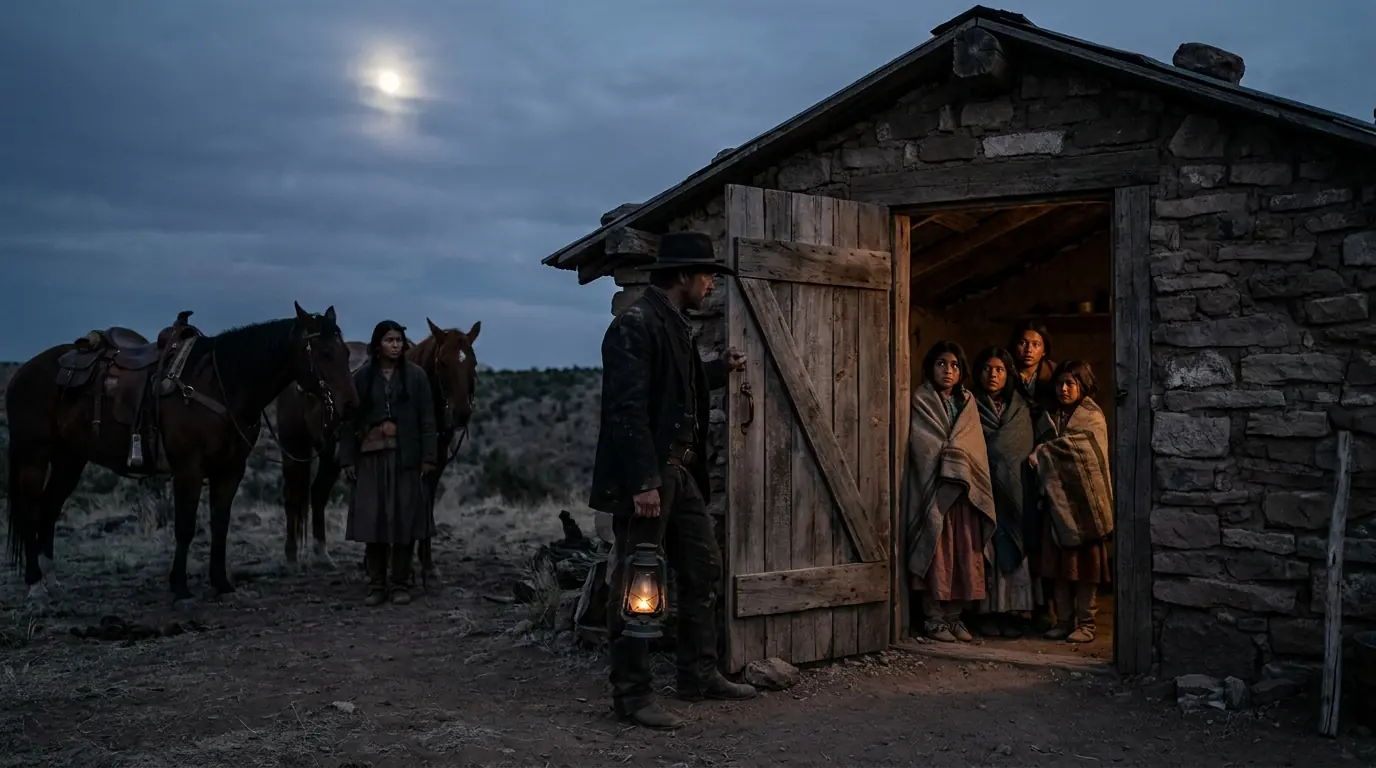
They approached Devil’s Rim under a moon three days past full. Bright enough to see by. Dark enough to hide movement.
Jesse, Marcus, and Nala rode single file, leading a spare horse.
The cave entrance was exactly where Marcus said it would be, hidden behind a thick stand of mesquite.
They dismounted. Jesse and Marcus checked their gear one final time. Colt pistols loaded six rounds each. Winchester rifles twelve rounds each. Rope, knives, lantern, matches, water.
Nala would split off here. She’d circle north to the ranch, wait for the guard change at midnight, then stampede the horses and set the hay pile on fire. The chaos would last maybe ten minutes. Long enough for Jesse and Marcus to get in, free the sisters, and get out.
If everything went perfectly.
Nothing ever went perfectly.
Nala faced Jesse in the moonlight. For a moment, neither spoke.
Then she placed her hand over his. Brief as a bird landing.
“If I do not return, tell Kiona I fought well.”
“Or you’ll tell her yourself.”
Her smile was small and sad.
“You honor my father’s memory, Jesse Walker.”
Then she was gone, vanishing into the darkness like smoke and wind.
Jesse watched the space where she’d been, feeling something shift in his chest. Not his failing heart this time. Something deeper.
“She’s quite a woman,” Marcus said quietly.
“Yeah,” Jesse said. “She is.”
They entered the cave.
The first chamber was fifteen feet to the ceiling, stable rock. Bats clung to the shadows above, disturbed by the lantern light. Their wings whispered like dry leaves as they shifted and resettled. Water dripped somewhere in the darkness. A steady pulse like a heartbeat.
Marcus led the way. He’d been through these caves before, sneaking supplies to Crane’s men when bad weather closed the main road. He knew the way.
The tunnel narrowed after one hundred feet, down to three feet wide, barely tall enough to crawl through.
Marcus went first. Jesse followed. The lantern in front of him. Winchester strapped to his back. The walls pressed close.
Jesse had been buried alive once during the war, pinned under a collapsed trench while shells exploded overhead. The memory tried to claw its way up from where he’d buried it. He pushed it back down, focused on breathing, on moving forward.
“You all right back there?” Marcus called.
“Fine. Keep moving.”
They emerged into the second chamber. This one was smaller, maybe fifty feet across, but the ceiling was high, and running through it was an underground stream four feet deep. Water so cold it made Jesse’s teeth ache just looking at it.
“We have to cross,” Marcus said. “Hold your rifle high. Current’s strong.”
They waded in.
The cold hit like a physical blow. Jesse gasped despite himself. The water pushed at his legs, trying to sweep him downstream into the dark. He planted his feet carefully, testing each step before committing his weight.
Marcus slipped, went under briefly, came up sputtering.
Jesse grabbed him, steadied him, and they pushed on.
On the far side, shivering and dripping, Marcus paused.
“Jesse, can I ask you something?”
“Now?”
“Because if we die in the next hour, I want to know.”
Marcus looked at Jesse in the lantern light, his young face suddenly older.
“You were cavalry. I can tell from the way you move, the way you check corners. You killed Apache during the war, didn’t you?”
Jesse was quiet for a long time. Then,
“Yes.”
“Do you regret it?”
“Every day. But regret doesn’t bring back the dead. Only action can balance blood. That’s why I’m here.”
Marcus nodded slowly.
“My brother used to say something similar. Before Crane killed him.”
They moved on.
The third chamber brought them directly beneath the ranch. They could hear voices above, muffled by layers of wood and earth.
The lantern showed a ladder. Iron rungs bolted to the stone, climbing twenty feet to a wooden trapdoor.
Marcus climbed first. At the top, he pressed his ear to the trapdoor, listening. Then he tried the handle. Locked from above.
Jesse climbed up beside him, drew his knife, and worked the blade into the crack between door and frame. The lock was simple, just a sliding bolt. It took five minutes of careful work, and Jesse’s hands were bleeding by the time he felt the bolt slide free.
They pushed the trapdoor open an inch. Darkness above. The smell of earth and potatoes.
They were in a root cellar.
Jesse and Marcus climbed through and stood in the darkness, letting their eyes adjust.
Voices filtered down from above. Guards talking.
“Crane says double the watch tonight. Thinks someone might try something.”
“Let them try. We got fifteen guns in a canyon. Nobody’s getting in.”
The voices moved away.
Jesse and Marcus crept up the cellar stairs. At the top, Jesse pressed his eye to a crack in the door. He could see the prisoner shed outside, maybe forty feet away. Small building, rough lumber, bars on the single window. Two guards stood outside, one young, maybe seventeen, the other older, maybe thirty, both armed with rifles.
The young guard was Apache. Swiftbird, probably. Even from here, Jesse could see the conflict in the boy’s posture. The way he held himself like a soldier but couldn’t quite kill the uncertainty in his eyes.
Jesse turned to Marcus.
“I’ll take the left guard. You take Swiftbird. Quiet. No shooting unless we have to.”
They slipped out of the cellar through a different door, one that opened behind the prisoner shed. Circled around in the darkness. The moon had set. Good. Darkness was their ally now.
Jesse approached from behind. The older guard never heard him. Jesse’s arm went around the man’s throat, cutting off his air and the blood to his brain simultaneously. The guard struggled for maybe eight seconds, then went limp. Not dead, just unconscious. Jesse lowered him silently to the ground.
Marcus moved on Swiftbird, but Marcus was nervous, inexperienced. He fumbled his approach. Swiftbird started to turn, started to raise his rifle, started to yell.
Jesse’s knife flew. It was instinct, pure reflex from twenty years of staying alive. The blade took Swiftbird in the shoulder, spinning him around and dropping the rifle from his hands. The boy gasped, but didn’t scream.
Jesse was on him in two steps, hand over his mouth.
“Easy,” Jesse whispered in Apache, a language he’d learned during the war. “Easy, young warrior. We’re not here to hurt you.”
Swiftbird’s eyes were wide with shock and pain, but he didn’t fight. Maybe because of the knife in his shoulder. Maybe because something in Jesse’s voice reached through the years of Crane’s conditioning.
“We’re taking the Black Feather sisters,” Jesse said still in Apache. “You can raise the alarm or you can let us pass. Your choice. But know this. Your real family is looking for you. A woman named Diving Hawk, your aunt. She never stopped searching.”
Something flickered in Swiftbird’s eyes. Confusion. Memory trying to surface through the wall Crane had built around it.
Marcus appeared with rope. They tied Swiftbird quickly but not cruelly, gagged him with cloth. The boy watched them with those confused eyes as they carried him into the prisoner shed.
Inside, two cells. Two young women chained to the wall.
The older one, maybe twenty, looked like Nala. Same high cheekbones, same dark eyes. But where Nala’s face was hard with anger, this woman’s face was gentle, even in fear.
Kiona.
The younger one was maybe twelve, small and thin, her hair cut short and ragged. She looked at Jesse and Marcus with eyes that held terror, but also a fierce refusal to break.
Yazi.
“Who are you?” Kiona asked, her voice weak with fever.
Jesse drew his bolt cutters and began working on her chains.
“Friends of your sister Nala. We’re getting you out.”
Yazi’s eyes went huge.
“Nala? She’s alive? Crane said she was dead.”
“She’s very much alive. And very angry.”
The chain broke. Jesse moved to Yazi.
“Can you walk?”
“I can run if I have to.”
Kiona tried to stand. Her left leg gave out. Jesse saw the infected wound, recognized the smell of rot. She’d been whipped and the wounds had festered.
“I’ll carry her,” Marcus said.
They exited the shed, started back toward the cellar, and that’s when everything went to hell.
An explosion loud from the north side of the ranch. Then gunfire. Horses screaming.
Nala’s distraction, but it was wrong. Wrong timing. It was supposed to be fifteen minutes from now. After they were clear of the camp.
The ranch erupted. Men poured from the bunkhouse, half-dressed, grabbing weapons. Someone rang a bell, loud and frantic. Flames rose from the hay pile, lighting the night orange and red.
Jesse and Marcus were forty feet from the cellar when three ranch hands ran past, heading for the prisoner shed. They saw the empty building. Then saw Jesse and Marcus with the two women.
“Prisoners escaped! They’re here!”
The alarm bell changed rhythm now. Everyone knew.
Jesse shoved Yazi toward Marcus.
“Run. Get to the cellar. I’ll cover you.”
He turned and brought up his Winchester.
The three ranch hands were raising their rifles.
Jesse fired first. Three shots, three seconds. The first man went down with a bullet through his chest. The second took one to the leg and collapsed, screaming. The third dove for cover.
More men coming. At least eight, maybe ten.
This wasn’t a rescue anymore. This was a fight.
Jesse fired again and again, laying down covering fire. Marcus disappeared into the cellar with both sisters.
Good. Get them out. That’s all that mattered.
A bullet cracked past Jesse’s head, close enough to feel. He dove behind a water trough. Return fire came from everywhere. Bullets punching holes in the wood. Water leaking out in streams.
Then Nala appeared.
She came riding in on a huge black horse, Crane’s own stallion from the look of it, firing arrows while the horse galloped. Her aim was impossible. Perfect. Deadly. Two men went down before they even saw her coming.
“Jesse!” she screamed. “This way!”
Jesse ran. Bullets chased him, kicking up dirt at his heels.
Nala pulled alongside, reached down. Jesse grabbed her arm and swung up behind her in one motion. The black horse didn’t even slow.
They were racing for the canyon entrance when Silus Crane stepped out of the ranch house.
Jesse had never seen the man before, but he knew him instantly. Tall, broad-shouldered, wearing a long black coat despite the summer heat. He held a shotgun like it was part of his arm. His face was weathered hard, the face of a man who’d killed many times and slept well afterward.
“You think you can steal my property?” Crane’s voice carried clearly over the chaos. “I’ll kill every one of you.”
He raised the shotgun and fired.
The buckshot spread, caught Marcus in the back. Jesse heard the young man scream, saw him stumble and fall. Kiona and Yazi went down with him, tangled in his arms.
Jesse tried to turn the horse, but Nala grabbed his hands.
“No. Leave him. We go now.”
“He’s dying.”
“We’re all dying if we stay.”
Jesse saw Marcus on the ground. Saw the blood spreading across his back. Saw Kiona trying to crawl to him. Saw Yazi crying. Saw Crane reloading the shotgun.
Every instinct screamed at Jesse to go back.
But Nala was right. If they stayed, they all died.
Jesse made the choice. The hardest choice.
He kicked the black horse forward.
They scooped up Yazi in one motion, but Kiona was too far and Marcus was going limp.
Jesse wheeled the horse and charged back anyway.
Nala screamed something in Apache, but Jesse ignored her.
He rode straight at Crane, drawing his Colt as he came.
Crane fired. Buckshot sprayed. Three pellets caught Jesse in his right side, burning lines of fire. But he didn’t fall.
He fired back. Three shots, forcing Crane to dive for cover.
In that moment, Jesse reached Marcus.
“Can you ride?”
Marcus coughed up blood.
“I don’t think so.”
Jesse grabbed him anyway, hauled him up with strength born of pure, desperate will. His heart screamed in protest, but he didn’t care.
He got Marcus across the saddle. Got Kiona up behind. Wrapped his own arm around them both to keep them from falling.
Nala appeared with two more stolen horses. Yazi on one. Swiftbird on the other. The Apache boy had broken free of his bonds and chosen a side.
They rode hard for the canyon entrance.
Behind them, Crane’s voice echoed like a curse.
“I’ll find you. You can’t hide. I’ll kill every one of you.”
Fifteen men on horses poured out of Devil’s Rim in pursuit. Gunfire lit up the night. Bullets zipping past, too many, too close.
One caught Jesse’s horse in the haunch. The animal screamed but kept running.
They made it to the canyon mouth. Made it into the open desert.
Behind them, the pursuit continued, but the horses were fresher, faster. They pulled ahead.
Jesse looked back once. Saw Devil’s Rim burning. Saw Crane’s silhouette against the flames. Saw the man raise his fist in rage.
Then they were swallowed by darkness and distance.
The fire in the cabin had burned down to coals when Ethan paused in his telling. Sarah sat unmoving, barely breathing, her eyes locked on his face.
“Marcus,” she whispered. “Did he die?”
Ethan reached for his coffee and took a slow sip. His hands, steady through the whole story, shook slightly now. The weight of memory.
“That’s the question, isn’t it?” he said softly. “And that’s where the story gets harder. Because my father made a choice that night. A choice that would haunt him for the rest of his life.”
He looked at Sarah.
“Do you want me to continue? It gets darker from here.”
“Yes,” Sarah said immediately. “I need to know how it ends.”
“It doesn’t end,” Ethan said. “Not really. These kinds of stories, they don’t have endings. Just places where we stop telling them.”
He stood, added another log to the fire. Sparks swirled up the chimney like fireflies.
Outside, the wind had died. Snow was falling now, silent and heavy.
“All right,” Ethan said, settling back into his chair. “Then let me tell you about the three days that followed. About how my father learned that some debts can never be fully paid. And about a woman named Nala Silverhawk who taught him that honor isn’t about winning. It’s about choosing to stand when running would be easier.”
The leather charm lay on the table between them. The Moonwing symbol catching the firelight. A promise kept. A debt acknowledged. A story still unfolding.
And in the dance of flame and shadow, the past reached forward to touch the present one more time.