The first time Vanessa Bellamy called Nathan Mercer's little boy a charity case, she did it in front of six neighbors and a car that looked as though it had been pulled from the bottom of a lake. Nathan was standing beside a borrowed flatbed trailer, his hands black with grease, trying to keep a rusted wheel from rolling off the ramp. His son, Caleb, stood on the porch with a one-eyed stuffed bear tucked against his chest. Vanessa watched them from the sidewalk, where the morning sun glinted on the white luxury SUV parked in front of her immaculate house.
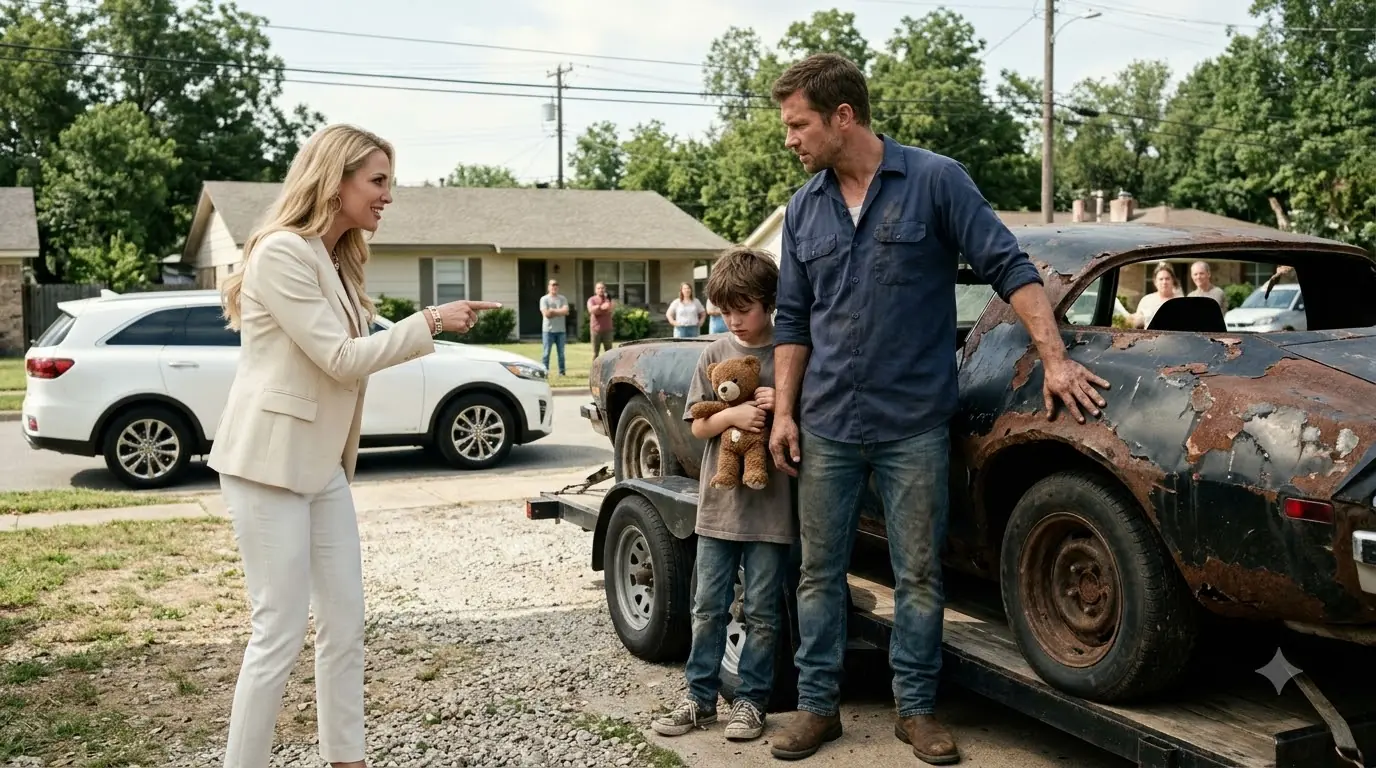
"A hundred dollars for that?" she asked, loud enough for the man walking his dog to stop. "Nathan, the scrap company would have charged you less to take it away. Isn't your son already wearing shoes from last year?" She turned toward the other neighbors with an indulgent smile. "Some people will spend their last dollar pretending they're going to become somebody." A few people laughed uneasily. Nathan felt Caleb go still behind him, and for one dangerous second he wanted to say something sharp enough to silence the whole street.
Instead he stepped between Vanessa and the boy. "Caleb, would you bring me the red toolbox?" he asked. His voice was steady, but not because the words had missed him. The child disappeared into the house, and Nathan lowered his eyes to the car's battered fender. He had spent a hundred dollars he could scarcely spare, and even he was not sure he had made the right decision. But there was something beneath the rust that had made him stop at the salvage yard that morning, something no amount of ridicule could explain away.
Five days later, a former racing champion would stand in that same driveway and offer five million dollars for the car. By then, Nathan would have been threatened with a lien, accused of stealing a national treasure, and forced to make a promise to his son that money alone could never keep. And the deepest secret of the car would have less to do with its price than with a woman who had been gone for two years and a letter she had never managed to send.
At thirty-five, Nathan had become exceptionally good at making small amounts of money stretch. He was a freelance mechanic in a town outside Columbus, Ohio, repairing engines in a converted two-car garage behind the narrow house he and his wife had bought when their future still seemed ordinary. His hours began before dawn because he had to finish customer work in time to pick Caleb up from school. He wrote every expense on ruled paper, checked the electric meter in winter, and knew exactly which grocery store marked down bread after six on Thursdays.