The morning light spilled across the marble lobby of Whitmore Capital Group, polishing every surface until the building itself seemed to be holding its breath. New York had not yet warmed. The screen above reception ran a soft loop of the company logo, gold over navy, while florists adjusted the white peonies along the event table.
Today, the firm would sign the largest real estate investment agreement in its history. A contract that would add hundreds of millions of dollars to the company's valuation by the close of business. The lobby filled slowly with the kind of people who never arrived in a hurry. 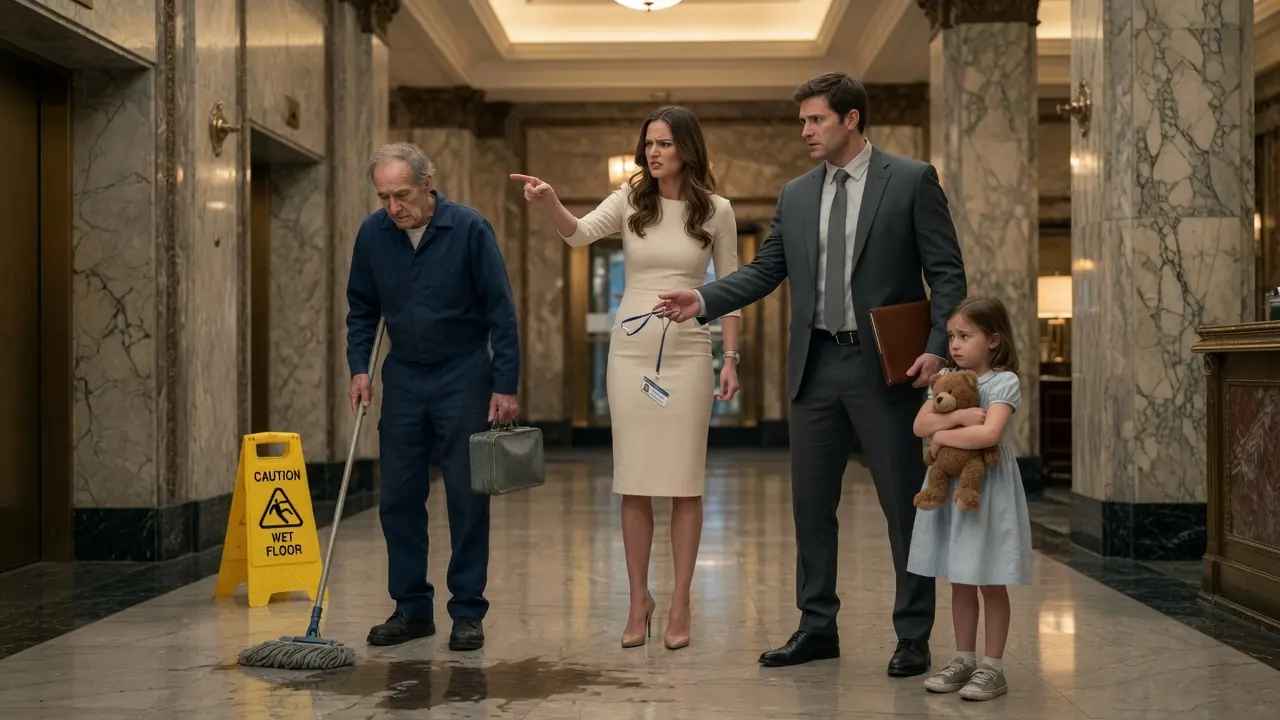
Investors in dark wool. Lawyers with slim leather folders. A line of reporters checking microphones at the press riser. Department heads in matching navy suits whispered into earpieces, repeating one word, "Ready."
The young chief executive had made it clear that nothing in this lobby would be allowed to look small, or old, or out of place. That was why George Bennett, 74 years old, was crouched near the corner of the executive elevator bank with a mop in one hand and a yellow caution sign in the other.
He had been at the building since just after sunrise, as he had been on every working day for 19 years. His uniform was clean and pressed in the careful way of a man who washed his own shirts in the sink. His hands shook a little when he was tired.
This morning, after a long night spent watching a leak no one else took seriously, he was very tired. The water was there again. A thin, persistent thread of it traveling down the inside of the wall from somewhere far above.
He had wiped the floor twice. He had placed the caution sign exactly where it needed to be. He had called the maintenance line at 6:00 in the morning, the way he had called it three times the previous week, the way he had filed his first report about this exact spot six months ago.
No one had answered. George straightened slowly. The soft chime of the executive elevator sounded behind him.
The doors opened. Scarlett Whitmore stepped into the lobby and the temperature of the room dropped a single degree. She was 28, the youngest chief executive in the firm's history.
Her hair was a deep, polished brown swept smooth over one shoulder. Her dress was a cream knit cut in a soft V at the collar, a color she had chosen because it photographed well against gray marble. Her heels were quiet against the floor, but everyone heard them anyway.
Conversations dropped half a register. She walked three steps before she saw the water. She saw the water before she saw George.
By the time her eyes reached him, the expression on her face had already chosen its target. "What is that doing on my floor?" It was not a question.
George opened his mouth to answer and at that moment a senior investor stepping off the express elevator slid on the wet stone. He did not fall. He caught the railing in time.
But the gasp that ran through the lobby was the kind of gasp that has consequences. Scarlett's voice, when she spoke again, was pitched precisely so the closest reporter could hear it.
"Do you have any idea what day this is?" George's hands tightened on the mop handle. "Ma'am," he said, "the water isn't from the floor.
There's a drip up by the ceiling near the air vent. I called it in last week and the week before and 6 months ago. I have the dates if you would like to see them."
"I asked," she said, "if you knew what day this was." George tried again in a smaller voice. "Yes, ma'am. I know what day it is.
That's why I was trying to." "Then you will understand," she said, "that today is not the day to embarrass this company by being too slow, or too old, or too unsure to do what a child could do."
Security." A guard stepped forward awkwardly. Scarlett pointed at George's identification badge. "Take that."
The guard hesitated. George reached up himself, with hands that did not stop shaking, and slipped the lanyard over his own head. He held the badge out quietly, the way a man hands over something he has worn for a very long time.
He set the mop against the wall. Then he bent to pick up a small metal lunchbox that had been sitting near the caution sign. As he did, the lid came open.
A single red apple rolled across the marble. No one moved to stop it. The apple turned twice, then settled against the heel of a reporter's shoe.
20 ft away, in the visitor waiting area, a man in his late 20s sat very still with a 6-year-old girl pressed against his side. The girl, Grace, watched everything with the wide, careful eyes of a child who knows that something has gone wrong, but cannot yet name it.
She tugged her father's sleeve. "Daddy," she whispered, "why is she being mean to him?" Connor Hayes did not answer right away.
He was 29, broad through the shoulders in a way that made the borrowed suit jacket sit a little stiffly. His hair was a dark, somewhat overgrown brown. His face had the steady quietness of a man who had been carrying weight long enough to forget what walking light felt like.
Two years ago his wife Emily had died of a heart condition that had taken 11 months from the first diagnosis. He had left his job in building safety inspection during the worst of it because Grace had needed him at home.
The hospital bills had not stopped arriving. The rent had not stopped arriving. After a year and a half, the resumes Connor had been sending out had begun coming back with the same gentle formulaic regret.
There was, employers said, a gap in his recent history. There was, they implied, an uncertainty about a young father with no child care backup. This morning's interview at Whitmore Capital was different.
Building safety supervision was something Connor knew the way a carpenter knows a saw. He understood air handling, condensate drains, elevator load patterns, the way a structure spoke through its small noises.
He had prepared for 2 weeks. He had pressed the suit himself the night before. He had brought Grace because the sitter had canceled at 6:00 in the morning and there had been no one else to call.
Now, watching an old man set down a lunchbox and pick up an apple from the floor of a marble lobby, the embarrassment of bringing his daughter felt very small. Grace tugged his sleeve again.
Daddy, why isn't anyone helping him? Connor looked around the lobby. He saw what she could not yet see.
A receptionist who had gone perfectly still behind her desk, a young engineer near the press riser who was looking at the floor, a security guard whose hand was on his radio but who had not yet pressed the button, a junior manager flipping his phone over and over again in his palm the way a man flips a coin when he does not want to call the outcome.
Connor knew that feeling. He had felt it himself twice on inspections years ago when a senior partner had asked him to overlook something that should not be overlooked.
He had said nothing those times. He had told himself that staying silent was the same as staying employed and that staying employed was the same as taking care of his family. Emily had not agreed.
Emily had said more than once that the worst kind of debt was the kind a man took out against his own conscience. He looked down at Grace. She was holding her stuffed bear.
The one with the worn left paw. The one she had carried into the hospital every day during her mother's last weeks. She was looking up at him with the expression Emily used to give him when she already knew the answer to a question but wanted him to find it himself.
He had taught Grace in small careful pieces over the past year that good people did not always win right away but they did not pretend not to see when someone was being treated unfairly. It had sounded simple in the quiet of their kitchen on a Saturday morning.
It did not sound simple now. He looked back at the wet marble. He looked at the trail of water.
He looked more slowly at the corner of the ceiling above the elevator bank where a faint tea colored stain had bloomed across two ceiling tiles in a shape his old training recognized immediately. He had not known George Bennett 1 minute ago.
He understood now with the same quiet certainty that he was about to. Scarlett meanwhile had not become chief executive by accident but she had not become chief executive without help and that distinction was the engine of nearly every choice she had made for the last 14 months.
Her father, Edward Whitmore, had built the firm out of a single floor of leased office space in the late 1980s on the absolute conviction that a Whitmore could only ever be photographed in clean light. When Edward had stepped down the previous year, the board had voted Scarlett into the corner office by a margin of three votes.
Three votes was not enthusiasm. Three votes was a question mark with a deadline. She had been told in private that she had 18 months to prove she could carry the brand.
Today's signing was 9 months in. Today's signing was the proof. She had spent the last 6 weeks rebuilding every visible inch of the firm.
The lobby flowers were her decision. The uniforms of the front desk staff were her decision. The wattage of the lights, the angle at which the security guard stood near the doors, all of it, her decision.
She believed, with the inflexible faith of someone who had been told too many times that they were not enough, that a company was the sum of what people saw when they first walked through its front doors. George Bennett did not fit inside that belief.
He had always been there, near the edges of her field of vision, a small old man in clean uniforms who shuffled rather than walked, who spoke to no one. She had never disliked him. She had simply never seen him.
He had been part of the building, the way the marble was part of the building. And now, at the worst possible moment, the marble was speaking back. She did not, in that first instant, ask herself why the floor was wet.
She thought instead about the senior investor's near fall. She thought about the reporter to her left. She thought about Henry Whitmore, the white-haired board member standing 30 ft away, watching her the way he had watched her in every meeting since the vote.
And so she chose the only response her training, her fear, and her exhaustion would allow her to choose. She found a target small enough to silence. She silenced him.
She did not know, as the apple finished its small useless arc across the floor that she had just told an entire lobby of investors, lawyers, and reporters something about herself that she had spent 14 months trying to hide. The lobby held its breath for almost 12 seconds.
In that time, every person who had any reason to know the truth knew that someone should speak. The receptionist behind the desk, a woman named Margaret Doyle, had logged 17 of George's calls about the leak. She did not move.
A young engineer near the press riser, Thomas Riley, had stood in the mechanical room on the mezzanine just 3 days ago and heard the slow ticking of a drip pan that had overflowed twice in a month. He had written it up. The entry had been marked low priority.
He did not move. The security guard with his hand on his radio, Robert Cleary, had seen George stand under that exact stretch of ceiling on three separate mornings with a notepad. He did not move.
The junior manager flipping his phone, Adam Pierce, had received an email from George 4 days earlier asking, "Please for someone to look at the leak." He had not forwarded it.
He had been told that no negative maintenance reports were to surface before the signing. None of these people were cruel. They were what most rooms are when they go silent, ordinary, frightened, calculating the cost of speaking and finding it higher than the cost of looking away.
This is the harder truth that the morning would eventually teach. The injustice in front of them did not survive because Scarlett was powerful. It survived because every one of them, for very good and very personal reasons, decided that someone else should be the one to interrupt her.
George, meanwhile, did the only thing he knew how to do. He gathered himself. He picked up the apple.
He returned it gently to the lunch box. He closed the lid. He set the box down again with the slow patience of someone who has been moved out of a great many places in his life and has learned not to make noise about it.
In the waiting area, Grace Hayes leaned closer to her father and her small hand found his. "Daddy," she said again. "Please."
Connor Hayes stood up. He did not stand up in anger. He stood up the way a man stands up when he has finally heard the question his daughter has been asking him for 2 years.
The sound of his footsteps on marble was the only sound in the lobby. He did not go to Scarlett first. He went to George.
He bent down and picked up the metal lunch box and he handed it to the old man with both hands the way he had been taught very long ago to hand something to an elder. "Sir," he said quietly enough that the reporters had to lean in to hear it.
"Are you all right?" George looked up at him in confusion. The kindness, after so much cold, seemed to take him a moment to translate. He nodded.
He did not trust his voice. Connor straightened. He turned then to face Scarlett.
His expression was not angry. It was the expression of a man who had just decided what he could and could not live with. "And you are?"
"Connor Hayes." "I have a 9:30 interview with Mr. Halliday upstairs." "The position is building safety supervision."
"How charming," she said. "If you wanted to make an impression, Mr. Hayes, this is a creative way to do it." A couple of nervous laughs from the back of the lobby.
Connor did not react. "Ma'am," he said, "the water on this floor did not come from his mop." He pointed calmly to the ceiling above the elevator bank.
"There is a stain on those two tiles. It is old. It is the color you get when condensate has been seeping out of an air handler drip pan for several weeks.
You can see the line of the drip on the wall under the vent. It tracks down to the corner. The puddle on the floor is not a splash.
It is a trail. If he had spilled it, it would have spread in a circle. It did not.
It is coming down." The lobby was very quiet. He did not make this puddle, ma'am.
He was trying to stop it from getting bigger. And from what he just told you, he has been trying to stop it for 6 months. Scarlett stared at him.
I am not suggesting anything. I am telling you what I see. I used to do this work.
He did not say the rest. He did not say that his father had done it before him. He just held her gaze.
Henry Whitmore, the white-haired board member, stepped a single pace forward. He did not speak yet, but Scarlett saw the step. And the lobby saw her see it.
Scarlett did the calculation in front of 300 people, and her face did not quite hide the math. She could apologize. She could pull back.
She could call maintenance, order an inspection, walk the senior investor to the executive lounge for coffee, and quietly reposition the morning as a near miss bravely caught. She did not choose any of that.
She chose instead the harder thing for her, which was to win. "Mr. Hayes," she said, "I appreciate the impromptu lecture, but I want to be clear.
I do not know you. I do not know your father. I do not know what you used to do.
What I do know is that you brought a child to a job interview." She turned her gaze deliberately to Grace. Which tells me very precisely how badly you need this position.
Connor said nothing. Now, Scarlett continued, the man you are defending was, before you arrived, going to leave my building today with the dignity of a quiet exit.
You have changed that. You have made him a problem. You have also made yourself one.
And I have a long memory, Mr. Hayes. So does this firm. So do our partners.
Grace's hand tightened around the strap of her bear. Connor felt it without looking. George took half a step forward.
Sir, he said softly, please, I am all right. Don't lose your interview over an old man's spill. It was the most George had said all morning.
Connor heard the gentleness of it, the lifelong habit of a man making himself smaller so that other people would not be inconvenienced. He looked down at his daughter. Grace did not say anything.
Her eyes were asking him the only question that mattered. He turned back to Scarlett. Ms. Whitmore, he said, if the price of this job is staying quiet while you humiliate a man who has not done anything wrong, then I am not poor enough to pay it.
Somewhere in the back of the lobby, someone exhaled audibly. Scarlett's jaw moved once before her face controlled it. Then I think your interview is over.
I think you are right. Security, please remove Mr. Hayes and Mr. Bennett from the lobby. Robert Cleary stepped forward, the radio at his shoulder.
He did not look at Connor. He looked at the floor. He did not have to act.
Connor lifted the folder out from under his arm before Robert reached him. Before you have us walked out, Connor said, I think the board should hear why George Bennett wrote a report about this leak 6 months ago and why no one acted on it.
The room went still in a different way. Henry Whitmore took a second step forward. Connor opened the folder.
There were photocopies. Plain photocopies on plain white paper in the order in which they had been written. The top sheet was a printed email dated 6 months ago.
The sender was George Bennett. The recipient was a building services manager. The subject line read recurring water trace, executive elevator bank.
In seven careful lines, George had described the location of the stain, the times he had observed water on the floor, the placement of the caution sign, and the request that the air handler on the mezzanine be checked for condensate pan overflow. Connor handed the page to Henry Whitmore without comment.
Henry read it slowly. He turned the page over. He read the next one.
It was a similar email dated 3 months ago. The third was a week old. The fourth was a maintenance log entry in which George's report had been downgraded from priority two to priority four, non-urgent, with no signature attached.
There is also, Connor said quietly, a series of photographs time stamped showing the stain growing week over week. Henry looked up. He looked at George.
George, he said finally. George Bennett. George lowered his eyes.
Forgive me, Henry said almost to himself. He turned to Scarlett. You do not know who he is, do you?
Scarlett did not answer. This man, Henry said, was on the original operations crew of this building. He worked on the mezzanine air handlers before we put marble on the lobby floor.
He is the reason this building did not have to close for 6 months in 1996. He noticed a pressure differential in the auxiliary pump room 2 days before it would have failed.
He stayed all night to keep the system stable until we got engineers in. There is a small brass plaque in the basement service corridor with his name on it. We put it there ourselves.
He moved into the janitorial staff, Henry continued, after his wife became ill. He asked for the early shift because the hours suited her treatment schedule. He has been in this building for 19 years.
Henry turned the photocopies face down on the reception counter. And you, he said to Scarlett, his voice level, called him a retirement home problem. In front of every investor in this room.
On the most important morning of our year. Scarlett's face had gone the color of paper. George Bennett, for the first time that morning, looked up.
He looked at Henry. He looked at Connor. He looked with confused, careful eyes at Grace.
Grace did not understand a single financial sentence that had just been spoken. But she understood the expression on the old man's face. She slipped her free hand into his.
The senior investor who had nearly fallen on the wet stone stepped forward then. He was a man in his 60s with the kind of quiet voice that becomes loud in a quiet room. Mr. Whitmore, he said to Henry, I would like to see the building services log.
And I would like to ask, he continued, turning to Scarlett, whether the leak referenced in these emails is the same one that nearly put me on the floor of your lobby this morning. Because if it is, and if a member of your staff has been writing about it for 6 months, and no one in your management has acted, then I would like to understand the nature of that delay before I sign anything.
It is a minor mechanical issue, Scarlett began. Ms. Whitmore, Connor said gently. It is not the leak.
It is the report. If a building employee files a safety warning in writing three separate times and that warning is downgraded by management before an investor event that is not a maintenance problem. That is a governance problem.
He had not raised his voice. He did not need to. The senior investor was already putting his pen down.
A second investor opened a portfolio and began to write. A third was already on a phone speaking in low urgent sentences. I would like, the senior investor said the signing to be paused until an independent inspection can be conducted today.
I think it is necessary, Henry Whitmore said. The reporters lifted their cameras. And then a voice from near the press riser said quietly, I want to add something.
It was Thomas Riley, the young engineer. He looked terrified. The mezzanine air handler condensate pan has been overflowing intermittently for at least six weeks, he said.
I logged it. The log was downgraded. I was told that we do not surface negative reports in the week before a signing.
Margaret Doyle the receptionist stood up behind her desk. Mr. Bennett, she said, voice trembling, called the maintenance line at 6:00 this morning. And at 6:00 on Tuesday.
And at 6:00 the Tuesday before. I have the call logs at this desk if anyone would like to see them. Robert Cleary, the security guard, finally lowered his hand.
I will attest to that, he said. Three months of mornings. Adam Pierce did not say anything.
But he turned his phone face down on the press riser, which in a small private way was its own confession. Scarlett opened her mouth. She did not, this time, find anything to say.
The morning had not turned against her the way she had been afraid mornings would turn against her, slowly, in board reviews and quarterly numbers. It had turned against her in 20 minutes, in front of every camera she had personally invited.
She tried, even then, one more time. "Mr. Hayes," she said with the last of the steel in her voice. "I would like to know how, exactly, you happened to arrive at my interview this morning with a folder full of internal correspondence belonging to my employee?"
It was the right question, asked too late. "Not all of these documents are internal," he said. "Some are copies George kept for himself.
He gave them to no one this morning. He has, in fact, asked me to stop talking three separate times. The other papers in the folder are from my father."
He paused. "My father was Patrick Hayes. He worked in this building's safety inspection program from 1991 until 2007.
He passed away 4 years ago. He left me a box of professional papers. Two months ago, when I started preparing for this interview, I went through that box."
He drew out a single envelope. The paper was yellowed at the corners. He removed a folded letter from inside it.
"I am not going to read all of it," he said. "He wrote it to me when I was 19, and a lot of it is private. But, there is a paragraph I would like to read out loud because it explains why I am standing here."
Henry Whitmore nodded once. Connor read. "If you ever meet a man named George Bennett, I want you to thank him for me.
There are people in every building who hold it up without ever appearing in any photograph of it. George is one of them. I am alive to write this letter to you because one night in the spring of 1996, when a high pressure line in the auxiliary pump room cracked and the room began to fill, he pulled me out before the steam reached the door.
He never asked for credit. He has never in 19 years told anyone that story. If you meet him, you do not need to make a fuss.
Just shake his hand and tell him your father did not forget." Connor folded the letter again. He did not, for a long moment, speak.
George Bennett's eyes had filled. He turned his face away, the way some men of his generation will when they do not want a room to see them feel something. Grace, very small and very serious, reached into her father's pocket, found a folded tissue, and offered it to George without saying a word.
The old man took it. He did not use it. He simply held the tissue and looked at the little girl as if she had handed him the entire morning back.
Henry Whitmore took out his phone. Two minutes later, two engineers came down from the mezzanine. Their faces were pale.
"The condensate pan is overflowing into the inside of the wall," one of them said. "There is a cracked joint. If we do not shut down the unit and reroute the drain, water is going to keep coming into this lobby for the rest of the day."
The signing was paused, on the record, at 10:32 in the morning. The next 2 hours did not look the way Scarlett had imagined the morning would look. She did not lose everything.
She did not collapse in front of a camera. She did not, as she had quietly feared in some recurring dream of failure, find herself walking out of the building with a box of personal effects under one arm.
The cost of the morning, for her, was both smaller and more permanent than that. The board convened in the executive boardroom on the 22nd floor at 11:15. The signing was officially postponed.
The lead investor's communications team issued a single sentence to the press. Pending an independent safety audit, the agreement remained under review. By noon, the firm's legal team had opened an internal inquiry into the downgrading of maintenance reports.
By 2:00 in the afternoon, three mid-level managers, including Adam Pierce's supervisor, had been placed on administrative leave. At 3:30, Henry Whitmore asked Scarlett to step out of executive responsibility for the duration of the inquiry.
He did not raise his voice. He did not say she had failed. He said, instead, that the firm could not be seen to be evaluating itself while the chief executive remained at the table.
He said it the way Edward Whitmore would have said it, if Edward Whitmore had been the one to do it. Scarlett did not argue. She nodded once.
She returned to her office. She closed the door. And for the first time in 14 months, she sat at her desk without doing anything.
The cost, as the financial press would later describe it, came in three layers. The first was a temporary suspension from executive duties pending the outcome of the audit. The second was the board's quiet, unanimous decision that when she was reinstated, it would be with a senior operations officer placed alongside her.
The third was personal. She had built her professional identity on the idea that her judgment, in moments of pressure, could be trusted. The morning had told her, in front of every person whose opinion she had been hoping to earn, that it could not be.
George Bennett was offered, formally, a senior advisory role on building safety. He declined the title. He accepted the function.
He asked for one thing, in writing. He asked that the firm create a direct reporting channel for janitors, security staff, and frontline technicians to file safety concerns that could not be downgraded by any single manager. The request was granted by the end of the week.
Connor Hayes was offered the position he had originally interviewed for, plus a slightly different title. Before he accepted, he asked Henry Whitmore one question. "If I take this job," he said, "and I find something the leadership does not want me to find, do I have the standing to report it?"
"Mr. Hayes," Henry said, "after this morning, I believe that is the only kind of standing this firm should have." Connor accepted on the spot. By the end of the day, the lobby was nearly empty.
The event table had been wheeled away. The screen had gone dark. Half-drunk cups of coffee sat on the press riser.
The marble floor, finally, was dry. George Bennett sat in the small maintenance room at the back of the basement service corridor. He had not been back in this room as a member of the technical staff in almost two decades.
The schematics on the wall were the same schematics. The pencil marks in the corner of the air handler diagram were his own. He sat very quietly with his lunch box on his knees and looked at all of it.
Scarlett came down to find him. The cream knit dress was the same. The heels were the same.
But the held-together quality of her face, the carefully managed angle of her chin, was gone. She stood in the doorway for almost a minute before he noticed her. "Mr. Bennett," she said.
He looked up. "I'm sorry," she said, "for what I said, for how I said it, for the place I chose to say it, for the years before I said it, in which I never bothered to learn your name."
George did not answer immediately. He set the lunchbox aside. He motioned with one shaking hand to the metal stool across from him.
She sat down. It was not a graceful sitting. It was the sitting of a young woman who had been on her feet in heels for too many hours.
"I do not want you to apologize to me on the news," George said. "And I do not want you to lose your job." "That is not what I came to work for.
I came to work this morning because the floor needed to be safe. That is all." "I know what I would like," he said, "is for you to understand something.
A building does not stand because of the people who cut the ribbons. A building stands because someone arrives before the lights come on, and someone listens to the sound of the machines, and someone puts a yellow sign on the floor when no one else has noticed the danger yet.
If you cannot see those people, Ms. Whitmore, you cannot run this place. It is not about kindness. It is about whether you can see."
She did not answer. He nodded once, more to himself than to her, and picked up his lunchbox again. Upstairs, Connor Hayes was walking out the front doors with his daughter's small hand in his.
The sky over the avenue had gone a soft early evening blue. Grace was holding her stuffed bear by one arm, the way she always did when she was tired and trying not to show it. "Daddy?"
"Yes." "Why wasn't Mr. Bennett mad?" Connor thought about that for a long time before he answered.
"Because people with their own kind of strength," he said, "do not need to hurt anybody to prove they are right. He told the truth. The truth did the rest.
That is all he ever needed it to do." Grace nodded slowly. The next morning, George Bennett came back into the building at the usual hour.
The security guard opened the door for him and said, "Good morning," by name. The receptionist stood briefly behind her desk and smiled at him as he passed. A young engineer in a hallway helped him carry his tool bag without being asked.
He did not say very much. He simply walked across the marble lobby toward the maintenance corridor, a little slower than he had walked the day before, but with his back straighter, the way a man walks when the room he is moving through has agreed, finally, to see him.
Connor stood near the reception desk in a new charcoal jacket, holding a tablet, looking up at the corner where the stained ceiling tiles had already been replaced. Grace sat in the visitor area with a coloring book. And when she saw George, she lifted her hand in a small wave.
George nodded back at her as if to thank her for the simple fact that her question, that morning in the lobby, had reminded her father what kind of man he wanted his daughter to remember him as. Power can silence a room for a moment. Truth, when one person is brave enough to speak it, can make that silence collapse into something better.
If you have ever stood in a room and watched a quiet person be treated as if they did not matter, remember this. Justice does not always begin with a shout. Sometimes it begins, very simply, with one person who is willing to say out loud.