The glass lobby of Hartwell Global caught the morning light and threw it back in sheets, polished, cold, indifferent. Expensive shoes crossed the marble floor without a second glance at the man guiding his mop cart along the far edge. Elias Flynn was used to that. He had learned, over the years, to exist in the margins of rooms that were never built for people like him. But on this particular morning, when he lunged forward and caught a small girl inches from cracking her head against a stone display table, the first sound to reach his ears was not gratitude. It was a command, sharp, loud, and aimed directly at him. 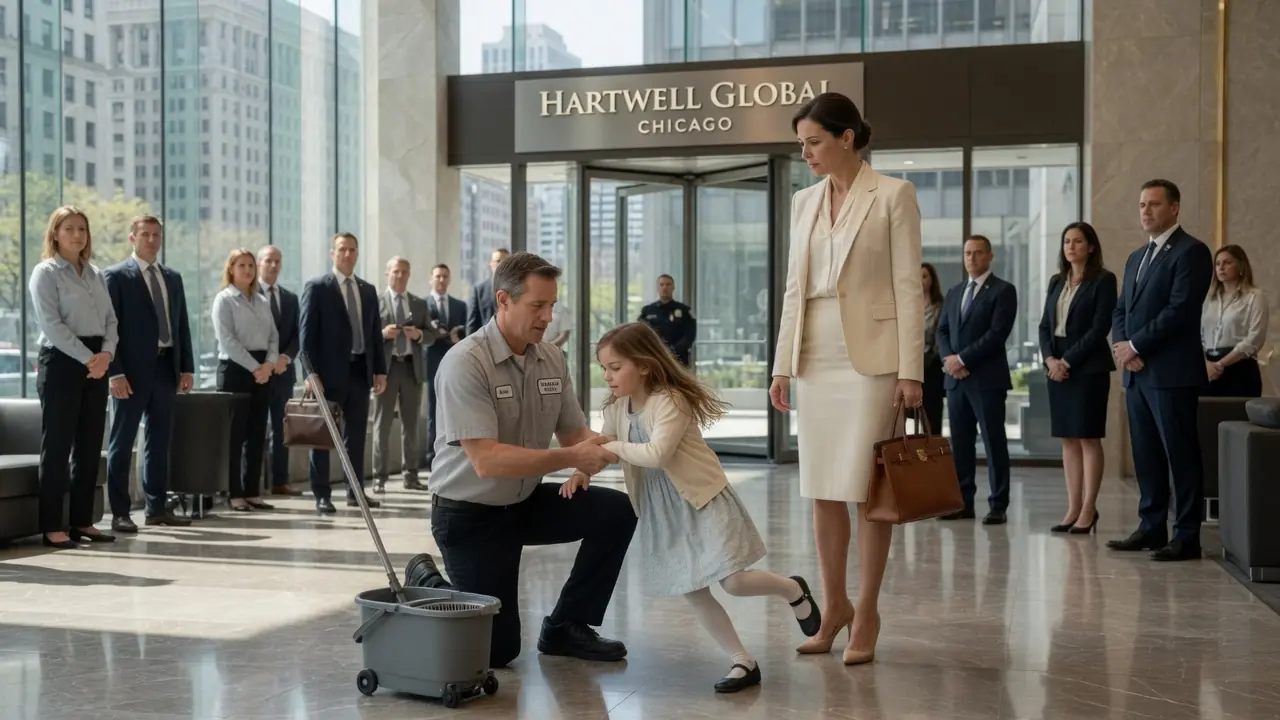
He hadn't even finished standing up before the verdict had already been delivered. The day had started the way most of his days did, quietly, in the dark, before anyone else was awake. Elias had set his alarm for 4:45, dressed in the bathroom so the light wouldn't wake Bonnie, and eaten half a piece of toast over the sink while reviewing the maintenance schedule in his head. His daughter was 8 years old and slept with her window cracked even in October, which meant he always checked the inhaler before he left blue cap, full canister, placed inside the front pocket of her backpack where she could find it without thinking.
He left her a note on the kitchen table, three lines. Don't forget the art project. Eat the eggs in the pan. I love you, kiddo. Bonnie would find it when she woke up and probably roll her eyes the way she always did when she thought he was being too careful. She was 8 going on 35. He didn't mind. The drive to Hartwell Global took 22 minutes on a clear morning. Elias parked two blocks away because the lot closer to the building charged by the hour, and he had done the math a long time ago.
He pushed his cart through the service entrance at 5:30, clocked in, and began where he always began, the east corridor on the ground floor, where foot traffic would pick up by 8:00, and the floor needed to be dry before then. Hartwell Global occupied the lower 14 floors of a tower in the center of the city. The lobby alone was larger than the apartment building Elias had grown up in. Marble floors, a reception desk made of pale wood and brushed steel, glass walls that turned the street outside into something that looked almost cinematic. The building was designed to make people feel important just by being inside it.
Elias had stopped feeling anything about the building a long time ago. It was a floor to be cleaned, a set of windows to be wiped, a hallway to be cleared of everything that made it look less than perfect. He had worked there for 2 years. Before that, he had spent 8 years doing building maintenance for a property firm downtown, inspecting systems, flagging structural issues before they became expensive problems. He had been competent in a way that people notice only after someone like him is gone.
His wife had died 14 months after her first diagnosis, leaving him with Bonnie, who was 6 years old, and a job he could no longer schedule his life around. He had taken the janitor position at Hartwell because the hours were predictable and the hiring process was fast. He told himself it was temporary. Two years later, he was still there, and he had quietly stopped using that word. He paused near the entrance to the main lobby and straightened the wet floor sign that someone had kicked slightly off center. He always did that, made sure the signs were placed where they would actually be seen.
The day ahead was one of the most important on the calendar, a strategic review with three international investment partners and two board members who had been asking questions she didn't want to answer yet. The kind of meeting where the air in the room was thicker than usual, and everyone was watching to see if she blinked. She was not going to blink. Audrey had built Hartwell Global into what it was over the past 6 years, not inherited it, not married into it, but built it from a regional property management company into a full-spectrum building technology operation.
She was 34 years old, and she ran it with the precision of someone who understood exactly how quickly things could dissolve if she stopped paying attention. Daniel Hart had been killed in a car accident on a wet highway on a Tuesday evening in November 3 years ago. Matilda had been 4. Since then, Audrey had kept her daughter close in a way that looked, from the outside, like love, which it was, but which also carried inside it a controlled fear that never fully released.
She monitored everything. She did not let things happen to her daughter that she had not already accounted for. This morning, her childcare arrangement had dissolved at 6:45 when her regular sitter called with a fever. There was no backup option that could arrive in time. Audrey had brought Matilda to the office before, though rarely, and only under conditions she could manage. Matilda sat in the backseat of the car now, wearing a soft cardigan the color of old cream, and holding her sketchbook against her chest like a shield. She was 7 years old and had the face of a child who thought more than she said. She had her father's eyes. Audrey tried not to think about that.
She settled Matilda in the cushioned chairs of the waiting area near the conference corridor, close enough to be seen from the glass-walled meeting room, far enough to feel like a contained arrangement. She promised lunch afterward. Matilda nodded without complaint before Audrey turned away. Matilda glanced toward the far end of the lobby. A man in a gray uniform was carefully repositioning a wet floor sign that someone had knocked out of place. He did it without looking up, without pausing, as if the rightness of the placement mattered to him in a way that required no audience.
Matilda watched him for a moment longer than she watched most people. By 9:15, the lobby had filled. The investment partners had arrived in a cluster, accompanied by liaisons who shook hands with practiced warmth that meant absolutely nothing. The board members came separately, guided toward the conference room with efficient choreography. Security was positioned at the corridor entrance. The entire floor had been calibrated to project competence and control. Matilda stayed in the waiting area for nearly 40 minutes. She was good at being still.
She had learned it the way most children learn things, by necessity and then by habit. She sat with her sketchbook open and drew the ceiling lights, which looked like suspended snowflakes if you tilted your head a certain way. But the waiting area had begun to feel too loud, too full of motion, too much like being inside something that was happening to other people. She slipped off the chair and walked quietly along the edge of the lobby toward the display area near the east wall, where Hartwell's architectural models were arranged under low-angled spotlights.
She leaned closer to look at one that resembled a tower with a glass spiral staircase running up its center. She didn't notice the floor. Elias had mopped this section an hour earlier. It was dry now, but the edge near the display table where the floor met the base of the stone platform was slightly uneven, a seam in the marble that caught moisture and released it slowly. He had flagged it twice in maintenance reports. Both times, the response was that it was within acceptable parameters.
Matilda's shoe caught the seam. Her body pitched forward, momentum carrying her head directly toward the hard right angle of the stone table's edge. Elias was 6 feet away. He didn't think. He dropped the cart handle and moved two strides and a lunge, catching her with one arm braced across her shoulders and one hand cupping the back of her head, pulling her backward and sideways and away from the stone in a single motion that put most of the impact onto his own knees against the floor.
He was crouched over her for less than 3 seconds before he realized she was unharmed. He began to straighten, one hand still steadying her shoulder. "You okay?" he asked. His voice was quiet, the way he talked to Bonnie when she had scraped a knee, not alarmed, just present. He heard the footsteps before he heard the voice. Audrey Callista Hart came across the lobby at a pace that had nothing common it.
She had looked up from the conference room, seen her daughter's silhouette near a man in a gray uniform, and the image had collapsed every rational thought she had. "Let go of her." The words came out in front of everyone, loud, flat, final. Elias released Matilda's shoulder immediately and straightened up. "Ma'am, she almost fell. The floor near the platform has a" "I said step back." Audrey moved between them, pulled Matilda against her, and turned to face him fully.
Her voice was still in that register, controlled fury, the kind that didn't shake. "This is a restricted area. You do not put your hands on my daughter." The lobby was not quiet anymore. Heads had turned. The investment partners were visible through the glass, watching. Two directors had stepped out of the conference corridor. A security guard was already moving toward them. "She was going to hit the table," Elias said, steady, no edge in it.
"We'll review the camera footage," Audrey said, not to him, but to the head of security who had arrived at her side. "I want an incident report filed." The security chief said yes without hesitation. One of the junior directors, standing near the reception desk, said something to the colleague next to him in a tone just loud enough to carry. Something about service staff and boundaries. Something about knowing better. Elias bent down and picked up the handle of his mop cart. He did not argue. He did not raise his voice. He said nothing more, but his hands, wrapped around the metal bar, had gone white at the knuckles.
They sent him to the service area at the back of the building to wait. His direct supervisor, a man named Garrett who had learned to survive 11 years at Hartwell by never attracting attention from the upper floors, found him there 20 minutes later. Garrett stood with the particular posture of someone carrying news he didn't want to deliver. "Look," Garrett said, "I'm not saying you did anything wrong, but the CEO is having a very bad morning and there are a lot of eyes on this. If you just If you go up to her floor and say you're sorry for the misunderstanding, the whole thing probably gets dropped."
Elias looked at him for a moment without speaking. "I'd lose the job if I pushed back," he said finally. It wasn't a question. Garrett didn't answer, which was an answer. Elias thought about Bonnie's school fees, which were due at the end of the month. He thought about the inhaler refill he needed to pick up on Thursday, which cost $42 with his current insurance. He thought about the registration form for the after-school art program she had showed him twice now. The one with the small star she had drawn in the corner of the flyer without explaining why she had done it.
He thought about all the small pieces of a life that required him to still be employed on Friday. He went to the men's room at the back of the building. He ran cold water over his face and stood in front of the mirror. For a moment, the tired eyes, the gray beginning at his temples, the set of his jaw that he couldn't quite release. He had been made into something unrecognizable in that lobby. Not a man who had caught a child before she fell. Not a father with eight years of maintenance experience who knew the seam on that floor was a hazard. Just a body in a gray uniform that needed to be managed.
It was not the first time someone had looked at him and seen only the surface. That knowledge didn't make the feeling smaller. He dried his face. He went back to work. Matilda, in the waiting area, was no longer drawing. She sat with the sketchbook closed in her lap. When Audrey came out briefly to check on her, the girl looked up and asked, very quietly, whether the man was hurt. Audrey said the matter was being handled. Matilda looked back down at the sketchbook, but did not open it. She pressed one small hand flat against the cover as if she were trying to hold something still inside it.
An hour after the incident, Elias was reassigned to the east wing corridor, far enough from the lobby to be out of the way, close enough that he could still hear the ambient sounds of the main floor through the glass partition. He worked steadily and did not let himself think too much. That was a skill he had developed over the past 2 years, the ability to compress feeling into something small and compact and push it aside until a moment arrived when it would be safe to look at it. But part of his attention, the trained part that had spent 8 years reading buildings the way other people read weather, was still running quietly in the background.
The east wing corridor connected to the main lobby through a set of automated glass doors, sensor-operated, heavy, calibrated to open and close on a 2-second delay. He had noticed, on his way through, that the mechanism was catching. The door hesitated before closing. It had been doing this for at least 3 days. He had mentioned it twice, informally, to the building maintenance log and once to a younger technician named Cole who had nodded and said he would put in a request. Near the doorway, positioned against the wall of the corridor, was a large decorative frame, a steel and glass architectural display piece, roughly 5 ft tall, that the events team had moved there the previous afternoon to clear floor space for the meeting setup.
It sat on a four-point base, two of which were properly leveled. The other two were not. Elias stopped and looked at it. He looked at the door. He looked at the frame. He looked at the floor beneath the base. He walked to the maintenance station at the end of the corridor and found Cole refilling a supply cart. "The frame near the east corridor doors needs to be moved," Elias said. "The base isn't level and the door sensor is misfiring. If it slams on the wrong cycle, the vibration could" "I hear you," Cole said. He didn't look up. "Everything's going through proper channels today. I've got six requests ahead of yours and the whole building is locked down because of the investor meeting. I'll get to it."
Elias stood there a moment longer. "It's a stability issue," he said. "I said I'll get to it." He walked back toward the east wing. He passed the waiting area on his way. Matilda was no longer in the cushion chairs near the conference corridor. He scanned the space briefly, then saw a pale cardigan moving slowly in the direction of the east wing corridor. He started walking faster. Inside the conference room, Audrey was standing at the head of the table. The presentation had recovered its rhythm after the disruption in the lobby.
She had composed herself with the efficiency of someone who had learned to separate personal turbulence from professional performance and the room had followed her lead. The investment partners were leaning forward. The numbers on the screen were the right numbers. She could feel the meeting beginning to tilt in the direction she needed. She did not look toward the lobby. She should have. Matilda had followed the sound of the automated doors not because she was drawn to them, but because the east wing corridor was quieter than everywhere else in the building and she wanted quiet.
She walked slowly, trailing one hand along the wall, watching the way the afternoon light came through the glass panels in long diagonal stripes across the floor. She stopped near the display frame. She looked at it. It was beautiful in the way tall things sometimes are imposing and still and self-contained. She reached out and touched one corner of the frame very lightly with the tips of two fingers. The automated doors chose that moment. The sensor, misfiring again, triggered a hard close cycle. The heavy glass panels slammed shut with a concussive sound that traveled through the floor.
The vibration reached the display frame's base in less than half a second. The two unlevel feet shifted. The frame swayed. In the conference room, Audrey heard the sound. She looked up. Through the glass wall and the open corridor, she could see her daughter's silhouette, small pale cardigan, standing directly beside a large shape that was beginning to move. She screamed Matilda's name. The sound hadn't even fully left her throat before Elias had already covered the distance. He came from the far end of the corridor at a dead run.
He had no time to calculate angles or assess weight distribution or think about anything at all. He threw his body between the frame and the child, one arm sweeping her backward, the other braced upward against the edge of the descending steel. The frame came down on his left forearm. One edge caught his upper arm and opened a clean line through the fabric of his uniform. His shoulder hit the floor hard enough to drive the breath out of him. He curled his body tighter around Matilda, keeping his arms around her head and back even as the frame crashed past them and struck the marble with a sound like something final.
Then there was silence. Real silence. The kind that follows something that was almost irreversible. Elias lay still for a moment, shoulder pressed to the cold floor, ears ringing faintly. He took one breath, then another. He loosened his grip and looked down. "Are you hurt?" he asked. His voice was rough but level. "Tell me if anything hurts." Matilda looked up at him. Her face was wet. He didn't know when she had started crying. She was trembling in the specific way that children tremble when the fear arrives after the danger is already passed all at once. From somewhere deep.
She looked at him for a long moment. Not at his uniform. Not at the blood beginning to seep through his sleeve. Just at his face. Then she wrapped both arms around his neck and pressed her face against his shoulder. "My hero," she said. She said it loudly, clearly. The way children say things when they mean them completely and without any awareness that the words might land on anyone besides the person they were meant for. They landed on everyone. The words moved through the corridor and into the open lobby and reached every person who had been standing in that space since 9:15 that morning, watching the man in the gray uniform be publicly dismantled.
Audrey Callista Hart stood in the doorway of the conference room. Her hand pressed flat against the glass. She could not move. The next 20 minutes happened the way emergencies happen in controlled environments, with sudden efficiency. With the arrival of people carrying radios and first aid cases. With the organized noise of a crisis being managed after the fact. The building's medical officer arrived first and knelt beside Elias while Matilda was gently encouraged to sit on a nearby bench. The cut on his arm was significant enough to require cleaning and pressure bandaging. His shoulder, which had absorbed the full force of a hard fall onto marble, would bruise deeply for the next 10 days.
Elias accepted the bandaging without comment. He kept watching Matilda. Audrey crossed the lobby in silence. She dropped to her knees beside her daughter and ran both hands over her face, her arms, her back, the inventory of a mother checking for damage she couldn't afford to find. Matilda was physically unharmed. A faint red mark on her forearm where the edge of the frame had grazed her in the first moment. Nothing more. Audrey pressed her forehead to her daughter's for a long moment with her eyes closed. Then she stood.
The building's security director, standing nearby with his incident tablet, said that the corridor cameras had already captured the full sequence of events. He said this as a professional note, not as accusation or absolution, just information. But the words landed on the gathered group like something heavy. Audrey turned to the nearest screen station and asked, quietly, for the footage to be pulled. It ran for 4 minutes. It showed Matilda crossing the lobby. It showed her stopping near the frame. It showed the door slam and the frame begin to tilt.
It showed Elias arriving at a run from 30 ft away, reaching her with less than a second to spare, putting his body between a falling 140-lb structure and a 7-year-old child. It also showed, if you looked back far enough, Elias steadying Matilda after she slipped near the stone display table that morning. His hand on her shoulder. His body crouching over hers. His face turned toward her with the particular attention of someone making sure she was okay before anything else. There was no ambiguity in any of it. The lobby was not as loud as it had been at 9:15, but it was not empty, either.
The investment partners were visible through the conference room glass. Two directors stood near the reception desk. The junior manager who had made the comment earlier had not yet found a reason to leave. Audrey stood in the center of the lobby and turned toward Elias. He was sitting on the bench beside Matilda, watching the medical officer seal the bandage on his forearm, not looking up. "Mr. Flynn," she said. He looked up. The words she said next were not rehearsed.
She would not have been capable of rehearsing them because she had never imagined needing to say them. She said she was wrong. She said she had reacted from fear and from a habit of certainty that had no business being as absolute as it was. She said that she had not given him the most basic thing one person owes another, the chance to be heard before being judged. And she was aware that acknowledging this in front of the people currently in this room did not repair what she had done. It only named it accurately.
She asked for the morning's incident report to be formally voided. She told the security director that she wanted a full review of the building's operations response process, specifically as it concerned safety flags from maintenance staff. She said these things directly, without softening them, without adding qualifications that would redirect the weight away from herself. The lobby was very quiet. Elias looked at her for a long moment. Then he looked back at Matilda. "Is she okay?" he asked. That was all he said.
The directors near the reception desk looked at their shoes. When the medical officer suggested moving Matilda to a quieter space for a proper check, the girl's reaction was immediate and clear. She gripped Elias's uninjured arm with both hands and said, "No." It was the loudest word she had produced all morning. She had not, since the frame fell, fully released her hold on him. Even when Audrey had knelt beside her and held her face in both hands, even when the medical officer had spoken to her gently and asked her name, Matilda had kept one hand anchored to the sleeve of Elias's bandaged arm.
She said again, when they tried to ease her toward a different seat, that he had saved her, that he had not let her fall, that he was her hero. She said this not as performance and not as the theatrical declaration that children sometimes make for attention. She said it with the quiet insistence of someone reporting a fact that she needed the room to understand. Audrey watched her daughter cling to a man she had met that morning. A man in a gray maintenance uniform with blood on his sleeve and a bruised shoulder. A man she had publicly accused, in front of 50 people, of being something he was not.
She had seen Matilda retreat over the past 3 years from most forms of contact. From relatives. From family friends who had known Daniel. From teachers who tried too hard to reach her. The walls had assembled slowly, quietly, the way a child builds defenses when the world has taught her that presence can disappear without warning. And yet, here was her daughter holding on. Audrey sat down on the bench a few feet away and watched Elias speaking quietly to Matilda about whether she wanted some water. Matilda answering in a small voice that yes, she thought she might.
The exchange was unremarkable in every detail and profoundly ordinary. And it was the most careful thing Audrey had witnessed in a very long time. On the car ride to the hospital, Matilda sat between Elias and the door. She was asleep before they reached the second intersection. One hand still loosely wrapped around his sleeve. Audrey sat across from them and looked at his face, the tiredness in it, the patience, the complete absence of any calculation about what this moment was worth to him.
He was watching Matilda breathe the way you watch someone breathe when the relief hasn't finished arriving yet. She had spent the morning seeing a uniform. She was only now beginning to see a man. Five days later, Audrey came to his door. She did not send Marcus. She had Matilda beside her carrying a folded piece of paper against her chest, and Audrey had a small container of food she had made herself badly, she would later admit, but genuinely because it was the only gesture that required no intermediary and no professional distance.
Elias opened the door looking like a man who had not been expecting company, which he hadn't. She had decided, after 3 days of trying to figure out how to properly do this, that calling ahead would let her compose herself too much. The apartment was small, two bedrooms and a kitchen that opened onto a living area just wide enough for a couch and a low table, but it was clean, the kind of clean that required sustained intention, and it was full of a life being carefully maintained.
A colored pencil drawing was taped to the refrigerator beside a handwritten weekly schedule. An inhaler sat on the kitchen counter in a specific spot, the way things are placed when their location needs to be found in the dark without thinking. One of the dining chairs had a different colored leg repaired with a piece of wood that didn't match but had been sanded smooth and secured with care. Bonnie appeared from the back hallway, barefoot, carrying a paperback book. She said hello, offered to get them water, and put the book down without being asked.
Matilda handed Elias the folded paper. He opened it. It was a drawing in colored pencil, four figures standing together, rendered with the confident imprecision of a 7-year-old who knows exactly what she means. A tall one and a shorter one on each side. Above them, a yellow sun with straight lines radiating outward. Beneath the figures, in careful, slightly tilted letters, "My hero." Elias looked at it for a long time. When Bonnie came back with two glasses of water, she paused behind her father and looked over his shoulder at the drawing. Then she said, in the straightforward manner of someone reporting a truth, "Dad's arm still hurts when it rains, but he doesn't say anything about it."
Audrey felt the sentence land somewhere she hadn't expected it to reach. She stayed for 40 minutes. Elias was polite and measured and kept a clear distance between courtesy and warmth. He answered her questions directly and did not ask many of his own, but he let them stay. And when they left, he walked them to the end of the hall. In the weeks that followed, Matilda began asking about Bonnie, not every day, but often enough that Audrey noticed. She would mention something Bonnie had said or wonder aloud whether the two of them could be in the same art class someday.
It was the kind of interest that children develop quickly and without strategy because they do not yet know that attachment carries risk. Audrey found reasons to be in the same neighborhood. She arranged a dinner, quiet, informal, at a place three blocks from Elias's building where the tables were close together. She brought Matilda. She said it was the least she could do, simply, without embellishment, and he said, "Okay." Dinner was not easy. There were stretches of silence and a few moments where the wrong thing hovered near the edge of the conversation before being set down again.
But Matilda and Bonnie sat at the corner of the table and divided a bowl of fries with the focused cooperation of children who have no time for adult complications, and the sound of the two of them arguing gently about who had eaten more was, by any measure, the most pleasant part of the evening. A second dinner followed. Then, a Saturday afternoon at the park where Elias noticed Matilda reaching for Bonnie's hand and not pulling away. He didn't say anything, but Audrey saw him notice, and she saw what moved across his face in the moment after.
She knew she was not forgiven. She was not sure she deserved to be. Not entirely. Not yet. She had changed things at Hartwell. Not performatively, but in the specific and durable ways that required effort and generated friction. A formal protocol requiring verification before incident reports were filed against service staff. A safety escalation path giving maintenance workers a direct line to operations leadership, a quarterly program on dignity in the workplace that her newly appointed director described as long overdue. Elias knew about the changes. He noticed them the way he noticed everything quietly, without announcing what he had seen.
One evening, standing outside the park while the girls chased something across the grass, he said without preamble, "I'm not going to pretend the morning didn't happen. I know." Audrey said, "I needed to say that." She looked out at the park. "I chose that moment, that place, to treat you like a problem in front of everyone who mattered to my reputation." She paused. "I'd like to not be that person anymore." "You're not asking me to decide that." Elias said. "No." She said, "I'm not."
They stood side by side in the cooling air without speaking. It was not comfortable, exactly, but it was honest, and it was real. And it was the first time in 6 weeks that something between them felt like neither of them was performing anything. Bonnie called from across the grass that Matilda had found a frog. Elias called back that she was not to put it in her pocket. Audrey laughed before she could stop herself. Elias looked at her sideways.
Hartwell Global held its annual community day in the second week of November, a half-day event in the building's lower floor common areas, open to employees and their families. Audrey had decided this year to actually be in the event rather than to appear at it. There was a difference, and she knew it. She stood at the welcome table for the first 40 minutes and spoke with people. She almost never spoke to the cleaning supervisor who had worked the early shift for 9 years, the security officer whose daughter had just started high school, the woman who ran the mail room and always brought homemade bread on Fridays.
She asked questions and let the answers land without steering them anywhere useful. Elias arrived with Bonnie at 11:00. Bonnie was wearing a jacket with a broken zipper that had been fixed with a small safety pin at the top. She took in the space with measured enthusiasm, not overwhelmed, just genuinely pleased. Matilda found her within 4 minutes. The two girls disappeared in the direction of the craft table, and Elias stood near the wall with a cup of coffee and watched them.
Audrey caught sight of Bonnie's shoelace coming undone near the edge of the activity area. She crossed the room before she was aware she had decided to move, crouched down, and tied it a double knot, firm, the way you tie a child's shoe when you have done it enough times that your hands know the shape of it without instruction. When she stood up, Bonnie said, "Thank you." in the tone of someone who meant it. Audrey said, "You're welcome." She turned and found Elias watching.
He was not smiling, but the expression on his face was different from any she had seen there before, something that required a moment to recognize, because she had only seen it on people who had decided, quietly and without announcement, to be a little less guarded about what they were feeling. At the end of the afternoon, Matilda ran across the room with another folded piece of paper and pressed it into Elias's hands without ceremony before running back to where Bonnie was assembling something out of pipe cleaners. He opened it. Four figures, a yellow sun, my hero in small, tilted letters across the bottom.
He folded it carefully and put it in the inside pocket of his jacket against his chest. That evening, Audrey appeared at his door. She was not wearing anything that suggested the office. She had on a coat she had owned for 5 years and boots that were practical and a look on her face that was simply itself, no armor, no performance, no professional distance maintained out of habit. She was holding a small white box from the bakery three streets over. "I was wondering." She said, "If you and Bonnie would want to come to the park on Sunday. Matilda has been asking." She paused. "And I" She stopped. Then she said it plainly, without dressing it up, "I would like it, too."
He looked at her for a moment. Then he looked past her into the hallway, where the evening had gone cool and still. Then he opened the door a little wider. "Come in." He said, "It's cold out there." The door stayed open behind them for a long moment before he reached back and gently pressed it closed, not all the way, not yet, but close enough to keep the warmth in. Outside, the city moved on, indifferent and bright. Inside, on the kitchen table, the colored pencil drawing of four figures beneath a yellow sun sat exactly where he had placed it, facing outward, lit by the lamp in the corner. He hadn't framed it yet, but he had already decided that he would.