The fluorescent lights hummed softly beneath the manufacturing floor as Adrian Cross walked through the basement corridors of Crosswell Industries.
It was nearly midnight on a Thursday.
Above him, the massive factory had settled into its quietest hours. Most assembly lines had stopped. Shipping bays were dark. Only the night maintenance crew, security staff, and a handful of technicians remained inside the building.
Adrian preferred the company at night.
During the day, people prepared for his arrival.
Supervisors straightened their desks. Managers rehearsed explanations. Department heads made sure the safest, cleanest, most efficient parts of the operation were the ones he saw.
At night, the building told the truth.
Adrian had founded Crosswell Industries fifteen years earlier with three employees, a rented workshop, and one manufacturing contract nobody else wanted. At thirty-eight, he now employed nearly twelve hundred people across two facilities.
Business magazines described him as disciplined and visionary.
His employees used other words.
Demanding.
Private.
Difficult to impress.
Adrian knew the reputation.
He had helped create it.
That evening, he entered through a side door using his executive access card and began an unannounced inspection. He checked the loading area, the maintenance logs, and a section of the production floor where several machines had recently failed inspection.
Nothing appeared unusual until he reached the oldest basement corridor.
A faint strip of light showed beneath the door of Supply Room B-7.
Adrian stopped.
The room should have been locked.
It contained industrial cleaning chemicals, replacement filters, paper products, and maintenance supplies. No employee had any reason to remain there after collecting what was needed.
He approached quietly.
At first, he heard nothing.
Then came the faint sound of breathing.
Adrian rested one hand on the handle.
His first thought was theft.
His second was that two employees might be using the room for something inappropriate.
He opened the door carefully.
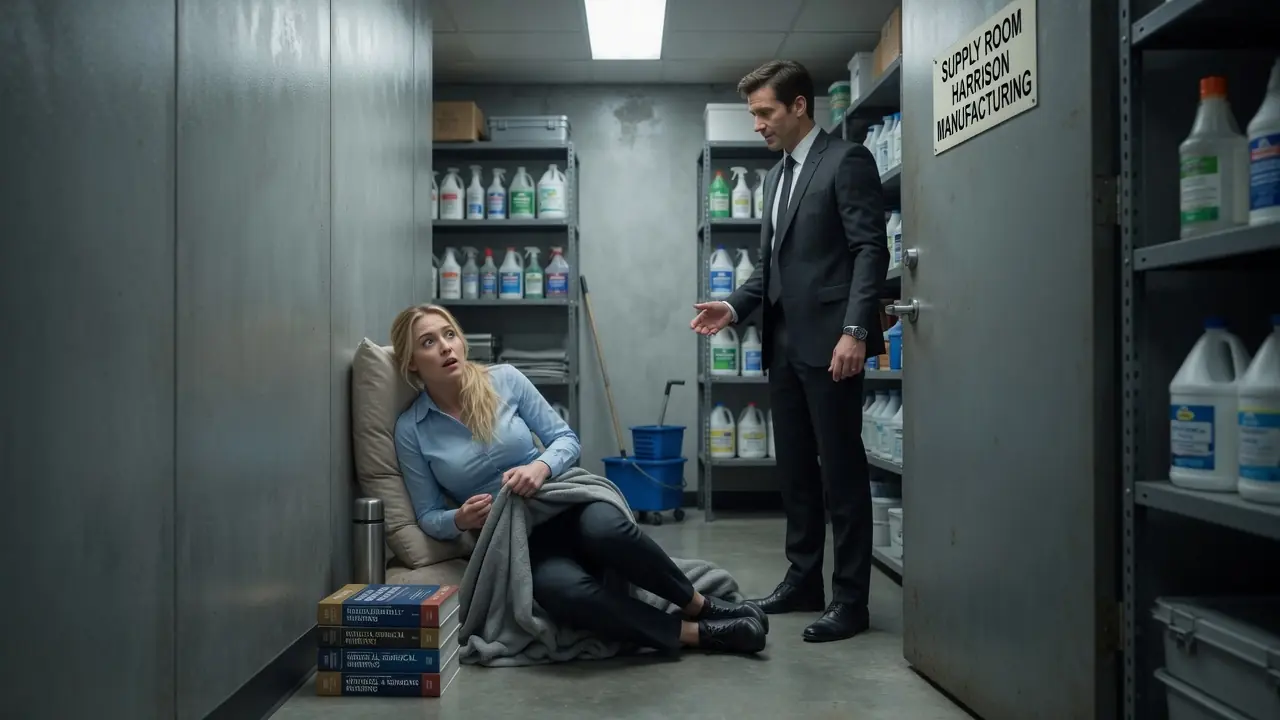
A young woman in a custodial uniform sat on the floor against the far wall.
Her eyes were closed.
Her head rested on a folded sweatshirt placed over a cardboard box. Her blond hair had been pulled into a practical ponytail, though several strands had fallen loose around her face.
Yellow rubber gloves lay beside her.
Her name tag read:
EMILY PARKER
She looked twenty-seven or twenty-eight.
Deep shadows marked the skin beneath her eyes.
Adrian remained in the doorway.
The supply room contained the expected shelves of cleaning products, but one corner had been arranged with almost military precision.
A thin blanket.
A travel pillow.
A small thermos.
Two sealed food containers.
A battery-powered lamp.
Several nursing textbooks stacked beneath a notebook.
Nothing blocked the aisle.
Nothing had been damaged.
No company product appeared to have been taken for personal use.
This was not someone casually napping during a shift.
It was someone trying not to be discovered.
“Excuse me,” Adrian said.
Emily’s eyes opened instantly.
She scrambled to her feet so quickly that she struck her shoulder against a shelf.
“I’m sorry.”
Her voice was breathless.
“I’m sorry, sir. I finished the south offices and the engineering hallway. I was only resting for a few minutes before starting the lower restrooms.”
Adrian stepped farther into the room.
“You’re not in trouble at this moment.”
Emily looked at his suit, shoes, and access badge.
The reassurance did not calm her.
“I know employees aren’t supposed to sit in storage areas. I understand. I can go back to work now.”
“What time did your shift begin?”
“Seven.”
“And when does it end?”
“Three-thirty.”
“It’s almost midnight.”
“Yes.”
“You still have several hours.”
“I know.”
Adrian’s eyes moved toward the blanket.
“Emily, are you living in this room?”
Her face lost color.
For several seconds, she seemed to consider lying.
Then her shoulders lowered.
“Only temporarily.”
“How long?”
“Twenty-four days.”
Adrian looked around again.
“You’ve slept here for more than three weeks?”
“Not every night.”
“How many?”
Emily stared at the floor.
“Most.”
Adrian closed the door behind him, leaving it unlocked.
“Tell me what happened.”
“I don’t want anyone else blamed.”
“That wasn’t my question.”
“My supervisor doesn’t know. Neither does security. I wait until the last cleaning inspection is finished, then I come down here. I wake before the morning maintenance crew arrives.”
“You have textbooks.”
“I’m finishing nursing school.”
Adrian picked up the top book.
Advanced Pharmacology.
Another covered critical-care nursing.
The third contained hundreds of handwritten notes sticking from the pages.
“How far are you from graduating?”
“Eight weeks.”
“And why are you sleeping in a supply room?”
Emily folded her arms across herself.
“My roommate moved out without notice.”
“Couldn’t you remain in the apartment?”
“Not on my salary.”
“Did you speak to the landlord?”
“Yes.”
“What happened?”
“He gave me ten days to cover the full rent. I couldn’t.”
“What about family?”
“My mother lives in Ohio with my stepfather. He made it clear I can’t stay there.”
“Your father?”
“He died when I was sixteen.”
“Friends from school?”
“Most live with spouses or family. One offered a sofa, but she has three children in a two-bedroom apartment. I stayed there two nights. Nobody slept.”
Adrian glanced toward the thermos.
“What are you eating?”
“Food from the grocery store. Sandwiches. Soup from the break-room microwave.”
“Where do you shower?”
“A twenty-four-hour gym three blocks away.”
“You kept the membership?”
“It costs less than a room.”
The answer came without self-pity.
That struck Adrian harder than tears would have.
Emily was not waiting for someone to rescue her.
She had created a system.
An unsafe, exhausting, humiliating system—but a system designed to carry her through eight remaining weeks.
“Why didn’t you tell your supervisor?”
Emily gave a tired laugh.
“And say what?”
“The truth.”
“That I’m homeless?”
“Yes.”
“I’ve worked here for two years. I’ve never missed a shift. I’ve never received a warning. The moment people know I’m homeless, everything changes.”
“How?”
“They stop seeing an employee. They see a problem.”
Adrian did not answer.
Emily gestured toward the room.
“I knew staying here was against policy. But if I lost this job, I would lose tuition. If I lost tuition, I would have to withdraw. If I withdrew, I would still be homeless six months from now, only with student debt and no nursing license.”
“So you made a calculation.”
“I made the least bad choice.”
Adrian understood calculations.
He had built an empire by choosing between imperfect options.
Yet his decisions had usually been made from conference rooms, with attorneys and financial analysts nearby.
Emily had made hers while calculating whether a gym membership could replace a bathroom.
“Are you working your full custodial schedule and attending classes?”
“Yes.”
“When do you sleep?”
“Between four and seven in the morning. Sometimes after class.”
“That’s three hours.”
“Usually.”
“You cannot continue that for eight weeks.”
“I only need to continue until graduation.”
“You may not reach graduation if you collapse first.”
Emily’s jaw tightened.
“I’m doing the best I can.”
“I believe you.”
For the first time, she looked directly at him.
“Who are you?”
“My name is Adrian Cross.”
Recognition came slowly.
Then all at once.
Emily stepped backward.
“The CEO.”
“Yes.”
Her hand moved toward her mouth.
“I’m going to lose my job.”
“No.”
“You can’t let an employee live in a supply closet.”
“You’re right.”
Tears formed in her eyes, though she blinked them away quickly.
“I haven’t stolen anything.”
“I know.”
“I clean this room every morning. Nobody else has had to do extra work because of me.”
“I believe you.”
“I can leave tonight.”
“You will leave tonight.”
Emily nodded once.
Adrian continued.
“But not to sleep outside.”
She stared at him.
He took out his phone.
Emily’s fear returned.
“Who are you calling?”
“Our employee relations director.”
“It’s midnight.”
“That is unfortunate for him.”
“No.”
Emily stepped forward.
“Please don’t.”
Adrian lowered the phone.
“Why?”
“Because you don’t understand what will happen when HR knows.”
“I own the company.”
“That doesn’t mean you know your own HR department.”
The words might have offended him from anyone else.
From Emily, they made him pause.
“What do you think will happen?”
“They’ll call this a security violation. They’ll say I created liability by sleeping near chemicals. They’ll say I used company property without authorization. Then they’ll terminate me in language that sounds compassionate.”
Adrian looked toward the shelves.
She was probably right.
Crosswell’s policies were designed to reduce exposure.
Unauthorized occupancy.
Improper use of restricted areas.
Safety risk.
Failure to report a material personal circumstance.
A lawyer could produce four reasons to dismiss her before breakfast.
“You’ve thought this through.”
“I’ve thought about almost nothing else for three weeks.”
Adrian put the phone away.
“Then tell me what solution preserves your dignity.”
Emily looked confused.
“I don’t know.”
“You don’t want charity.”
“No.”
“You need housing.”
“For eight weeks.”
“You need to keep working.”
“Yes.”
“And finish school.”
“Yes.”
“What can you afford?”
“Maybe four hundred dollars a month.”
“That won’t rent anything nearby.”
“I know.”
“What if the company provided a temporary room and deducted an affordable amount from your pay over time?”
Emily hesitated.
“That would be a loan?”
“Yes.”
“Not a gift?”
“If that matters to you.”
“It does.”
“Then a loan.”
She looked toward the blanket.
“What happens to my job?”
“That depends on whether you have been honest about your performance.”
“I have.”
“I will verify it.”
Adrian checked the time.
“Finish nothing else tonight.”
“I still have assigned areas.”
“You are too tired.”
“My supervisor will notice.”
“I’ll speak to her.”
“You said I wasn’t in trouble.”
“You aren’t. That does not mean I will let you operate equipment after sleeping three hours a day.”
Emily remained still.
“Where will I go tonight?”
Adrian considered several options.
Hotels would raise questions.
His home would be inappropriate.
The company maintained two furnished apartments for visiting engineers. One was currently empty.
“There is a corporate apartment near the east facility.”
“I can’t afford that.”
“We will establish the repayment terms tomorrow.”
Emily looked toward her few belongings.
“Why are you doing this?”
Adrian glanced around the supply room.
“Because no employee working full-time inside my company should need to hide in one of its closets to survive.”
The sentence sounded noble.
He did not yet understand how incomplete it was.
By eight the following morning, the situation had become a battle.
Martin Hayes, director of human resources, sat across from Adrian in the executive conference room. Beside him were the company’s general counsel, Linda Shaw, and facilities director Craig Turner.
Emily was not present.
Adrian wanted facts before placing her in a room where three executives might discuss her as a risk rather than a person.
“This is a termination-level violation,” Martin said.
“She has excellent performance reviews.”
“That’s irrelevant to the safety issue.”
“It is not irrelevant.”
“She slept in a chemical-storage room. If she became ill, if there was a spill, if security discovered her—”
“Security did not discover her.”
“That makes it worse.”
Adrian leaned back.
“Explain.”
“It means our controls failed.”
“That is our failure, not hers.”
Linda opened the policy manual.
“Legally, there are several concerns. Unauthorized access, occupational safety, workers’ compensation exposure, and potential claims that the company tolerated an unsafe living arrangement.”
“We didn’t know.”
“Now we do.”
Craig spoke next.
“The supply room contains concentrated cleaning agents. She could have been seriously injured.”
Adrian nodded.
“Then the room should have been monitored better.”
Craig frowned.
“You are turning this into a management issue.”
“It is a management issue.”
“An employee violated policy.”
“Because she was homeless while working full-time for us.”
Martin folded his hands.
“We cannot become responsible for every employee’s personal choices.”
“Her roommate left.”
“Personal circumstance.”
“She could not afford rent on her wages.”
Martin’s eyes narrowed.
“Are you questioning the custodial pay scale?”
“Yes.”
The room became quiet.
Crosswell’s custodial staff did not work directly for the company.
They were technically employed by BrightLine Facility Services, a contractor that had won the cleaning agreement three years earlier by submitting the lowest bid.
Adrian had approved the contract.
He had seen annual cost savings.
He had not examined what those savings required from workers such as Emily.
“How much does she earn?” he asked.
Martin checked the file.
“Fourteen dollars and twenty cents an hour.”
Adrian stared.
“She works overnight.”
“There is a shift differential.”
“How much?”
“Thirty-five cents.”
Adrian looked toward Craig.
“BrightLine told us the custodial workers received competitive compensation.”
“They are within market range.”
“That was not my question.”
No one answered.
Adrian opened Emily’s performance record.
Two years of excellent reviews.
No absences except one day for a nursing examination.
Repeated commendations from department managers.
One supervisor described her as the most dependable member of the night crew.
“She is working full-time,” Adrian said. “She is attending nursing school. She is receiving excellent evaluations. She still cannot rent a room.”
Martin shook his head.
“We cannot solve the housing market.”
“No. But we can stop congratulating ourselves for supporting employees while outsourcing the people who clean our floors to the cheapest bidder.”
Linda intervened.
“We need to separate the immediate case from the broader policy issue.”
“Fine. Immediate case: she keeps her job. She receives temporary housing under a written repayment agreement. Her schedule is reduced until graduation without losing health coverage.”
Martin looked alarmed.
“She does not receive health coverage through Crosswell.”
Adrian stared at him.
“She works in our building every night.”
“She is a contractor employee.”
“So if she gets injured cleaning our machinery, she is essential. If she needs medical insurance, she belongs to someone else.”
“That is how the contract is structured.”
“Then the structure is wrong.”
By noon, Emily sat in the same conference room.
She had showered and changed into jeans and a plain blue blouse. The exhaustion remained visible.
Adrian sat across from her with Martin and Linda.
He introduced them.
Emily’s posture became guarded immediately.
Martin spoke in a careful professional tone.
“Ms. Parker, we have reviewed the circumstances. Your conduct violated several workplace and safety policies.”
Emily looked toward Adrian.
He raised one hand.
“Let him finish.”
Martin continued.
“Ordinarily, unauthorized occupancy of a restricted company area would result in termination. However, Mr. Cross has directed that exceptional measures be considered.”
Emily’s face hardened.
“I don’t want to be treated as an exception everyone resents.”
Linda leaned forward.
“What would you consider fair?”
“A loan for temporary housing. A schedule I can work while finishing school. No promotion I haven’t earned. No announcement about what happened.”
Adrian nodded.
“Agreed.”
Martin looked toward him.
“The contractor must approve schedule changes.”
“Crosswell will take over her employment directly for the remaining period.”
Martin’s eyebrows rose.
“That creates classification issues.”
“Resolve them.”
Emily looked between them.
“What position?”
“Temporary facilities assistant,” Adrian said. “Same essential work, fewer overnight hours, direct benefits.”
“I don’t want a title created for me.”
“It is not.”
Adrian slid a document across the table.
“We have three open facilities positions. One has remained unfilled for six weeks.”
Emily read the description.
The hourly wage was higher than what she earned through BrightLine.
“Why wasn’t I told about this?”
Martin answered.
“Contract staff are not always included in internal postings.”
Emily looked at Adrian.
“That is another reason people like me stay invisible.”
He accepted the criticism.
“Yes.”
The company apartment became available that afternoon.
Emily signed a simple loan agreement based on what she said she could repay after graduation.
Adrian insisted the repayment carry no interest.
She insisted deductions not begin until she was working as a licensed nurse.
They compromised.
The loan would begin six months after graduation, and payments could never exceed five percent of her monthly income.
Emily moved into the apartment with one duffel bag, a box of textbooks, and the blanket she had used in Supply Room B-7.
She did not thank Adrian with tears.
She shook his hand.
“I will repay everything.”
“I believe you.”
“That isn’t what I meant.”
He waited.
“I will prove this was not a mistake.”
Adrian looked at her.
“You do not owe me proof of your value.”
Emily gave him a tired, skeptical expression.
“Everyone owes someone proof.”
She closed the apartment door.
Adrian remained in the hallway longer than necessary.
Over the following weeks, he began examining his company differently.
He met with the night shift without managers present.
Employees told him things no report had shown.
A machine operator had delayed dental treatment for nine months because the company insurance deductible was too high.
A single father slept in his car between shifts twice a week because commuting home used more fuel than he could afford.
A warehouse employee had dropped out of community college after mandatory overtime changed with less than twenty-four hours’ notice.
Two workers rationed insulin.
Several contractor employees performed the same daily work as Crosswell staff but earned less and received fewer benefits.
Adrian had believed the company paid fairly because compensation reports showed wages near industry averages.
He had never asked whether the industry average allowed people to live.
His executive team resisted the review.
Costs would rise.
Margins would shrink.
Competitors would not follow.
Shareholders might object.
Adrian listened.
Then he requested a calculation of employee turnover, training losses, absenteeism, safety incidents, overtime caused by understaffing, and production delays linked to exhaustion.
The hidden costs were enormous.
Crosswell had saved money by paying some employees less.
Then paid much of it back through instability.
“This is not charity,” Adrian told the board. “It is badly delayed risk management.”
That argument convinced the directors more effectively than morality alone.
The company raised its minimum wage.
Contracted custodial workers were given the opportunity to become direct employees.
Emergency hardship loans replaced ad hoc assistance.
A temporary-housing partnership was created with three local apartment complexes.
Employees pursuing accredited education could request predictable schedules during final semesters.
The program was modest at first.
Adrian refused to name it after Emily.
She had asked for privacy.
Three weeks before graduation, Emily failed an important clinical assessment.
Adrian learned from the manager of the employee health clinic, not from Emily.
She had worked a facilities shift after a classmate called out sick from their study group, then completed a hospital rotation with almost no rest.
Her instructor allowed one retake.
Adrian called her into his office.
“You’re going off the facilities schedule until the exam.”
Emily stared at him.
“I need the income.”
“Your housing is secure.”
“I have other bills.”
“We can extend the loan.”
“No.”
“This is exactly why the program exists.”
“I don’t want another exception.”
“You are not listening.”
“I am listening. You think because you helped me once, you can manage my life.”
Adrian’s expression tightened.
“I think you are exhausted and about to lose the qualification you sacrificed everything to earn.”
“That is my decision.”
“Yes.”
He leaned forward.
“And it is my decision whether to schedule an exhausted employee around industrial equipment.”
Emily stood.
“You don’t understand what it feels like to have every part of your life depend on another person deciding you deserve help.”
Adrian said nothing.
She continued.
“First a landlord. Then a contractor. Then HR. Now you.”
“I am trying to reduce that dependence.”
“By making decisions for me.”
The words struck.
Adrian had intended to preserve her future.
He had repeated the same pattern she feared—someone with more power deciding what was best.
“What do you propose?” he asked.
Emily sat again.
“Two shorter shifts. I’ll use vacation hours for the rest.”
“You have almost none.”
“Then unpaid hours.”
“You need income.”
“I need control.”
Adrian nodded slowly.
“Two shorter shifts.”
She passed the retake.
Six weeks later, Emily graduated from nursing school with honors.
Adrian attended the ceremony but sat near the back.
He did not arrange photographers.
He did not present a surprise job offer onstage.
Emily had already applied for an open nursing position in Crosswell’s employee clinic through the regular process.
The clinic director interviewed her alongside four other candidates.
Her custodial work did not guarantee selection.
Neither did Adrian’s involvement.
Emily scored highest.
Before she could begin, she still had to pass the licensing examination.
She studied in the corporate apartment, at the public library, and occasionally inside a converted room in the Crosswell basement.
Supply Room B-7 had been emptied.
The chemicals were moved to a properly ventilated storage area.
The room became a small overnight study lounge with desks, lockers, comfortable chairs, bright lamps, and a microwave.
No plaque mentioned Emily.
A simple sign on the door read:
QUIET ROOM — OPEN TO ALL SHIFTS
She passed her licensing examination on the first attempt.
On her final night in facilities, Mrs. Teresa Rodriguez gathered the custodial team near the loading bay.
Teresa had supervised Emily for nearly two years.
She presented her with a new stethoscope purchased by the crew.
“You always cleaned the clinic better than anywhere else,” Teresa said.
Emily smiled.
“I was studying the posters.”
“I know.”
Several people hugged her.
Adrian watched from a distance.
He finally understood that her achievement did not belong to him.
He had opened one door.
Emily had crossed every mile before and after it.
Her first position at the clinic was not head nurse.
She worked under two experienced nurses and a physician assistant.
She learned occupational medicine, injury documentation, emergency response, and employee-health education.
She made mistakes.
She asked questions.
She earned trust.
Her unusual background made employees comfortable speaking to her.
They knew she understood night shifts, contractor badges, aching feet, and the fear of missing one paycheck.
When a warehouse worker admitted he had been sleeping in his truck, Emily did not immediately call security or HR.
She asked what had happened.
Then she connected him with the emergency-housing program.
When a machine operator skipped medication because of cost, Emily helped her apply for assistance and brought the insurance problem to management.
She became a bridge between people who wore uniforms and people who wrote policies.
Three years later, she was promoted to senior occupational-health nurse.
Five years after that, she became clinic director.
By then, she had repaid every dollar of the housing loan.
Adrian received the final payment electronically.
He sent her a message.
You could have stopped paying years ago. The board converted the early loans into grants.
Emily replied:
Mine was a loan. We had an agreement.
He smiled.
Some things had not changed.
The employee-support program expanded across both Crosswell facilities.
It did not eliminate hardship.
No company policy could prevent divorce, illness, rent increases, family emergencies, or every personal crisis.
But employees no longer had to hide those crises until they became dangerous.
Requests were confidential.
Assistance came with clear terms.
Managers were trained to distinguish between performance problems and emergencies affecting performance.
Contract workers were included.
That last change caused the greatest resistance and produced the greatest impact.
Turnover decreased.
Safety improved.
Educational completion rose.
The board celebrated the numbers.
Adrian remembered the blanket in Supply Room B-7.
Seven years after the night he found Emily, Crosswell opened a larger employee health and education center.
The building contained the clinic, counseling rooms, financial-planning offices, training classrooms, and a twenty-four-hour study area for shift workers.
At the opening ceremony, Adrian stood before employees and local reporters.
He had prepared a speech about retention and investment.
Then he looked toward Emily in the front row.
She wore navy medical scrubs beneath a white clinic jacket. Her hair was shorter now. A badge identified her as Director of Employee Health.
Adrian set aside his notes.
“When I started this company,” he said, “I believed leadership meant building something successful and giving people jobs inside it.”
He looked across the room.
“I was wrong.”
The audience became quiet.
“A job is not automatically dignity. A paycheck is not automatically stability. And a company does not truly know its employees simply because it measures their productivity.”
Emily lowered her eyes.
“Years ago, I discovered that someone working in our building every night had become invisible to the people responsible for her well-being.”
Adrian did not name her.
“She was not invisible because she lacked value. She was invisible because our systems had been designed to notice failures, violations, and costs—but not struggle.”
He gestured toward the new center.
“This building exists because we learned to notice earlier.”
Afterward, Adrian found Emily near the clinic entrance.
“You changed the speech,” she said.
“It needed changing.”
“You made yourself sound almost humble.”
“I have occasional symptoms.”
She smiled.
Across the hallway, the original battery-powered reading lamp from Supply Room B-7 sat inside a glass display.
Emily had agreed to donate it only after insisting that the exhibit contain no sentimental exaggeration.
The card beneath it read:
This lamp belonged to a Crosswell employee who continued studying through a housing crisis. Her experience led to the creation of expanded education, emergency-housing, and employee-health programs.
No claim that Adrian had saved her.
No claim that hardship had been a gift.
No suggestion that determination alone could solve poverty.
Only the truth.
A hardworking employee faced a crisis.
The company almost punished her for surviving it.
Someone finally looked closer.
Years later, Emily occasionally returned to the basement quiet room during night shifts.
She liked seeing employees studying there.
Electricians preparing for certification exams.
Machine operators completing online degrees.
Parents finishing homework after children were asleep.
One winter night, she found a young custodian named Brianna asleep over an anatomy textbook.
Emily touched her shoulder gently.
Brianna woke in panic.
“I’m sorry. I was only resting for a minute.”
Emily recognized the words.
“You’re not in trouble.”
Brianna sat upright.
“I finished my assigned rooms.”
“I believe you.”
Emily pulled out the chair across from her.
“How much are you sleeping?”
The young woman hesitated.
That hesitation told Emily more than the answer might.
She did not promise that everything would become easy.
She did not offer a promotion.
She did not tell Brianna that suffering proved character.
She listened.
Then she explained the programs available and asked which form of help would preserve the young woman’s control over her own life.
That was the lesson Emily carried from the supply room.
Help without dignity could become another kind of power.
Leadership was not finding a struggling person and deciding what her future should be.
It was creating enough stability for her to make that decision herself.
Adrian learned a different lesson.
For years, he had walked through Crosswell at night believing he was searching for inefficiency.
He checked machines.
Inventory.
Security doors.
Maintenance records.
He believed truth could be found by looking where managers had not prepared for him.
He had been partly right.
But the most important failure he discovered was not a broken process hidden from management.
It was a human being management had trained itself not to see.
Emily had been present every night.
Her work appeared on every clean floor and emptied trash bin.
Her name appeared on performance reports.
Her hours appeared in vendor invoices.
Her access badge appeared in security logs.
The company possessed thousands of pieces of information about her.
It understood almost nothing about her life.
The night Adrian opened Supply Room B-7, he believed he had found an employee violating policy.
Instead, he found evidence that policy had failed an employee.
That distinction changed Crosswell Industries.
It also changed him.
True leadership did not begin when a powerful man offered help to someone with less.
It began when he asked why she had needed to hide before anyone was willing to offer it.
And it continued only when the answer became more than one private act of kindness.
Emily finished nursing school because she had already done most of the impossible work herself.
Adrian’s responsibility was not to become the hero of her story.
It was to make sure the next employee in crisis did not need a locked supply closet before the company finally paid attention.