The door at the far end of the hidden room moved another inch.
Daniel Carter stopped breathing.
His flashlight remained fixed on the narrow opening as the old wooden panel slowly swung inward, its lower edge dragging across the floor with a dry scrape. Oliver stood several feet ahead of him, back arched, orange fur raised along his spine, a low warning growl vibrating in his throat.
“Oliver,” Daniel whispered.
The cat did not look back.
Daniel tightened his grip on the flashlight. He had entered the hidden passage expecting dust, old family papers, perhaps a forgotten storage room sealed during one of the house’s many renovations. He had not expected fresh footprints. He had not expected a clean journal on a dusty desk.
And he certainly had not expected a door to open by itself.
The opening widened.
A thin beam of pale light appeared across the floor.
Not electric light.
Daylight.
Daniel frowned.
The hidden room was located inside the second floor of the house. According to the exterior walls, there should have been nothing beyond that door except open air above the rear porch.
Yet the light continued growing.
Oliver suddenly darted forward.
“No!”
Daniel lunged after him, but the cat slipped through the opening before his hand reached the door. The panel swung wider under Oliver’s weight, revealing a narrow stairway descending sharply between stone walls.
Daniel stared.
The stairs went down.
Farther than the second floor.
Farther than the first.
The pale light came from a small glass fixture mounted on the wall below, not from outside. It glowed with the weak, yellow-white flicker of an old battery lantern.
Someone had turned it on.
Recently.
Daniel stepped closer to the threshold.
“Oliver?”
A faint meow rose from below.
Then silence.
Daniel looked back toward the hidden room. The leather-bound journal remained on the desk. The words CARTER FAMILY RECORDS seemed almost to follow him through the beam of his flashlight.
He should have called the police.
He knew that.
There were fresh footprints inside a concealed passage in his home. Someone had entered without using any visible door or window. That alone should have sent him back through the library, downstairs, and outside until help arrived.
But Oliver was somewhere below.
Daniel could not leave him.
He pulled out his phone.
No signal.
The walls were too thick.
He activated the camera instead and began recording.
“If anyone finds this,” he said quietly, feeling foolish as soon as the words left his mouth, “I found a hidden passage behind the library bookshelf. There are fresh footprints inside. I’m going down because Oliver ran ahead.”
The cat meowed again.
Closer this time.
Daniel stepped onto the first stair.
The wood groaned beneath his weight.
He descended slowly, sweeping the flashlight across each step before trusting it. The stone walls were cold and damp. Old iron hooks had been driven into the mortar at regular intervals, though whatever they once held was gone.
After twelve steps, the stairway turned.
After another fifteen, it ended at a low underground corridor.
Daniel’s confusion deepened.
The house had no basement.
At least, that was what every inspection report had claimed.
He had spent six months restoring the property. He had crawled beneath the first floor to repair pipes and replace rotted support beams. The crawlspace was shallow, barely three feet high.
This corridor should not have existed.
Yet it stretched ahead of him, high enough to stand in, its ceiling supported by heavy timber beams blackened with age.
Oliver waited near the lantern.
His tail was still puffed, but he no longer hissed. He stared toward the opposite end of the passage, where another door stood open.
Fresh footprints crossed the dirt floor and disappeared through it.
Daniel crouched beside the cat.
“You’re going to take ten years off my life.”
Oliver looked at him, then turned toward the open door.
Daniel noticed something caught in the cat’s collar.
A thread.
Dark blue wool.
He carefully pulled it free.
It was clean.
Not old fabric from the house.
Someone wearing a dark blue garment had passed close enough for Oliver’s collar to catch it.
Daniel stood.
“Okay,” he whispered. “Someone is definitely here.”
The passage ended in a stone chamber beneath the rear portion of the house. Shelves had been built into the walls, and several wooden crates rested beneath canvas covers. A small worktable stood in the center.
On it sat a modern thermos.
Beside the thermos was a half-eaten sandwich wrapped in wax paper.
Daniel touched the cup.
It was still warm.
A sharp sound came from behind him.
The hidden stairway door slammed shut.
Daniel spun around.
The lantern flickered.
Oliver hissed again.
Then a voice spoke from the darker side of the chamber.
“You should have left the shelf alone.”
Daniel swung the flashlight toward the sound.
A man stepped from behind one of the canvas-covered crates.
He appeared to be in his late sixties, tall but thin, with a white beard trimmed close to his face. He wore a dark blue wool coat, heavy boots, and leather gloves. One hand held an old revolver pointed toward the floor.
Daniel’s heart pounded.
“Who are you?”
The man’s eyes moved from Daniel to Oliver.
“That cat has always been a problem.”
Daniel took one step in front of Oliver.
“You’ve been inside my house.”
The man gave a tired smile.
“It was never entirely your house.”
Daniel stared at him.
“What does that mean?”
The man lowered the revolver slightly, though he did not put it away.
“My name is Samuel Carter.”
The surname landed heavily.
Daniel searched the man’s face.
“I don’t know any Samuel Carter.”
“No,” Samuel replied. “Your grandmother made certain of that.”
Daniel’s grip tightened around the flashlight.
“My grandmother is dead.”
“I know.”
Something in Samuel’s voice shifted. Not satisfaction. Grief.
Daniel glanced toward the closed door behind him.
“If you’re related to me, why are you hiding under my house?”
Samuel looked at the covered crates.
“Because there are things upstairs that were never meant to be found by strangers.”
“I’m not a stranger.”
“To this house, maybe not.”
Samuel raised his eyes.
“To the truth, you are.”
Oliver slipped past Daniel and approached the older man.
Daniel whispered, “Oliver, no.”
But the cat did not appear afraid anymore.
He sniffed Samuel’s boots, circled him once, then sat beside his left foot.
Samuel looked down.
“He remembers me.”
Daniel’s stomach tightened.
“You’ve been feeding him.”
“Only when you were away.”
The realization came slowly.
Oliver’s unexplained absences.
The sound Daniel sometimes heard inside the library walls late at night.
The food bowl that occasionally seemed less empty than it should have been.
“You’ve been coming into the house for months.”
Samuel nodded.
“Longer.”
Daniel felt anger replace fear.
“You watched me renovate this place. You let me tear open walls, replace floors, and sleep here without telling me there was a hidden passage beneath my bedroom.”
“I watched to make sure you didn’t find it.”
“Well, that worked.”
Samuel almost smiled.
Then his face became serious again.
“The cat found the mechanism because your grandmother trained another cat to use it decades ago. Animals remember places differently than people do.”
Daniel stared at him.
“You knew my grandmother?”
Samuel looked toward the ceiling as if he could see through the layers of wood and plaster to the rooms above.
“Eleanor Carter was my sister.”
Daniel said nothing.
His grandmother had never mentioned a brother.
Not once.
There were no photographs of Samuel in the family albums. No letters. No name in the genealogy records Daniel had found. Eleanor had spoken often about her parents, cousins, and neighbors from childhood.
But never a brother.
Daniel slowly lowered the flashlight.
“Prove it.”
Samuel reached inside his coat.
Daniel stiffened.
The revolver remained pointed down.
Samuel removed a small photograph and held it out.
Daniel did not move at first.
Then he stepped forward and took it.
The picture showed two children standing on the front porch of the Victorian house. The girl was perhaps eleven. The boy beside her looked thirteen or fourteen.
Daniel recognized his grandmother immediately.
She had the same serious eyes he remembered from old photographs.
On the back, written in faded ink, were the words:
Eleanor and Samuel, summer 1952.
Daniel looked up.
“Why did she erase you?”
Samuel returned the revolver to a leather holster beneath his coat.
“She didn’t erase me.”
His expression hardened.
“She protected me.”
“From what?”
Samuel nodded toward the ceiling.
“Open the journal.”
Daniel remembered the leather-bound book on the desk upstairs.
“Why didn’t you take it?”
“Because it belongs to the house.”
“That doesn’t answer my question.”
Samuel walked toward the worktable and poured coffee from the thermos into its metal lid.
“For the first seventy years of this house’s life, it was not only a home. During Prohibition, your great-grandfather used the tunnel to move liquor from the old carriage barn to the road. During the war, the chamber stored machine parts for a local defense contractor.”
Daniel glanced at the crates.
“And after the war?”
Samuel did not answer immediately.
He took a sip of coffee.
“After the war, people began using it for secrets.”
“What kind of secrets?”
“The kind that made men disappear.”
The words sounded theatrical, but Samuel did not deliver them that way. His voice was flat, almost weary.
Daniel thought of the fresh footprints in the passage.
“Who else knows about this place?”
“Fewer people every year.”
“That isn’t a number.”
“Three, before your grandmother died.”
Daniel looked at him.
“And now?”
“Two.”
The chamber seemed colder.
Daniel pointed toward the crates.
“What’s in them?”
Samuel walked to the nearest canvas cover and pulled it away.
Beneath it sat a stack of metal filing boxes, each labeled with dates ranging from 1968 to 1989. Some bore the names of local construction companies. Others carried government contract numbers.
Daniel stepped closer.
“Records?”
“Evidence.”
“Of what?”
Samuel opened one of the boxes.
Inside were photographs, ledgers, land surveys, and copies of checks.
Daniel picked up a document.
The header belonged to a development company called North Valley Holdings.
He knew the name.
It was one of the companies that had repeatedly offered to buy the property after Eleanor’s death.
“They wanted the house because of this?”
Samuel nodded.
“They wanted what was beneath it.”
Daniel studied the checks.
Several were signed by men whose names appeared on schools, roads, and municipal buildings throughout the county.
“What did they do?”
“They bought land through shell companies, polluted it through illegal dumping, then sold it to the state at inflated prices for public projects. Your grandfather discovered the records while repairing survey equipment for one of their contractors.”
Daniel looked up.
“My grandfather died in a car accident.”
Samuel’s eyes held his.
“That was what the newspaper printed.”
Daniel’s hand went still.
“No.”
“Your grandmother found his notebook after the crash. She brought it to me because I was working as a county investigator.”
Daniel struggled to connect the pieces.
“You were law enforcement?”
“For twelve years.”
“What happened?”
“I trusted the wrong superior.”
Samuel closed the box.
“The investigation disappeared. Two witnesses changed their statements. One left the state. Another was found dead in the river.”
Daniel felt the room tilt slightly.
“And you?”
“I was charged with stealing evidence.”
He smiled without humor.
“I had stolen it, technically. Just not for the reason they claimed.”
Samuel looked around the chamber.
“Eleanor hid the records here while I went to prison.”
Daniel stared at him.
“You were in prison?”
“Seventeen years.”
“My grandmother never said anything.”
“She visited every month.”
The answer struck Daniel harder than he expected.
He pictured Eleanor as he remembered her: quiet, disciplined, always careful with money and time. Every first Saturday of the month, she used to disappear for most of the day. She told Daniel she was visiting an old school friend in Burlington.
“She was visiting you.”
Samuel nodded.
“Until I was released.”
“And after that?”
“I stayed away.”
“Why?”
“To keep danger away from her.”
Daniel looked toward the staircase.
“You’ve been living down here?”
“Not living. Watching.”
“For how long?”
“Since North Valley began contacting you.”
Daniel thought of the polite letters. The increasing offers. The developer who had appeared unannounced twice, walking around the property as though already planning where to place equipment.
“Why didn’t you tell me?”
Samuel’s voice softened.
“Because Eleanor asked me not to.”
“She’s gone.”
“Yes.”
“And you still decided for me.”
Samuel lowered his eyes.
“That was a mistake.”
Daniel looked at the files again.
“How much of this is real evidence?”
“All of it.”
“Then why not take it to the police now?”
Samuel laughed quietly.
“North Valley’s president sits on the state police advisory board. His brother-in-law is a judge. Two county commissioners owe their careers to his father.”
“That was decades ago.”
“Systems grow old. They don’t always die.”
A noise came from the corridor.
Not from the closed stairway door.
From farther away.
A metallic strike.
Samuel’s head snapped toward it.
Oliver stood, ears forward.
Daniel whispered, “What was that?”
Samuel moved quickly to the wall and extinguished the lantern.
Darkness swallowed the chamber.
Daniel raised the flashlight, but Samuel caught his wrist.
“Turn it off.”
Daniel obeyed.
They stood in complete darkness.
Then came another sound.
A door opening somewhere beyond the chamber.
Samuel leaned close.
“There’s a second entrance.”
“Where?”
“The old carriage barn.”
Daniel’s mind raced.
The carriage barn had collapsed before he inherited the property. Developers had asked repeatedly for permission to inspect its foundation.
Footsteps entered the corridor.
More than one person.
Samuel drew the revolver.
Daniel whispered, “You said only two people knew.”
“I was wrong.”
A flashlight beam swept across the passage outside.
A man’s voice echoed through the stone corridor.
“Check the chamber.”
Another voice answered, “The shelf upstairs is open. Someone found it.”
Samuel pushed Daniel behind the filing crates.
“Stay with the cat.”
“I’m not hiding while you—”
“You don’t know this tunnel.”
“And you’re almost seventy.”
“Sixty-eight.”
“That doesn’t help.”
The footsteps came closer.
Samuel looked toward the far wall, then grabbed Daniel’s shoulder.
“There’s another way out.”
He pulled aside a narrow shelf, revealing a low opening in the stone.
Daniel stared.
“How many doors does this house have?”
“More than your blueprints.”
Oliver slipped through first.
Samuel gestured.
“Go.”
Daniel crawled into the opening. The passage was barely wide enough for his shoulders. Behind him, Samuel dragged the shelf back into place, sealing them inside.
They moved through the narrow space on hands and knees. Daniel could hear voices entering the chamber behind the wall.
“Coffee’s still warm.”
“He was here.”
“What about the files?”
“Find the ledger. Burn the rest.”
Daniel stopped.
Samuel pushed gently against his boot.
“Keep moving.”
The crawlspace angled upward and ended beneath a trapdoor.
Samuel unlocked it with a key from his pocket.
They emerged inside a small stone shed hidden behind overgrown trees at the edge of the property.
Rain fell steadily outside.
Daniel stood, breathing hard.
Samuel closed the trapdoor behind them.
“They’re going to destroy everything.”
“Not if they don’t find what they came for.”
Samuel reached inside his coat and removed a thin black ledger.
Daniel recognized it from the crates.
“You took it.”
“I stopped trusting hiding places a long time ago.”
“What’s in it?”
“Names. Payments. Dates. Enough to prove the original conspiracy and connect it to the land purchases happening now.”
Daniel looked toward the house through the trees.
“Oliver.”
The cat stood beside them, tail low.
Daniel scooped him up.
“We need the police.”
“We need someone outside the county.”
Daniel remembered a college friend who worked as an investigative reporter in Boston. He also remembered an attorney his grandmother had insisted he contact if anyone ever challenged the estate.
At the time, Daniel thought she was being overly cautious.
Now he understood.
“My grandmother left me a sealed letter,” he said.
Samuel turned.
“I found it with the will. It said not to open it unless someone tried to force me to sell the house.”
Samuel’s expression changed.
“Where is it?”
“In a bank deposit box.”
For the first time, Samuel looked hopeful.
“Then Eleanor planned further ahead than I knew.”
They moved through the rain toward Daniel’s truck, keeping low behind the stone wall that separated the property from the road. Before they reached it, headlights appeared near the house.
A dark SUV pulled into the driveway.
Then another.
Daniel counted four men.
One stood beneath the porch light.
Daniel recognized him immediately.
Charles Vale.
The representative from North Valley Holdings who had visited twice.
Vale looked toward the upper library window.
Then at the open front door.
Daniel whispered, “He has a key.”
Samuel’s jaw tightened.
“Your grandmother’s spare.”
“How?”
“She trusted a caretaker during her last year.”
Daniel remembered the man who had helped Eleanor after her fall. Quiet. Helpful. Recommended by North Valley’s local office.
“They planned this before she died.”
Samuel nodded.
“Probably.”
Daniel felt anger rise beneath the fear.
“This is my house.”
“No,” Samuel said. “Tonight it’s evidence.”
They reached the truck.
Daniel placed Oliver inside and called his attorney first. Then the reporter. Then the state attorney general’s public corruption hotline.
He sent photographs of the ledger from his phone.
Samuel recorded a statement while Daniel drove.
By dawn, the property was surrounded by state investigators, not local officers.
Vale and the three men with him were arrested while carrying boxes from the hidden chamber toward the collapsed carriage barn. One of them had gasoline. Another carried demolition charges intended to bring down the remaining tunnel walls.
The story spread quickly.
North Valley Holdings denied everything until documents from the ledger were matched with bank records, property transfers, and archived government contracts. The investigation widened beyond Vermont. Retired officials were questioned. Old deaths were reexamined.
Samuel’s conviction was reviewed.
The evidence showed that he had not fabricated the records or stolen them for personal gain. He had tried to preserve them after senior investigators ordered their destruction.
Eight months later, his conviction was vacated.
Daniel attended the hearing.
Samuel stood before the judge wearing an old navy suit that hung loosely from his shoulders. When the ruling was read, he did not smile immediately.
He closed his eyes.
Then he whispered Eleanor’s name.
Afterward, Daniel drove him back to Ashford.
They entered the library together.
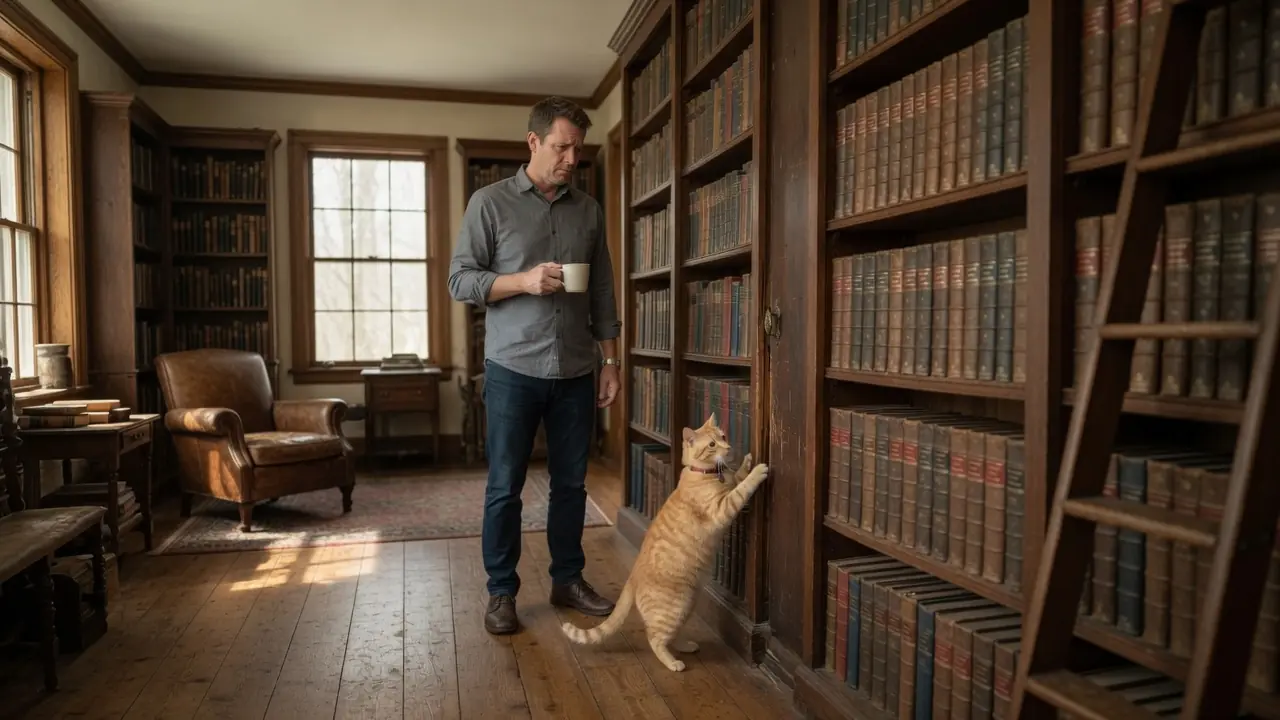
The bookshelf remained open while restoration specialists examined the hidden mechanisms and historians cataloged the chamber below. Oliver sat near the brass handle, watching everyone with the severe expression of a supervisor dissatisfied with the quality of human labor.
Daniel placed the Carter family journal on the desk.
This time, he opened it.
The first entries dated back to the nineteenth century. Generations of family members had recorded births, deaths, harvests, wars, illnesses, and secrets.
Near the end, he found his grandmother’s handwriting.
If Daniel is reading this, then the house has chosen to speak.
He read the sentence twice.
Below it, Eleanor had written:
Samuel was never the disgrace people called him. He was the bravest person in this family. I kept silent because I believed silence would keep him alive. Perhaps it did. Perhaps it only kept him alone.
Daniel stopped reading.
Samuel stood near the window, looking out at the rain.
“She regretted it,” Daniel said.
Samuel nodded.
“So did I.”
Daniel turned another page.
The final entry contained only a few lines.
The house does not belong to whoever holds the deed. It belongs to whoever protects the truth inside it.
Daniel closed the journal.
For months afterward, the hidden room was preserved as part of a local historical archive. The evidence recovered there helped restore Samuel’s name and exposed a network of corruption stretching back nearly half a century.
Daniel refused every new offer to purchase the property.
Instead, he finished restoring the house.
The library became the last room completed.
He repaired the shelves but left the hidden door functional. The brass handle remained visible once the dust and varnish were removed.
Visitors often asked how he discovered it.
Daniel always pointed toward Oliver.
The cat usually sat beside the bookshelf, pretending not to listen.
One autumn afternoon, almost exactly a year after the discovery, Daniel found Samuel asleep in Walter’s old reading chair beside the library window. Oliver was curled on his lap.
The rain tapped gently against the glass.
The house creaked around them.
For the first time, it no longer sounded like an old building settling.
It sounded like a family remembering how to breathe.
Daniel walked toward the shelf and rested one hand on the hidden door.
He thought about all the years his grandmother had guarded the truth. All the years Samuel had lived outside the family history. All the people who had entered the house believing secrets could remain buried forever.
Oliver opened one eye.
Daniel smiled.
“You knew, didn’t you?”
The cat stretched, jumped from Samuel’s lap, and walked toward the narrow brass handle.
Then he scratched it once.
Slowly.
Deliberately.
As if reminding Daniel that some doors remained hidden only until someone decided it was time to open them.