"Dump the rest," Russell Baird said. "Every bin. Maybe the dirt on this place will finally get something worth feeding."
The forklift operator looked from his boss to the woman standing beside the gate. He had driven trucks for Orchard Gate Processing for seven years, and he knew the look Russell wore when he expected obedience without questions. The first wooden bin was already tipped, and hundreds of red tomatoes lay scattered across the old concrete loading apron. Some had burst against the surface, leaving trails of juice that ran toward a drainage grate. Others rolled intact through the dust and stopped against Claire Maddox's boots.
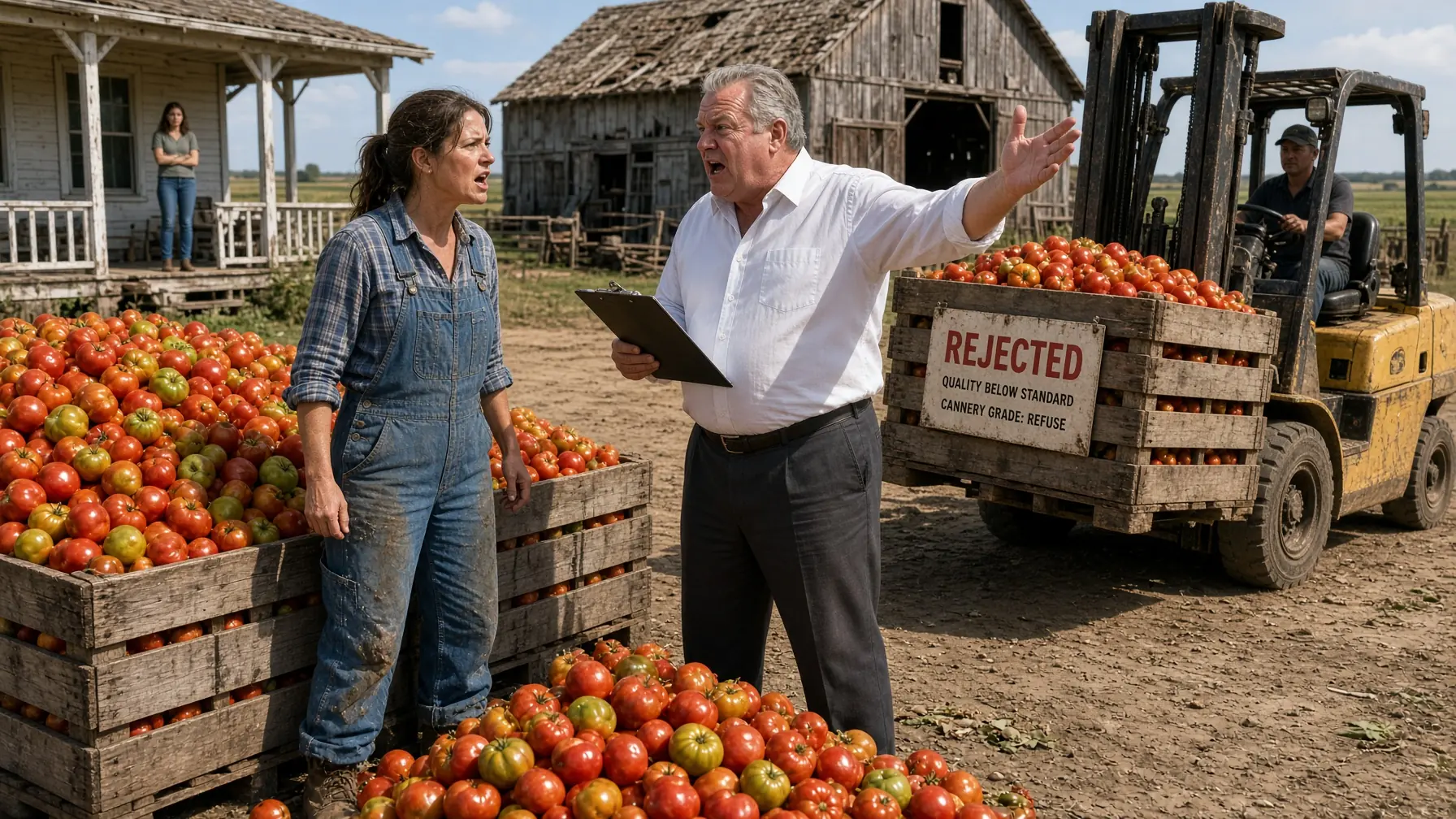
"This agreement expired two years ago," Claire said. She held a photocopy in one hand and pointed toward the county road with the other. "You have no permission to bring produce here, Russell. You need to load those bins back onto your truck."
Russell wore a pale-blue company shirt and sunglasses expensive enough to conceal the direction of his eyes. He had spent thirty years turning a family cannery into one of the most efficient tomato processors in the northern San Joaquin Valley. His plant handled thousands of tons in a season, and growers who needed a buyer learned to accommodate his preferences. Claire was a woman with peeling paint, fifty-two acres, and a broken irrigation line. In Russell's arithmetic she was not the person who made demands.
"Your land?" he asked, surveying the sagging fence beside the driveway. "Looks like it needs someone who can afford to take care of it. Those tomatoes didn't pass our line. They're garbage. I'm saving you money on fertilizer."
Behind him, one of his drivers shifted uncomfortably. Russell saw the movement and raised his voice, turning the private insult into a little show. "You want me to explain to everybody why a woman who can't pay her bills thinks she's running a commercial operation?"
Claire felt heat rise to her cheeks, but she did not give him the answer he wanted. She knew the difference between tomatoes rejected for contamination and tomatoes rejected because mechanical sorters could not handle them efficiently. The fruit in the intact bins looked irregular, not spoiled, and several rejection labels remained attached to the wood. She made herself study the codes instead of his face. Russell mistook her silence for defeat and waved the forklift forward.
Another bin tilted. Red fruit tumbled over the steel lip, bounced on concrete, and rolled into a shallow ditch. The operator winced when a pallet cracked, but Russell laughed. "Twelve thousand tomatoes, Claire. Now you can tell your neighbors you're the biggest tomato farmer in the county."
A gravelly voice came from the porch. "You don't have to talk to her like that." Claire turned and saw her daughter, nineteen-year-old Sadie, standing beside a packed duffel bag. Sadie had been loading her car for the return to the University of California, Davis, where her sophomore year would begin after Labor Day. She had heard enough from the porch to understand the shape of the humiliation. Her hands were clenched, and Claire knew that expression meant she was one sentence away from saying something she would regret.