For eighteen months, Adrian Cole had spoken only when silence became impossible.
One word for pain.
One word for water.
Occasionally, a bitter sentence sharp enough to make another caregiver reconsider coming back the next morning.
He did not speak to his doctors unless they asked questions requiring verbal answers.
He ignored his company’s executives.
He refused calls from old friends.
When his younger sister visited, he turned his wheelchair toward the windows and watched the Pacific Ocean until she finally left in tears.
Before the accident, Adrian had been known for his voice.
At thirty-eight, he could silence a boardroom without raising it. He had built Cole Meridian Technologies from a four-person software company into an international engineering and communications empire valued in the billions.
Investors repeated his predictions.
Journalists quoted his speeches.
Employees remembered the way he could enter a difficult meeting and make everyone believe there was still a solution.
Then, on a rain-soaked November evening outside Seattle, a tractor-trailer crossed the median and struck Adrian’s car.
The collision crushed part of his spine.
Surgeons stabilized the damage, but his spinal cord had been severely injured. He retained limited sensation in his legs and occasional involuntary movement, yet no doctor promised he would walk independently again.
Recovery, they told him, would be measured differently.
Upper-body strength.
Transfer skills.
Pain control.
Independence.
The ability to build a meaningful life whether or not his legs ever carried him through another room.
Adrian heard only one sentence.
You may never walk again.
During the first weeks, everyone promised to remain.
His fiancée, Celeste, slept beside his hospital bed and told him they would face everything together.
His college friends called daily.
Relatives filled the private waiting room with flowers, expensive food, and assurances that family never abandoned family.
Three months later, the flowers had died.
Six months later, the calls became occasional messages.
By the first anniversary of the crash, almost everyone was gone.
Celeste lasted the longest.
She sat beside him one evening in the rehabilitation hospital, holding a cup of coffee she never drank.
“I care about you,” she said.
Adrian looked toward her.
The sentence already sounded like a farewell.
“I thought I could do this.”
He said nothing.
“I wanted to be stronger.”
Still nothing.
Celeste began crying.
“I don’t know how to build the life we planned around hospitals, ramps, and appointments. Every time I look at you, I feel guilty for missing who you were.”
Adrian’s hands tightened on the blanket.
He could have told her that he missed that man too.
Instead, he watched her place the engagement ring on the bedside table.
A week later, she moved her belongings out of his home.
Adrian never asked her to return.
He simply added her name to the growing list of people who had promised not to leave.
After being discharged, he returned to the glass-and-stone mansion overlooking the California coast.
The house had been renovated for his wheelchair. Doorways were widened. An elevator connected the floors. The bathrooms contained rails, transfer benches, and equipment that made every room feel partly medical.
Adrian hated all of it.
He stopped attending physical therapy consistently.
He refused invitations from the company.
He delegated control to his board and ignored financial reports.
Most mornings, the staff found him beside the same enormous window, watching waves strike the rocks below.
He rarely read.
He no longer listened to music.
He had once risen before sunrise because the world seemed too full of possibilities to waste time sleeping.
Now he woke because his body hurt.
Four private nurses came and went.
The first lasted three weeks.
The second resigned after Adrian threw a glass against the wall.
The third told the agency that the patient refused all cooperation.
The fourth remained six days.
By then, Adrian had turned departure into a contest.
People left eventually.
He preferred to make them leave before he began depending on them.
On a gray Monday morning, Helena Brooks, the longtime manager of his home, entered the library.
Adrian sat near the window.
“Your new rehabilitation nurse arrives this afternoon,” she said.
He did not turn.
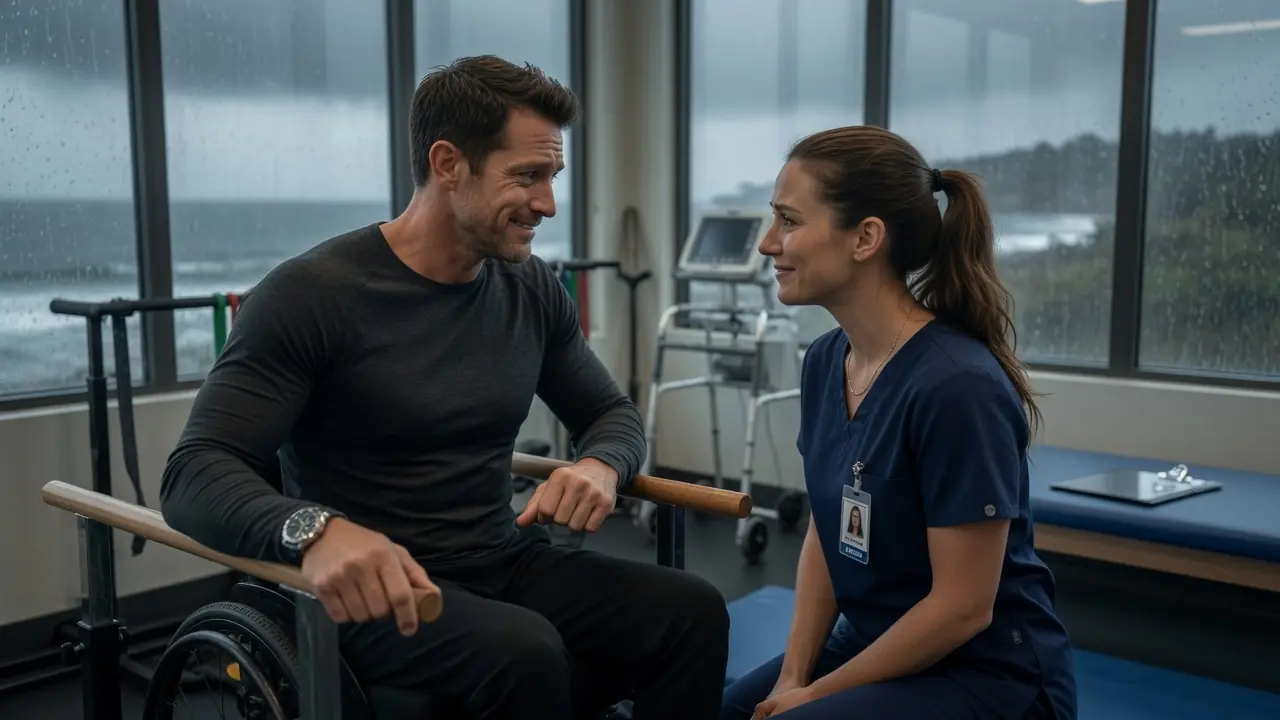
Helena had worked for the Cole family for twenty-two years. She remembered Adrian at nineteen, running through the house with college acceptance letters in his hand. She remembered him bringing his first prototype to the dining table and keeping everyone awake until midnight while he explained it.
The man in the wheelchair looked older than thirty-eight.
“You might try not insulting this one before dinner,” Helena said.
Adrian continued watching the ocean.
“The last one lasted six days,” he finally said.
His voice was rough from disuse.
Helena stopped near the doorway.
“That is the longest sentence you’ve spoken this week.”
“This one will leave in five.”
“Perhaps she is stubborn.”
“Everyone has a limit.”
“So do you.”
Helena left before he could answer.
The new nurse arrived at two in the afternoon carrying one travel bag, a laptop case, and a folder thick with rehabilitation notes.
Adrian heard her footsteps from the hallway.
They were not hesitant.
Most caregivers entered the mansion as though it contained a dangerous animal.
This woman walked as if she had somewhere specific to be.
She stopped behind his wheelchair.
“Good afternoon, Mr. Cole.”
Adrian did not turn.
The woman waited.
Rain tapped against the windows.
“Well,” she said, “this silence is either deeply meaningful or extremely inconvenient.”
Adrian slowly rotated the chair.
She appeared to be around thirty.
Her dark blond hair was pulled into a practical knot. She wore navy trousers, flat shoes, and a pale blue shirt beneath a lightweight jacket. Her expression was open without being falsely cheerful.
A badge clipped near her waist identified her as EMILY DAWSON, RN, CRRN.
Certified rehabilitation nurse.
Not a temporary companion.
Not an inexperienced aide.
Adrian looked at the travel bag.
“Running away already?”
“I just arrived.”
“Congratulations.”
“For what?”
“You have accepted the least rewarding nursing assignment in California.”
Emily smiled.
“I worked two years in a neurological trauma unit. You will need to make a stronger effort.”
Adrian turned back toward the window.
“There is the door.”
“I noticed it.”
“You may use it.”
“I may.”
She placed her folder on the table.
“My contract lasts twelve weeks. The agency can terminate it for unsafe conditions. You can request reassignment. Until one of those things happens, I will be here at eight each morning.”
“I don’t need a nurse.”
“You require medication management, skin monitoring, transfer assistance during pain episodes, and rehabilitation support.”
“I have staff.”
“You have household staff. They are not rehabilitation clinicians.”
Adrian said nothing.
Emily opened the folder.
“Your physical therapist arrives tomorrow at nine.”
“No.”
She looked up.
“No therapist.”
“Why?”
“Because I said so.”
Emily nodded once and closed the folder.
“Fine.”
Adrian glanced toward her.
He had expected persuasion.
“What?”
“We will not begin at nine tomorrow.”
A faint sense of victory moved through him.
Emily continued.
“We will begin at ten.”
His eyes narrowed.
“That is not what I said.”
“No. But refusing one hour does not cancel the profession.”
“Cancel it.”
“You may contact your physician and rehabilitation team. Until the treatment plan changes, I will continue offering medically appropriate care.”
“Offering?”
“Yes.”
“You cannot force me.”
“No.”
Emily pulled a chair closer and sat across from him.
“You are an adult with decision-making capacity. You can refuse therapy.”
“Then we understand each other.”
“We do.”
She folded her hands.
“You can also live with the consequences of refusing it. I will not pretend those consequences belong to anyone else.”
Adrian studied her.
Most caregivers reacted to his refusals as though he were a child misbehaving.
Emily did not plead.
She did not threaten.
She left the decision where it belonged.
With him.
That irritated him more.
At dinner, Adrian pushed away his plate without tasting it.
“I’m not hungry.”
The housekeeper looked toward Emily.
Emily sat in the chair beside him and opened a paperback novel.
Adrian waited.
She began reading silently.
“What are you doing?”
“Reading.”
“Here?”
“Yes.”
“Why?”
“Your evening medication should be taken with food.”
“I’m not taking it.”
“Then I will document your refusal.”
She turned a page.
Adrian stared at her.
“You plan to sit there all night?”
“No. My shift ends at eight.”
“It is six-thirty.”
“I read quickly.”
Fifteen minutes passed.
Emily did not watch him.
She did not comment on the food.
She simply remained present.
Finally, Adrian picked up the fork.
Not because he accepted her authority.
Because the sound of turning pages had become unbearable.
He ate several bites.
Emily closed the book, stood, and placed his medication beside the water.
“Good evening, Mr. Cole.”
“That’s it?”
“That is what?”
“No lecture?”
“You already understand why nutrition matters.”
“No congratulations?”
“You ate dinner, not crossed an ocean.”
She walked away.
Adrian watched her leave.
For the first time in months, he almost smiled.
The following morning, Emily entered at exactly eight carrying coffee.
“Good morning, Adrian.”
“Do not call me Adrian.”
“All right.”
She placed the cup beside him.
“Good morning, Your Majesty.”
He turned sharply.
Emily’s expression remained completely serious.
Adrian looked at the coffee.
“I did not ask for this.”
“I know.”
“Then why bring it?”
“Helena says you drink it every morning.”
“I could have requested it.”
“You could also have said thank you.”
He stared at her.
She checked her watch.
“Therapy begins at ten.”
“No.”
“Noted.”
At ten, Adrian remained in the library.
Emily entered with a resistance band, a therapy ball, and the same novel.
“What is that?”
“A compromise.”
“I did not agree to one.”
“The physical therapist is in the gym. You refuse to go to the gym. We can perform the first portion here.”
“No.”
Emily sat down and opened the book.
Adrian lasted twenty minutes.
“Aren’t you supposed to be working?”
“I am.”
“You are reading.”
“I am waiting for my patient to choose between twenty minutes of upper-body therapy or another hour listening to me turn pages.”
“That sounds like coercion.”
“It is annoyance. The legal distinction matters.”
Adrian stared at her.
Then he reached for the resistance band.
“Ten minutes.”
“Fifteen.”
“Twelve.”
“Done.”
By the end of the session, his shoulders burned.
Emily did not celebrate.
She recorded the exercises, checked his blood pressure, and moved on.
During the first week, Adrian tested every boundary.
He ignored questions.
Emily waited.
He criticized meals.
She suggested he speak directly with the chef.
He complained that his wheelchair cushion was uncomfortable.
She examined it and discovered a pressure point that genuinely required adjustment.
He deliberately knocked a stack of printed therapy plans from a low table.
Pages scattered across the floor.
Emily looked at the papers.
Then at him.
“You did that intentionally.”
“Yes.”
“Pick them up.”
Adrian laughed.
“I’m in a wheelchair.”
“Your spinal injury did not remove your arms.”
“You are paid to assist me.”
“I am paid to support your independence, not reward bad behavior.”
She moved the table closer and placed a reaching tool beside his chair.
Adrian stared at it.
Emily walked across the room and began updating his notes.
After several minutes, Adrian leaned forward and collected the first page.
The movement required him to stabilize his torso, extend one arm, and return upright.
By the tenth page, he was breathing harder.
Emily glanced over.
“I dislike you,” he said.
“That is allowed.”
“You arranged this as an exercise.”
“You arranged it when you threw the papers.”
Adrian held the last sheet.
Emily took it from him.
“Excellent trunk control.”
He almost threw it again.
Instead, he laughed.
The sound was brief.
Rusty.
Unexpected.
Emily looked at him.
Adrian’s expression immediately closed.
“Do not make a comment.”
“I wasn’t going to.”
“You were.”
“I was going to say your laugh sounds less frightening than your silence.”
“That is a comment.”
“Then I am glad I did not make it.”
By the second week, Adrian began listening for her footsteps each morning.
He still refused some sessions.
He still had days when pain made him angry at every person within reach.
Emily did not pretend those days were motivational opportunities.
She adjusted the plan.
Sometimes rehabilitation meant completing a transfer with less assistance.
Sometimes it meant preventing a pressure injury.
Sometimes it meant acknowledging that pain had won the morning without allowing it to take the entire week.
Adrian gradually spoke more.
At first, only to argue.
Then to ask questions.
Eventually, to tell stories.
He described building his first computer with parts taken from three discarded machines.
He told Emily about sleeping under his desk during the company’s early years.
He admitted that his greatest business decisions often began as arguments everyone else wanted to end.
“What did Celeste think of that?” Emily asked once.
Adrian became quiet.
She did not apologize for the question.
After a moment, he answered.
“She liked the successful version.”
Emily waited.
“She didn’t like the part where I worked through birthdays and dinners.”
“That sounds fair.”
Adrian looked at her.
“You are supposed to tell me she was cruel for leaving.”
“I don’t know her.”
“She left after the accident.”
“That was cruel.”
Emily adjusted a strap on his therapy equipment.
“It does not mean every criticism she ever made was false.”
He disliked the answer because it was honest.
Three weeks after Emily arrived, Adrian agreed to return to the private rehabilitation gym.
His physical therapist, Dr. Nathan Cho, hid his surprise.
They began with seated balance and transfer practice.
Adrian failed twice while attempting to move from his wheelchair to a padded bench with minimal assistance.
On the third attempt, his right arm gave way.
Emily and Nathan prevented a fall.
Adrian struck the wheelchair armrest.
“I’m finished.”
Nathan stepped back.
Emily did not.
“We can stop for today.”
Adrian turned toward her, almost disappointed.
“You agree?”
“Yes.”
“Why?”
“Because your shoulder is fatigued and continuing would increase injury risk.”
He looked toward the bench.
“I thought you never let me quit.”
“I do not control whether you quit.”
She crouched until they were at eye level.
“My job is to help you tell the difference between stopping safely and surrendering because failure embarrassed you.”
Adrian looked away.
“What is this?”
“Today?”
“Yes.”
Emily glanced toward his shaking hand.
“Both.”
The answer stayed with him.
Over the following month, the house changed.
The staff no longer whispered in hallways.
Adrian began joining Helena for lunch.
He attended one company meeting by video, then another.
He did not return as chief executive.
Not yet.
He listened while others reported what had happened during his absence.
Some divisions had improved without him.
That truth hurt.
It also relieved him.
The company had not died because he stopped controlling it.
His sister returned for dinner.
Adrian apologized for refusing her visits.
She cried.
He did not ask her to stop.
Afterward, Emily found him on the terrace overlooking the ocean.
“I hate apologies,” he said.
“Most people do.”
“They make you wait while the other person decides whether you are worth forgiving.”
“That is part of the risk.”
“I preferred business negotiations.”
“Money makes disappointment easier to calculate.”
Adrian looked toward her.
“You always have an answer.”
“No. I speak confidently when I don’t.”
He smiled.
This time, he did not hide it.
Their first serious conflict came during the seventh week.
Adrian had spent a difficult morning attempting supported standing between parallel bars.
His injury was incomplete, meaning some nerve signals still traveled through damaged pathways. With braces, significant upper-body support, and close supervision, he could briefly bear weight through his legs.
That did not mean he was steadily recovering the ability to walk.
Some days, his right foot moved.
Other days, it did not.
That morning, neither leg cooperated.
Adrian tried four times.
Each ended with his body sagging into the harness.
Finally, he struck the rail with one hand.
“This is pointless.”
Nathan began lowering the support system.
Emily reached for Adrian’s water.
He knocked it away.
The bottle hit the floor.
“I said I’m done.”
Nathan looked toward Emily.
She nodded.
“I’ll stay with him.”
When the therapist left, Adrian stared at the empty bars.
“Everyone keeps pretending this is leading somewhere.”
“It is.”
“To what?”
“Greater strength. Safer transfers. Better circulation. Possibly increased standing tolerance.”
“I mean walking.”
Emily did not answer immediately.
Adrian laughed bitterly.
“There it is.”
“What?”
“The silence doctors use when they don’t want to destroy hope.”
“You asked for honesty.”
“Then say it.”
“We do not know whether you will walk independently.”
His jaw tightened.
“After all this.”
“Yes.”
“What is the point?”
“To build the most independent life your body allows.”
“I don’t want the life my body allows.”
“That does not make another one available.”
Adrian turned toward her.
“You think you understand because you read the reports.”
“No.”
“You arrive every morning, tell me to try, then go home in your own legs.”
“Yes.”
The answer angered him more.
“You don’t know what it is to wake up inside a body that betrayed you.”
“No.”
“You don’t know what it is to watch everyone disappear.”
“No.”
“Then why are you still here?”
Emily remained still.
Adrian’s pain turned toward the nearest target.
“Maybe I know.”
She waited.
“Maybe you are better at hiding what you want.”
Her expression changed.
“What do you think I want?”
“Money.”
The room became silent.
Adrian continued because stopping would require admitting he had gone too far.
“Perhaps loyalty to a billionaire looks profitable.”
Emily’s face lost all warmth.
“You believe I am waiting for a reward.”
“I believe everyone wants something.”
“Then you have not been paying attention.”
She set down the clipboard.
“When I was sixteen, my mother developed an aortic aneurysm.”
Adrian’s anger faltered.
“We had no adequate insurance. My father had died two years earlier. The hospital told us the surgery would require specialists in another state.”
Emily’s voice remained controlled.
“My mother began organizing her papers because she believed she was going to die.”
Adrian said nothing.
“A charitable medical fund covered the surgery, travel, and six months of follow-up care.”
She reached into her pocket and removed an old folded letter protected inside a transparent sleeve.
At the top appeared a faded logo.
THE COLE MERIDIAN HEALTH ACCESS FUND
Adrian stared at it.
He had created the program during the company’s fifth year after an employee’s daughter died waiting for treatment.
The board later expanded it.
Thousands of families had received assistance.
Adrian rarely knew their names.
“My mother lived,” Emily said. “She saw me graduate from nursing school. She was at my wedding.”
Adrian looked up sharply.
“You’re married?”
“Widowed.”
The word changed the room.
“My husband died from leukemia four years ago.”
“I didn’t know.”
“You never asked.”
Adrian lowered his eyes.
Emily placed the letter on the therapy bench.
“I did not accept this assignment because I owed you my life. I accepted because your foundation once gave my family time we could not buy.”
She stepped closer.
“But gratitude is not ownership. I do not owe you tolerance for cruelty.”
Adrian’s face tightened.
“I—”
“No.”
It was the first time she had stopped him.
“You spent years helping people whose names you never knew. That mattered.”
Emily’s eyes glistened, but her voice remained steady.
“Then you were injured, and you decided the worst thing that happened to you erased every good thing you had ever done.”
Adrian stared at the letter.
“I am not here to repay a debt,” she said. “I am here because I believed the man who created that fund might still exist.”
She picked up her clipboard.
“Today, I am not certain.”
Then she left.
Adrian remained alone in the gym.
For the first time since the crash, he felt ashamed of something other than his body.
That evening, he wheeled himself into the kitchen.
Emily sat at the counter eating soup while finishing her notes.
She looked up but did not smile.
Adrian stopped several feet away.
“I was cruel.”
“Yes.”
“I wanted to hurt you.”
“I know.”
“Because you were close enough.”
Emily closed the tablet.
“That is an explanation.”
“Not an excuse.”
“No.”
He looked toward the floor.
“I’m sorry.”
She studied him.
“I accept the apology.”
Adrian looked up.
“That quickly?”
“I accepted the words. Trust takes longer.”
He nodded.
“Your husband.”
“Daniel.”
“What was he like?”
Emily’s expression softened slightly.
“Annoyingly patient.”
“That sounds familiar.”
“He would have liked you before the accident.”
“And now?”
“He would have told you to stop making pain everyone else’s problem.”
Adrian almost smiled.
Then he stopped himself.
Emily noticed.
“You are allowed to laugh while apologizing.”
“I am still learning the rules.”
“So am I.”
After that day, their relationship changed.
Not into romance.
Not yet.
Into honesty.
Emily stopped pretending his sarcasm did not affect her.
Adrian stopped using wealth and injury as permission to wound people.
When he crossed a line, she named it.
When she pushed too hard, he told her.
He began seeing a trauma therapist twice a week.
He returned gradually to company work, not as the man he had been, but as someone learning to lead without treating control as proof of value.
His rehabilitation continued.
There was no miracle.
He did not rise from the wheelchair and walk across the mansion.
He learned to transfer independently on good days.
He became strong enough to navigate ramps and uneven ground.
With braces, parallel bars, and assistance, he could stand for several minutes.
One afternoon, a damaged nerve pathway allowed him to move his left foot forward.
The step was small and unstable.
Most of his weight remained supported through his arms.
Emily stood nearby with her hands ready but did not touch him.
Adrian shifted again.
The right foot dragged several inches.
Then his knees weakened, and he lowered into the wheelchair.
He looked up.
“Did you see that?”
Emily’s eyes were wet.
“Yes.”
“It was terrible.”
“It was.”
He laughed.
“So why are you crying?”
“Because terrible and important can happen at the same time.”
Adrian looked toward his feet.
For months, he had imagined hope as the promise of complete restoration.
Now he understood it differently.
Hope could be a single movement.
A safer transfer.
A conversation with his sister.
A morning anticipated rather than endured.
It did not require certainty.
During the final week of Emily’s contract, Adrian noticed her becoming quieter.
She spent more time organizing records.
She reviewed his medication plan with the incoming clinical team.
One evening on the terrace, he asked, “What is wrong?”
“Nothing.”
“You are a poor liar.”
She smiled.
“My contract ends Friday.”
Adrian knew that.
He had always known.
Still, the words entered him like unexpected cold.
“Oh.”
Emily looked toward the ocean.
“You have a permanent rehabilitation team now. Nathan will continue therapy. Your new nurse begins Monday.”
“You arranged that?”
“With the agency and your physician.”
“Without asking me?”
“You approved the transition plan last month.”
Adrian remembered signing it.
At the time, Friday seemed distant.
“You are leaving.”
“Yes.”
He could have offered more money.
Double her salary.
A permanent position.
A private house on the property.
Before the accident, he solved uncertainty by purchasing stability.
Emily would recognize that immediately.
So he asked, “What do you want?”
The question surprised her.
“I accepted a position at a spinal rehabilitation hospital.”
“Here?”
“In San Diego.”
“That’s two hours away.”
“Yes.”
Adrian looked toward the water.
“I don’t want you to go.”
Emily’s expression softened.
“I know.”
“Then stay.”
“As your nurse?”
He hesitated.
“No.”
Silence stretched between them.
Emily turned toward him.
“Adrian.”
“I know.”
“Do you?”
“You are my clinician.”
“Yes.”
“There are rules.”
“There are also reasons for those rules.”
He nodded slowly.
A patient could become emotionally dependent on a caregiver.
Gratitude, vulnerability, authority, and intimacy blurred easily.
What felt like love might be survival attaching itself to the person who remained.
Adrian looked at her.
“I don’t know what I feel separately from what you have done for me.”
Emily’s eyes filled.
“That is the most honest thing you could say.”
“What happens now?”
“You continue your life.”
“And you?”
“I continue mine.”
He laughed softly, though nothing was funny.
“That sounds simple.”
“It will not be.”
On Friday, Emily packed the last of her things into the same travel bag she had carried through the front door twelve weeks earlier.
Adrian met her in the entrance hall.
He wore a tailored jacket for the first time since the accident.
Not because she required it.
Because he wanted to feel like himself.
“You barely spoke when I arrived,” Emily said.
“You spoke enough for both of us.”
“And now?”
“Now people complain I talk during meetings.”
“That is progress.”
The laughter faded.
Adrian handed her the old letter from the Cole Meridian fund.
She had allowed him to make a copy but kept the original.
“I had it placed in a new protective sleeve.”
“Thank you.”
He did not touch her.
Not yet.
“I won’t ask you to promise to come back,” he said.
Emily held the letter against her chest.
“Good.”
“I spent too long turning other people’s choices into evidence about my worth.”
She looked at him.
“What will you ask?”
“Whether I may contact you after enough time has passed for us to know what this was.”
Emily’s eyes glistened.
“Yes.”
“How much time?”
“At least six months.”
Adrian grimaced.
“That is unreasonable.”
“It is ethical.”
“I dislike ethics.”
“No. You dislike waiting.”
“That too.”
Emily stepped forward and embraced him.
Not as a lover.
Not as a nurse completing a task.
As one human being saying goodbye to another.
Then she left.
The mansion became quiet again.
But it did not become empty.
Adrian continued therapy.
He kept his appointments with the trauma counselor.
He returned to the boardroom twice a month and joined other meetings remotely.
He established clearer boundaries with relatives who suddenly remembered him once his recovery became public.
He apologized to the staff members he had mistreated.
Two accepted.
One told him the apology did not undo the damage.
Adrian agreed.
Six months passed.
He did not call Emily.
Not because he forgot.
Because he wanted the promise to mean something.
During that time, he learned that he could survive a difficult morning without her.
He could complete therapy with another nurse.
He could make decisions without imagining how Emily would react.
He began supporting a nationwide accessibility initiative, but he refused to place himself at the center of it.
He hired disabled architects, engineers, and policy specialists to lead.
When journalists described his rehabilitation as inspirational, Adrian corrected them.
“My life did not become valuable because I learned to stand for several minutes,” he said. “It was valuable when I could not stand at all.”
On the first Saturday after the six-month mark, he called Emily.
She answered on the third ring.
“Hello?”
“It has been six months and one day.”
A pause.
Then she laughed.
“I wondered whether you would count.”
“I own a technology company. We measure everything.”
“How are you?”
Adrian considered the question.
“Different.”
“That is not a medical answer.”
“You are no longer my nurse.”
“True.”
“I’m doing well.”
They met for coffee at a public café halfway between their cities.
Adrian arrived in his wheelchair without household staff.
Emily wore a green sweater and looked younger outside a clinical uniform.
For the first hour, they discussed work.
Then grief.
Then everything that had happened during the months apart.
Adrian did not ask her to return to his home.
Emily did not monitor what he ate.
They were no longer patient and nurse.
They were two people meeting again under new conditions.
Their relationship developed slowly.
Emily visited the mansion as a guest.
Adrian visited her small home and discovered that her kitchen table wobbled.
He offered to replace it.
She handed him a screwdriver.
“You may fix the leg.”
“Do you know how much my time is worth?”
“Less than a table if we cannot set coffee on it.”
He repaired it badly.
Emily repaired his repair.
They began dating.
Adrian’s disability remained part of their relationship without becoming the center of it.
Some restaurants claimed to be accessible and were not.
Travel required planning.
Pain interrupted evenings.
Emily did not become his permanent caregiver.
Professional staff handled clinical needs.
Adrian protected that boundary fiercely.
When he eventually proposed, it was not during therapy, on the anniversary of his first step, or at a foundation event.
It happened in Emily’s kitchen beside the uneven table.
He placed a small ring near her coffee.
“No speeches?” she asked.
“I prepared one.”
“How long?”
“Four pages.”
“Absolutely not.”
Adrian smiled.
“Emily Dawson, you stayed when staying was your job. Then you left when leaving was the right thing to do.”
Her eyes filled.
“You returned only after I had learned to live without needing you to save me.”
He reached for her hand.
“I do not love you because you repaired me.”
“Good.”
“I was not broken in the way I believed.”
“No.”
“I love you because you told me the truth when pity would have been easier.”
Emily looked at the ring.
“And because I fixed your table.”
“That is a major factor.”
She laughed through her tears.
“Yes.”
Their wedding took place the following year near the rehabilitation hospital where Emily worked.
Adrian used his wheelchair throughout the ceremony.
He stood briefly with braces during the vows because he chose to, not because the moment required a performance of recovery.
Emily stood close but did not hold him upright.
The support came from equipment, training, and his own arms.
When he returned to the chair, no one treated it as a defeat.
Years later, the Cole Meridian Health Access Fund merged with a larger medical foundation led by patients, nurses, disability advocates, and families who had experienced gaps in care.
Emily served on its clinical advisory board.
Adrian did not appoint her.
She applied and was selected by an independent committee.
At one annual gathering, Adrian told the story of a nurse whose mother had received surgery from a fund he barely remembered creating.
People expected him to describe fate.
Instead, he said, “Kindness is not a transaction placed into the world so it can return to reward us.”
Emily watched from the side of the stage.
“My donation did not purchase her loyalty. Her nursing did not create a debt I repaid with love.”
He looked toward the audience.
“The gift was that one act of care continued beyond the moment when I believed it had ended.”
Adrian never regained independent walking.
He could stand with support and take several assisted steps, but the wheelchair remained the primary way he moved through the world.
He no longer called that failure.
The chair carried him into board meetings, restaurants, airports, hospitals, and the kitchen where Emily continued refusing to let him replace the crooked table.
The accident took much from him.
Movement.
Privacy.
Certainty.
A future he had assumed was guaranteed.
It also exposed relationships built around convenience.
But Emily did not enter his life to prove everyone else wrong.
She arrived as a professional with a twelve-week contract.
She challenged him because care without honesty would have been useless.
She left because remaining as both nurse and desired companion would have blurred a boundary neither of them could safely ignore.
Only after Adrian learned to continue without her did they discover what remained.
The billionaire had once believed his life ended when his body stopped obeying him.
He was wrong.
His life had not ended.
It had become unfamiliar.
And the woman who helped him recognize its value did not save him by promising never to leave.
She saved nothing.
She simply reminded him that being left was not the same as being worthless—and then gave him the space to decide, for himself, to begin again.