Dr. Claire Evans entered the Whitfield Grand Ballroom with a black contract folder held firmly against her chest and the quiet posture of a woman who had learned never to ask permission to belong. Above her, crystal chandeliers poured light over marble floors, gold-trimmed walls, and tables filled with champagne glasses that cost more than most families spent on groceries in a week. Around her, America’s wealthiest investors, executives, heirs, and social climbers turned their heads with polished smiles that sharpened the moment they realized they did not recognize her. Claire felt the room judge her before anyone said a word, but she kept walking.
She was not dressed to beg for respect. Her black off-shoulder gown was simple, elegant, and controlled, the kind of dress that made no noise because it did not need to. Her hair was pulled back neatly, her earrings caught the light, and her expression was calm enough to make people uneasy when they expected insecurity. In her hand was the final partnership agreement between her company, Sentinel Silicon, and the Whitfield family’s AI startup, Novamind.
The deal was worth one billion dollars over five years. Seven hundred thousand custom AI accelerator chips were scheduled to begin fabrication the following Monday, all designed around tooling that only Claire’s foundry could run. Richard Whitfield’s family had spent two years telling investors that Novamind would change national security, medical robotics, and cloud intelligence forever. They never mentioned that the entire launch depended on a Black woman they had never bothered to meet properly.
Richard Whitfield stood near the front of the ballroom, silver-haired and perfectly dressed in a dark suit with a patterned tie and a pocket square sharp enough to look rehearsed. He was the kind of man people listened to before he proved he deserved it, because his last name had carried money through four generations. Around him stood his wife Margaret, his son Connor, and a circle of investors laughing as though the future had already been divided among them. When Claire approached, Richard’s eyes moved over her once and settled into the practiced arrogance of a man deciding she was beneath the evening.
Margaret saw Claire first. She tilted her head, glanced at the folder, then smiled with a softness that made the insult worse. “Excuse me,” she said, loud enough for the nearest guests to hear. “Are you with event staff, dear? The service entrance is near the east hall.” A ripple of laughter moved through the people behind her, quiet at first, then bolder when no one important objected.
Claire stopped five feet away. She did not look down at her gown, did not shift the folder, and did not explain herself. She looked directly at Richard because she understood power well enough to know where the rot usually began. Richard did not correct his wife. He only watched Claire with faint amusement, as if the humiliation unfolding in front of him were simply another form of entertainment provided by the evening.
Connor Whitfield lifted his champagne glass. “Mom, be careful,” he said with a smirk. “She might be here to clean up after the speeches.” The laughter grew louder now, relieved by cruelty, fed by the safety of a room that had never punished people like them for saying what they thought in private. A few guests looked uncomfortable, but discomfort without action was still permission. Claire knew that kind of silence well.
Richard stepped closer, his smile polished and cold. “I’m sure there’s been a misunderstanding,” he said, the words smooth enough to sound polite to anyone not listening carefully. “This is a private strategic partner event.” His eyes dropped briefly to the folder in Claire’s arms, then returned to her face. “You should be grateful we let you in this room.”
The sentence landed across the ballroom like a slap dressed as etiquette. Some guests laughed again, but others stopped smiling, suddenly sensing they had reached the edge of something dangerous. Claire remained still. Her face did not change, but her fingers moved slowly to the latch of the folder.
Richard mistook her calm for submission. “Now,” he continued, lowering his voice just enough to make the insult intimate but still audible, “if you are looking for someone to validate parking or direct you to catering, I’m sure my assistant can help.” Margaret covered her mouth as if hiding laughter made it more refined. Connor leaned toward a friend and whispered something that made the young man bark out a short, ugly laugh.
Claire opened the folder. The top page bore the Whitfield crest, the Sentinel Silicon seal, and a signature line waiting for the final ceremonial confirmation Richard had insisted on doing in front of investors. He had wanted cameras in the room when the partnership was announced. He had wanted applause, headlines, and proof that his family could still command the most advanced supply chain in the country.
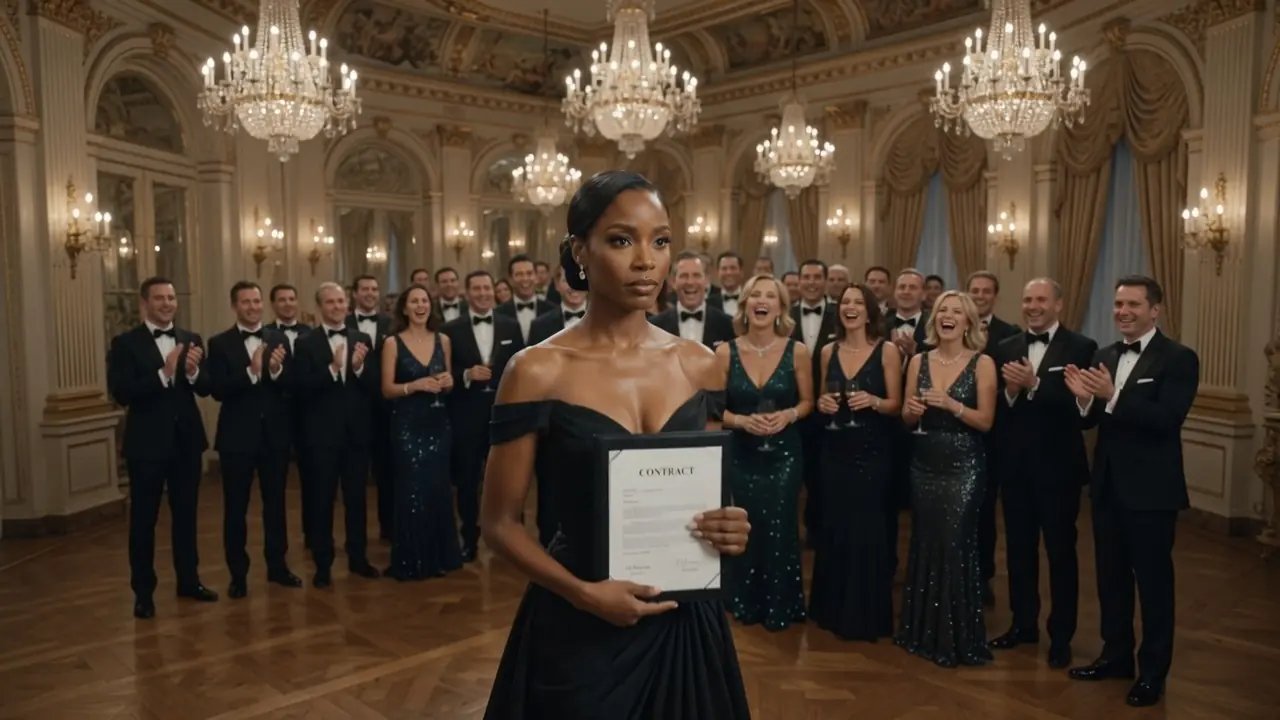
Claire lifted the contract where everyone could see it. “Then you never deserve my partnership,” she said. Her voice was quiet, but it cut through the ballroom with more force than shouting. Richard’s smile flickered, not because he was afraid yet, but because he was confused by the word partnership coming from someone he had decided was powerless.
“What did you say?” he asked. Claire looked at him with cold steadiness, then gripped the first pages with both hands. For the first time all night, Richard’s eyes sharpened with real attention. “Wait,” he said, stepping forward. “What are you doing?”
Claire tore the contract in half.
The sound was small, almost delicate, but the room reacted as if glass had shattered above them. The laughter died instantly. Margaret’s mouth opened, Connor lowered his glass, and Richard froze with one hand half-raised in front of him. Claire tore the pages again, clean and slow, letting each rip travel through the silence.
“Canceling your billion-dollar future,” she said.
No one moved. The band near the back stopped playing mid-note, leaving only the faint clink of ice in someone’s trembling glass. Richard stared at the torn paper in Claire’s hands as if his mind refused to connect the act to the consequences. He had spent his entire life believing contracts were weapons his family held over other people, never imagining one could be taken from him in front of the same people he had invited to admire his power.
Connor recovered first, though only enough to sound foolish. “You can’t do that,” he snapped. “Do you know who we are?” Claire turned her eyes toward him, and he took a half step back before he could hide it. “Yes,” she said. “That was the problem.”
Richard’s voice dropped into warning. “Dr. Evans, if this is some attempt to embarrass my family, I strongly suggest you think carefully before damaging a signed commercial agreement.” Claire gave him a faint smile, and it was the first expression that looked remotely like amusement. “It was not signed by Sentinel’s final authority,” she said. “That authority is mine.”
Margaret’s face changed first. She understood social power, but not manufacturing. Richard understood enough to go pale around the mouth. The final execution page had been awaiting Claire’s signature, because her board had insisted on one last in-person confirmation after weeks of troubling comments from Whitfield counsel. Richard had thought the ceremony was symbolic. Claire had known it was the last door he needed her to open.
The guests began whispering. A venture capitalist near the front pulled out his phone and typed quickly. A woman from a private equity firm leaned toward her partner and said, “Did she say Sentinel?” The name spread through the room like fire finding dry grass. Most had heard of Sentinel Silicon, the secretive chip fabrication company that had solved packaging constraints everyone else called impossible.
Richard looked at the torn paper, then back at Claire. “Dr. Evans,” he said, now choosing her title carefully. “Let’s not allow a careless comment to derail years of work.” His voice had lost its sharpness and gained the strained patience of a man trying to pull a collapsing ceiling back into place. “Whatever was said, we can discuss it privately.”
Claire lowered the torn contract pieces to her side. “Privately is where people like you usually apologize, Richard,” she said. “Publicly is where you humiliate people.” His jaw tightened at the sound of his first name. Around him, several investors stopped pretending not to listen.
Margaret stepped forward, forcing a laugh that shook at the edges. “Surely we all understand this has become unnecessarily emotional.” Claire turned to her slowly. The older woman’s smile failed under that stare. “You mistook dignity for emotion,” Claire said. “That mistake is why you are all standing here without a supplier.”
Connor’s face flushed. “We have other options.” Claire nodded once. “Name one.” The challenge emptied him. He glanced at his father, who did not answer, because Richard knew what Connor did not fully understand: the Novamind chip had been customized around Sentinel’s proprietary interconnect architecture, and there was no second foundry ready to fabricate it.
Claire reached into her clutch and removed her phone. Richard’s eyes followed the movement like a starving man watching water being poured away. She tapped once, then put the phone on speaker. “Rebecca,” she said calmly.
A woman’s voice answered at once. “Yes, Dr. Evans.” The room was silent enough that every syllable carried. Claire looked directly at Richard. “Cancel the Whitfield Novamind capacity reservation effective immediately. Reassign the Q4 and Q1 fabrication slots to HelixCore and Meridian Defense. Notify legal that the partnership will not proceed.”
Richard lurched forward. “No.” It was the first honest word he had spoken all night. “Claire, wait.” The use of her first name came too late and sounded too familiar. Claire did not blink.
Rebecca answered through the phone. “Understood. Confirming cancellation of seven hundred thousand Novamind units and reassignment of reserved capacity.” A sharp intake of breath moved through the ballroom. Several phones began buzzing at once as people received messages from assistants, analysts, and board members who were hearing the same disaster from other channels.
Richard’s face drained of color. “You cannot reassign that capacity tonight.” Claire looked at him with the calm of someone who had built her power one sleepless year at a time. “I already had contingency buyers waiting,” she said. “Unlike you, they understood the value of the room they were trying to enter.”
Margaret grabbed Richard’s arm. “Richard, fix this.” The command came out in a whisper, but panic made it ugly. He shook her off, then caught himself because too many people were watching. For the first time, Claire saw the family machine misfire: the patriarch no longer untouchable, the social queen helpless, the son too shallow to understand the size of the hole opening beneath them.
Richard lowered his voice. “Dr. Evans, please. This launch is tied to payroll, investor commitments, federal review, public offering preparation.” His eyes flicked toward the guests, then back to her. “If the chips do not ship, confidence collapses.”
Claire placed the torn contract pieces on a nearby table. “You should have thought about confidence before you taught this room to laugh at me.” Richard swallowed hard. The word please seemed trapped behind his teeth, too bitter for a man who had never needed it.
A man in a tuxedo near the back pushed through the crowd. Claire recognized him as Leonard Voss, Whitfield’s lead investor. His face was tight, and his phone was already open to a private market alert. “Richard,” Leonard said, “tell me she is not the only foundry.” Richard did not answer.
Leonard turned to Claire. “Dr. Evans, I apologize for anything said tonight. Surely there is a commercial remedy.” Claire studied him for a moment. “You are apologizing for risk exposure, Mr. Voss,” she said. “Not disrespect.” Leonard’s face hardened, but he had enough discipline not to argue. Everyone in the room understood the difference.
Connor made one last mistake. “This is why people say deals shouldn’t be run on feelings.” Claire turned toward him, and this time even Richard looked frightened. “My company runs on yield rates, thermal stability, delivery accuracy, and contract discipline,” she said. “Your family apparently runs on inherited arrogance and nervous laughter.” A few guests looked down, as if the floor had become fascinating.
Claire took one step closer to Connor. “And since you brought up feelings, let me be very clear. My feelings did not cancel your deal.” She held up her phone. “Your conduct triggered a final approval failure under Sentinel’s partner integrity clause.” Connor’s mouth opened, but no sound came.
Richard stared at her. “Integrity clause?” Claire smiled without warmth. “You signed the preliminary terms six weeks ago. You were too busy negotiating press access to read the part where Sentinel reserves final execution rights if partner leadership demonstrates reputational or governance risk.” She looked around the ballroom. “Thank you for demonstrating both.”
The first flash went off near the entrance. Then another. The doors had opened, and a few business reporters who had been invited for the announcement stepped inside, sensing immediately that the event had become something very different. Margaret turned away from the cameras, her hand lifting toward her necklace. Richard stood stiffly, trapped between begging and pretending nothing had happened.
Claire did not speak to the press. She did not need to. The torn contract on the table, the frozen faces, the buzzing phones, and Richard Whitfield standing pale under the chandeliers told enough of the story. A reporter whispered, “Is the Novamind launch canceled?” Another asked, “Dr. Evans, has Sentinel withdrawn?”
Richard’s control broke. “Everyone, please,” he said loudly, forcing his voice into authority. “This is a private matter being discussed between strategic partners.” Claire picked up the torn contract pieces and looked at him. “We are not partners.”
The sentence ended him in the room.
Leonard Voss turned away and began speaking urgently into his phone. Two other investors followed him toward the side hall. Connor’s friends, who had laughed loudest minutes before, now kept their faces blank and their distance wide. Margaret stood alone beside Richard, her elegance crumbling into fear as the social circle she had controlled for years recalculated its loyalty in real time.
Richard stepped toward Claire one final time. His voice lowered to something almost human. “Dr. Evans, I was wrong.” Claire watched him carefully. “No,” she said. “You were honest. That is different.” His eyes flickered with humiliation because he understood the cruelty of the distinction.
“I can apologize publicly,” he said. “I can issue a statement tonight.” Claire nodded. “You should.” Hope moved across his face. She let him have it for one second before continuing. “But not to recover my partnership. You should apologize because it is what decent people do after indecent behavior.”
Richard’s shoulders sank.
The ballroom watched in silence as Claire closed her empty folder. She had arrived carrying the future of the Whitfield empire in clean legal pages. She would leave carrying nothing but her own name, and somehow that looked heavier, sharper, and more valuable than any contract in the room. When she turned toward the doors, the crowd parted without being asked.
Margaret spoke behind her, voice shaking with anger disguised as grief. “Do you have any idea what you have done to this family?” Claire paused, then looked back. “Yes,” she said. “I treated you with the same mercy you showed me.” Margaret flinched as if the answer had touched skin.
Claire walked out of the ballroom with every camera following her and every whispered conversation bending around her absence. In the marble hallway, Rebecca stood waiting with Claire’s coat and a tablet already open to the cancellation notice. Rebecca was younger, sharp-eyed, and visibly furious on Claire’s behalf, though she kept her voice professional. “Capacity reassignment confirmed,” she said.
Claire nodded. “Legal?” “Already drafting.” “Engineering?” “Relieved,” Rebecca said. “They hated the Whitfield thermal tolerances.” Claire almost smiled, but the emotion faded before it reached her eyes. “Tell them we pivot to HelixCore at eight tomorrow morning.”
Rebecca glanced back toward the ballroom doors. “Are you all right?” Claire looked down at her hands. They were steady now, though she knew they might not be later, when the adrenaline left and the old exhaustion returned. “I will be,” she said.
By midnight, the story was everywhere. Business channels reported that Sentinel Silicon had withdrawn from the Novamind partnership minutes before a planned announcement. Social media filled with clips of Claire holding the torn contract while Richard Whitfield stood speechless behind her. Someone had recorded Connor’s cleaning staff joke, and within hours the Whitfield family’s polished public image cracked under the weight of its own voice.
By morning, Novamind’s private valuation had begun to collapse. Investors demanded emergency calls. Federal reviewers requested clarification on manufacturing continuity. The company’s Monday launch was postponed indefinitely, then quietly removed from the website. Richard appeared on television two days later with a prepared apology, but the words sounded like legal anesthesia applied to a wound everyone had already seen.
Claire did not watch the full interview. She sat in her office above Sentinel Silicon’s fabrication campus, looking through glass walls at the cleanroom corridor where engineers moved in white suits beneath bright lights. Those people had built the miracle the Whitfields thought they could purchase without respecting the woman who led it. They had worked nights, weekends, failed prototypes, and impossible timelines into functioning silicon.
Rebecca entered with coffee and a stack of revised agreements. “HelixCore signed the emergency capacity premium,” she said. “Meridian wants to increase their order by twelve percent.” Claire took the papers. The billion-dollar future Richard lost had not vanished. It had simply moved to companies that understood power did not always arrive wearing the face they expected.
A week later, Claire received a handwritten letter from one of the younger women who had attended the gala. The woman admitted she had laughed at first, not because she thought it was funny, but because everyone else had laughed and she was afraid of standing alone. She said watching Claire tear the contract had made her feel ashamed, then awake. Claire read the letter twice before placing it in the drawer where she kept reminders that consequences could teach what politeness never had.
Three months later, Sentinel Silicon announced two new partnerships and a national expansion of its fabrication campus. Claire stood at the podium in a navy suit this time, no torn contract, no ballroom, no laughter behind her. Reporters asked whether she regretted ending the Whitfield deal so publicly. Claire looked into the cameras and answered with the same calm that had frightened Richard under the chandeliers.
“I did not end it publicly,” she said. “They disrespected me publicly. I simply made the business consequence visible.” The quote ran everywhere by evening. Some called her ruthless. Others called her brave. Claire knew both words were too simple.
She had not wanted revenge as much as she wanted the truth to stop being hidden in private rooms. She wanted people like Richard Whitfield to understand that access was not ownership, invitation was not charity, and partnership was not a favor granted downward. She wanted every young woman watching to know that leaving a table could be more powerful than begging for a seat. Most of all, she wanted the world to remember that dignity was not decoration for success; it was infrastructure.
Years later, business schools would study the collapse of the Whitfield-Novamind launch as a case about governance risk, supplier dependency, and leadership failure. Analysts would focus on the chip architecture, the exclusivity clauses, and the catastrophic lack of manufacturing redundancy. But people who had been inside the ballroom remembered something simpler. They remembered Richard Whitfield saying, “You should be grateful we let you in this room.”
And they remembered Dr. Claire Evans standing beneath the chandeliers, contract in hand, refusing to carry one more insult quietly. They remembered the sound of paper tearing through a room full of billionaires. They remembered her voice, calm and final, answering the panic of a man who had mistaken cruelty for power.
“Canceling your billion-dollar future.”