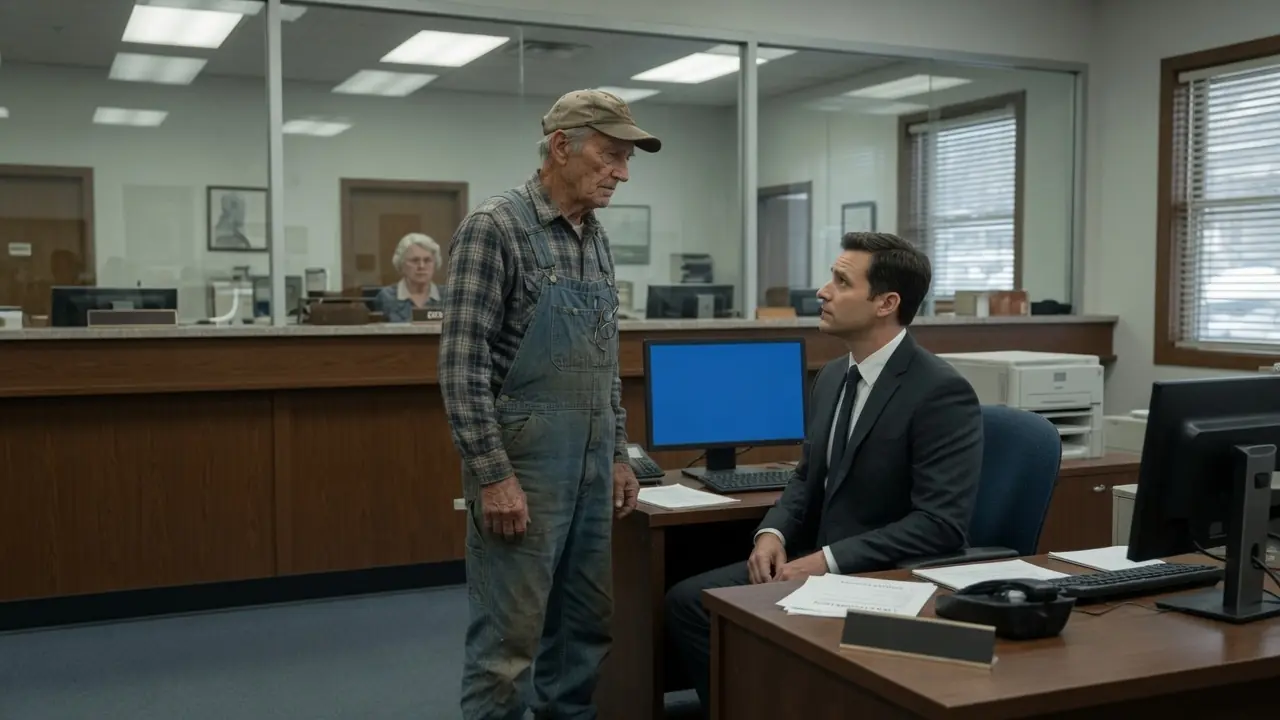
Earl Perkins did not look like a millionaire when he walked out of Marcus Webb’s glass office. He looked like what he had always looked like in Hadley: an old farmer with cracked boots, faded denim overalls, a clean flannel shirt, and hands shaped by fifty-five years of dirt, machinery, and weather. The only thing different about him that morning was the quiet in his face, the kind of quiet that made Doris at the teller counter stop typing before he reached her window. Behind him, Marcus was already sitting back down, believing he had handled a routine denial with professional courtesy.
The bank lobby was nearly empty, but it felt full of everything that had not been said. One customer stood at the far counter filling out a deposit slip, and a young teller sorted rolled coins beside a drawer. Fluorescent lights hummed over the blue carpet, and Marcus’s glass office reflected Earl’s slow walk across the room. Doris watched him come with tight eyes, because she had known Earl Perkins for more than thirty years and knew exactly how wrong the young manager had just been.
“How did it go?” Doris asked, though she did not need the answer. Earl rested one rough hand on the edge of the counter and looked at her for a moment. There was no anger in his eyes, and that somehow made Doris feel worse. “About how you expected,” he said.
Doris glanced toward the office. Marcus had opened another file on his laptop, already moving on from the old farmer with fourteen dollars in checking and a loan request he considered impossible. Earl followed her glance and then looked back at her. He lowered his voice, not because he was ashamed, but because he had always believed private business deserved a private tone. “Doris, pull up my other account.”
The words changed the air around the teller counter. Doris stopped completely, her fingers hovering over the keyboard. She had been waiting for Earl to say it, yet hearing it still made her swallow hard. “You sure?” she asked.
“I’m sure,” Earl said. He reached into his shirt pocket and touched the wire-framed reading glasses he carried there, the ones that had belonged to Helen. The gesture was small, but Doris noticed, because she noticed everything about people she cared for. Then she turned to her computer and typed an account number she had known by heart for years.
The screen shifted from the small checking account Marcus had judged to something almost no one in Hadley knew existed. Earl and Helen Perkins Family Trust. Balance: $12,417,832. Doris stared at the number, even though it was not new to her, because seeing it after what had just happened made it feel heavier than before.
Earl did not lean forward to check it. He did not smile, did not straighten proudly, and did not turn around to see whether Marcus was watching. He simply stood there, calm and still, like a man waiting for the weather to show what it had been carrying. Doris looked at the screen, then at Earl, and her eyes went wet.
“He didn’t check the full profile, did he?” she asked quietly. Earl shook his head once. “No.” Doris’s jaw tightened, and for a second she looked less like the bank’s head teller and more like a woman ready to march into that glass office and scold a boy who had forgotten his raising. “I told him when he came here,” she said. “Full review before any decision on long-term customers.”
Earl placed his hand flat on the counter. “It’s all right, Doris.” She looked up sharply. “No, Earl. It is not all right.” He gave her a tired little look that was not quite a smile. “Maybe not. But it told me what I came to learn.”
Doris understood then that this had never truly been about the five thousand dollars. Earl had not needed the money for a combine header, not in the way Marcus thought. He had walked into the bank wearing what he wore every day, asking for something ordinary, because he wanted to know whether the new manager could see past dust, age, cracked leather, and one small balance on one screen. Marcus had not merely denied a loan; he had failed to recognize the man standing in front of him.
Doris turned the monitor slightly. Not toward Earl, who already knew the number. She turned it toward the glass office behind him, where Marcus sat with his hand on the mouse. “Marcus,” she called, her voice controlled but sharp enough to cut through the lobby. “You should look at this.”
Marcus glanced up without urgency. His eyes moved first to Doris, then to Earl’s back, then to the monitor she had angled toward him. At first, his face showed only mild confusion, the expression of a man interrupted during paperwork. Then his eyes found the balance.
He leaned forward. He squinted slightly, as if the screen had made a mistake. Then he stood so quickly his chair rolled backward and bumped the wall behind his desk. The sound echoed through the glass office.
For a few seconds, Marcus did not move. His professional face disappeared piece by piece, leaving a young man caught in the exact instant he understood his own error. The screen did not say fourteen dollars. It did not say eight hundred dollars in savings. It said more than twelve million dollars held in a trust under the name of the old farmer he had just offered senior assistance forms.
Marcus stepped out of his office doorway, one hand still touching the frame as if he needed it to stand. His mouth opened, but no words came. He looked at Earl’s boots, then at Earl’s shoulders, then at the screen again. The polished bank manager had suddenly become very pale under the fluorescent lights.
Doris turned the monitor back toward herself. She had made her point, and she was not the kind of woman to turn a man’s embarrassment into a circus. But the silence in the lobby had already done enough. The young teller stopped sorting coins, and the customer with the deposit slip looked down at his paper as if pretending not to witness anything.
“Mr. Perkins,” Marcus finally said. His voice sounded smaller outside the office. Earl did not turn around immediately. He kept his eyes on Doris and said, “I didn’t need the money.”
Doris nodded slowly. Marcus took one step closer, still confused, still ashamed, still trying to find where the conversation had gone wrong. Earl turned then and looked at him across the lobby. “I needed to see the man.”
Marcus swallowed. “Sir, I didn’t know.” Earl’s pale eyes held him, steady and unreadable. “You didn’t ask.”
The sentence landed harder than shouting would have. Marcus looked toward his office, where the rejected loan form still sat open on his desk. He remembered Earl lowering himself into the chair, asking for five thousand dollars, and offering his word as collateral. He remembered thinking of risk, age, low balance, worn clothing, lack of visible income, and all the clean little categories that had allowed him to dismiss the old man quickly.
“I should have reviewed the entire file,” Marcus said. Earl tilted his head slightly. “Yes.” Marcus flinched, not because the word was cruel, but because it was true. Earl reached into his shirt pocket and touched Helen’s glasses again. “A man shows what he sees before he shows what he knows.”
Doris looked down, blinking fast. She had heard Helen Perkins say things like that for years, always plain and final enough to end an argument without raising her voice. Earl had learned some of his best sentences from his wife. Marcus did not know that, but he felt the weight of the words anyway.
“Mr. Perkins,” Marcus said, “if you would like to come back into my office, I can reopen the application.” Earl shook his head. “No.” The refusal was quiet, but it closed the door more firmly than anger could have. “The loan was never the important part.”
Marcus looked at Doris, then back at Earl. “Then what was?” Earl studied him for a long moment, as if deciding how much of the truth the young man deserved. “I am planning a large transfer,” he said. “Something for Hadley. Something Helen wanted done.”
Doris drew in a breath. She knew what Earl meant, or at least suspected it. For months, she had watched him come in to ask small questions about charitable accounts, trustee structures, and construction payments without explaining the whole plan. The old community center had burned four years earlier, and everyone in town knew Helen had never stopped mourning that loss. Now Doris could see the promise taking shape.
Marcus seemed to understand only part of it. “A transfer from the trust?” he asked. Earl nodded. “Two million dollars.” The young teller behind the counter dropped a roll of quarters into the drawer, and the sound snapped across the lobby. Marcus did not even look away.
“Two million,” Marcus repeated. Earl’s face did not change. “For a new community center. Helen’s name will be on it.” Doris pressed a hand against the counter, and this time she could not hide the tears in her eyes. Marcus looked from Doris to Earl and realized that he was not simply standing in front of a wealthy customer. He was standing in front of a man about to change the life of the town he had barely bothered to learn.
Earl looked toward the glass office. “I came in today because a project like that needs people I can trust. It needs a bank that remembers people are more than their balances.” Marcus lowered his eyes. No defense came to him, and for once, that was wisdom. “I failed that,” he said.
“You failed the first chance,” Earl replied. “That’s not always the same as failing forever.” Marcus looked up quickly, surprised by the opening. Earl did not soften his face. “But I will not put Helen’s promise in careless hands.”
The mention of Helen changed the tone of the moment. Doris knew Helen Perkins as the woman who had quietly helped half the town balance checkbooks, organize food drives, and teach children to love books in a building now gone to ash and weeds. Marcus only knew the name from the account title, but he began to understand that the trust balance represented a lifetime, not a number. It had roots, grief, discipline, and love attached to it.
Earl turned back to Doris. “I’ll be back Monday. I need someone to help arrange the transfer and contact the lawyer.” Doris nodded, wiping quickly under one eye with her thumb. “I’ll be ready.” He glanced once toward Marcus. “Not with him. Not yet.”
Marcus accepted it without protest. A minute earlier, that might have wounded his pride. Now pride felt useless. He stood in the lobby and watched Earl tap the counter once with his knuckle, then turn toward the door.
The bank bell chimed as Earl stepped outside. Sunlight fell across his old cap and shoulders before the door closed behind him. Through the front window, Marcus saw him cross the sidewalk toward the parking lot, moving slowly but without weakness. The rusted Ford pickup waited near the curb, its paint faded and its passenger seat empty.
Doris cleared her throat behind the counter. Marcus turned back toward her, still pale. She looked at him over her glasses, and for the first time since he had transferred to Hadley, he felt like a schoolboy in front of a teacher who expected better. “I told you to look at the full profile,” she said.
“I know,” Marcus said. Doris shook her head. “No, you do not know yet. But you are going to.” She turned back to her keyboard, and that was the end of the conversation as far as she was concerned.
Marcus returned to his office, but he did not sit down right away. The rejected loan application still glowed on his screen, neat and terrible. He looked at the fields for “current balance,” “risk category,” and “collateral,” and all of them seemed suddenly smaller than they had before. The file had not lied, but he had asked it the wrong questions.
He pulled up Earl’s full customer profile. This time he read everything. The trust account. The mineral rights income. The agricultural seed royalty deposits. The internal note Doris had placed years earlier: Priority client, full review required for any transaction.
Marcus sat down slowly. The note had been there the entire time. It was not hidden behind a secret code or an obscure tab. He had ignored it because the first screen had told him the story he expected to hear.
Outside, Earl sat in his pickup without starting the engine. He pulled Helen’s glasses from his pocket and held them in both hands. The parking lot was quiet, and a sparrow landed on the hood, cocking its head as if waiting for him to speak. Earl smiled faintly.
“Well, Helen,” he said. “You were right. The old manager would have known.” He turned the glasses over in his palms, feeling the small scratch on the left lens. “This new fella doesn’t see past the boots.”
The sparrow hopped once, then flew away. Earl watched it disappear over the bank sign. For two years after Helen died, he had carried her dream like a folded letter, reading it in private but not yet sending it out into the world. That morning, Marcus’s mistake had done something useful: it had made Earl certain he had waited long enough.
“I’m going to build it,” Earl whispered. “Two million, just like we talked about.” He looked at the empty passenger seat where Helen had sat for fifty years, reading the paper aloud on drives into town. The faint scent of her lavender hand cream still lived somewhere in the glove box because he had never cleaned it out. “And I’m putting your name above the door.”
Back inside the bank, Marcus watched the old Ford pull away. He was still standing near his desk, unable to return to ordinary work. The number on the screen remained open, but it no longer dazzled him the way it had at first. The longer he stared, the less it looked like money and the more it looked like evidence.
Evidence of a farmer he had dismissed. Evidence of a wife who had built wealth in silence. Evidence of a marriage that had chosen purpose over display. Evidence that Marcus Webb had walked into a small town with a polished suit and had still missed the most important lesson in the building.
At ten o’clock, Doris knocked on his office door. She did not wait for him to say come in before opening it, and Marcus did not object. She stepped inside, closed the door behind her, and stood in front of his desk with both hands folded over the customer files she carried. “I want to tell you about Earl Perkins,” she said, “and I need you to listen.”
Marcus nodded. “I’m listening.” Doris’s face remained stern, but not cruel. “Helen opened that trust years ago. She came in every month with deposits. Sometimes fifty dollars, sometimes five hundred. Earl would come with her sometimes, waiting while she talked through numbers with the old manager.”
Doris looked toward the lobby where Earl had stood minutes earlier. “They never changed how they lived. Same house, same truck, same breakfast at the diner. People thought they were just scraping by, and they let them think it.” Marcus did not interrupt. He understood this was not gossip; it was testimony.
“Earl has never missed a payment, never bounced a check, never asked for anything he did not intend to repay,” Doris continued. “He has helped families in this town without letting his name be attached. Funerals, medical bills, church repairs, school supplies, more than most people will ever know.” Her voice tightened. “You saw fourteen dollars and thought you had the measure of him.”
Marcus closed his eyes briefly. “I did.” Doris leaned slightly forward. “And that is what scares me. Not that you made a banking mistake. That you made a human mistake and used banking language to cover it.”
The words stripped away his last protection. Marcus thought of his father then, a mechanic back in the town where he grew up, with oil in his nails and a name patch stitched on his work shirt. As a teenager, Marcus had been embarrassed by him. He had let friends drop him off two blocks from the garage so they would not see where his father worked.
His father had never mentioned it. He had just kept working, kept paying bills, kept showing up. Marcus had not thought about that shame in years, but now it came back with Earl’s cracked boots attached to it. The old farmer had not merely revealed money; he had revealed something rotten in Marcus that had been hiding under ambition.
“I owe him an apology,” Marcus said. Doris held his gaze. “Yes. But do not rush over there with one if you only want relief from feeling guilty.” Marcus nodded slowly. “Then what should I do?”
“Become the kind of man who would not make that mistake twice,” Doris said. “Then apologize.” She opened the office door and paused before leaving. “Earl notices more than people think. If you change, he will see it.”
The rest of the day moved strangely. Customers came in, phones rang, loan papers printed, and tellers counted cash. Marcus did his work, but every ordinary task now carried a new edge. When an older man came in asking about a small certificate of deposit, Marcus read the entire profile before speaking. When a young mother asked about overdraft fees, he asked two more questions than he normally would have asked.
At closing time, Doris balanced her drawer and said nothing about any of it. She did not praise him for basic decency. That, Marcus understood, was another lesson. You did not get applause for doing what should have been done the first time.
That evening, Marcus walked past the diner on his way to the small apartment the bank had rented for him above the hardware store. Louise was wiping the front window and paused when she saw him. Her face was not unfriendly, but it was not warm either. By then the story had already begun moving through town, and Marcus could feel Hadley measuring him in a new way.
He deserved it. That was the part that stung most. In the city branch where he trained, mistakes could hide inside paperwork and volume. In Hadley, a mistake had a name, a truck, a stool at the diner, and a dead wife whose dream might have passed through his hands if he had been worthy.
On Monday, Earl returned to the bank, but he asked for Doris. Marcus saw him through the glass and stayed seated, though every part of him wanted to stand, apologize, and repair the moment immediately. Earl did not look into the office. He handed Doris a folder and spoke with her for nearly twenty minutes.
Marcus watched without resentment. It hurt, but it was useful hurt. Earl was trusting Doris with the first steps of a two-million-dollar transfer, and Marcus understood he had excluded himself from that moment with his own conduct. The old farmer was not punishing him loudly. He was simply placing trust where trust had been earned.
Over the next week, Marcus learned more about Earl from the town than from the file. Frank at the hardware store told him Helen had taught half the town how to balance a checkbook. Louise at the diner stopped speaking when Earl’s name came up, then finally said, “That man sees people when they are trying hardest not to be seen.” The town clerk said Helen had believed Hadley needed a gathering place again, and Earl had carried that promise alone since her death.
Each story made Marcus feel smaller and more determined at the same time. He began staying late to review long-term accounts properly. He called elderly customers by name instead of account number. He asked Doris questions and accepted her corrections without defending himself.
Two weeks after the account reveal, Marcus found Earl at the diner. It was not Saturday, but Earl sat on the third stool from the left with coffee and eggs, reading a folded newspaper. Louise glanced at Marcus when he entered, and the whole diner seemed to lower its voice. Marcus walked to the counter and stopped two stools away.
“Mr. Perkins,” he said. Earl looked up. “Marcus.” The sound of his name in Earl’s voice held no warmth, but no cruelty either. Marcus asked if he could sit, and after a long moment, Earl nodded toward the empty stool.
Marcus sat down and placed both hands on the counter. He had practiced the apology several times, but now all the polished sentences felt wrong. “I owe you an apology,” he said. “A real one. Not the kind where I say the words and hope everyone forgets.”
Earl set down his newspaper. Marcus forced himself to meet his eyes. “I saw your balance, your clothes, your age, and your boots. I decided who you were before I gave you the chance to show me. I denied the loan before I saw the man sitting in front of me.”
Louise stood nearby with the coffee pot, pretending not to listen. Earl looked at Marcus for a long time. “Yes,” he said finally. “You did.”
Marcus accepted the words without flinching. “Doris told me about Helen, the trust, and some of what you’ve done for this town.” Earl’s face closed slightly, and Marcus corrected himself. “Not details she shouldn’t have shared. Just enough for me to understand what I failed to see.”
Earl lifted his coffee, then set it down without drinking. “Let me tell you something,” he said. “You remind me of my son when he was young. Too busy looking at what things cost to see what they’re worth.” Marcus nodded slowly because the sentence described him too well.
“My wife spent fifty years building money we never touched,” Earl continued. “She could have had a new house, a new car, whatever she wanted. But Helen said money was not for showing people what you had. It was for doing something when the right need appeared.” He looked toward the diner window, where Main Street sat quiet under the afternoon sun. “That lesson takes some folks a while.”
Marcus lowered his voice. “I’m trying to learn it.” Earl studied him, not kindly yet, but fairly. “Trying matters if it turns into doing.” Marcus nodded. “I understand.”
Then Earl surprised him. “I need someone to manage the fund’s bank side. Disbursements, contractor payments, accounting oversight. Doris is retiring next year. I need someone who knows numbers and plans to stay long enough to know people too.” Marcus stared at him.
“You are asking me?” he said. Earl picked up his coffee. “I am asking if you are willing to do the work.” Marcus sat straighter. “Yes. I am willing.” Earl gave him one small nod. “Then talk to Dale. He’ll walk you through the budget.”
Marcus looked down at the counter, overwhelmed by something that felt both like forgiveness and responsibility. “Thank you, Earl.” It was the first time he used the old farmer’s first name. Earl did not object.
After Marcus left, Louise walked over and refilled Earl’s cup. “You sure about that?” she asked. Earl watched the young manager cross the street toward the bank. “No,” he said. “But Helen always said you learn more about a man from his second chance than his first mistake.”
The community center project began to move after that. Dale Perkins came home from Chicago, carrying his own shame and a one-way ticket he had not meant to buy. He and Earl unfolded sketches across the farmhouse table, marking rooms, budgets, timelines, and Helen’s reading room in the corner she would have loved. Marcus came to the construction site with a laptop, a folding chair, and a willingness to be useful without being important.
At first, people watched Marcus carefully. Small towns do not forget quickly, especially when one of their own has been insulted. But he kept showing up. He brought coffee to crews, double-checked invoices, caught billing errors, and worked through payment schedules with Dale late into the evening.
Over time, suspicion softened into cautious acceptance. The banker who had once judged Earl by his boots began learning the names of roofers, teachers, farmers, widows, and children who would use the building. He learned that Hadley was not a market territory. It was a place where people remembered whether you showed up when showing up cost something.
When the Helen Perkins Memorial Community Center opened in November, Earl stood beneath the carved walnut sign above the door. It read: A town is only as strong as its kindest people. Marcus stood near the back with his wife and daughter, watching Earl speak briefly about Helen, the old center, and the promise he had finally kept. The applause that followed filled the hall so completely that Marcus felt it in his ribs.
He thought back to the moment in the bank lobby when the monitor turned and the $12 million appeared. At first, he had thought the number was the shock. Now he understood the real shock had been Earl himself: quiet, patient, wounded but not bitter, powerful but not proud. Marcus had been stunned by the money, but changed by the man.
Late that afternoon, Marcus found Earl in Helen’s reading room. Sunlight fell across built-in oak shelves, and children’s books sat in neat rows waiting for small hands. Marcus stood in the doorway and said, “Thank you for letting me help.” Earl turned from the shelves and looked at him.
“You earned the second chance,” Earl said. Marcus shook his head slightly. “I almost missed the whole man.” Earl touched the glasses in his shirt pocket, the habit still with him though the building was finished. “Most people do, if they are in too much of a hurry.”
Marcus extended his hand. Earl took it with a firm grip, not the quick handshake of a transaction, but the full grip of a man acknowledging work done honestly. For Marcus, it felt heavier than any promotion he had ever received. It felt like being allowed to begin again.
That night, Earl drove home in the same rusted pickup, on the same road, past the same fields. The bank, the loan, the account balance, the apology, the construction, and the opening all sat behind him like chapters finally written. At the farmhouse, he stepped inside and placed Helen’s glasses on the kitchen table, not hidden away, not abandoned, simply set in the place where she used to sit. The house was quiet, but not empty in the old way.
Earl made coffee and sat by the window, looking out at the dark fields. The trust still held millions. The old pickup still needed work. His boots were still cracked, and his checking account still rarely held more than he needed for the week.
But Helen’s center was built. Dale was home. Marcus had learned to look twice. And a whole town had been reminded that a man’s worth is not shown by the polish on his shoes, the balance on the first screen, or the noise he makes when he enters a room.
Sometimes the richest person in a town is the one nobody notices. Sometimes the poorest-looking man at the counter is carrying a promise worth more than money. And sometimes a bank manager has to watch twelve million dollars appear on a screen before he understands that the real account he failed to open was the human being sitting right in front of him.