The auctioneer’s voice carried across the barnyard on a raw March morning in 1985. Ladies and gentlemen, we’re here today for the liquidation sale of the Schroeder farm operation, 640 acres, Farabo County, Minnesota. We’ll start with equipment at 9 sharp, move to livestock at 11:00, and the land parcels at 2:00 this afternoon.
Tom Schroeder stood 30 feet back from the crowd, arms crossed tight against his chest like he was trying to hold himself together. His wife, Linda, wasn’t there. She couldn’t be. She had taken the kids to her sister’s place in Mankato 3 days earlier. She couldn’t watch strangers pick through 23 years of their lives.
The crowd numbered maybe 200 people. Some were neighbors. Some were dealers from as far as Sioux Falls looking for equipment they could steal at depression prices. And some, Tom knew exactly who they were, represented the First Agricultural Bank of Blue Earth. The bank had called his operating loan in November. The bank had refused every restructuring proposal his lawyer had submitted. The bank wanted this land.
But standing at the very back, almost hidden behind a grain truck, was Rick Palowski. 42 years old, farming 800 acres about six miles north. Rick had his hands shoved deep in his Carhartt jacket pockets, his John Deere cap pulled low. Nobody was paying him any attention. That was about to change.
Now, before we go further, you need to understand what was happening in American agriculture in early 1985. According to Federal Reserve data, farm debt had reached $215 billion nationally. Triple what it had been just 7 years earlier. In Minnesota alone, over 400 farms had gone into foreclosure proceedings in 1984. Land prices that had peaked in 1981 at an average of $2,200 per acre in prime areas were now selling for less than $900. The farm economy wasn’t struggling. It was in complete collapse.
The Schroeder farm was worth about $380,000 in 1981. Tom owed $340,000 on it now after the bank had capitalized years of unpaid interest onto the principal. But the farm would be lucky to bring $200,000 at auction. Tom knew it. The bank knew it. Everyone standing in that barnyard knew it. The bank didn’t care. They wanted the asset off their books. They’d foreclose, take the loss, sell the land to an investor within 6 months when prices recovered. And they were betting prices would recover and make their money back. Standard operating procedure for agricultural lenders in 1985.
Tom Schroeder wasn’t a bad farmer. He was a farmer who believed the experts. In 1979, the county extension agent had told him to expand. The AG economist from the University of Minnesota had shown charts proving land values would keep climbing. The loan officer at First AG had said, “Tom, you’re leaving money on the table if you don’t leverage up and grow.” So Tom had bought his neighbor’s quarter section. He’d upgraded his equipment. He’d done everything right.
Then interest rates hit 21%. Then the grain embargo dried up export markets. Then land prices collapsed. Then operating loans got called in. Doing everything right hadn’t mattered at all. Lot number one, the auctioneer called out, John Deere 4440, 1979 model, showing 4,200 hours. We’ll start the bidding at $12,000. The 4440 was Tom’s primary tractor, 110 horsepower, synchro range transmission, sound guard cab. He bought it new in 1979 for $38,000. At $12,000, it was worth less than a good used pickup truck.
12,000. Do I hear 12? 12. Got it. 13. 13,000. Yes, sir. 14. The bidding climbed slowly. A dealer from Worthington dropped out at 16. A farmer from Martin County went to 17,500 and stopped. The tractor sold for $18,200 to an implement dealer who had driven down from Marshall. Tom watched the man hand over a cashier’s check. The dealer would have that tractor cleaned up and on his lot by Monday morning with a $28,000 price tag.
It went like that all morning. The International 1086 that Tom used for heavy tillage, bought for $27,000 in 1978, sold for $11,500. The John Deere 7000 planter, six row with monitor, $4,800. The Kewanee disc, 24 ft, $1,200. The Brent gravity wagon, $450. Rick Palowski watched every lot. Didn’t bid on anything. Just watched.
Around noon during a break before the livestock sale started, Tom’s brother drove up from Fairmont and found Tom sitting on the tailgate of his truck, staring at nothing. You okay? Tom didn’t answer right away. Then you know what the worst part is? It’s not losing the farm. I mean, it is, but it’s not. The worst part is knowing that in 6 months that bank’s going to sell this land to some doctor from the cities who wants a tax write-off or some corporation and it’ll go for what it’s actually worth. But I won’t see a dime of that. I’ll still owe them $140,000 after today. They get the land and they get to sue me for the deficiency. His brother didn’t have an answer for that. There wasn’t one.
The livestock went fast. The Holstein herd brought decent money. Dairy prices were holding better than grain. But watching his cattle sell, cattle he’d raised from calves in some cases, Tom felt something break inside him that hadn’t broken yet. A man can lose equipment. Equipment is just metal. But livestock, you know. You’ve pulled calves at 2 in the morning in February. You’ve treated them when they’re sick. They know your voice.
At 1:45, the crowd started gathering again for the land auction. This was what everyone had really come for. 640 acres of class A soil, tile drained, less than 2 miles from a paved road. Good farm ground, the kind that doesn’t come up for sale often. Except now it came up for sale every week somewhere in Minnesota, Iowa, Kansas, Nebraska. Another farm went under the hammer.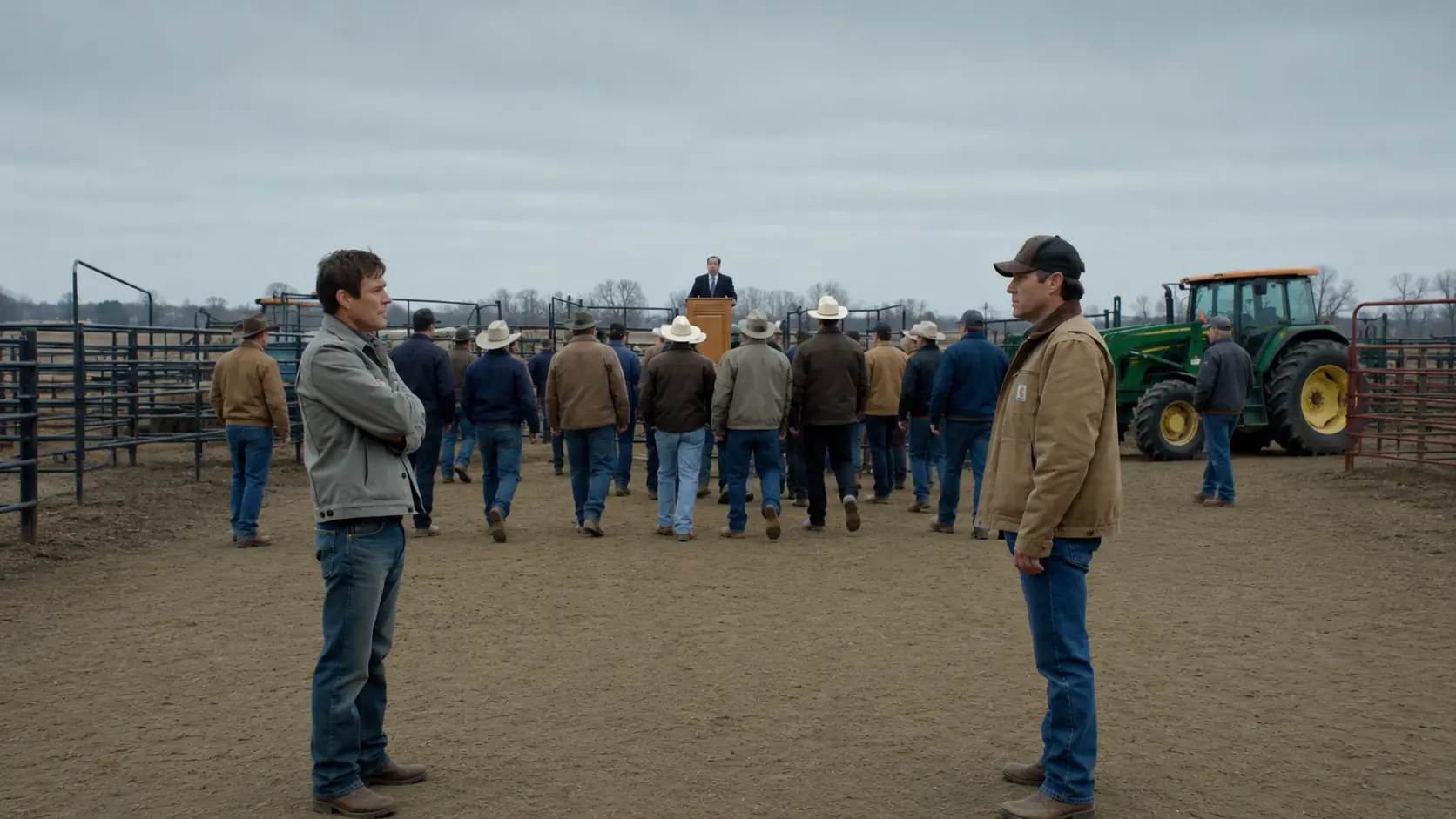
The auctioneer had set up a platform with a microphone at the top of the driveway. The crowd pressed closer. Rick Palowski moved forward too, but he stayed at the edge, still not drawing attention. All right, folks. Here’s how we’re going to work this. We have four parcels. The home quarter, 160 acres including all buildings and homestead, the north quarter, the south quarter, and the west 80 acres. We’ll sell them individually first, then offer them as a package. Bidding will start at $1,000 per acre on the home quarter. $1,000 per acre for land that should have been worth 1,500 minimum, 2,000 in a normal market.
Tom felt his jaw clench. The bank’s appraiser had valued it at $850 per acre for foreclosure proceedings. That’s what Tom would be credited, but they’d start the bidding higher. And whatever it brought above $850, the bank would pocket as recovery costs. Do I hear 1,000 per acre? That’s $160,000 for the home quarter with all improvements. A hand went up. Local farmer guy who’d been expanding by buying foreclosed land for 2 years. 1,000. Got it. Do I hear 1,050? Another hand. One of the bank representatives. 1,100. 1,100 per acre. 176,000 total. Do I hear 1,150?
The local farmer shook his head. He knew when the bank was bidding. You don’t fight the bank. The bank has infinite money and no conscience. Going once at 1,100 per acre. And then Rick Palowski’s hand went up. 1,200. Every head in that crowd turned. Tom Schroeder’s eyes went wide. Rick Palowski. Rick was a good farmer, but everyone knew his situation. He’d borrowed heavy too. Maybe not as heavy as Tom, but heavy enough. Rick had no business bidding on land in 1985. Hell, half the people there figured Rick would be in Tom’s position inside a year.
The bank representative looked annoyed, raised his hand again. 1,300. Rick didn’t hesitate. 1,400. A murmur went through the crowd. The auctioneer looked confused. This wasn’t how these auctions usually went anymore. Usually the bank bid once or twice and everyone else stayed quiet because they knew the fix was in. 1,500, the bank man said, voice tight. 1,600. Rick’s voice was steady, loud enough for everyone to hear. Now people were openly staring. What the hell was Rick Palowski doing?
The bank representative turned and had a quick urgent conversation with his colleague. Then he raised his hand again. 1,700 per acre. Rick paused just for a moment, long enough that Tom Schroeder felt his heart drop. Then 1,800. The bank man’s face was red now. 1,900. 2,000. Rick said it calmly like he was ordering coffee. 2,000 per acre. $320,000 for the home quarter alone. That was more than fair market value even before the collapse.
The bank representative looked like he wanted to throw something. He huddled with his colleagues again. This time the conversation took longer. Meanwhile, the auctioneer was trying to keep things moving. We’re at 2,000 per acre, $320,000. Do I hear any advance? The bank huddle broke up. The representative looked at Rick Palowski with pure hatred. Then he shook his head and stepped back into the crowd. Sold. The auctioneer’s hammer came down. 160 acres to bidder number 73, Rick Palowski, at 2,000 per acre.
The crowd erupted in confused conversation. Tom Schroeder felt like the ground was tilting under him. Rick had just bought his farm. With what money and why? Why would Rick saddle himself with that kind of debt in this market? But Rick wasn’t done. North quarter, the auctioneer called. 160 acres, excellent tillable, some terracing. We’ll start at 1,000 per acre. The bank bid immediately. 1,000. Rick’s hand went up before the auctioneer could even call for advances. 1,500. The bank man’s eyes narrowed. 1,600. 2,000. Rick said. This time the bank representative didn’t even bother to confer with his colleagues. He just turned and walked away from the auction, got in his car and drove off. His two colleagues followed 30 seconds later.
The auctioneer looked stunned. Well, all right then. Sold to bidder 73 at 2,000 per acre. The pattern repeated for the south quarter and the west 80. Rick bid each parcel to exactly 2,000 per acre. Nobody else bid against him. By 3:15 that afternoon, Rick Palowski owned all 640 acres of the Schroeder farm. Total price, $1,280,000. The crowd was silent. Now this wasn’t celebration. This was shock. Everyone there was doing the same math. Rick Palowski had just obligated himself to over a million dollars in debt in the worst farm economy since the Great Depression. This wasn’t heroic. This was suicide.
Tom Schroeder pushed through the crowd toward Rick. His face was twisted with confusion and something that might have been anger. Rick, what the hell did you just do? You can’t afford this. You know you can’t afford this. Rick pulled an envelope out of his jacket pocket. Plain white envelope, sealed. He handed it to Tom. Open it when you get home, Rick said. Not here. Then he turned to the auctioneer. I need to settle up. Where do I sign?
Tom stood there holding the envelope like it might explode. People were starting to drift away now. The auction over, the shock fading into gossip. By dinner time, everyone in Farabo County would be talking about what Rick Palowski had done. Most of them would be saying he’d lost his mind. Tom went back to what had been his house, what was now Rick Palowski’s house legally. His hands were shaking as he opened the envelope. Inside was a single sheet of paper, handwritten in Rick’s careful printing.
Tom, the farm is still yours. I bought it to keep the bank from getting it. Total cost, including auction fees, $1,287,400. I’m selling it back to you for exactly what I paid. You can pay me when you can pay me. If that’s 5 years from now, fine. If it’s 10 years, fine. If it’s never, that’s fine too. The bank doesn’t get to win. Not this time. Rick.
Tom read it three times. Then he sat down on his front porch, not his porch anymore except apparently it still was, and cried for the first time since this whole nightmare started. But here’s the part you need to know about Rick Palowski. The part that makes this story bigger than one auction in one county. Rick’s father had lost their family farm in 1961. Different crisis, same story. The old man had died in 1978, bitter and broken, having spent the last 17 years of his life working in a meat packing plant in Albert Lea.
Rick had sworn, actually sworn out loud at his father’s funeral, that he’d never let what happened to his dad happen to anyone he could help. So starting in 1981, when he saw the crisis coming, Rick had sold off a quarter section he bought in 1976, got out while land prices were still high, paid down his debt to almost nothing. Then he’d done something that made his wife think he’d lost his mind. He’d stopped farming 200 acres of his best ground and rented it out to a neighbor, took the cash rent, lived on almost nothing, and saved every penny for four years.
While everyone around him was leveraging up, buying new equipment, expanding, Rick was saving money and waiting. Waiting for what? His wife Margaret had asked him in 1983. For when someone needs help, he told her. She thought he meant they’d loan someone money. She didn’t realize he meant he was building a war chest specifically to fight foreclosure auctions. Rick had $340,000 in cash when he walked onto the Schroeder farm that morning, cash he’d saved by living like a Depression-era farmer. While everyone else was riding high, he borrowed the rest. $950,000 from a bank in Rochester that knew him, knew his history, and knew he was good for it.
The loan officer had asked him what he was planning to do. Going to buy a farm and sell it back to the farmer who lost it? Rick had said. The loan officer had looked at him for a long moment, then he’d approved the loan. Now, let me give you some historical context that matters here. What Rick did wasn’t entirely original. During the 1930s there had been penny auctions or neighbor sales where communities would show up to farm foreclosures and bid exactly one penny for everything, intimidating outside bidders into staying quiet. Then they gave everything back to the foreclosed farmer. It was collective action. It was sometimes enforced with the threat of violence. It worked.
By the 1980s that kind of organized resistance was harder. Banks had learned. They brought sheriffs. They filed criminal charges. The Farm Credit System had federal backing and federal authority. You couldn’t just run a penny auction anymore. But Rick found a different way. He used the market itself. He didn’t threaten anyone. He didn’t break any laws. He just had enough money to outbid the bank and enough principle to do it.
The news spread fast. By evening cars were pulling into Rick’s driveway. Farmers Rick barely knew showing up to ask if he’d heard about their situations. Could he help them too? Rick had to tell most of them no. He didn’t have infinite money. The Rochester bank would only go so far. And some farms, the truth was hard but true. Some farms were too far underwater. He couldn’t save everyone. But word of what he’d done reached other farmers with capital. Within two weeks a group of eight farmers from Farabo, Blue Earth, and Martin counties had formed what they called a fair price committee. Not a formal organization. No bylaws or officers. Just farmers who agreed to show up at foreclosure auctions with cash and bid against the banks.
They saved four more farms before the banks figured out what was happening and changed tactics, started doing sealed bid sales instead of public auctions, started selling directly to investors before foreclosure was even finalized. The banks always adapt. But those four farms and the Schroeder farm, those families stayed on their land. Tom Schroeder paid Rick back in full in 1992. Took him seven years. He did it by farming the land like his life depended on it because it did. He diversified into hogs. When grain prices stayed low he rented additional ground. He and Linda worked jobs in town during the winter. They sent their kids to college, both of them first generation.
Tom made the last payment to Rick on a Saturday morning in June. Handed him a cashier’s check for $87,000, the final installment. They were standing in the same barnyard where the auction had happened 7 years earlier. We’re square, Tom said. Rick looked at the check. Then he looked at Tom. We were always square, but I appreciate this. What did it cost you? Tom asked. Really? What did carrying my debt for 7 years cost you? Rick thought about it. Well, I couldn’t expand. Couldn’t buy new equipment. Drove the same truck for 10 years. Margaret made do with a kitchen that needed remodeling. I’m sorry. Don’t be. That wasn’t a cost. That was the point.
Let me give you the broader picture of what happened to that fair price committee. Of the eight farmers involved, two of them ended up in foreclosure themselves within 3 years. The debt they took on trying to save neighbors’ farms pulled them under when commodity prices stayed low longer than anyone expected. One of them, a man named Don Magnusen from Martin County, lost his farm in 1987. The same auction format he’d fought against at other farms. Rick Palowski showed up and bought Don’s farm, sold it back to him for cost. Don paid him back in 1995.
This cycle, farmers helping farmers, sometimes breaking themselves in the process, happened in small pockets across the Midwest. It’s not in the history books. It didn’t make national news. Farm Aid got the coverage. Willie Nelson and John Mellencamp got the attention. But in communities like Blue Earth the real resistance was farmers like Rick making choices that made no financial sense and perfect moral sense.
Now here’s what happened to the First Agricultural Bank of Blue Earth in 1987. They were absorbed by a larger regional bank after their agricultural loan portfolio collapsed. The building in downtown Blue Earth that had housed the bank since 1923 became a thrift store. The loan officers who pushed farmers to expand in the late 70s and then foreclosed on them in the mid-80s took jobs at other banks in other towns. Most of them are retired now. Some of them probably never think about the farms they foreclosed on, but the farmers remember.
Tom Schroeder is 73 now, still farms, though his son runs most of the operation. That farm, the one that was supposed to become a bank asset, has been in continuous operation under the Schroeder name since 1947. Tom’s grandson is planning to take it over in a few years. Rick Palowski died in 2019. His funeral was in Blue Earth. The church couldn’t hold everyone who came. Farmers drove from three states. Tom Schroeder gave one of the eulogies. He talked about the auction. He talked about the envelope. He talked about what it meant to be saved by a neighbor.
After the service Margaret Palowski, Rick’s widow, told something I want to share with you. She said that in all the years after the auction Rick never once mentioned it unless someone else brought it up. Never sought recognition. Never used it to make himself look good. He’d done it because it needed doing. And then he’d moved on with his life. That’s who he was. Margaret said he saw a problem. He fixed what he could fix. He didn’t need credit for it.
Let me connect this to something that’s happening right now in modern agriculture. Today farmland in Minnesota averages around $5,000 to $6,000 per acre in prime areas. Young farmers trying to start operations face the same debt trap that crushed farmers in the 1980s. Buy in at inflated prices, leveraging heavily, betting that commodity prices will stay high enough to service the debt. The same cycle, different numbers, same fundamental problem. And when the next crisis comes, not if, when, the question will be the same as it was in 1985. Will we help each other or will we watch each other drown?
Rick Palowski showed one way to answer that question. It cost him something. Cost him 7 years of growth. Cost him the equipment he couldn’t buy and the expansion he couldn’t pursue. But he got something too. He got to live in a world where he’d done the right thing. Where his neighbor’s kids grew up on the farm instead of in town. Where the community stayed a little more intact than it would have otherwise. You can’t put a price on that. Banks try. They reduce everything to numbers on a balance sheet. But some things don’t fit on balance sheets.
The end.