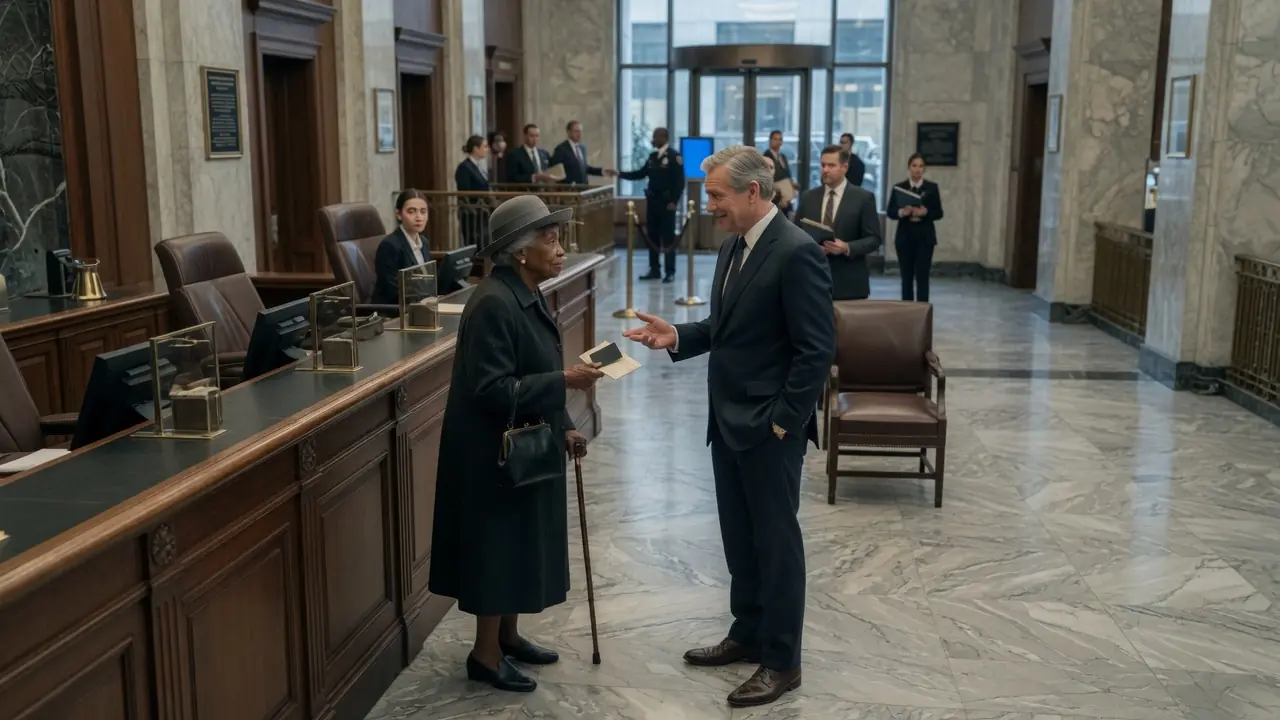
Margaret Bennett walked into First National Bank just after ten in the morning, leaning on a polished wooden cane that clicked softly against the marble floor. The lobby was wide, bright, and expensive, with tall glass walls, dark wood counters, brass details, velvet rope lines, and leather chairs arranged neatly for private clients. Behind the long service counter, bank employees moved quietly between computers and polished drawers, while wealthy customers waited with folders, watches, and the bored confidence of people used to being served quickly. Margaret wore a simple dark wool coat, modest black shoes, pearl earrings, and a small vintage hat that framed her silver-gray hair and deeply wrinkled face.
She looked ordinary to anyone who did not know how to look closely.
Her hands trembled slightly as she reached into her handbag, but her eyes did not tremble at all. Those eyes had seen 90 years of America, from segregated classrooms to boardrooms where men smiled at her like she had wandered into the wrong century. She had survived hunger, insult, silence, and rooms that tried to shrink her. That morning, she did not enter the bank to beg for kindness, ask for a loan, or prove herself to anyone.
She only wanted to check her balance.
At the main teller counter, a young employee named Janet looked up and smiled politely. “Good morning, ma’am. How may I help you?” Margaret placed an old black bank card and a folded account slip on the counter. The card was worn at the edges, the numbers nearly faded, and one corner had been taped years earlier with a narrow strip of clear plastic.
“I would like to check my balance, dear,” Margaret said calmly.
Before Janet could reach for the card, a laugh cut through the lobby.
It came from the executive side of the bank, near a glass office with frosted panels and a brass nameplate. Charles Hayes stepped into view wearing a tailored navy suit, a gold watch, polished leather shoes, and a smile sharp enough to slice dignity from anyone he considered beneath him. At 52, Charles was bank president, heir to one of the city’s oldest financial families, and a man who believed money could be smelled from across a room. He looked Margaret up and down once, then laughed again, louder this time.
Several customers turned.
Margaret did not.
Charles walked toward the counter as if the lobby belonged to him personally. His eyes moved from Margaret’s worn shoes to her simple coat, then to the old card on the marble counter. He stopped beside Janet and rested one hand on the polished wood, blocking the young employee from touching the card. “Ma’am,” he said, loud enough for the nearby clients to hear, “I think there has been a misunderstanding.”
Margaret turned her head slowly. “There has?”
Charles smiled as if speaking to a confused child. “This is First National’s private banking floor. We handle serious accounts here, investment portfolios, trust services, high-value clients.” He gestured toward the glass entrance with two fingers. “There is a community credit union three blocks down. They may be more appropriate for your situation.”
A few wealthy customers chuckled.
One woman in a cream-colored suit lifted her designer handbag to hide her smile. A man near the leather chairs shook his head and muttered something about people wandering in off the street. Janet’s face tightened with discomfort, but she said nothing. The security guard near the entrance shifted his weight from one foot to the other.
It was not a weak smile, not an embarrassed smile, and not the smile of someone who had misunderstood the insult. It was the smile of a woman who had heard worse from men far more dangerous than Charles Hayes. She lifted the old card gently between two fingers. “Young man,” she said, her voice steady, “I asked to check my balance. I did not ask you to explain where you think I belong.”
The smile fell from Charles’s face.
His pride did not tolerate correction, especially not in his own lobby, and especially not from a 90-year-old Black woman in worn shoes. He straightened, adjusted his gold watch, and glanced around as if inviting the room to witness his authority. “Janet,” he said sharply, “do not waste time processing that card.”
Janet swallowed. “Sir, maybe we should just check it quickly.”
Charles snapped his eyes toward her. “Absolutely not.”
The whole lobby heard it.
Margaret rested both hands on her cane. “Is it bank policy to refuse a balance inquiry?”
Charles looked at her card with open disgust. “It is bank policy to protect our staff from nonsense.” He turned toward the security guards. “Gentlemen, escort this woman outside before she disturbs our private clients further.”
That was when the air changed.
The two guards stepped forward, but neither looked eager. One of them was young, perhaps twenty-five, with nervous eyes and a quiet voice. “Ma’am,” he said softly, “Mr. Hayes has asked us to take you outside.” His hand hovered near her elbow, but he did not touch her. Margaret looked at that hand, then at the young guard’s face.
“I did not say I was leaving,” she said gently. “I said I wanted to check my balance.”
Charles laughed again, but this time the sound cracked slightly at the edge.
“See?” he said to the lobby. “This is exactly why we have security. Confused people walk in, wave old cards around, and expect private banking services.” His eyes swept over the waiting clients, searching for approval. “We cannot let every person who looks lost hold up serious business.”
The woman with the cream suit whispered loudly, “Poor thing. Maybe it’s Alzheimer’s.”
Margaret finally turned toward her.
The woman looked away too late.
“Alzheimer’s,” Margaret repeated, softly amused. “That is interesting, because I remember very clearly cleaning your grandfather’s office in 1955.” The woman froze. Margaret looked back at Charles. “And I remember your grandfather too, young Hayes.”
Charles’s smile vanished completely.
The room quieted.
“My grandfather?” he said.
Margaret nodded. “Thomas Hayes. He smoked cigars near the back window of this very building when the lobby was half this size. He used to tap ash into the marble cracks and tell me to scrub until my knees stopped shaking.” Her voice remained calm, but the lobby seemed to grow colder with every word. “I was fifteen. I cleaned this bank after school so my mother and I could eat.”
Charles’s face reddened.
“These are old stories,” he muttered. “Anyone can invent stories.”
Margaret leaned slightly on her cane. “Your grandfather had a scar across the back of his left hand.” She looked directly at Charles now. “He got it when he threw a glass paperweight at me and missed. It shattered against the wall, cut his own hand, and he told everyone it happened in the garden.”
Nobody laughed now.
The cream-suited woman lowered her handbag slowly.
Charles glanced around the lobby and saw the faces changing. Curiosity had become discomfort, and discomfort was beginning to become judgment. He had intended to make Margaret look small, but somehow she had brought the ghosts of his family into the room. “Enough,” he said, voice tight. “I will not allow this kind of scene in my bank.”
“Your bank?” Margaret asked.
Charles stepped closer. “Yes. My family built this institution.”
Margaret’s eyes sharpened. “Your family worked in this institution. Other people built it.” She lifted the card again. “Now, for the last time, check my balance.”
Charles pointed toward the entrance. “Security, remove her.”
The young guard flinched.
Before anyone moved, the private elevator doors opened at the far side of the lobby.
A tall man in a charcoal suit stepped out, carrying a folder under one arm. His hair was silver at the temples, his posture straight, and his presence caused several employees to stand without thinking. This was Gerald Simmons, senior vice president and one of the bank’s most powerful board members. He had the calm authority of a man who never needed to shout because everyone already listened.
“Charles,” Gerald said, his voice cutting through the room. “Why am I hearing shouting from my office?”
Charles turned quickly, relief flooding his face. “Gerald, thank goodness. We have a confused woman causing a disturbance with what appears to be a fake card.”
Gerald looked past him.
His face changed at once.
He walked directly to Margaret, ignoring Charles so completely that the bank president seemed to disappear from the conversation. Gerald’s stern expression softened into something close to reverence. “Mrs. Bennett,” he said warmly, “it is good to see you again. Are you all right?”
The lobby stopped breathing.
Charles stared. “You know her?”
Gerald did not look at him. “Of course I know her.” He held out both hands, and Margaret placed one hand in his. “Margaret Bennett was my math teacher in Brooklyn when I was twelve years old. She was the first person who told me I was not too poor to become somebody.”
The cream-suited woman’s mouth opened.
Janet’s eyes widened.
Margaret smiled gently. “Hello, Gerald. You have grown into that promise quite nicely.”
Gerald bowed his head slightly. “Because you made me believe it.” Then his expression hardened, and he turned toward Charles. “My office. Now.”
Charles tried to speak. “Gerald, this is being blown out of proportion.”
“Now,” Gerald repeated.
The word filled the lobby.
Charles looked at the waiting clients, then at the guards, then at Margaret. For the first time that morning, he looked afraid. He followed Gerald toward the elevator with stiff steps, his expensive shoes clicking too loudly against the marble. The doors closed behind them, leaving the lobby in a silence so thick it felt physical.
Margaret sat calmly in one of the leather chairs.
Her cane rested against her knee. The old black card remained in her hand. Customers who had laughed earlier now avoided her eyes. Some stared at the marble floor as if it had suddenly become fascinating.
Janet approached carefully with a tablet. “Mrs. Bennett,” she said softly, “Mr. Simmons asked me to help you with anything you need. Would you like to check your balance somewhere private?”
Margaret looked around the lobby.
“No, dear,” she said. “We will do it right here.”
Janet hesitated.
Margaret’s voice softened, but the firmness remained. “People judged me publicly. Let truth arrive publicly too.”
Janet nodded.
She took the card with both hands, as if it were no longer an old piece of plastic but a historical document. She typed carefully, double-checking the numbers, then paused when the system loaded. Her eyes widened almost immediately. She blinked, checked again, then looked at Margaret with a stunned expression.
“Would you like me to read it aloud?” Janet asked.
Margaret nodded. “Loud and clear, dear.”
Janet swallowed. “Your main checking balance is eight hundred forty-seven thousand dollars.”
A murmur swept through the lobby.
The man in the leather chair sat forward. The cream-suited woman dropped her handbag, and it hit the marble with a dull thud. One of the security guards stared at Margaret as if she had transformed before his eyes. Margaret only smiled politely.
“But that is only one account, isn’t it?” she asked.
Janet looked down again, her fingers moving across the screen. Her face became even paler. “Yes, ma’am. You also have an education savings fund with one point two million dollars, an investment account with three point eight million dollars, and an endowment education fund with twelve point four million dollars.”
The lobby went silent again.
Almost nineteen million dollars sat behind the name of the woman Charles Hayes had tried to throw out.
Margaret folded her hands over the top of her cane. “Thank you, Janet. Accuracy is important in banking.”
The words carried quietly, but everyone understood the lesson.
The elevator opened again.
Charles stepped out first, looking like a man who had aged ten years in ten minutes. Gerald followed behind him, his face carved from stone. The lobby shifted as everyone turned to watch. Charles walked toward Margaret, every step slower than the last.
Gerald stopped beside him. “Apologize properly.”
Charles swallowed. “Mrs. Bennett, I apologize if there was a misunderstanding.”
Margaret lifted one finger.
Charles stopped.
“If?” she asked.
His face tightened.
Margaret stood slowly, with Janet immediately reaching out to help, though Margaret did not need it. At ninety, she rose with effort, but with dignity strong enough to pull the whole room upward with her. “You did not misunderstand me,” she said. “I spoke plainly. You understood me and chose to humiliate me.”
Charles could not meet her eyes.
“I did not know who you were,” he said weakly.
Margaret’s expression became very still. “That is the problem, young Hayes. You believe dignity requires identification.” She stepped closer, leaning on her cane. “You did not know I was wealthy. You did not know I knew Gerald. You did not know I had influence. So you thought it was safe to treat me like nothing.”
No one moved.
Charles opened his mouth, then closed it.
Margaret continued, her voice calm but carrying the authority of a lifelong teacher. “If I had three dollars in my account, you still would have been wrong. If my card had been declined, you still would have been wrong. If I had walked into the wrong bank entirely, you still would have owed me respect.”
Gerald looked at her with pride.
Janet wiped at her eyes.
The cream-suited woman stepped forward, her face flushed with shame. “Mrs. Bennett,” she said, trembling, “I want to apologize too. I made a cruel remark. There is no excuse.”
Margaret turned toward her. “No, dear, there is not.” Then her face softened slightly. “But mistakes can become teachers if we let them.”
The woman nodded, tears rising.
Gerald cleared his throat. “For everyone present, Mrs. Bennett is not only one of our most significant private clients. She is the largest donor to our education foundation and has funded scholarships for hundreds of students over the past decade.” He turned toward Charles. “Students this bank proudly advertises in its annual report.”
Charles looked physically ill.
Margaret reached into her handbag and removed a small phone. “Technology is useful,” she said, almost kindly. “I have been recording since I walked through the door.”
Charles froze.
Gerald’s eyes sharpened. “Good.”
“I believe the board should hear it,” Margaret said. “Not because I want revenge, but because leadership reveals itself most clearly when it thinks no consequences are watching.”
Gerald nodded. “Emergency board meeting at five.”
Charles turned to him in panic. “Gerald, please. My career, my reputation—”
Margaret interrupted softly. “Your reputation spoke for itself today.”
Security approached again.
This time, they did not approach Margaret.
Charles looked at the same guards he had ordered toward her only minutes before, and his humiliation settled over him like a coat he could not remove. He walked toward the executive exit with his head lowered. Nobody laughed. Nobody whispered. The silence was harsher than any insult.
Margaret sat back down.
“Janet,” she said calmly, “I would like to make several transfers. There are new scholarship students who need tuition paid.”
Janet smiled through tears. “Of course, Mrs. Bennett.”
Six months later, First National Bank looked different.
Not the marble, not the glass, not the brass counters. Those remained. What changed was the training, the policies, the faces in leadership meetings, and the way employees greeted every person who walked through the doors. Charles Hayes was fired the next morning after the board reviewed the recording, employee complaints, and years of arrogant behavior that had been quietly tolerated because he came from the right family.
The video went public three days later.
It spread faster than anyone expected. Millions watched a ninety-year-old woman stand in the middle of a private bank and teach a lesson the president should have learned as a child. News programs discussed it. Business schools used it. Customer service seminars replayed Margaret’s line about dignity not requiring identification.
Gerald Simmons became CEO by unanimous vote.
Janet was promoted to inclusive service manager after Margaret personally recommended her for speaking up when Charles tried to silence her. Mrs. Catherine Vance, the wealthy client who had mocked Margaret, became one of the bank’s largest scholarship donors. She later admitted at a public event that shame had changed her faster than comfort ever had.
As for Margaret, she accepted a seat on the board.
At ninety years old, she became the first Black woman in the bank’s long history to hold that position. On the day she entered the boardroom, every member stood, not because she demanded it, but because respect had finally learned how to stand on its own. She wore the same modest hat, the same pearl earrings, and carried the same vintage handbag.
Charles had mistaken simplicity for poverty.
The bank would never make that mistake again.
One winter afternoon, Margaret sat in her new office on the fifteenth floor, reading a letter from a scholarship student named Marcus Simmons, Gerald’s nephew. He had just received his first paycheck as an aerospace engineer. In careful handwriting, he thanked her for believing in him before he had learned how to believe in himself. Margaret placed the letter in a drawer with hundreds of others.
Each letter was a balance greater than money.
She looked out over the city, her cane resting beside her chair and sunlight falling across her hands. She thought about the lobby, Charles’s laughter, the security guards, the old black card, and the moment the room learned that wealth does not always dress loudly. Then she smiled, not with bitterness, but with peace.
Margaret Bennett had not won because she had nineteen million dollars.
She had won because she never let anyone else count her worth for her.
And from that day forward, every person who entered First National Bank, whether in a tailored suit or worn shoes, was greeted with the same words Margaret insisted they place in every training manual.
Welcome. How may we serve you today?