“What are you going to do with eleven ruined milk cans?” Glendon Meyer asked as he stood beside the borrowed flatbed on a cold Saturday morning in April 1962, staring at a pile of dented galvanized steel that looked as though somebody had dropped it from the roof of a creamery and then driven over what survived. Twenty minutes earlier, his thirty-one-year-old sister Ardis Meyer had paid four dollars and seventy-five cents for the entire lot at a farm auction outside Viroqua, Wisconsin, bidding fifty cents above a scrap dealer who wanted the cans only for their metal and who stared at her afterward as if she had interrupted serious business with a joke. Several cans had split seams, two were crushed almost flat along one side, three had necks bent slightly out of round, four had bottoms badly dented, and one was missing the lid completely, yet Ardis examined each piece before loading it and never once asked whether she could return anything later. Glendon finally laughed, shook his head, and said, “Dad taught you how to repair machinery, Ardis, not how to spend good money proving junk is still junk,” while his sister tightened the last rope across the load and answered only, “Then I guess four dollars and seventy-five cents bought me a cheap way to find out.”
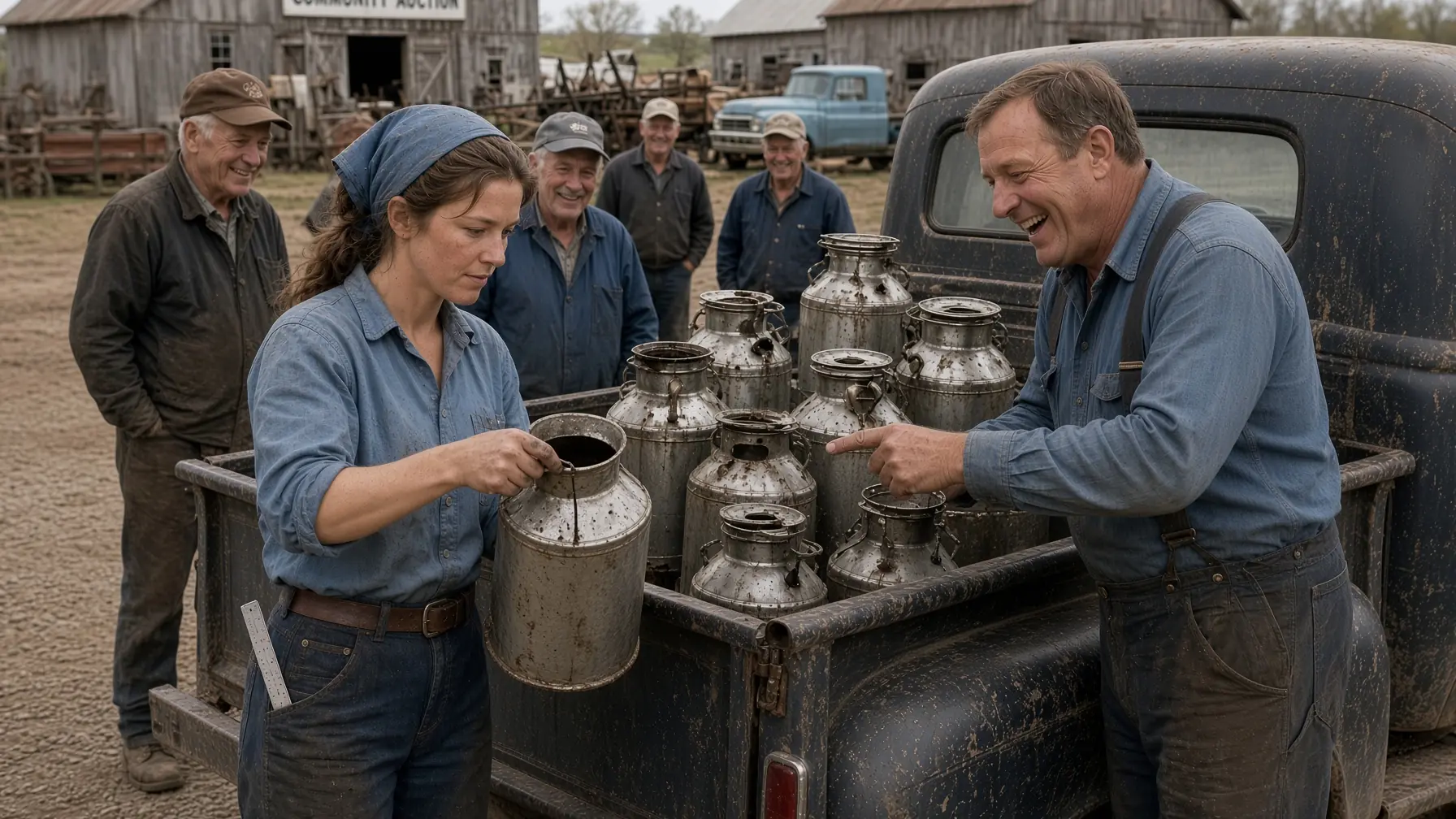
By Sunday morning, the story had traveled farther through Vernon County than anything Ardis herself had said in months, because rural communities could move information faster than telephone lines whenever the information included an unusual woman, an auction, and the possibility of public embarrassment. At Lundquist Feed and Seed, somebody claimed Ardis had bought fifteen milk cans for two dollars because even the auctioneer wanted them gone, while outside church another version said she intended to repair them and compete with operating creameries despite bulk milk tanks already making old cans less important on larger dairy farms. The men telling the stories were not all cruel, and several had known Ardis since childhood, but amusement required less effort than curiosity, particularly because a woman buying broken farm equipment for reasons nobody understood fit comfortably inside the category of harmless entertainment. Ardis heard three versions before noon, corrected none of them, returned home after church, changed into work clothes, hauled the cans into the machine shed her father had left her, and slid the heavy workshop door closed before anyone passing on County Road N could see what happened next.
The workshop had belonged to Harold Meyer, Ardis and Glendon’s father, a dairy farmer who considered paying someone else to repair something an admission that he had not yet tried enough reasonable alternatives himself. He owned no machine shop in the commercial sense, only a concrete-floored building containing a stick welder, drill press, bench grinder, hand brake, vise, oxyacetylene torch, sheet-metal tools, measuring instruments, shelves of saved hardware, and thirty years of components Harold believed might someday become useful if nobody discarded them prematurely. Ardis had spent more evenings there than Glendon while growing up, partly because she liked knowing why mechanical things failed and partly because Harold never told her that welding, machining, or equipment repair belonged to sons as long as she followed the same rules he imposed on anybody holding a tool. His most repeated rule had been simple enough that Ardis eventually wrote it over the bench in pencil: Never confuse broken with useless, and never confuse repairable with worth repairing.
Harold died from a stroke five years before the milk-can auction, leaving the eighty-six-acre Meyer farm jointly to Ardis and Glendon but leaving the workshop specifically to Ardis because, as his will bluntly stated, “Glendon knows how to use it, but Ardis knows how to put things back where they belong.” Glendon ran most of the dairy operation with his wife Helen, milking thirty-eight Holsteins and raising replacement heifers, while Ardis lived in the smaller farmhouse across the lane and earned cash repairing cream separators, pumps, lawn mowers, small engines, balers, wagon gears, and anything else neighbors were willing to bring to a woman after exhausting cheaper male opinions. Her repair income was inconsistent, but it allowed her to remain on the land, contribute to shared farm expenses, and avoid taking a factory job in La Crosse that would have left the workshop dark except on weekends. The arrangement worked because Glendon respected her skill even when he teased her choices, and Ardis respected his responsibility for keeping a dairy herd producing every morning regardless of whether machinery, weather, prices, or siblings felt cooperative.
The reason she bought the cans began three months before the auction, during a January evening when snow pressed against the farmhouse windows and Ardis sat at her kitchen table studying a dealer brochure from Madison. The machine pictured on the page was a compact pasture and small-seed drill designed to place clover, alfalfa, timothy, orchardgrass, and similar seed into shallow rows without requiring the aggressive tillage that could leave steep Wisconsin hills vulnerable to erosion, and the dealer’s quoted price for the model Ardis wanted was three hundred forty dollars before delivery. Three hundred forty dollars did not sound enormous beside the price of a tractor, but on the Meyer farm it represented winter feed, several months of electricity for the milking system, veterinary reserves, machinery repairs, or more than Ardis could justify spending on equipment intended primarily to reseed seventeen worn acres above Miller Hollow. Hiring custom work was cheaper initially, yet the available drills were larger than she liked for the narrow contour strips around the hills, and several neighbors had equally small fields where bringing commercial equipment produced almost as much turning and travel as actual seeding.
The upper Meyer pasture had become steadily poorer during the previous decade because dairy cows grazed the easiest sections harder than the slopes, shallow soil dried quickly in summer, and earlier attempts to broadcast clover over established sod produced patchy stands that disappeared whenever spring conditions failed to cooperate. Glendon wanted to plow and reseed the worst acreage in wider strips, but both Ardis and county conservation technician Leonard Voss worried that disturbing too much soil on those slopes could increase erosion if heavy rain arrived before cover reestablished. Voss suggested using a narrow drill or no-till-style overseeding approach where possible, yet the equipment available through local dealers cost more than the Meyers wanted to own for such limited acreage and the county’s shared machinery schedule rarely matched weather windows exactly. Ardis began sketching a lighter eleven-drop seeder small enough for their old tractor, narrow enough to follow contour turns, simple enough to repair in Harold’s workshop, and cheap enough that building it badly would hurt less than buying the wrong commercial machine.
Her first drawings were embarrassing. The original frame placed too much weight behind the tractor, the seed box sat so high that filling it on a slope would be awkward, the drive mechanism required gears she did not own, and the shallow openers she sketched would clog in heavy sod the moment roots or old hay wrapped around them. She redrew the machine on quarter-inch graph paper at least eleven times, measuring the farm’s existing cultivator parts, a discarded hay-rake axle, two small packer rollers Harold had saved behind the shed, and a set of worn planter chains stored in coffee cans beneath the workbench. What she could not solve cheaply was the seed-delivery system, because making eleven tapered hoppers with consistent outlets would require more sheet-metal forming than she wanted, while one large seed box created bridging and uneven distribution unless she built a more complicated metering system. Then she saw the damaged milk cans listed in the auction notice and remembered that the narrow necks of old dairy cans already possessed nearly the exact taper and diameter she needed above eleven homemade metering cups.
That was what she measured beneath the workshop light on the evening after the auction. Ardis selected the least distorted can, turned it upside down, measured the neck with a steel rule and calipers, checked the dimensions against the circles she had drawn on graph paper, and smiled when the numbers landed close enough that a short adapter ring could connect the can directly to the galvanized seed tubes she planned to make. The crushed body did not matter because she intended to remove most of it, straighten only the section needed for a hopper, cut away the original bottom entirely, invert the can, and use the surviving neck as a naturally formed funnel that would feed seed toward an adjustable gate. Eleven cans meant eleven independent hoppers, each aligned above its own drop tube and opener, which looked absurd compared with a polished commercial seed box but offered one advantage Ardis liked immediately: if one passage clogged or a seed mixture behaved badly, she could see and service each run separately without emptying the entire machine.
Glendon found her Sunday evening with three cans already marked in chalk and one metal bottom cut away. He stared at the inverted shell clamped in the vise, looked toward the graph-paper drawing pinned above Harold’s old bench, and stopped laughing long enough to understand that his sister had not bought milk cans because she wanted milk cans. Ardis explained how each neck would become a funnel, how eleven simple metering gates could sit beneath a common agitator shaft, how the machine’s ground wheel would drive that shaft by chain so seed flow increased with travel speed, and how shallow scratch openers followed by the old packer wheels could press small seed into disturbed sod without turning an entire hillside black. Glendon listened until she finished, then said, “That is either the smartest four dollars you ever spent or the beginning of the ugliest machine in Wisconsin,” and Ardis answered, “Those possibilities are not mutually exclusive.”
The first week involved less invention than cleaning. Ardis soaked seams, removed decades of milk residue and corrosion, cut damaged bottoms, straightened necks over wooden forms, discarded one section where rust had thinned the metal too severely, and used pieces from badly crushed areas as patches for hoppers worth saving. Harold had taught her never to weld contaminated galvanized steel carelessly, so she worked with proper ventilation, removed coatings around weld areas where appropriate, and relied on mechanical fastening or soldered seams in several locations rather than treating the workshop like a place where experience made fumes harmless. By Friday she had eleven open-topped tapered hoppers that looked nothing like milk cans from a distance but still carried enough handles, ribs, and stamped metal to make their origin obvious whenever anyone stepped close.
The frame came from heavier steel already lying around the farm. Harold had saved the rectangular backbone from a retired cultivator, and Ardis cut it down, reinforced two stress points, fabricated mounting brackets, and arranged eleven hopper positions across slightly less than seven feet so the machine could fit comfortably through older gates. She used worn cultivator shanks as the basis for shallow openers, grinding and reshaping them rather than buying new components before she knew whether the geometry worked, while two salvaged packer sections formed the rear pressure system that would close disturbed soil lightly behind the seed. Her cash ledger showed four dollars and seventy-five cents for the cans, two dollars for replacement bolts, three dollars and forty cents for chain and master links, several small amounts for tubing, bearings, welding rods, paint, and seed-gate material, plus a growing list of salvaged items carrying no purchase price but very real labor.
Ardis counted labor separately because she disliked stories where homemade equipment became “free” simply because the builder did not invoice herself. Every evening she recorded hours beside each task, not because she expected to pay herself before the machine earned anything but because she wanted to know whether copying the design later would actually make financial sense. By the end of April she had already invested more than forty hours, which meant the machine would be foolish if measured at full commercial shop rates, yet those hours came from winter and early spring periods when outside repair work remained slow enough that the alternative was not necessarily forty hours of paid employment. The distinction mattered because Ardis never wanted a neighbor believing four dollars and seventy-five cents could replace three hundred forty dollars unless that neighbor also owned tools, scrap, skills, time, and enough patience to discover which of those resources had been quietly omitted from the comparison.
The metering system became the hardest part. Her first design used simple sliding gates beneath each milk-can neck, but small clover and alfalfa seed flowed too freely through even narrow openings while timothy bridged differently, creating exactly the inconsistent rates she hoped to avoid. Ardis built eleven small rotating cups from sheet metal and mounted them along a common shaft, then tested the assembly by elevating the machine on blocks and rotating the ground wheel while seed dropped onto eleven numbered pieces of canvas. The first test produced nearly twice as much seed from the third hopper as the eighth, while hopper eleven delivered almost nothing because a rough solder joint interrupted the flow.
Glendon wandered into the workshop during the second test and made the mistake of asking whether commercial manufacturers had perhaps already solved this problem for a reason. Ardis told him they had, which was why they charged three hundred forty dollars, then handed him a coffee cup and made him turn the drive wheel exactly twenty revolutions while she weighed seed from each canvas square on the kitchen scale. The results improved after she filed the rough outlet and adjusted several cups, but variation remained large enough that Ardis would have wasted expensive seed if she accepted the machine simply because all eleven rows technically delivered something. She spent another week changing gate shapes, adding a light agitator wire above each cup, adjusting shaft alignment, and repeating calibration until the spread between individual rows became small enough for the mixed pasture seed she intended to plant.
The first public sighting happened accidentally when Helen sent Glendon to retrieve a wrench while Ardis had the nearly completed machine rolled outside for alignment checks. A milk truck passed the farm at exactly that moment, the driver slowed, recognized eleven silver hopper bodies lined like upside-down dairy cans over a homemade frame, and told three people before finishing his route. By supper the feed-store version described Ardis building a “milk-can corn planter,” while another man swore she intended to plant potatoes through the cans and somebody else claimed she had invented equipment for feeding cows while they walked. Ardis asked Glendon whether rural men ever became exhausted from being wrong so creatively, and he answered that most had spent decades conditioning for the effort.
Leonard Voss heard the stories too, but unlike the feed-store crowd he drove to the farm with a notebook. He was forty-two, worked with the county soil and water conservation office, and had originally encouraged the Meyers to improve the upper pasture without exposing entire slopes, so he wanted to know whether Ardis’s machine might produce the shallow soil disturbance and seed placement she described or simply create eleven narrow erosion channels down every hill. She showed him the contour layout first, emphasizing that she planned to travel along the slope rather than directly downhill, maintain existing sod between disturbed lines, seed during favorable spring moisture, and test only two acres before expanding. Leonard approved of the small trial but cautioned that uneven opener depth on rolling ground could bury tiny seed too deeply, while insufficient pressure might leave seed exposed enough for birds, drying, or runoff to reduce establishment.
Ardis modified the packer linkage after that conversation. She had originally mounted the rear rollers rigidly because the shop frame was easier to build that way, but Leonard’s comment made her realize the arrangement would bridge across humps and leave poor soil contact in shallow depressions. She cut the assembly apart, added a simple pivot and spring tension using parts from an abandoned rake, and immediately lost three days of progress while making the machine more complicated than she hoped. Glendon said the commercial drill was beginning to look cheap, and Ardis answered that the difference was she could afford to change her own machine before discovering a flaw on seventeen acres.
Her first field test occurred on May fifth under a sky clear enough to make everyone nervous about rain rather than mud. Glendon pulled the machine behind the Meyer farm’s older tractor while Ardis walked alongside for the first fifty yards, watching openers, seed tubes, chain tension, and packer contact as though staring harder could make metal behave better. The machine rattled loudly, one hopper vibrated more than the others, seed fell visibly through ten tubes, and the left packer wheel bounced over rough sod in a way Ardis disliked immediately. They completed one short contour pass, stopped, and discovered that the drive chain had already begun walking toward the edge of one sprocket because the shaft sat slightly out of alignment.
Glendon expected disappointment. Ardis appeared relieved. “Good,” she said, and when he asked what could possibly be good about a machine failing after one pass, she answered, “It failed where I can see it instead of after I tell somebody it works.”
They returned to the workshop. Ardis shimmed the shaft bearing, remounted the sprocket, reinforced the vibrating hopper, altered packer tension, and added simple sight marks allowing her to detect chain misalignment before it became severe. Two days later they returned to the field, completed five passes without mechanical trouble, then discovered another problem when Ardis dug behind individual rows and found seed depth inconsistent wherever old sod clumps lifted beneath the openers. She stopped the test before completing the acre.
Leonard suggested changing opener shape rather than increasing down-pressure. More force might cut sod better but would also increase draft, disturbance, and the risk of placing small seed deeper than intended, so Ardis reshaped the worn cultivator points into narrower knife-like scratchers and added small deflectors to push loose debris aside. The modification looked almost too minor to matter. During the third test, seed placement became noticeably more consistent.
By then the machine had consumed nearly two months. Cash expenses had reached thirty-eight dollars and twelve cents beyond the four-dollar-and-seventy-five-cent purchase, not counting fuel, the seed used in calibration, Harold’s accumulated scrap, or Ardis’s labor, which had passed seventy hours. The total remained far below three hundred forty dollars because she had access to tools and materials other farmers might need to purchase, but the difference was no longer the fairy-tale contrast between five dollars of garbage and a dealer machine. Ardis considered that encouraging rather than disappointing because a machine could be worthwhile without requiring the story around it to lie.
The two-acre test strip emerged slowly. Spring rain came three days after seeding, enough to settle soil without producing destructive runoff, and within two weeks fine green lines began appearing through the existing sod wherever clover, alfalfa, and grasses established successfully. Some rows looked better than others, one section near a shaded edge remained poor, and several spots where the ground became too wet showed seedling loss. Leonard counted plants across fixed intervals and advised waiting through summer before calling anything successful.
At the feed store, nobody waited. A teenager working weekends had seen the green rows and told customers Ardis’s milk-can contraption actually planted something, which transformed laughter into questions almost overnight. The same men who had enjoyed the auction story began stopping Glendon to ask how the machine metered seed, whether the milk cans held enough for a full acre, and if Ardis planned to sell the design. Glendon enjoyed answering only, “You should probably ask the woman who built it,” because several of those men had spent months asking him questions about his sister’s machine while Ardis stood within twenty yards of them.
Ruter Halvorsen became the first neighbor to cross that distance. He farmed one hundred forty acres three miles away, milked twenty-six cows, and owned a steep six-acre pasture where repeated broadcasting had failed to establish enough clover to justify the seed. Ruter had laughed openly at the auction story and admitted it when he walked into Ardis’s workshop carrying a paper sack from the feed store. “I brought twenty pounds of seed and a willingness to be embarrassed,” he said, then asked whether she would try the machine on two acres if he paid for fuel and whatever she considered fair.
Ardis refused to quote a custom-seeding rate before she knew whether the machine could survive more than testing. She offered to seed one acre at Ruter’s farm if he accepted that the equipment was experimental, understood that stand establishment depended on weather and soil as well as machinery, and agreed not to tell anyone the result proved anything until they inspected it together later. Ruter accepted. Glendon volunteered to come because, as he put it, “If the machine loses a milk can on Halvorsen’s hill, I want to see where it lands.”
The machine did not lose a hopper. It lost a chain. Halfway through the third contour pass, the ground-wheel drive hit a clump, the worn chain jumped from the sprocket, and several yards went unseeded before Ardis recognized that nothing was moving beneath the hoppers.
Ruter said nothing while she repaired it. That silence bothered Ardis more than jokes because she knew he had trusted his seed to equipment nobody else owned. She finished the acre, returned the following morning to reseed the missed section accurately, and refused payment beyond fuel because she considered the breakdown part of development rather than a service Ruter should finance.
Ruter paid anyway by leaving ten dollars on Harold’s workbench beneath a wrench. Ardis found it after he drove away and carried the bill to Glendon, who told her returning money to a dairy farmer required more courage than buying milk cans. She recorded the ten dollars as the machine’s first revenue, then added a note identifying the chain failure and the cost of replacing the worn drive components with better material. That repair brought total cash investment closer to sixty dollars, still far below the commercial machine but enough to make the original four-dollar-and-seventy-five-cent joke increasingly irrelevant to anyone reading the ledger honestly.
By July, the Meyer test strip had survived its first cutting. Establishment was uneven but strong enough across most of the two acres that Leonard recommended expanding carefully during late-summer conditions if moisture allowed, while keeping an untreated comparison area so the family could see whether the machine actually improved stand density relative to broadcast seed. Ardis agreed. Glendon wanted to seed all seventeen acres immediately.
That argument changed their relationship with the project. For months Glendon had been the skeptic reminding Ardis that scrap metal could consume money without becoming equipment, yet now Ardis found herself slowing her brother because early success had made him eager to turn an experiment into a solution before summer drought tested the roots. “You were the one laughing in April,” she told him. Glendon answered, “I’m flexible.”
August brought the test they had not planned. Rain largely disappeared for three weeks, afternoon temperatures climbed, shallow pasture browned, and even established grass slowed enough that Glendon began feeding hay earlier than usual. The new seedlings suffered more than mature plants, especially alfalfa in the thinnest soil, while several clover rows remained surprisingly persistent beneath the existing sod canopy. By early September the stand had thinned noticeably.
Glendon thought the machine had failed. Leonard disagreed. The seeder had placed seed with reasonable consistency, but no piece of equipment could create moisture that did not exist, and comparing surviving plants with the untreated broadcast section showed that drilled areas still retained substantially more new growth despite losses.
Ardis entered the result in her notebook without softening it. The machine improved establishment under the conditions they experienced, but it did not eliminate weather risk, and the species mixture needed adjustment on shallow ground where alfalfa struggled. She reduced alfalfa content in later hill plantings, increased clover and grasses suited to those conditions, and began viewing the seeder not as a finished invention but as one part of a larger pasture-management problem. That attitude made the machine less dramatic and more useful.
The following spring produced the sight that changed local opinion completely. Glendon reseeded a six-acre contour section using Ardis’s machine while neighboring farmer Carl Peterson prepared a similar slope by more aggressive tillage because he needed to establish a new stand quickly and believed the season looked stable enough to accept the risk. Both methods were reasonable within their circumstances, and Carl’s seedbed initially looked far cleaner and more professional than the narrow lines threading through Meyer sod. Then three inches of rain fell in less than four hours.
Water ran from every hillside in the neighborhood. Carl lost visible soil from two exposed sections and later spent days repairing small washes before reseeding, though most of his field survived and eventually produced adequately. The Meyer slope shed water too, but existing sod between the narrow seeded rows slowed surface movement enough that erosion remained minor, and the little seeder tracks were almost impossible to identify after the storm.
People came to the fence because of that storm, not because anyone finally decided milk cans were beautiful. Farmers wanted to see whether the hill had truly remained intact, Leonard wanted measurements rather than stories, and even the scrap dealer from the original auction drove past slowly enough that Glendon recognized him. Ardis refused to claim her machine had “saved” the field because the established sod, contour direction, soil condition, rainfall pattern, and luck all mattered, yet the storm demonstrated that she could introduce seed without exposing the entire hillside. For small farms with narrow contour strips, that was enough to make the ugly machine suddenly interesting.
The first man to ask Ardis to build another one was not a farmer. It was Carl Nystrom, owner of a small equipment dealership outside Viroqua, who had sold the three-hundred-forty-dollar drill Ardis originally decided she could not afford. He visited the Meyer farm after hearing about the storm, examined every homemade bearing mount and ugly soldered seed gate, then said, “I should hate this thing, but mostly I hate that your hoppers look like a dairy meeting gone wrong.” Ardis answered, “I can paint them,” and Carl said, “Please don’t.”
Carl explained that the machine did not compete directly with everything he sold. Commercial drills were stronger, faster to fill, better standardized, easier to calibrate across a broad range of conditions, supported by replacement parts, and more appropriate for farmers seeding enough acreage to justify ownership. Ardis’s narrow homemade unit offered something different: low cash cost, light weight, easy repair, individual row visibility, and a frame that turned well on small contour strips where larger equipment felt clumsy.
He asked whether she had considered making two or three units for sale. Ardis showed him the labor ledger. Carl stopped smiling.
At more than one hundred hours of development, the first machine could never be sold profitably at anything resembling its cash cost. A second would be faster because Ardis now had patterns, dimensions, and fewer mistakes to discover, but eleven individual milk-can hoppers still required cleaning, cutting, shaping, adapters, metering pieces, mounting, and calibration work that a fabricated seed box could eventually replace more efficiently. Ardis told Carl she was not interested in becoming a manufacturer merely because one prototype worked. He answered, “Good, because manufacturing is what happens when the same repair comes back a hundred times.”
Instead they developed a quieter arrangement. Carl sold Ardis new chain, bearings, tubing, and small components at normal dealer rates, while she referred customers to him whenever a commercial machine made more financial sense than custom work with hers. Carl referred small-acreage farmers to Ardis when purchasing a full drill would be difficult to justify. Nobody became rich, and nobody had to lose for the arrangement to work.
Custom seeding became the first real business opportunity. Ardis calculated tractor fuel, travel, maintenance, machine wear, seed calibration time, expected repair reserve, and her labor before setting a modest per-acre charge with a minimum for small jobs. Glendon thought the price too high because neighbors were accustomed to seeing his sister as someone who fixed things inexpensively in Harold’s old shop. Ardis asked whether he wanted the machine operating five years from now or becoming another favor that wore itself out without earning replacement bearings.
The first season she seeded twenty-nine acres outside the Meyer farm. Two jobs were simple pasture overseeding, one involved a narrow conservation strip, three required adjusting seed rates for different mixtures, and one became such a muddy disaster after unexpected rain that Ardis refused to continue until the field dried. The customer complained because he had taken the day off specifically to help, but Ardis would not drag openers through saturated soil simply to protect a schedule. A week later he admitted postponement had probably been correct.