Holden Whitmore stood behind the reinforced steel gate at Whitmore Champion Genetics in Amarillo, Texas, watching three thousand four hundred pounds of white muscle slam into metal again. The impact rang through the facility so loudly that two young handlers stepped backward without realizing it. Nabid, the prized Charolais bull, pawed the concrete, lowered his massive head, and struck the gate a second time. The gate bent inward, and every man in the room understood that the next mistake could cost someone his life.
On paper, Nabid was worth a fortune. His bloodline came from champion cattle, his body carried perfect structure, and breeders had once talked about him as if he were the future of elite beef genetics. But paper meant nothing when the bull charged handlers, destroyed equipment, and reacted to every confined space like an enemy. Holden clenched the disposal papers in his hand and looked at Vernon Hayes, his oldest cattle manager.
“He’s done,” Holden said, his voice flat with frustration. “No bloodline is worth another man’s life.” Vernon did not answer immediately, because he had spent thirty years reading cattle and knew this bull was different from the others. Nabid was not wild in the ordinary way, and he was not simply mean. He watched, calculated, waited, and struck when humans trapped him too tightly.
“He’s not stupid, Holden,” Vernon said quietly. “He’s trapped, and he knows it.” Holden shook his head because he did not have room for sympathy anymore. Three handlers had already been injured, four gates had been ruined, and one lawsuit could destroy the facility’s reputation. “Then let Alaska deal with him before he destroys this place,” Holden said.
The plan was supposed to be simple. Nabid would be donated to Northern Lights Animal Refuge in Anchorage, a sanctuary with enough land to house difficult livestock safely. It looked better than slaughter, gave Whitmore a tax deduction, and removed the liability from Texas. Vernon signed the transport paperwork with a heavy heart, hoping that open space might do what expensive experts had failed to do.
But the mistake happened in an office hundreds of miles away. A transport coordinator’s assistant entered one wrong digit into the receiving code, and the manifest sent Nabid not to the sanctuary, but to a small tourist ranch near Talkeetna, Alaska. Crow’s Edge Ranch was run by Silas Crowe, a former bush pilot with forty acres, six horses, three calm cattle, and no idea that a giant rejected breeding bull was heading toward his gate. By the time anyone noticed the error, the truck was already crossing frozen highways toward the north.
Silas was repairing fence wire when the livestock hauler rumbled up his snowy access road. The driver climbed down with a clipboard and announced a delivery like this happened every day. “One Charolais bull,” he said, holding out the papers. Silas stared at him, then at the huge trailer, and felt his stomach tighten.
“I didn’t order a bull,” Silas said. The driver checked the manifest and shrugged. “This address is Crow’s Edge Ranch, right?” Silas nodded slowly, already sensing trouble. “Then he’s yours until somebody above me fixes the paperwork.”
When Silas asked how big the animal was, the driver gave a grim little laugh. “Three thousand four hundred pounds, mean as hell.” Buck Toliver, Silas’s sixty-two-year-old ranch hand, arrived in his pickup just in time to hear that sentence. He looked at the trailer, then at Silas, and muttered, “Boss, please tell me that thing isn’t staying here.” Silas did not answer, because the driver was already lowering the ramp.
Nabid exploded out of the trailer like a white avalanche. He hit the snow-covered ground, charged thirty feet, spun around, and released a bellow that rolled toward the mountains. Buck froze near the truck door, one hand on the frame, while Silas stood perfectly still. The bull was enormous, but what struck Silas most was not the size; it was the intelligence in the animal’s eyes.
Nabid did not immediately attack the fence or charge the men. He lifted his head and looked around, studying the pasture, the spruce trees, the snow, the mountain line, and the open sky. His breathing was heavy from travel, but his body slowly stopped trembling. It was as if the bull had stepped into a world he had never been allowed to imagine.
The driver left quickly, promising someone would call after the holiday weekend. Silas phoned the transport company, the Texas facility, and every number on the paperwork, but most offices were closed for Thanksgiving. By sundown, he had no answers, one impossible bull, and forty acres of standard fence that would never hold Nabid if the animal truly wanted out. Buck shook his head and said, “We’re babysitting a monster.”
But by the next morning, the monster was grazing peacefully near the far fence. Nabid walked the perimeter slowly, not slamming the wire, not testing it with rage, but learning it. He stopped often to look toward Denali’s distant white peak, his breath steaming in the cold air. Silas watched from the fence and began to wonder if Texas had sent him the wrong story along with the wrong bull.
Silas’s daughter Nessa arrived from Anchorage that evening for Thanksgiving break. She was nineteen, studying wildlife biology, and immediately fascinated by the giant white bull in the pasture. After watching Nabid for half an hour, she told her father that the animal did not behave like a naturally violent creature. “He’s exploring,” she said. “He’s using the space like an animal that finally has enough of it.”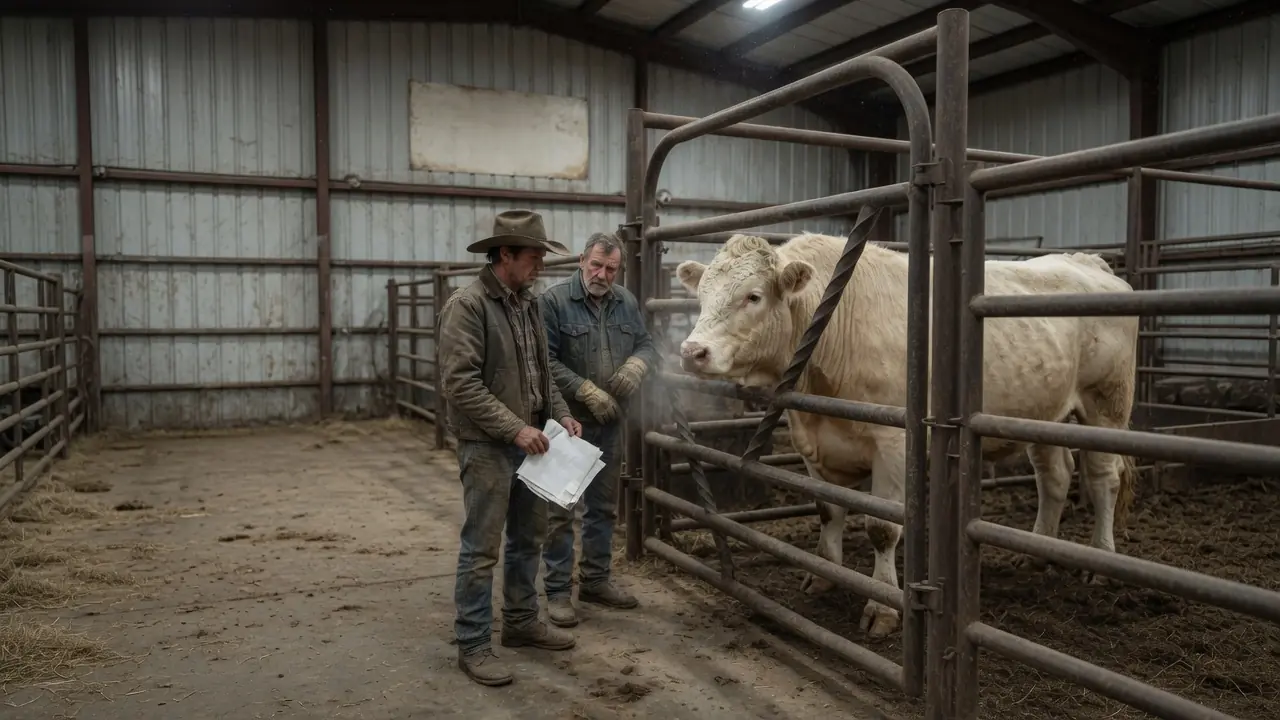
Silas explained the reports from Texas: the attacks, the destroyed gates, the failed behavior treatments, and the decision to send him away. Nessa listened carefully, then looked back at Nabid as he stood near the spruce trees. “Dad, if he spent his life in small pens, that might be the problem,” she said. “Some animals don’t break because they’re bad; they break because the place around them is wrong.”
Monday brought the truth. Margot Vance from the transport company called in a panic, apologizing for the address error and explaining that Nabid had been meant for the Anchorage sanctuary. Then came the second problem: the sanctuary was under quarantine after a respiratory illness outbreak and could not accept new animals for at least six weeks. Whitmore Champion Genetics would not take Nabid back, and no other facility wanted the risk.
Silas looked through the kitchen window at the bull standing calmly in the snow. “He hasn’t shown aggression here,” he said. Margot went silent for a moment, as if unsure she had heard him correctly. Silas repeated it, explaining what Nessa had observed and what he had seen with his own eyes.
Temporary custody papers were prepared that afternoon. Whitmore would cover feed costs, the transport company would cover legal waivers, and Nabid would stay at Crow’s Edge Ranch until another solution appeared. Buck was not thrilled, but he admitted the bull had done nothing wrong since arriving. “Maybe he just likes Alaska,” he said.
A local veterinarian named Rowan Pike came out two days later. She had treated everything from sled dogs to injured moose, and she approached Nabid with caution and respect. Nabid watched her from a distance, alert but not hostile. After thirty minutes of observation, Rowan lowered her binoculars and said, “This is not the animal described in those reports.”
Rowan explained that chronic confinement could create extreme stress behavior in intelligent animals. A bull like Nabid, kept in small pens and handled constantly, might learn that every human approach meant restriction. Aggression could become his only way to create distance. “Here,” Rowan said, “he has choice, space, weather, movement, and something to pay attention to besides walls.”
Nessa began documenting Nabid’s behavior for a university project. She filmed his morning perimeter walks, his preferred resting area beneath the spruce trees, and his evening habit of watching the mountains. She noted that he did not attack the small herd of cattle already on the ranch, and within weeks he began grazing near them without conflict. The bull once labeled uncontrollable was slowly becoming predictable because his world finally made sense to him.
Holden Whitmore did not believe it at first. When Silas sent video footage and Rowan’s report, Holden called from Texas with disbelief in every word. “We tried everything,” he said. Silas answered carefully, “Maybe you tried everything except giving him room.”
Two weeks later, Holden arrived in Alaska to see Nabid himself. He stepped out of his rental truck in a heavy coat, looking smaller without the authority of his Texas facility around him. Nabid recognized him immediately and lifted his head, muscles tightening for a moment. Then, instead of charging, the bull simply moved away and stood at a distance, watching.
Holden stared at him for ten full minutes. “In Texas, he would have hit the fence by now,” he said. Silas nodded. “In Texas, the fence was all he had.” The words landed heavily between them.
Rowan showed Holden updated stress markers and explained that Nabid’s cortisol levels had dropped dramatically since arriving. Nessa showed him three weeks of footage that revealed routines, social behavior, environmental awareness, and no aggression. Holden watched in silence, and by the end, the confidence that had made him so certain in Texas had disappeared. “We were wrong,” he finally said.
That admission changed the future. Holden offered to fund Nabid’s permanent care at Crow’s Edge Ranch, including stronger fencing, shelter, feed, veterinary expenses, and research support. He also offered Silas a monthly care stipend if he would agree to keep Nabid long-term. Silas hesitated because his ranch was small, seasonal, and never meant to become part of an animal behavior study.
Nessa argued that Nabid’s case was bigger than one bull. “He proves that some animals we call dangerous are really animals trapped inside bad systems,” she said. Buck added that the money would help the ranch through winter and that Nabid had caused less trouble than half the tourists who came through in July. Silas looked toward the pasture, where the massive white bull stood quietly under the gray sky. “All right,” he said. “He stays.”
Six months later, Nabid stood in an expanded seventy-acre pasture. The new fencing was stronger, the shelter was built for Alaska weather, and Buck had become surprisingly protective of the bull he once called a monster. Nessa’s research had drawn interest from the University of Alaska, and Rowan’s reports had circulated among animal welfare specialists. Nabid’s transformation was no longer a local curiosity; it was evidence.
A journalist visited that spring to write about the rejected bull. She asked Silas what it felt like to care for an animal considered too dangerous to keep alive. Silas leaned against the fence and watched Nabid graze beside the other cattle. “Humbling,” he said. “Because he wasn’t broken. He was just in the wrong place.”
The article spread faster than anyone expected. Breeding operations began contacting Holden, asking whether other aggressive animals might be evaluated differently before being destroyed. Whitmore Champion Genetics announced changes to its handling protocols, including larger pens, reduced confinement time, environmental enrichment, and behavioral review before disposal decisions. Holden publicly credited Nabid’s case, even though doing so meant admitting his own facility had failed.
Nabid became a symbol, though he did not know it. He cared only about his pasture, the mountains, the spruce shade, and the steady rhythm of days without walls closing around him. Tourists sometimes came to Crow’s Edge Ranch hoping to see the famous bull, and Silas allowed them to watch from a safe viewing fence. More than once, people stood in silence when they saw how peacefully the giant animal moved through the open land.
Years later, Nessa would present Nabid’s case at conferences, always beginning with the shipping mistake. She told audiences that one wrong digit sent a rejected bull to the only place that could reveal the truth about him. She explained that intelligence without freedom can look like danger, and distress inside confinement can be mistaken for bad character. Her words changed how people thought not only about cattle, but about every living thing forced into systems too small for them.
Holden returned to Alaska once a year after that. The first visits were professional, then personal, then almost like penance. He would stand at the fence with Silas and watch Nabid in the distance, both men quiet. One evening, Holden said, “I thought I was saving people from him, but maybe someone needed to save him from us.”
Silas did not answer immediately. The sky was turning pale pink behind the mountain, and Nabid stood where he always stood at evening, his massive body outlined against the snow. Finally, Silas said, “Sometimes we mistake control for care.” Holden nodded slowly, and neither man said anything else.
Nabid lived the rest of his life at Crow’s Edge Ranch. He was never used for commercial breeding, never forced back into narrow pens, and never handled like a machine built for profit. He simply existed in the space that allowed him to become himself. For an animal once reduced to a liability, that was its own kind of victory.
The mistake that sent him to Talkeetna became the most important accident in Whitmore history. It saved a bull from slaughter, gave a small Alaska ranch a new purpose, and forced an entire industry to ask harder questions about the animals it labeled impossible. Nabid did not need to become gentle in the way humans demanded. He only needed an environment where his strength was not treated as a threat.
On quiet winter evenings, Silas still stood by the fence and watched the giant white bull face the mountains. Nabid’s breath rose in silver clouds, calm and steady in the cold air. Behind him lay the long road from Texas, full of steel gates, fear, and misunderstanding. Ahead of him stretched open land, deep snow, and the freedom to finally be at peace.
And that was the truth everyone had missed. The bull had not been worthless, ruined, or too dangerous to save. He had been powerful, intelligent, and trapped in a world too small for him. One shipping mistake took him to the only place wide enough to prove it.