A young 15-year-old boy is racing to complete his final delivery of the day on his bicycle, praying the tips will be enough to help cover an overdue electric bill at home. On his way he spots an elderly man collapsed outside a rundown house. He hesitates, stop and risk getting in trouble or losing the little money he had earned or walk away and betray the values his grandmother raised him with. He chooses to help, calls 911 and walks away thinking it's over. But a year later a lawyer shows up at his door with documents that will change his life forever.
Walter's eyes got watery. He turned away quickly back to his chair. Malik left, got on his bicycle, rode home through streets covered in snow that had not been cleared and wondered how much more he could give before there was nothing left of him at all. Malik found the journals by accident. He was looking for Walter's insurance papers, something the hospital kept asking for, digging through a desk in Walter's bedroom while the old man slept in his chair downstairs. The desk was old, probably older than Malik. Drawers that stuck when you pulled them.
Inside, papers stacked in no particular order. Bills from years ago, receipts, photographs of people Malik did not recognize, and three leather-bound notebooks worn at the edges. Malik opened the first one, saw dates, entries in neat handwriting that got shakier as the pages went on. He knew he should not read them. They were private, personal, but something made him keep turning pages. Maybe curiosity, maybe the desperate need to understand this man whose life had become tangled with his own.
The first journal was from decades ago, Walter writing about Margaret, about loving her, about the house they had bought together, about having children. The words were simple but full of a happiness Malik had never seen in the old man's face. The second journal was darker. Margaret was sick. The treatments were not working. Walter writing about fear, about prayer even though he had not prayed since he was a boy, about bargaining with God or fate or anything that might listen. Margaret died on October 14th. The entry for that day was just one sentence written so hard the pen had torn through the paper. She is gone and I do not know how to breathe.
The third journal was smaller, more recent. The handwriting messier like his hands had started failing. Malik read one entry dated three years ago. Steven called. First time in two years. Wanted money. That is all he ever wants. I asked him to visit. He said he was busy. I told him I am alone here. He said I made my choice a long time ago. Maybe he is right. When he told me he was gay, I said things, terrible things. I thought I was protecting him, protecting our family's reputation. I thought being hard made me strong. It just made me alone. He hung up. I do not think he will call again.
Malik closed the journal. His hands were shaking, not from fever anymore, from something else. Recognition maybe, understanding. He had thought Walter was just a lonely old man. He had never considered that the loneliness might be self-inflicted, that Walter had driven away the people who loved him with words and stubbornness and pride that looked like strength but was really fear. There were letters too, stuffed in the back of the drawer. Letters written but never sent to Steven, to Rachel, to Margaret even though she was dead.
Malik opened one to Margaret. You were right about everything, about the kids, about me being too hard, about needing to bend before I broke. I broke anyway. After you died, I broke and I never put myself back together. Steven came to your funeral. We did not speak. Rachel did not come at all. I stood there watching them lower you into the ground and thought about how you had spent your whole life trying to make us a family and I had spent mine building walls. Now you are gone and the walls are still here but there is nobody on either side of them. I am sorry. I am so sorry. I hope wherever you are, you know I am sorry.
Malik put the letter back. His eyes were burning but not from being sick. He went downstairs. Walter was awake now, sitting in his chair staring at the television that was not even on. I read your journals. Walter turned to look at him. Did not seem angry, just tired and twanged. Why did you never send the letters? Because words on paper do not fix what you broke with words out loud. Malik sat down on the couch, the one with sunken cushions that probably should have been thrown out years ago. You could still try, call them, tell them you are sorry. It is too late. You do not know that. I do. Some things you cannot take back. Some damage is permanent.
They sat in silence. Outside the wind was picking up, winter settling in for real now. I was scared. Walter's voice was barely a whisper. Of what? Of everything. Of Steven being different, of Rachel not living up to what I thought she should be, of people judging us, of not being strong enough to protect them. So I tried to make them stronger by being hard, by not accepting anything less than what I thought was right. And all I did was break them, break us. People make mistakes. Not like this. Not mistakes that last 40 years.
Malik thought about his own father, about the absence that had shaped his whole life, about how sometimes the people who were supposed to protect you were the ones who hurt you most. My dad left when I was eight, came back when I was 12, left again when I was 14, went to prison, got out. I do not know where he is now. Maybe he is sorry too, but it does not matter because he is not here. Walter looked at him. I am sorry. It is what it is. You learn to live with empty spaces. You learn that the people who leave do not always have good reasons. Sometimes they just leave. Is that why you stayed with me? Because you know what it is like to be left.
Malik thought about it, about why he had stopped that day, why he kept coming back, why he had spent what little money he earned from deliveries and given up so much for an old man who forgot his name. Maybe. Or maybe I just know what it is like to be alone. They did not talk more that night, but something had shifted. Some understanding had passed between them that did not need words. Before Malik left, Walter spoke one more time. When I am gone, look in the desk, top drawer. There is something there for you. Do not talk like that. I am 82 years old and my mind is leaving. We both know how this ends.
Malik did not know what to say to that. So he just nodded and left, carrying the weight of journals and letters and a lifetime of regret that was not even his. It happened on a Thursday. Malik had been at the house all morning, made breakfast, helped Walter with his pills. They had been sitting in the living room, Walter telling some story about the steel mill, when Walter stopped mid-sentence. His face went strange, pale, sweaty. His left hand clutched at his chest. Walter, Walter tried to speak. Nothing came out, just a strangled sound. Then he slumped forward in his chair.
Malik moved without thinking, caught him, lowered him to the floor, already dialing 911 with shaking hands, already doing chest compressions like he had learned in some mandatory first aid class at school that he had barely paid attention to, but now was the only thing between Walter and death. The operator's voice was calm, too calm, telling Malik what to do. Count to 30, two breaths, again. Keep going. Malik's arms burned. His whole body screamed at him to stop, but he could not stop because Walter was not breathing on his own and the ambulance was not there yet. And this could not be happening. Not now. Not like this.
The paramedics arrived, took over, pushed Malik aside. He stood against the wall watching them work, watching them shock Walter's chest, watching them load him onto the stretcher. One of them looked at Malik. You coming? Malik followed them on his bicycle as best he could, then waited at the hospital. The same hospital where this had all started. The same emergency room doors. The same smell. The same sense of everything falling apart. They would not let him in at first. Family only. He said he was family. The nurse looked skeptical but let him sit in the waiting room. Hours passed.
Malik sat in a plastic chair that hurt his back and stared at a television playing some daytime talk show nobody was watching. Other people came and went. Some crying, some silent. All of them waiting for news that might be good or might destroy them. Finally a doctor came out. Young guy, maybe 30. Looked tired. Family of Walter Reynolds. Malik stood. I am his friend. The doctor looked at his clipboard. He is stable for now, but it was a massive heart attack. He needs surgery, bypass. Without it, the next attack will kill him. Okay, do the surgery. It is expensive. Does he have insurance? Medicare. That will not cover everything. He will need to pay out of pocket for about $30,000.
The number hit Malik like a physical thing. 30,000. He had maybe $800 left, maybe. What if he cannot pay? The doctor's face said everything. They would stabilize him, keep him comfortable, but without the surgery, it was just a matter of time. Can I see him? Briefly. Walter was in the ICU, tubes everywhere, machines beeping. His eyes were closed, his chest rising and falling with mechanical precision. Malik sat in the chair next to the bed, put his hand on Walter's arm. The old man's skin was cold. I am here. I am not going anywhere.
Walter's eyes fluttered open, looked at Malik, recognition there, faint but present. You should leave. The words came out weak, raspy. I am not leaving. You have done enough, more than enough. Go live your life. My life can wait. No, it cannot. I am old. I have had my time. You are young. Do not waste it on me. It is not a waste. Walter's hand moved slightly, found Malik's hand, squeezed with what little strength he had. Thank you for everything. A nurse came in, said Malik needed to leave. Walter needed rest. Malik stood, looked at Walter one more time. I will be back tomorrow. Walter just closed his eyes.
That night, Malik sat in his small room at home, looked at his small savings on his phone. $817. He thought about the surgery, about $30,000, about Walter dying without it. He thought about school, about the future he had been dreaming of, about helping his family get out of this cycle of poverty. Then he thought about everything he could do. Over the next days he worked extra deliveries on his bicycle, asked for advances, sold what little he had of value. It was not enough, not close, but it was a start. The hospital took it, said they would work out a payment plan for the rest. Walter would have the surgery.
Without his bicycle for some deliveries, Malik struggled even more with school and helping at home. He was back to nothing, just debt and an old man in a hospital bed who might not even remember his name tomorrow. The surgery went well. That is what the doctors said. Walter would recover, would need time, would need care, but he would live. Malik visited every day, took the bus when he could, walked when he had to, hours each way. He would sit next to Walter's bed, and they would watch television or sit in silence, or talk about nothing important. Walter got stronger, started asking questions. How are you getting here? Bus or walking. Where is your bicycle? Sold some things to help. Why? Malik did not answer, did not need to. Walter's face changed, understanding, horror, guilt. You gave up so much for me. You needed the surgery. But there was no anger in it, just sadness, deep and painful. You should have let me die. No, you had time left. Now what do you have?
Malik looked at him, at this old man who had spent 40 years alone because he had pushed everyone away, who had forgotten how to be loved because he had never learned how to love without conditions. I have you. Walter turned his face away, but not before Malik saw the tears. Two weeks later, Walter came home. Malik helped him up the steps, got him settled in his chair, the same chair where this had all started, the same house that had witnessed 40 years of loneliness. But it felt different now, less empty, less cold, for a little while anyway, because on the 15th day after coming home, Walter had another heart attack. This one was smaller, did not need surgery, but it was a warning. The next one might not be so forgiving.
Malik was there when it happened, called the ambulance, held Walter's hand in the back of the ambulance while the paramedics worked, sat in another waiting room in another hospital, thinking about how many times a person could almost lose something before they actually lost it. This time, Walter did not come home. He lasted three more days in the hospital, got weaker each day. The doctor said his heart was worn out, said there was nothing more they could do, said to make him comfortable. Malik stayed, slept in the chair next to Walter's bed when allowed, did not leave when he could. On the third night, Walter woke up, looked at Malik. You are still here. Where else would I be? Living your life, like you should. This is my life right now. Walter's hand found Malik's, held on with the last of his strength. I wish I had met you 40 years ago. Maybe things would have been different. Maybe. I am sorry I could not give you more. You deserve more. You gave me what I needed. What was that? Someone to take care of, someone who needed me. Walter smiled, weak but real. You are a good person, Malik Johnson. So are you, Walter Reynolds.
Walter closed his eyes, his breathing slowed, the machines beeped steadily. Malik held his hand and waited. Walter died just before sunrise, quietly, peacefully, with someone who cared next to him instead of alone in an empty house. The nurses were kind, asked if Malik needed anything. He said no, just sat there holding the hand of a dead man, and feeling emptier than he had ever felt in his life. Everything he had given up, everything he had sacrificed, and for what? For those months with an old man who had yelled at him. But then he thought about Walter not dying alone, about those months mattering, at least to Walter, about being the person who stayed when nobody else would. Maybe that was enough. Maybe it had to be.
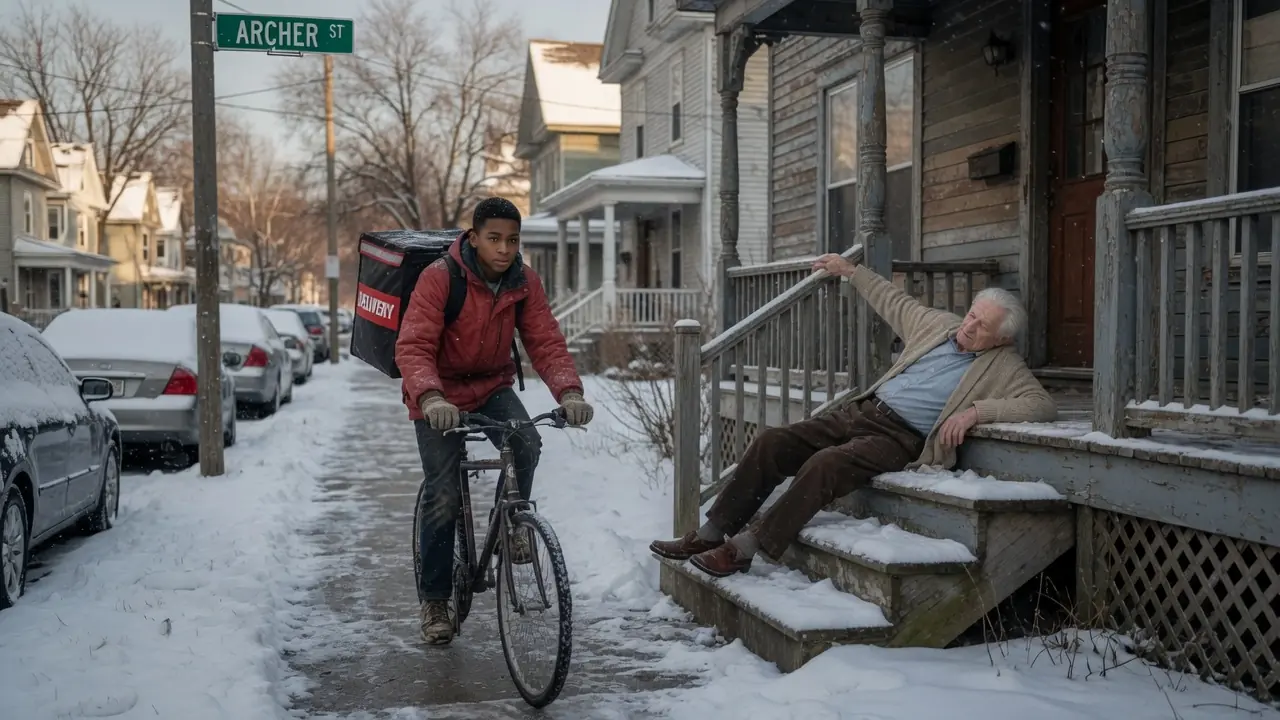
The funeral was small, just Malik and the funeral home staff, and a priest who had never met Walter but said kind things anyway. Nobody else came, no family, no old friends, no neighbors who had lived next to him for decades. Malik paid for it with money scraped together from deliveries and help from family. The cheapest option, simple casket, simple service, but dignified. Walter deserved that much. After Malik went back to the house on Archer Street, he had keys now, had been coming here for months, but walking and knowing Walter would not be in that chair, would not call out asking what took so long, would not be there at all, made the house feel different, colder, more dead than it had ever been. He needed to start cleaning it out. The city would want it eventually, back taxes probably, or the bank. Malik did not know how these things worked. He just knew he needed to sort through Walter's life before someone else did.
He was in the living room, boxing up books, when there was a knock at the door. Malik answered it. A man stood there, 50-something, gray suit that looked expensive, briefcase, hair combed neat, the kind of person who did not belong on this street. Can I help you? Are you Malik Johnson? Yeah. My name is Thomas Miller. I am an attorney. I represented Walter Reynolds. Malik's stomach dropped. Of course, lawyers meant debts, meant bills Walter had not paid, meant trouble. Look, I do not have any money. I paid for the funeral, but that is it. Whatever Walter owed, I cannot pay it. The lawyer's expression did not change. I am not here about debts. May I come in?
Malik stepped aside, let him in. The lawyer looked around the house, at the worn furniture, the boxes Malik had started packing, the general sense of a life being dismantled. You were close with Mr. Reynolds. I took care of him. The last few months. Yes, I know. He told me about you. That surprised Malik. Walter had never mentioned talking to a lawyer. He changed his will 3 weeks ago, made you his primary beneficiary. The words did not make sense. Malik heard them, but they bounced off his brain without sticking. I am sorry, what? The lawyer opened his briefcase, pulled out papers, set them on the coffee table. Walter Reynolds left everything to you, his estate, his assets, all of it. But he did not have anything. He could barely pay his bills. The lawyer sat down on the couch, gestured for Malik to sit, too. Malik sat, still not understanding.
Mr. Reynolds wanted it to appear that way. He lived simply, very simply, but that was not because he had to. What are you saying? Walter Reynolds founded a company in 1972, industrial supply, steel equipment, machinery parts, that sort of thing. He sold it in 1998 for a considerable sum. He invested wisely, lived off the interest, but he kept his wealth private, very private. Malik's head was spinning. How much are we talking about? The lawyer looked at his papers. The estate is valued at approximately $43 million, give or take, depending on current market conditions. There is also this house, which is paid off, and several other properties he owned but rented out. A few investment accounts, a trust fund that has been accumulating for decades. The room tilted. Malik gripped the armrest of the couch. That cannot be right. It is. I have all the documentation. Mr. Reynolds was a very wealthy man. He just chose not to live like one.
Why? He told me once that he wanted to know who would stay when there was nothing to gain. Who would help him when he appeared to have nothing. He said money had made people disappear from his life before. His children, old friends. He did not want that anymore. Malik thought about the small amounts he had given, the deliveries he had missed, the school time lost, all for a man who could have written a check for any amount and not even noticed. Did he know what I was giving up? Yes, he knew and it killed him. But he needed to know you were real. That your kindness was not about what you could get from him. I did not want anything from him. I know. That is why he chose you. The lawyer stood, pulled more papers from his briefcase. There is a lot to go through. Legal documents, accounts, properties. It will take time to sort through everything. But as of today, you are the legal heir to Walter Reynolds' estate. Congratulations, Mr. Johnson. You are a very wealthy young man.
After the lawyer left, Malik sat in the empty house surrounded by boxes, surrounded by the ghost of a lonely old man who had tested him without telling him. Who had watched him sacrifice what little he had and said nothing. He should have been angry, should have felt betrayed. But instead, he thought about Walter's journal entries. About a man who had driven everyone away with his hardness, his demands, his inability to bend. Who had spent 40 years alone because he did not know how to trust that people would stay without a reason. Malik had given him that reason. Not money, not obligation, just staying, just showing up. Just being there when nobody else was. He walked to the desk, opened the top drawer like Walter had told him to. Inside was an envelope with his name on it. He opened it. Inside was a letter.
Malik, if you are reading this, I am gone. I am sorry I did not tell you the truth. I am sorry I let you struggle, but I needed to know. After Steven and Rachel, after everyone who left or only came back when they wanted something. I needed to know that someone could care without a reason. You did. You stayed when you had every reason to leave. You gave when you had nothing to give. You were kinder to a mean old man than he deserved. I cannot give you back the time or the opportunities you lost, but I can give you this. Not as payment. You cannot pay someone for genuine kindness, but as a gift, as a way of saying that you mattered. That what you did mattered. That I died knowing at least one person in this world was good for no other reason than because they chose to be. Thank you, Malik, for letting me die loved instead of alone. Use this money to build the life you deserve. And remember that you already had everything that mattered before you had any of this. Walter.
Malik folded the letter, put it back in the envelope, sat in the chair where Walter used to sit. Outside snow was starting to fall again. The same snow that had been falling the day everything changed. The day he stopped for an old man lying in the street while everyone else drove past. He thought about his grandmother, about how she always said doing the right thing was its own reward. How he had never really believed her until now. The money did not change what he had done. Did not make the sacrifice less real. Did not erase the struggles at home or the school days missed. But it did mean something that Walter had seen it, had valued it. Had trusted him with everything because he had proven he wanted nothing. Malik sat in that chair as the snow fell and thought about second chances. About how sometimes they came too late for the person who needed them most. But maybe that was okay. Maybe that was how it was supposed to work. Someone gives, someone receives, and the world gets a little less cold.
Three months later, Malik stood on the porch of the house at 1750 Archer Street with the help of family and the lawyer. The chair was still there. The same chair where Walter used to sit, watching the world go by, waiting for nobody because nobody came. Malik had made a decision with guidance from adults around him. He could have sold the house, but instead the place was becoming something new now. Repairs were made with part of the estate. The house felt warmer, more welcoming. But he kept Walter's chair, kept it right there on the porch.
With support, he helped start something called the Reynolds Foundation, a simple mission to help the elderly in this neighborhood who had nowhere else to turn. Hot meals delivered, rides to doctor appointments, someone to help with small tasks or just sit and talk when the loneliness got too heavy. Small things. The kind of things that did not make headlines but made the difference between surviving and living. Volunteers from the community got involved. Every evening the porch light would turn on. A signal, a promise that this was a house where someone was paying attention. Where you could come if you needed help and nobody would turn you away.
Old people in the neighborhood had started to notice. A few had already reached out, needed help with bills or groceries or just wanted someone to talk to. Malik helped where he could while continuing school. The money made many things possible, but the money was not the point. The point was what Walter had taught him without meaning to. That the loneliest people were often the ones who had forgotten how to ask for help. That sometimes the greatest gift you could give someone was not fixing their problems, but just being there while they figured it out themselves.
One evening, as the first snow of the new winter started to fall, an old woman walked up to the porch. She was maybe 75, wearing a coat too thin for the weather. Is this the place that helps people? Yes, ma'am. Come on in. She followed him inside. He made her tea, let her warm up. She told him about her grandson who was supposed to be helping her but had not called in months. About the sink that leaked. About not being able to afford a plumber. About being too proud to ask the neighbors because she did not want to be a burden. Malik listened, made notes, told her help would come tomorrow, no charge. And if she needed anything else, just call. Why are you doing this? Because someone did it for me once, in a way. Who? Malik looked at the chair in the corner. The old recliner where Walter used to sit, telling stories about Margaret and the steel mill and a neighborhood that used to be something different. Just a friend. He taught me that everybody needs somebody, even if they pretend they do not.
The woman left with a promise that someone would come fix her sink. When she was gone, Malik sat in Walter's chair and thought about all the people in this neighborhood who were sitting alone right now. Who needed help but were too proud or too scared or too forgotten to ask for it. He could not save everyone, could not fix everything, but he could keep the light on, could make sure that at least some people did not have to die alone the way Walter almost had. His phone buzzed. Another call had come in. An old man three streets over had not eaten in two days. Too embarrassed to go to the food bank. Could they help? Malik stood, sent a message for help to come. On my way.
Before he left, he paused at the front door, looked back at the house, at Walter's chair, at the light burning on the porch. He whispered, so quiet nobody would hear even if they were standing right there. I will stay at least long enough that nobody has to die alone. Then he stepped out into the snow, closing the door behind him but leaving the light on. Always leaving the light on. Because that is what Walter had taught him. That kindness was not about grand gestures or big moments. It was about showing up. About staying when it got hard. About being the person who kept the light burning when everyone else had gone dark. And if he could do that, if he could be that for even one more person the way he had been for Walter, then maybe all of it had been worth it. The sacrifice, the struggle, the days wondering if he was doing the right thing. Maybe goodness did not need a reason. Maybe it was enough just to be good. To stay. To care. Maybe that was how you honored the people who came before. Not by forgetting them or moving on, but by becoming the kind of person they needed you to be.
Malik walked through the snow toward the address. Another old person. Another empty house. Another chance to make sure someone knew they mattered. Behind him, the light on the porch at 1750 Archer Street burned steady and bright. A beacon in the darkness. A promise kept. The chair sat empty, but not lonely. Not anymore. Because someone was finally paying attention. Someone was finally staying. And in a neighborhood where people had learned not to see each other, that was everything.