Good afternoon, sir. Mind telling me what you're doing out here by the gate? I'm waiting for my daughter to come out. School lets out in a few. What's her name?
Uh Maya Hall, third grade. I'm here every Thursday. Do you have some ID on you? I've told you who I'm waiting for. She's right inside.
I still need to see identification, sir. Fine. Here. Derek Hall. That's me.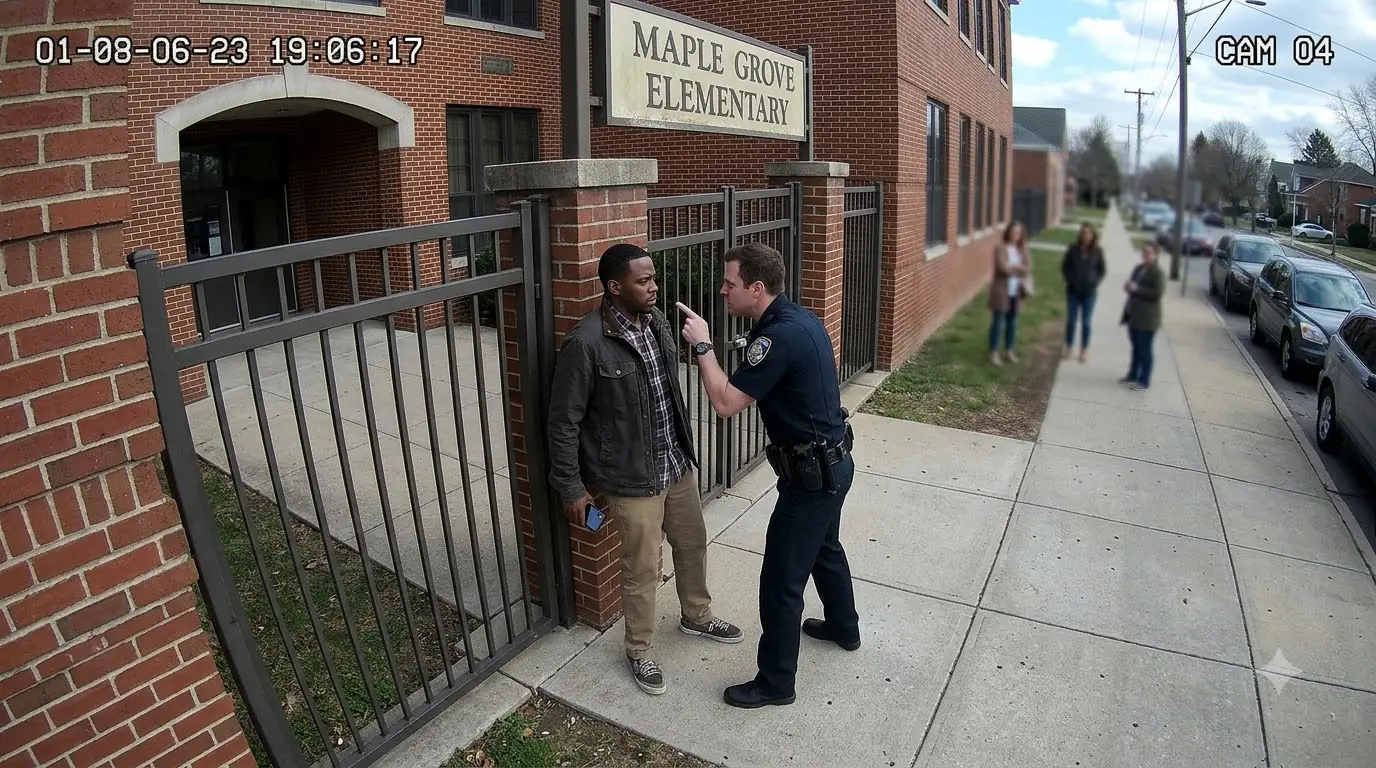
That's her dad. His name is Derek Hall. He is not unemployed. He is not transient. He is not unknown to the child waiting behind those doors.
It wasn't about behavior. It wasn't even about concern. It was about perception and what happened next exposed how quickly a single assumption can turn a parent into a threat. Derek Hall built his life deliberately. Every choice, every routine, every responsibility.
He grew up watching men disappear, not always physically, but emotionally. Promises made them forgotten, birthdays missed, school events unattended. Derek noticed what absence did. So when his daughter Aaliyah was born, he decided early. Presence would be his legacy.
He structured his career around it. Turned down promotions that required travel. Negotiated flexible hours. Learned which days teachers sent homework early and which days dismissal ran late. Pickup was sacred.
Not because it was convenient, but because it was visible. It told his daughter, "I show up. " It told him itself, "I am where I'm supposed to be. " For years, no one questioned it until the day someone did. Maple Grove Elementary sat in a neighborhood parents described as quiet, family oriented, good brick building, trimmed hedges, murals painted by PTA volunteers. It was the kind of place where people assumed danger came from outside, never from inside, never from assumptions made in broad daylight. Dererick arrived early as usual.
He stood near the front gate, phone in hand, answering a work email while waiting for dismissal. His posture was relaxed, his attention divided, his focus elsewhere. Inside the building, a teacher noticed him through the glass. She didn't recognize him. That alone should have meant nothing.
But in certain spaces, unfamiliar becomes unacceptable. She didn't check the pickup list. She didn't ask the front office. She didn't step outside to speak to him. She interpreted and interpretation became action.
Her voice was measured on the phone. Yes, I'm calling from Maple Grove Elementary. Pause. There's a man outside by the gate. Another pause.
He's been standing there for a while. The dispatcher asked questions. She answered selectively. Yes, he's black. Then came the justification, the sentence that transforms uncertainty into urgency.
With everything going on these days, I just want to be cautious. Caution, a word that sounds harmless until it summons authority armed with suspicion instead of facts. Within minutes, a patrol car was dispatched. Derek never saw it coming. The cruiser rolled up slowly.
Too slowly. That was the first sign something was wrong. Derek noticed the officer before the officer spoke. The way his posture stiffened, the way his eyes scanned, not to understand, but to confirm. Sir, Derek looked up.
Yes. What are you doing here? The question was framed as neutral. The tone was not. I'm waiting to pick up my daughter.
The officer didn't relax, didn't smile, didn't acknowledge the answer. How long have you been standing here? About 10 minutes. Do you have a child enrolled at this school? Yes.
The officer leaned slightly closer. We received a call about a man matching your description engaging in concerning behavior around children. Derek frowned. What behavior? The officer paused.
They were worried you might be a predator. The word echoed. Predator, not parent, not guardian, not confused visitor. Predator. Derek felt the anger immediately.
Sharp. Instinctive. He swallowed it. He knew the rules. Hands visible, voice steady, no sudden movements.
That's not true, he said carefully. I'm her father. The officer studied his face, not for truth, but for reaction. Do you have proof of that? Proof?
As if fatherhood only existed on paper. Parents nearby slowed their conversations. A few phones came out. Whispers rippled through the pickup crowd. Derek realized the danger wasn't just the officer.
It was the audience. Once suspicion spreads, facts struggle to catch up. I'm going to reach into my pocket. Derek said, narrating every movement. My wallet is there.
He removed his ID and handed it over. The officer examined it, then checked his tablet, then frowned. Why doesn't your last name match the students? Derek exhaled. She has her mother's last name.
The officer paused, not relieved, not satisfied. Pauses like that aren't neutral. There are moments where doubt looks for somewhere else to attach. The officer glanced toward the school doors. "Who's her teacher? " Derek answered.
"What grade? " answered. "What does she look like? " Derek stopped. That question wasn't about verification. It was about power. Before Derek could respond, a voice cut through the tension.
"Daddy. " Aaliyah burst through the doors, backpack bouncing, eyes locked on him. She ran, wrapped her arms around his leg. The scene froze. Parents stopped talking. Phones stopped moving.
The officer's posture changed instantly. The teacher who made the call stepped outside and saw the truth unfold in real time. A child, a father, a hug, her face drained of certainty. The officer cleared his throat. "Sir, it appears there's been a misunderstanding. " "Misunderstanding? " Derek looked down at his daughter, then back at the officer.
You accuse me of being a predator. Silence. No apology. Just discomfort. What Derek didn't know was that another parent had been recording.
From the moment police arrived, from the accusation, from the word predator spoken aloud. That night, the footage was posted online. By morning, it had millions of views. Commentators weighed in. Civil rights attorneys dissected the exchange.
Former teachers spoke out. This is racial profiling. This could have ended in tragedy. This is why trust is broken. The school district released a statement emphasizing student safety.
The police department cited protocol. Neither addressed the accusation itself. Neither addressed the harm. Pressure mounted. Within weeks, the teacher was placed on administrative leave.
The officer was reassigned pending review. Mandatory bias training was announced districtwide. Derek Hall filed a formal complaint in civil claim. The school promised reform. But Dererick's daughter noticed something else.
She held his hand tighter at pickup. She asked quieter questions. Why didn't they know you were my dad? Derek had no answer that wouldn't break something. This wasn't about safety.
It was about assumptions. About how quickly authority can be summoned without verification. About how black fatherhood is treated as suspicious until proven legitimate? Why is presence interpreted as threat? Why does fear outweigh fact?
Why does the benefit of the doubt travel in only one direction? If this can happen at a school gate in daylight with witnesses, how often does it happen where no one is filming? Derek Hall still shows up. Same gate, same time, same routine. But now, every glance feels heavier because he understands something he never should have had to learn.
In some spaces, fatherhood isn't protection. Belonging is conditional and innocence must be proven again and again. So the question remains unresolved, uncomfortable, unavoidable. How many parents are one phone call away from being turned into a threat?