Jonah Mercer had learned a long time ago that machines never lied. They might whisper, they might groan, they might scream at the last second, but they always told the truth if you knew how to listen. People were different. People lied to protect their pride, their jobs, their time, or simply because they didn’t want to look foolish. Machines didn’t care about any of that.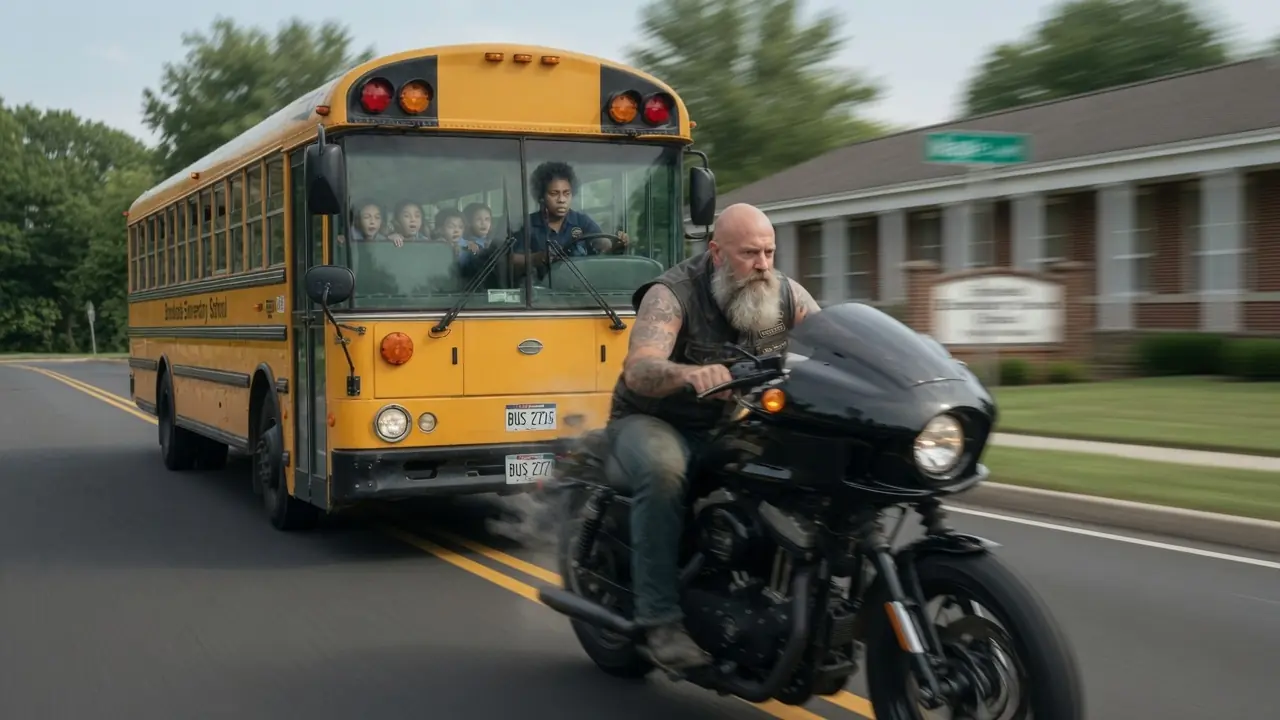
At fifty-six, Jonah had spent more years listening to engines and wheels than he had spent listening to most people. His garage sat on the edge of an industrial strip in Columbus, Ohio, where the smell of solvent and old grease never quite left the concrete. The sign above the door read Mercer & Sons, though there had never been a son. He had painted it that way anyway, the same way some men kept an empty chair at the table. It was easier than explaining.
That Monday afternoon he had been across from Brookside Elementary because Mrs. Alvarez’s son had blown the rear shocks on his old Harley. Jonah finished the job early, wiped his hands on a rag that had once been blue, and sat on the bike watching the dismissal line. He didn’t like schools. Never had. The sound of children shouting and laughing always made something in his chest feel tight, like a belt that had been left too long in the sun.
He was about to start the Harley when Bus 42 rolled past at walking speed.
The sound reached him before the bus had even cleared the crosswalk.
A dull, uneven knock from the left rear wheel. Not loud. Not dramatic. Just wrong. Then a slight wobble in the rhythm, like a heartbeat that had lost its steady count. Jonah’s stomach tightened. He had heard that exact language before, twenty-four years earlier, on a delivery truck in a different yard. He had stayed quiet that day because he was the youngest mechanic and didn’t want to make trouble. Two miles later the wheel came off. The driver survived but never walked without a cane again.
Jonah stepped off the bike.
He raised both arms and waved. The driver, a Black woman in a navy uniform, glanced at him but kept rolling toward the exit onto Maple Avenue. Jonah didn’t think. He swung the Harley across the driveway and stopped directly in the path of the bus. The brakes locked hard. Children inside looked up from their phones and backpacks.
Parents waiting at the curb started shouting almost immediately.
“Move that damn motorcycle!”
“What the hell is wrong with you?”
Jonah kept his hands visible and stayed several yards from the bus door. When the driver cracked her window, he spoke clearly.
“Left rear wheel. It’s loose. You need to check it before this bus moves another block.”
Angela Morris stared at him like he had lost his mind. She had driven this route for thirteen years. She knew every pothole, every child who got motion sick, every parent who was always late. She had not heard anything wrong with her bus.
“Sir, you are blocking a school bus full of children. Move your motorcycle right now.”
“I will,” Jonah said. “After someone looks at that wheel.”
Angela’s hand hovered near the radio. “I’m calling dispatch.”
“Please do.”
A school security officer arrived at a run. Then a white district pickup pulled up and a man in a reflective vest got out already furious. Parents were filming now. One woman had her phone up and was narrating loudly for whoever would watch later. Jonah stayed exactly where he was, the Harley’s engine ticking as it cooled.
The transportation supervisor, Dennis Cole, pushed through the small crowd. “What exactly do you think you’re doing?”
Jonah recognized him. They had worked in the same district years ago. “Left rear wheel. Lug nuts are backing off. I can hear it.”
Dennis looked at him for a long second, then at the bus. “You’re Torque Mercer.”
Jonah gave a small nod.
Dennis turned to Angela. “Set the brake. Don’t move this thing.”
Angela did as she was told, though her jaw stayed tight. Dennis walked to the rear of the bus with a flashlight. He knelt. For almost thirty seconds he didn’t speak. When he stood up, his face had changed.
“Everybody off,” he said. “Now.”
The children filed out under the eyes of teachers who had come running from the school. Most of them looked confused rather than scared. One small girl with red hair in two braids stood near the fence and watched Jonah the whole time. She didn’t look afraid. She looked curious.
Parents who had been shouting minutes earlier now stood in uneasy silence. The father in the gray jacket — Craig Dutton — kept glancing between Jonah and his daughter Sophie, who was still watching the biker like he was the only person who understood what was happening.
Dennis came back from under the bus. His voice was low. “Several lug nuts are loose. One’s gone. The wheel has already started shifting. If this had gone another mile, especially on the curve down Maple…”
He didn’t finish the sentence.
Angela stepped down from the bus slowly. She looked at Jonah. “I didn’t hear anything.”
“You weren’t supposed to,” Jonah said. “Not from the driver’s seat with the engine running and thirty kids talking.”
She studied him for a moment. “You used to work fleet, didn’t you?”
“Seventeen years. West yard.”
Angela nodded once, then walked away to help get the children onto the replacement bus that had been called. She didn’t thank him. Not yet. She was still angry that he had made her look incompetent in front of parents and her own supervisor. Jonah understood that anger. He had carried versions of it himself for decades.
By the time the replacement bus left, two police cruisers had arrived. Officer Dana Ruiz spoke with everyone in turn. Jonah answered her questions calmly. He had not touched the bus. He had not approached any children. He had blocked a driveway on school property while the bus was still on school grounds. The danger he had pointed out had been real and immediate.
Dana wrote everything down. Before she left she said, “You understand how this looked, right?”
“I knew exactly how it looked,” Jonah answered. “That’s why I did it anyway.”
She studied him for a second longer, then nodded and walked back to her car.
Jonah rode home in the fading light. He expected the story to die there. He had done what needed doing. The rest was paperwork and politics.
It didn’t die.
By the next morning the video had spread beyond the neighborhood. Some versions called him a hero. Others called him a dangerous biker who had terrified children. Jonah ignored all of it. He posted one sentence on the garage page and nothing else:
Do not blame the driver. Listen to machines. Never put pride ahead of children.
That afternoon Craig Dutton showed up at the garage. He looked like a man who had spent the night arguing with himself.
“I came to say I was wrong,” Craig said. “I was the one yelling the loudest yesterday. I thought you were trying to hurt them.”
Jonah wiped grease from his hands. “You saw a big man with tattoos and a motorcycle blocking a bus. You protected your kid. That’s what you’re supposed to do.”
Craig looked down at the concrete. “My daughter hasn’t stopped talking about you. She wants to draw you something.”
Jonah started to say he didn’t need anything, but Craig had already turned and walked back to his truck.
That evening Sophie came with her father. She handed Jonah a drawing done in blue crayon. A yellow bus. A motorcycle. A giant wheel floating above them like a dark moon. Underneath, in careful letters, she had written:
THE MAN WHO HEARD THE BUS.
Jonah took the paper and stared at it until the lines blurred. He taped it to the wall above his workbench and didn’t say another word about it.
But the story kept moving.
Three days later Dennis Cole called and asked Jonah to come to the transportation office. The investigation into the wheel had turned up something ugly. The tire work on Bus 42 had been done by an outside contractor two days earlier. The contractor’s records showed the lug nuts had been torqued correctly. The district’s own inspection log showed the same. Someone had either lied on the paperwork or the work had been redone sloppily afterward and covered up.
Dennis looked tired. “We’re going to have to go public with this. The contractor is already lawyering up. They’re saying our drivers are making it up to avoid responsibility.”
Jonah leaned back in the plastic chair. “Angela didn’t make anything up. I heard it before she even knew I was there.”
“I know,” Dennis said. “But this is going to get messy. The board wants you to speak at the meeting next week.”
Jonah hated meetings. He hated microphones even more. But he said yes anyway.
The night before the meeting, Jonah sat in his garage with the lights off and let himself remember the thing he had spent thirty-four years trying not to remember too clearly.
He had been twenty-two. Newest mechanic in the fleet shop. A driver had brought in a box truck complaining about a vibration in the rear. Jonah had heard the wheel. He had known what it meant. But the driver was in a hurry and the supervisor had already signed off on the truck for another route. Jonah had told himself it wasn’t his place to override them. He was the kid. They were the ones with the years.
Two miles later the wheel came off on the highway. The driver had been lucky. He lived. He just never walked straight again. Jonah had stood outside the hospital room and listened to the man ask the same question over and over: “What happened? I don’t understand what happened.”
That night Jonah had made himself a promise in the parking lot under the yellow lights. He would never again stay quiet because he was afraid of looking foolish or because someone older told him to mind his business. The cost of being wrong about a bad wheel was always higher than the cost of speaking up.
He had kept that promise for thirty-four years. It had cost him friends, jobs, and once almost his life when a supervisor who didn’t like being questioned swung a tire iron at his head during an argument about brake lines. The shoulder injury that eventually pushed him out of district work had come from that same fight. Jonah had never told anyone the real story. He let people think it was just an accident in the bay.
Now, sitting in the dark garage with Sophie’s drawing watching him from the wall, he wondered if he still had the stomach to stand in front of a room full of strangers and say the same thing out loud.
The school board meeting was held in the cafeteria. Folding chairs, bad lighting, the smell of floor wax and old coffee. Angela Morris spoke first. She stood in her navy uniform and told the room exactly what had happened without trying to make herself look better or worse.
“I have driven children for thirteen years,” she said. “I am proud of my safety record. But pride cannot be louder than a warning sign. Mr. Mercer stopped my bus because he heard something I could not hear from the driver’s seat. I am grateful he acted before we reached Maple Avenue.”
Dennis Cole spoke next. He confirmed the mechanical failure without exaggerating and without hiding how close they had come.
Then they called Jonah’s name.
He walked to the front feeling every eye in the room. Some parents still looked at him like he was the problem. Others looked at him like he had saved their children personally. Both versions made his skin crawl. He adjusted the microphone once, then left it alone.
“I blocked a school bus,” he said. “I understand why that scared people. I would rather spend the rest of my life explaining why I did it than spend one minute wishing I hadn’t.”
He paused. The room stayed quiet.
“I know the sound a wheel makes when it’s getting ready to leave the axle. I heard it once on a truck when I was twenty-two. I didn’t speak up because I was the youngest guy in the shop and I didn’t want to make trouble. That wheel came off two miles later. The driver lived, but he never walked the same. I’ve carried that with me every day since.”
Jonah’s hands tightened on the edges of the podium.
“After that I promised myself I would never keep quiet again just because I was afraid of looking foolish. That’s all I did on Monday. I heard something wrong and I refused to pretend I hadn’t.”
He looked out at the crowd. Craig Dutton was sitting in the third row with Sophie beside him. She was holding another drawing in her lap. Jonah couldn’t see what it showed from where he stood, but he could see the way she watched him — steady, without fear.
“I don’t want to be a hero,” Jonah said. “I just don’t want to be the man who stayed quiet again.”
The room stayed silent for several seconds after he sat down. Then Angela stood up and started clapping. Slowly, others joined her. Not everyone. But enough.
After the meeting, Craig and Sophie waited for him in the hallway. Sophie held out her new drawing. This one showed the bus with all four wheels firmly on the ground. In the corner she had drawn a small motorcycle and a bearded man with one hand raised beside his ear.
When her teacher had asked earlier what the man was doing, Sophie had answered, “He’s listening.”
Jonah took the drawing and folded it carefully. He didn’t trust himself to speak right away.
Craig cleared his throat. “I wanted to tell you something. After what happened, I went back and looked at every video I could find of that day. I saw how you stood there with your hands up while people were yelling at you. Most men would have gotten angry or defensive. You just… waited.”
Jonah nodded. “Anger doesn’t fix wheels.”
Sophie tugged on her father’s sleeve. “Can we go to his garage sometime? I want to see the motorcycles.”
Craig looked at Jonah. Jonah hesitated, then nodded. “Anytime. Just call first.”
In the weeks that followed, the district changed their procedures. They required a second verification after any tire work. They added a short briefing for drivers about reporting new sounds or vibrations before leaving school property. The contractor who had worked on Bus 42 lost the district contract after their records were shown to have discrepancies. None of it made the evening news. That was fine with Jonah. The changes that actually kept children safe rarely did.
Jonah went back to his garage and tried to return to normal. People still came by to look at him. Some thanked him. Some wanted pictures with the Harley. He accepted the handshakes and turned down the pictures. He kept saying the same thing: “I heard a noise. That’s all.”
But it wasn’t all.
One rainy afternoon in late November, Sophie showed up at the garage alone. She had walked from the bus stop two blocks away. She stood in the doorway with her backpack and her braids slightly damp and asked if she could watch him work.
Jonah almost told her to go home. Then he remembered the way she had looked at him that first day — not like he was dangerous, not like he was a hero, just like he was someone who had heard something important.
He let her stay.
She sat on an old stool in the corner and watched him change the oil on a pickup. After a while she asked, “Did it hurt when people yelled at you?”
Jonah wiped his hands and considered the question. “It wasn’t comfortable.”
“But you did it anyway.”
“Yeah.”
“Why?”
Jonah looked at the drawing she had given him, now taped above the bench. “Because a long time ago I didn’t, and someone got hurt. I decided I wasn’t going to make that mistake twice if I could help it.”
Sophie thought about that. “My dad said he was scared when he saw you. He thought you were going to hurt us.”
“He was doing what fathers are supposed to do,” Jonah said. “He was protecting you the only way he knew how in that moment.”
Sophie nodded. Then she said, very quietly, “I’m glad you were there.”
Jonah didn’t answer. He just went back to work. But something in his chest loosened for the first time in years.
By spring the story had mostly faded from the neighborhood. New videos had replaced it online. New problems had replaced it at the district. But every time Jonah saw a school bus on the road, he still listened. He couldn’t help it.
One warm Saturday in May, Craig and Sophie came to the garage together. Sophie had a new drawing. This one showed the garage itself, with motorcycles lined up and a bearded man standing in the doorway. She had written at the bottom:
THE MAN WHO LISTENS.
Jonah looked at it for a long time. Then he did something he hadn’t done in years. He asked if they wanted to stay for lunch. He ordered pizza and they ate it sitting on old milk crates in the open bay while rain started to fall outside.
Craig talked about his job. Sophie talked about school. Jonah mostly listened. When they left, Sophie hugged him quickly around the waist and then ran to the car like she was embarrassed by her own affection.
Jonah stood in the doorway watching them drive away. The rain smelled clean. The garage behind him smelled like oil and metal and the faint trace of pizza. For the first time in a very long time, the tightness in his chest that had lived there since he was eleven years old felt a little smaller.
He went back inside and looked at the drawings on the wall. Three of them now. Each one simpler than the last. Each one saying the same thing in different ways.
He had spent most of his life believing that the only thing he was good for was hearing what was about to break. He had never expected that the same skill might also be the thing that let him hear something else — the quiet sound of a life that could still be repaired, even after decades of carrying the weight of one mistake.
Outside, the rain kept falling. Inside, the old Harley sat under a drop cloth, waiting for the next job. Jonah wiped his hands on a clean rag, turned off the lights, and locked the door.
He would be here tomorrow. And the day after that. Listening.
Because that was what he had promised himself he would do.
And because, sometimes, the thing that saves the most lives is not the loudest voice or the biggest gesture.
Sometimes it is simply one person who refuses to look away when something starts to come loose.