This young college student juggling classes and multiple jobs just to survive has spent his whole life scraping by. Yet he has never let poverty smother the compassion in his heart. So when he saw an elderly frail man collapse in the middle of a violent storm while everyone else hurried past, he didn't hesitate for a second. He rushed in, gave first aid, helped stabilize him, and then walked with him through 15 city blocks in the worst downpour Philadelphia had seen in years.
What Elias didn't know was that the trembling man leaning on him was a billionaire with an enormous fortune and that this rain-soaked walk was about to change both of their lives forever.
Tuesday morning, 6:47 a.m. Elias Monroe's alarm doesn't go off because he never set one. His body wakes him at the same time every day. Twenty years old, exhausted before the day even starts, he rolls out of a mattress on the floor, springs poking through, no bed frame, can't afford one. The apartment is silent except for his grandmother's breathing from the other room.
Marlene, 73 years old. Arthritis so bad her hands look like twisted tree branches. Elias walks to the kitchen. Two-bedroom walk-up in West Dockside, the part of Rivergate where buildings lean and nobody asks questions. Peeling wallpaper, water stains on the ceiling. When it rains hard, they put buckets in three spots.
He makes instant oatmeal. Two bowls, brown sugar, and grandma's plain in his. Saves 30 cents. Then the pills. He lines them up on the counter. Blood pressure, diabetes, arthritis. He counts the arthritis medication. Three pills left. The refill cost $92. They don't have $92. His stomach knots.
He checks the emergency jar hidden inside the flower canister. $53.18. Rent is due in 6 days. They need 420 total. The math doesn't work. It never works. Elias thinks about money approximately 200 times a day. Every meal, every bus ride, every textbook he can't buy. It's not stress anymore. It's just background noise like tinnitus but financial.
Baby, you're up early. Grandma Marlene shuffles into the kitchen. One hand on the wall for balance. She moves slow. Everything hurts. Morning, Grandma. Made you oatmeal. You're too good to me. No, he's not good enough. If he was good enough, she wouldn't be working two cleaning jobs at 73. If he was good enough, he'd have figured out how to fix this by now.
But he doesn't say that. He just kisses her forehead and hands her the bowl. You working both shifts today? He asks. Just morning at the diner. Double tomorrow? He nods. Does the calculation automatically? Morning shift pays $8 an hour. 4 hours. $32 minus taxes. $26 take home. Not enough. Never enough.
I'll pick you up after your shift. He says. Baby, you got class. I'll make it work. She doesn't argue, she needs the help. They both know it. Elias is a sophomore at Trinity State College. Engineering major, second year. Straight A's in every class because he has to be. Scholarship covers tuition, but not books, not rent, not food, not life.
At Trinity State, Elias is invisible. 3,000 students and not one of them knows his name. He sits in the back, wears the same rotation of four shirts, two pairs of jeans, one pair of sneakers with holes in both soles that he covers with duct tape. His engineering professor, Dr. Chen, stopped him after class last month.
Elias, you scored 97 on the structural analysis exam, highest in 5 years. Thank you, sir. Have you considered applying to the graduate fellowship? Full ride to MIT or Stanford? You'd be a strong candidate. Elias looked at the floor. MIT Stanford, words from a different universe. I work two jobs, Dr. Chen. I don't have time for applications.
Dr. Chen started to say something else. Probably about scholarships, about opportunities, about futures. Elias walked away. Dr. Chen didn't ask again. Because here's the thing about poverty. It's not just about not having money. It's about not having time, not having energy, not having the mental space to dream because you're too busy calculating whether you can afford eggs this week.
Elias works two jobs, morning shift at Rosy's Diner, 6 to 11, serves coffee, clears tables, takes from customers who don't tip, $7.50 an hour plus tips. On a good day, he makes $40. Evening shift as a delivery driver for Ly's restaurant. 6:00 to midnight drives his beat up Honda Civic with over 200,000 miles. The check engine light permanently on and lately the engine had been stalling at random.
Gets paid per delivery plus tips. On a good night, $60. Between shifts, he goes to class. Does homework in the car between deliveries, eats whatever mistakes the kitchen makes that they let him take home. He's done this for 2 years since his dad died. Aaron Monroe, construction worker, fell from scaffolding three stories up, died instantly. No life insurance, just debt.
His mom gone. Left when Elias was 12. Couldn't handle the pressure. Chose herself. He doesn't blame her. Sometimes he understands. So, it's just him and Grandma Marlene. And the weight, the constant crushing weight of knowing that if he fails, she has nobody.
Tuesday afternoon 2 p.m. Elias sits in structural engineering class trying to stay awake. Professor is talking about load distribution in suspension bridges. Elias loves this stuff. He really does. When he's not exhausted, when his brain isn't screaming about rent and medicine and food, he can lose himself in the math. The elegance of forces in balance. The beauty of something that holds weight without breaking.
He has a notebook not for class notes for his own designs, bridge sketches, building concepts, dreams drawn in pencil during the 10 minutes before he falls asleep each night. Nobody knows about the notebook. It feels dangerous to want things you can't have. Class ends. Elias checks his phone. Text from his manager at Rosy's. Can you cover Sarah's shift tomorrow morning? She called in sick.
He texts back immediately. Yes, more hours, more money, less sleep. The equation of his life. 4:30 p.m. Elias walks past the construction site on Broad Street. Chainlink fence, security trailers, massive sign, future home of the Hail Institute for Innovation. Opening fall 2027. The rendering shows a gleaming glass building, outdoor plaza, a pedestrian bridge connecting to the public library two blocks away.
Elias walks away. Tries not to want things he can't afford to want. But something about that bridge stays with him. The way it curves, the way it seems to reach across space with purpose, connecting knowledge to opportunity. That's what the sign said. Knowledge on one side, opportunity on the other, and a bridge bringing them together. He thinks about it all the way to work.
5:45 p.m. Elias is at Ly's restaurant picking up his first delivery order of the night. The kitchen is chaos. Line cooks shouting. Tickets printing. Manager stressed. An old man walks in. Late 60s, maybe early 70s. Expensive coat, the kind with a label you can see from across the room. Leather shoes that probably cost more than Elias makes in a month. Gold watch catching the fluorescent light.
But something's wrong. His hands tremble. His breathing is labored. He leans heavily on the counter like it's the only thing keeping him upright. Can I get a water, please? The cashier, Maria, rolls her eyes. She's been here 10 years and her patience died about 9 years ago. This is a restaurant, not a. I'll get it. Elias grabs a cup, fills it with ice water, hands it to the old man.
The man drinks, hands shaking so badly, water spills down his chin, soaking into his expensive collar. You okay, sir? Yes. Thank you. How much do I owe you? It's just water. No charge. The man pulls out his wallet. Real leather, worn, but expensive. He tries to pull out a bill, but his hands shake so badly the entire wallet drops. Bills scatter on the floor.
Elias kneels, collects them. 20s, 50s, hundreds. He hands the wallet back. Every bill accounted for. The man stares at him. You didn't take anything. Why would I? The man's eyes water. Most people would have, especially. He trails off, but Elias knows what he was going to say. I'm not most people, sir. The man pulls out a 20, tries to hand it to Elias. Please, for your kindness, sir.
I just got you water and you could have walked past. Could have let me drop that wallet and taken what you wanted. Nobody would have known. I would have known. The man's hands drop. He looks at Elias like he's seeing something he forgot existed. What's your name? Elias, sir. Elias. He says it slowly like he's memorizing it. I'm Edmund. Edmund Hail.
The name doesn't register. Should it? Elias nods politely. Thank you, Elias. You're a rare kind of person. Just trying to get through the day, sir. Edmund smiles sadly. Aren't we all? He leaves. Elias watches him go. Notices how he grips the door frame on his way out. The man is sick. Really sick. Maria appears next to him. Rich people are so weird.
Maybe he's just having a bad day with that coat. His bad days are better than our good ones. Elias shrugs. Gets back to work. Forgets about it. The next two hours blur together. Delivery to an apartment building where the elevator's broken. Six flights up. Delivery to a house where the guy tips $3 on a $70 order. Delivery to a college dorm where nobody answers the door for 10 minutes.
By 9:00 p.m. Elias has made $41. Not great, not terrible. He's got three more hours to go. 9:30 p.m. Elias finishes another delivery. His phone buzzes. Text from grandma. Baby, don't forget to pick me up. Bus stop on Market. He checks the time. Her shift ends at 9:45. He can make it. He drives to Market Street. Parks under a street light that flickers like it's trying to decide whether to quit. Waits.
9:47 p.m. The bus pulls up. Grandma Marlene gets off slow, gripping the handrail. Each step looks painful, face tight. She sees his car and her face softens, but the pain doesn't leave her eyes. Baby, you didn't have to come. I know. He gets out, takes her bag, 15 lbs of nothing, her lunch container, change of clothes, library book. She checks out every week and never finishes because she falls asleep after one page.
She eases into the passenger seat with a small sound of pain that she tries to hide. Doesn't work. Elias hears it anyway. They drive in silence for a few blocks. She stares out the window at Rivergate passing by. The city looks different at night, softer. The darkness hides the peeling paint and broken windows. Your father used to pick me up, she says quietly.
Every Tuesday and Thursday, even when he was dead tired from the construction site, he'd be here waiting. Elias grips the steering wheel. Doesn't trust his voice. He had a gift. Your daddy could see what needed fixing and just knew how to fix it. Broken sink, squeaky door, wobbly table. People called him all hours. Aaron, can you help me? And he'd go. Didn't matter if they couldn't pay. Didn't matter if it was midnight.
She turns to look at him. Her eyes are wet. You got that same heart, baby. I see it. Every day you pick me up when you should be studying. Every time you work a double when you're already exhausted. That's your daddy's heart. Elias blinks hard. Just trying to help grandma. I know, but sometimes I worry you're giving so much you'll have nothing left for yourself.
He doesn't answer because she's right. He feels hollowed out most days, running on fumes and obligation. They pull up to the apartment. He helps her out up the three flights of stairs. She takes each step like it might be the one that breaks her. By the time they reach 3C, she's breathing hard, face pale. Inside, he helps her to her chair, makes her tea. The ritual of their nights.
Baby, you got homework. I'll do it after my next shift. Elias, I'm fine, Grandma. Really? She looks at him like she knows he's lying, but is too tired to fight. You know I'm proud of you, right? Engineering school, working two jobs, taking care of me. Your daddy would be so proud. Thanks, Grandma. But baby, you can't carry the world forever. Eventually, something's got to give.
He kisses her forehead. Nothing's going to give. I got this. He doesn't. They both know it, but saying it out loud makes it easier to pretend. He leaves for his last 3 hours of work. In the car, he lets himself feel it for just a moment. The weight, the exhaustion, the fear that one unexpected expense will topple everything they've carefully balanced. Then he shoves it down, turns the key, gets back to work.
What Elias doesn't know, in exactly 90 minutes, his life is going to change and it starts with a storm. Tuesday evening, 10 p.m. The weather forecast said 40% chance of showers. By 9:45, the sky turns black like someone flipped a switch. Wind picks up. Rattling windows. Temperature drops 20° in 15 minutes. By 10:00, it's not rain. It's a wall of water.
Thunder shakes buildings. Lightning cracks so bright it turns night into day for half seconds, leaving ghost images burned into your vision. Flash flood warnings light up every phone in the city. Emergency alert. Severe thunderstorm warning. Seek shelter immediately. Do not travel. The city advises everyone to stay indoors. Streets empty within minutes.
Elias is at Ly's waiting for his next delivery order. The restaurant manager, Carlos, watches the news with increasing alarm. This is bad. Really bad. They're saying possible flooding in low-lying areas. Rain hammers the windows so hard it sounds like someone's throwing rocks. The lights flicker once, twice. Elias, go home. Your grandmother's probably worried sick, but I have two more deliveries.
I'll assign them to someone else or refund them. Go now before it gets worse. Elias doesn't argue. He pulls his hood up. Thin jacket, not waterproof, the only one he owns, and pushes through the door. The rain hits him like a physical force. Within 3 seconds, he's soaked through. Water running down his back, filling his shoes. The holes in his soles let water in with every step.
He runs toward his car parked two blocks away. He fumbles for the keys, heart pounding, rain blinding him. The engine coughs once, twice, then dies completely. The dashboard lights flicker and go dark. Has to run because the rain is so thick he can barely see. Lightning flashes and for a moment everything is bright as noon. In that flash, he sees him. The old man from earlier, Edmund.
The one with the trembling hands. Standing outside a medical building. No umbrella, no coat, soaked through. Dress shirt plastered to his body like a second skin, trying to hail a cab with one hand while the other clutches his chest. Cabs pass without slowing down. Windshield wipers on full blast. Drivers hunched forward, focused only on getting home.
The man stumbles, catches himself on a lamp post, face pale even in the dim light. Lips slightly blue, breathing visible even from 20 ft away. Chest heaving, mouth open. Elias's mind races. Grandma's waiting. She's probably panicking. She'll think I'm hurt. I'm already soaked. I need to get home. He's a stranger. He's clearly rich. Look at that watch, that coat. He'll be fine.
Someone else will help. He probably has people, a driver, an assistant. But the man staggers again. Even through the rain, Elias can see his chest heaving. Labored wrong. He looks like dad. That day, the day before the fall, Dad had come home from work early, face gray. Said his chest felt tight. Grandma wanted to take him to the hospital. Dad refused. Just tired. Long day. Need to rest.
Went to work the next morning. Fell 40 ft 3 hours later. Then Elias notices something strange. A black Lincoln Town car is parked 50 ft away. Hazard lights blinking orange through the rain. Driver's door opens. A man in a suit steps out holding an umbrella. The old man, Edmund, sees him, waves him off sharply, angrily. No, I said no. Get back in the car.
Mr. Hail, please. You're not well. I told you I'm not riding with you. I'll find my own way home. Sir, this is dangerous. I said, No, Mitchell. Get back in the car. The driver hesitates, looks torn, then retreats to the vehicle. Elias is confused. Why would someone refuse their own ride in a storm like this when they're clearly sick? It doesn't make sense.
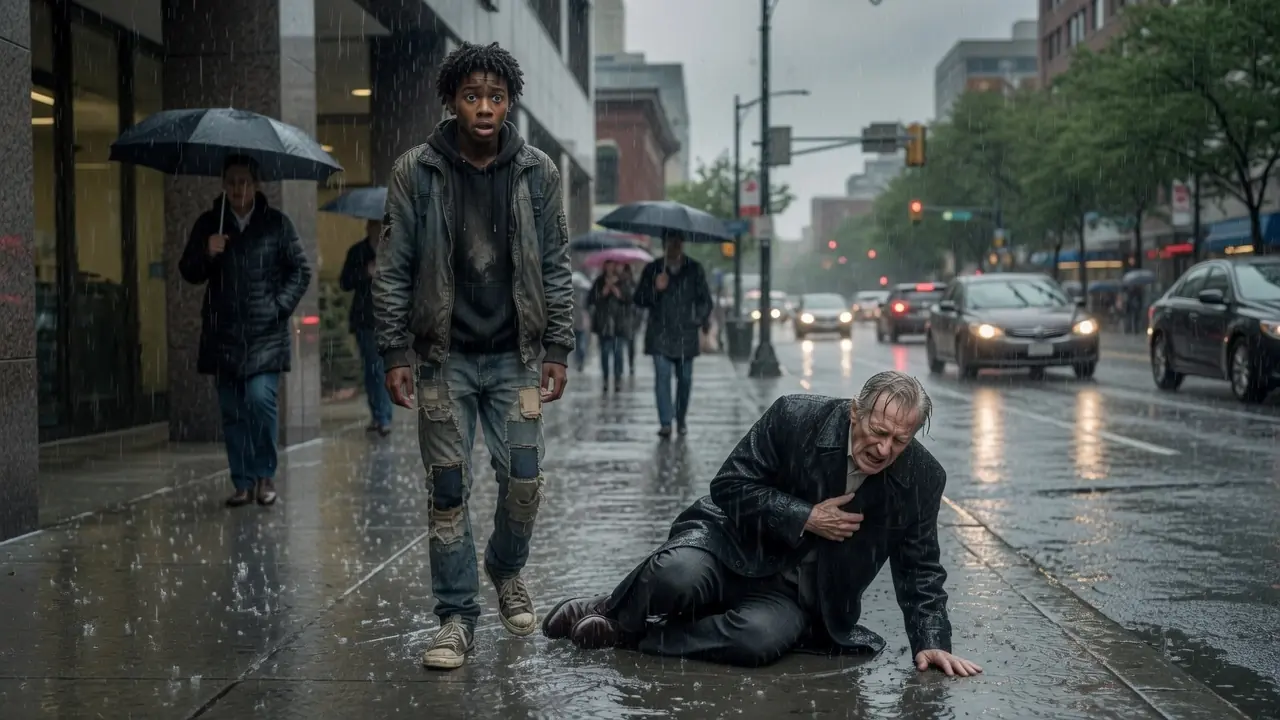
Unless there was a fight, an argument about something big enough to make a sick man choose a storm over a warm car. Thunder cracks directly overhead. The old man's knees buckle. He goes down hard, catches himself on his hands, kneeling on the wet sidewalk, water rushing past him toward the storm drain. People rush past under umbrellas, heads down, focused on their own survival.
Cars splash through puddles without slowing. No one stops. The man tries to stand. Can't. His arms give out. He collapses onto his side. Elias moves before he decides to. Sir, are you okay? He runs. Kneels next to the man. Rain pouring down both their faces, making it hard to see, hard to breathe. The man looks up, eyes unfocused. I just I need to get home. Can't find my phone. I can't.
His voice is slurred. Confused. Medical distress. Where do you live? Rose Hill Square. The building with the green awning. 18th Street. I can't can't remember the number. He walks 15 blocks home. His car dead behind him. Useless metal in the rain. Through the worst of the storm. Elias's phone is in his car a block away. He could run, get it, call 911.
But this man might collapse before he gets back. Might die alone on this sidewalk while Elias is trying to help. Sir, your driver is right there. No. The man grabs Elias's arm with surprising strength, desperate, frightened. Not with him. Please, I can't. I can't explain right now, but I need to walk. I need to get home on my own. He's not making complete sense, but he's desperate.
And he's sick. Dangerously sick. This isn't about the storm. This is about something else. Something personal. Pride maybe, or fear, or anger. Doesn't matter what. What matters, this man is going to die if someone doesn't help him. The stakes flash through Elias's mind in rapid sequence. If I walk this man 15 blocks through this storm, I'll be soaked for over an hour.
Risk of getting sick, missing work, missing school, grandma will be terrified. She'll think something happened to me. I might lose tomorrow's shift. We need that money. Every dollar matters. But if I walk away and this man dies alone on this sidewalk, I'll carry that forever. I'll see his face every time it rains. Every time I walk past this street, I'll wonder if I could have saved him.
The choice isn't really a choice at all. Elias takes off his jacket, thin, soaked, basically useless at this point, but it's something, a gesture, a promise. He drapes it over the man's shoulders. I'll walk you home, sir. Lean on me. The man looks at him. A long searching look. Water running down his face. Could be rain. Could be tears. You don't have to do this. You don't even know me.
I know you need help. That's enough. Come on. Elias pulls the man to his feet. He's heavy. At least 190, maybe more. Dead weight. Elias is 5'9", 140, soaking wet, and every pound of that weight settles onto his shoulder. They start walking. Behind them, the driver gets out of the car again. Mr. Hail, please. Edmund doesn't turn around. Just keeps walking, leaning on this stranger.
Elias doesn't know it yet, but this walk, this choice, this moment, it's about to change everything. Every step through that storm is a choice. And Edmund Hail is counting every single one. Blocks one through three are a physical battle. Rain comes in sheets almost horizontal. Wind tries to knock them over. Elias's sneakers. Holes in both soles fill with water immediately.
Every step, squish, squish. Cold water between his toes. His socks are gone, basically disintegrated. Edmund is dead weight, leans heavily on Elias's right shoulder, breathing ragged, wet, labored. Every breath sounds painful. Elias's shoulder already aches. A deep burning ache that spreads down his arm. His legs burn. They've walked two blocks. 13 more to go.
Lightning strikes close, maybe three blocks away. The thunder comes instantly. So loud Elias feels it in his chest, in his bones. Edmund stumbles. His legs give out. Elias catches him. Nearly goes down himself. I got you. Just keep moving. One foot, then the next foot, one foot, then the next. He repeats it out loud this time, creating a rhythm, a chant, something to focus on besides the cold, the pain, the exhaustion.
His teeth chatter, his hands are numb. Water streams down his face. Can't tell rain from sweat from the water running from his hair. Don't let him fall. Don't let him die. One foot, next foot. Don't let him fall. Block four. The rain lessens slightly, still pouring, but no longer feels like needles hitting skin. The worst of the cell has passed overhead.
Edmund's breathing stabilizes just enough for talking. He lifts his head slightly. What's your name, son? Elias, sir. Elias. He repeats it carefully like he's memorizing it. Strong name, old name. I'm Edmund. Edmund Hail. The name still doesn't click for Elias. He nods. Focuses on keeping them both upright. You should have just called 911 Elias. This is too much to ask of a kid.
I'm 20, sir, and I didn't see my phone. You needed help now, not in 20 minutes when an ambulance might get here. Edmund falls quiet for half a block. Just breathing, walking, trying to stay conscious. You remind me of someone, he finally says. Blocks five and six. Edmund starts talking. Maybe to distract himself from the pain. Maybe because he needs to say it out loud. Maybe because he thinks he might not get another chance.
I had a son once, Marcus. He'd be 31 now, I think. Might be 32. I lose track sometimes. Time gets blurry when you're trying not to count it. Elias doesn't know what to say. Just listens. Keeps walking. Car accident. 19 years ago. He was 19. Just finished his freshman year at Penn. Engineering major. Coming home from volunteering at a youth shelter in West Philadelphia.
Drunk driver ran a red light doing 60 in a 35 zone. Marcus didn't have a chance. Edmund's voice cracks. Breaks. Reforms. He was a lot like you. Kind without thinking about it. Saw people who needed help and just helped. Didn't calculate the cost. Didn't wonder what he'd get in return. Just helped because someone needed it. I'm sorry, sir. That's I'm sorry.
He wanted to be an engineer. Civil engineer. Bridges specifically. Used to drive me crazy talking about load distribution and tensile strength and arch calculations. I didn't understand half of it. Probably didn't listen as well as I should have. Edmund laughs. It's bitter, sad, painful. Bridges, things that connect people. That's what he'd say.
Dad, a bridge isn't just about getting across water or a valley. It's about connection. It's about making sure everyone can reach opportunity, not just the people born next to it. His voice drops to almost a whisper. And I've spent the last 19 years building walls instead. Big, expensive, impressive walls. What kind of walls? Emotional ones. Professional ones.
I threw myself into work after he died. Made a lot of money. Started a foundation in his name. Built buildings, funded programs, wrote checks with lots of zeros, thought I was honoring him, keeping his memory alive. He pauses, takes several labored breaths. But really, I was running from grief, from guilt, from the fact that I worked 80-hour weeks when he was alive and barely knew him.
Missed his baseball games because I had meetings. Missed his science fairs because I was traveling. Missed his high school graduation speech because I was closing a deal in Tokyo. Always too busy building my empire to notice I was losing my son long before that car hit him. His voice breaks completely. And now I'm 68 and sick. And I realize I spent 19 years building monuments to my guilt instead of living the life Marcus would have wanted me to live.
I stopped seeing people. Stopped seeing what Marcus saw. Humans who need help. I just saw transactions, investments, returns. They walk another block in silence. Just the sound of rain and their footsteps and Edmund's labored breathing. Then Elias speaks. You're seeing me right now, sir. Edmund stops walking. Looks at Elias through the rain. What?
You're seeing me right now in this moment. So maybe you didn't forget how. Maybe you just needed a reminder. Edmund's eyes water. Definitely not rain this time. How old are you, Elias? 20, sir. 20. He shakes his head slowly. When I was 20, I was drunk every weekend, failing half my classes, chasing girls and money in that order. You're walking a sick stranger home in a storm at 20. You're different.
Elias shrugs. Water runs off his shoulders. I'm just cold and wet, sir. Let's keep moving before we both freeze. They walk one foot, next foot. Blocks 7 through 9. The struggle intensifies. They're in center city now. Street lights brighter, more frequent. More people, though still not many, in this weather. The ones who are out move quickly, hunched under umbrellas, focused on their destinations.
Edmund's pace slows. He's exhausted. Every step is a fight. His legs barely lift. Elias is essentially dragging him now. I'm sorry. God, I'm so sorry. I'm slowing you down. Don't be sorry. Just keep walking. We're over halfway there. A car passes too close to the curb, splashes them with a wave of gutter water. It smells like oil and rot. Elias closes his eyes, keeps moving.
His whole body is shaking now. Not just from cold, from exhaustion. He's been on his feet since 6:00 a.m. It's after 11 p.m. 17 hours. Two jobs, classes, now this. But he doesn't stop. Can't stop. This man will die if he stops. Edmund notices. You're limping. Hole in my shoe. Water's getting in. It's fine. It's not fine.
Edmund looks down, sees Elias's beat up sneakers, the duct tape barely holding the water pouring out with each step. His face changes. Shame, realization, horror. Those shoes. How long have you had those? Couple years. They work. They have holes in them. Yeah. And you're walking me 15 blocks in the rain wearing shoes with holes. You needed help.
Edmund stops walking, forces Elias to stop, looks at him directly, really looks like he's trying to see through skin and bone to whatever makes Elias who he is. Elias, why are you doing this? You could have walked away. Everyone else did. You could have called 911 and left. You could have helped me to that car and let my driver take me. Why are you here?
Elias thinks about it. Rain running down his face. Exhaustion, making his thoughts slow and heavy. My dad used to say something. He'd say, If you see someone who needs help and you can help, you help. That's it. No reason needed. No reward expected. You just help because that's what people are supposed to do for each other. Your dad sounds like a good man. He was. He really was.
Was 3 years ago, construction accident, fell from scaffolding. Edmund goes quiet. They walk another block in silence. Just breathing. Just surviving. I'm sorry. Edmund finally says that's too young to lose a father. Yeah, it is. Another block. They're breathing synchronized now. In, out, step, step. Two bodies moving as one through the storm. What does your dad's voice tell you right now? Edmund asks quietly.
Elias doesn't hesitate. Keep walking. Edmund smiles. First real smile since they started. Mine, too. Marcus's voice. I mean, I can hear him. Dad, you don't get to give up. Not when someone's trying to help you. Honor that then. Let's honor it. Come on. Blocks 10 through 12. The rain picks up again. Another cell moving through, but they're close now. So close.
Elias can feel his body starting to shut down. His vision gets spotty around the edges. His legs are moving on autopilot. Everything hurts. But Edmund is still upright, still breathing, still alive. That's enough. Blocks 13 and 14. Rose Hill Square appears ahead. The difference is stark, immediate, almost obscene. Elegant brownstones, manicured trees that somehow look perfect even in the storm. Doormen in uniforms, gas lamps, iron fences, wealth radiating from every brick, every window, every carefully placed flower box.
Elias feels it immediately. The shift. He doesn't belong here. He's soaked, looks homeless. People will assume the worst. They always do, but he keeps walking because Edmund needs him to. That one. Edmund points. Green awning. Block 15. The arrival. They reach the building. Six stories. Limestone facade. Green awning with gold lettering. The Prescott doorman station visible through glass doors.
The doorman. Middle-aged man. Name tag says George sees them coming through the window. His eyes go wide. He rushes out with a massive umbrella. Too late to help, but the gesture is there. Mr. Hail, my God, what happened? Are you hurt? Should I call Dr. Patterson? I'm fine, George. Just got caught in the rain. This young man helped me home.
George looks at Elias for the first time. Really looks. His expression shifts through several emotions in quick succession. Surprise, confusion, suspicion, disapproval. He looks Elias up and down. Takes in the cheap clothes, the soaked jacket, the shoes with holes, the duct tape, the way water is literally pooling around Elias's feet. His eyes say everything his mouth doesn't.
What is this kid doing here? Why is Mr. Hail with someone like this? Should I call the police? Elias feels it like a punch to the gut. The shift, the judgment, the unspoken, you don't belong here. He's felt it before, many times, but it never stops hurting. He steps back away from the shelter of the awning. You're home now, sir. You should get inside. Get warm.
Edmund grabs his arm. Surprisingly strong grip. Wait, please don't go yet. Mr. Hail, perhaps I should call George hovers. Protective. Still eyeing Elias like he might be a threat. George, give us a moment. Please. George hesitates, looks between them, then steps back, but not far. He's watching, vigilant. Edmund looks at Elias. Really looks, eyes still unfocused from exhaustion and illness, but clear in their intensity.
Thank you. You didn't have to do this. You had every reason to walk away, but you didn't. That means something. That means everything. Elias nods. Doesn't know what to say. His teeth are chattering too hard. Anyway, you should get inside, sir. Get warm. Maybe see that doctor your doorman mentioned. I will. But first, Edmund starts to reach for his wallet.
Elias is already backing away. No, sir. I don't want money. Elias, please. At least let me. I helped because you needed help. Not for a reward. If I take money, it changes what it was. Edmund's hand drops. He stares at Elias like he's seeing something impossible. A myth made real. Do you have any idea how rare you are? I'm just trying to get home, sir.
No. Listen to me. I know billionaires who would take money they don't need just because it's offered. I know people who calculate the value of every interaction, every gesture, every moment. And you, you need money. I can see it in those shoes, in that jacket. And you're saying no. Elias shrugs, shivers. I'm not from your world, sir.
Edmund laughs. Real, genuine, despite everything. No, you're not. And thank God for that. Thank God someone like you still exists. He puts his wallet away, pulls out a business card instead. Heavy stock, embossed lettering. Even wet, it feels expensive. Elias takes it, reads it even though he can barely focus his eyes. Edmund J. Hail founder and chairman. Hail Foundation.
His stomach flips. The construction site. The Hail Institute. This is that Hail. You're you're building that center on Broad Street. The one with the bridge. Edmund nods slowly. You've seen it. I walk past it every day on my way to class. I stop and look at the rendering. That bridge. He trails off. Tell me. It's beautiful, sir. The arch. The way it connects the center to the library.
Like it's saying, knowledge should meet opportunity. People should be able to cross from one to the other without barriers. Edmund's eyes water. That's exactly what Marcus said. Those almost exact words. Dad, bridges remove barriers. They stand there for a moment. Rain falling. Two people from completely different worlds who've somehow collided in this storm. Elias Monroe. What school do you go to?
Trinity State. Sir, engineering major. Second year. Second year. Engineering. Edmund nods slowly, memorizing every detail. Of course, of course you are. George brings towels from inside. Still watching Elias wearily. Edmund wraps one around his own shoulders, hands another to Elias. Thank you, Elias Monroe. You didn't just help an old man tonight. You reminded him why he does what he does.
You reminded him what Marcus saw in people. Elias nods, wraps the towel around his shoulders, even though it won't help. He's soaked through to the bone. Get inside, sir. Please see that doctor. I will. I promise. And Elias. Edmund holds up the business card. Make sure Elias is holding it securely. If you ever need anything, and I mean anything, call that number day or night. Promise me you'll keep it.
I promise. I mean it. Not just for favors. If you ever need help, if you're ever in trouble, if you ever just want to talk about bridges and engineering with someone who misses hearing about it, call. I will, sir. I won't forget this. I won't forget you. Elias nods one last time, turns, walks back into the rain. Behind him, he hears George's voice. Mr. Hail, we should really get you inside. You're hypothermic.
I'm calling Dr. Patterson. And Edmund's response. In a minute, George, I just need to watch him go. Need to make sure he's real. Elias walks 15 blocks home opposite direction through the storm he just walked through. His body is beyond pain now. Beyond cold, moving on pure will. But somehow despite everything, despite the exhaustion, despite the cold, despite the ache in every muscle and bone, Elias feels something he hasn't felt in a long time.
He feels like maybe, just maybe, doing the right thing still matters in this world. Even when nobody's watching, even when it costs you everything, even when the world tells you to keep walking, to mind your own business to protect yourself first, he did the right thing. And for tonight, in this moment, that's enough. He makes it home at 12:47 a.m., climbs the three flights of stairs on legs that barely function, opens the door as quietly as possible.
Grandma is awake, sitting in her chair by the window, crying. Baby, she stands, winces, rushes to him anyway. Oh my god, baby. I thought something happened. I thought you were hurt. The storm and you weren't answering your phone and. I'm okay, Grandma. I'm sorry. My phone's in the car. I had to help someone. She sees how wet he is, how he's shaking, how he can barely stand. What happened?
Old man, sick, needed help getting home. I couldn't leave him. Her face does something complicated. Pride, fear, love, frustration. Of course you couldn't. You got your daddy's heart. She pulls him inside. Now get out of those wet clothes before you freeze to death. You trying to kill me with worry? No, ma'am. She makes him strip right there in the living room. Brings towels, makes hot tea, heats up soup, wraps him in two blankets.
This man you helped he okay? Yeah. Got him home safe. He give you anything. Money for a cab. Elias thinks about the business card in his wet jacket pocket. About Edmund Hail. About the Hail Foundation and the billions of dollars behind that name. Just his thanks grandma. That's all. She looks at him for a long moment. Sees something in his face, decides not to push.
Your daddy would be so proud of you, baby. So proud. Thanks, grandma. But don't you ever scare me like that again. You hear me? Yes, ma'am. She kisses his forehead, goes to bed. Elias sits at the table, drinks tea, his hands shake around the cup. He thinks about Edmund Hail, about Marcus, about bridges that connect people, about doing the right thing. Even when it's hard.
He pulls out the business card. Still damp but intact. Reads it again. Edmund J. Hail, founder and chairman. Hail Foundation. Hail Foundation. Will he remember me? Tomorrow he'll wake up warm and dry in his expensive building. And I'll just be a story he tells at dinner parties. The kid who helped me in the storm. That's all. But then he remembers the way Edmund looked at him. The way he said, I won't forget you. Maybe, maybe he meant it.
Elias finishes his tea, goes to his mattress on the floor, lies down. He's asleep in 30 seconds. He dreams of bridges. What Elias didn't know. Edmund Hail spent that entire night awake, sitting in his study, staring at the storm through his window, thinking about a 20-year-old kid with holes in his shoes who walked 15 blocks in the rain for a stranger, and making plans, big plans, plans that would arrive at Elias's door in less than 24 hours.
But for now, both of them sleep. One in a million dollar condo, one on a mattress on the floor. Both dreaming of bridges. Wednesday morning, 6:00 a.m. Elias wakes up sore. Every muscle in his body screams. His shoulder throbs where Edmund leaned on him. His feet are covered in blisters from walking 15 blocks and wet shoes. Dark circles under his eyes. He looks like he aged 5 years overnight.
He finds the business card on his nightstand where he put it to dry. Pulls out his cracked phone, opens the browser, types Edmund Hail, Philadelphia. Results flood in. Hundreds of them. Billionaire philanthropist Edmund Hail pledges $50 million to Philadelphia Education. Hail Foundation awards $500 million in grants to urban development over 5 years. Edmund J. Hail, the man who rebuilt Philadelphia's economy.
Forbes profile net worth estimated at $2.9 billion. Hail Foundation opens fourth community center in West Philadelphia. Elias's hands shake. He clicks on the Forbes article reads. Edmund J. Hail, 68, is one of Philadelphia's most successful entrepreneurs and philanthropists. After making his fortune in commercial real estate development, Hail has dedicated the last two decades to social impact.
There's a photo. Edmund in a sharp suit, smiling, looking healthy. Nothing like the sick, desperate man from last night. The Hail Foundation has invested over $800 million in Philadelphia communities since its founding 19 years ago. Hail's latest project, the Hail Institute for Innovation, represents his most ambitious undertaking yet. A $120 million facility dedicated to providing free engineering and technology education to underserved youth.
Elias's breath catches the construction site. The bridge, $120 million, he keeps reading. Hail's philanthropic focus intensified following the death of his only son, Marcus, in a drunk driving accident in 2009. Friends say Hail channeled his grief into creating opportunity for young people, particularly in education and technology sectors. Elias looks at the business card again. I walked home a billionaire and I turned down his money.
Part of him regrets it. That money could have solved immediate problems. Rent, medicine, food, relief. But a bigger part of him is proud. He didn't help for a reward. He helped because someone needed help. Still, the math is impossible to ignore. If Edmund Hail wanted to thank him, really thank him. He could change Elias's entire life without even noticing the expense. But that's not going to happen.
Rich people say nice things, make nice promises, then they forget. Elias, you're going to be late for class. He pockets the card, tells himself to forget about it. It was one night, one moment, that's all. But he can't stop thinking about Edmund's voice. I won't forget you. Time will tell. Elias drags himself through his morning routine. Breakfast. Grandma's pills.
She watches him move slow, wincing. Baby, you should stay home. You're exhausted. I'm fine, Grandma. Got a quiz in structural engineering. You can't take care of me if you don't take care of yourself. I'll rest this weekend. I promise he won't. They both know it, but saying it makes them both feel better. He's about to leave for class when he checks his temperature. Curious, worried. 100. Fahrenheit. Fever.
He probably caught something walking through that storm. Grandma. Yeah, baby. I feel a little warm. Maybe I should stay home after all. Her face shifts from concern to action mode. Get back in bed. Now I'm calling the diner, telling them you can't work today. But no buts. Bed. Now he's too tired to argue. Goes back to his mattress. Wraps himself in blankets. Falls asleep almost immediately.
He dreams fitfully. Edmund's face. Marcus's face from the photo. Bridges collapsing. His father falling from scaffolding. All mixed together in fever dream logic. Hours pass. 11:30 a.m. Elias is half asleep on the couch, wrapped in blankets. Grandma is in the kitchen making tea, humming gospel songs softly. Ben sounds outside. Distinct wrong. Car doors slamming. Multiple vehicles. Heavy doors. Expensive doors.
Grandma stops humming, goes to the window. Her face goes white, actually white, bloodless. Elias, baby, come here right now. Her voice has a tone he's never heard before. Terror. Pure terror. What? He throws off the blankets, stands on wobbly legs. Come here now. He goes to the window, looks down at the street. Three black SUVs, Lincoln navigators, tinted windows, parked in perfect alignment.
Six people in dark suits step out. Sunglasses despite the overcast sky. Earpieces moving with military precision. One carries a leather folder. Another speaks into his wrist. A third, a woman in a charcoal suit clearly leads. Neighbors freeze midstep. Mrs. Washington from 2B clutches her rosary. Lips moving in prayer. Kids on bikes scatter like startled birds. Someone drops their grocery bag.
Windows all along the street start opening. People lean out watching. Someone yells FBI. Someone else. I sees a teenager with his phone out. Yo, somebody's in trouble. Somebody getting arrested. Mrs. Rodriguez from the first floor runs up the outside steps pounding on doors. Marlene. Marlene, you okay? You need me to call somebody? Grandma's hands shake. She grabs Elias's shoulders, fingers digging in.
Baby, what did you do? What did you do? I didn't do anything. Then why are they here? People like that don't come to places like this unless someone's in trouble. Grandma, I swear I don't know. Heavy footsteps on the stairs. Multiple people moving fast. Professional. Three flights up. Getting closer. The footsteps stop right outside their door. Grandma looks at Elias with fear he's never seen in her eyes.
Did you steal something? Did you get in a fight? Did someone accuse you of something? Tell me the truth right now. No. I swear to God, no. Then what? Knock on the door. Three sharp authoritative raps. Grandma and Elias stare at each other. His heart is hammering. Hers too. Probably. The moment stretches. Another knock. Louder. More insistent. A voice. Female. Professional. Calm. Authority without aggression.
Mrs. Monroe, this is Camille Hart with the Hail Foundation. We need to speak with Elias Monroe. It's urgent. Grandma mouths the word hail. Elias's heart stops, then starts again. Racing the business card. Edmund. Oh my god. But why would he send people? Why like this? Grandma's hands shake as she approaches the door. Keeps the chain on. Opens it 2 in.
A woman stands there. Mid-40s, perfectly tailored charcoal suit, crisp white shirt, pearl earrings, briefcase, hair pulled back, professional but not cold, kind face, sharp eyes. Behind her, two men in suits, hands clasped in front of them, not threatening, but clearly security. Mrs. Monroe, I'm Camille Hart, director of special projects for the Hail Foundation. She shows an ID badge. Official laminated photo matches.
I apologize for the dramatic arrival. Is Elias home? What do you want with my grandson? Grandma's voice is strong despite her fear. Mr. Edmund Hail would like to speak with him today as soon as possible. It's regarding last night. Last night when Elias helped Mr. Hail get home safely during the storm. Mr. Hail would like to thank him properly. Is my grandson in trouble?
Camille smiles, warm, genuine. The first smile that reaches her eyes. No, ma'am. Absolutely not. The opposite, actually. May we come in? I have something for Elias, and this conversation is better had inside. Grandma looks back at Elias. He nods. She opens the door, removes the chain. Camille steps inside. The two security men stay outside, flanking the door.
Camille looks around the apartment without judgment. Takes it in. The peeling wallpaper, the water stains, the careful poverty, everything clean but worn, used until it can't be used anymore. Is Elias here? Elias steps forward, still in sweatpants and a t-shirt, barefoot, fever flushed. I'm Elias. Camille's face softens immediately. It's good to meet you, Elias. Mr. Hail told me about last night, about what you did for him.
I just helped him get home. You did more than that. She sets her briefcase on the small table, opens it. Mr. Hail would very much like to speak with you in person tomorrow, Thursday morning, 10:00 a.m. at the Hail Institute construction site. Would that work for you? I guess. Why? He'll explain everything when you meet, but he asked me to give you this now.
She pulls out an envelope, thick cream colored, heavy paper stock, Hail Foundation logo embossed on the front in gold. Please open it. Elias takes the envelope with shaking hands, opens it carefully. Inside a handwritten note, real handwriting, not printed, blue ink, slightly shaky letters, but elegant. Elias, you asked for nothing last night. That's exactly why I want to give you everything you need.
Tomorrow, we'll talk about your future, but today, please accept this small gesture to address immediate concerns. You and your grandmother deserve peace of mind. Thank you for saving my life. Thank you for reminding me what matters. With deep gratitude, Edmund Hail below the note. A check. Elias pulls it out. Pay to the order of Elias Monroe. $6,000.
$6,000 memo for rent medicine and peace of mind. Grandma gasps behind him. Covers her mouth with both hands. Her eyes fill with tears. Elias can't breathe. $6,000. 6,000. That's rent for four months. That's grandma's medicine for a year. That's breathing room. That's the difference between drowning and surviving. Mr. Hail wanted you to have that now. No strings attached, no expectations, just his gratitude.
Elias's hands shake so badly, the check flutters. This is This is too much. Mr. Hail doesn't think so. He's a very wealthy man, Elias. This is a drop in the bucket for him, but he knows it means more to you. He wants you to have it. Grandma is crying now. Full tears. Baby, is this real? Camille pulls a card from her briefcase, hands it to grandma. You can call the bank. The check will clear. I guarantee it.
Elias looks at Camille. What does he want from me? Nothing. He wants to give you something. That's different. Tomorrow at 10:00 a.m., a car will pick you up here. 9:45 a.m. Black Mercedes. The driver's name is James. He'll take you to the Hail Institute site. Mr. Hail will explain everything. Then she closes her briefcase. Straightens. Elias what you did last night.
Walking a sick stranger 15 blocks in a storm. Mr. Hail says people like you are rare. He wants to help you. Let him. She heads for the door, pauses, turns back. One more thing. Mr. Hail asked me to tell you. Marcus would have liked you. He hopes you'll understand what that means tomorrow. She leaves. The security men follow. Footsteps descending the stairs. Car doors. Engines starting.
The SUVs pull away. Silence. Outside. Neighbors start talking immediately. Loud. Excited. Confused. What was that about? Who's in trouble? Did you see those suits? That was the Hail Foundation. That's Edmund Hail's people. Inside 3C, Grandma and Elias just stare at each other. He's holding a check for $6,000. She's crying. Baby, she whispers. What did you do last night?
I told you. I just walked him home, grandma. He was sick. I couldn't leave him. She starts crying harder. Sits down hard in her chair. Your daddy. Oh, your daddy is so proud right now. Wherever he is, he's smiling so big. Elias sits next to her, shows her the check, the note. She reads Edmund's handwriting, traces the words with her finger. You ask for nothing. That's why I want to give you everything you need.
$6,000, she whispers. Baby, do you know what this means? We can pay rent. We can pay rent for months. We can get my medicine. We can We can breathe. They hold each other. Both crying now. Outside, Mrs. Rodriguez pounds on the door. Marlene, you okay in there? Grandma wipes her eyes, opens the door. Mrs. Rodriguez, Mr. Chen from across the hall. Three neighbors from downstairs, all crowded outside, worried.
We're fine, Grandma says. Better than fine. My grandson. He helped someone last night. Someone important. They came to thank him. Who was it? Edmund Hail. Silence, then gasps. The billionaire. The one building that big center downtown. What did Elias do? Grandma's smile is enormous. Proud. He was kind, that's all. Just kind to someone who needed help. The neighbors look at Elias with new eyes. Respect, wonder.
Word spreads through the building within an hour. By dinner, the whole block knows. The kid from 3C helped Edmund Hail and Hail sent people to thank him. That night, Elias and Grandma order Chinese food for the first time in 8 months. Eat it at their small table. The check sits between them. Tomorrow you'll meet him. Grandma says. I'm nervous. Don't be. You just be yourself. That's who he wants to see.
What if he wants something from me? Then you listen. But baby, that man wrote, You ask for nothing. He respects that. He's not going to ruin it by asking too much. Elias nods, looks at the check again. Still can't believe it's real. Grandma, what if this changes things? Let it change things, baby. You've been carrying the world for 2 years. Let somebody help you carry it for once.
That night, Elias lies on his mattress, staring at the ceiling. Tomorrow, he meets Edmund Hail again, and nothing will ever be the same. He falls asleep thinking about bridges, about Marcus, about the way Edmund looked at him and said, I won't forget you. He meant it. And tomorrow Elias will find out exactly what that means.
When Elias met Edmund Hail on Thursday morning, he learned the truth. And the truth was bigger and more heartbreaking and more hopeful than he could have possibly imagined. Thursday morning, 9:30 a.m. Elias stands in front of his bathroom mirror trying to look presentable. He doesn't own a suit. Doesn't own dress shoes. Best he can do. Khaki pants he bought at Goodwill 2 years ago. Still in decent shape.
A button-up shirt. Light blue. Slightly too big because grandma bought it on clearance thinking he'd grow into it. He hasn't. Black belt with a crack in the leather that he covers with a marker when it gets too obvious. Shoes are the problem. His only pair of non-sneakers are old dress shoes from his father's funeral. Leather cracked soles worn thin, but they're better than the sneakers with holes.
He looks at himself nervous, scared, excited. Grandma appears in the doorway. She's wearing her Sunday dress even though it's Thursday. Wants to see him off properly. You look handsome, baby. I look broke. You look like a young man with dignity. That's what matters. 9:45 a.m. exactly. A black Mercedes S-Class pulls up outside. Pristine, gleaming, even under gray skies. The neighbors are watching. Everyone's watching.
Word has spread. The kid from 3C is going to meet Edmund Hail. The driver gets out. Black suit, professional, opens the back door. Elias Monroe. Yes, sir. I'm James. Mr. Hail is looking forward to meeting you. Grandma hugs him tight, whispers in his ear, Be yourself. Be honest. Your daddy's with you. Elias gets in the car. Leather seats, climate control, smooth, silent ride. He's never been in a car this nice.
They drive through Rivergate, through West Dockside, where he lives, through Center City, to Broad Street to the construction site. The Hail Institute for Innovation. Up close, it's even more impressive. The main building is mostly framed glass and steel. Modern clean lines purpose in every angle. And the bridge, his bridge, Marcus's bridge, even half built. It's beautiful. Curved arch connecting the institute to the public library.
Pedestrian walkway. Led strips that will light up at night. James parks at a trailer marked administration. Mr. Hail is inside. Go right in. Elias's hands are shaking. He wipes them on his pants. Steps out. The trailer is nicer than most offices. Inside, blueprints covering every wall, 3D models on a central table, renderings, computer monitors showing design software, and at the head of the table, Edmund Hail.
He looks better than Tuesday night. Clean, dry, rested, gray slacks, navy cardigan over a white shirt, but still tired, still sick. Using a cane that leans against his chair, oxygen cannula in his nose, connected to a small portable tank, he sees Elias. His face transforms. Lights up like someone just turned on every light in the room. Elias, you came. Yes, sir. Did you cash the check?
Yes, sir. We deposited it yesterday. Thank you. It's more than it's not enough. Sit, please. Elias sits. A woman he recognizes, Camille Hart, sits to Edmund's right. A man he doesn't know sits to the left, laptop open. This is Camille. You met her. And this is David Chen, my attorney. They're here to witness and to help explain what I'm about to offer you. Offer me.
Edmund takes a breath. Winces slightly. Pain or emotion? Hard to tell. I owe you an explanation about Tuesday night. About why I refused my driver. About why I was willing to risk my life walking through that storm. Sir, you don't owe me anything. I do because what I'm about to ask requires you to understand who I am and why this matters so much. Another breath deeper.
Tuesday afternoon. I had a doctor's appointment. Cardiologist heart disease advanced. They've been managing it for 3 years, but it's gotten worse. He taps his chest. He told me I have 6 months, maybe a year with aggressive treatment. No surgery, no cure, just time and not much of it. Elias's stomach drops. I'm sorry. Let me finish, please. I'm 68. I've built companies, made billions, started a foundation.
I lost my wife Susan 10 years ago to cancer. Lost my son Marcus 19 years ago to a drunk driver. And when the doctor told me I was next, that my time was coming, I felt relief. His voice cracks. Relief. Can you imagine? I was relieved to be dying because I'm tired, Elias. So tired. Tired of waking up alone in that big apartment. Tired of throwing money at problems to avoid feeling them.
Tired of pretending the foundation and the buildings and the donations are anything other than expensive monuments to my guilt. He pulls out a photo, slides it across the table. A teenage boy, brown hair, bright smile, holding a model bridge made of balsa wood, wearing an engineering t-shirt. My son Marcus died when he was 19. Freshman year at Penn, engineering major. He wanted to be a civil engineer.
Bridges specifically used to talk about load distribution and tensile strength until my eyes glazed over. I didn't appreciate it then. Didn't listen the way I should have. Edmund smiles through tears. He believed bridges were about more than crossing rivers. They were about connection, about making sure everyone everyone could reach opportunity. He'd say, Dad, what's the point of building something amazing if half the people who need it can't get to it?
Elias's throat tightens. He sounds like someone I would have liked. You would have, and he would have loved you. Edmund wipes his eyes. After he died, I threw myself into work. Built my fortune, started the Hail Foundation 19 years ago. Named it after him. Built community centers, funded scholarships, wrote big checks. Thought I was honoring his memory, but really I was running from grief, from guilt, from the fact that I worked 80-hour weeks when he was alive.
Missed his baseball games, missed his science fairs, missed his graduation speech because I was in Tokyo closing a deal. I was too busy building my empire to notice I was losing my son long before that car hit him. His voice breaks completely. Tears stream down his face. And now I'm 68 and dying. And I realize I spent 19 years building monuments to my guilt instead of living the life Marcus would have wanted me to live.
I stopped seeing people, stopped seeing what Marcus saw, humans who need help. I just saw investments, returns, tax write offs. He looks directly at Elias. So Tuesday night after that doctor's appointment, I did something stupid. I sent my driver away, sent my assistant away, walked into that storm thinking, If this is how it ends, fine, let it end. I'm tired of pretending any of this matters.
Silence, just the hum of the oxygen tank. But then you appeared, 20 years old, soaking wet, shivering, wearing shoes with holes in them, and you took off your jacket, your only jacket, and put it on my shoulders, said, I'll walk you home, sir. Like it was the most natural thing in the world. Edmund leans forward and I realized I don't get to quit. Not yet.
Because if a kid who has nothing can give everything, what the hell am I doing giving up? If you can see someone suffering and run toward them instead of away, then maybe there's still good in this world. Maybe Marcus's vision of people connecting, of bridges being built, of kindness mattering. Maybe it's not dead. He reaches across the table, takes Elias's hand. You didn't just save my life that night.
You gave me a reason to fight for the time I have left. You reminded me what Marcus saw in humanity. And now I want to spend every day I have left doing what Marcus would have wanted. Building bridges, real ones and metaphorical ones. Tears stream down Elias's face. Now he can't help it, sir. I just I just helped because you needed help. I know. That's exactly why this matters.
Edmund releases his hand, opens the folder in front of him. Here's the truth, Elias. I'm not doing this out of guilt. I'm not doing this because of charity. I'm doing this because for the first time in 19 years, I feel like I can breathe. Like maybe Marcus's death wasn't meaningless. Like maybe if I can help you live the life he would have lived, his dream lives on through you.
He slides the first document across. Official legal letterhead. This center opens September 2027. 18 months from now, 500 students, full scholarships, tuition, meals, supplies, everything. Focus on engineering, technology, skilled trades, creating opportunity for kids who've been told they don't belong in these fields. Next document. I'm establishing the Marcus Hail Memorial Scholarship.
Full ride to any university in the country. Four years undergrad, four years graduate school if you want, plus a $60,000 annual stipend for living expenses and family support. Elias's breath catches 60,000 a year. Yes. So you can focus on school instead of working yourself to death. Another document. Total scholarship value over 8 years. Approximately $1.3 million. Elias can't breathe 1.3 million.
You'll be the first recipient. Every year after, we'll select one new scholar, 20 total over 20 years. I'm endowing it with $50 million. Your scholarship, Marcus' legacy, will exist as long as there are kids who need it. Camille adds, You'd have full choice of schools. MIT, Stanford, Penn, Caltech, anywhere. Edmund points to blueprints on the wall. The bridge.
We're building a bridge connecting this institute to the public library. Knowledge to opportunity. It'll be called Marcus's bridge, and I want you to co-design it with my engineering team. Me? But I'm just a sophomore. You're passionate. You're talented. You see what Marcus saw? That's enough. You'll work with our team. Paid consultant. $30 an hour. Weekends and after classes, 8-month timeline through construction.
Elias does the math automatically. 30 * 10 hours * 32 weeks almost $10,000. One more thing, Edmund slides another document. I know your grandmother works two cleaning jobs. I know her arthritis makes everyday painful. I'd like to offer her a position as community outreach coordinator for the Hail Institute part-time, 20 hours a week, $70,000 per year.
Elias's mouth falls open, 70 plus full health benefits. Her arthritis treatment will be covered. Physical therapy, medication, surgery if needed, everything. Tears stream down Elias's face. He can't stop them. Can't breathe. She'll never have to scrub floors again. Never. She'll work with families in the community, help with enrollment, coordinate with churches, use her life experience to help others.
20 hours a week, she can rest, heal, live. Elias buries his face in his hands, sobs, can't help it. Camille hands him tissues, rubs his shoulder. It's okay. Take your time. Edmund waits, lets him cry. Finally, Elias looks up. Why me? There are thousands of kids who need this more. Kids smarter than me. Kids who've had it worse.
Edmund leans forward. Are there? Because from where I'm sitting, you're exactly who needs this. You're brilliant. Your professors say so. You're working two jobs while maintaining straight A's. You saw a sick stranger and ran toward him when everyone else walked past. You refused money because you helped from the heart. He pauses and you're one bad month away from dropping out to work full-time. Am I wrong?
Elias looks down. Can't deny it. I've been thinking about it. We need the money. I know. So, let me help. Let Marcus's dream live through you. Let me build this bridge from where you are to where you could be. David, the attorney, lays out contracts, everything's here. The scholarship terms, your grandmother's employment contract, the consultant agreement for the bridge project.
Since you're over 18, you sign for yourself. Elias reads carefully. Every word, the way grandma taught him, it's all there. Everything Edmund promised. No catches, no hidden clauses, just opportunity. He looks at Edmund. What if I fail? What if I'm not good enough? Edmund smiles. Then you fail and you learn and you try again. That's what Marcus would have done. That's what engineers do.
We try, we fail. We iterate, we build. But if I take this and fail, then you fail with support instead of failing alone. Either way, you'll have tried. And trying with help is better than drowning in silence. Elias picks up the pen. His hand shakes so badly he can barely hold it. He signs his name. Elias J. Monroe. The signature is barely legible, but it's done.
Edmund stands, walks around the table with his cane, offers his hand. They shake. Welcome to the Hail family, Elias. Let's build something beautiful together. Elias breaks down. Full sobs. This 68-year-old billionaire pulls him into a hug. Thank you, Edmund whispers. Thank you for giving me a reason to fight. Every extra day I get is because of you. Because you reminded me why any of this matters.
They stay like that for a long moment. Two people from completely different worlds connected by a storm and a choice and a bridge yet to be built. Camille wipes her own eyes. Even David looks moved. There's one more thing, Edmund says, pulling back. I want you to meet the team. The people who help make this happen. He leads Elias out of the trailer across the construction site.
Workers in hard hats wave. Some recognize him. Word has spread about the kid who helped Mr. Hail to another trailer. Inside, three people waiting. A man in his 50s, wearing glasses. Dr. James Okafor, head structural engineer. I'll be your supervisor on the bridge project. A woman in her 30s, warm smile. Maria Santos, education director. I'll help with your college applications and transition.
A younger man, maybe 30, casual clothes. Tom Chen, community liaison. I'll work with your grandmother on her new role. They all shake Elias's hand. Welcome him. For the first time in years, Elias feels like he's not carrying everything alone. There are people here, people who want to help, people who see him. James drives Elias home. The whole way, Elias clutches the folder, reads the contracts again, makes sure it's real. It's real.
He bursts through the apartment door. Grandma, she's cooking. Gospel music on the radio. Turns, sees his face. Baby, what happened? He can't speak. Just hands her the folder. She sits down, reads. Her hands shake. She reads the scholarship terms. The stipend then her employment contract. Her face crumples. She starts crying. 70,000 a year plus benefits, full health coverage, your arthritis treatment.
I don't have to go back to the hospital laundry. Never. You'll work with families 20 hours a week. You can rest, grandma. You can heal. She drops the folder, buries her face in her hands, sobs. Elias kneels beside her.