The rain had been falling since before midnight, heavy and cold, drumming against the tin awning of Hollow Creek Diner like a slow, persistent warning. Inside, the fluorescent lights cast their familiar white glow over the scuffed linoleum floor, the scratched stainless steel counter, the old wooden chairs, and the smell of burned coffee that had soaked into every surface over decades of late-night service. The highway outside was nearly empty. The diner felt like the last warm place left on Earth.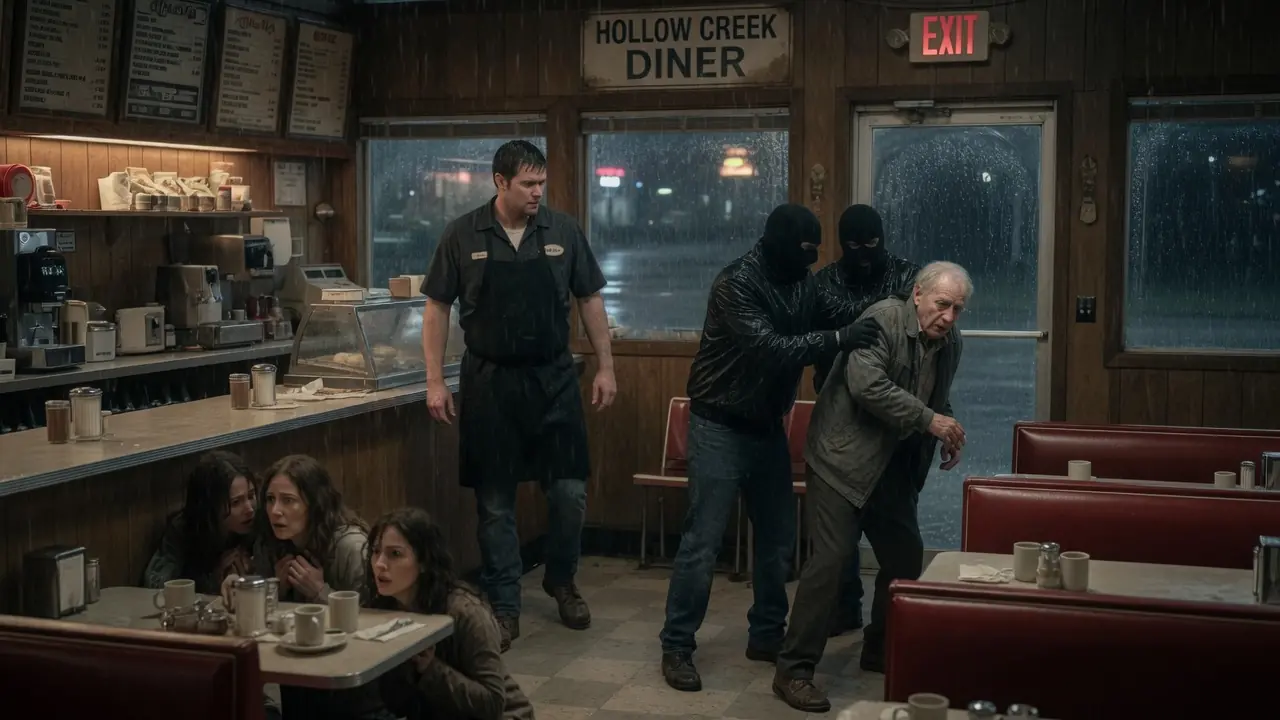
Nathan Brooks was wiping down the counter when the front door exploded open. Two men stepped in fast, shoulders wet from the rain, dark jackets, ski masks pulled down over their faces. One held a handgun, elbow bent, swinging across the room. The other held a short blade, already raised.
He counted four customers, a middle-aged truck driver mid-bite on a sandwich, a nurse still in scrubs finishing her coffee, an elderly couple near the door gathering their coats, and at the far end of the room, a thin old man in a worn gray jacket sitting alone at a corner table. Nobody had been talking loudly before the door opened. Now nobody made a sound at all.
The man with the knife moved down the row of tables, yanking a wallet here, pulling a watch there. He was looking for the easiest target in the room. He found it without difficulty. The old man at the corner table had not moved, had not tried to hide, had not even flinched.
He sat very still, one hand resting on the edge of the table, the other wrapped loosely around a bowl of soup that had gone cold more than an hour ago. The robber grabbed the old man by the collar, pulled him upright, and pressed the blade against the side of his neck. Nathan watched this happen.
He registered the old man's face, pale, tired, still the face of someone who had long since learned that panic never helps. And he registered the trembling in the old man's right hand, the small involuntary tremor that came with age and cold and shock. Something locked into place inside Nathan Brooks, something quiet and certain, without drama or announcement. He was going to have to do something.
Three days later, when the black cars pulled up in front of Hollow Creek Diner, and the lawyers stepped out in their pressed suits, Nathan still would not understand why. He would not understand for another hour. But the old man in the gray jacket, the one Nathan had risked everything to protect, was William Whitmore, founder of Whitmore Industrial Group.
One of the most quietly powerful investors in American manufacturing. And William Whitmore had been watching Nathan Brooks very carefully from the moment Nathan had set a cup of hot tea on the table for a stranger who looked cold, without asking for anything in return. Nathan Brooks was twenty-nine years old and had not slept a full eight hours in longer than he could clearly remember.
He was tall, a little over six two, with broad shoulders built not by a gym but by years of physical labor, the kind of body that comes from hauling equipment, climbing into machine bays, and spending long hours crouched over motors in unheated work spaces. His face was clean-cut and naturally handsome in the way of men who do not think about it. Dark brown hair trimmed close. A jaw that stayed defined even when he was exhausted.
Eyes that were calm in a way it sometimes made people assume he was unworried when in fact he was simply very good at not showing it. He had grown up in Hollow Creek, Kentucky, a town that smelled like motor oil and iron, where children of factory workers learned the names of machine parts before they knew state capitals. His father had been a mechanic. His mother had worked in a school cafeteria.
The house they rented was small and drafty in winter. And Nathan had learned early that the way to feel dignity in a small house was to keep it clean and to keep your word. After high school he took a maintenance certification program instead of a four-year degree because the four-year degree would have required money he did not have. He was good with machines.
He understood how systems worked, how failure accumulated in small overlooked details, how a bearing worn three percent past its tolerance became a two o'clock in the morning shutdown. He'd been doing this kind of work since he was nineteen and he was very good at it. His wife, Claire, had died two years before the night of the robbery. An infection caught too late, managed poorly, ended one morning in a hospital room.
She had been twenty-seven years old. Their son, Leo, had been four. Nathan had driven home from the hospital alone and sat in the parking lot of their apartment building for forty-five minutes before he could make himself go upstairs. Since then Nathan had held himself together with routine.
He rose early, made Leo's lunch the night before, dropped him at school, drove to the machine shop for part-time maintenance work, drove to the diner in the evenings, took the shifts nobody else wanted, came home after midnight and started again. He carried it the way a man carries something heavy over a long distance, with his back straight and his jaw set and his eyes pointed forward. He was not a man without fear. He was a man who had learned to function alongside it.
What he had not done in all those months was stop believing that a person's choices mattered. He had watched men become bitter. He had watched men go numb. He understood both. But he had a six-year-old son at home who was watching him without knowing he was being watched, and Nathan had decided, in the quiet stubborn way of a man who does not make speeches, that the lesson Leo would carry out of his childhood was not that the world was unfair.