I was dead to them long before my heart stopped beating.
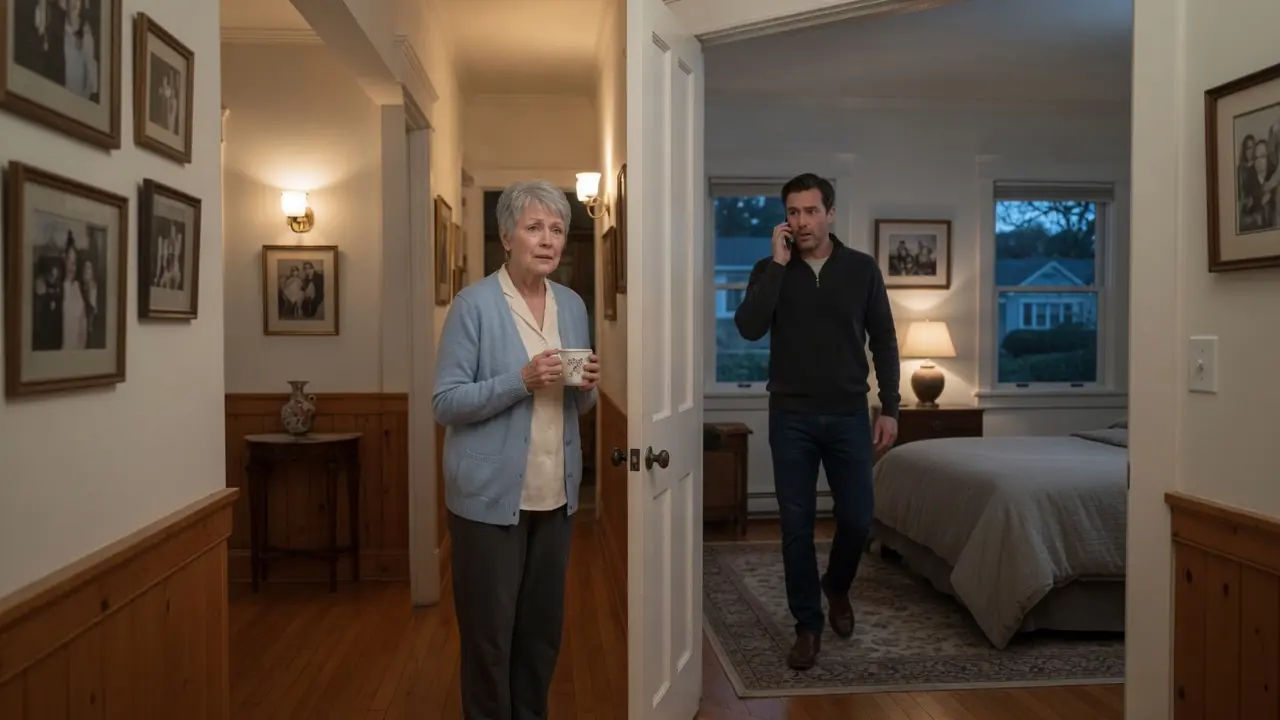
That was the thought that came to me as I stood in the upstairs hallway of my own home, barefoot on the cold wooden floor, holding a cup of tea that had gone untouched for nearly an hour.
It was a little after midnight on a wet November night in Astoria, Oregon. The wind off the coast pushed against the old Victorian windows, making the glass tremble in its frame. I should have been asleep. At seventy-four, sleep was supposed to come easily, or so people liked to tell me. But ever since my husband, Arthur, passed five years earlier, the night had become my least faithful companion.
That night, insomnia saved my life.
I had left my bedroom for more tea when I heard my son’s voice coming from the guest room. Julian thought I was asleep. He thought I was too old, too soft, too tired to hear anything through closed doors.
He was wrong.
“She’s getting worse,” he whispered.
At first, I thought he was speaking to one of his business partners. Julian was always on the phone with investors, lenders, or men who spoke too quickly and smiled too little. His ventures were bright, loud, and always collapsing.
Then I heard Bianca answer.
His fiancée.
She was downstairs, or at least she was supposed to be. Instead, they were talking on their phones inside the same house, as though the walls themselves had ears they feared.
“She forgot where the salt shaker was at dinner,” Julian said. “It’s starting.”
“It’s not starting fast enough,” Bianca replied. “The bridge loan is due in thirty days. If you don’t get control of the house by then, we’re finished.”
My fingers tightened around the mug.
Julian exhaled sharply. “I can’t just throw her out. It has to look legal. The competency hearing is the only way. Once I get guardianship, I can sell the house, pay the debt, and move her to that facility in Eugene.”
“The cheap one?”
“The subsidized one.”
Bianca gave a small laugh. “That place is a warehouse for the dying.”
Julian said nothing.
Then Bianca added, “She won’t last six months there. Problem solved.”
I did not cry.
Not then.
My body became still in the way a deer becomes still when it sees a rifle.
My son—the boy I had held through fevers, the man whose failed dreams I had quietly funded for years—was discussing my death as if it were a convenient business outcome.
I backed away from the door without making a sound.
For thirty years, I had worked as a head archivist at the city library. I had spent my life preserving truth from dust, lies, and careless hands. I knew one rule better than most people.
The next morning, their campaign began.
I walked into the kitchen to find one burner on the stove hissing blue flame into the quiet room.
Julian rushed in behind me.
“Mom!” he shouted, turning it off. “You left the gas on again?”
“I didn’t use the stove.”
Bianca looked up from her tablet with perfect concern. “Evelyn, I saw you near it earlier. You were just standing there, staring at the knobs.”
“I was not.”
Julian sighed. “We’re worried about you.”
Worried.
The word sounded almost elegant in his mouth.
Over the next week, things moved.
My reading glasses appeared in the refrigerator. My house keys turned up in the trash. A saucepan I had not touched was found scorched in the sink. Every incident came with Julian’s soft voice.
“Mom, don’t you remember?”
And Bianca’s gentle poison.
“It’s okay to need help, Evelyn.”
If I had not heard that midnight call, I might have believed them.
That was the cruelest part.
They were not only trying to take my house.
They were trying to make me distrust my own mind.
On Friday, Julian left early. Bianca said she was going to a weekend wellness retreat. For the first time in days, the house was mine again.
I went straight to the study Julian had claimed as his office.
He kept it locked, but the house had belonged to me long before it belonged to his schemes. Arthur had taught me how to open that old brass lock with a bobby pin when we misplaced the key in 1998.
Inside, Julian’s desk looked like the inside of a storm.
Bills.
Receipts.
Loan paperwork.
Expired business cards.
I ignored the mess and searched the bottom drawer.
There, beneath a false panel, I found a red folder.
The truth was worse than I imagined.
Gambling debts.
Collapsed crypto investments.
Private loans.
Threatening letters from people who did not use company letterhead because they did not need to.
The amount circled in red was $410,000.
Almost exactly what my home was worth.
I was holding the folder when a car door slammed outside.
My heart seized.
I returned everything, locked the study, and made it to the kitchen just as the front door opened.
Julian stepped inside with a woman in a gray suit.
She carried a clipboard and wore a practiced expression of sympathy.
“Mom,” Julian said softly, “this is Ms. Sterling. She’s a geriatric social worker.”
“A social worker?”
“Just to talk.”
Ms. Sterling smiled. “Your son is concerned about your safety, Mrs. Vance. He mentioned confusion, wandering, and some dangerous incidents in the kitchen.”
“I do not wander,” I said.
She made a note.
I saw the note.
Paranoia? Defensive?
The blood in my ears began to roar.
“The stove was staged,” I said. “The misplaced items were staged. My son is trying to have me declared incompetent so he can sell my house and pay his debts.”
Julian’s face changed.
Only for a second.
But I saw it.
Then he turned to Ms. Sterling with the wounded expression of a loving son.
“See?” he whispered. “This is what I’ve been trying to tell you.”
Ms. Sterling’s eyes softened toward him.
Not toward me.
Toward him.
“Mrs. Vance,” she said, “these kinds of accusations can be symptoms of cognitive decline.”
“I am not declining.”
Julian stepped closer. “Mom, please. Don’t make this harder.”
“You mean don’t make it harder for you to send me to Eugene?”
His face went pale.
Ms. Sterling looked between us. “Eugene?”
Julian recovered quickly. “She heard me discussing facilities. She twists things.”
Then he said the words that made the room tilt.
“We’re filing for emergency temporary guardianship.”
For a moment, I could not breathe.
He was no longer planning.
He was moving.
That night, I locked myself in my bedroom and sat on the edge of the bed until the house fell quiet.
Then I packed.
Not clothes.
Documents.
The deed to the house. Bank statements. Passport. Birth certificate. Arthur’s death certificate. My diary. Every piece of paper that proved I still existed as a person and not just an asset waiting to be transferred.
At two in the morning, I climbed out the study window and onto the porch roof the same way Julian used to sneak out as a teenager.
The irony almost made me laugh.
Almost.
My knees screamed when I dropped into the hydrangeas, but I kept moving.
Julian had taken my car keys “for my safety,” so I walked three miles through mist and wet pavement to a garage on the edge of town.
Leo’s Auto Repair.
A light glowed in the back office.
I knocked with frozen fingers.
The door opened, and a broad-shouldered man with oil on his hands stared at me in disbelief.
“Mrs. Vance?”
“Leo,” I whispered. “I need help.”
He did not ask why I was there at three in the morning.
He pulled me inside, wrapped me in a wool blanket, made me strong tea, and listened.
Six years earlier, Leo had been a young mechanic with no money and too much honesty. He had exposed a crooked shop owner who tried to cheat Arthur and me. He lost his job for telling the truth. Arthur helped him get certified. Later, when Leo’s father was falsely accused of theft, I found the employment records that cleared him.
Leo never forgot.
When I finished telling him everything, he stood up and paced the office like a man trying not to put his fist through a wall.
“He’s trying to bury you alive,” Leo said.
“Yes.”
“Then we dig faster.”
By eight that morning, I was sitting in the office of Sarah Jenkins, an elder-law attorney with sharp eyes and a sharper voice.
She read my documents without interrupting.
When she finished, she looked at me and said, “This is financial abuse.”
“I know.”
“And psychological abuse.”
“I know that too.”
“And if he gets temporary guardianship before we act, he may be able to freeze you out of your own life.”
My hands trembled in my lap.
Sarah leaned forward.
“Mrs. Vance, are you ready to fight your son?”
That question nearly broke me.
Because Julian was still my child.
Some part of me still remembered him at seven years old, asleep on the couch with a fever, holding my hand like I was the whole world.
But that little boy had grown into a man willing to trade my last years for his debts.
“Yes,” I said. “I am.”
Sarah moved quickly.
By noon, I had completed an independent cognitive evaluation with a forensic psychiatrist. Three hours of memory tests, reasoning exercises, financial questions, medical history, and legal capacity evaluation.
At the end, Dr. Thorne smiled.
“Mrs. Vance, you are not only competent. You are sharper than most attorneys I testify against.”
By three o’clock, Sarah had filed for a protective order alleging financial exploitation and elder abuse. My assets were flagged. My accounts were protected. My bank was instructed to report suspicious activity.
By five, Leo drove me home.
Julian’s car was in the driveway.
Ms. Sterling’s sedan was beside it.
My suitcases sat near the front door.
They had packed for me.
When I stepped inside, Julian jumped up.
“Where the hell have you been?”
“The city.”
“You disappeared for twelve hours!”
“I left intentionally.”
“No,” I said.
She reached toward my arm.
“Do not touch me.”
The room froze.
I took a thick envelope from my bag and dropped it onto the coffee table.
“That is a protective order against Julian for financial exploitation. It includes an affidavit from Dr. Aris Thorne declaring me fully competent. It also includes notice from my attorney that my assets are frozen pending investigation.”
Julian stared at the envelope as if it were alive.
“You went to a lawyer?”
“I did.”
His voice cracked. “Mom, you don’t understand.”
“I understand everything.”
I looked at Ms. Sterling.
“And you should know that my attorney is very interested in how you supported an emergency guardianship request without interviewing me privately.”
Ms. Sterling’s face drained of color.
“I acted on information provided by family.”
“Then I suggest you review your information.”
She grabbed her bag and left so quickly she nearly forgot her clipboard.
Julian and I stood alone in the living room.
For a moment, he looked small.
Cornered.
Afraid.
Then he began to cry.
“Mom, please. They’ll kill me if I don’t pay. I made mistakes. I know I did. But you can save me. Sell the house. Just this once.”
Just this once.
I almost laughed.
I had been saving Julian his entire life.
Tuition. Rent. Business loans. Divorce attorneys. Credit cards. Emergency checks disguised as birthday gifts so he would not feel ashamed.
And now he had mistaken my love for a resource that would never run dry.
“I am your mother,” I said. “Not your collateral.”
His tears vanished.
“You selfish old woman.”
There he was.
The truth without costume.
“You’ll die alone in this house.”
I looked around the home Arthur and I had restored with our own hands.
The staircase we sanded.
The kitchen we painted.
The window seat where Julian once read comic books.
“I would rather die alone in my home,” I said, “than live in a cage you built for me.”
His jaw tightened.
“Get out,” I said.
He stared at me.
“The order is effective immediately. You have ten minutes to collect your things. Leo is outside. If you refuse, he will call the sheriff.”
Julian went upstairs.
I heard drawers slam. Glass break. A suitcase hit the wall.
Ten minutes later, he walked out carrying two bags.
Bianca waited in the car.
She did not come inside.
She knew the game was over.
When they drove away, I locked the door, slid to the floor, and wept.
Not because I had lost the house.
Because I had saved it.
And in saving it, I had finally admitted I had lost my son long before that night in the hallway.
The months that followed were not easy.
People think survival feels heroic.
Often, it feels like paperwork.
Bank calls.
Lawyer meetings.
Police reports.
Replacing locks.
Changing passwords.
Explaining the same wound to strangers in offices with fluorescent lights.
Julian disappeared for a while. Later, I heard he had filed for bankruptcy in Nevada. He did not apologize. He did not ask forgiveness. He sent only a formal notice through an attorney.
I placed it in a folder marked Past.
Then I began rebuilding.
Leo repaired the porch steps Arthur had always promised to fix.
We tore down the gloomy wallpaper in the hall and painted it a bright yellow that Bianca would have hated.
I turned Julian’s study into a sunroom filled with orchids, ferns, and morning light.
Sarah became more than my attorney. She became a friend. Leo came by on Sundays. His wife brought soup. Their children called me Aunt Evelyn, though I had earned no such title except by staying alive.
One spring afternoon, Leo drove me to an abandoned airfield outside town.
“Move over,” he said.
“For what?”
“You’re driving.”
“I haven’t driven since 1992.”
“Then you’re overdue.”
I sat behind the wheel with my hands trembling, feeling the engine hum beneath me.
At first, I drove slowly.
Then faster.
The car moved forward, and so did I.
After that, I drove everywhere.
To the library, where I volunteered to organize the town archives.
To the coast, where I watched waves crash against black rocks.
To the farmers market, where I bought more flowers than any reasonable woman needed.
I started a gardening club for seniors in my backyard. Every Wednesday, women with silver hair and sharp opinions gathered under my apple tree. We traded seeds, gossip, recipes, and stories about the ways our children had disappointed and surprised us.
The house became loud again.
Not with scheming.
With life.
On my seventy-sixth birthday, I stood on the porch with a glass of wine in my hand.
Inside, Leo was laughing with Sarah. Someone had put rosemary chicken in the oven. The windows glowed warmly against the evening fog.
For years, I thought the final chapter of my life would be quiet.
Perhaps lonely.
Perhaps dignified.
I never imagined it would begin with betrayal.
But I had spent my life among books. I knew endings could be revised. I knew margins held space for notes. I knew a woman could take a story written against her and write herself back into it.
Julian had tried to make me disappear.
Instead, he reminded me I was still here.
I lifted my glass toward the darkening ocean.
The wind moved through the trees.
It no longer sounded like something trying to break in.
It sounded like music.