She was seven years old, 42 pounds, and she had just done the one thing every adult in that diner had silently agreed not to do. The big man at the counter hadn't moved, hadn't spoken, just sat there absorbing it. The comments, the laughter, the studied cruelty of men who knew nobody would stop them. And then a little girl in a red jacket climbed onto the stool right beside him, like it was nothing, like he was nobody to be afraid of. Nobody could have known what that moment would cost her family, or what it would save them. one hundred eighty motorcycles showed up that night, and it all started with four words.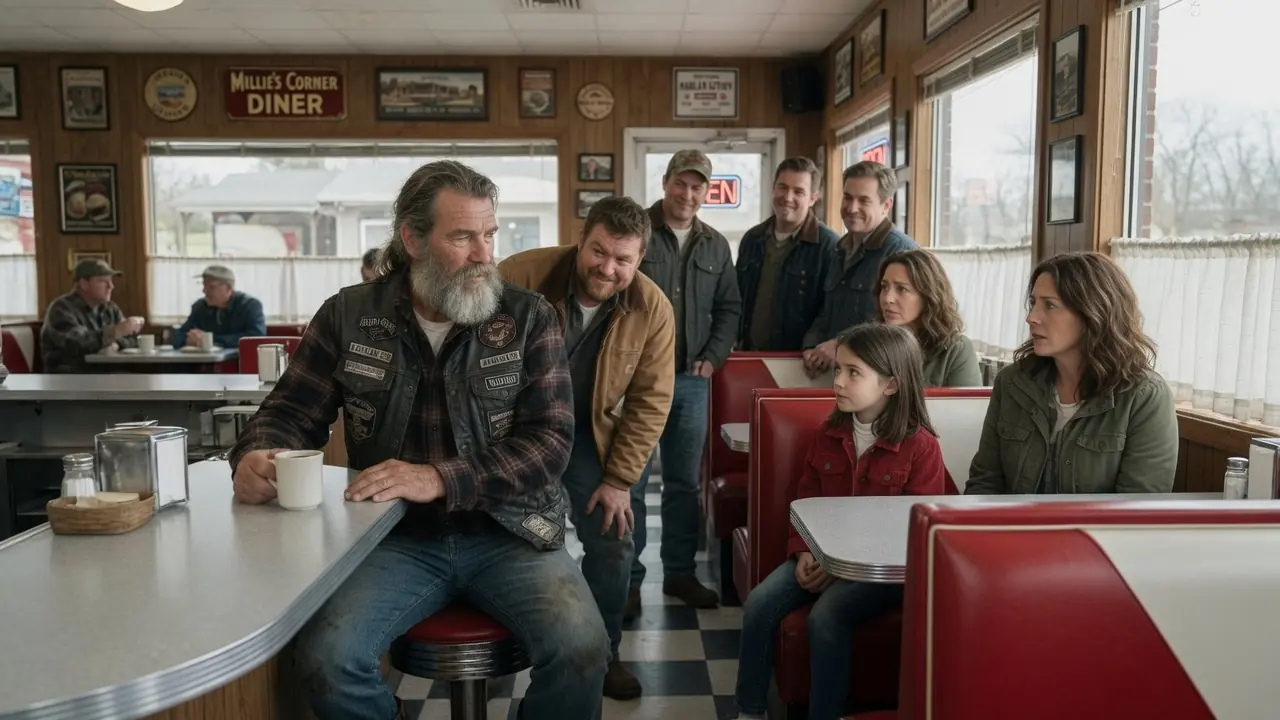
The smell of burnt coffee and bacon grease had soaked into the walls of Millie's Corner Diner so deeply that even the wood remembered it. Situated on the edge of Route 119, just past the old coal company sign that nobody had bothered to repaint since 1987, the diner was the kind of place where time moved slower than anywhere else in Harlan County. The vinyl booths had cracked and been taped over so many times that the repairs had their own repairs. The jukebox in the corner still played Merle Haggard if you fed it a quarter, and the ceiling fan wobbled on every third rotation like it was thinking about giving up entirely. It was a Tuesday in late October, and the mountains surrounding Harlan had already started pulling their colors back, leaving behind the bare gray bones of the ridgelines.
The morning fog had burned off by ten, but the air still carried that cold edge that came down from Pine Mountain every fall. The kind of cold that settled in your collar and stayed there. Susan Carter had parked their 2009 Ford Focus in the gravel lot beside the diner at half past eleven, and she'd barely gotten Lily out of the backseat before her daughter had spotted a caterpillar on the pavement and stopped everything to observe it. "Lily, honey, we're going to be late. " Susan said, though there was nothing particular they were late for. It was just the thing mothers said.
Lily Carter was seven years old and built like a question mark, always leaning forward, always looking at something nobody else had noticed yet. She had her mother's dark brown hair cut straight across the back and her father's green eyes, which had a way of focusing on things with an intensity that sometimes made adults uncomfortable. She was wearing a red corduroy jacket over a light-colored turtleneck and her sneakers had a drawing of a sun on the left toe that she'd put there herself with a yellow marker. She straightened up from the caterpillar and followed her mother inside. The diner held maybe fourteen tables and on a Tuesday late morning, it was running at about half capacity.
There were two older men in a corner booth sharing a newspaper without speaking, a young woman with a baby stroller parked beside her table, and Patty Owens behind the counter refilling a coffee mug for a man in a trucker hat who was staring at his phone. Patty was fifty-five years old and had worked at Millie's for twenty-two of those years. She had reading glasses pushed up on her head that she used for everything except reading and she moved behind that counter like water moving around rocks, automatically, efficiently, without any wasted motion. Susan chose a booth near the window. Lily slid in across from her and immediately pressed her face against the glass to look at the parking lot.
"What do you want to eat, bug? " Susan asked, opening a laminated menu she already knew by heart. "The pancakes with the smiley face. " Lily said without turning from the window. "They don't make the smiley face unless you ask. I'll ask. That was when the motorcycle pulled in.
It was a dark Harley-Davidson Road King, the chrome dulled by road miles, and the man riding it was large enough that the bike looked almost modest beneath him. Wade Holloway swung off the motorcycle with the careful deliberateness of a man whose knees had logged too many miles, and he stood in the parking lot for a moment, pulling off his helmet. He was 4eight years old with a thick gray-streaked beard that reached the second button of his jacket, and arms that strained the leather at the shoulders. He wore a cut, a leather vest with patches, over a dark flannel shirt, and his boots were the kind that had been resoled at least twice. His face was weathered in the way that outdoor work and outdoor living weathered a person, with deep lines around his eyes and a jaw that looked like it had been set against something difficult for a very long time.
Lily watched him walk toward the diner door. "Mama," she said, "that man has a lot of patches. " "Don't stare," Susan said, not looking up from the menu. Wade came through the door, and the bell above it announced him. Patty glanced up, and something passed across her face. Not hostility exactly, but a kind of cautious assessment.
The two men with the newspaper looked up, and then looked back down with slightly more deliberateness than before. The young woman with the stroller shifted in her seat. Wade didn't appear to notice any of it. Or if he did, he gave no sign. He took a stool at the counter, three seats down from the trucker, set his helmet on the stool beside him, and picked up a menu.
"Coffee? " Patty asked. "Please," he said. His voice was low and even, the kind of voice that didn't use more air than necessary. Patty poured it and moved away quickly. Wade wrapped both hands around the mug and looked at the menu.
"Smells like the highway in here," he said, and the others laughed. Wade's shoulders didn't move. The red-faced man, whose name was Danny, leaned toward his friends and said something lower, and they laughed again. Then louder, "Hey Patty, you let just anybody sit at your counter these days? " Patty kept her eyes down and refilled a napkin dispenser. "Maybe the health code's changed," one of the others offered, and more laughter followed.
Wade set his coffee mug down carefully. He did not turn around. His jaw tightened once and then released, and he picked the mug back up. Lily had been watching all of this from the booth. She had watched the men come in.
She had watched the comments land. She had watched Wade not turn around, and she had understood something, not in words, but in the way children understand things before language catches up. That the man at the counter was absorbing something unfair, and that it was costing him something to absorb it quietly. She slid out of the booth. "Lily," Susan said sharply, but Lily was already walking toward the counter with the particular determination of a seven-year-old who has decided something.
She climbed up onto the stool next to Wade, the one without the helmet, and settled herself there with her hands flat on the counter. Wade looked down at her. She looked up at him. "I like your patches," she said. The diner went quiet in the specific way that diners go quiet when something unexpected happens.
Not silent, but attenuated, with everyone's attention suddenly redirected without anyone wanting to admit it. Wade looked at her for a moment. Something moved in his expression, something that had been held very still releasing slightly, like a door opening just a crack. "Thank you," he said. "What's that one? " Lily pointed to a patch on his chest, a set of wings with a wrench through them.
"That's from a ride I did for veterans," he said. "Fundraiser. " "Are you a veteran? " "Yes. " "My grandpa was a veteran," Lily said. "He had a flag at his house. He died. " "I'm sorry to hear that," Wade said. "He was really old," Lily said with the philosophical pragmatism of a seven-year-old.
"What's that one? " She pointed to another patch. Wade looked down at it. "That one's from a toy drive. Every Christmas our group collects toys for kids in the county. " Lily considered this with great seriousness. "So, you give kids presents? " "We try to. " "That's like Santa," she said.
Something happened in Wade's face then, not a smile exactly, but something adjacent to it, something that hadn't been there thirty seconds ago. "I guess it is a little," he said. Behind them, the table of men had gone quiet. Danny was looking at his coffee. The others were looking at various neutral points in the middle distance.
Susan had come up behind Lily without either of them noticing. She put a hand on her daughter's shoulder and when Wade looked up at her, she held his gaze steadily. "I'm sorry if she bothered you," she said. "She didn't," Wade said and the way he said it made it clear he meant it entirely. Susan looked at her daughter then back at the man.
"I'm Susan Carter," she said and extended her hand. Wade shook it. "Wade Holloway. " "Can we sit with you? " Lily asked. Susan started to redirect her but Wade had already said "If your mother doesn't mind. " With a tone that left it entirely Susan's choice and carried no pressure whatsoever. Susan looked at her daughter's face then at the man at the counter and made a decision.
"Sure," she said. They ordered breakfast. Lily got her pancakes and negotiated successfully for the smiley face and for the next 40 minutes Wade Holloway sat at the counter of Millie's Corner Diner and talked with a seven-year-old girl about patches and motorcycles and toy drives and her late grandfather's vegetable garden while the group of men in the booth behind them paid their check and left without further comment and Patty Owens refilled coffee mugs with a slightly different expression than she'd had an hour before. When the Carters were ready to leave, Lily hopped off her stool and looked up at Wade with the directness that was entirely her own. "I hope people are nicer to you," she said.
Wade looked at her for a long moment. "Today they were," he said. They walked out into the cold October air and Susan buckled Lily into the backseat and as she pulled out of the gravel lot, she watched in the rearview mirror as Wade stood beside his motorcycle in the parking lot not moving just standing there in the gray mountain light with his hands at his sides and she thought he looked like a man who had just been handed something he hadn't known he was still waiting for. She didn't know yet what that moment would mean. She didn't know what Wade Holloway carried with him, or what he would carry forward from that diner, or what the cold Tuesday in October would set in motion.
She was just a mother who had let her daughter follow her instincts, and she drove home through the bare October mountains thinking about nothing more complicated than whether she had enough milk at home. She didn't know about Frank Mercer. Not yet. Wade Holloway had been back from his second tour for twenty-one years, and in those twenty-one years he had rebuilt himself in the way that men who have come apart rebuild themselves, methodically, without ceremony, one fixed thing at a time. He had gone back to Eastern Kentucky because it was where he was from, and because the mountains had a quality of not asking questions that suited him during the years when questions were hard to answer.
He had worked construction, then pipe fitting, then started his own small operation doing welding and metal work out of a shop on Catron Creek Road. The shop was modest, but paid its own way, and he had a house with a good wood stove and a dog named Calhoun, who was half hound and half something nobody had ever identified, and that was most of what he needed. The Brotherhood of the Road was not what most people assumed it was. Wade had joined eleven years ago through a veteran he'd known in the service, a man named Rex Donovan, who was now the chapter president and the closest thing Wade had to a best friend. The chapter had forty-one members in the Harlan area, and what they did mostly was ride and raise money and show up for each other.
They did the Veterans Benefit Ride every Memorial Day. They did the toy drive every December. They had helped seven different families in the county rebuild after house fires in the last eight years. They were mechanics and welders and contractors and one high school math teacher. And they looked like what people feared and were almost entirely the opposite.
Wade had learned to live inside the gap between what he looked like and what he was. It was not always a comfortable place to live, but it was familiar and familiarity had its own kind of comfort. After the diner, he had ridden south on 119 and then east on a county road that wound up into the hills. And he had sat in his shop for a long time without working, just turning a piece of steel bar stock over in his hands and thinking about a seven-year-old girl with green eyes who had climbed up on a stool beside him as if it were the most natural thing in the world. He thought about the look on her face.
Purely interested. Completely without guile. I like your patches. No performance in it. No calculation.
Just a child looking at a person and seeing a person and saying so. He thought about how long it had been since someone had done that without an agenda. He set the steel bar down and called Rex. Had a thing happen today. He said when Rex picked up.
Good thing or bad thing? I don't know yet. Good thing, I think. He paused. Little girl at Millie's.
Maybe seven years old. Sat down next to me while some fellas were running their mouths. Rex was quiet for a moment. Just sat down? Just sat down.
Started asking about my patches. Another pause. Kids don't have the filter yet, Rex said. No, Wade agreed. They don't.
He didn't tell Rex what it had done to him. How it had hit him somewhere below the ribs in a place he didn't have a name for. He didn't say that he had sat in the parking lot after they left and had to wait for something to pass before he could get back on his bike. Rex would have understood, but some things didn't need saying. What Wade did not know, as he sat in his shop on Catron Creek Road with the dog at his feet and the wood stove ticking, was that Susan Carter had driven home to a house where a problem had been growing for three months.
A problem with a name, and that name was Frank Mercer. Frank Mercer was 44 years old and had grown up two hollows over from where Tom Carter had grown up, and the two men had a history that went back to high school and had never fully resolved. Tom Carter had testified in a property dispute four years ago that had gone against Mercer's family, and Mercer had carried that the way some men in the mountains carried things, quietly and for a long time and with increasing weight. Tom Carter worked for a mining supply company that required him to be on the road three weeks out of four, and during those 3 weeks, Susan was alone in the house on Sawmill Road with Lily. The house was a quarter mile from the nearest neighbor, set back from the road in a grove of hemlocks, and it was the kind of place that was beautiful in daylight and very quiet at night. three months ago, Mercer had started driving past, just driving past, slowly.
Susan had noticed it twice before she mentioned it to Tom on the phone, and Tom had called Mercer's older brother to ask him to talk to Frank, which had been the wrong move because it had made Mercer feel publicly managed, and public management was the thing he most resented. After that, it wasn't just driving past, it was a message left on the answering machine that said nothing, just breathing and then a hang-up. It was a dead bird left on the porch step one morning. It was the sense, persistent and impossible to fully verify, of being watched. Susan had called the county sheriff's office twice.
The first time, a deputy had taken a report and told her to document everything. The second time, a different deputy had told her that without direct threats or trespassing, there wasn't a great deal they could do and suggested she consider a dog. She had told none of this to Lily, who was seven and didn't need to carry it. She had told it to her sister in Lexington and to Tom on the phone and to the sleepless hours of 3:00 in the morning when the house made its sounds and she lay still listening to them. She had not told it to the man at the diner counter whose name she now knew was Wade Holloway and whom she would not see again for nine days.
On the fourth day after the diner, she found the word leave scratched into the driver's side door of the Ford Focus. It was done with something sharp, deeply enough that it couldn't be buffed out, and she stood in the driveway in the cold morning looking at it for a long time before she went inside and called the sheriff's office again. This time the deputy who came was a young man named Davis, who took photographs and wrote everything down with apparent sincerity and told her the same thing the previous deputies had told her. Without direct threats or trespassing, there was limited legal recourse, but the documentation was good. She was doing the right thing.
Keep documenting. She called Tom and told him. He was in Pikeville and couldn't get back until Friday. She heard the fear in his voice wrapped inside the reassurance he was trying to give her, and she matched it with her own reassurance. And they both pretended it was enough.
That night, after Lily was asleep, Susan sat at the kitchen table with a cup of tea she wasn't drinking and a phone she was holding without calling anyone. Outside the wind came down off Pine Mountain and moved through the hemlocks, and the house made its ordinary sounds, and she sat very still and listened to them and tried to sort the ordinary from the not ordinary and found that she could not. She did not think about Wade Holloway. She had no particular reason to. But 6 miles away on Catron Creek Road, Wade was awake, too, sitting on his porch with Calhoun across his feet and a cup of coffee cooling in his hand, looking out at the dark shapes of the trees against the slightly less dark sky.
He was thinking, as he sometimes did at this hour, about the particular weight of being misread, of moving through the world inside a shape that other people had decided the meaning of before you arrived. He thought about the girl with the green eyes. "I hope people are nicer to you. " He thought, "I hope they are, too, kid. " He thought, "I hope you never find out that some of them won't be. " He didn't know yet that the lesson was already in progress. He didn't know about the word on the car door or the dead bird on the porch step or the three months of slowly building dread in the house on Sawmill Road. He was just a man on a porch in the dark in Eastern Kentucky drinking cold coffee and listening to the wind, not knowing that the seven-year-old who had climbed up beside him at the counter of Millie's Corner Diner was asleep in a house where fear had been a roommate for three months.
He didn't know, but nine days later, he would. It would begin with something small, as the important things usually did. It would begin with a phone call from Rex, who had heard something from someone who knew someone, the way information moved in Harlan County, sideways and by water, following the path of least resistance through the connective tissue of a community that was small enough that everything eventually touched everything else. Rex Donovan had a face that had been rearranged by life in ways that were visible but not disfiguring. A nose that had been broken twice, a scar through his left eyebrow from a job site accident in 1998.
The particular deepened lines around the eyes that came from years of squinting into the wind on a motorcycle. He was 52 years old and had been riding since he was 16, and he had led the Brotherhood of the Road chapter in Harlan County for nine of those years with a steadiness that the members relied on without always saying so. He called Wade on the second Thursday after the diner at 7:30 in the morning. "You remember that family, the Carter woman and her little girl, the ones from Millie's? " Rex said. Wade straightened in his chair.
"Yeah. " "Tommy Briggs works a shift at the Sunoco on 421. He said he was talking to a guy who knows the Carter family, says the woman's been having trouble. Some fellow named Mercer has been making things uncomfortable for her while her husband's on the road. " Wade was quiet. "Scratched something into her car," Rex continued. "Left things on the porch.
Sheriff's been out a couple times but hasn't done much. " "How bad? Bad enough that people are noticing? " Rex paused. "I don't know the full picture, but Tommy thought I should know, and I thought you should know. Wade stood up from the table and walked to the window. Outside, the October light was flat and gray, the hemlocks across the road dark against a pale sky.
You know where she lives? Sawmill Road, I'm told. House back in the trees. I know that road. Wade Rex's voice was measured.
I'm not telling you to do anything. I'm just telling you what I heard. I understand that. There was a pause. What are you thinking?
I'm thinking I'm going to drive by Sawmill Road this morning. Rex let out a slow breath. You want company? Not yet, Wade said. Let me take a look first.
He drove by at 9:15, slowly enough to see the house, light-colored clapboard with green shutters, set back from the road in the hemlock grove, a gravel drive running up to it. The Ford Focus was parked in front, and even from the road he could see the pale scratch across the driver's door. There was a child's bicycle on the porch, and a wreath on the door that someone had made from bittersweet vines, and it looked like a house where someone was trying hard to maintain ordinary life inside an extraordinary situation. He drove past and parked a quarter mile down the road, and sat for a few minutes thinking. He was not a man who acted on impulse.
He had trained the impulse out of himself over many years because impulse in the places he had been had consequences that outlasted the moment. What he did instead was think carefully about what he actually knew, what he was assuming, and what the right next step was without overreaching. What he knew a woman and her daughter were being harassed. The authorities had been responsive but ineffective. The husband was away.
What he assumed: the little girl from the diner and her mother were the Carter family on Sawmill Road, he was not certain. What the right next step was: find out if his assumption was correct before doing anything else. He drove back to his shop and called Patty Owens at the diner. Patty had been in Harlan her whole life and knew most people and all of the currents between them. I need to ask you something, Patty, and I need you to be straight with me.
When am I not? She said with the flat directness that was entirely her. The woman and the little girl who were in Tuesday before last, the ones who sat with me at the counter. Do you know them? A pause.
Susan Carter lives out on Sawmill Road. Her husband, Tom, works for Consolidated Mining Supply. You know anything about trouble she's been having? A longer pause this time. When Patty spoke again, her voice was quieter.
I know she came in about 2 weeks ago and looked like she hadn't slept. I know she asked me if I'd heard anything about Frank Mercer. I know I told her to be careful. She stopped. Why are you asking, Wade?
Because I heard something, he said. Another pause and then Patty said, She's a good woman and that little girl is something else. Whatever you're thinking, don't overthink it. He thanked her and hung up. He sat in his shop for a long time with the dog at his feet and the steel and iron of his trade surrounding him and he thought about a seven-year-old girl on a stool beside him saying, I like your patches as if it were the simplest and most natural thing in the world.
He picked up the phone and called Rex back. It's them, he said, the Carter family. It's the woman and the little girl from Millie's. Rex was quiet for a moment. What do you want to do?
I want to talk to her first. I don't want to roll up on her with 40 people and frighten her. She doesn't know us. I want to go myself and introduce myself properly and find out what the actual situation is. That makes sense, Rex said.
But Rex, Wade paused. If the situation is what it sounds like, I'm going to need the chapter. The chapter will be there, Rex said without hesitation and without drama. You know that. Wade did know that.
He had known it for eleven years and it was one of the few things in his life he knew without any qualification. Whatever the Brotherhood of the Road looked like from the outside, the leather and the iron and the roar of engines, what it was from the inside was this, a group of men who showed up. That was the whole of it. Men who showed up when showing up was what was needed without requiring the situation to be dressed up in a way that made it comfortable. He drove out to Sawmill Road the following morning.
He parked at the end of the gravel drive and walked up slowly in plain sight with his hands visible because he understood that a woman who had been under sustained threat for 3 months would be watching from the window and that how he approached mattered as much as why he was there. He knocked on the door. Susan Carter opened particular controlled expression of a woman who had learned to be careful about her face. A face that held its reaction back until it had information. She looked at him.
He watched the recognition move through her eyes. Mr. Holloway, she said. Mrs. Carter. He took his sunglasses off and held them at his side. I heard something that concerned me and I decided to come and check instead of doing nothing.
I'm sorry if this is an intrusion. I can go if you'd like. She looked at him for a moment longer and then she said, "Come in. " He sat at her kitchen table with a cup of coffee she made without asking if he wanted one and she sat across from him and told him everything. She told it plainly and without dramatizing it, the way people who have been frightened for a long time eventually tell things, stripped down to the facts because the facts were frightening enough without embellishment. The slow drives past, the phone call, the bird on the porch step, the words scratched into her car, the sheriff's deputies and their documentation and their suggestions to get a dog.
Wade listened without interrupting. When she finished, he was quiet for a moment. Do you have documentation of all of this? I have photographs, the sheriff's reports, the phone records showing the hang-up call. Does Mercer know your husband is away on a regular schedule?
Everyone who grew up around here knows Tom's job. It's not a secret. Wade nodded slowly. He turned his coffee mug in a slow circle on the table. "Mrs. Carter, I want to be straightforward with you.
I'm not here to offer you anything I can't follow through on. I'm not here to alarm you further or make this bigger than it is. But what you're describing is a campaign of intimidation and it's being run by someone who has calculated that the response will stay official and slow. " He paused. "Sometimes the most effective thing isn't official. " Susan looked at him carefully. "What does that mean? " "It means that some situations change when the calculation changes," Wade said.
"When the person doing the intimidating realizes that what he's dealing with is not just a woman alone in a house, but a community that is paying attention. " "And you can provide that," she said. It wasn't quite a question. "I can talk to some people," he said. "I don't want to overstate what that means, but the men I ride with, they're from this county. Some of them have kids of their own.
And when they hear about something like this, they tend to want to be useful. " Lily came into the kitchen then in her pajamas still with her hair coming out of its nighttime braid. She stopped when she saw Wade and stared at him with complete openness. "You're the Patches man," she said. "I am," Wade said. "What are you doing in our kitchen? " "Lily," Susan said.
"It's all right," Wade said. He looked at Lily directly, the way she had looked at him without deflection. "I'm visiting your mother. Is that okay with you? " Lily considered this with great seriousness. "Do you want some crackers?
We have the good kind. " "I'm okay," he said. "But thank you. " Lily climbed onto the chair beside him, the same unconscious choice she had made at the diner counter, and propped her chin in her hands and looked at him. "Are you going to help us? " she asked. Susan started to redirect her, but Wade answered before she could. "I'm going to try," he said.
Lily nodded as if this were satisfactory. "Good," she said. And then, "You want to see my caterpillar? I kept it. " Wade looked at Susan, who was watching her daughter with an expression that lived somewhere between exhaustion and fierce love. "Sure," he said.
"Show me your caterpillar. " And Lily slid off her chair and ran toward her room. And Susan looked at the man across her kitchen table, and she thought about what it meant to trust someone who the world had decided to distrust, whether that was wisdom or desperation or both. And she thought about her daughter who had made no such calculation, who had just climbed up on a stool and said, "I like your patches. " because she liked them. She thought, "Maybe the absence of the calculation is the point. " Outside, the wind came through the hemlocks, and somewhere down the road, Frank Mercer was doing whatever Frank Mercer did on a Friday morning, not knowing that the calculation he had been living inside was about to change. Wade called Rex that evening.
"I need the full chapter. " he said, "and I need you to make some calls. " Rex didn't ask for a full briefing. He asked three questions. "Is anyone in immediate danger? " Wade said not tonight. He didn't believe so, but that could change. "Is the family willing? " Wade said yes, he'd spoken with the mother.
"What do you need and when? " Wade said, "Saturday night, as many as we can get. Visible presence, nothing aggressive, just presence. " Rex said, "Give me twenty-four hours. " Wade spent Friday driving Sawmill Road at intervals, not stopping, just present. He called the county sheriff's office himself and spoke to the watch commander, a man he knew slightly from a veterans event two years earlier, and described the situation with the specificity of the documentation Susan had given him and the measured directness of a man who was not asking for anything, just informing. The watch commander listened and said he would have a deputy do a drive-by rotation through the weekend. Saturday morning, Rex called back.
"I've got forty-one from our chapter. " he said, "I've got 38 from the Middlesbrough group. I've got twenty-four from Corbin. I've got seventeen from the Cumberland chapter. " He paused. "I also put a call in to the state organization. " Wade was quiet. "They're sending sixty," Rex said.
Wade sat down. "Wade," Rex said, "people want to come. When I told the story, the little girl in the diner, what she did, what this family is dealing with, people wanted to come. " "I wasn't arm-twisting anybody. How many total? " Rex did the arithmetic. "Somewhere between one hundred seventy and one hundred ninety, depending on who makes it in time.
I'm calling it 180 for planning purposes. one hundred eighty motorcycles on Sawmill Road on a Saturday night in October. " Wade thought about what that looked like. He thought about what it communicated, not as a threat. They were not going to Frank Mercer's house. They were not going to confront him. They were not going to do anything that could be characterized as intimidation or harassment, but as a simple, overwhelming, visible fact, "This family is not alone. " He drove back out to Sawmill Road in the afternoon and knocked on Susan Carter's door again.
"Saturday night," he said, "around 7:00. I need to tell you what's going to happen so you're not frightened. " She let him in and he sat down at the kitchen table and told her. He watched her face as he described the numbers, the chapters, the distances people were traveling, the 180 motorcycles. He watched the careful, controlled expression she had learned to wear crack open just slightly, just enough. "They don't know us," she said.
"They know the story," Wade said. "Sometimes that's enough. " She pressed her fingers against her mouth for a moment, then she said, "Why? " Wade looked at her steadily. "Because your daughter sat down next to a man that most people had decided the meaning of before he walked through the door. And what she did, that small thing, that simple thing, it meant something, not just to me. " He paused. "Some people, when they hear a story like that, they want to be on the right side of it. " Susan was quiet for a long moment.
"I have to tell Lily," she said. "What will you tell her? " "I'll tell her the truth," Susan said, "that the people she was kind to are being kind back. " Lily's response when Susan told her that evening was characteristically direct. "How many motorcycles? " "About 180. " Lily thought about this. "That's a lot," she said. "It is. " "Are they all going to have patches? " "Probably most of them. " Lily nodded with great satisfaction.
"Good," she said. Saturday came cold and clear, the kind of Kentucky October night where the stars are sharp and the air has real weight to it. At 6:30, Wade arrived and parked in the gravel drive, and at ten minutes to 7:00 they heard it. A sound that built from the distance like weather, a low rolling thunder that grew and resolved into the unmistakable sound of motorcycles, dozens of them, coming up Route 119 and turning onto Sawmill Road. They came in groups, headlights moving through the dark trees, and they lined both sides of Sawmill Road for a quarter mile in each direction, engines going quiet one by one until the only sound was the wind in the hemlocks, and one hundred eighty men sitting on their motorcycles in the dark with their headlights on facing the house.
No noise, no shouting, no movement, just light, just presence, just 180 people who had driven from Harlan and Middlesboro and Corbin and Cumberland and beyond on a cold Saturday night to sit in the dark on Sawmill Road and make a fact visible. Lily stood on the porch in her red corduroy jacket looking out at the headlights and she was very still for a long time. Wade stood beside her. "They all came for us. " She said. "They came for you. " Wade said.
She reached up without looking and found his hand and held it the way children hold the hand of someone they trust without performing the trust, just doing it. Tom Carter had driven four hours from Pikeville to be there arriving at 6:30 and he stood on the other side of his daughter with his wife's hand in his looking out at the road and he could not speak for a long time. And he didn't try. Rex Donovan walked up the drive and stopped at the porch steps and looked at the family standing there and he pulled off his sunglasses and said simply, "Nobody bothers this family. That's what tonight is. " Tom Carter nodded.
"I don't know how to thank you. " "You don't need to. " Rex said. "Your daughter thanked us already. " Tom looked down at Lily who was still holding Wade's hand and looking out at the 180 headlights on the dark road with the calm satisfaction of someone watching something right happen. Frank Mercer lived twelve miles away. By 10:00 that evening everyone in Harlan County who had a phone had heard about Sawmill Road. The specific arithmetic of small communities, how information moved, how it accumulated, how it landed meant that Frank Mercer knew before midnight.
He made no further moves against the Carter family. Not that weekend, not the following week, not again. Whether it was the sheer weight of the visible community that had organized itself around the family, or the follow-up call the watch commander made to Mercer on Monday morning citing the documentation Susan had assembled, or simply the cold fact that his calculation had been proven profoundly wrong, whatever the combination of reasons, the slow drives past Sawmill Road stopped. The phone calls stopped. The sense of being watched lifted the way a weather system lifts leaving the air clean behind it.
Tom Carter extended his work rotation so he could be home for six weeks. He filed an additional report with the sheriff's office and retained a lawyer in Harlan who sent Mercer a formal letter documenting the pattern of behavior and its legal implications. Whether the letter, or the 180 motorcycles, or the combination of both was the decisive factor, nobody could say for certain. In communities like Harlan County, cause and effect moved in complex patterns that didn't always resolve into clean narratives. What was clean, what was simple and undeniable was this: a family that had been alone was no longer alone, and everyone who needed to know that knew it.
The winter came to Harlan County the way it always did, by degrees, first the color going out of the trees, then the first frosts turning the ground hard, then the snow finding the hollows and staying there. By December, Pine Mountain had its first real snowfall and Route 119 ran gray and sanded between walls of snow, and Millie's Corner Diner had its Christmas lights up in the window, the same ones Patty Owens had been hanging every year since 2004. Wade drove past on a Tuesday morning in the first week of December and pulled in. Not because he'd planned to, but because the lights were on and the coffee would be good. He took his usual stool at the counter and Patty poured without asking and they talked for a few minutes about nothing in particular, the weather, the state of Route 119, the price of heating oil.
The bell above the door rang. He turned around. Susan Carter came in with Lily, who was wearing her red corduroy jacket and a wool hat with a pom-pom that she had pulled down so far it nearly covered her eyes. She was looking out from under it with the expression of someone who considered this situation hilarious. She spotted Wade immediately.
She crossed the diner in about four steps and climbed onto the stool beside him. The same stool without any hesitation. "You're here again. " She said as if this were a satisfying continuity. "I am. " He said. "We're going to get hot chocolate. " she announced.
"And the pancakes with the smiley face. " "Sounds like a good plan. " Susan slid onto the stool on the other side of her daughter and Patty produced a second coffee without being asked and for a few minutes they just sat at the counter of Millie's Corner Diner while outside the December cold moved through Harlan and the mountains held their particular gray winter light. "Tom's home until the New Year. " Susan said. "Good. " Wade said. "He wants to meet you properly when you have time. " "I have time. " Wade said. Lily had been drawing on a paper napkin with a crayon she'd produced from her jacket pocket.
She slid the napkin toward Wade without looking up from her work. He looked at it. She had drawn, with the particular determined inaccuracy of a seven-year-old, what was recognizably a motorcycle, and on the side of it she had drawn a series of circles that were apparently meant to be patches. Underneath it, in careful letters that leaned in different directions, she had written, "Wade. " He looked at it for a long moment. "Thank you," he said.
"You can keep it," she said magnanimously. He folded it carefully and put it in the inside pocket of his jacket against his chest. Patty brought the hot chocolate with a small mountain of whipped cream on top, and Lily's eyes went large with assessment, and the moment passed into the ordinary comfort of a winter morning in a diner, and the jukebox played something with a steel guitar, and the coffee was good, and outside the mountains stood in their winter shapes against a pale sky. Later that month, on the second Saturday of December, the Brotherhood of the Roads annual toy drive moved through Harlan County in its usual formation, the motorcycles running slow and loud through the downtown streets, the truck behind them loaded with wrapped toys, the kids lined up on the sidewalks. It was cold enough to see breath, and the riders had their gear on, and it looked like what it was, a procession of people who had found a way to be useful and had been doing it long enough that it was simply part of what December meant in Harlan County.
Lily Carter stood on the sidewalk between her parents and watched the procession go by, looking at each rider in turn with the focused attention she brought to everything. When Wade came past, he spotted her immediately, the red corduroy jacket, the pompom hat, the green eyes tracking everything, and he raised one hand from the handlebar in a brief acknowledgement. She raised both hands above her head and waved with her whole body, the way children wave when they mean it entirely. Tom Carter watched this exchange. He looked at his daughter, then at the rider, then back at his daughter.
She really sat down next to a stranger at the counter, he asked Susan. Like she'd known him her whole life, Susan said. Tom thought about that. He thought about the 180 headlights on Sawmill Road, the rumble of engines that had built from the distance and filled the hollow and then gone quiet, the silence of all those people sitting in the dark with their lights on. He thought about what it had meant to drive four hours from Pikeville and come around the bend on Sawmill Road and see that.
She knew something we didn't, he said. Susan watched the procession moving down the street. She didn't know anything, she said. She just didn't decide what he was before she looked. The toy drive moved on through Harlan and the crowd on the sidewalk thinned and the sound of the motorcycles faded up the road and was replaced by the ordinary sounds of a December Saturday.
Traffic and wind and the distant specific ring of the church bell from the Baptist Church on the hill counting out the hour. Lily had turned away from the street and was looking at something on the ground. Tom leaned down to see what she was looking at and she pointed to a small spot of ice on the sidewalk perfectly clear with a brown leaf frozen inside it. Look, she said, you can see through it. Tom crouched beside her and looked.
She was right. The ice was perfectly transparent and the leaf inside it was visible in every detail. The veins, the shape of the edge, the particular brown of late autumn. You're right, he said.
Most things you can see through, Lily said with the authority of someone stating an obvious fact that others had simply failed to observe. "You just have to look. " She stood up and took her father's hand, and they walked back toward where Susan was waiting, and the December light fell flat and clean on Harlan County, and the mountains stood in their old places, and the town went about its Saturday, and in the inside pocket of a leather jacket on a motorcycle heading north on Route 119, a folded paper napkin carried a drawing in crayon, a motorcycle with patches and a name underneath it written in the careful leaning letters of a child who had looked at a person and seen a person and said so, and in doing so, had started something that neither of them would ever fully be able to account for, and that neither of them would ever want to. The world was full of people who had been decided about before they arrived, and here and there, in diners and doorways and sidewalks and December streets, there were seven-year-olds who hadn't gotten the memo. And that, it turned out, was enough.