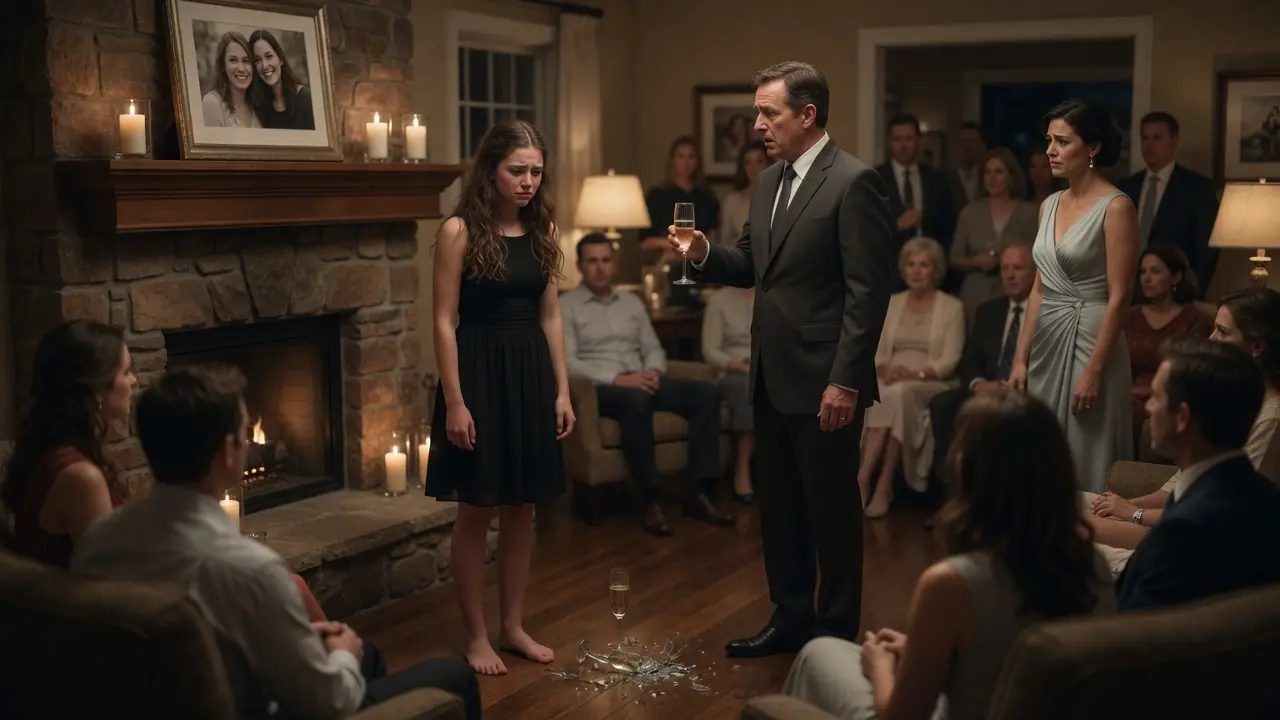
The champagne glass shattered against the fireplace before my father could finish his wedding toast.
Everyone in the living room went silent as crystal fragments scattered across the hardwood floor, catching the warm light from the candles my mother had chosen years earlier. My father stood beside the mantel in a charcoal suit, one hand still raised around his own glass, while the woman wearing my mother’s pearl earrings stared at me from across the room.
“You don’t get to wear those,” I said.
My voice did not sound like mine. It was too steady, too cold, and much louder than I had intended.
“Claire,” my father warned.
“No.” I pointed at the earrings trembling beneath Rebecca’s dark hair. “Those belonged to Mom. You’ve already taken her husband, her bedroom, and her place at this table. You don’t get to take those too.”
Rebecca’s face went pale. Around us, twenty relatives and family friends suddenly found the floor fascinating.
My aunt Diane hurried toward me, but I stepped backward before she could touch my shoulder. I was fourteen years old, barefoot beneath a black dress that no longer fit correctly, and so full of grief that I felt capable of setting the entire house on fire just by breathing.
My father put down his glass. “That is enough.”
“Six months,” I said. “She’s been dead for six months.”
His expression tightened as if I had slapped him.
“You couldn’t even wait a year.”
Rebecca reached for the earrings. “Claire, I can take them off.”
“You should take everything off,” I snapped. “The earrings, the ring, the whole costume. Maybe then everyone can stop pretending this isn’t disgusting.”
Someone gasped. My grandmother whispered my name like a prayer, but no one contradicted me.
That silence convinced me I was right.
My father crossed the room with a look I had never seen before. He did not touch me, but his anger felt physical, like heat coming off an open oven.
“Go upstairs,” he said.
“This is my house.”
“It is my house too.”
“It was Mom’s house.”
His face broke for half a second, and I saw the pain under the anger. At fourteen, I mistook that pain for guilt.
“Go upstairs now,” he repeated.
I looked at Rebecca one last time. Her mascara had smudged beneath one eye, but she did not defend herself.
“I hope she haunts you both,” I said.
Then I ran.
Behind me, the room remained silent until my bedroom door slammed hard enough to shake a framed photograph from the wall. The picture fell facedown on the carpet, but I did not pick it up.
It was a photograph of my mother and Rebecca laughing together at the lake.
Six months earlier, my mother had died in a hospital room that smelled like bleach, wilted flowers, and something metallic I could never forget. She had been forty-two years old. The doctors called her cancer aggressive, which sounded almost insulting, as though the disease had a personality and deserved credit for its efficiency.
For nearly two years, our lives had revolved around test results, infusion schedules, insurance calls, and careful lies. We said things like “when you get better” even after her doctor stopped saying them. We planned summer vacations we knew we would never take and talked about replacing the kitchen cabinets as if the future were something we could trick into staying.
Rebecca Hale had been there through all of it.
She and my mother, Ellen, had been best friends since college. There were photographs of them with enormous hair in the late nineties, wearing denim jackets and laughing outside a dormitory. Rebecca had introduced my parents at a Fourth of July cookout, a fact I would later treat as evidence that she had been circling our family from the beginning.
During my mother’s illness, Rebecca drove her to appointments when my father had to work. She cooked soup that my mother could barely swallow, cleaned the bathroom after she was sick, and slept on our couch during the final weeks.
She also held my father’s arm at the funeral.
That image became the center of my private prosecution.
My father was bent forward, sobbing into his hands, and Rebecca stood beside him with one arm around his shoulders. Her own face was twisted with grief. At the time, I saw two devastated people holding each other upright.
After the wedding, I remembered it as the beginning of an affair.
Grief can revise memory with terrifying confidence.
It can take a harmless glance and sharpen it into betrayal. It can rearrange a room, move people closer together, and make every moment before the loss feel like a clue that should have warned you.
Three weeks after the funeral, Rebecca began coming by every afternoon.
At first, she brought groceries. Then she started doing laundry, paying bills my father forgot, and leaving casseroles in our freezer with instructions taped to the lids. She never stayed overnight, at least not that I saw, but she was in the house often enough that her perfume began to linger in the hallway.
My father looked like a man walking underwater.
He went to work, came home, and sat at the kitchen table staring at nothing. Sometimes I found him asleep in the garage with the car door open and the engine off, still wearing his office clothes. Other nights, he stood in my mother’s closet and pressed one of her sweaters against his face.
I hated him for grieving differently than I did.
I hated him when he cried because it frightened me. I hated him when he did not cry because it seemed proof he had stopped loving her.
There was no version of him I could forgive.
Four months after my mother died, I came home early from a friend’s house and found my father and Rebecca in the kitchen.
She was holding his face in both hands. His forehead rested against hers, and his eyes were closed.
They were not kissing.
That distinction did not matter to me.
I backed out before they saw me, walked three blocks to the park, and sat on a wet swing until darkness fell. When my father found me, he was frantic.
“What were you thinking?” he demanded, wrapping his coat around my shoulders. “You can’t disappear like that.”
“Neither can Mom,” I said.
His mouth closed.
“You should have thought of that before replacing her.”
He looked stunned, then tired.
“No one is replacing your mother.”
“I saw you.”
His eyes shifted toward the empty basketball court. That tiny hesitation became a confession in my mind.
“Rebecca and I have been helping each other,” he said carefully.
“With what?”
“With surviving.”
I laughed in his face.
Two weeks later, they sat me down at the kitchen table. My father’s hands were clasped so tightly that his knuckles had gone white. Rebecca sat beside him, not touching him, which somehow looked more suspicious than if she had.\
“We’ve decided to get married,” he said.
I thought I had misheard him.
The kitchen clock ticked three times before I understood the words.
Then I stood so quickly that my chair fell backward.
“You’re sick.”
“Claire,” Rebecca whispered.
“You’re both sick.”
My father rose. “Please sit down.”
“No.”
“We need to talk about this as a family.”
“We are not a family.”
His face changed, but I was not finished.
“You waited until she couldn’t stop you.”
Rebecca covered her mouth.
My father came around the table. “That is not what happened.”
“Then tell me what happened.”
He opened his mouth, but Rebecca shook her head almost imperceptibly.
I noticed.
That private signal between them confirmed everything.
“There’s more,” I said. “Isn’t there?”
“No,” my father replied too quickly.
Rebecca stared down at her hands.
They married at our house on a cold Saturday in November. There was no church, no white dress, and no music beyond a string quartet recording playing quietly from the stereo. My father told me they were keeping it simple out of respect for my mother.
I thought simplicity was just another way to hide shame.
I spent the morning locked in my room until Aunt Diane threatened to remove the door from its hinges. She helped me put on the black dress and brushed my hair while I stared at the mirror with the rigid expression of someone preparing for an execution.
“You do not have to be happy,” she said. “But you cannot be cruel.”
“They’re being cruel.”
“They are lonely.”
“So am I.”
Her hand stopped moving through my hair.
“I know.”
“No, you don’t.”
She met my eyes in the mirror. “You think grief belongs only to the person who hurts the loudest. It doesn’t.”
At fourteen, I considered this betrayal too.
The ceremony lasted nine minutes.
Rebecca wore a pale blue dress and carried no flowers. My father’s voice cracked during the vows. I stood near the staircase with my arms crossed while our relatives watched me more closely than they watched the couple.
Then, during the toast, I saw the pearl earrings.
My mother had worn them on every anniversary dinner, every school recital, and every Christmas Eve service. I remembered resting my head on her shoulder when I was little and tracing one pearl with my finger.
Seeing them on Rebecca felt like finding my mother’s body desecrated.
After I ran upstairs, no one followed me for almost an hour.
When the knock finally came, it was Rebecca.
“Go away.”
She opened the door anyway.
The earrings were gone. Her earlobes were bare and slightly red.
“I’m sorry,” she said.
I sat against the headboard with my knees drawn to my chest. “Did he give them to you?”
“No.”
“You stole them?”
“Your mother gave them to me.”
The answer made me so angry that I threw a pillow at her.
“You’re a liar.”
She let the pillow hit her and fall.
“She gave them to me before she died.”
“Get out.”
“She said she wanted me to have something that had been part of your family.”
“You are not part of my family.”
Her face crumpled, but she held herself together.
“I know you don’t believe me.”
“Because it’s not true.”
“She gave me a letter too.”
“Of course she did.”
“It means you can say anything now. She’s not here to correct you.”
The cruelty landed exactly where I intended.
Rebecca stared at me for a long moment. Then she walked to my dresser and placed the earrings beside my hairbrush.
“They’re yours,” she said.
“I don’t want anything you’ve touched.”
She flinched.
“I loved your mother.”
“You loved her life.”
Rebecca turned toward me. For the first time, something like anger appeared beneath her grief.
“You don’t know what you’re talking about.”
“I know you got everything you wanted.”
She looked as if I had struck her. Then the anger disappeared, replaced by exhaustion.
“No,” she said quietly. “None of us did.”
She left the room and closed the door with care.
That gentleness infuriated me more than a slam would have.
The earrings remained on my dresser for two years.
I did not wear them. I did not put them away. They became another object in the museum of my anger, collecting dust beside photographs I refused to look at.
Rebecca moved into my parents’ bedroom but changed almost nothing. My mother’s books stayed on the shelves, her scarves remained in a basket in the closet, and her favorite yellow chair sat near the window.
I interpreted this as performance.
When Rebecca tried to change the bedspread, I accused her of erasing Mom. When she put the old one back, I accused her of pretending to preserve her.
She could not win because I had designed the game that way.
At first, my father tried to mediate.
“Rebecca is not your enemy,” he told me one evening after I refused to come downstairs for dinner.
“She’s not my mother.”
“She has never said she is.”
“She doesn’t have to.”
He leaned against my doorway. The skin beneath his eyes had become dark and hollow.
“What do you want me to do, Claire?”
“Undo it.”
“I can’t.”
“You could divorce her.”
“That would not bring your mother back.”
“You don’t know that.”
He stared at me.
I knew how irrational the statement was, even then. But I was not speaking from the part of myself that understood reality.
“If you loved Mom,” I said, “you wouldn’t be with Rebecca.”
His expression hardened. “Do not question how much I loved your mother.”
“You replaced her in six months.”
“You think I don’t wake up every morning and remember she’s dead?”
“You have someone in your bed.”
His hand struck the doorframe beside him, making us both jump.
“I have nightmares,” he shouted. “I have panic attacks in grocery stores because I see a woman with her hair. I still reach for Ellen in my sleep, and then I remember I held her hand while she died.”
The house went silent.
My father had never raised his voice at me before.
Rebecca appeared at the end of the hallway. “Daniel.”
He turned away, breathing hard.
She approached him but did not touch him until he nodded. Then she placed a hand on his back.
I watched them with hatred so complete that it felt clean.
“You see?” I said. “You always choose her.”
My father looked at me over his shoulder.
“No,” he said. “I am trying to choose life.”
I closed the door in his face.
After that, silence became my weapon.
I answered questions with shrugs, ate meals in my room, and learned the rhythms of the house so I could avoid both of them. I stayed late at school, joined clubs I did not care about, and spent weekends at my friend Marissa’s house.
Marissa’s mother believed my version of events completely.
“That is awfully fast,” she said when she thought I was out of earshot. “The best friend too? I’d have questions.”
Those words fed me for years.
Every sympathetic look from an adult became validation. Every awkward pause after I explained the timeline told me that reasonable people agreed with me.
I began telling the story in a particular way.
My mother died. Her best friend comforted my father. Six months later, they married.
I omitted the chemotherapy appointments, the nights Rebecca stayed awake while Mom screamed from bone pain, and the months my father could not remember to eat. I never mentioned how Rebecca drove me to school when Dad could not get out of bed or how she sat in the parking lot during my soccer practices without trying to speak to me.
Facts are easy to arrange into a lie when none of them are technically false.
At sixteen, I got caught shoplifting a silver bracelet from a department store.
I did not want the bracelet. I wanted to feel something happen.
The security guard called my father, but Rebecca arrived instead.
When I saw her enter the back office, rain darkening the shoulders of her coat, I laughed.
“Of course he sent you.”
“He’s in Chicago for work.”
“You don’t have to pretend you’re my parent.”
“I’m not pretending anything.”
The security guard explained that the store would not press charges if a guardian signed the paperwork and paid for the item. Rebecca did both without arguing.
In the car, she kept her eyes on the road.
“Aren’t you going to lecture me?” I asked.
“No.”
“Why not?”
“Would you listen?”
I crossed my arms.
She nodded once. “That’s what I thought.”
Rain tapped against the windshield.
“You’re not going to tell him?”
“I didn’t say that.”
“He’ll hate me.”
“Your father could never hate you.”
“You don’t know him.”
Her fingers tightened on the steering wheel.
“I know him well enough to know losing you would destroy him.”
“Maybe he should have thought about that before marrying you.”
Rebecca pulled the car to the curb so abruptly that another driver honked.
She put the vehicle in park and turned toward me.
“I have spent two years letting you say whatever you needed to say because you were a child in pain,” she said. “But pain does not give you permission to keep hurting everyone around you forever.”
My face grew hot.
“You want me gone.”
“No.”
“You said losing me would destroy him. Not you.”
She stared at me.
“You want honesty?”
I looked away.
“Losing you would destroy me too.”
I laughed, but it came out weak.
“You barely know me.”
“I know you hate peas but love pea soup because your mother used to blend it with too much cream. I know you read the last page of every novel first and pretend you don’t. I know you still sleep with the quilt Ellen made, even though you hide it when friends come over.”
My throat tightened.
“I know you leave the hallway light on because you had nightmares after the funeral. I know you stand outside our bedroom door sometimes when you think we’re asleep.”
I turned toward the window.
“You don’t know anything.”
“I know you,” she said. “That doesn’t mean you have to love me. But stop pretending I’m made of stone.”
We drove home without speaking.
That night, I heard my father and Rebecca arguing downstairs.
“She needs consequences,” my father said.
“She needs help.”
“She stole something.”
“She wanted us to notice.”
“We notice everything she does.”
“No,” Rebecca replied. “We notice everything she does wrong.”
There was a pause.
Then my father said, “I don’t know how to reach her.”
Rebecca’s answer came so softly I almost missed it.
“Then don’t stop trying.”
The next morning, my father grounded me for six weeks and scheduled an appointment with a grief counselor.
I refused to speak during the first three sessions.
The counselor, Dr. Patel, had a small office above a dentist’s practice and kept a bowl of peppermint candy on her desk. She never pushed me to talk. She simply sat across from me and allowed silence to become uncomfortable.
During the fourth session, she asked, “Who would you be if you stopped being angry?”
The question frightened me.
“I don’t know.”
“Does that feel dangerous?”
“Yes.”
“Why?”
I stared at the bowl of candy.
“Because then what happened would be okay.”
Dr. Patel nodded. “You believe anger is proof that your mother mattered.”
I began to cry before I realized I was crying.
“If I forgive them, it’s like choosing them over her.”
“Do you think love works like a courtroom?”
“What does that mean?”
“That honoring one person requires condemning another.”
I wiped my face angrily. “You weren’t there.”
“No,” she said. “But you are. And you seem exhausted.”
I stopped therapy after that session.
For years, I told myself it was because Dr. Patel did not understand. The truth was that she had understood too quickly.
At eighteen, I left for college in Boston.
My father carried my boxes to the dorm while Rebecca made my bed. She had packed a first-aid kit, extra batteries, sewing supplies, and a stack of gift cards hidden inside envelopes labeled for emergencies.
I found them after they left.
I used every gift card and never thanked her.
College gave me a new audience for my story.
At parties and in late-night conversations, I spoke about my father’s marriage with practiced detachment. People called it shocking, cruel, and suspicious. One roommate suggested they must have been having an affair before my mother died.
I had no proof, but I stopped correcting people who assumed it.
That omission became another kind of accusation.
I rarely went home.
When I did, I stayed with Aunt Diane or Marissa’s family. My father called every Sunday evening, and I let most of his calls go to voicemail.
Rebecca sent birthday cards with short messages.
Thinking of you.
Proud of you.
Your mother would be so proud.
The last sentence always made me furious.
I tore up the cards but kept the checks.
During my junior year, my father suffered a mild heart attack.
Aunt Diane called me at two in the morning.
“He’s stable,” she said before I could panic. “Rebecca got him to the hospital quickly.”
I took the first flight home.
When I arrived, Rebecca was asleep in a chair beside his hospital bed, her head tilted at an uncomfortable angle. My father looked smaller beneath the white blanket.
I stood in the doorway, unable to move.
Rebecca woke and immediately rose.
“You came.”
“How is he?”
“The cardiologist says there’s no major damage.”
“Why didn’t he call me himself?”
“He was unconscious.”
Guilt struck so sharply that I became defensive.
“You should have told me sooner.”
“I called Diane because I knew you would answer her.”
The truth embarrassed me.
My father opened his eyes.
“Claire?”
I crossed the room and took his hand. He smiled weakly.
“You came home.”
“Of course I did.”
His eyes filled with tears.
Behind me, Rebecca quietly left the room.
I stayed three days.
During that time, I watched her manage medications, speak with doctors, and sleep in brief stretches without changing clothes. She knew every detail of my father’s medical history and corrected a nurse who nearly gave him a drug that interacted with his blood thinner.
I felt grateful.
Then I hated myself for feeling grateful.
On the final evening, I found Rebecca alone in the hospital cafeteria.
She was stirring coffee she had not tasted.
“Thank you,” I said.
Her spoon stopped.
“For getting him here.”
“Of course.”
I waited for her to look pleased, but she only looked tired.
“I know you love him,” I added.
She raised her eyes.
“Yes.”
The answer was simple, without apology.
“Did you love him before Mom died?”
The question had lived inside me for seven years.
Rebecca did not react with surprise. She seemed almost relieved that I had finally asked.
“I cared about him because he was Ellen’s husband.”
“That isn’t what I asked.”
“No,” she said. “I was not in love with your father while your mother was alive.”
“Were you attracted to him?”
Her expression tightened. “Claire.”
“You expect me to believe you married him six months later and never thought about him before?”
“I expect you to understand that the months before Ellen died were not normal months.”
“What does that mean?”
She looked toward the cafeteria windows, black mirrors against the night.
“Your mother knew she was dying long before you did.”
I stared at her.
“We all knew.”
“No. You knew she was sick. She knew she was dying.”
“What does that have to do with you and Dad?”
Rebecca’s hand wrapped around the coffee cup.
“Ask him.”
“You’re the one sitting here.”
“And he is the one whose story it is too.”
I leaned closer. “What are you hiding?”
Her eyes met mine.
“Something your mother asked us not to tell you until you were ready.”
A cold sensation moved through me.
“Ready for what?”
She stood.
“For the truth to be more complicated than betrayal.”
I followed her from the cafeteria, demanding an explanation, but she refused.
My father claimed not to know what I meant.
The denial reopened every old wound.
I left the hospital the next morning without saying goodbye to Rebecca. For the next four years, I spoke to my father only on holidays and ignored every message from his wife.
Then I met Ethan.
He was patient, funny, and grounded in a way I distrusted at first. He worked as an architect, called his mother twice a week, and had never learned how to disguise kindness as indifference.
We met at a friend’s birthday dinner when I was twenty-six.
By dessert, he knew I hated olives and loved old mystery novels. By the end of the month, he knew my mother was dead and my father had married her best friend.
“That’s complicated,” he said.
It was not the response I expected.
“Complicated?”
“Yes.”
“Most people say it’s horrible.”
“I don’t know enough to say that.”
I almost stopped seeing him.
His refusal to condemn my father felt disloyal, even though he had never met him. But Ethan did not challenge my version of events. He simply asked questions no one else had.
“Was your mom’s friend close to your whole family?”
“Yes.”
“Did your father date anyone else?”
“No.”
“Did they have a big wedding?”
“No.”
“Did your stepmother try to replace your mother?”
“She moved into her room.”
“That isn’t what I asked.”
I became angry.
“You think I made it up?”
“No. I think you were fourteen.”
The sentence echoed something Rebecca had once said.
I left the restaurant and did not answer Ethan’s calls for three days.
He sent one message.
I’m not saying your pain is wrong. I’m saying pain can be true without every conclusion it creates being true.
I stared at the words until my eyes blurred.
Then I called him.
Two years later, he proposed on a rainy footbridge in October.
I said yes before he finished asking.
The engagement should have been the happiest season of my life, but wedding planning turned grief into a physical presence again. Every dress fitting reminded me that my mother would not zip the gown. Every conversation about flowers made me remember her garden.
When the bridal boutique consultant asked whether my mother would be joining us, I froze.
Rebecca was the first person I thought of.
That frightened me so much that I invited no one.
I chose a dress alone.
My father offered to pay for the wedding. I refused until Ethan pointed out that rejecting the money would not resurrect my mother.
“You’re very fond of saying things like that,” I told him.
“Someone has to.”
We planned the ceremony for the following September at a renovated barn outside Asheville, where Ethan’s family lived. The venue had open fields, mountain views, and an enormous oak tree near the ceremony site.
My mother had loved oak trees.
I did not tell anyone that was why I chose it.
My father and Rebecca accepted the invitation. Rebecca texted once to ask whether I wanted help with anything.
I did not answer.
As the wedding approached, my dreams became violent.
In one, my mother stood at the end of the aisle wearing her hospital gown. She tried to speak, but dirt poured from her mouth.
In another, Rebecca cut my wedding dress into strips while my father watched.
I began waking with my jaw clenched and my hands numb.
Ethan encouraged me to return to therapy.
This time, I chose Dr. Patel again.
She was older, her hair almost completely gray, but the bowl of peppermint candy still sat on her desk.
“You came back,” she said.
“I’m getting married.”
“That can bring old grief to the surface.”
“I think they lied to me.”
“Your father and Rebecca?”
I told her about the hospital conversation.
Dr. Patel listened without interrupting.
“What would it mean if they kept something from you?” she asked.
“That I was right.”
“About what?”
“That there was more going on.”
“And if the hidden truth does not confirm an affair?”
“I don’t know.”
She leaned back.
“You have spent half your life waiting for evidence that will justify the first conclusion you made at fourteen.”
“Because no one will tell me anything.”
“Have you asked your father directly since the hospital?”
“He lied.”
“You said he claimed not to know what you meant.”
“That was a lie.”
“Perhaps. Or perhaps you asked a vague question while angry.”
I hated how reasonable she sounded.
“What am I supposed to do?”
“Ask for the full truth. Then be prepared to hear it.”
I called my father that night.
He answered on the first ring.
“Claire?”
“I need to ask you something.”
“All right.”
“What did Mom know before she died?”
The line went silent.
My heartbeat quickened.
“Dad?”
“Where is this coming from?”
“Rebecca said Mom asked you to keep something from me.”
Another silence.
“What exactly did Rebecca say?”
“She said the months before Mom died weren’t normal and that Mom knew she was dying before I did.”
My father exhaled slowly.
“She shouldn’t have said anything.”
“So there is something.”
“There are many things you didn’t know. You were twelve when Ellen got sick.”
“I was fourteen when she died.”
“You were a child.”
“I’m not a child now.”
“No.”
“Then tell me.”
His voice became strained. “Not over the phone.”
“Why?”
“Because it is not a phone conversation.”
I laughed bitterly. “That’s convenient.”
“Claire, please.”
“No. You don’t get to ask me for patience after thirteen years.”
“I am not asking for patience.”
“You married her six months after Mom died, and every time I asked why, you told me you were choosing life. What does that mean?”
My father began to cry.
I had heard him cry only twice since the funeral.
“Your mother made me promise,” he said.
My fingers tightened around the phone.
“Promise what?”
“I can’t do this tonight.”
“Then don’t come to my wedding.”
The words escaped before I could stop them.
Silence filled the line.
My father’s voice, when it came, was almost inaudible.
“Do you mean that?”
I looked across the room at Ethan, who had gone still.
“I mean I’m done being lied to.”
My father breathed in sharply.
“All right.”
Then he ended the call.
I stared at the screen.
Ethan crossed the room. “Call him back.”
“No.”
“You don’t want him at your wedding?”
“I want him to tell me the truth.”
“That is not what you said.”
“He knows what I meant.”
“People can only respond to the words you actually use.”
I turned away.
“Don’t take his side.”
“I am on your side. That’s why I’m telling you not to make a permanent decision in the middle of a temporary rage.”
“You don’t understand.”
“No,” Ethan said. “And neither do you, because they haven’t told you everything.”
I slept on the couch that night.
The next morning, I found an email from Rebecca.
Claire,
Your father told me what happened. I am not writing to defend myself or persuade you to invite us. I know your wedding must feel safe, and I understand that our presence may not feel safe to you.
There is something your mother left for you. I have kept it because she asked me to wait until a specific moment. I believed I was honoring her wishes, but I now understand that waiting has caused damage too.
I would like to give it to you before the wedding.
You do not have to speak to me afterward.
Rebecca
I read the message six times.
Then I called her.
“What did she leave?”
“I would rather give it to you in person.”
“Is it a letter?”
“Yes.”
“Why didn’t you give it to me before?”
“Because your mother told me when.”
“When?”
“The week before your wedding.”
A chill moved through me.
“How could she know I’d get married?”
“She didn’t know when. She wrote instructions.”
“Why would she do that?”
Rebecca’s voice cracked. “Because she knew that would be when you missed her most.”
I closed my eyes.
“Come Saturday.”
They drove from Maryland to our apartment in North Carolina.
My father did not come inside.
I watched from the window as Rebecca stepped out of their car holding a brown leather bag. My father remained behind the wheel, staring straight ahead.
For one second, I wanted to run outside and tell him I had not meant what I said.
Then Rebecca looked up at the window, and the moment passed.
Ethan offered to stay, but I asked him to leave us alone.
Rebecca sat at our kitchen table.
She had aged since the hospital. Silver threaded through her dark hair, and the lines around her mouth had deepened. She looked nothing like the triumphant thief I had created in my mind.
She looked nervous.
“There’s coffee,” I said.
“No, thank you.”
I sat opposite her.
For several seconds, neither of us spoke.
Then she opened the leather bag and removed a worn envelope.
My name was written across the front.
I knew my mother’s handwriting instantly.
The letters leaned slightly to the right, and the tail of the y curled beneath my name. Seeing it felt like hearing her voice from another room.
My hands began to shake.
“She wrote this three weeks before she died,” Rebecca said. “She made me promise to give it to you shortly before your wedding.”
“Why you?”
“Because she did not trust your father to wait.”
A broken laugh escaped me.
“That sounds like her.”
Rebecca smiled through tears. “Yes.”
I touched the envelope but did not open it.
“Did she know you were going to marry him?”
Rebecca lowered her eyes.
“Yes.”
The room seemed to tilt.
My hand withdrew from the envelope.
“So it was planned.”
“Not exactly.”
“You just said she knew.”
“She knew it was possible.”
“You were talking about marrying my father while she was dying?”
“No.”
“Then explain it.”
Rebecca folded her hands together.
“Your mother’s cancer spread to her brain during the final months.”
“I know.”
“You know what the doctors told you. You do not know what she told us.”
My pulse pounded in my neck.
“She had episodes,” Rebecca continued. “Confusion, seizures, moments when she did not recognize your father. But she also had periods when she was completely clear.”
“I remember.”
“During one of those periods, she asked me to take her to a hotel.”
I stared at her. “Why?”
“She wanted privacy from you and your father.”
“For what?”
“To make arrangements.”
Rebecca opened the bag again and took out a small digital recorder, old and scratched.
My stomach turned.
“What is that?”
“Your mother’s voice.”
I stood so quickly the chair scraped backward.
“No.”
“Claire.”
“No.”
“She wanted you to hear it.”
“I said no.”
Rebecca remained seated.
“She was afraid you would think she had abandoned you.”
“She did abandon me.”
The moment the words left my mouth, shame followed.
Rebecca’s face softened.
“She fought until her body could not fight anymore.”
“I know that.”
“Knowing something intellectually does not stop a child from feeling abandoned.”
I sat again because my legs had begun to tremble.
Rebecca slid the recorder across the table.
“There are several recordings. Some are for your father. One is for me. One is for you.”
“Why didn’t anyone tell me?”
“Because Ellen asked us not to.”
“Why?”
“She wanted you to remember her as your mother, not as a woman arranging everyone’s lives after her death.”
“That sounds exactly like her.”
“Yes.”
I looked down at the envelope.
“What did she arrange?”
Rebecca’s eyes filled.
“Us.”
The word hung between us.
I felt fourteen again, barefoot in a black dress, watching pearls tremble beneath another woman’s hair.
“Tell me everything.”
Rebecca inhaled slowly.
“Your mother knew your father was not functioning. Even before she died, he was having panic attacks. He stopped sleeping. He forgot to pay the mortgage twice.”
“I didn’t know that.”
“She did. She was terrified of what would happen to both of you.”
“So she assigned you to us?”
“No.”
“That’s what it sounds like.”
“She asked me to promise that I would not disappear after the funeral. She asked me to help Daniel with the bills, meals, and getting you to school.”
“That doesn’t explain marriage.”
“No.”
Rebecca looked toward the window.
“Two weeks before Ellen died, she asked your father to consider marrying me someday.”
I stared at her.
“That’s insane.”
“Your father said the same thing.”
“You were in the room?”
“Yes.”
“All three of you discussed this?”
“Not the way you imagine.”
“How should I imagine it?”
Rebecca’s voice became unsteady.
“Your mother was in pain. She was frightened. She said she knew Daniel would either isolate himself completely or attach himself to the first person who made him feel less alone. She did not want a stranger raising you.”
“I was fourteen.”
“She still saw you as her little girl.”
“So she picked you.”
“She trusted me.”
“That doesn’t mean you had to agree.”
“I didn’t.”
The answer stopped me.
“What?”
“I refused.”
Rebecca pressed both palms against the table.
“I told her it was inappropriate and impossible. I told her Daniel loved her and that I loved her, and that none of us should be discussing marriage while she was alive.”
“What did Dad say?”
“He walked out of the room.”
I could picture it.
“He was furious,” Rebecca continued. “He did not speak to Ellen for several hours. Then he came back and apologized because he could not bear wasting time being angry.”
“Did she ask again?”
“Yes.”
“How many times?”
“Three.”
I laughed once, without humor.
“That sounds like Mom.”
“She told me she was not asking me to love him. She was asking me not to close the door if love happened after she was gone.”
The room blurred.
“She said that?”
“Yes.”
“Why would she do that?”
“Because she knew both of us.”
I looked away.
Rebecca’s voice softened.
“She knew I had spent most of my adult life caring for other people. She knew I had given up on having a family of my own. And she knew your father trusted very few people.”
“You did want her life.”
Rebecca’s face tightened.
“No, Claire. I wanted my friend to live.”
The words cut through me.
She opened the leather bag and removed a second envelope.
“This is the letter she wrote to me. I have never shown it to anyone.”
I did not take it.
“Why show me now?”
“Because you deserve proof.”
“Proof can be manufactured.”
Her eyes flashed.
“I will not defend Ellen’s handwriting to her own daughter.”
The sharpness surprised me.
For the first time, I saw not only patience but years of contained anger.
“I gave up having children because I spent ten years caring for my parents,” she said. “My mother had dementia. My father had Parkinson’s disease. By the time they were gone, I was thirty-eight and exhausted. Ellen was the person who kept me from disappearing into that grief.”
I had known Rebecca’s parents were dead. I had never known the rest.
“She brought groceries to my house. She sat with my mother so I could sleep. She reminded me that I was still a person when everyone else treated me like a caregiver.”
Rebecca wiped her cheek.
“When Ellen became sick, I did for her what she had done for me. Not because I wanted her husband or her daughter. Because she was my family.”
I lowered my eyes.
“After she died,” Rebecca continued, “I intended to help for a few months and then step back.”
“But you didn’t.”
“No.”
“Why?”
“Because your father tried to kill himself.”
The room went completely silent.
I heard the refrigerator hum. A truck passed outside, its brakes squealing at the intersection.
“What did you say?”
“Eight weeks after the funeral, I found him in the garage.”
My chest tightened.
“No.”
“The car was running.”
“No.”
“The garage door was closed.”
I shook my head.
“You’re lying.”
“I wish I were.”
“My father would never do that.”
“He was not thinking like your father.”
“I was in the house.”
“Yes.”
The word tore through me.
Rebecca’s voice broke.
“You were asleep upstairs.”
I stood and backed away from the table.
“No.”
“I came over because he had sent me a message that didn’t make sense. When no one answered the door, I used the key Ellen had given me.”
“You’re lying.”
“I found him unconscious.”
I covered my ears.
Rebecca rose but did not approach me.
“I called 911. He survived because I came when I did.”
“Stop.”
“He spent four days in a psychiatric unit.”
“That’s not true. He told me he was on a business trip.”
“I stayed with you.”
Memory rushed back.
Rebecca sleeping on the couch. My father calling once from an unfamiliar number. Aunt Diane saying he had been delayed in Chicago.
I had believed it without question.
“You all lied to me.”
“Yes.”
I lowered my hands.
Rebecca was crying openly now.
“We lied because your father was ashamed and because every therapist we consulted said you were already carrying too much.”
“You let me think he chose you because he didn’t love Mom.”
“He chose not to die.”
The sentence struck with devastating force.
I sank into the chair.
Rebecca remained standing.
“When he came home, I told him I was stepping back. I thought my presence was confusing you and that he needed professional support.”
“What happened?”
“He begged me not to leave.”
I closed my eyes.
“He said he did not trust himself alone. He said the house felt full of ghosts, and that you looked at him like he had killed your mother.”
I pressed my fist against my mouth.
“We started grief counseling together,” Rebecca said. “Not romantic counseling. Survival counseling.”
“When did it become romantic?”
“A month later.”
“Four months after Mom died.”
“Yes.”
“That’s still fast.”
“It was.”
“Didn’t you feel guilty?”
“Every moment.”
“Then why marry so quickly?”
Rebecca sat again.
“Because your father’s health insurance would cover me.”
I stared at her.
“What?”
She looked down at her hands.
“I had been diagnosed with ovarian cancer.”
The room tilted again.
“No.”
“Early stage. Treatable. But I had left my job to care for my parents and then Ellen. My private insurance had lapsed. I was facing surgery and chemotherapy without coverage.”
My breath caught.
“Dad married you for insurance?”
“That was part of it.”
“Part?”
“He also believed marriage would make me stay.”
A sad smile touched her mouth.
“He was terrified of losing another person.”
“Did you love him?”
“Not the way I do now.”
The honesty startled me.
“I loved him as Ellen’s husband, as your father, and as a broken man I had pulled out of a garage. Romantic love came slowly and unevenly. We did not tell people about my cancer because your father thought the gossip would be unbearable for you.”
I remembered the short ceremony, Rebecca’s thinness, the dark circles beneath her eyes. I remembered hearing her vomit late at night and assuming she was pregnant.
I had spread that suspicion at school.
“She was pregnant before the wedding,” I had told Marissa.
The memory made me nauseated.
“The earrings,” I whispered.
“What about them?”
“You wore Mom’s earrings.”
Rebecca’s eyes lowered.
“Ellen gave them to me at the hotel.”
“Why wear them to the wedding?”
“Because I was starting chemotherapy the following Monday. She had written that I should wear them on a day when I needed courage.”
My vision blurred.
“I thought…”
“I know what you thought.”
“And when I said you stole them…”
“I understood.”
“No, you didn’t.”
“I understood that you were fourteen.”
I began to cry.
Not gracefully, not quietly. Thirteen years of certainty collapsed inside me, and the sound that came out felt torn from somewhere beneath language.
Rebecca moved toward me, then stopped.
She waited.
That was what she had done for years. She had waited outside every boundary I built, never forcing her way across it.
I reached for her without looking.
She wrapped her arms around me.
For several minutes, I sobbed against the shoulder of the woman I had blamed for surviving.
“I’m sorry,” I said.
Rebecca held the back of my head.
“I know.”
“No, I’m sorry for everything.”
“You were a child.”
“I wasn’t a child forever.”
Her arms tightened.
“No.”
The forgiveness in that single word hurt more than anger would have.
When I could breathe again, she returned to the table and placed the envelope in front of me.
“Read your mother’s letter.”
I opened it carefully.
The paper had yellowed at the folds. My mother’s handwriting remained steady through the first half, then became less controlled near the end.
My darling Claire,
If you are reading this, you are close to your wedding day. I wish more than anything that I could see the person you have become and the person you have chosen to love.
You are probably angry with me for writing to you from a future I will not share. You are allowed to be angry. I have been angry too.
I am angry that I will not help you choose a dress. I am angry that I will not sit in the front row. I am angry that someone else may have to hold your hand when you miss me.
That person may be Rebecca.
Please do not mistake her presence for my absence.
Nothing can replace me because love is not furniture. People do not move into the empty space another person leaves behind and become the same shape.
Your father is going to break after I die. I have seen it happening already. He will try to hide it from you because he believes fathers must stand when everyone else falls.
Rebecca knows how to sit beside someone who cannot stand.
I have asked her to stay close to both of you. I have also told her something that may make you angry: if she and your father ever find comfort or love together, I give them my blessing.
I am not giving away my life.
I am trying to protect the people in it.
I trust Rebecca because she has loved me without envy and helped me without keeping score. I trust your father because he has loved me through fear, sickness, and every version of myself.
Most of all, I trust you.
But grief may tell you not to trust anyone. It may tell you that healing is betrayal and that every laugh after I am gone is proof that I did not matter.
Grief will be lying.
You do not honor me by staying wounded.
You honor me by becoming someone who can still love after loss.
There is one more truth you deserve to know. Rebecca did not ask for any of this. I asked her. More than once, because she is stubborn and because she loves me enough to say no when she thinks I am being unreasonable.
Please do not punish her for staying.
Please do not punish your father for surviving.
And please do not punish yourself for whatever you felt when you were young and hurting.
Wear my pearls if you want them.
Let Rebecca help you fasten them.
Then walk toward your future without feeling that you are walking away from me.
I will be in every brave step.
Love always,
Mom
I finished the letter and pressed it against my chest.
Rebecca sat across from me, crying silently.
“She knew,” I whispered.
“She knew you very well.”
“Why didn’t you give this to me earlier?”
“Because she wrote instructions on the envelope.”
Rebecca turned it over.
In my mother’s handwriting, beneath a line that had been hidden by the fold, were the words:
Give this to Claire one week before her wedding. Not sooner. She will need to choose forgiveness when she is old enough to understand it.
I touched the sentence.
“She assumed I would hate you.”
“She was afraid you might.”
“You should have ignored her.”
“I considered it many times.”
“Why didn’t you?”
“Because I had already broken one promise.”
I looked up.
“What promise?”
Rebecca’s expression changed.
“She asked me to tell you the truth about your father’s suicide attempt when you turned eighteen.”
My stomach tightened.
“You waited.”
“Yes.”
“Why?”
“Because you had just left for college. You seemed happy for the first time since Ellen died. Your father begged me not to tell you.”
“So he kept lying.”
“He was ashamed.”
“That doesn’t make it right.”
“No.”
“You protected him.”
“Yes.”
“At my expense.”
Rebecca absorbed the accusation without retreating.
“Yes.”
The honesty prevented me from turning her into a saint, which I needed.
She had made mistakes. My father had made mistakes. My mother, even from her deathbed, had tried to control a future none of them could predict.
The truth was not clean.
That made it more believable.
“I need to talk to Dad.”
“He’s outside.”
I looked toward the window.
“He waited all this time?”
“He said he would wait as long as you needed.”
I walked to the front door with my mother’s letter in my hand.
My father stood beside the car rather than inside it. His shoulders were hunched, and he had loosened his tie even though it was Saturday.
For a moment, we stared at each other across the parking lot.
Then I saw how old he had become.
Not elderly, but older in ways I had refused to notice. His hair was mostly gray. His body, once broad and strong, had narrowed.
I remembered him unconscious in a garage I had slept above.
My knees weakened.
He crossed the distance but stopped several feet away.
“Did she tell you?”
“Yes.”
His eyes closed.
“All of it?”
“I think so.”
He nodded.
“I’m sorry.”
“For what part?”
He flinched, but I needed the answer.
“For lying,” he said. “For marrying Rebecca without explaining. For expecting a fourteen-year-old to accept something most adults would struggle to understand.”
“Why didn’t you tell me Mom asked you to consider it?”
“Because it felt obscene.”
The bluntness surprised me.
“She was dying, and she was trying to arrange our lives as if she were making a grocery list. I was furious with her.”
“So you ignored what she wanted?”
“At first.”
He looked toward the apartment.
“After she died, I hated myself for every moment I had resented that conversation. Then I hated myself because part of me understood why she chose Rebecca.”
“Did you love her?”
“Your mother?”
“Rebecca.”
“Not at first.”
The answer matched Rebecca’s.
“I needed her,” he said. “That is not the same as love, though I confused the two for a while.”
“And the garage?”
His face drained of color.
“I don’t remember deciding to do it.”
“You started the car.”
“Yes.”
“I was upstairs.”
His eyes filled.
“Yes.”
“You were going to leave me.”
“No.”
“That is what would have happened.”
“I know.”
Anger rose through the grief.
“How could you?”
“I was sick.”
“That’s not enough.”
“No,” he said. “It isn’t.”
He did not defend himself.
“I remember sitting in the car,” he continued. “I had one of your mother’s scarves. I thought I could smell her perfume. I believed that if I closed my eyes, I might wake up wherever she was.”
“And me?”
His mouth shook.
“I convinced myself Rebecca would take care of you.”
The cruelty of that logic knocked the air from me.
“So Mom asked Rebecca to stay, and you used that as permission to die?”
“Yes.”
I stepped backward.
My father began to cry.
“There is no explanation that makes it forgivable. I have spent thirteen years knowing that.”
“Why didn’t you tell me when I was older?”
“Because every year made the lie harder to confess.”
“You let me believe Rebecca destroyed our family.”
“I thought your anger at her was safer than knowing I had tried to abandon you.”
“It wasn’t safer for her.”
“No.”
“It wasn’t safer for me.”
“No.”
I looked at him, this man I had loved, hated, missed, and judged from a distance.
“Why did she stay with you?”
“Because she is better than I deserved.”
“That isn’t an answer.”
He wiped his face.
“She stayed because she understood what it was to lose years of your life to caring for people who were dying. She stayed because I was honest about how broken I was, even when I was dishonest with you.”
“And you loved her eventually?”
“Yes.”
“Do you still love Mom?”
He looked almost offended.
“Every day.”
“How can both things be true?”
His expression softened.
“Because your mother was right. Love is not furniture.”
A broken laugh escaped me.
“She was always proud of that line.”
“She tested it on me several times.”
I imagined my mother lying in the hotel room, dictating everyone’s future while cancer pressed against her brain. The image was heartbreaking and somehow funny.
That mixture felt more like her than the saint I had preserved.
“I told you not to come to my wedding.”
“Yes.”
“I didn’t mean it.”
“I know.”
“No. Ethan says people can only respond to the words we use.”
“Ethan sounds wise.”
“He’s irritating.”
“That too.”
I took a breath.
“I want you there.”
My father’s face folded.
I stepped toward him, and he pulled me into his arms.
For a few seconds, I was fourteen again. Then I was six, then twenty-eight, then every age I had ever been while needing my father.
“I’m sorry,” I whispered.
“So am I.”
Rebecca stood in the doorway behind us.
My father reached one hand toward her.
She hesitated.
Then I reached for her too.
 The three of us stood in the parking lot holding one another while a neighbor struggled past us with grocery bags and politely pretended not to stare.
Healing did not arrive like lightning.
It did not erase the years we had lost or transform every memory into something gentle. The following days were filled with difficult conversations, conflicting details, and moments when I became angry all over again.
I learned that my father and Rebecca had attended counseling for nearly five years. I learned that her cancer treatment had left her unable to have children, though she had not expected to become pregnant anyway.
I learned that my mother had recorded eleven messages before she died.
One was for my high school graduation. One was for my first heartbreak. One was for my wedding day.
Rebecca had kept all of them.
“Why didn’t you give me the graduation recording?” I asked.
She looked embarrassed.
“Your father and I argued about it.”
“Of course you did.”
“He thought hearing Ellen’s voice would undo the progress you had made.”
“And you?”
“I thought withholding it was another form of control.”
“Who won?”
“Your father.”
I looked at him.
He rubbed the back of his neck.
“I was wrong.”
“Again.”
“Yes.”
There was a strange relief in hearing him admit it.
For years, I had believed the truth would divide us permanently. Instead, the secrets had done that.
The truth, painful and imperfect, gave us something solid enough to stand on.
Three days before the wedding, Rebecca came with me to the venue.
We walked beneath the oak tree while workers arranged chairs. The mountains rose blue in the distance beneath a pale sky.
“Your mother would have loved this,” Rebecca said.
For once, I did not resent her for speaking on Mom’s behalf.
“She loved oak trees.”
“I know.”
“She said they looked wise.”
“She also said they looked judgmental.”
I laughed.
“That sounds more like her.”
Rebecca smiled.
There was still hesitation between us, but it was no longer hostility. It felt like the uncertainty of two people learning a language they should have spoken years ago.
“Did you ever hate me?” I asked.
She stopped walking.
“Yes.”
The answer startled me.
“When?”
“Many times.”
“You never acted like it.”
“I tried not to.”
“What did you hate?”
“The way you could reduce my entire life to one accusation. The way your father excused everything because you were grieving. The way I lost my best friend and was expected to behave as if my grief mattered less because I married her husband.”
I looked down.
“I’m sorry.”
“I know.”
“No, let me say it.”
Rebecca waited.
“I treated you like you didn’t love her because your grief looked different from mine. I made you pay for being the person who stayed.”
Her eyes filled.
“Yes.”
“I told people you had an affair.”
Rebecca went still.
“I never said it directly. I just let them assume.”
“That explains several Christmas dinners.”
Shame burned through me.
“I can correct it.”
“With whom?”
“Anyone who matters.”
She considered this.
“That would mean something.”
“I’ll do it.”
We continued walking.
Near the ceremony site, she touched one of the chairs in the front row.
“I never wanted Ellen’s place.”
“I believe you.”
“She had a way of filling every space she entered. No one could take her place even if they tried.”
“I know.”
Rebecca looked at the oak tree.
“I spent years wondering whether marrying Daniel betrayed her.”
“Even with her blessing?”
“Especially with her blessing. It is easier to blame yourself than a dead woman who made an impossible request.”
I smiled sadly.
“She did like being right.”
“Infuriatingly.”
We laughed together for the first time.
On the morning of the wedding, rain hammered the roof of the bridal cottage.
The outdoor ceremony was scheduled for four. By noon, the field had begun to flood, the mountain view had disappeared behind gray clouds, and the oak tree swayed beneath violent wind.
The coordinator recommended moving everything into the barn.
I stood in my wedding dress staring out the window as workers carried chairs through the rain.
“It’s ruined,” I said.
Ethan’s sister, Lily, adjusted the hem behind me. “The barn is beautiful.”
“It isn’t what we planned.”
“No wedding is.”
I wanted my mother.
The need struck with such force that I could not breathe.
I locked myself in the bathroom and sat on the closed toilet, gathering the skirt around me. Outside, someone knocked.
“Claire?” Rebecca called. “May I come in?”
I almost said no from habit.
Then I opened the door.
She entered carrying a small velvet box and the old digital recorder.
“I thought you might want these.”
My mother’s pearls lay inside the box.
I touched them with one finger.
“I haven’t seen them since I left home.”
“I kept them safe.”
“You should have kept them.”
“They were always yours.”
I turned toward the mirror.
“Will you help me?”
Rebecca’s breath caught.
She lifted the necklace from the box and fastened it around my neck. Then she placed the earrings through my ears, her hands trembling.
In the mirror, I saw my mother’s pearls and Rebecca’s face behind mine.
For years, I had believed the image would feel like replacement.
It did not.
It felt like history.
Rebecca handed me the recorder.
The message began with static.
Then my mother’s voice filled the bathroom.
“Hello, my beautiful girl.”
My knees nearly gave out.
Rebecca caught my elbow.
Mom’s voice was weaker than I remembered but unmistakably hers.
“If today is your wedding day, I hope someone remembered to make you eat breakfast. You get mean when you are hungry, and no bride should threaten the florist before noon.”
I laughed through tears.
Rebecca covered her mouth.
“I wish I were there,” Mom continued. “I wish I could tell you that marriage is not built from perfect days. It is built from the days when the plan collapses, the rain comes, someone says the wrong thing, and you choose to remain kind anyway.”
Thunder shook the window.
I began laughing harder.
“She planned the weather too,” Rebecca whispered.
Mom’s recording continued.
“Do not look for me in an empty chair. I will not be there. Look for me in the people who kept loving you when you made it difficult. Look for me in your courage to apologize and your willingness to begin again.”
I closed my eyes.
“And if Rebecca is with you, let her know she still owes me twenty dollars from our last card game.”
Rebecca let out a sobbing laugh.
“She cheated,” she said.
The recording ended with my mother singing two lines of the lullaby she used when I was little.
When the room became silent, I leaned against Rebecca.
“I miss her.”
“So do I.”
“I wasted so much time.”
“You survived the only way you knew how.”
“That’s what you always say.”
“Because it’s true.”
I looked at her reflection.
“Will you walk with Dad and me?”
Her eyes widened.
“Down the aisle?”
“Yes.”
“Claire, I don’t think—”
“Mom said to look for her in the people who stayed.”
Rebecca began to cry again.
My father was waiting outside the barn when we told him.
He stared at us as though he had forgotten how to speak.
“You want both of us?”
“Yes.”
He looked at Rebecca, then back at me.
“Are you sure?”
“No,” I said. “But I’m learning that certainty is overrated.”
The rain softened just before the ceremony.
We walked through the barn doors together, my arm linked with my father’s and my hand holding Rebecca’s. Guests turned, and a quiet murmur moved through the room.
Ethan stood at the far end of the aisle.
When he saw the three of us, he smiled.
My mother’s pearls rested against my skin.
Halfway down the aisle, my father began trembling. Rebecca adjusted his sleeve exactly as I had seen her do at every difficult moment for years.
This time, I understood the gesture.
She was holding together what remained.
At the altar, my father kissed my cheek.
“I love you,” he whispered.
“I love you too.”
Rebecca began to step away.
I held onto her hand.
“I love you,” I told her.
Her face crumpled.
“I love you too.”
She took her seat beside my father.
The ceremony was not perfect.
The microphone failed during Ethan’s vows. A child began crying just as we exchanged rings, and rain leaked through one section of the roof.
But when Ethan looked at me and promised to choose honesty even when the truth was uncomfortable, I understood marriage differently than I had before.
Love was not proof that grief had ended.
Love was what people built in the ruins.
At the reception, my father stood to give a toast.
I tensed instinctively, remembering the shattered champagne glass from thirteen years earlier.
He looked toward Rebecca first.
“Many of you were present the last time I attempted to give a wedding toast in front of my daughter.”
A few relatives laughed nervously.
“I did not finish that toast,” he continued. “And I am grateful I did not, because I did not understand then what I understand now.”
He looked at me.
“I believed keeping painful truths from Claire would protect her. Instead, silence allowed pain to invent its own explanations.”
The room became still.
“I cannot change the years we lost. I can only thank my daughter for giving me the chance to know her again.”
He raised his glass.
“To Claire and Ethan. May you tell each other the truth before fear tells it for you.”
Everyone drank.
I remained seated for a moment.
Then I stood.
“There’s something I need to say too.”
Rebecca’s expression changed.
I looked around the room at relatives who had witnessed our first wedding disaster, neighbors who had heard rumors, and friends who knew only my version.
“For years, I told a story about my father and Rebecca,” I said. “The facts were simple. My mother died, and six months later, my father married her best friend.”
Several people lowered their eyes.
“I allowed people to believe there had been an affair. There wasn’t.”
Rebecca looked down.
“My mother trusted Rebecca with our family. My father was severely ill after Mom died, and Rebecca saved his life. She was also fighting cancer when they married.”
A gasp moved through the room.
“I did not know those things. But even after I became old enough to question my assumptions, I chose anger because it made the world feel easier to understand.”
My voice shook.
“I was wrong about Rebecca.”
She covered her mouth.
“She did not steal my mother’s life. She carried pieces of it when the rest of us could not.”
My father began to cry.
“I am sorry it took me thirteen years to say that publicly.”
Rebecca stood.
For one terrifying second, I thought she might leave.
Instead, she walked toward me and pulled me into her arms.
The room erupted in applause, but I barely heard it.
Later that night, after most guests had gone, the storm cleared.
Ethan and I stepped outside beneath the oak tree. Water dripped from the branches, and the clouds had opened to reveal a scattering of stars.
My father and Rebecca stood near the barn doors, speaking quietly.
“She waited a long time for you,” Ethan said.
“I know.”
“Do you regret it?”
“Yes.”
He took my hand.
“Regret can become another way to punish yourself.”
“You sound like Dr. Patel.”
“I’ll take that as a compliment.”
I leaned against him.
“I spent years needing someone to be the villain.”
“And now?”
“Now I think everyone was just scared.”
My mother had been scared of leaving us. My father had been scared of living without her. Rebecca had been scared that loving us would dishonor the person who brought us together.
I had been scared that healing would mean forgetting.
None of us had been villains.
But none of us had been innocent either.
That was the truth I had resisted most: people can love deeply and still cause harm. They can make selfish decisions for understandable reasons, hide the truth in the name of protection, and hurt one another while trying desperately to survive.
A week after the wedding, I visited my mother’s grave with my father and Rebecca.
We brought white roses from her old garden.
The headstone was damp from recent rain. Her name looked too permanent carved into granite.
I knelt and placed the flowers beneath it.
“I got married,” I said.
My father stood behind me with one hand on Rebecca’s shoulder.
“It rained, which you probably arranged.”
Wind moved through the cemetery grass.
“I wore the pearls.”
My voice broke.
“And Rebecca helped me.”
I looked up at her.
She knelt beside me.
For several minutes, we said nothing.
Then Rebecca placed her hand against the headstone.
“You were right,” she whispered.
“About what?” I asked.
She smiled through tears.
“That love could survive being changed.”
My father lowered himself beside us.
The three of us remained there until the afternoon light turned gold.
Before leaving, I placed my palm against my mother’s name.
For years, I had thought grief was a locked room I had to guard. Letting anyone inside felt like allowing them to steal what remained of her.
But love had never been inside the room.
Love was the door.
My father had not married Rebecca because my mother was forgotten. He married her because Mom’s absence had nearly destroyed him, and because Rebecca had stood in the darkness long enough for him to see another way out.
Rebecca had not replaced my mother.
She had kept a promise that cost her years of rejection, suspicion, and silence. She had stayed when leaving would have been easier.
And I had not been a cruel child beyond redemption.
I had been fourteen, burning with a pain too large for my body, mistaking anger for loyalty because anger was the only thing that made me feel powerful.
Healing did not change the past.
It changed what the past was allowed to become.
For thirteen years, the story began the same way.
Six months after my mother died, my father married her best friend.
Now I knew where the story truly began.
Before my mother died, she chose someone she trusted to stand beside the people she loved. A grieving man nearly disappeared into his pain, and a grieving woman pulled him back. A frightened girl mistook survival for betrayal, then carried that misunderstanding into adulthood.
The story was not about a woman stealing her best friend’s family.
It was about a promise that looked like betrayal from the outside.
It was about secrets kept too long, forgiveness offered without being earned, and love that refused to fit inside the narrow roles we gave it.
As we walked toward the cemetery gates, I slipped my hand into Rebecca’s.
She looked down at our joined hands, then at me.
Neither of us spoke.
We did not need to.
For the first time since my mother died, I was not leaving the cemetery with the feeling that I had abandoned her.
I was leaving with the people she had trusted to help me find my way home.