“Walk away, Grandma. This ain’t your business.”
Eleanor Briggs stopped beside pump four with a paper grocery sack tucked against one hip.
For seventy-two years, she had learned that there were moments when fear arrived before thought.
This was one of them.
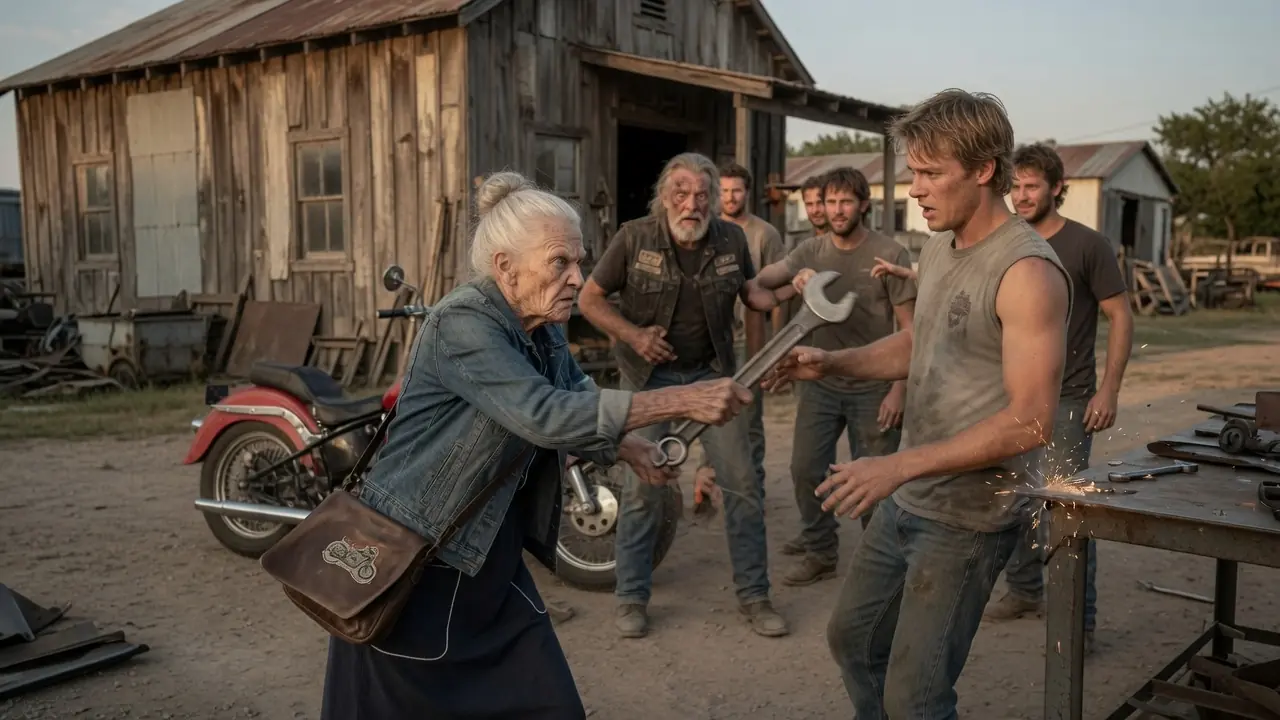
Six young men stood in a loose circle near a cherry-red motorcycle.
The oldest-looking one held a rusted pipe wrench.
Another had already smashed a plastic chair across the back of the gray-haired biker kneeling on the pavement.
Broken glass glittered near his boots.
The old man had one hand pressed against his ribs.
Blood ran from the corner of his mouth.
The motorcycle beside him was beautiful—old, hand-built, polished carefully enough that even Eleanor could tell someone loved it.
But nobody seemed interested in the motorcycle anymore.
They were interested in humiliating the man who owned it.
The leader noticed Eleanor watching.
He was perhaps twenty-three, skinny through the face, wearing a sleeveless shirt and the expression of someone who had spent his entire life mistaking cruelty for strength.
“Keep walking,” he told her.
Eleanor did not.
The biker lifted his head.
Their eyes met.
There was no embarrassment in his face.
Only pain.
And something worse.
Recognition that everyone else had already chosen not to help.
The cashier inside the gas station had locked the glass door.
A pickup had slowed near the entrance, then accelerated away.
A woman pushing a stroller had crossed the street.
People had seen.
People had calculated.
Six against one.
Not my problem.
Then the biker spoke.
“Ma’am…”
His voice broke.
“Please.”
That single word carried Eleanor backward almost sixty years.
She was twelve again, standing inside her father’s motorcycle garage in Wichita while two drunk men kicked a young mechanic behind the building.
Her father, Caleb Briggs, had put down the carburetor in his hands and walked outside.
Eleanor had grabbed his sleeve.
“There are two of them.”
Caleb had looked down at her.
“And only one of him.”
He went anyway.
She remembered what he told her that night while washing blood from his knuckles.
Being outnumbered explains fear, Ellie. It doesn’t excuse pretending you didn’t see.
Her father had been dead twenty-nine years.
But Eleanor heard him clearly.
She set the grocery bag on the hood of her Buick.
Then she took out her phone.
The young man with the wrench laughed.
“What are you doing?”
“Recording.”
“You think I care?”
“No,” Eleanor said. “But your probation officer might.”
His smile disappeared.
One of the others snorted.
“Come on, Corey. Leave her.”
So the leader had a name.
Eleanor raised the phone higher.
“Thank you.”
Corey Maddox stared at his friend.
The boy realized his mistake immediately.
Eleanor continued.
“Corey Maddox. Good. Five more.”
Corey stepped toward her.
“You better put that phone away.”
Eleanor’s knees hurt.
Her left hip had hurt every morning for three years.
She had a bottle of metformin in her purse, cataract surgery scheduled in October, and exactly eleven dollars in cash until her pension deposit arrived Friday.
But she stood still.
“No.”
Corey tightened his grip on the wrench.
The biker tried to rise.
One of the boys shoved him back down.
Eleanor saw it.
Something inside her settled.
Fear remained.
But decision had arrived beside it.
She pressed the panic button on her Buick key.
The horn exploded through the gas station.
Lights flashed.
Corey jumped.
“What the hell?”
Eleanor kept pressing it.
The alarm screamed.
Cars on the road slowed.
Two people at the traffic light turned their heads.
A landscaping truck stopped near the entrance.
Corey shouted over the horn.
“Turn that off!”
Eleanor raised her voice.
“HELP! CALL 911! SIX MEN ARE ROBBING AN OLD MAN!”
The doors of the landscaping truck opened.
Two workers stepped out.
Not approaching yet.
But watching.
That changed the numbers.
Corey saw it too.
He moved toward Eleanor.
“You stupid old—”
The biker surged up behind him.
Not fast.
Not dramatically.
He simply got one foot beneath himself and caught Corey’s wrist before the wrench could rise.
The movement was practiced.
Corey’s hand opened.
The wrench hit the pavement.
The old biker kicked it away.
Then pain folded him again.
Eleanor reached him before he fell completely.
She put one arm around his back.
He was far heavier than she expected.
“Easy.”
“Ma’am, get away from here.”
“No.”
“There are six.”
“I can count.”
One of the landscaping workers shouted from the entrance.
“Police are coming!”
Another driver had stopped now.
Then a third.
Phones were raised.
Corey looked around.
The private little world where six men could terrorize one stranger had vanished.
Now there were witnesses.
“Everybody get in the car,” he snapped.
One of his friends hesitated.
“What about the bike?”
“Forget the damn bike!”
Within seconds, the six scrambled into a battered Chevrolet.
Corey pointed at Eleanor through the passenger window.
“This isn’t over.”
She looked directly at him.
“At my age, son, everything is closer to over than you think.”
The Chevy tore out of the lot.
Eleanor finally released the panic alarm.
Silence hit almost as hard as the noise had.
The biker took one breath.
Then another.
His knees buckled.
Eleanor lowered him onto the curb.
“You staying conscious?”
“I was planning on it.”
“Good. Saves paperwork.”
Despite the blood at his mouth, he smiled.
“Name?”
“Victor Hale.”
“I’m Eleanor Briggs.”
He looked at her.
“Briggs?”
“Yes.”
Something flickered across his face.
Before she could ask, sirens approached.
Two patrol cars and an ambulance arrived minutes later.
The gas-station cashier finally unlocked the door.
The officers collected Eleanor’s video, the station’s security footage, and statements from the landscaping crew.
Corey’s name made things easier.
The officers knew him.
So did the sheriff’s office.
The six men had been suspected in two previous robberies involving older drivers at isolated gas stations.
Victor had simply been the first victim who refused to surrender his motorcycle quickly enough.
A paramedic examined him.
“Possible cracked ribs. You need imaging.”
“I’m fine.”
Eleanor looked at him.
“No, you’re old and stubborn. Those are different medical conditions.”
Victor glanced toward the paramedic.
“She always like this?”
“I met her ten minutes ago.”
“Feels longer.”
The paramedic smiled.
Victor eventually agreed to go to urgent care instead of the hospital.
His motorcycle was undamaged, but he was in no condition to ride it.
The landscaping company owner offered to secure it inside his fenced yard until someone could collect it.
Victor thanked him.
Then he turned to Eleanor.
“You saved my life.”
“No.”
“You did.”
“I made noise.”
“You walked toward six men when everyone else walked away.”
Eleanor picked up her grocery bag.
One side had split.
A can of peaches rolled onto the pavement.
Victor bent automatically to retrieve it, then winced and stopped.
Eleanor picked it up herself.
“You’d better learn something quickly about me, Mr. Hale.”
“What?”
“I don’t accept dramatic statements before supper.”
Eleanor lived alone in a small white house on Sycamore Street.
Her husband, Frank, had died eleven years earlier.
Their son lived in Denver and called every Sunday.
Their daughter lived in Atlanta and called whenever she remembered, which was often enough that Eleanor forgave her for the weeks she did not.
The house had belonged to Eleanor’s father before her.
Almost everything inside it had changed over the decades.
The kitchen had been remodeled.
The wallpaper removed.
The old coal furnace replaced.
But one room remained nearly untouched.
Caleb Briggs’s workshop.
It occupied a converted garage behind the house.
Eleanor kept it locked most of the time.
Inside hung her father’s leather riding vest.
A faded photograph showed Caleb at twenty-six beside three veterans and four motorcycles.
His military dog tags rested in a wooden box.
His battered black helmet sat on a shelf above coffee tins full of bolts he had once insisted might become useful.
There were old club patches, race programs, photographs from motorcycle rallies, and a hand-painted fuel tank bearing the delicate silver-and-blue pinstriping that had made Caleb locally famous.
Eleanor never called the objects a collection.
They were simply her father’s things.
She had spent most of her adult life pretending she was saving them for someone.
Her son did not ride.
Her grandchildren lived far away.
Frank had always said they should put the best pieces in display cases.
Eleanor refused.
“They weren’t museum pieces when Daddy used them.”
So they remained where Caleb left them.
She thought about that room after the gas-station attack.
Something about Victor’s face when she said her last name bothered her.
He knew it.
Or thought he did.
The following afternoon, a black pickup stopped outside the house.
Victor climbed out slowly.
Fresh bruises colored the side of his face.
He wore a plain denim shirt instead of his leather vest.
Behind him stood a younger man carrying Eleanor’s grocery bag.
A new grocery bag.
Full.
Eleanor opened the screen door.
“What is this?”
Victor pointed.
“Replacement groceries.”
“I did not lose all my groceries.”
“You lost the eggs.”
“Four eggs broke.”
“Then consider the rest interest.”
Eleanor folded her arms.
“You’re already becoming irritating.”
“So I’ve been told.”
The younger man introduced himself as Victor’s nephew, Miles.
He carried the groceries inside while Victor remained on the porch.
Then Victor removed an envelope from his shirt pocket.
Eleanor saw money inside.
“No.”
“You don’t know what it is.”
“It’s money.”
“Yes.”
“No.”
“Mrs. Briggs—”
“Eleanor.”
“Eleanor, you stepped between me and a man holding a pipe wrench.”
“And?”
“You were shoved.”
“I have been shoved before.”
“My ribs are cracked.”
“Those are your ribs.”
He looked at her for a long moment.
Then laughed carefully.
“That family name really is Briggs, isn’t it?”
Eleanor’s expression changed.
“What does that mean?”
Victor looked through the screen toward the hallway.
On the wall hung a framed photograph of Caleb in his mechanic’s coveralls.
Victor became silent.
“May I come in?”
Eleanor hesitated.
Then opened the door.
Victor walked toward the photograph.
He stood inches from it.
His face seemed to lose twenty years.
“Caleb Briggs.”
Eleanor’s heart gave a strange little jump.
“You knew him.”
Victor did not answer immediately.
“Do you still have his shop?”
Her suspicion returned.
“How do you know there was a shop?”
“Because I slept there for three months.”
Eleanor stared at him.
Victor turned.
“In 1977.”
She sat down without meaning to.
Victor lowered himself carefully into the chair across from her.
“I was nineteen,” he said. “I had eighty-two dollars, a 1962 Harley that leaked more oil than it held, and a father who had decided I wasn’t welcome home anymore.”
Eleanor listened.
Victor had grown up outside Tulsa.
His father drank.
His mother disappeared when he was fifteen.
At nineteen, after an argument that ended with Victor being thrown through a kitchen door, he left.
He rode north.
The motorcycle broke down outside Wichita.
He pushed it nearly four miles.
Then he found Briggs Motor & Welding.
“Your father was closing,” Victor said. “I asked if I could use a wrench.”
Eleanor could almost see Caleb’s reaction.
“He said no.”
Victor smiled.
“He said, ‘A wrench isn’t going to fix whatever stupidity got that engine this hot.’”
Eleanor laughed.
“That sounds like Daddy.”
“He looked at the bike for maybe thirty seconds. Then he looked at me for five.”
Victor rubbed one hand across his jaw.
“He knew.”
“Knew what?”
“That I wasn’t just traveling.”
Victor’s voice softened.
“He let me sleep in the back room.”
Eleanor had never heard this story.
Her father rarely talked about the people he helped.
Maybe that had been the point.
“He made me work,” Victor continued. “Wouldn’t give me cash. Said cash was too easy to waste. Paid me in meals, parts, and eventually wages.”
“For how long?”
“Three months.”
“What happened?”
“He told me I was good enough to build motorcycles if I stopped pretending I already knew everything.”
Eleanor smiled.
“That also sounds like Daddy.”
“He taught me welding properly. Paint preparation. Engine timing. How to listen to customers even when they didn’t know how to explain what was wrong.”
Victor’s eyes moved back to Caleb’s photograph.
“He gave me my life.”
The words made the room quieter.
“What did you do after?”
“I left for California. Worked at two shops. Opened my own place in ’84.”
“You own Hale Custom Motorworks?”
Victor looked surprised.
“You know it?”
“My father read motorcycle magazines until the day his eyesight failed.”
Victor smiled faintly.
“Hale Motorworks has eight shops now. We build maybe forty custom motorcycles a year. Restoration, fabrication, training.”
Eleanor studied him.
“Why didn’t Daddy ever tell me about you?”
“Probably because I wasn’t special.”
“You just said he gave you your life.”
“He gave a lot of people something.”
That was true.
Eleanor remembered men appearing at Caleb’s funeral whom she had never seen before.
Mechanics.
Veterans.
Former addicts.
A schoolteacher who claimed Caleb paid his tuition.
A woman who said Caleb taught her to rebuild a carburetor after her husband left.
Her father had accumulated people quietly.
Victor leaned forward.
“I came back in 1996.”
Eleanor looked up.
“To find him.”
She knew the year immediately.
“Two years too late.”
Victor nodded.
“The shop was closed.”
“Daddy died in ’94.”
“I found someone who told me.”
He looked down at his hands.
“I had imagined walking in wearing an expensive jacket, showing him what I built. Stupid, really.”
“No.”
“I wanted him to know he was right.”
Eleanor’s throat tightened.
“He knew.”
Victor looked at her.
“How?”
“Because my father believed people long before they believed themselves.”
For a while, neither spoke.
Then Victor noticed the door leading toward the old workshop.
“Is that…”
Eleanor understood.
“You want to see it?”
“If you’ll let me.”
She led him outside.
The garage door groaned when she lifted it.
Victor stepped inside.
He stopped breathing.
Caleb’s vest.
Helmet.
Tools.
Photographs.
Old motorcycle parts.
Forty years of dust and memory.
Victor walked slowly.
He did not touch anything at first.
Then he saw the silver-and-blue fuel tank.
His hand rose to his mouth.
“He painted that the night I left.”
Eleanor turned.
“What?”
Victor moved closer.
“I watched him.”
The tank had always been a mystery.
Caleb never installed it on a motorcycle.
He simply finished it, wrapped it in cloth, and stored it.
Victor pointed toward a tiny imperfection in the silver stripe.
“He let me pull that line.”
Eleanor stared at the mark.
“You painted part of this?”
“About three inches.”
He smiled sadly.
“Badly.”
She laughed through sudden tears.
Victor looked around.
Then he noticed a tarp at the rear of the garage.
“What’s under there?”
Eleanor hesitated.
“My father’s motorcycle.”
Victor turned sharply.
“You still have it?”
She pulled the tarp back.
Beneath decades of dust sat a 1951 Harley-Davidson.
The tires were collapsed.
Chrome had dulled.
The seat had split.
Rust marked the exhaust.
But the lines remained beautiful.
Victor looked at it the way some people looked at cathedrals.
“Dear God.”
“He stopped riding after his first heart attack.”
Victor walked around it.
“Has it run since?”
“1990.”
“Why keep it?”
“Because selling it felt like admitting he wasn’t coming back.”
Victor nodded.
He understood immediately.
Eleanor wiped her cheek with the heel of her hand.
“You restore motorcycles.”
“Yes.”
“No.”
He looked at her.
“I haven’t offered anything.”
“You’re about to.”
Victor smiled.
“I was.”
“No.”
“Why?”
“Because I know what a restoration like that costs.”
“I owe your father.”
“You owed him forty-nine years ago.”
“I never paid.”
“He never asked.”
“That doesn’t mean the debt disappeared.”
Eleanor shook her head.
Victor looked toward the motorcycle.
“All right. Not a gift.”
She waited.
“A job.”
“What?”
“You own the motorcycle. I have the shop. We restore it together.”
“I’m seventy-two.”
“So?”
“I don’t know how to rebuild a motorcycle.”
“Neither did I before your father taught me.”
She looked at him.
Victor’s smile widened.
“You saved me Tuesday. Let me teach you something Thursday.”
By Friday morning, the gas-station video was on local television.
By Friday afternoon, it was everywhere.
The headline changed depending on the station.
72-YEAR-OLD WIDOW CONFRONTS SIX MEN ATTACKING BIKER.
GRANDMOTHER’S PHONE CAMERA HELPS POLICE IDENTIFY ROBBERY SUSPECTS.
ELDERLY WOMAN REFUSES TO WALK AWAY FROM GAS-STATION ATTACK.
Eleanor hated every version.
“I am not elderly.”
Her son laughed over the phone.
“Mom, you are seventy-two.”
“That is older. Elderly is eighty-eight and complaining about soup.”
Her son stopped laughing when he watched the actual footage.
“Why didn’t you call me?”
“And what would you have done from Colorado?”
“Mom.”
“I am fine.”
“You walked toward six men.”
“One of them had terrible posture. I wasn’t impressed.”
“Mom.”
She softened.
“I was scared.”
That silenced him.
“I was terrified,” Eleanor said. “But the man asked me for help.”
Her son exhaled.
“You sound like Grandpa.”
“I know.”
The six young men were identified within two days.
Corey Maddox and two others were charged with aggravated robbery and assault. The others faced lesser charges based on their involvement.
The security footage made denial difficult.
Victor refused every interview request.
Eleanor accepted exactly one.
When the reporter asked what made her brave enough to intervene, she corrected her.
“I wasn’t brave enough.”
The reporter looked confused.
“Then why did you do it?”
“Because courage isn’t a quantity you wait to have enough of.”
Eleanor folded her hands.
“I was frightened and moved anyway.”
The clip became almost as popular as the attack footage.
Then came Saturday morning.
At 8:12, Eleanor heard thunder.
There were no storms in the forecast.
The sound grew until dishes rattled in her cabinet.
She stepped onto the porch.
Motorcycles turned onto Sycamore Street.
Ten.
Twenty.
Thirty.
Then more.
They rode slowly.
No racing.
No revving.
No blocking intersections.
Old bikes.
New bikes.
Touring machines.
Restored classics.
Men and women ranging from their twenties into their seventies.
Forty-seven motorcycles in all.
Neighbors appeared on porches.
Children ran toward the sidewalks.
At the front rode Victor on the cherry-red machine from the gas station.
He parked before Eleanor’s house.
Every rider behind him stopped.
One by one, the engines shut down.
Silence descended.
Eleanor crossed her arms.
“If this is some kind of parade, I’m going back inside.”
Victor removed his helmet.
“It’s not.”
He walked toward her.
The riders remained beside their motorcycles.
Victor stopped at the bottom of the porch steps.
“These are members of the Grey Road Association.”
Eleanor glanced across the street.
“Are you all allergic to cars?”
A few riders laughed.
Victor continued.
“We’re mechanics, veterans, nurses, firefighters, truck drivers, teachers. Mostly people who should know better than to spend this much money on machines that attract rain.”
More laughter.
Then his expression became serious.
“For forty years, our organization has had a rule.”
Eleanor raised one eyebrow.
Victor looked directly at her.
“We don’t forget who stops.”
A woman stepped forward carrying a wooden box.
Victor opened it.
Inside lay a small brass plaque.
It read:
CALEB BRIGGS
HE TAUGHT US TO STOP
Eleanor stared.
Victor pointed toward the old workshop.
“With your permission, I want that mounted inside the garage.”
Her eyes filled.
“You brought forty-seven motorcycles for a plaque?”
“No.”
He smiled.
“I brought forty-seven people because twenty-three of them were trained by someone I trained.”
Eleanor looked along the line.
Victor continued.
“And eight were trained by those people.”
Understanding came slowly.
Her father had taught one nineteen-year-old runaway.
That young man built shops.
Those shops trained mechanics.
Those mechanics trained others.
Caleb Briggs had been dead nearly thirty years.
Yet half a street of people existed differently because he once opened a garage door.
Eleanor covered her mouth.
Victor lowered his voice.
“This is what your father built.”
She looked away.
For several seconds, she could not speak.
When she finally did, her voice was small.
“He never knew.”
Victor shook his head.
“Maybe people like him aren’t supposed to.”
The restoration began the following Monday.
Eleanor expected technicians to do most of the work.
Victor refused.
“Your motorcycle.”
“My father’s motorcycle.”
“Your name is on the title now.”
“I’m seventy-two.”
“You keep repeating that like it’s a mechanical defect.”
So Eleanor learned.
She learned to label parts.
She learned the difference between rust that looked bad and corrosion that mattered.
She cleaned hardware in solvent.
She polished metal.
She cursed at a seized bolt until Victor laughed so hard his ribs hurt again.
She learned why her father kept coffee tins full of washers.
Victor never rushed her.
When her hands hurt, they stopped.
When her blood sugar dropped one afternoon, he drove her home without treating her like glass.
Their friendship formed in the quiet hours between tasks.
Victor told her about his wife, Patricia, who had died from cancer eight years earlier.
Eleanor told him about Frank.
They compared grief without competing.
They discussed children.
Regrets.
Age.
The strange embarrassment of needing help after decades of providing it.
One evening, Victor found Eleanor staring at Caleb’s riding vest.
“What?”
She shook her head.
“I was angry at him for years.”
“For dying?”
“For being everybody’s hero.”
Victor waited.
“He fixed strangers’ cars for free. Found jobs for men nobody trusted. Took calls in the middle of dinner.”
She smiled sadly.
“As a child, I thought everyone got more of him than I did.”
“That can happen.”
Eleanor looked at Victor.
“You would know.”
“Yes.”
He did not defend Caleb.
That made her trust him more.
“But when my husband got sick,” she continued, “Daddy drove four hundred miles every month to help us.”
Victor nodded.
“People aren’t one story.”
“No.”
She touched the edge of the leather vest.
“I think I’m finally old enough to forgive him for being human.”
Victor smiled.
“Careful. That’s a dangerous habit.”
The restored Harley started seven months later.
Eleanor stood beside it inside the workshop.
Victor turned the key.
The engine hesitated.
Coughed.
Then roared to life.
The sound hit Eleanor in the chest.
Suddenly she was nine years old.
Caleb was outside.
Her mother was yelling that dinner was cold.
Her father was laughing.
The past did not return.
But for thirty seconds, it came close enough to hear.
Eleanor cried openly.
Victor stood beside her.
Neither apologized.
After the engine warmed, he shut it down.
“There’s one more thing.”
Eleanor wiped her face.
“What?”
Victor pointed toward a sidecar sitting near the wall.
She stared.
“No.”
“You haven’t even heard the proposal.”
“I know exactly what you’re proposing.”
“You said your balance isn’t good enough to ride solo.”
“I’m seventy-two.”
Victor grinned.
“There it is again.”
Three weeks later, Eleanor Briggs rode in her father’s restored motorcycle for the first time in forty years.
Victor drove.
She sat in the sidecar wearing Caleb’s restored helmet.
The Grey Road riders followed several car lengths behind.
No parade.
No cameras.
Just a Sunday morning road outside Wichita.
Eleanor laughed until tears streamed beneath her glasses.
At the first stop, Victor looked down.
“You all right?”
She nodded.
“My father would hate the sidecar.”
“Why?”
“He thought they were ugly.”
Victor smiled.
“He was wrong about many things.”
“You knew him three months.”
“Long enough.”
The next chapter began because of Corey Maddox.
Eighteen months after the gas-station attack, Eleanor walked into Victor’s flagship workshop and saw Corey standing near the office.
He had lost weight.
His hair was shorter.
He held a folder in both hands.
Eleanor stopped.
Victor immediately came from behind his desk.
“You want him gone?”
Corey lowered his eyes.
Eleanor studied him.
“No.”
Victor remained close.
Corey swallowed.
“I’m not here to ask you to forgive me.”
“Good,” Eleanor said. “I wasn’t planning to.”
He nodded.
“I took a plea.”
She knew.
Fourteen months in county custody followed by probation, treatment, and restitution.
“I got out six weeks ago.”
“And?”
“Nobody’ll hire me.”
Eleanor waited.
“I heard Mr. Hale has a training program.”
Victor folded his arms.
“For people who want to become mechanics.”
“I do.”
“You tried to rob me.”
“Yes, sir.”
“You threatened her.”
“Yes, sir.”
“You believe that disappears because you want a job?”
“No.”
Corey finally looked at Eleanor.
“I’m asking for a place to start being somebody else.”
The workshop became silent.
Eleanor saw the boy from the gas station.
Then she saw the man standing before her.
They were not different people.
That was important.
Change did not erase responsibility.
It had to carry it.
She looked toward Victor.
“Do you need anyone to clean?”
Victor understood.
“There’s always cleaning.”
Corey started with a broom.
He was not trusted with motorcycles.
He did not touch customer tools.
For three months, he swept floors, emptied bins, cleaned bathrooms, and arrived before everyone else.
Then Victor allowed him into the parts room.
Six months later, he began basic training.
One year later, Corey stood beside Eleanor at a youth workshop helping a fourteen-year-old remove a seized bolt.
The boy grew frustrated.
Corey said quietly, “Don’t force it because you’re angry. That’s how you break things.”
Eleanor heard him.
Corey saw her watching.
Neither mentioned the irony.
Some lessons worked better without speeches.
The community workshop opened two years after the gas-station attack.
Eleanor came up with the idea.
Victor provided the building.
A former grocery store on the east side became Briggs Road Garage & Training Center.
Teenagers could learn welding, motorcycle repair, automotive basics, electrical work, and fabrication.
Students paid nothing.
They earned places through attendance and effort.
Local businesses hired graduates.
Caleb Briggs’s tools were mounted behind glass near the classroom.
His old vest hung beside them.
Not because Eleanor finally agreed it belonged in a museum.
Because she realized history was useful when it could teach.
Beneath the display was the brass plaque.
HE TAUGHT US TO STOP.
Eleanor worked at the front desk two days a week.
Victor insisted on paying her.
She argued.
He won by reminding her that Caleb had never believed in free labor.
At seventy-four, Eleanor learned accounting software.
At seventy-five, she learned to text without using one finger.
At seventy-six, she could identify six motorcycle engines by sound.
Children called her Mrs. B.
She corrected anyone who called her Grandma unless they were related.
Victor visited nearly every day.
People occasionally asked whether they were a couple.
Eleanor would answer, “At our age, minding your own business is a form of community service.”
Victor enjoyed that answer so much he stopped correcting anyone.
Their relationship was not something either needed to name.
They had both loved deeply before.
They had both buried the people who knew their younger selves.
What they gave each other now was different.
Companionship.
History.
Someone to call when the doctor gave confusing instructions.
Someone who understood why an old song could ruin an entire afternoon.
Someone who would sit quietly when words became unnecessary.
Four years after Eleanor entered that gas station, Victor and she attended a graduation ceremony inside Briggs Road Garage.
Twelve students received trade certificates.
Corey Maddox stood among the instructors.
His mother attended.
She cried through most of the ceremony.
The youngest graduate was a seventeen-year-old girl named Tasha Monroe who had spent part of her childhood moving between foster homes.
Tasha had arrived at the garage angry at nearly everyone.
Machines made sense to her.
Victor understood that.
So did Eleanor.
When Tasha’s name was called, she crossed the floor and hugged Eleanor first.
“You said no hugging.”
“I changed my mind.”
Eleanor whispered, “People are allowed to.”
After the ceremony, Victor and Eleanor sat outside near Caleb’s restored Harley.
The evening light settled across the parking lot.
Students laughed near the doors.
Corey was helping a boy load tools into an old pickup.
Victor looked at Eleanor.
“Do you ever think about that day?”
“The gas station?”
“Yes.”
“Sometimes.”
“Were you really not scared?”
She turned slowly.
“Victor Hale, I was seventy-two years old, five foot four, and had six angry young men threatening me.”
“So?”
“So I nearly wet myself.”
Victor laughed hard enough to cough.
Eleanor smiled.
“Courage gets edited after the fact.”
“What do you mean?”
“People tell stories and remove the shaking.”
She looked toward the garage.
“They say, ‘She walked right up.’ They forget I wanted to keep walking.”
“But you didn’t.”
“No.”
“Why?”
Eleanor considered the question.
Then she looked at Caleb’s motorcycle.
“Because my father had already taught me the answer sixty years earlier.”
Victor nodded.
“One of him.”
“One of him,” Eleanor repeated.
Eleanor Briggs died peacefully at eighty-three.
Not at the gas station.
Not on a motorcycle.
Not in some dramatic final act.
She died at home on a Tuesday morning after drinking half a cup of coffee and complaining that the weather forecast was wrong again.
Victor was eighty years old by then.
He stood beside Eleanor’s son at the funeral.
Hundreds attended.
Mechanics.
Former students.
Neighbors.
Veterans.
Nurses.
Teachers.
Police officers.
Men and women from the Grey Road Association.
Corey Maddox came with his wife and two children.
Tasha came wearing a Briggs Road instructor shirt.
Outside the church stood Eleanor’s father’s Harley with the sidecar attached.
Her helmet rested on the seat.
After the service, Victor walked alone to the workshop.
He stood before Caleb’s display.
Then he placed something inside the case.
Eleanor’s Buick key.
The one with the red panic button worn nearly white from years of use.
Beside it, he added a small brass plate.
ELEANOR BRIGGS
SHE MADE ENOUGH NOISE FOR EVERYONE TO LOOK
The following Saturday, forty-seven motorcycles gathered outside the garage.
Then sixty.
Then ninety.
Former students brought their own bikes.
Others came in cars.
Some arrived by bus.
Nobody had planned the size of the gathering.
People simply came.
Victor stood before them leaning on a cane.
His voice was weaker now.
It still carried.
“Most of you know the story.”
He looked toward the restored Harley.
“Six men had me on the ground.”
A few people shifted quietly.
“I asked for help.”
Victor swallowed.
“One person stopped.”
He looked toward the young students standing near the doors.
“That’s what everyone remembers.”
He shook his head.
“But that isn’t the whole story.”
Victor raised one hand toward Caleb’s workshop display.
“Eleanor stopped because someone had spent a lifetime teaching her what stopping meant.”
Then toward himself.
“I built shops because Caleb Briggs stopped for me.”
Toward Corey.
“He became a mechanic because Eleanor gave him a way to earn another beginning.”
Toward Tasha.
“She became an instructor because this garage opened its door.”
Victor smiled.
“That’s the part people misunderstand about kindness.”
He paused.
“They think it’s a line between two people.”
His eyes traveled across the crowd.
“It isn’t.”
“It’s a chain.”
No one applauded immediately.
The words were too quiet for that.
Eventually, Victor placed Eleanor’s helmet inside the sidecar.
He started Caleb’s motorcycle.
The old engine settled into a deep rhythm.
One by one, engines started behind him.
Victor rode first.
The sidecar remained empty.
But Eleanor’s helmet rode inside it.
They passed the old gas station on Fifth Street.
It had changed owners twice.
The pumps were newer.
The faded wall had been repainted.
Most people driving past would never know anything had happened there.
Victor slowed anyway.
So did everyone behind him.
For a few seconds, dozens of engines dropped to idle.
Then Victor continued down the road.
Years later, students at Briggs Road Garage still heard the story.
They heard about six men.
An old biker.
A frightened seventy-two-year-old widow.
A car alarm.
A phone held steady despite shaking hands.
But the instructors always corrected one part.
Eleanor Briggs did not save Victor because she was fearless.
She saved him because fear had asked her to walk away…
…and somewhere inside her lived the voice of a mechanic who had taught his daughter that being outnumbered explained fear, but never excused pretending she had not seen.
That was why she stopped.
That was why Victor remembered.
That was why the garage remained open.
And that was why three words were carved above the entrance where every student could see them before stepping inside.
WE DON’T WALK AWAY.