By the time the old John Deere returned to Dawson’s Agricultural Repair for the third time, its mysterious noise had become a county legend.
Farmers argued about it over breakfast at Miller’s Diner.
Mechanics discussed it beside parts counters and fuel pumps.
Some described the sound as a hard metallic clank, like a wrench striking the inside of a transmission housing. Others claimed it was deeper—a single dull blow that seemed to travel through the entire rear axle.
Everyone agreed on only one thing.
It happened while the tractor was climbing a hill.
Never on level ground.
Never while idling.
Never when backing up.
Never while descending.
Only when the engine was pulling hard and the tractor tilted against gravity did the sound appear.
One sharp strike.
Then silence.
That single clank had already cost Samuel Whitaker thousands of dollars.
It had also damaged something no invoice could measure.
The pride of six professional mechanics.
The tractor was a John Deere 4020 that had worked Whitaker Farm for nearly fifty years.
Its original green paint had faded beneath decades of sunlight. Scratches crossed the hood where tree branches, loader hooks, and careless tools had found it over the years. Repairs were visible everywhere—a welded step, a patched fender, a newer hydraulic hose beside one that looked almost as old as the tractor itself.
Most people saw an aging machine near the end of its useful life.
Samuel saw his family.
He had purchased the John Deere new in the early 1970s after years of saving money from harvest work on neighboring farms. It had plowed every field he owned, hauled corn during cold autumn evenings, pulled hay wagons through spring mud, and carried three generations of Whitakers around the property.
His wife, Martha, used to tease him about the tractor.
“You polish that green hood more often than you polish your church shoes,” she would say from the porch.
Samuel always denied it.
Martha always smiled because both of them knew she was right.
After she died five years earlier, the John Deere became even more important to him.
On difficult afternoons, Samuel sometimes climbed into the seat without starting the engine. He rested his hands on the worn steering wheel and remembered Martha bringing coffee to the field, their children riding beside him, and the years when the farm still seemed full of voices.
That was why he noticed the strange sound immediately.
The first clank came while he was pulling a loaded hay wagon up the hill behind the north pasture.
The engine settled into a deep working rhythm.
The front end lifted slightly beneath the load.
Then came the sound.
Clank.
Samuel stopped at the top.
He checked the drawbar, hitch pin, wagon tongue, rear axle, wheel bolts, and hydraulic connections.
Nothing appeared loose.
The next morning, he drove the same hill without the wagon.
No sound.
He attached a manure spreader and climbed again.
Clank.
He tried a different gear.
Same result.
He changed the transmission oil and examined the magnetic drain plug.
Only normal wear particles appeared.
He inspected everything he could reach.
Still, the sound returned.
After two weeks, his grandson Ethan convinced him to take the tractor to Dawson’s Agricultural Repair.
“If anyone can find it, Grandpa, Rick can.”
Samuel looked toward the John Deere.
“We’ll see.”
Dawson’s was the largest repair shop in the county.
Six certified mechanics worked beneath bright overhead lights using pressure gauges, diagnostic computers, precision measuring tools, and factory service manuals.
Rick Dawson had owned the business for twenty-five years.
He had repaired tractors that other shops refused to touch. Farmers trusted him with machines worth more than their homes.
When Samuel described the problem, Rick listened carefully.
“One clank?”
“Yes.”
“Only uphill?”
“Yes.”
“Under load?”
“Usually.”
“Any vibration afterward?”
“No.”
“Does the steering change?”
“No.”
“Hydraulic pressure drop?”
“No.”
Rick nodded confidently.
“We’ll find it.”
He meant it.
The mechanics began with the transmission.
The sound seemed to come from beneath the seat, and the hill placed extra torque through the drivetrain. A damaged gear, worn bearing, or shifting shaft appeared to be the logical explanation.
Three days later, much of the tractor lay across several workbenches.
The transmission had been opened.
Gears were inspected under magnification.
Shaft movement was measured.
Bearings were checked.
Seals, bushings, and spacers were examined one by one.
They found wear, but no failure capable of producing the sound.
Rick replaced several questionable components anyway.
The tractor was reassembled.
He drove it toward the test hill behind the shop.
Halfway up, the engine began working harder.
Clank.
Rick’s hands tightened around the steering wheel.
The sound had not changed.
Back inside the shop, the mechanics developed new theories.
Jerry Mills blamed the differential bearings.
Alan Foster suspected the final drive.
A younger technician named Cody believed the clutch assembly shifted when the tractor’s weight moved backward.
Each explanation sounded reasonable.
Each was supported by experience.
The tractor came apart again.
The rear axle was inspected.
The clutch was rebuilt.
Engine mounts were replaced.
The hydraulic pump was overhauled after one mechanic argued that internal pressure might be forcing a bracket against the housing.
Thousands of dollars in parts and labor disappeared into the machine.
The clank remained.
One afternoon, Cody leaned against a toolbox and watched Samuel arrive.
“Maybe the old man’s hearing something that isn’t there.”
Jerry shook his head.
“Rick heard it.”
“Old tractors make noise.”
“Not one noise in one place under one condition.”
Samuel walked past them.
He had heard every word.
He did not respond.
He simply said, “I’ve driven that tractor for fifty years. It wasn’t born making that sound.”
The third inspection became even more aggressive.
The tractor was split again.
Every major component between the engine and rear axle was checked.
A factory-trained technician reviewed the work and suggested replacing a thrust washer inside the transmission.
The part showed slight polishing along one edge.
Rick doubted it was responsible, but by then the shop had run out of stronger ideas.
They replaced it.
Another test followed.
Clank.
The sound now felt less like a mechanical symptom and more like an insult.
Two more weeks passed.
Samuel remained patient, but Ethan saw the worry beneath his calm expression.
The repair bill had grown larger than the tractor’s market value.
Hay needed moving.
Autumn work was approaching.
Buying another tractor would have been practical.
Samuel refused to discuss it.
“That Deere has more good years in it.”
“You don’t know that,” Ethan said.
“I know the engine.”
“The engine isn’t making the sound.”
“That’s what everyone keeps saying.”
On a rainy Tuesday afternoon, Rick called them back to the shop.
He stood near the tractor looking exhausted.
“I’m running out of places to look.”
Samuel nodded.
“I know you’ve tried.”
Rick removed his cap.
“I’m sorry.”
“There’s nothing dishonest about not knowing.”
“I’ve replaced parts I couldn’t prove were bad.”
“They were worn.”
“That doesn’t mean they needed replacing.”
Samuel looked at the tractor.
“What have you not checked?”
Rick laughed without humor.
“At this point? The paint.”
One of the younger mechanics smiled.
Samuel did not.
“Show me everything.”
Rick spent nearly half an hour walking him around the John Deere.
He explained every inspection.
Every measurement.
Every replacement.
Samuel listened without interrupting.
His hands remained clasped behind his back.
When Rick described the transmission work, Samuel asked about load direction.
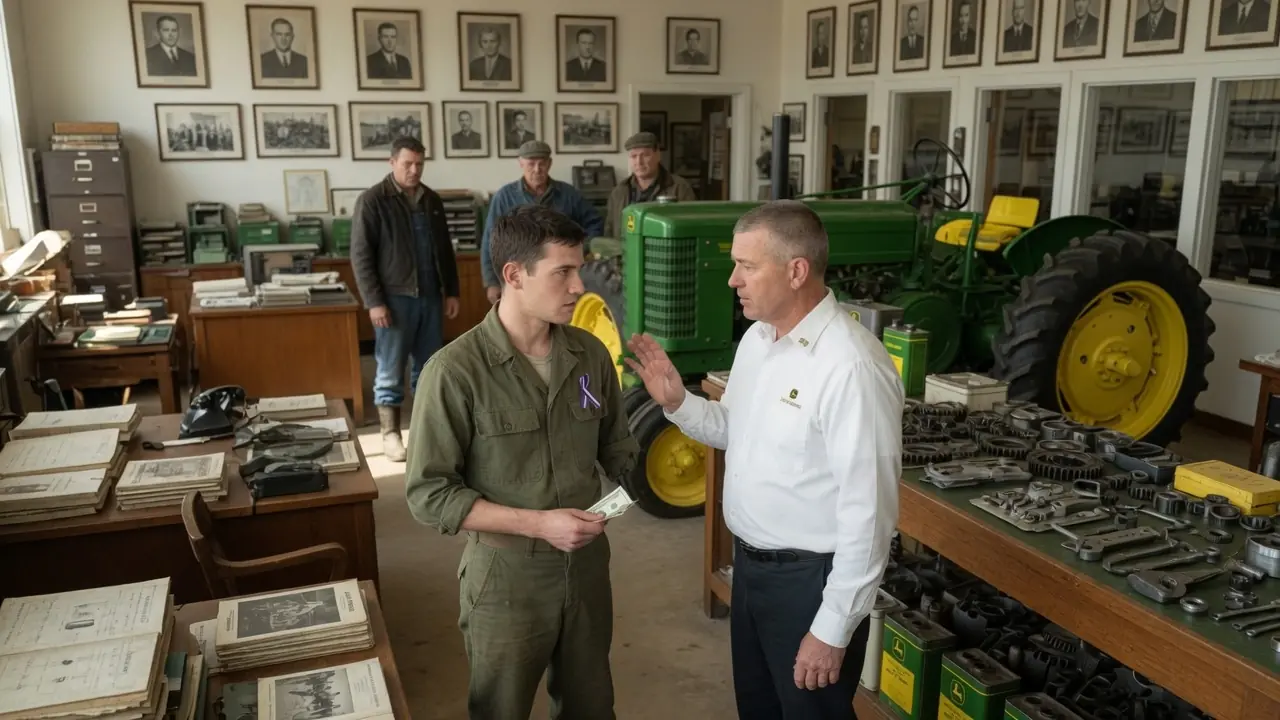
When he explained the axle inspection, Samuel asked whether the tractor had been tested with different rear-tire pressures.
When they reached the hydraulic system, Samuel asked whether the sound changed when the three-point hitch carried weight.
“No,” Rick said.
Samuel nodded.
Then he asked, “May I drive it?”
Cody whispered to another mechanic, “Now the customer’s going to diagnose it.”
The other man chuckled.
Samuel heard them.
He climbed into the seat.
The diesel started immediately.
Its deep exhaust note filled the yard.
Samuel rested his hand on the steering wheel and closed his eyes.
He listened.
Not only to the engine.
To vibration through the seat.
To the faint movements of sheet metal.
To the hydraulic pump.
To everything that had become familiar over half a century.
Then he drove toward the hill.
Halfway up—
Clank.
He continued to the top.
Turned around.
Drove down.
Then climbed again.
Clank.
He repeated the test three more times.
Each time, the sound occurred near the same section of the slope.
Rick watched from below.
Samuel was not merely listening for the noise.
He was testing when gravity changed the tractor.
When he returned, he parked on level ground and shut off the engine.
He climbed down and walked slowly around the machine.
First the front.
Then the right side.
Then the rear.
Finally, he stopped beside the left rear wheel.
The mechanics gathered behind him.
Samuel crouched with some difficulty and rested one hand on the axle housing.
“What are you feeling?” Rick asked.
“Nothing.”
He ran his fingers along a steel support bracket mounted near the rear fender.
Attached to it was an old cast-iron toolbox.
The box had been there since Samuel bought the tractor.
Its green paint had darkened beneath years of oil and dust. Two bolts held it firmly to the bracket.
Samuel pressed against it.
It did not move.
He smiled.
“There you are.”
Cody looked confused.
“The toolbox?”
Rick crouched beside Samuel and shook it hard.
“It’s solid.”
“On level ground.”
Samuel removed a wrench from his pocket.
He loosened the bolts and lifted the box free.
Inside were several old hitch pins, two nuts, a short steel clevis, and three large washers.
The contents looked ordinary.
Rick reached inside.
“Nothing’s broken.”
Samuel placed everything back exactly as he found it.
Then he tilted the box backward, matching the angle of the tractor on the hill.
A thin washer slid across the bottom.
Clank.
Every mechanic became still.
Samuel lowered the box.
Then tilted it again.
The washer moved several inches, struck the rear wall, and produced the same metallic sound that had followed the tractor for months.
Clank.
Rick stared at the washer.
“No.”
Samuel repeated it.
Clank.
Jerry stepped closer.
“That can’t sound like it’s inside the transmission.”
“Steel carries sound,” Samuel said. “The toolbox is bolted to the axle bracket. The impact travels through the frame and cast housing. The seat sits above it.”
Cody picked up the washer.
It had worn almost paper-thin along one edge.
Samuel explained.
“On level ground, it lies flat beneath the other tools. When the tractor climbs, the box tilts backward. Vibration works the washer loose, and it slides into the rear wall.”
“One time,” Rick said.
“One clank.”
“And downhill?”
“Gravity holds it against the opposite side.”
“What about rough ground?”
“It moves, but not far enough in one direction to strike cleanly.”
Rick looked toward the dismantled transmission parts stacked along the wall.
“We split the tractor three times.”
Samuel nodded.
“Because the sound appeared beneath the seat.”
“We replaced bearings.”
“Yes.”
“Rebuilt the clutch.”
“Yes.”
“Overhauled the hydraulic pump.”
“Yes.”
“For a washer inside a toolbox.”
Samuel’s eyes softened.
“The washer made the noise.”
He looked around the shop.
“Assumptions caused the repairs.”
No one spoke.
The younger mechanics avoided Samuel’s eyes.
He did not embarrass them further.
Instead, he placed the washer in Cody’s hand.
“You were not wrong to inspect the transmission.”
Cody looked up.
“We were very wrong.”
“You began in a reasonable place.”
“Then why didn’t we find it?”
“Because every time the transmission looked healthy, you asked how it could still be responsible.”
Rick slowly understood.
“We protected the theory.”
Samuel nodded.
“The first diagnosis is usually a guess. Trouble begins when a mechanic becomes loyal to it.”
Jerry leaned against the tractor.
“How did you know to check the toolbox?”
“I didn’t.”
“You went directly to it.”
“No. I drove the tractor five times.”
“What were you testing?”
“What changed.”
Samuel pointed toward the hill.
“The engine worked harder. The chassis flexed. Weight shifted backward. Loose objects shifted backward. Everyone had already tested the parts that carried power.”
He tapped the toolbox.
“No one tested the parts that carried nothing important.”
Rick laughed.
It began quietly.
Then the absurdity of the entire situation took over.
Alan laughed next.
Even Ethan joined them.
Cody remained embarrassed until Samuel smiled at him.
Then he laughed too.
Rick insisted on refunding nearly the entire repair bill.
Samuel refused.
“You and your men worked.”
“In the wrong direction.”
“You replaced worn parts.”
“Parts that might have worked another ten years.”
“Then refund the labor you believe was unnecessary.”
“All of it was unnecessary.”
Samuel looked at him.
“Did your men learn anything?”
Rick glanced toward the washer.
“Yes.”
“Then it wasn’t all wasted.”
They argued for several minutes.
Finally, Samuel accepted a partial refund on the condition that Rick use part of the remaining payment to buy lunch for everyone in the shop.
Hamburgers, fries, and cold drinks arrived that afternoon.
The mechanics gathered around a large worktable.
The mood had changed.
No one joked about Samuel’s age.
Instead, they asked questions.
“How do you separate a sound from where it seems to come from?”
“You don’t at first,” Samuel said. “You write down what you know before naming the cause.”
“What would you have written?”
“One metallic strike. Uphill only. Usually under load. No vibration after. No loss of power.”
Rick nodded.
“Not transmission clank.”
“No.”
“Because that already assumes the source.”
Samuel drank his coffee.
“Descriptions should belong to the machine. Theories belong to the mechanic. Don’t mix them too early.”
Cody looked toward the tractor.
“What if the toolbox hadn’t been the cause?”
“Then we would keep testing conditions.”
“Which conditions?”
“Angle. Load. Weight transfer. Heat. Fluid movement. Chassis flex.”
Samuel looked around the table.
“Ask what changes when the symptom appears.”
Rick repeated it quietly.
“What changes?”
“That question is often more useful than asking what part is broken.”
The tractor returned to Whitaker Farm that evening.
Samuel attached the heaviest hay wagon he owned and drove toward the north hill.
Ethan followed in the pickup.
The John Deere climbed once.
No sound.
Samuel descended and tried again.
Nothing.
On the third climb, he stopped at the top and looked back.
Ethan raised both arms.
The mystery was finished.
Samuel drove home slowly.
Near the barn, he shut off the engine and remained in the seat.
The old tractor settled into silence.
He placed one hand on the steering wheel.
“Martha,” he said softly, “you wouldn’t believe what they found.”
For a moment, he imagined her standing on the porch.
Hands on her hips.
Smiling.
Rick mounted the worn washer inside a wooden frame.
He hung it above the main workbench.
Beneath it, he placed a handwritten sign:
NEVER LET YOUR EXPERIENCE BECOME LOUDER THAN THE MACHINE.
Every new mechanic who joined Dawson’s Agricultural Repair heard the story before completing the first week.
Rick explained how six trained professionals inspected every expensive system while an ordinary washer slid inside an old toolbox.
He did not tell the story to mock his mechanics.
He told it because the mistake could happen to anyone.
The more experience a person gained, the easier it became to recognize patterns.
That skill saved time.
It also created danger.
A familiar symptom could pull the mind toward a familiar failure before the evidence was complete.
After Samuel’s visit, Dawson’s changed its diagnostic process.
Difficult cases began with a written symptom list.
No suspected cause was allowed in the first section.
Instead of writing:
TRANSMISSION KNOCK UNDER LOAD
they wrote:
SINGLE METALLIC IMPACT WHILE CLIMBING. DOES NOT REPEAT. NO CHANGE IN PERFORMANCE.
A mechanic not involved in the original diagnosis was asked to inspect the entire machine before major disassembly.
Rick called it the Whitaker Walk.
The mechanic had to circle the machine slowly.
Touch every bracket.
Open every box.
Check every weight, mount, chain, loose tool, shield, seat, fender, and accessory.
Only then could the shop begin tearing into expensive systems.
The rule saved customers thousands of dollars over the following years.
One tractor that appeared to have a failing final drive had a loose wheel weight.
A combine with an apparent separator vibration had a stone trapped inside a shield.
A loader that knocked during turns had a wrench beneath the cab floor.
Each time, someone looked toward Samuel’s washer.
The John Deere 4020 continued working for another twelve years.
It developed other problems.
The water pump failed.
An injector began leaking.
The generator required rebuilding.
Each problem had its own voice.
Samuel listened carefully.
He never again ignored the toolbox.
As he grew older, Ethan assumed more responsibility for the farm.
Samuel still drove the John Deere during hay season.
Eventually, his knees made climbing difficult.
Ethan installed a wider step and handrail.
Samuel objected at first.
Then he remembered how often machines had been modified to fit the person using them.
He accepted the change.
At eighty-seven, Samuel stopped farming full-time.
He parked the 4020 inside the machine shed after one final evening drive.
The tractor remained operational.
He insisted on that.
“A machine should retire because the work changed,” he told Ethan, “not because someone stopped caring for it.”
Samuel died two years later.
At his funeral, Rick Dawson stood near the back with all six mechanics who had worked on the tractor.
Cody, once the youngest, had become the shop foreman.
After the service, Rick gave Ethan the framed washer.
“It belongs with the tractor.”
Ethan shook his head.
“Grandpa would want it in the shop.”
“Why?”
“Because that’s where people still need the lesson.”
The washer remained above Dawson’s workbench.
Years later, apprentices sometimes assumed the story had been exaggerated.
Then Rick showed them the original invoices.
Transmission work.
Bearings.
Clutch rebuild.
Hydraulic repairs.
Thousands of dollars spent chasing one clank.
Cody eventually took ownership of the shop.
On his first day as owner, he replaced several faded signs and repainted the waiting area.
He did not move Samuel’s washer.
During training, he told young mechanics what Samuel had taught them.
“Diagnostic tools are valuable. Service manuals are valuable. Experience is valuable.”
He would point toward the frame.
“But each of those becomes dangerous when it starts telling the machine what it is allowed to be.”
One apprentice once asked, “Was Samuel Whitaker a mechanic?”
Cody considered the question.
“He was a farmer.”
“That’s not what I asked.”
“Yes, it is.”
The young man looked confused.
Cody smiled.
“Farmers of his generation repaired the machines because waiting for someone else could cost a crop. He learned from broken equipment, bad weather, and fifty years of consequences.”
“So he knew more than certified mechanics?”
“Not about everything.”
“About that tractor?”
“More than anyone alive.”
The apprentice looked at the washer.
“How?”
“Because we knew tractors.”
Cody turned toward the workbench.
“He knew that tractor.”
There was a difference.
A professional might understand how a system was designed to operate.
A person who had used one machine for fifty years understood how it breathed, shook, pulled, and changed as it aged.
Samuel knew which rattle had existed since 1974.
Which gear whined in cold weather.
Which floorboard vibrated above fifteen hundred revolutions.
And which sound did not belong.
That knowledge could not be downloaded.
It had been built one hour at a time.
The old John Deere eventually became part of Whitaker Farm’s history display.
Ethan restored the sheet metal but refused to remove every scratch.
The toolbox remained mounted beside the left rear wheel.
Inside it sat the original hitch pins, clevis, nuts, and two thick washers.
The paper-thin washer stayed at Dawson’s.
Visitors often asked why the toolbox had been preserved.
Ethan told them the story.
Some laughed.
Mechanics usually did not.
They understood how close expertise could come to blindness.
The mysterious clank had never truly hidden itself.
It appeared only uphill.
Only when gravity moved loose objects toward the back of the tractor.
Only once, because after the washer struck the wall, it remained there.
The symptom had described the answer perfectly.
The mechanics heard transmission because that was where the sound seemed to emerge.
Samuel heard movement because he first asked what the hill changed.
That was the difference.
He did not possess better tools.
He did not know more technical language.
He was willing to begin again without defending the previous answer.
Years after his death, the sign beneath the washer was replaced because the original paper had faded.
Cody copied the words exactly.
NEVER LET YOUR EXPERIENCE BECOME LOUDER THAN THE MACHINE.
Below it, he added another sentence:
DESCRIBE WHAT HAPPENS BEFORE DECIDING WHY.
Every apprentice who entered Dawson’s eventually stood beneath those words.
They learned that wisdom was not measured only by certificates, expensive equipment, or the number of machines a person had repaired.
It was also measured by patience.
By humility.
By the willingness to test an ordinary answer after an impressive theory had already failed.
Six professional mechanics had searched inside the most complicated parts of the John Deere.
An eighty-year-old farmer listened to one clank, considered what changed on a hill, and opened an old toolbox.
The answer had been there all along.
Not hidden deep inside the transmission.
Not buried behind gears, bearings, or hydraulic pressure.
Just a thin steel washer sliding several inches through the quietest part of the machine.