By the time the six motorcycles reached the old Carter house, the Oklahoma road behind them had disappeared beneath the snow.
The storm had begun as a light dusting shortly before noon. By dusk, it had become a full whiteout, swallowing fence lines, covering road signs, and pushing deep drifts against every building standing alone on the open prairie.
Wind struck the small farmhouse hard enough to shake its windows.
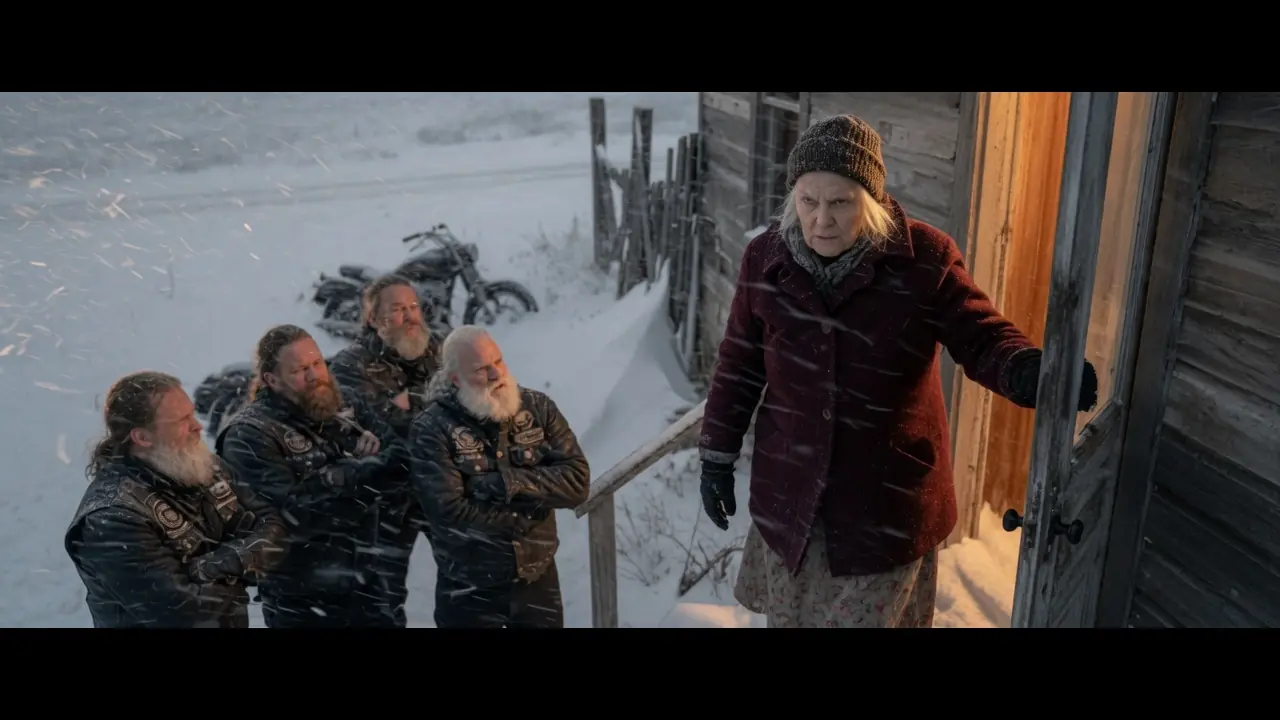
The porch roof sagged beneath the accumulating snow. Paint peeled from the wooden siding. Two of the front steps had split down the middle, and the railing leaned toward the yard as though it had grown tired of standing.
Inside, Evelyn Carter fed another piece of wood into the cast-iron stove.
At eighty-one, she moved carefully but not weakly.
Her knees ached in cold weather. Her right hand had stiffened after an accident decades earlier, and she needed the wall for balance whenever she crossed the narrow hallway.
But the mind behind her pale gray-blue eyes remained sharp.
Evelyn had survived droughts, tornadoes, the death of a husband, the loss of a son, and fifty-three Oklahoma winters.
A storm did not frighten her.
Foolish people did.
She had just finished securing the kitchen shutters when she heard engines.
At first, she believed the sound came from the wind working beneath the porch.
Then it grew louder.
Low.
Uneven.
Mechanical.
Motorcycles.
Evelyn stopped beside the front window.
No sensible rider would be on that road in such weather.
The engines struggled closer, coughing beneath the storm until the first motorcycle emerged from the white darkness. Its headlight swung from side to side as the rider fought for control.
A second motorcycle followed.
Then four more.
The six riders entered Evelyn’s yard and stopped near the fence. One machine slid sideways before its rider forced both boots into the snow.
The engines shut down one after another.
Silence returned, broken only by the wind.
The men remained near their motorcycles.
They were large, rugged figures in black leather jackets and heavy boots. Snow covered their shoulders, beards, and club patches. One man bent forward with both hands resting on his knees. Another slapped his arms against his sides, trying to restore feeling.
Their leader stood closest to the porch.
He was tall and broad-shouldered, with a gray-flecked beard and a long scar beside his left eye. He looked toward the house as if deciding whether approaching it would be more dangerous than remaining outside.
Evelyn opened the door.
Warm amber light spilled across the porch and reached the first line of snow.
The men turned toward her.
Their leader climbed the damaged steps but stopped several feet from the doorway.
“Evening, ma’am.”
“You boys lost?”
The men exchanged glances.
The leader looked behind him at the road, though there was no longer any road to see.
“Storm turned faster than the forecast said.”
“Storm did exactly what the sky told it to do.”
His jaw tightened slightly.
“We need shelter until it passes.”
Evelyn studied him.
His leather vest bore the faded emblem of a black iron wheel surrounded by silver wings.
Across the top rocker were the words IRON DISCIPLES.
The patch sent something cold through her that had nothing to do with the weather.
She had not seen it at her door in more than thirty years.
The leader noticed her looking.
“We don’t need pity, ma’am.”
“Then stop shaking like boys and get out of my storm.”
The second biker climbed the steps.
He was younger, perhaps forty, with ice hanging from his dark beard.
He looked past Evelyn into the small house.
“This place looks like it’ll collapse before morning.”
Evelyn turned her eyes toward him.
“No. But you might.”
One of the men behind him laughed once before hiding it beneath a cough.
The leader remained still.
“Why would an old woman open her door to a gang like us?”
Evelyn’s eyes returned to the patch on his chest.
“Because that patch belongs to men who used to know what honor looked like.”
The leader’s expression changed.
Evelyn stepped aside.
“Move quickly. You’re letting the heat out.”
The six men entered.
They filled the narrow front room with wet leather, snow, and the smell of gasoline.
Evelyn pointed toward a line of hooks beside the stove.
“Jackets there. Boots stay near the door. Nobody touches anything that isn’t offered.”
The younger biker looked around.
“You always give orders to strangers?”
“Only the slow ones.”
The men removed their outer jackets.
Their leader remained near the doorway, watching Evelyn.
“What’s your name?”
“Evelyn Carter.”
The name appeared to mean nothing to the younger riders.
The leader, however, went completely still.
Evelyn noticed.
She closed the door and placed the wooden bar across it.
“Yours?”
“Jonah Mercer.”
The other men introduced themselves as Wade, Russell, Cole, Danny, and Mitchell.
Evelyn placed a kettle on the stove.
“I have coffee, beans, cornbread, and enough blankets to keep you from freezing. If you expect whiskey and dancing girls, you stopped at the wrong house.”
“We’ll take the coffee,” Russell said.
“You’ll take what I give you.”
Russell nodded.
“Yes, ma’am.”
The men gathered near the stove, holding their hands toward the heat.
Danny, the youngest, could not stop trembling. His lips had turned pale, and he struggled to unfasten his gloves.
Evelyn pulled a wool blanket from the cot and wrapped it around his shoulders.
“You feeling your fingers?”
“Barely.”
“Sit down before pride makes you fall down.”
He obeyed.
Wade noticed something beneath Evelyn’s open burgundy coat.
A strip of cracked black leather.
He touched Jonah’s arm.
“Boss.”
Jonah followed his gaze.
Evelyn had worn the old vest beneath her coat for warmth. Most of it remained hidden, but part of a weathered patch was visible near her chest.
Jonah stepped closer.
“That patch…”
Evelyn turned.
“Where did you get it?” he asked.
“I didn’t get it.”
She slowly opened her coat.
The old biker vest had faded almost gray with age. One shoulder had been repaired with rough stitching. Across the back was the same iron wheel surrounded by wings, though the design was simpler than the emblem on Jonah’s vest.
Beneath it were three words.
HONOR BEFORE FEAR.
Jonah’s face lost its color.
“Who are you?”
Evelyn closed the coat halfway.
“I was riding these roads before your club learned how to wear leather.”
No one spoke.
Evelyn pointed toward the stove.
“Now get warm.”
She looked directly at Jonah.
“Then you’re going to tell me why six Iron Disciples were running from something worse than this blizzard.”
Jonah lowered his eyes.
“We’re not running.”
Evelyn poured coffee into mismatched cups.
“Men who aren’t running don’t keep watching the windows.”
The riders looked toward Jonah.
He took the cup but did not drink.
“We were headed to the sheriff’s office in Red Mesa.”
“Red Mesa is seventy miles south.”
“We know.”
“You left the highway?”
“It was blocked.”
“Why not stop in town?”
“Because the people following us would check every motel, gas station, and truck stop between here and the county line.”
Evelyn sat at the small table.
Her body looked frail against the straight wooden chair, but the six men stood as if she controlled the room.
“Start at the beginning.”
Jonah remained near the stove.
“The Iron Disciples have thirty-eight chapters now.”
“I know.”
That surprised him.
Evelyn continued.
“I also know the Tulsa chapter lost its clubhouse, the western chapter split, and the national president stopped publishing the relief-fund accounts nine years ago.”
Jonah’s grip tightened around the cup.
“How?”
“Old people still have telephones.”
No one laughed.
Jonah sat across from her.
“The club isn’t what it was.”
“That is obvious.”
“The national president is Silas Vane.”
Evelyn’s expression hardened.
“I remember Silas.”
“You knew him?”
“He was seventeen when he first came around. Skinny boy with more anger than sense. My husband made him sweep the garage for six months before allowing him near a motorcycle.”
Jonah stared.
“Your husband was Samuel Carter?”
“Yes.”
The riders looked at one another.
Samuel “Railroad” Carter was more legend than man inside the Iron Disciples.
The oldest members still told stories about him.
A Vietnam veteran who returned to Oklahoma and built motorcycles in a tin-roofed workshop. A rider who led convoys through storms to deliver medicine to isolated towns. A man who established the first Iron Disciples charter with two rules written by hand.
No rider left behind.
No patch placed above an innocent life.
Samuel had been dead for thirty-four years.
Few current members knew Evelyn had helped write those rules.
Jonah removed his cup from the table.
“Silas never mentioned you.”
“He would not.”
“Why?”
“Because he knows what I remember.”
The wind struck the house.
Snow hissed against the windows.
Evelyn waited.
Finally, Jonah placed a small waterproof pouch on the table.
Inside was a black ledger, two memory cards, and a cellular telephone with a cracked screen.
“Silas has been stealing from the club’s Widows and Children Fund,” Jonah said. “Not a little. Hundreds of thousands over six years.”
Evelyn did not touch the items.
“How do you know?”
“Wade managed accounts for the Kansas chapter. A rider died last spring. His widow applied for mortgage assistance. National said the fund was empty.”
Wade moved closer.
“It shouldn’t have been. Every chapter pays into it. I started checking transfers.”
“And?”
“The money was moved through repair shops, event companies, and a trucking business controlled by Silas’s brother.”
Evelyn looked toward the memory cards.
“Financial records?”
“And recordings,” Jonah said.
“Of what?”
Jonah glanced at the other men.
“Silas explaining how the system worked. Threatening chapter officers who asked questions. Ordering two businesses burned after the owners refused to participate.”
The room became quieter.
Evelyn looked from one man to another.
“You six stole the evidence.”
“We copied it,” Wade said. “The originals are still in the national clubhouse.”
“They know we have it,” Jonah added.
“How?”
“Danny was seen leaving the office.”
The young rider beneath the blanket lowered his eyes.
“I thought everyone was asleep.”
Jonah continued.
“Silas called us into the clubhouse yesterday morning. Asked whether we knew anything about missing records.”
“What did you say?”
“Nothing.”
“He believed you?”
“No.”
Russell stepped forward.
“One of his men pulled Danny into the back room.”
Evelyn looked at the youngest biker.
A bruise had begun forming along his jaw.
Jonah’s voice became colder.
“They wanted him to name everyone involved. We got him out.”
“How?”
“We fought.”
“Did anyone die?”
“No.”
“Anyone seriously hurt?”
“Two men were hospitalized.”
Evelyn considered that.
“And then you ran.”
“We left,” Jonah said. “There’s a difference.”
“Not to the men chasing you.”
Jonah looked toward the covered windows.
“We contacted Sheriff Daniel Harris in Red Mesa. He knows Samuel’s old road captain. Harris told us to bring the evidence directly to him and speak to no one else.”
“Why not send it electronically?”
“The files are encrypted. Wade has the only key.”
Evelyn looked at Wade.
“You make copies of the key?”
He hesitated.
“One.”
“Where?”
“My attorney has it.”
“Good.”
Jonah leaned forward.
“We saw two of Silas’s trucks behind us outside Enid. Then motorcycles near the county road. The storm helped us lose them.”
“No,” Evelyn said. “The storm slowed everyone.”
She looked toward the front door.
“They’re still coming.”
Danny stood too quickly.
“What?”
His legs weakened, and Cole caught him.
Evelyn did not move.
“A man like Silas does not allow a blizzard to protect someone who can put him in prison.”
Jonah crossed the room and pulled back the edge of a curtain.
There was only snow.
“How isolated is this place?”
“Nearest neighbor is four miles east.”
“Telephone?”
“Landline died last winter.”
“Cell signal?”
“Gone when the storm came.”
Russell swore.
Evelyn looked at him.
“You can swear in my house after you bring your mother here to approve it.”
He lowered his head.
“Sorry.”
Evelyn stood and walked toward a narrow door beside the kitchen.
She opened it.
Wooden steps descended into darkness.
Jonah moved closer.
“Storm cellar?”
“More than that.”
She took a lantern from a hook.
“Samuel built it during the seventies. Tornado shelter, radio room, storage.”
They followed her down.
The basement walls were poured concrete. Shelves held canned food, water, tools, blankets, and first-aid supplies.
At the far end stood an old radio console beneath a protective canvas.
Evelyn pulled the cover away.
Jonah stared.
“That thing works?”
“It did the last time men with patches brought trouble to my door.”
She sat before the radio and switched it on.
The equipment hummed.
A needle moved across the display.
Static filled the room.
Evelyn adjusted two dials.
“Samuel talked to truckers, ranchers, volunteer fire crews, and every fool who spent more money on an antenna than on his roof.”
She lifted the microphone.
“North Star calling Red Mesa relay. North Star calling Red Mesa relay. Emergency traffic.”
Only static answered.
She tried again.
After the fourth transmission, a broken voice came through.
“North Star, this is Cottonwood Base. Signal weak. Go ahead.”
Jonah looked at her.
Evelyn spoke clearly.
“Six riders sheltered at Carter property, County Road Eighteen. Possible armed pursuit. Evidence related to criminal investigation intended for Sheriff Harris.”
The operator asked her to repeat the location.
She did.
“Roads are closed,” the voice responded. “Sheriff has been notified. Response delayed by storm.”
“How delayed?”
“Unknown.”
Evelyn looked toward the ceiling.
“Tell him to hurry.”
The radio crackled.
“We’ll keep the channel open.”
Jonah exhaled.
“At least they know.”
Evelyn turned toward him.
“Knowing someone is drowning and reaching them are different things.”
A sound came from above.
Low.
Distant.
Engines.
Every biker in the cellar became still.
Evelyn rose.
“How many weapons?”
Jonah hesitated.
“Four handguns.”
“Keep them holstered unless someone enters with a weapon.”
“They may shoot first.”
“Then staying behind wooden walls is foolish.”
“What do you suggest?”
Evelyn lifted a ring of old keys from the radio table.
“Samuel designed this place for tornadoes and angry men.”
A second door led from the cellar through a narrow underground passage ending inside the barn thirty yards from the house.
Evelyn divided the men.
Wade and Danny remained in the shelter with the evidence.
Russell and Cole moved into the barn but stayed out of sight.
Jonah and Mitchell returned upstairs with Evelyn.
“Why keep me with you?” Jonah asked.
“Because they came for the leader.”
“You believe that’s me?”
“No. I believe Silas does.”
Headlights appeared through the snow.
Two large pickup trucks entered the yard.
Behind them came three motorcycles.
The vehicles stopped near the buried fence.
Eight men climbed out.
They wore Iron Disciples patches.
The final man exited the passenger side of the first truck.
He was nearly seventy, thick through the shoulders, with white hair tied behind his neck.
Silas Vane.
Time had widened him and slowed his movements, but Evelyn recognized the face immediately.
He climbed the porch steps.
Jonah stood several feet behind Evelyn.
Silas saw him through the doorway.
“You made a bad decision, Jonah.”
Jonah said nothing.
Silas looked toward Evelyn.
Recognition came slowly.
Then his mouth opened.
“Eve?”
“No one calls me that anymore.”
He removed his gloves.
“I heard you were dead.”
“You hoped.”
Silas glanced at the old vest beneath her coat.
“Still wearing that thing?”
“It lasted longer than your honor.”
The men behind him shifted.
Silas’s expression hardened.
“This is club business.”
“You brought it to my house.”
“Those men stole from us.”
“They stole proof that you stole from widows.”
A few of Silas’s riders looked toward him.
He kept his face controlled.
“You don’t know what you’re talking about.”
Evelyn opened the door wider.
“Samuel left you in charge of the Tulsa garage for three weeks in 1988. You sold two donated engines and kept the cash. He removed your patch.”
Silas’s jaw tightened.
“You begged for another chance,” Evelyn continued. “You cried in our kitchen. Promised you would spend the rest of your life earning the cloth he gave back.”
“That was a long time ago.”
“Character does not expire with memory.”
Silas stepped closer.
“Give me the ledger and the phone.”
“No.”
“This house won’t protect you.”
Evelyn looked toward the snow gathering along the porch.
“Neither will your men.”
Silas turned slightly.
Several riders avoided his eyes.
They had heard enough to become uncertain.
Silas noticed.
His voice rose.
“Jonah attacked club members and stole private property. We’re taking him back.”
“No,” Evelyn said.
“You do not command this club.”
“I never did.”
She touched the old patch.
“This commanded it. The promise behind it.”
Silas laughed.
“That world is gone.”
“Because men like you were too weak to preserve it.”
His hand moved toward his coat.
Jonah tensed.
Evelyn lifted one finger.
“Think carefully.”
Silas stopped.
“You believe I am frightened of you?”
“No.”
Evelyn’s voice softened.
“I believe you are frightened of prison.”
A new sound moved through the storm.
Not a police siren.
A truck horn.
Then another.
Lights appeared along the county road.
A county snowplow led the way, followed by two sheriff’s vehicles, a volunteer fire truck, and several ranch pickups equipped with emergency lights.
The radio message had traveled farther than Evelyn expected.
Truckers had relayed it.
Volunteer firefighters had cleared part of the road.
Local ranchers had followed with chains and shovels.
Sheriff Harris had come behind them.
Silas looked toward the approaching vehicles.
For the first time, fear entered his face.
He turned toward his riders.
“Get in the trucks.”
No one moved.
The oldest man in Silas’s group removed his club vest.
He placed it in the snow.
“I joined because Railroad Carter pulled my father out of a wreck.”
Another rider lowered his hands.
“I didn’t know about the fund.”
Silas looked at them.
“You believe her?”
The first man nodded toward Evelyn.
“I believe you’re afraid of what’s in that house.”
Sheriff Daniel Harris stepped from the lead patrol vehicle.
Two deputies followed.
Their weapons remained holstered, but their hands stayed near them.
“Everyone keep your hands visible,” Harris called.
Silas attempted to move toward his truck.
A deputy blocked him.
Jonah brought the waterproof pouch from the cellar after Harris secured the yard.
Wade provided the encryption instructions.
The sheriff collected the evidence and recorded statements from every rider.
Silas denied everything.
He claimed the ledger had been fabricated.
Then Wade unlocked the audio files.
Silas’s recorded voice filled the small front room.
Payments.
Threats.
Instructions to hide money.
Names of businesses.
Dates.
Silas stopped speaking.
The storm continued through the night.
There were too many people for Evelyn’s house, so the firefighters opened the barn, distributed emergency blankets, and started safe heaters.
The sheriff remained until the roads cleared enough to transport Silas and two of his closest men.
Several riders who had followed him agreed to cooperate.
Before Silas was taken outside, he looked at Evelyn.
“You destroyed what Samuel built.”
Evelyn shook her head.
“You did that years ago.”
She glanced toward Jonah and the five men near the stove.
“They may decide whether anything deserves to remain.”
The investigation lasted nearly fourteen months.
The financial records exposed the theft of more than nine hundred thousand dollars from relief funds, member dues, and charitable rides.
Silas Vane and three associates were convicted of fraud, arson conspiracy, intimidation, and related charges.
Several businesses received compensation through seized assets.
The Iron Disciples lost chapters.
Some closed permanently.
Others abandoned the name.
Jonah refused to become national president.
Instead, he and the five riders who survived the blizzard formed a smaller riding association devoted to the principles Samuel and Evelyn had written decades earlier.
They called it the Carter Road Fellowship.
Membership required no performance of toughness.
No one earned respect through expensive motorcycles, fights, or fear.
They repaired homes for riders’ widows.
Delivered medicine during storms.
Provided transportation for veterans attending medical appointments.
Every financial record was public to the membership.
The new patch contained no iron wheel.
Only a small road disappearing toward a star.
Beneath it were the words:
HONOR IS AN ACTION.
Evelyn initially refused every invitation to attend their meetings.
“I am too old to sit around listening to men discuss motorcycles as if they invented them.”
Jonah persisted.
The following spring, six motorcycles returned to the Carter property.
This time the weather was warm.
The riders carried lumber, roofing material, tools, and a new wood stove.
Evelyn stood on the porch with both hands on her hips.
“What is all this?”
“Repayment,” Jonah said.
“I don’t accept payment for shelter.”
“Then call it maintenance.”
“You think I need six men to repair a porch?”
Jonah looked at the broken steps.
“Yes.”
Evelyn considered sending them away.
Then Danny emerged from the final truck carrying a photograph.
It showed Samuel and Evelyn in 1971.
Samuel sat on a motorcycle outside the original garage. Evelyn stood beside him wearing the black leather vest, one hand resting on the handlebar.
Someone had written on the back:
North Star kept us pointed home.
Evelyn stared at the photograph.
“Where did you find this?”
“In the national clubhouse archives.”
She looked toward the young rider.
The bruise had faded from his jaw.
“You still shaking?”
“Not today.”
“Good. Start with the porch.”
The men worked for three days.
They repaired the roof, reinforced the steps, replaced cracked windows, and serviced the cellar radio.
They did not transform the farmhouse into a mansion.
Evelyn would never have allowed it.
They made it safe.
Before leaving, Jonah placed a new patch on her kitchen table.
The road.
The star.
Honor is an action.
“I’m not joining another club,” Evelyn said.
“It isn’t a membership patch.”
“What is it?”
“A reminder that the road still points somewhere.”
Evelyn ran one finger across the stitching.
Then she placed it beside Samuel’s photograph.
Every winter afterward, the Carter Road Fellowship monitored storms across rural Oklahoma.
When highways closed, riders and volunteers delivered blankets, fuel, and food using trucks rather than motorcycles.
Evelyn insisted on that detail.
“If you ride into a blizzard after what happened,” she told Jonah, “I will personally drag you off the machine.”
He believed her.
Evelyn lived four more years.
She remained in the farmhouse until the end.
Jonah and the others visited regularly.
Danny brought his wife and newborn daughter.
Wade repaired the radio whenever it developed static.
Russell stopped swearing inside the house.
Mostly.
When Evelyn died at eighty-five, more than three hundred riders, truckers, veterans, firefighters, and local families attended her funeral.
No one revved engines during the service.
Evelyn had left written instructions against it.
“Motorcycles are transportation,” the note read. “They are not grief.”
Jonah delivered the eulogy.
He did not describe Evelyn as fearless.
She had been afraid many times.
She feared losing Samuel in Vietnam.
Feared raising their son alone.
Feared the tornado that removed half their barn.
Feared that the club they built had become something cruel.
Courage, Jonah explained, had never been the absence of fear.
It was Evelyn opening her door despite knowing exactly what the patch outside might represent.
After the funeral, six riders returned to the Carter house.
Snow had begun falling lightly.
They stood on the repaired porch where Evelyn first faced them.
Danny looked toward the road.
“We really looked that bad?”
“Worse,” Jonah said.
Russell pulled his coat tighter.
“She called us boys.”
“You were shaking like one.”
“So were you.”
Jonah smiled.
Inside the house, the old vest remained mounted behind glass.
The leather was cracked.
The stitching had faded.
But beneath the winged wheel, three words remained clear.
HONOR BEFORE FEAR.
People later told the story as though Evelyn had saved six bikers from a blizzard.
That was only partly true.
She gave them warmth.
Coffee.
A strong roof.
She also forced them to decide what the patches on their backs actually meant.
The storm outside had nearly frozen their bodies.
The corruption inside their club had come far closer to destroying who they were.
Evelyn protected them from both.
Not through strength of muscle.
Not through a weapon.
Not through fear.
She did it by standing in the doorway of a fragile house and reminding six hardened men that leather, engines, and reputation meant nothing without the courage to choose what was right when doing so could cost everything.
On the final page of Evelyn Carter’s will, beneath instructions regarding the house and the old motorcycle parts in the barn, she left one sentence for Jonah and the others.
A patch cannot make a man honorable.
But an honorable man may still make the patch worth wearing.