“Sir, I think I can help your daughter walk again.”
The boy said it so quietly that Andrew Bennett wondered whether he had heard correctly. He was sitting at the far end of Magnolia Park in Seattle, looking at the wet brick path and trying not to count the years since the accident. Beside him, his daughter Grace sat in her wheelchair with a one-eyed stuffed rabbit tucked under her arm. Cherry blossoms passed over them in the breeze, pale and almost translucent in the afternoon sun. Eight feet away stood a small Black boy with tangled hair, a faded blue sweatshirt, and sneakers whose soles had begun to separate from the uppers. He looked no older than eight.
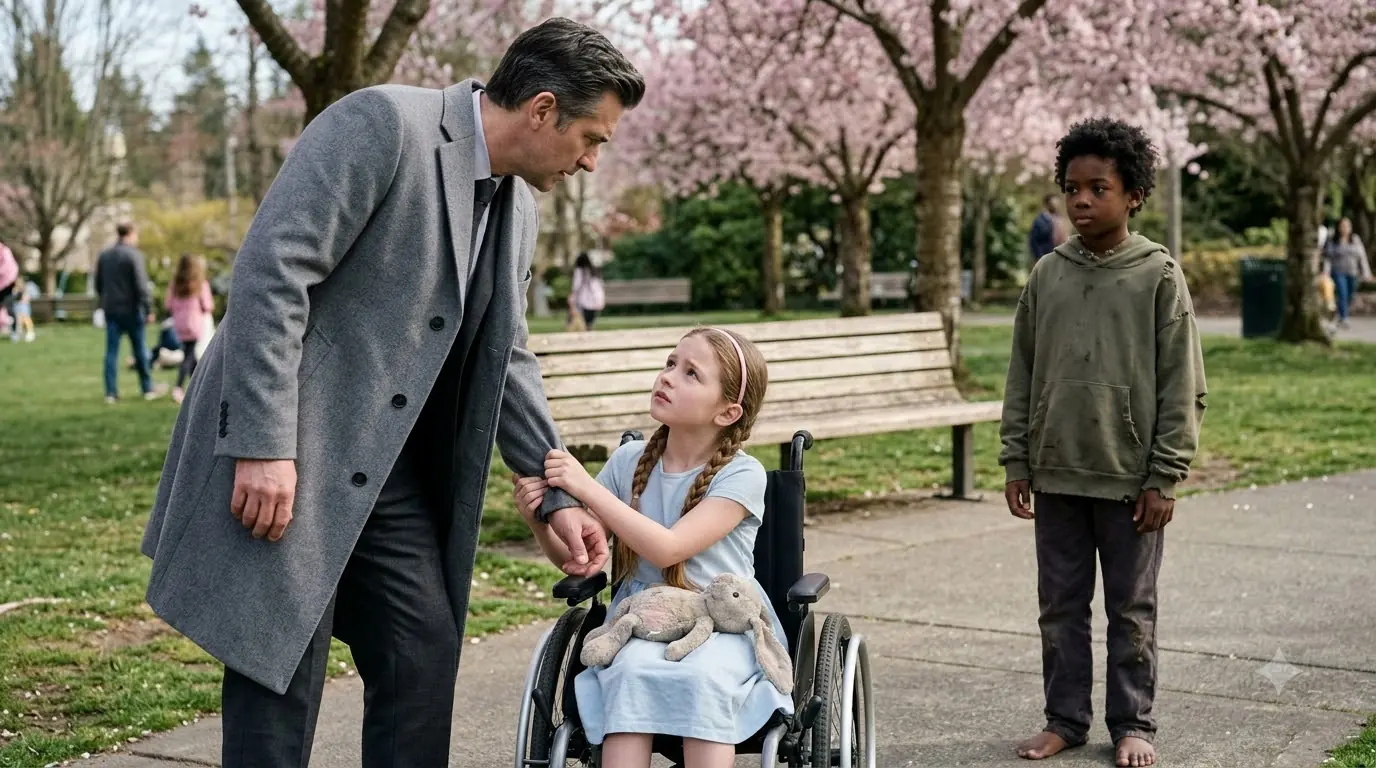
Andrew turned slowly. “You want to say that again?”
“I can help her,” the boy answered. Then, after looking at Grace rather than her father, he added, “If she wants me to.”
Andrew had heard promises in Boston, Zurich, Tokyo, and half a dozen other places where experts could recite the anatomy of the human spine with effortless precision. Some had promised only a comprehensive evaluation. Some had offered experimental devices. Others had carefully avoided the word never while explaining that Grace's injury was unlikely to change. The worst ones had seen his bank balance before they saw the child and had sold him a kind of hope that came with wire-transfer instructions. He had learned to distrust certainty, particularly when it appeared in a person who had never examined his daughter.
“You don't know anything about her,” he said.
The boy met his eyes. “You're right.”
The simple admission caught Andrew off guard. He had expected an argument. Instead the boy continued, “I don't know what the doctors said. I only saw that she looked at the fountain like she wanted to go there, and you were looking at your phone like you didn't know how to ask. I think I can help with that part.”
Grace looked from one face to the other. She was nine, with dark blond hair carefully braided by a woman who had become almost as important in their household as family. She had been six when the collision killed her mother and damaged her spinal cord. Since then, adults had held conversations about what she might someday do while she sat inches away listening. They meant to be kind. Grace had grown weary of kindness conducted in the third person.
“Dad,” she said, tugging his sleeve, “can he just talk to me?”
Andrew opened his mouth, closed it, and looked at the boy again. “What's your name?”
“Micah Torres.”
“Where are your parents, Micah?”
The question changed his face. Only a little, but enough. “I don't have any now.”
Andrew felt the ground of the conversation shift. He glanced toward the crowded path and the park information kiosk, aware that an unaccompanied child was an entirely different matter from an unusual offer. “Is there an adult here who knows where you are?”