At dawn on the fifth day, Willow Creek heard the motorcycles before anyone saw them.
The sound began as a low trembling beneath windowsills, coffee cups, porch railings, and picture frames. It rolled across the flat Oklahoma morning like distant thunder, growing heavier as it moved closer to Franklin Street. Dogs barked from behind fences. Curtains shifted. People stepped onto their porches in robes and slippers, staring east toward the pale haze gathering over the road.
One headlight appeared first. Then another. Then ten more. Within minutes, motorcycles filled the street from curb to curb, chrome and steel and black leather advancing in disciplined lines. Almost eight hundred riders came that morning, not to threaten anyone, not to frighten the neighborhood, and not to make a spectacle of power.
They came because five days earlier, a thirty-four-year-old single mother had opened her door.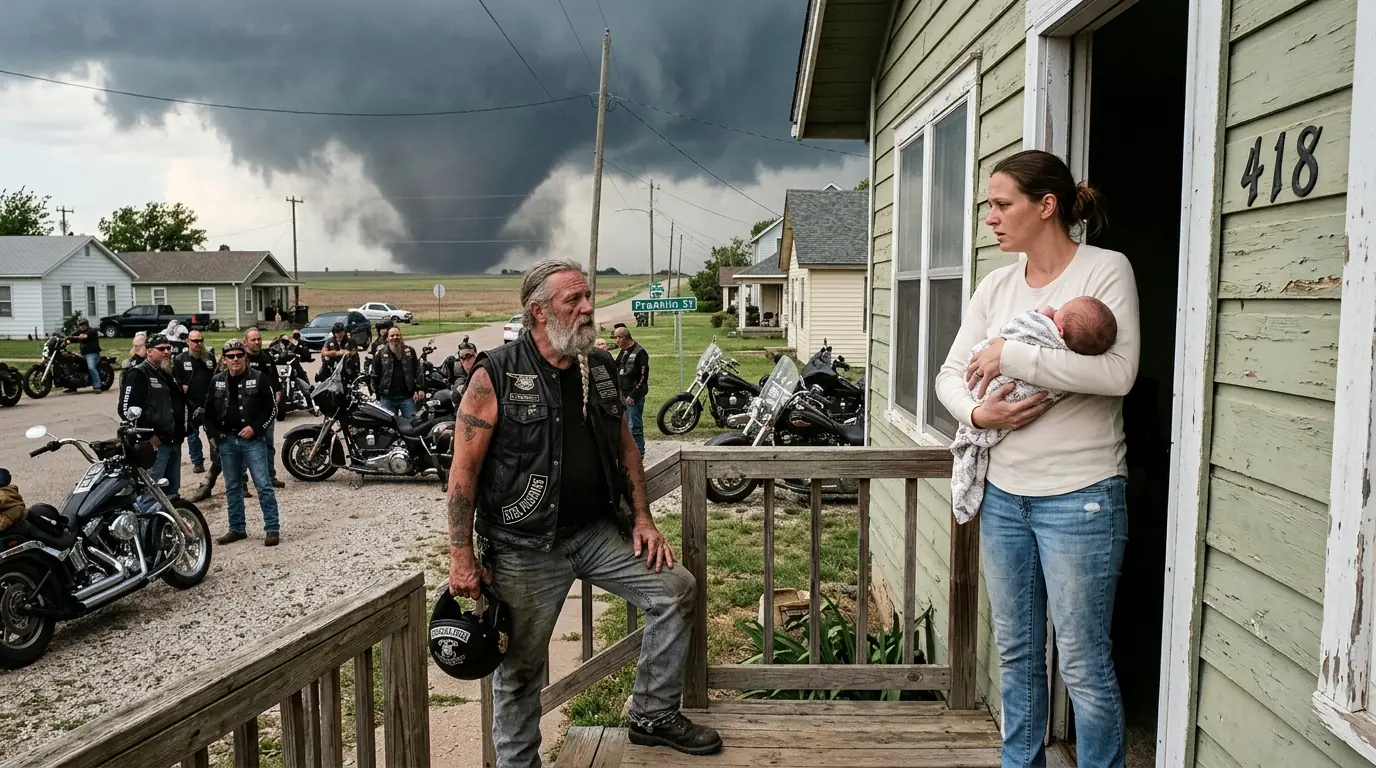
Rachel Carter had been holding a foreclosure notice on the porch of 418 Franklin Street when the story began. The house had belonged to her father, Arthur Carter, and before that it had belonged to the hope he carried home after Vietnam. It was not a beautiful house anymore. The yellow paint had faded almost white beneath the Oklahoma sun, the porch leaned toward the sidewalk, and several boards near the railing gave a warning groan whenever anyone stepped too close.
The roof leaked above the hallway and near the kitchen window. Whenever rain came hard, Rachel placed bowls beneath the leaks in the same order her father had used when she was a child: the silver pot under the hallway light, the blue enamel bowl near the refrigerator, and the old aluminum saucepan beside the window. The rest of the house was tired, but the basement was different.
Arthur had built the basement himself after returning from war. He had been a mechanic, a welder, and later a motorcycle repairman, the kind of man who trusted steel, concrete, and anything he could take apart with his own hands. He never trusted cheap shelters or shallow promises. Anything meant to protect a family, he used to say, should be built deeper than necessary.
So he poured the basement walls thick and reinforced them with steel rods. He braced the ceiling beneath the center of the house and tied it into the foundation with more care than the inspector required. Arthur joked that if a tornado ever carried the whole neighborhood to Arkansas, his basement would still be sitting beneath Franklin Street, waiting for everyone to come home.
Arthur had been dead for six years.
The basement remained.
So did nearly everything he had left inside it. His old leather riding vest hung from a nail near the workbench, the back marked by a cracked patch from the Road Saints Motorcycle Club, a veterans' riding group that had disappeared decades earlier. His black helmet sat on the highest shelf beside worn gloves, a rusted toolbox, a handful of spark plugs, military dog tags, and a photograph of Arthur standing beside a motorcycle with two young soldiers who looked too tired to smile properly.
Rachel had never moved those things. They belonged where he had put them, as if keeping them in place kept a part of him in the house.
Her eight-year-old son, Finn, called the basement Grandpa's room, even though Arthur had died when Finn was two. Rachel had raised the boy alone after his father vanished from their lives without one dramatic goodbye. There had been missed child-support payments, unanswered calls, and eventually a letter from another state that made it clear he had started over with someone else.
For years, Rachel managed anyway. She worked the front desk at a dental clinic during the week and cleaned two small offices on weekends. She stretched groceries, repaired what she could, and smiled for Finn whenever fear tried to show itself. Then Finn got appendicitis, and the surgery that saved him brought bills Rachel could not outrun.
She refinanced the house to cover the hospital balance and a broken sewer line. The loan came with changing interest rates and penalties she did not fully understand until the payments began to climb. She called Prairie River Bank. She asked for a modification, then for more time. A volunteer attorney helped her file hardship documents. The bank delayed foreclosure once, then again.
Eventually, the notice came.
Five days to leave.
Five days to remove what she and Finn could carry.
Five days before the bank changed the locks on the last physical thing connecting her to her father.
Rachel read the letter twice, folded it carefully, and placed it on the kitchen table beside a photograph of Arthur sitting on his motorcycle. Across the street, Elaine Bishop watched from behind a white porch railing.
Elaine was sixty-two, recently retired, and president of the Franklin Street Neighborhood Association. The association had no legal power over Rachel's home, but Elaine had never needed legal power to behave as though she owned the street. For six months, she had circulated complaints about the Carter house: peeling paint, loose shingles, rotting porch boards, a damaged gutter, and an overgrown side yard.
She called her campaign the Franklin Street Safety and Renewal Petition. Thirty-two neighbors signed it. Some believed the house was unsafe. Some signed because Elaine stood at their doors with a clipboard until saying no became harder than giving in. A few assumed someone had checked on Rachel first.
No one had.
Rachel remembered watching Elaine's children after school years earlier when Elaine's babysitter quit. She remembered her father repairing Mr. Alvarez's motorcycle without charging labor. She remembered carrying soup to Sarah Nolan after Sarah's husband left. None of those memories appeared on Elaine's petition.
That afternoon, the sky turned the copper-green color Rachel had feared since childhood. The air grew warm, heavy, and wrong. Birds disappeared from power lines. Leaves stopped moving. Even the insects went quiet.
At two forty-seven, the weather radio sounded. A particularly dangerous tornado watch had been issued for the county. Forecasters warned that violent, long-track tornadoes were possible before evening.
Finn's school had released early, so he sat at the kitchen table folding a paper airplane while Rachel prepared the basement. The third wooden step had cracked through the center, and the fifth sagged near the wall. She placed flashlights, bottled water, blankets, Finn's asthma inhaler, Arthur's military first-aid box, and an old battery radio near the entrance.
"Are we going to Grandpa's room?" Finn asked.
"Only if the sirens start."
"Can I wear his helmet?"
"No."
"Why not?"
"Because it weighs almost as much as your head."
Finn looked toward the basement door. "It looks strong."
Then, softer, she added, "So was he."
At three-fifteen, she heard motorcycles.
Twenty-four riders turned onto Franklin Street, searching for shelter. They belonged to a veterans' and tradesmen's motorcycle organization called the Steel Pilgrims. Most were headed north after a charity ride in Texas when police closed the highway because of the storm. Their leader, Gabriel Stone, had tried to guide them toward the county fairgrounds, where their route map listed a public shelter. Floodwater blocked the access road.
Now they were in Willow Creek, looking for any building with a basement.
Neighbors reacted quickly. Garage doors closed. Curtains moved. Deadbolts clicked. Elaine Bishop stepped onto her porch just long enough to see leather vests and motorcycles before retreating inside.
The riders stopped near Rachel's house because Gabriel saw her standing by the porch steps.
He was sixty-four, tall, broad-shouldered, with a gray beard divided into two short braids. Tattoos covered his forearms, and a surgical scar disappeared beneath the collar of his shirt. He removed his helmet before approaching.
"Ma'am, I'm sorry to bother you," he said.
Rachel looked beyond him at the riders watching the sky. One pointed toward a rotating wall cloud west of town.
"We were trying to reach the public shelter," Gabriel continued. "The road is closed. Do you know another place nearby?"
The tornado sirens began before Rachel could answer.
Their rising wail moved across Willow Creek, cutting through the heavy air.
Rachel opened the screen door. "My basement."
Gabriel looked at the riders behind him. "There are twenty-four of us."
"Then stop counting."
"We don't want to crowd you or frighten your boy."
Rachel looked toward the sky. "The storm will not care whether you were polite."
She pointed through the house. "Kitchen door. Third step is cracked. Fifth one bends. Stay close to the wall."
Finn appeared in the hallway holding his paper airplane. One of the younger riders, a man with tattooed hands and nervous eyes, gave him a small smile.
"Is that thing rated for tornado flight?" the rider asked.
Finn looked at the airplane. "I don't know."
"Better test it later."
The riders entered carefully. Their boots shook the old linoleum, but they moved with surprising gentleness, lifting helmets away from family photographs and avoiding the china cabinet in the hallway. Several noticed the motorcycle pictures on the walls. One paused beneath a framed photo of Arthur wearing his Road Saints vest, but there was no time to ask questions.
Rachel stayed at the front door until the last rider came inside.
Gabriel followed her downstairs.
The basement had been built for one family, not twenty-six people. The riders stood shoulder to shoulder among laundry shelves, canned food, Arthur's workbench, and decades of stored memory. Finn crawled beneath the workbench with his paper airplane held tight against his chest.
Gabriel noticed the old vest on the wall. His expression shifted.
"Your father rode?"
"Most of his life."
"What club?"
"Road Saints. Veterans, mostly."
Gabriel stepped closer. "I haven't seen that patch in years."
Rain struck the house so hard it sounded like gravel.
"Questions later," Rachel said.
Gabriel nodded and introduced himself quickly. "These are my brothers and sisters from the Steel Pilgrims."
Rachel waved one hand. "We can exchange names after the roof stays where it belongs."
The youngest rider was Daniel Ruiz, though the others called him Danny. He was twenty-seven and had joined the Steel Pilgrims after leaving the Army. When the pressure dropped, his breathing changed. His hands shook. The rings on his fingers rattled together.
Gabriel noticed. "Slow breaths."
Danny tried, but the first heavy wind struck the house and the structure groaned. His face drained of color.
Rachel moved through the crowded basement and took his hand. His fingers were nearly twice the size of hers.
"First tornado?" she asked.
He nodded. "I can't breathe."
"Yes, you can."
"I can't."
"Look at me."
Danny forced his eyes toward hers.
"Think of someone who makes you feel safe," Rachel said.
"My mother."
"Picture her face. Breathe when I breathe."
They inhaled together. Slowly. Then again.
Finn crawled closer and took Rachel's other hand.
Then the tornado reached Franklin Street.
The sound was not wind anymore. It was a freight train, a collapsing world, a thousand engines tearing the sky apart directly above the house. Windows shattered upstairs. Timber cracked. Metal ripped away with a long scream. Dust poured from the ceiling. The bulb overhead swung violently, flickered twice, and went out.
Someone prayed. Someone else shouted for everyone to cover their heads. The house twisted above them as if a giant hand had seized it by the roof and tried to wring it dry.
Rachel pulled Finn against her side and held on to Danny's trembling hand. In the darkness, she thought about Arthur pouring those basement walls. She thought about him adding extra steel after the inspector said it was unnecessary. She thought about the motorcycle friends who helped him mix concrete in exchange for food, beer, and laughter on summer evenings.
Six years after his death, Arthur Carter was protecting his daughter, his grandson, and twenty-four strangers.
The tornado remained above them for less than five minutes.
It felt like a lifetime.
When the roar moved east, silence returned in pieces: breathing first, then coughing, then a distant car alarm. Gabriel turned on a flashlight.
"Everyone answer."
Names moved through the darkness.
All twenty-six responded.
The basement door would not open. Debris covered it from above. Four riders climbed the damaged stairs and pushed together until the door moved a few inches. Wet insulation and broken wood fell through the opening. They cleared enough for Gabriel to climb out.
He disappeared upstairs, then stopped.
"Rachel," he said quietly. "Bring Finn slowly."
The kitchen no longer existed.
Most of the roof was gone. Two exterior walls had collapsed into the yard. The refrigerator rested against a tree nearly eighty feet away. The dining table stood on one end in the street. Only part of the central wall remained, still holding several family photographs.
Finn stared at the open sky where the ceiling should have been.
"Where's our house?"
Rachel could not answer.
Gabriel helped her over a broken beam. Arthur's old motorcycle helmet lay partly buried in wet insulation, its face shield cracked. Danny picked it up carefully, as if it were something alive. Near the remains of the hallway, another rider recovered Arthur's leather vest from beneath a fallen cabinet. Mud stained the back patch, but the words were still clear.
ROAD SAINTS — OKLAHOMA.
Gabriel took the vest and stared at it.
"What was your father's full name?" he asked.
"Arthur James Carter."
Gabriel's face lost color. "Arthur Carter?"
"Yes."
He looked again at the patch. "Vietnam? Army mechanic?"
Rachel frowned. "Yes."
Before he could explain, Finn called out. He had found Arthur's framed military photograph beneath a broken section of wall. The glass was shattered, but the picture had survived. Arthur stood beside a damaged armored vehicle with another young soldier, one Rachel had seen many times but never known.
Gabriel crouched beside Finn. "May I see that?"
Finn looked to his mother. Rachel nodded.
Gabriel took the photograph with both hands.
"That's my father," he whispered.
Rachel stared at him. "What?"
"Leonard Stone." Gabriel pointed to the young soldier standing beside Arthur. "My father rode with the Road Saints after the war."
The world seemed to go quiet around Rachel. Before she could ask anything else, Elaine Bishop shouted from across the street.
"You brought those people into the neighborhood."
Elaine stood in her nearly untouched yard, holding up her phone to record. Her house had lost a piece of fence and several branches. Nothing more.
The riders emerging from Rachel's ruined home became still.
"This is exactly what we warned everyone about," Elaine continued. "Dangerous strangers, motorcycles, people coming and going at all hours."
"A tornado destroyed the house," Gabriel said.
Elaine lifted her phone higher. "This house was already a hazard. Now look at the street."
Several riders moved forward.
Rachel raised one hand. "Leave her."
Gabriel turned toward her. "She's blaming you for a tornado."
"She needs someone smaller than herself to look down on."
Rachel took Arthur's damaged helmet from Danny.
"Do not become what she expects."
The words stopped twenty-four angry riders more effectively than any command could have.
Doors opened along Franklin Street. Neighbors emerged one by one. Some stared at the damage. Others photographed it. No one immediately crossed the street. No one asked whether Rachel or Finn was hurt.
Sarah Nolan stood with her youngest daughter beside her. Mr. Alvarez remained near his mailbox. Several people who had signed Elaine's petition gathered in silence.
Gabriel looked at them, then at Rachel, who had opened the strongest part of her home to strangers while everything else in her life was being taken.
Something changed in his eyes.
Emergency crews arrived twenty minutes later. Paramedics examined Rachel, Finn, and the riders. County officials marked the structure unsafe. The foreclosure complicated everything because Prairie River Bank now held legal title. Rachel could not authorize repairs, and that evening a demolition notice appeared on the temporary fence.
DEMOLITION PENDING STRUCTURAL REVIEW.
Rachel saw the notice before she reached the Red Cross shelter. She sat on a folding chair beside an ambulance while Finn rested against her shoulder, holding Arthur's cracked helmet in his lap.
Gabriel spoke quietly with his riders. Danny wiped his eyes. Several others made phone calls.
Finally, Gabriel approached.
"We need to leave so emergency crews can work," he said.
"You should go before the roads close again."
"We will." He looked at Finn. "But we're coming back."
Rachel shook her head. "You don't owe us anything."
"You opened the door."
"That is what people are supposed to do."
Gabriel looked across the street at the neighbors who still had not crossed. "Apparently not everyone agrees."
Rachel rested one hand on his arm. "Do not confuse failure with permanence."
He frowned.
"People failed today," she said. "That doesn't mean they have to fail tomorrow."
Gabriel studied her for a long moment. "You sound like my father."
"Was he sensible?"
"Occasionally."
"Remember those parts."
The Steel Pilgrims rode away before sunset.
Rachel and Finn spent the night in an elementary school gymnasium converted into a Red Cross shelter. Their cots stood beside a family of five. A volunteer gave them donated clothing and two plastic hygiene kits. Finn slept wearing one of Rachel's sweaters because every shirt given to him was too large.
Arthur's helmet, vest, dog tags, photograph, and motorcycle key stayed beneath Rachel's cot. Everything else she owned had become whatever rescue workers could recover safely.
The shelter could keep them for three nights. After that, a caseworker would help Rachel apply for temporary housing. The waiting list for affordable family apartments was months long.
Rachel lay awake beneath fluorescent lights, measuring her life through the house she had lost. The pencil marks showing her childhood height on the kitchen doorway. The oil stain by the back steps where Arthur once dropped a motorcycle engine part. The dent in the garage wall from the first time she tried to move his old bike. Finn's drawings on the refrigerator. The small bedroom she had painted blue before he was born.
She knew a home was more than wood.
That did not make losing the wood painless.
The next morning, she returned to Franklin Street with a disaster volunteer. The property had been fenced off. Rachel searched the accessible debris in borrowed gloves while Finn stayed with a shelter worker.
Elaine stood on her porch with several neighbors.
"I spoke with the city inspector," Elaine announced. "The structure must be removed."
Rachel kept searching.
"The bank already owned it," Elaine added. "The storm merely accelerated what was going to happen."
Sarah Nolan shifted uncomfortably. Elaine softened her voice, which somehow made it worse.
"Choices have consequences."
Rachel found Arthur's old motorcycle key beneath a broken drawer. A short leather strap remained attached to it. Stamped into the metal were two fading words.
RIDE HOME.
Rachel closed her hand around the key.
For the first time since the tornado, she cried.
Not because of Elaine. She had survived the judgment of smaller people before. She cried because Arthur once used that key to start the motorcycle that carried him home after long nights at the repair shop. Now the motorcycle was gone. The garage was gone. Arthur was gone. And the house he built was about to be removed by people who would never understand what it held.
Fifty miles away, Gabriel Stone sat inside the Steel Pilgrims regional clubhouse with his officers. A photograph of Rachel's destroyed house had been projected on the wall. The organization had more than six thousand members across several states. Many were military veterans, emergency workers, mechanics, electricians, nurses, builders, roofers, truck drivers, and contractors.
Gabriel placed Arthur's restored photograph on the table. Then he set down a second photograph from his own home. It showed the same two young soldiers beside the damaged armored vehicle.
One was Arthur Carter.
The other was Leonard Stone.
"My father told this story until the day he died," Gabriel said.
During an ambush outside Da Nang, Leonard had become trapped inside a burning armored vehicle. Arthur Carter had gone back under fire and pulled him free moments before the fuel ignited. After the war, the two men helped form the Road Saints, a riding group for veterans trying to survive civilian life. Arthur later moved to Willow Creek. Leonard moved north. They lost contact.
For years, Leonard searched for him. Letters came back. Telephone numbers changed. Life moved on. Leonard died believing he had never properly thanked the man who saved him.
Five days before the tornado, Gabriel had never heard of Rachel Carter.
Now he had found Arthur's daughter by accident inside a basement built by Arthur's hands.
"She sheltered twenty-four strangers," Danny said. "She held my hand while the house came apart."
Gabriel nodded. "Then we finish what our fathers did not."
The Steel Pilgrims began working before the sun went down. Their legal team contacted Prairie River Bank. The bank refused at first to delay demolition, citing liability. A local attorney obtained a temporary preservation order allowing Rachel time to recover personal belongings and giving an interested buyer room to make an offer.
The Steel Pilgrims Relief Foundation proposed purchasing the foreclosed parcel for the amount necessary to satisfy the unpaid loan, taxes, fees, and demolition exposure. The bank accepted after a disaster-relief organization agreed to insure the site during reconstruction.
It took legal review, title work, county approval, and constant pressure. It could not happen in a single afternoon. The team completed it in four days.
Meanwhile, Steel Pilgrims chapters across seven states collected donations and volunteers. Gabriel established rules from the beginning. Licensed contractors only. No improvised construction. No unsafe spectacle. Architects studied photos of the original house. Engineers inspected Arthur's basement and confirmed what Rachel already knew: almost everything above it was gone, but the reinforced walls remained.
A new house could be built over them.
Members gave ten dollars, fifty dollars, or thousands. Contractors offered labor. Suppliers reduced prices. A family-law attorney created a trust to protect the property for Rachel and Finn. By the fourth evening, more than half a million dollars had been pledged for the purchase, construction, maintenance, and Finn's future education.
The goal was not to give them a mansion.
It was to return a safe version of the home they had lost.
Before sunrise on the fifth day, the riders began entering Willow Creek.
Elaine heard them while drinking coffee. At first, she assumed the vibration came from cleanup equipment. Then her cup rattled against the saucer.
Neighbors emerged from their houses as motorcycles filled Franklin Street in controlled lines. Police officers and traffic volunteers were already present. Permits had been arranged. Emergency access remained clear. No rider entered private yards.
Gabriel raised one gloved hand.
The engines shut down.
The silence afterward settled over the neighborhood like judgment.
He removed his helmet. "We are here for Rachel and Finn Carter."
Elaine stepped toward the edge of her porch. "They no longer own the house."
A foundation attorney approached holding a folder.
"As of yesterday afternoon, Prairie River Bank no longer owns it either," he said.
Elaine stared at him.
"The Steel Pilgrims Relief Foundation purchased the parcel. The property has been transferred to the Arthur Carter Family Trust. Rachel Carter is the lifetime beneficiary, and her son is the protected successor."
A demolition contractor arrived at six and stopped his truck when he saw the motorcycles. He had instructions to remove an unsafe structure. The attorney explained that those instructions came from the previous owner. The county had approved a revised permit limited to dangerous debris, and a licensed contractor would assume control after the site meeting.
The foreman checked the documents, called his office, and stepped aside. No one threatened him. No one shouted. The law had changed hands before sunrise.
Gabriel turned toward the neighborhood.
"Five days ago, Rachel Carter opened her father's basement to twenty-four strangers while a violent tornado approached," he said.
Several neighbors lowered their eyes.
"She did not ask what club we belonged to. She did not ask whether we could pay. She did not ask what people might say after seeing our motorcycles. She opened the safest place she had."
Sarah Nolan began to cry.
Elaine crossed her arms.
"When Rachel came out and found her home destroyed, many of you watched," Gabriel continued. "Some were frightened. Some were ashamed. Some followed the loudest person on the street."
His gaze passed briefly over Elaine.
"But Rachel asked us not to answer cruelty with cruelty. So we did not come here to intimidate anyone."
He gestured toward the construction trucks waiting beyond the motorcycles.
"We came to work."
A Red Cross van arrived soon after. Rachel stepped out holding Finn's hand. She wore donated jeans and a sweatshirt that did not belong to her. Finn carried Arthur's cracked helmet.
Rachel stopped when she saw the motorcycles, then looked at Gabriel.
"What have you done?"
"Paid part of an old debt."
"I told you that you owed us nothing."
"This began before the tornado."
Gabriel handed her the two military photographs. Rachel recognized Arthur instantly. Then she saw the young soldier beside him.
"That is my father," Gabriel said. "Leonard Stone."
Rachel traced the edge of Arthur's face with one finger. "My father never told me."
"Mine never stopped telling us. Arthur pulled him from a burning vehicle. My father lived another forty-two years because yours went back for him."
Rachel's knees weakened. Danny placed a chair behind her, and she sat while holding the photographs.
"Leonard spent years searching for Arthur," Gabriel said. "He died believing he failed to thank him."
Rachel looked up. "My father would have hated being thanked."
Gabriel smiled faintly. "Then I really did find the right family."
He placed the property documents on her lap.
"There is no mortgage."
Rachel shook her head. "I can't repay this."
"You are not borrowing it."
"I don't accept things I haven't earned."
Danny crouched beside her. "You held my hand while the roof disappeared."
His voice shook.
"I was terrified. You didn't laugh. You didn't know me."
"That was not worth a house," Rachel whispered.
"It was worth my life."
Gabriel looked toward Arthur's helmet in Finn's arms.
"This is not payment for kindness," he said. "It is family completing something our fathers began."
An architect named Helen Cho brought the plans. The new house would follow the footprint and appearance of the original: yellow siding, white trim, the same front porch, and a stronger frame hidden beneath familiar lines. The basement would become a certified storm shelter with reinforced doors, backup power, emergency ventilation, and an exterior rescue hatch. There would be a small workshop for Arthur's tools and motorcycle keepsakes.
Finn pointed at the plans. "Where does Grandpa's vest go?"
Helen opened another page. A glass-front cabinet had been designed beside the basement entrance. The vest, helmet, riding gloves, dog tags, photographs, and motorcycle key would be displayed there, not as decorations but as proof of the man who built the strongest part of the house.
Rachel touched the drawing. "He would say the cabinet was unnecessary."
"Should we remove it?" Helen asked.
Rachel smiled through tears. "No. He said many things that were wrong."
Work began that day.
The unstable walls came down under professional supervision. Salvage crews recovered photographs, dishes, books, and sections of handmade furniture. Arthur's vest and helmet were sent to a restorer. By noon, Sarah Nolan crossed the street carrying sandwiches.
"I'm sorry," she said.
Rachel stood beneath a temporary canopy, reviewing cabinet samples.
Sarah's face crumpled. "You watched my children when I had nowhere else to take them. When you needed help, I signed Elaine's petition."
"Why?"
"I told myself the house was dangerous."
"It was."
Sarah lowered her eyes. "That wasn't the whole reason. I wanted to belong."
Rachel looked toward the neighbors gathering near the site. "That can make people do lonely things together."
"I don't deserve forgiveness."
"Probably not yet."
Sarah looked surprised.
Rachel pointed toward the sandwiches. "Set them on the table. Ask the workers what they need."
Sarah did.
Others followed. Mr. Alvarez brought tools. The Chen family delivered water. Two teenagers collected debris from the roadside. Some neighbors apologized. Others were too embarrassed to speak and worked quietly.
Elaine stayed on her porch.
Near sunset, Gabriel approached her.
"This many bikers on one street is intimidation," she said.
"We coordinated with the city and the police."
"You're trying to make me look like a monster."
"We did not circulate the petition."
Elaine's mouth tightened. "The house was unsafe."
"It was."
"The neighborhood had standards."
"It did."
She seemed to regain confidence.
Gabriel looked toward Rachel and Finn. "The problem was never that you noticed the house needed repair."
"Then what was it?"
"You wanted the woman and her child removed more than you wanted the danger repaired."
Elaine opened her mouth, but nothing came out.
"You still have a choice," Gabriel said. "You can stay here explaining why everyone else is wrong, or you can cross the street and become useful."
Elaine did not join them that day.
She came the next morning wearing old jeans and carrying a box of photographs. The pictures showed the Carter house during neighborhood gatherings years earlier. They captured porch details, window shapes, and sections destroyed by the tornado. Helen used them to reproduce the original appearance.
Elaine sat beside Rachel beneath the canopy.
"I was cruel," she said.
"Yes."
"I convinced myself I was protecting the street."
"You were protecting how you wanted the street to look."
Elaine stared at her hands. "I don't know how to fix what I did."
"You can't erase it."
"Then what can I do?"
Rachel looked toward the workers. "Become useful."
Elaine worked throughout the rebuilding. One month of labor did not erase six months of humiliation, and it never would. But Rachel believed redemption was rarely a speech. It was a habit practiced after excuses ended.
Construction took seven weeks. Weather delayed the roof. Inspectors required corrections. A shipment of windows arrived in the wrong size. The house was built carefully rather than impossibly fast.
During that time, Rachel and Finn stayed in an extended-stay hotel funded by the relief foundation. Steel Pilgrims members rotated through Willow Creek. Some framed walls. Others installed wiring, plumbing, and roofing. Many handled meals, paperwork, tools, and transportation. The project succeeded because it functioned as a construction operation, not a performance.
Rachel visited every afternoon. She selected the kitchen cabinets. Finn chose the color of his bedroom. Rachel rejected a refrigerator with a digital screen because she did not need an icebox sending her messages. Helen found a simpler model.
Wood recovered from Arthur's workbench became the top of a new kitchen table. A damaged section of wall containing Rachel's childhood height marks was mounted beneath glass in the hallway. Beside the basement door stood the cabinet containing Arthur's keepsakes: the Road Saints vest, restored helmet, riding gloves, dog tags, the photograph of Arthur and Leonard, and the motorcycle key stamped RIDE HOME.
On move-in day, two hundred motorcycles returned. The riders formed two silent lines along Franklin Street, with neighbors standing between them. Rachel arrived in Gabriel's pickup with Finn beside her.
The rebuilt house looked almost identical from the road.
Yellow siding. White trim. The familiar porch. Hidden steel strengthened the frame. Beneath it, Arthur's basement waited behind a reinforced storm door.
Rachel touched the porch post. "My father would complain about what this cost."
Gabriel smiled. "Mine would tell him to stop talking."
"They probably argued constantly."
"According to my mother, they did."
Inside, familiar objects occupied new rooms. A replica of Arthur's reading chair sat near the front window. The table made from his workbench rested in the kitchen. Family photographs covered the hallway. A leather-bound book sat on the counter, signed by every volunteer.
Most messages were simple.
Thank you for opening the door.
Your father saved Leonard. You saved us.
A strong house begins with people who refuse to close it.
Danny's note filled an entire page.
When the sky becomes loud, I will remember your hand.
Rachel closed the book, sat in Arthur's chair, and cried. No one photographed her. Gabriel had forbidden cameras inside the house unless Rachel asked for them. Some moments did not become public property just because they were emotional.
The Steel Pilgrims later created the Arthur Carter Open Door Fund. Its purpose was practical: emergency roof repair for single parents and elderly homeowners, temporary mortgage assistance connected to legal counseling, heating repairs, storm-shelter improvements, and safe electrical work. During its first three years, the fund helped forty-one households.
Elaine became one of its most consistent local volunteers. She and Rachel never became close friends. Some damage did not disappear because behavior improved. But Elaine drove Rachel to every foundation meeting held outside town, and whenever another neighborhood complaint appeared, she asked one question before circulating paperwork.
"Have we offered to help?"
Finn grew up knowing his grandfather through stories. Gabriel told him about the young mechanic who crossed fire to pull Leonard from a burning vehicle. Rachel told him about the father who repaired motorcycles for people who could not pay. Danny told him about the concrete basement and the hand that stopped shaking only because Rachel refused to release it.
When Finn turned sixteen, Gabriel helped him restore Arthur's old motorcycle. The frame had been stored for years in a Steel Pilgrims warehouse after being recovered from a shed behind the house. The engine needed rebuilding. The fuel tank had rust inside. Several parts had to be made by hand.
Finn performed most of the work himself.
Rachel watched from the garage.
On the afternoon the engine finally started, the sound shook the windows of the yellow house.
Finn looked at his mother. "Too loud?"
Rachel wiped her eyes. "Your grandfather would say it isn't loud enough."
Years later, people still told the story as though the miracle had been the morning eight hundred motorcycles filled Franklin Street. That was the image newspapers loved: chrome beneath the rising sun, leather from curb to curb, a powerful organization arriving for a single mother and her son.
Gabriel never believed that was the real miracle.
The real miracle happened five days earlier, when Rachel stood on a damaged porch with a foreclosure notice inside her house and a violent storm moving toward her child. She had little money, no secure future, and twenty-four strangers at her door wearing clothes that frightened her neighbors.
She did not know their names. She did not know their history. She did not know one rider's father had once owed his life to hers.
She saw people who needed shelter.
And she opened the door.
Everything else—the motorcycles, the lawyers, the rebuilt house, the restored keepsakes, the fund, and the family created across generations—began with that decision.
Kindness did not guarantee Rachel a reward. She acted before reward existed. Her father built walls strong enough to protect the body. His daughter proved the rest of his lesson without ever hearing him say it.
A locked door might preserve what belongs to one family.
An open one can create a family large enough to carry them when the walls fall.