Hand it over. Keys, wallet, the ring, all of it. You don't want to do this, son. That's enough. And who exactly are you supposed to be?
Someone who's not leaving. You've got a daughter waiting on you. Don't be stupid. She's why I'm staying. You're nobody.
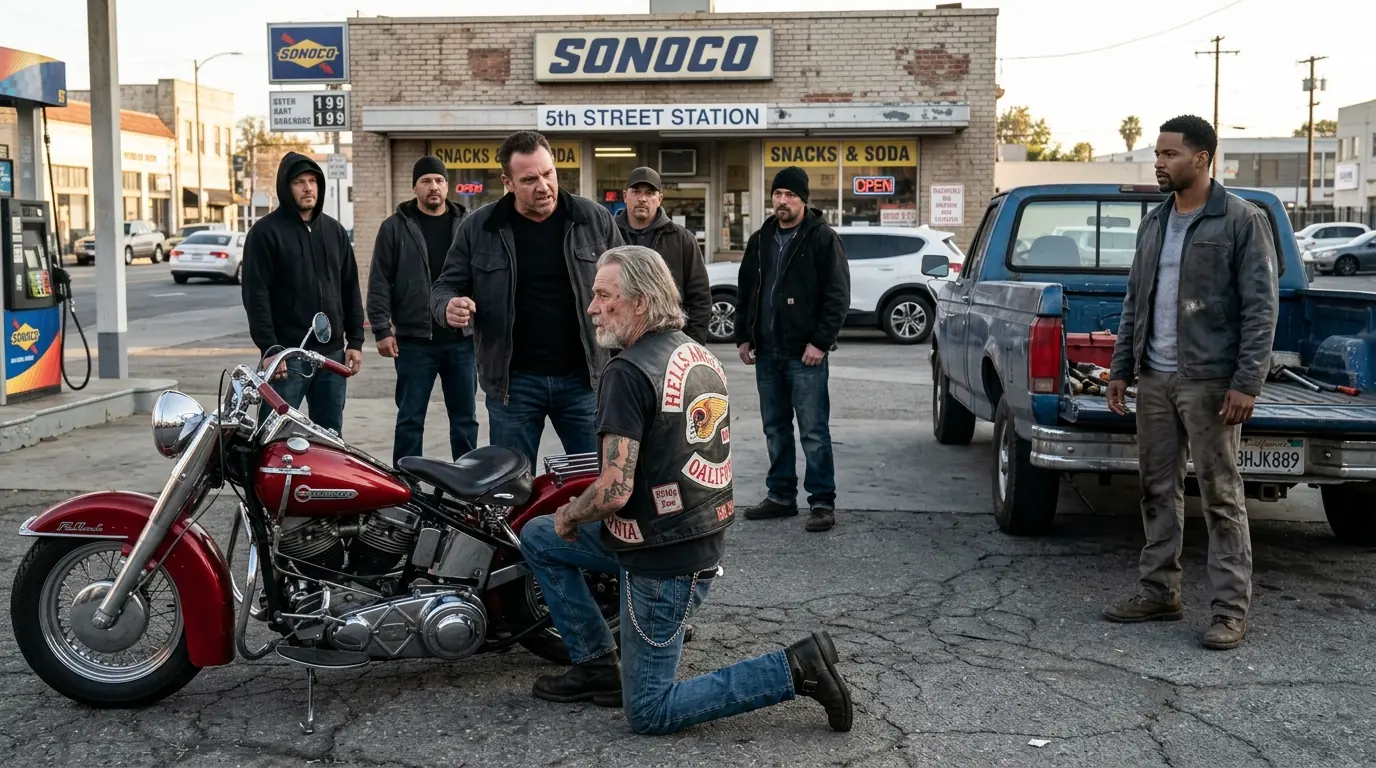
Now get out of my sight. Trent Vaughn had spent years reading people, spotting the ones who would look away, step back, and convinced themselves it wasn't their problem. When the single father in the work jacket stepped into that gas station, Trent read him instantly. A nobody going nowhere. What he couldn't read was the quiet decision already made behind Darius Bennett's eyes.
The years of choosing right over easy, even when no one was watching. The kind of man who taught his daughter that courage wasn't the absence of fear. It was showing up anyway. Trent had dismissed hundreds of men just like that. None of them had ever stayed.
What happens when the one man you wave off turns out to be the last person you should have ignored? Every morning started the same way. Darius Bennett was up before the sun moving through a kitchen that was too quiet for a man who used to fall asleep to the sound of someone else breathing beside him. He'd crack eggs onto a skillet, set out the small orange pill container Nia needed with breakfast, and lay her school uniform across the back of the chair, the way Talia used to do, pressed flat collar turned down just right. It wasn't a routine he had chosen so much as one he had built piece by piece over four years of learning how to be two parents at once.
Nia was 9 years old and had her mother's eyes patient and alert, the kind that noticed everything. She had a chronic condition that required daily monitoring, the kind that didn't show on the outside, but showed up in bills in specialist appointments scheduled 3 months out in a glucose monitor. She wore on her arm and checked before every meal. The condition was manageable. The cost of managing it was another thing entirely.
Darius kept a sealed envelope in the kitchen drawer thick with whatever cash he could set aside each week. He hadn't opened it in 2 years. He told himself he wouldn't not unless there was no other choice. He wore the same three shirts in rotation. He drove a pickup truck that overheated if he pushed it past 60 mph on the highway and needed a new alternator.
He kept putting off because the alternator cost $340 and $340 was a month of Nia's medication. He ate lunch most days from whatever was left in the garage refrigerator and he didn't think of it as sacrifice. He thought of it as math. Cole Hartman had run his auto shop on Grover Street for 31 years and was not a man who gave compliments without being pushed. He was 64, slow-moving, and had the hands of someone who had spent every decade of his adult life inside an engine.
Cole didn't say much to Darius beyond what the job required, but he scheduled Darius's shifts around Nia's school pickup without being asked, and he had never once questioned why Darius sometimes stayed late to help a neighbor push a wheelchair-bound woman's electric scooter into the back room for a free repair. That was Cole's version of approval, and Darius understood it perfectly. What Darius could do with an engine was difficult to explain to anyone who hadn't watched him work. He could listen to a car idle for 30 seconds and tell you which cylinder was misfiring. He could take apart a carburetor in the dark if needed going by feel alone.
But where his attention sharpened into something close to obsession, was with old motorcycles, specifically with the handbuilt customs that had come out of small American shops in the 1950s and '60s when a single craftsman with the right tools and enough patience could build something that didn't look like anything else on the road. He had read everything he could find about Henry Callaway. The man everyone in the custom motorcycle world called Iron Hank had started with nothing. A rented space secondhand equipment and a reputation built one frame at a time. His early work from the late 1950s was considered collector's territory now.
And the most famous piece was a 1959 pan head in cherry red that Hank had built himself during his first year in business. Darius had a photograph of it torn from a magazine taped inside his locker at the shop. He knew the bike the way some people knew songs every curve of the tank, the handlettered pinstripe along the fender, the small brass badge riveted just behind the seat. He had never seen it in person. He had never expected to.
Nia knew about the dream. She had heard her father talk about it in the way he talked about things he believed, but couldn't afford quietly, carefully, like something fragile he didn't want to break by holding too tight. She expressed it differently. In her sketchbook, she drew the same image in variations. Two figures standing in front of a building with a handlettered sign that read Bennett Community Garage.