The rain hammered downtown Seattle as James Carter ran toward the most important interview of his life, his only suit already soaked through.
Water streamed from the edge of his navy jacket and collected inside his shoes. Every step made a wet sucking sound against the pavement, but he did not slow down.
He could not afford to.
The interview began at nine.
His watch read 8:31.
For three months, James had sent out applications before dawn, during lunch breaks, and after putting his seven-year-old daughter to bed. Forty-six applications had produced five automated rejections, two interviews that went nowhere, and one opportunity that might finally change everything.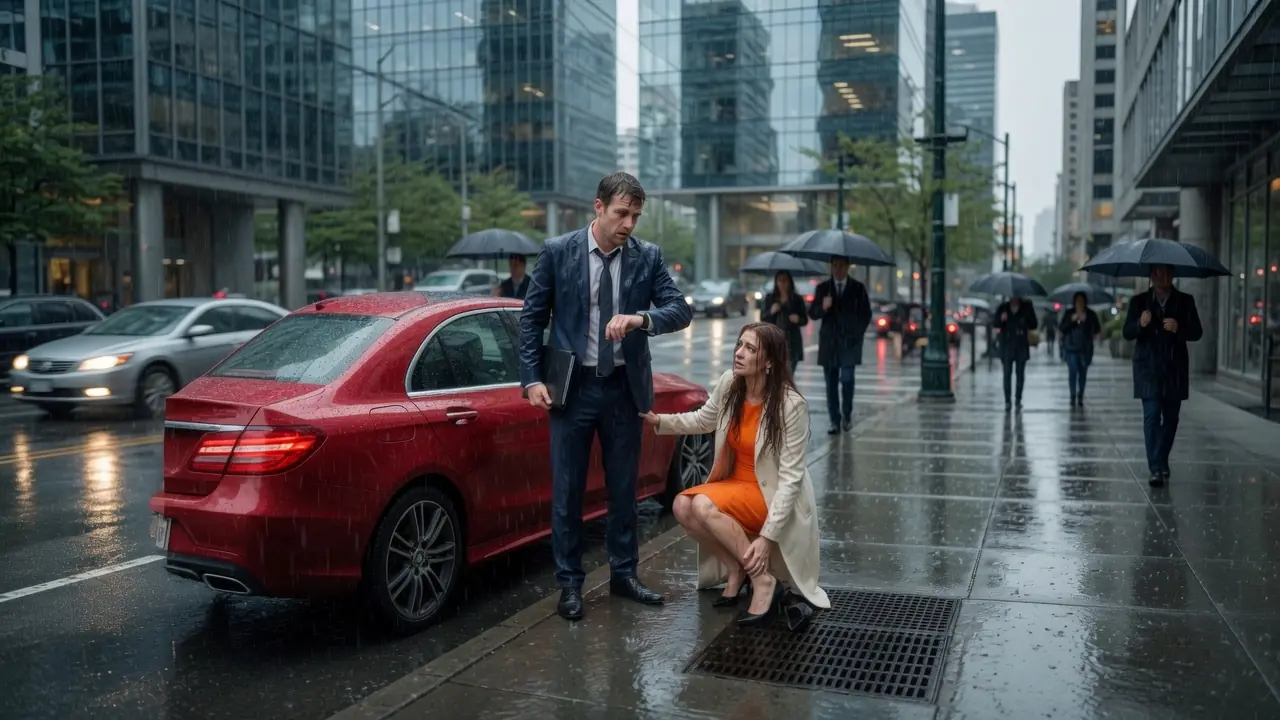
Director of Operations at Northbridge Technologies.
A real salary.
Health insurance.
A retirement plan.
Enough money to stop choosing which bills could wait.
Enough to keep the small apartment where his daughter, Lily, had already drawn flowers around the crack above her bedroom window and declared it their “forever home.”
James had promised her that morning he would come back with good news.
“You always tell me not to promise things I can’t control,” she had said while eating cereal.
He had smiled and adjusted the purple barrette above her left ear.
“Then I promise I’ll do my best.”
She had held out her little finger.
“That counts.”
Now a bus roared through a puddle beside him and sent a sheet of cold water over his trousers.
James closed his eyes for half a second.
“Perfect.”
He had left home at 7:15. The neighbor who normally watched Lily before school had arrived late. Then the light rail stopped between stations because of an electrical problem. When passengers were finally allowed off, James was nearly two miles from Northbridge Tower.
So he ran.
At 8:34, he reached the corner of Fifth Avenue and Madison Street.
That was when he saw the red Mercedes.
It sat crooked against the curb with its hazard lights blinking through the rain. The rear tire had climbed halfway onto the sidewalk, and the driver’s door remained open.
A woman in a brilliant orange dress stepped out.
She was perhaps thirty-eight, with dark brown hair pinned neatly behind her head and a long beige coat draped over one arm. Her dress and black heels looked expensive enough to belong in one of the glass towers surrounding them.
She took one step onto the sidewalk.
Her heel caught in a storm drain.
Her ankle twisted.
She went down hard.
Her shoulder struck the side of the car before she landed on both hands.
A leather folder slid across the wet pavement. Papers burst from it and scattered into the gutter.
Cars splashed past.
People moved around her.
Nobody stopped.
A man carrying an umbrella glanced down and hurried toward the crosswalk. A cyclist swerved around the papers. Two office workers stepped over the woman’s coat without interrupting their conversation.
James stopped running.
He looked at his watch.
8:35.
Then at the tower three blocks away.
Then back at the woman.
She tried to stand.
Her injured ankle folded beneath her.
A sharp cry escaped her.
James ran toward her.
“Don’t move.”
The woman looked up, startled.
Rain had loosened strands of hair across her face. Blood marked one palm where the pavement had scraped the skin.
“I’m fine,” she said.
“You’re not.”
“I just need to get inside the car.”
She reached for the door.
James crouched beside her.
“Your ankle may be broken.”
“It’s not broken.”
“You can’t put weight on it.”
“I have a meeting.”
“So do I.”
She looked at his soaked suit, then at the folder lying open in the street.
“My papers.”
“I’ll get them.”
James stood and moved into the rain.
He collected pages from beneath parked cars, beside the gutter, and under the feet of people who barely acknowledged him. One page had already become soaked beyond repair. Another floated toward a drain.
James stepped into ankle-deep water and caught it before it disappeared.
The paper was covered in financial projections.
At the top, in bold letters, were the words:
NORTHBRIDGE RESTRUCTURING — CONFIDENTIAL.
James noticed the company name.
His stomach tightened.
The woman was heading to the same building.
Perhaps she was another candidate.
Perhaps an executive assistant.
Perhaps one of the people scheduled to interview him.
He placed the thought aside and gathered the remaining pages.
When he returned, she was trying to pull her heel from the storm drain.
“Stop,” he said. “You’ll make it worse.”
“I can’t leave the shoe.”
“You may have to.”
“It was a gift.”
James knelt and examined the narrow heel wedged between two metal bars.
“From someone important?”
“My sister.”
“Then we’re saving it.”
Despite the pain, the woman gave a brief laugh.
James loosened the strap around her ankle and carefully slid her foot out of the shoe. Her skin was already swelling.
He twisted the heel sideways, pulled once, then again.
The shoe came free.
He held it up.
“Still alive.”
“The leather is ruined.”
“Alive, not unharmed.”
She accepted it and looked at him more carefully.
“Thank you.”
“You’re welcome.”
James removed his jacket.
“What are you doing?”
“Keeping your foot still.”
He folded the jacket around her ankle and secured the sleeves loosely beneath it.
“You’re destroying your suit.”
“The rain handled that before you did.”
He took out his phone.
“I’m calling an ambulance.”
“No.”
James paused.
“I don’t need an ambulance.”
“You can’t stand.”
“I have a driver.”
She looked toward the Mercedes and frowned.
The driver’s seat was empty.
“Where is he?” James asked.
“That decision aged badly.”
Another reluctant laugh escaped her.
She took out her phone.
The screen was cracked.
She pressed the power button.
Nothing happened.
James held out his own.
“Call him.”
She entered a number.
No answer.
She tried again.
Still nothing.
James checked his watch.
8:42.
Seventeen minutes until the interview.
He could still reach Northbridge Tower if he left immediately.
He looked toward the woman.
She was trying not to show how much pain she felt, but her breathing had become shallow.
“Is there someone else I can call?”
“My assistant.”
She dialed another number.
Voicemail.
The woman muttered something under her breath.
James almost smiled.
“What?”
“I employ people specifically to answer phones.”
“Maybe they’re all helping strangers in the rain.”
She looked at him.
“You should go.”
James did not answer.
“I mean it,” she continued. “You said you have a meeting.”
“An interview.”
“What time?”
“Nine.”
Her eyes moved toward the tower visible through the rain.
“Where?”
“Northbridge.”
Something changed in her expression.
It disappeared before James could understand it.
“You’ll be late,” she said.
“I know.”
“Then go.”
“I can’t leave you sitting on a sidewalk.”
“You’ve already done more than anyone else.”
“That’s not a reason to stop halfway.”
The woman studied him.
“Do you always argue with injured strangers?”
“Only the stubborn ones.”
Her lips almost curved.
James called emergency services.
The dispatcher said severe weather had caused multiple traffic accidents across downtown. An ambulance would come, but there was no reliable arrival time.
“Could be twenty minutes,” James told her. “Could be longer.”
She looked toward the Mercedes.
“The keys are inside.”
“You’re not driving.”
“You can.”
James shook his head.
“I don’t drive other people’s cars.”
“Why?”
“Because other people own cars worth more than my apartment.”
She handed him the key.
“I am giving you permission.”
“What hospital?”
“Harborview.”
James checked the street.
Traffic was barely moving.
The hospital was less than two miles away, but in the storm it could take thirty minutes.
Northbridge Tower stood three blocks in the opposite direction.
His watch read 8:46.
The woman saw him looking.
“Go to your interview.”
James thought of Lily at the breakfast table.
Purple barrette.
Missing front tooth.
Little finger held out for a promise.
He thought of the past year.
The warehouse where he had worked shutting down without warning. The final paycheck delayed for six weeks. His wife’s medical debt still arriving in white envelopes two years after her death.
He needed the job.
Not in the abstract way people said they needed a vacation or a better phone.
He needed it because the landlord had raised the rent.
Because Lily’s inhaler cost more each month.
Because his savings account held eighty-seven dollars.
Because every night he calculated how long he could protect his daughter from understanding how frightened he was.
The interview could change their lives.
James looked at the woman’s swollen ankle.
Then at the empty sidewalk where dozens of people had already chosen themselves.
He opened the passenger door.
“I’ll drive you.”
The woman stared at him.
“You’re serious?”
“I’m already late.”
“That is terrible logic.”
“Get in before I improve it.”
He helped her up carefully.
She placed one arm around his shoulders while keeping weight off the injured foot. For a woman who appeared so composed, she was surprisingly bad at accepting support.
“I can manage,” she insisted.
“You’re hopping in a storm drain with one shoe.”
“I am adapting.”
“You are falling slowly.”
They reached the passenger seat.
James helped her inside and placed the recovered folder on her lap.
He ran around the front of the car and got behind the wheel.
The interior smelled like leather and jasmine. The dashboard displayed controls he had never seen before.
He pressed the start button.
Nothing happened.
The woman pointed at the brake pedal.
“You have to press it.”
“I knew that.”
“You clearly didn’t.”
“I was testing the car’s patience.”
The engine started.
James pulled into traffic.
For the first few blocks, neither spoke.
Rain struck the windshield faster than the wipers could clear it. Sirens echoed somewhere ahead. Cars crawled through standing water while pedestrians clustered beneath building awnings.
The woman looked down at James’s jacket tied around her ankle.
“What’s your name?”
“James Carter.”
“I’m Claire.”
“Nice to meet you, Claire.”
“Is it?”
“Too early to tell.”
She smiled.
Then pain tightened her face.
James noticed.
“There are painkillers in the glove compartment,” she said.
He opened it at the next red light.
Inside were sunglasses, charging cables, a small notebook, and an unopened bottle of ibuprofen.
He handed it to her along with a bottle of water from the cup holder.
“You keep a pharmacy in here?”
“I travel often.”
“For work?”
“Yes.”
“What do you do?”
Claire hesitated.
“Management.”
James glanced at her.
“That sounds deliberately vague.”
“It is.”
“Human resources?”
“No.”
“Finance?”
“Sometimes.”
“Consulting?”
“Depending on whom you ask.”
James smiled.
“You’re very bad at normal conversation.”
“I have been told that.”
“By employees?”
“Frequently.”
The light changed.
James continued toward the hospital.
Claire looked at his wet shirt.
“What position are you interviewing for?”
“Director of Operations.”
“At Northbridge?”
“Yes.”
“Do you have experience?”
“Fourteen years.”
“Where?”
“Rainier Distribution.”
“I know the company.”
“Then you know it no longer exists.”
“It was acquired.”
“It was dismantled.”
Claire looked toward him.
“That sounds personal.”
“It became personal when twelve hundred people lost their jobs.”
“You blame the buyer?”
“I blame anyone who calls workers ‘redundancies’ before learning their names.”
Claire became quiet.
James wondered whether he had offended her.
He did not care enough to take it back.
After a moment, she asked, “What did you do there?”
“I started on the loading floor. Became a shift supervisor. Then regional logistics manager.”
“You moved from warehouse worker to regional management?”
“Slowly.”
“Why didn’t you leave for a larger company?”
“My wife became ill.”
Claire looked at him.
James kept his eyes on the road.
“She had ovarian cancer. We thought treatment had worked. Then it came back.”
“I’m sorry.”
“Thank you.”
“You stayed because she needed you?”
“I stayed because we had a five-year-old daughter and one parent had to know where the clean socks were.”
Claire smiled softly.
“What’s her name?”
“Lily.”
“How old now?”
“Seven.”
“Who is with her this morning?”
“A neighbor took her to school.”
James glanced at the dashboard clock.
9:03.
The interview had begun.
He felt the loss before it became official.
Somewhere inside Northbridge Tower, a receptionist was probably staring at an empty chair. An interview panel was moving to the next candidate. His résumé was being placed at the bottom of a stack, perhaps marked NO SHOW.
James tightened his hands around the steering wheel.
Claire noticed.
“You can still call them.”
“My phone is on the dashboard.”
“I’ll call.”
He unlocked it and gave her the number from the interview email.
Claire dialed.
A receptionist answered.
“Northbridge Technologies. How may I direct your call?”
Claire looked at James.
“His name?”
“James Carter.”
She spoke into the phone.
“This is Claire calling on behalf of James Carter. He has a nine o’clock interview for Director of Operations.”
A pause.
“Yes, I understand he is late. He encountered a medical emergency downtown.”
Another pause.
Claire’s eyebrows lifted.
“No, it is not possible for him to arrive within five minutes.”
James could hear the receptionist’s voice but not the words.
Claire’s tone cooled.
“He did call before the interview. You are speaking to the call.”
She listened again.
Then she ended the call.
James glanced at her.
“That sounded successful.”
“She said the hiring committee has a strict lateness policy.”
“I expected that.”
“She also said your application would be marked as withdrawn.”
“That sounds efficient.”
“I can call again.”
“No.”
“They should hear the circumstances.”
“They heard enough.”
Claire frowned.
“You missed the interview because of me.”
“I missed it because I made a choice.”
“A choice you wouldn’t have needed to make if I had worn sensible shoes.”
“That would be a tragic loss for the orange dress.”
She looked down at it.
“You hate the dress.”
“It’s very orange.”
“That isn’t the same thing.”
“It looks like a traffic cone received an inheritance.”
Claire stared at him.
Then she laughed.
Not politely.
Not carefully.
She laughed hard enough to wince and clutch her ankle.
James smiled despite himself.
“You did ask.”
“I absolutely did not.”
They reached Harborview Medical Center at 9:17.
James parked near the emergency entrance and found a wheelchair inside the lobby.
A nurse helped Claire transfer into it.
“You don’t have to stay,” Claire said.
“I know.”
“Your daughter is expecting good news.”
James looked at the rain outside.
“She is expecting me to do my best.”
“And did you?”
He looked at her.
“Yes.”
Claire studied his face, then nodded.
“Then go.”
James hesitated.
She held out his jacket.
It was soaked, wrinkled, and stretched around one sleeve.
“Your suit.”
“Keep it until they check the ankle.”
“I can buy you another.”
“That wasn’t an invoice.”
“I know.”
James accepted the jacket.
Claire held out her hand.
“Thank you, James Carter.”
He shook it carefully.
“Try not to drive until you can operate both feet.”
“I have employees for that.”
“Employees who do not answer phones.”
Her smile returned.
James walked out of the hospital at 9:26.
He stood beneath the covered entrance and checked his email.
There was already a message from Northbridge.
Dear Mr. Carter,
Due to your failure to attend your scheduled interview, we have withdrawn your application from consideration.
We appreciate your interest and wish you success in your future endeavors.
The message was signed by Martin Kessler, Vice President of Corporate Operations.
James read it twice.
Then he put the phone away and began walking toward the light rail station.
At 3:10 that afternoon, he stood outside Lily’s elementary school wearing a borrowed sweatshirt from his neighbor and trousers still marked by rain.
Children poured through the doors.
Lily spotted him and ran across the sidewalk.
“Did you get it?”
James caught her as she jumped into his arms.
Her hopeful face pressed close to his.
He could have softened the truth.
He could have said the company was still deciding.
Instead, he set her down.
“I missed the interview.”
Her smile faded.
“Why?”
“A woman fell and hurt her ankle. I took her to the hospital.”
Lily considered this.
“Was she okay?”
“I think so.”
“Was she old?”
“No.”
“Did she cry?”
“Not much.”
“Did you cry?”
“Only when I saw the parking fee.”
Lily did not laugh.
“You needed that job.”
“I did.”
“Are we going to lose our apartment?”
The question struck him.
James crouched.
“Where did you hear that?”
“You and Mrs. Alvarez were talking.”
James closed his eyes briefly.
He thought Lily had been asleep.
“We are not losing our home today.”
“What about tomorrow?”
He took both her hands.
“I don’t know everything that will happen tomorrow. But I know I will keep looking for work, and I know we will stay together.”
She looked at him for a long moment.
“Was helping the woman the right thing?”
“Yes.”
“Even if you don’t get a job?”
James hesitated.
Children deserved truth, but not every burden attached to it.
“Yes,” he said finally. “Something doesn’t become wrong just because it costs you.”
Lily nodded slowly.
Then she hugged him.
“You still did your best.”
James held her tighter.
“That counts.”
The next morning, he woke at 5:30 and submitted four more applications.
By noon, two companies had rejected him.
At 2:17, Northbridge Technologies called.
James almost did not answer.
“James Carter?”
“Yes.”
“This is Amanda from the executive office at Northbridge. We would like you to come in tomorrow morning.”
James looked at the phone.
“For what?”
“To meet with our leadership team.”
“My application was withdrawn.”
“There has been a change.”
“What kind of change?”
“I’m not authorized to discuss that.”
James leaned back in his kitchen chair.
“Is this another interview?”
Amanda hesitated.
“Yes.”
“With the same panel?”
“Not exactly.”
“What time?”
“Nine.”
James looked toward Lily’s drawing taped to the refrigerator.
A crooked picture of two stick figures beneath a purple roof.
“Will anyone object if I arrive early?”
Amanda laughed nervously.
“No, Mr. Carter.”
“I’ll be there at eight forty-five.”
The following morning was clear.
James wore the same navy suit after spending half the night pressing it beneath a towel and repairing one loose seam by hand. A faint water stain remained near the left pocket, but it was the best he could do.
Mrs. Alvarez took Lily to school.
This time, the train ran on schedule.
James arrived at Northbridge Tower at 8:39.
The lobby rose three stories beneath a ceiling of steel and glass. Employees crossed polished floors carrying laptops and coffee. A digital wall displayed stock prices, company announcements, and photographs of Northbridge offices around the world.
At the reception desk, James gave his name.
The receptionist looked up quickly.
“Mr. Carter.”
She was the woman who had spoken to Claire on the phone.
Her badge read Hannah.
“Please take the executive elevator to the thirty-second floor.”
“The executive floor?”
“Yes.”
James entered the elevator alone.
As the doors closed, he caught his reflection in the mirrored wall.
The suit still looked worn.
His tie was slightly uneven.
He adjusted it once.
Then he stopped.
The elevator opened into a quiet reception area overlooking downtown Seattle.
Amanda, a woman with short black hair and a tablet in one hand, greeted him.
“Mr. Carter, they are ready.”
“Who is they?”
She gave him a polite smile.
“You’ll see.”
The conference room was larger than his entire apartment.
Twelve people sat around a long table.
At the far end was Martin Kessler, the man who had signed the rejection email. He was in his mid-fifties, with silver-framed glasses and a blue tie. Beside him sat two executives James recognized from the company website.
At the head of the table was an empty chair.
Martin stood.
“Mr. Carter.”
“Mr. Kessler.”
“I understand there was some confusion regarding yesterday’s interview.”
“There was no confusion. I was late.”
Martin’s expression tightened.
“Please sit.”
James took the chair nearest the door.
No one spoke.
The atmosphere felt less like an interview than a disciplinary meeting.
At 9:01, the conference-room doors opened.
Claire entered on crutches.
Her left ankle was wrapped in a medical boot. She wore a dark green suit instead of the orange dress, and her hair fell loosely over her shoulders.
James stared.
Claire looked at him.
“You cleaned up well.”
He stood slowly.
“You work here.”
Several people around the table shifted.
Claire moved toward the empty chair.
“I do.”
Martin cleared his throat.
“Mr. Carter, this is Claire Beaumont, chief executive officer of Northbridge Technologies.”
James looked from Martin to Claire.
Then back again.
Of course.
The Mercedes.
The confidential documents.
The employees who failed to answer their phones.
Management.
Very deliberately vague management.
James sat down.
“You could have mentioned that.”
Claire lowered herself into the chair with care.
“You could have asked better questions.”
“I asked what you did.”
“I answered.”
“Badly.”
A few executives smiled.
Martin did not.
Claire placed a folder on the table.
“Yesterday morning, Mr. Carter missed his scheduled interview because he drove me to Harborview after I injured my ankle.”
Martin folded his hands.
“We are aware.”
“Are you also aware that his application was withdrawn before anyone allowed him to explain?”
“Our policy requires candidates to arrive on time.”
Claire looked at him.
“He called at 9:03.”
“The interview began at nine.”
“He was driving an injured stranger to a hospital.”
“We had no way to verify that at the time.”
“You were speaking to the injured stranger.”
Martin’s face reddened.
“You did not identify yourself.”
Claire’s gaze sharpened.
“Would the circumstances have mattered more if I had?”
No one answered.
James understood then that the meeting was not solely about him.
Claire looked around the table.
“This company’s values statement uses the word integrity eleven times. Yesterday, a candidate demonstrated integrity at personal cost, and our process disqualified him because his behavior did not fit a calendar entry.”
Martin spoke carefully.
“With respect, Claire, we cannot ignore procedures every time a candidate offers an explanation.”
“No. But we can employ people capable of judgment.”
She turned toward James.
“Mr. Carter, your interview begins now.”
James looked at the executives.
“I was not expecting the CEO.”
“Neither was the hiring panel,” Claire replied.
Martin adjusted his glasses.
“We should clarify that Ms. Beaumont’s experience yesterday does not guarantee any outcome.”
James looked at him.
“I would hope not.”
That answer surprised several people.
Claire leaned back.
“Explain.”
“If I receive the job because I helped you, then I was not hired for my qualifications. I was rewarded for a coincidence.”
Martin’s expression eased slightly.
Claire studied James.
“And if yesterday revealed something relevant about your qualifications?”
“It revealed that I can drive a Mercedes badly in heavy rain.”
“It also revealed that you can make a decision under pressure.”
“A personal decision.”
“Operations leadership is a series of personal decisions disguised as spreadsheets.”
James thought about that.
Claire opened his résumé.
“You managed five distribution centers.”
“Yes.”
“Your employee retention rate was the highest in the company.”
“Yes.”
“Productivity increased eighteen percent over three years.”
“Seventeen point six.”
“Your résumé says eighteen.”
“My former director liked whole numbers.”
Claire smiled.
“Why was your retention rate higher?”
James glanced at Martin, then at the others.
“Because we stopped treating people as replaceable.”
“That is not an operational strategy.”
“It is when replacing a trained worker costs more than listening to one.”
Martin leaned forward.
“What specifically did you change?”
James answered for nearly twenty minutes.
He explained how he reorganized shift schedules around public transit. How absenteeism dropped when workers could exchange shifts through a simple internal system. How injury claims declined after employees were allowed to pause production lines without supervisor approval.
He described a warehouse where management had blamed staff for late orders, though the real problem was a routing algorithm built around outdated loading times.
He did not speak in polished corporate phrases.
He spoke as someone who had stood on loading floors at four in the morning and watched good people blamed for systems designed by people who never touched a box.
Claire listened.
Martin challenged him.
James challenged back.
When asked what he would do during his first ninety days, he said he would spend the first thirty listening to warehouse teams before changing anything.
One executive frowned.
“That sounds slow.”
“So does fixing the wrong problem.”
The interview lasted ninety minutes.
At the end, Claire closed the folder.
“Do you have questions for us?”
James did.
He asked why the previous director had left.
No one answered immediately.
Martin eventually said the man had “pursued another opportunity.”
Claire corrected him.
“He was fired.”
James looked at her.
“Why?”
“Three regional centers missed targets. He altered reporting methods to hide the losses and blamed frontline managers.”
“Was anyone else involved?”
Martin’s shoulders tightened.
Claire answered.
“We are still determining that.”
James looked around the table.
“Then my question is whether you want an operations director or someone to inherit the blame.”
Silence followed.
Martin stared at him.
Claire’s expression became unreadable.
Finally, she asked, “Why would you think that?”
“Because the job has been open for five months. The posting emphasizes accountability six times but decision-making authority only once. That usually means the person holds responsibility without control.”
Martin closed his notebook.
“This is highly inappropriate.”
James looked at him.
“You asked whether I had questions.”
Claire raised one hand before Martin could reply.
“He has a point.”
She turned toward James.
“What authority would you require?”
“Direct access to regional data. Authority to pause initiatives that create safety or staffing problems. And the ability to tell the CEO when her plan is wrong without losing my job before lunch.”
Claire glanced at the clock.
“I rarely fire people before lunch.”
“That is reassuring.”
The interview ended at 10:47.
Amanda escorted James to the elevator.
“Do you think I still have a chance?” he asked.
She looked toward the closed conference-room doors.
“I have worked here six years.”
“That doesn’t answer the question.”
“I have never seen anyone tell Martin Kessler that a job description looked like a trap.”
“That also doesn’t answer it.”
She smiled.
“I think you made an impression.”
James returned home and waited.
One day passed.
Then two.
Northbridge did not call.
By Friday, James assumed he had lost the position.
He continued applying elsewhere.
On Monday afternoon, he accepted temporary work unloading trucks at a grocery warehouse during the night shift. The pay was low, but it covered part of the rent.
At 6:40 that evening, someone knocked on his apartment door.
James expected Mrs. Alvarez.
Instead, Claire Beaumont stood in the hallway on crutches.
She wore jeans, a black sweater, and the medical boot. Her hair was pulled into a loose ponytail.
James stared.
“How did you get my address?”
“I am the CEO of a technology company.”
“That answer creates more concerns than it solves.”
She held up a paper bag.
“I brought dinner.”
From the kitchen, Lily called, “Is it pizza?”
Claire looked past James.
“Yes.”
Lily appeared beside him.
Her eyes moved immediately to the boot.
“Are you the lady Daddy saved?”
James closed his eyes.
“I did not say saved.”
“You said she fell and nobody helped.”
Claire smiled at Lily.
“I’m Claire.”
“I’m Lily.”
“I know.”
Lily looked suspicious.
“How?”
“Your father talked about you.”
“Did he tell you I’m good at science?”
“He mentioned clean socks.”
Lily looked at James.
“That is private.”
James stepped aside.
Claire entered.
Their apartment was small but clean. Children’s drawings covered the refrigerator. A secondhand sofa faced a television resting on a low wooden shelf. One wall held photographs of James, Lily, and a smiling woman with blonde curls.
Claire paused near the largest picture.
“My wife, Rachel,” James said.
“She was beautiful.”
“She was.”
Lily carried the pizza to the kitchen table.
“Why are you here?”
James gave her a look.
“What? You say direct questions are good.”
Claire sat carefully.
“I came to offer your father a job.”
Lily looked at James with wide eyes.
“You got it?”
James looked at Claire.
“I did?”
Claire placed an envelope on the table.
“Director of Operations. Full salary as listed, health coverage beginning immediately, and the authority terms we discussed.”
James did not touch the envelope.
“What happened to the other candidates?”
“One accepted another offer. Two completed their interviews. The panel ranked you first.”
“Did you influence the decision?”
“Yes.”
James leaned back.
Claire’s honesty caught him off guard.
“How much?”
“I reopened your application. I added myself to the panel. I argued that your judgment yesterday was relevant.”
“That sounds like a great deal of influence.”
“It was.”
“Then I can’t accept.”
Lily froze with a pizza slice halfway to her plate.
Claire did not look surprised.
“Why?”
“Because everyone will think I got the job for helping you.”
“Some will.”
“And you?”
“I think you got the interview again because you helped me. You got the job because Martin spent two days trying to prove another candidate was stronger and failed.”
James looked at the envelope.
Claire continued.
“You were the only candidate who identified the structural problem hidden inside the role. You were also the only one who asked whether you would have enough authority to protect employees from bad executive decisions.”
“You still influenced the process.”
“I influence every senior hire. That is part of being CEO.”
James said nothing.
Claire looked toward Lily.
“Your father is extremely difficult.”
Lily nodded.
“Yes.”
“Both of you are outnumbering me,” James said.
Lily lowered her voice toward Claire.
“He worries about everything.”
“I noticed.”
James opened the envelope.
The salary was more than he had earned before Rainier Distribution closed.
Enough to pay the rent.
Enough for Lily’s medical care.
Enough to breathe.
He read every page.
Claire waited.
Finally, he looked up.
“When would I start?”
“Next Monday.”
Lily jumped from her chair.
“You got it!”
She threw both arms around him.
James held her tightly.
Over Lily’s shoulder, he looked at Claire.
“Thank you.”
Claire shook her head.
“Do not thank me until you meet the regional directors.”
The job was harder than James expected.
Northbridge had grown too quickly. Systems did not communicate with one another. Regional managers competed for resources instead of sharing them. Executive bonuses depended on short-term performance, encouraging leaders to hide problems until they became expensive disasters.
James spent his first month traveling between facilities.
He listened.
Workers expected speeches.
He asked questions instead.
At a warehouse in Tacoma, a supervisor blamed employees for missing shipping targets. James spent one night on the loading floor and discovered that trucks arrived in an order different from the schedule displayed to workers.
In Portland, injury rates had increased after management reduced break times by six minutes.
In Spokane, an automated inventory system classified damaged products as employee theft.
James documented everything.
Then he presented his findings to the executive board.
Martin Kessler interrupted him repeatedly.
“These are local management issues.”
“No,” James said. “They are incentives created here.”
Martin’s eyes narrowed.
“You have been employed for six weeks.”
“Long enough to read the reports you signed.”
Claire watched from the head of the table.
James expected her to intervene.
She did not.
She made him defend every conclusion.
Afterward, she found him near the elevators.
“You were angry.”
“I was accurate.”
“You can be both.”
“Was I wrong?”
“No.”
“Then what is the problem?”
“You stopped listening after Martin challenged the injury data.”
“He was trying to discredit it.”
“He was.”
“So?”
“So you were not speaking to Martin. You were speaking to the eight undecided people watching you handle resistance.”
James considered this.
Claire adjusted her crutch.
“You were right,” she continued. “But leadership is not merely being right in a room. It is moving the room.”
“You could have supported me.”
“I did.”
“When?”
“When I didn’t rescue you.”
He laughed despite himself.
“You enjoy this too much.”
“Frequently.”
They began spending more time together.
At first, every meeting had a purpose.
Operations review.
Budget planning.
Safety audits.
Then conversations continued after the purpose ended.
Claire told him she had taken control of Northbridge after her father suffered a stroke. She was thirty-one and had been expected to hold the company steady until a “more experienced” executive could replace her.
She never left.
Under her leadership, Northbridge tripled in size.
But success had required armor.
She worked longer than everyone else. Remembered every number. Allowed no one to see indecision.
“I assumed being needed would feel like belonging,” she told James one evening.
They were standing beside the conference-room windows as Seattle lights appeared below.
“Did it?”
“No. It felt like being needed.”
James understood more than he wanted to.
After Rachel died, everyone praised his strength.
No one asked whether strength was simply the absence of another option.
Claire met Lily at a company family event.
Lily immediately asked whether the orange dress had survived the rain.
“It did,” Claire said.
“The shoes?”
“One survived.”
“What happened to the other?”
“Your father put it somewhere in my car, and no one has found it.”
James frowned.
“I put both shoes in the back.”
Claire looked at him.
“You left one in the storm drain.”
“I rescued the shoe.”
“You rescued one shoe.”
Lily gasped.
“You left her shoe?”
“It was raining.”
“That is not an excuse.”
Claire smiled.
For the next three months, Lily referred to the incident as “the shoe abandonment.”
Claire began joining them for Saturday breakfasts.
At first, she arrived in pressed coats and answered emails beneath the table.
Lily confiscated her phone.
“No working during pancakes.”
“I run a global company.”
“Daddy runs warehouses.”
James looked at her.
“I oversee operations.”
“You still don’t work during pancakes.”
Claire surrendered the phone.
Their relationship changed quietly.
There was no single moment when professional respect became friendship, or friendship became something more dangerous.
It happened in pieces.
Claire remembering Lily’s science-fair date.
James bringing her coffee before a difficult board meeting.
Claire sitting beside him on the anniversary of Rachel’s death without trying to fill the silence.
James teaching her to make grilled cheese after discovering her refrigerator contained mineral water, olives, and nothing resembling a meal.
One evening, six months after the storm, James found Claire alone in the Northbridge lobby.
Rain streaked the windows.
She stood beside the glass doors holding an umbrella but not opening it.
“Waiting for a driver?” he asked.
“No.”
“Afraid of storm drains?”
She looked at him.
“Deeply.”
He joined her.
Neither moved.
Claire glanced toward his suit.
It was new.
Dark charcoal.
Properly fitted.
“Better than the first one,” she said.
“The first one had character.”
“The first one was dissolving.”
“It survived.”
“So did we.”
James looked at her.
The lobby was nearly empty.
“Did you ever wonder what would have happened if I kept running?”
Claire looked through the glass.
“I would have called an ambulance eventually.”
“That is not what I meant.”
“I know.”
She turned toward him.
“You would have attended the interview. Martin would have asked his standard questions. You might have been selected.”
“Might?”
“You were wearing a transparent suit.”
“It was not transparent.”
“It was raining very hard.”
James smiled.
Claire continued.
“You would have received the job. We would have worked together. You would have argued with me in meetings.”
“And you would have hated me.”
“For at least four months.”
“What changed?”
“You saw me on the pavement before you saw my title.”
James looked at her.
“And you saw me miss my interview before you saw my résumé.”
“That too.”
The rain softened outside.
Claire opened the umbrella.
James placed one hand over hers.
She became still.
“Dinner?” he asked.
She looked toward him.
“Is this a work dinner?”
“No.”
“Will Lily be there?”
“She is staying with Mrs. Alvarez.”
Claire’s eyes narrowed.
“You planned this.”
“Operationally.”
“Efficient.”
“I learned from management.”
She smiled.
“Then yes.”
A year after James missed the interview, Northbridge announced its strongest employee-retention numbers in company history.
Workplace injuries fell by twenty-six percent.
Shipping delays decreased.
Regional managers were evaluated partly on employee development rather than only quarterly output.
Martin Kessler resigned after an internal review discovered he had altered performance projections to protect executive bonuses.
James was offered Martin’s position.
He declined.
Claire asked why.
“I’m not finished with operations.”
“That is not the answer.”
James looked at her across the same conference table where they had interviewed him.
“The vice president role would put me farther from the people affected by my decisions.”
“You could still visit facilities.”
“I could also stay where I am.”
Claire studied him.
“Most people ask how quickly they can move up.”
“Up is not always closer to where you want to be.”
She smiled faintly.
“That sounds annoyingly wise.”
“I practice.”
That evening, James picked Lily up from school.
She climbed into the car and dropped her backpack onto the floor.
“Claire says you rejected a promotion.”
James looked at her in the mirror.
“Claire discusses company business with you?”
“She says I’m an independent adviser.”
“You are eight.”
“Almost nine.”
“That does not improve your qualifications.”
Lily folded her arms.
“Why did you say no?”
“Because I like my job.”
“Would it pay more?”
“Yes.”
“Then that was not very smart.”
“Thank you for the analysis.”
She leaned between the seats.
“Are you going to marry Claire?”
James nearly missed the green light.
“What?”
“She has dinner with us four nights a week.”
“Two.”
“She leaves shoes at our apartment.”
“One pair.”
“And she bought cereal.”
James glanced at her.
“What does cereal prove?”
“Claire does not eat cereal.”
“She might want guests to have options.”
“She bought the kind I like.”
James pulled into their street.
“Your argument is circumstantial.”
Lily sat back.
“That means I’m right.”
Claire was waiting outside the apartment building.
She wore the orange dress.
James parked and stared through the windshield.
Lily gasped.
“The traffic-cone dress.”
Claire opened the passenger door.
“I heard that.”
Lily climbed out.
“You look pretty.”
“Thank you.”
“Are you marrying Daddy?”
James closed his eyes.
Claire looked at him over the roof of the car.
“Is that tonight’s agenda?”
“There is no agenda.”
Lily pointed toward his jacket pocket.
“Yes, there is.”
James looked down.
The small ring box was visible through the fabric.
Claire stopped smiling.
Lily covered her mouth.
“I wasn’t supposed to say that.”
“No,” James said. “You were not.”
Claire looked from the box to James.
“You planned this?”
“Poorly, apparently.”
Lily ran toward the building.
“I’m going to Mrs. Alvarez’s!”
The front door closed behind her.
James and Claire stood beside the car.
For once, neither knew what to say.
Rain began falling lightly.
Claire looked up.
“Of course.”
James laughed.
He reached into his pocket.
Claire raised one hand.
“Before you do anything, I need to ask a question.”
James froze.
“That does not sound promising.”
“Do you still have my shoe?”
He stared at her.
“The one from the storm drain.”
“You said it disappeared.”
“I wanted to see whether you kept it.”
James opened the trunk.
Beneath an emergency blanket and a box of jumper cables was a black high heel wrapped in tissue paper.
Claire looked at it.
“You did.”
“I found it under the passenger seat when I returned the car.”
“Why keep it?”
“I was going to return it.”
“For a year?”
“I became busy.”
“Operations.”
“Very demanding.”
Claire laughed, and suddenly the nervousness between them disappeared.
James took out the ring box.
“I lost an interview because you wore ridiculous shoes.”
“You chose to miss an interview.”
“I know.”
“You must remain accurate during proposals.”
“I have not started proposing.”
“You opened the box.”
“You interrupted.”
Claire smiled through tears.
James looked at her beneath the Seattle rain.
“A year ago, I thought helping you had cost me the best opportunity of my life.”
She waited.
“I was wrong.”
Claire’s eyes filled.
James lowered himself onto one knee.
The pavement immediately soaked through his trousers.
Claire laughed.
“You never learn.”
“Claire Beaumont, will you marry me?”
She looked at him, at the ring, and at the ruined black shoe in his other hand.
“Yes.”
James stood.
Claire kissed him beneath the rain.
From the apartment window above them, Lily shouted loud enough for the entire street to hear.
“I knew it!”
James looked up.
Mrs. Alvarez pulled Lily away from the glass.
Claire rested her forehead against his.
“Your daughter is terrible at confidentiality.”
“She takes after management.”
They married the following spring in a small garden overlooking Lake Washington.
Lily wore an orange ribbon in her hair.
Claire’s sister gave her a new pair of black heels.
James checked both shoes before the ceremony.
At the reception, Claire placed the rescued heel beside their wedding photographs.
Guests asked why.
She told them the story.
Not the version newspapers later printed about a struggling single father who helped a mysterious CEO and received a job in return.
That version was simple.
Too simple.
James had not helped Claire because she could improve his life.
He helped when he believed she was only an injured stranger who might cost him the future he wanted.
Claire had not hired him because she owed him.
She reopened a door that an inflexible system had closed, then made him prove he belonged inside.
The job did change James’s life.
So did Claire.
But the choice on the sidewalk mattered before either outcome existed.
Years later, when Lily was old enough to understand the whole story, she asked her father whether he would make the same decision again.
James thought about the soaked suit.
The rejection email.
The eighty-seven dollars in savings.
The fear he had hidden from her.
He thought about how close he had come to running past the red Mercedes because the future seemed too fragile to risk on someone else’s pain.
“Yes,” he said.
“Even if Claire wasn’t a CEO?”
James smiled.
“Especially then.”
Because character was not what a person did after discovering who was watching.
It was what they chose when they believed no reward was coming.
On that rainy Seattle morning, James Carter had thought he was sacrificing his last chance.
He had no way of knowing that the woman beside the storm drain would become his employer, his friend, and eventually his wife.
But that was never what made his decision right.
She had fallen.
Everyone else kept moving.
James stopped.