The first warning appeared in a narrow corner of the enormous screen, where no one in the front row was looking. A tiny amber number climbed from forty-one milliseconds to sixty-eight, then to a hundred and twelve. Around it, the simulated attacks on the national power grid blossomed across a map of the United States in red arcs, each one disappearing beneath a green shield as the audience watched.
Fifty thousand artificial sources had been scheduled to strike the demonstration network in carefully controlled waves, and for thirty beautiful seconds the system behaved exactly as the company had promised. Then the number turned red, and a man wearing a faded blue custodial uniform understood that the next ninety seconds were going to decide the futures of people who did not know he existed.
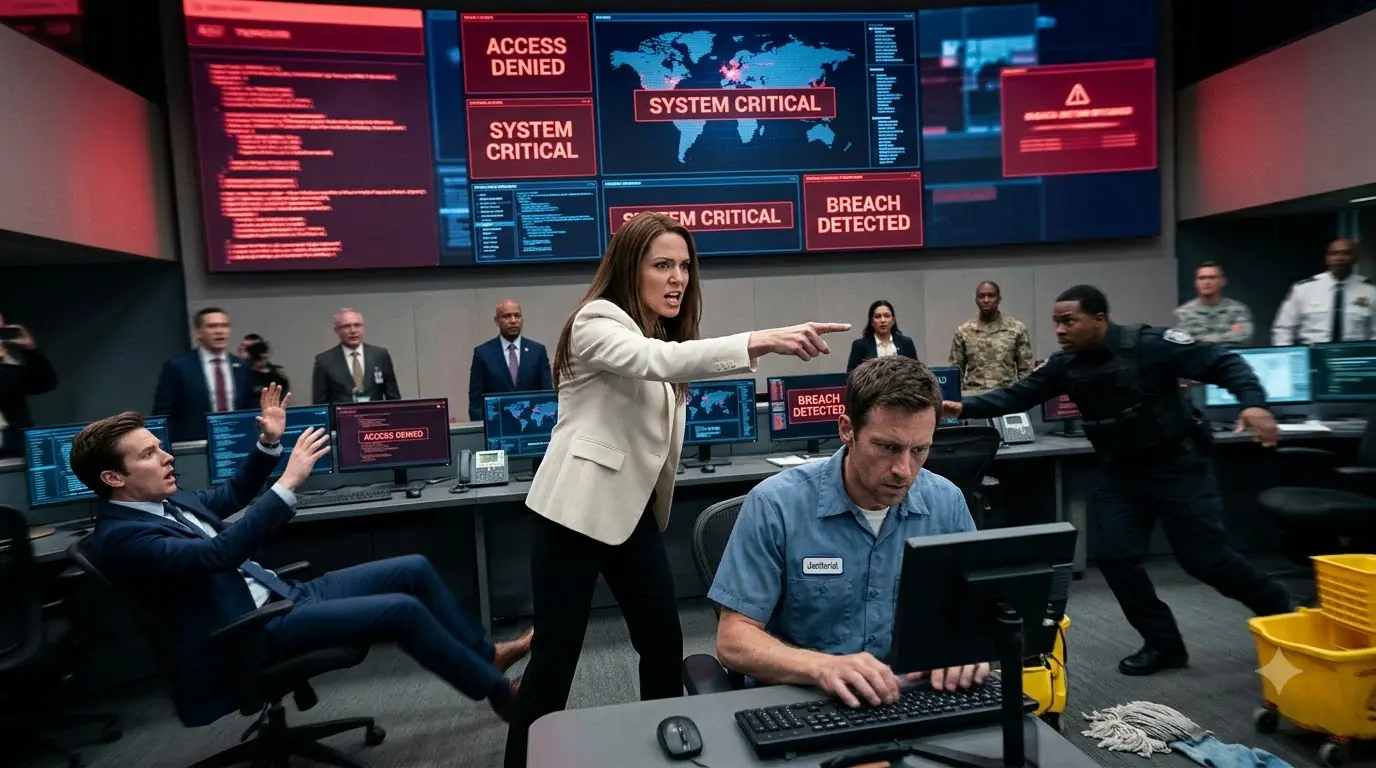
He stood beside a carpet extractor at the back of the command center, holding the machine's heavy cord in one hand. His name was Daniel Mercer, and that morning he had come to the forty-second floor to clean up coffee, not to solve a national defense contractor's engineering crisis. He could have finished winding the cord and gone downstairs without anyone remembering that he had been present.
That was what he had done for nearly seven years: appear when something needed cleaning, leave when it was clean, and collect a paycheck that kept his little daughter insured. Instead, Daniel watched a second diagnostic counter begin to climb, and the shape of the failure was so familiar that his stomach tightened before the alarms began.
At the front of the room, Charlotte Wynn stood between the demonstration console and General Edward Hayes, the senior military official overseeing the evaluation. Charlotte was thirty-six, the founder and chief executive of Helix Dynamics, and every public photograph of her seemed to feature a glass building, a determined expression, and a headline describing her as the woman who could build anything.
That morning she wore a midnight-blue suit that had been tailored within an inch of perfection. Her hair was pinned neatly despite the rain beyond the windows, and she spoke with the confidence of someone who had practiced the presentation through several sleepless nights. Daniel could see the tension in her shoulders from the back of the room. He was the only person there who knew it was not the first time she had been handed a system with a beautiful interface and an unstable heart.
The system was called Aegis, and it was meant to detect and contain coordinated attacks on isolated test networks modeled after critical infrastructure. Helix had spent eighteen months developing it, using an investment round, a federal evaluation agreement, and nearly every ounce of goodwill Charlotte possessed. The potential contract was worth more than a hundred million dollars over several years, provided the company could meet security, reliability, and audit requirements.
The morning demonstration would not itself authorize deployment to a real power grid; it was a decisive technical milestone that could make or break the project. Charlotte's engineers understood that difference. Unfortunately, their lead architect, Blake Harlan, had spent too much time promising the public a miracle and too little time admitting what the internal load tests had shown.