The morning at Chicago O'Hare International Airport began the way most winter mornings began at the first class gate with a polished silence that money had been buying for decades. Outside the tall windows, thin snow drifted across the runway. Inside, the white light bounced off the marble floor and the gold trim of every counter. Travelers in cashmere coats and tailored suits stood in a quiet line, their luggage gleaming like small monuments to wealth.
Every person in this corner of the airport seemed to be performing the same quiet ritual, the ritual of proving that they belonged. It was into this careful picture that Adelaide Monroe stepped, almost unnoticed. She was 76 years old, small and gentle in shape, with silver hair pulled into a low knot at the back of her head. She wore a charcoal wool coat that had seen many winters, a simple long skirt, and soft leather shoes worn smooth at the toes.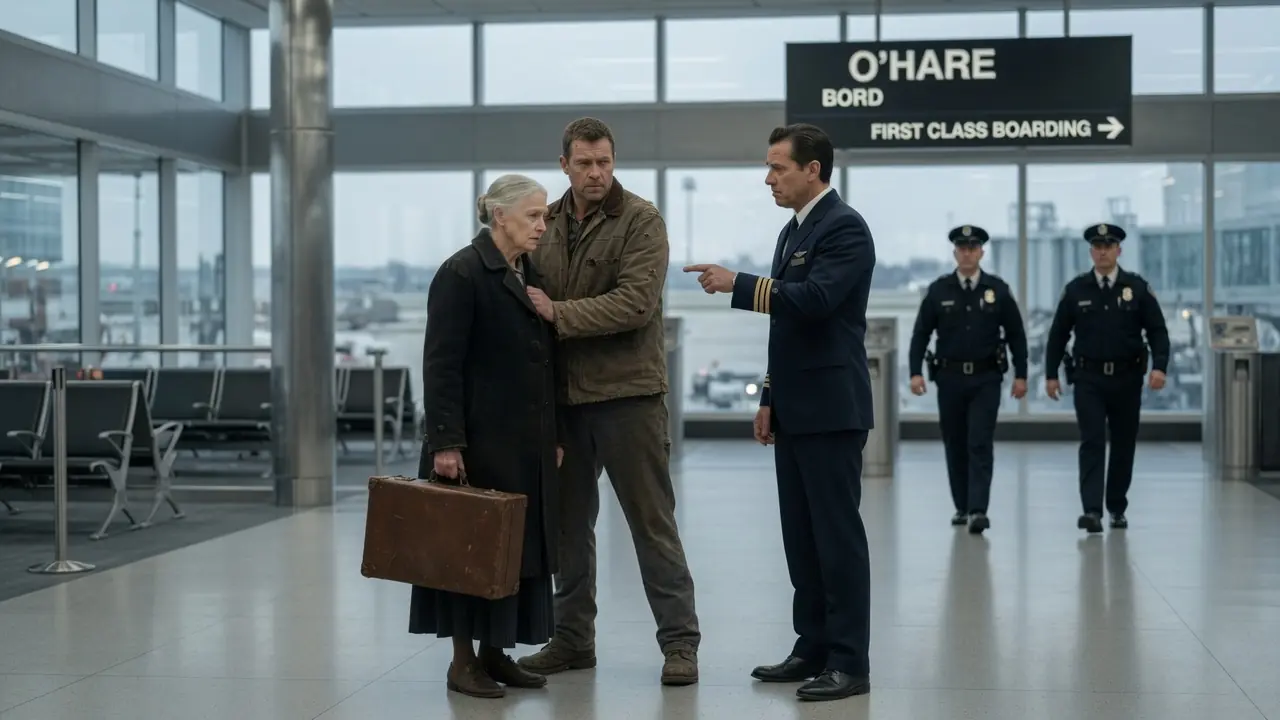
She pulled a single old suitcase behind her, its surface scuffed, its corners softened by years of travel. She wore no jewelry beyond a thin gold band on her left hand. She held a first class ticket in her hand and stepped quietly into the boarding line as though she were nothing more than a grandmother going on a long trip. Corbin Vail saw her at once.
He was 43 years old, the head of the first class boarding section for Northstar Airways at O'Hare. His navy blue uniform was pressed sharp at every seam. His dark hair was combed back, slick, and shining. He wore a practiced smile that did not reach his eyes.
He had spent 20 years sorting people into categories with a single look, and his look at Adelaide took only a moment. He saw the coat. He saw the worn suitcase. He saw the absence of every signal he had been trained to recognize as wealth.
The verdict was already written. He stepped forward, placing himself directly in her path, and offered the smile he saved for these moments. "Ma'am," he said, voice loud enough to carry, "this area is reserved for first-class passengers. I'm afraid you may be in the wrong line."
Adelaide stopped. She did not look surprised, only tired. She drew her ticket from the inner pocket of her coat and held it up between them. "I am not in the wrong line," she said softly. "This is my ticket. This is my seat."
But Corbin did not glance at the screen behind him to verify it. He did not scan the barcode. He took the ticket between two fingers, studied it as though he were reading a forged document, and then frowned in a way that everyone nearby would notice. "And where did you purchase this, ma'am? Was it bought on your behalf? Are you certain you have not taken someone else's ticket by mistake?"
A few heads in the line turned. A young man in a navy blazer leaned toward his girlfriend and whispered something that made her smile. A middle-aged woman tightened her grip on her handbag as though Adelaide had become, in that single moment, a danger. Toward the back of the line, a single passenger watched without smiling, and his name was Archie Whitman.
He was 71 years old, tall, broad-shouldered, dressed in a brown coat that had been mended at the cuffs more than once. His hair had turned silver years ago. His eyes were a calm gray-blue, very steady when something he did not like came into view. His hands were large and roughened, marked with the faded scars of 40 years spent fixing aircraft engines.
Archie had never been famous or wealthy, but pilots had trusted him with their lives. Young mechanics had called him sir without being asked. He had known exactly how an engine sounded when it was working well, and exactly how it sounded when it was lying. His wife had died when their daughter, Callista, was only 5 years old.
From that day on, Archie had been mother and father both. He'd learned how to braid hair, how to make breakfast at 4:00 in the morning, how to sit beside a sick child through the night and then go to work without complaint. He had skipped his own warm coat so Callista could have new school books. Callista had grown up clever and ambitious.
She did not like it when he wore the same brown coat to her business dinners. The first-class ticket she had bought him for this trip had been a gift. She had wanted him to see the world she lived in now. She had not expected him to be tested in it.
When the small commotion at the front of the line began, Archie watched in silence for a long, long moment. Then he leaned slightly toward his daughter and said, "Do you see what is happening up there?" Callista was checking her email on her phone. She glanced up, took in the scene, and lowered her voice.
"It's probably just a procedure check, Dad. Let's not get involved." Archie did not answer right away. He looked at her gently, and there was something a little sad in his expression. He did not blame her.
He simply remembered as he watched the old woman's hand begin to tremble around the boarding pass that he had once told a much younger Callista a very simple thing. He had told her that the day she stopped seeing the people the world tried to push into corners would be the day he would have failed as her father. Corbin was still holding Adelaide's ticket between two fingers. Like a man unwilling to give back something he had decided was suspect.
He could have looked at the screen. He could have typed the confirmation number. The verification would have taken 3 seconds. He chose instead to keep her standing there.
"Ma'am," he said, "First class tickets are usually purchased through verified accounts. Do you have identification? Did someone purchase this for you?" Adelaide opened the small leather wallet she had been carrying. Her hand trembled, but her voice remained polite.
She offered her driver's license. She said her name was Adelaide Monroe. She had bought the ticket herself. She was flying to New York on a personal trip.
She added that today was a special day. It was the 50th anniversary of her wedding to her late husband. He had promised many years ago that one day he would take her to New York in a first class seat and walk with her through Central Park while the snow was falling. He had died before he could keep that promise.
She was making the trip herself with the old suitcase they had shared on every journey of their lives together. In another life, in another moment, that story would have stopped a man like Corbin in his tracks. But this Corbin only tilted his head as though her story were a small inconvenience and gave her a slow performative smile.
"Ma'am," he said, loud enough for the entire line to hear, "I'm very sorry for your loss, but a sad story does not prove that you belong in the first class cabin." It landed the way a slap lands. Adelaide flinched once, almost imperceptibly. A woman near the front of the line laughed and then quickly covered her mouth.
A businessman behind Adelaide sighed loudly because his boarding had been delayed. Corbin felt the attention. He felt the small heat of being watched and he mistook it for approval. He told her that Northstar Airways had a responsibility to protect the experience of its premium guests.
He told her that he was simply doing his job. He used the word procedure three times in 1 minute and each time it became a smaller cage around the old woman in front of him. Callista watched and her expression began to shift. She did not like the way the man was talking.
The cold formality of it was the same formality she had been trained to produce when she wanted someone to disappear from a meeting without a scene. She recognized the trick. And she could feel deep in her chest the first small turn of something uncomfortable. But she also recognized the man two rows behind her in the line.
He was the chief financial officer of a fund she had been trying to win for 9 months. She knew with the precision of a chief executive who had built a habit of these calculations that if her father stepped forward right now every person on this flight would carry the memory of it into the conference in New York. Archie stepped out of the line. He did not move quickly.
He did not raise his voice. He walked the way a man walks who has spent a lifetime learning that calm is its own kind of strength. He moved past two travelers, past the velvet rope, past Callista's quiet, alarmed look and stopped beside Adelaide. He simply stood close enough that she could feel another body, another presence beside her.
Then he turned to Corbin Vail. "She has a ticket," he said. "Your job is to check the ticket. It is not to check her worth through her coat." The entire boarding area went still for a second.
Corbin turned his head slowly. He took in Archie's brown coat, his worn leather shoes, the small cloth bag he carried. The smile on his face came back, sharper than before. "Sir," he said, "are you also a first-class passenger?"
"I am," Archie said. "But even if I were not, I would still have the right to ask you to treat an elderly woman with respect." A few people in the line lowered their eyes. A young woman behind Adelaide quietly stepped a little closer to her, as though she had only now understood that she should have done so already.
Corbin did not back down. He said something about premium guest experience, about protecting against ticket fraud, about how the public did not understand the demands of his role. He was building a wall of polished words. Archie watched him build it.
When Corbin paused, Archie spoke again, very simply. "No," he said, "you are protecting your own pride." That was the sentence that broke something in the room. Several passengers looked away.
The young man with the phone slowly lowered it. The businessman who had been sighing pretended to read a newspaper that he had been carrying upside down for the last 5 minutes. Callista hurried forward. She slipped her hand around her father's elbow and lowered her voice so that only he could hear.
"Dad, please," she said, "we are about to board. Do not make this bigger than it has to be." Archie did not pull away from her. He looked into his daughter's face. He was not angry with her.
He only asked, very quietly, "Do you want me to be silent because I am wrong, or because this is awkward for you?" Callista did not answer. Because deep beneath the dress and the title and the careful career she had built brick by brick, she knew her father was not wrong. She was only afraid.
Adelaide, who had been watching this exchange with the careful eyes of a woman who had seen many such moments, turned to Archie. Her voice was barely above a whisper. "You do not have to do this for me," she said. Archie's answer would later be remembered by every person who heard it.
"I am not doing this because you are rich or poor," he said. "I am doing it because I hope that if I am ever the one standing alone, someone will speak a fair word for me." The smile on Corbin's face had stiffened. He had not expected to be embarrassed by a man in a brown coat.
The shame turned, almost instantly, into a colder kind of anger. He glanced down at the screen beside him and searched. His face changed slightly when he found the name Whitman. Archie listed beside the name Whitman, Callista, with the title Chief Executive.
He understood at once who he was speaking to. The shape of his attack changed in the next breath. "Mr. Whitman," he said, "if you continue to interfere with my boarding procedure, I have the authority to ask security to remove you from this area." Callista paled.
Until that moment, she had still hoped this might end quietly. Corbin turned to her then, his voice softening in a deliberately measured way. "Ms. Whitman," he said, "I am sure you understand that the first-class experience must be protected. Your father seems to be a bit overwhelmed. I would hate for this incident to affect your trip."
It was a kind of cruelty. It put her, the daughter, into the position of having to choose between standing with her father and saving her image. Several travelers near them recognized her now. She heard her own company's name spoken in a half whisper.
She felt the heat climb up her neck. She did not want her father to be insulted. She also did not want this moment to become the moment that defined her year. She looked at her father, and her voice came out thinner than she meant it to be.
"Dad," she said, "I know you want to help, but we do not know everything that is going on." Archie's eyes were patient, but they were also a little heavy. "I know enough, Callista," he said. "An elderly woman with a ticket is being humiliated. That is everything that is going on."
Corbin did not let it stop there. He turned back to Adelaide. He told her that she would have to step aside for additional verification. He said it in the gentlest, most polished voice, and yet the meaning beneath it was simple.
He wanted her out of the line so it could continue without an embarrassment. Adelaide began to move, slowly, but Archie spoke softly. "You do not need to step aside, ma'am. Stay where you are."
Then, to the agent, he said, "If you want to verify the ticket, you can do it right here, at this desk, in 2 seconds. Why are you asking her to leave the line?" Corbin's jaw tightened. It was the moment everyone understood that the agent had no real answer.
Adelaide pressed a hand softly against her chest. The color in her face had begun to thin. She drew in a long, slow breath. Archie turned to her quickly. "Ma'am, are you all right?"
Corbin's voice cut across the moment, sharp and clinical. "Sir, she is unwell. Perhaps she should not be flying at all." Archie turned his head slowly toward him. "You just used her age as a reason to push her out," he said. "Do you hear yourself?"
A few steps to the left of the velvet rope, a woman in a black V-neck dress stood watching the entire scene without moving. Her name was Vanessa Hart. She was 28 years old, the chief executive of a luxury fashion brand with storefronts in five cities. Her hair was pulled back into a sleek, perfect knot.
She had seen everything. She had seen Corbin lift the ticket. She had seen the line laugh. She had seen the old woman tremble.
She had watched, with the detached interest her industry had taught her, as a single father in a brown coat stepped forward where she had not. And she had not, until this moment, asked herself why. In her world, she was used to seeing people sorted by what they wore. Doors opened for those who looked the part.
Doors closed politely on those who did not. But Archie's words had cracked something quiet inside her. The way he had asked his daughter, "Do you want me to be silent because I am wrong? Or because this is awkward for you?" kept turning over in her mind.
It was not a question for Callista alone. It was a question for everyone in the line. She had money. She had reputation.
She had a voice. If she had spoken at the start, the agent would have moved differently. The old woman would have been spared half of this. And she had let a 71-year-old single father do what she, with all her power, had been afraid to do.
She took a small step forward. But before she could speak, Corbin raised his hand and waved toward the end of the corridor. Two airport security officers in dark uniforms began walking toward the boarding gate at a measured pace. The two officers arrived at the gate with the trained calm of men who had handled many problems in this airport.
They looked first to Corbin, who after all was wearing the airline's uniform and the airline's authority. Corbin took his story to them before anyone else could speak. He said the elderly woman had presented a ticket with unclear ownership. He said she had refused to step aside for verification.
He said an older male passenger had inserted himself into the situation and was now obstructing the boarding process. He did not say she looks poor or he is in her way. He said irregularity and verification and obstruction. The language did the work that his thoughts had been doing all along.
Adelaide tried to explain. "I have documents," she said. "The ticket is mine. Please check the system."
Corbin cut across her. "Ma'am, we have heard enough. Please cooperate." Archie spoke directly to the older of the two officers. "Officer, please check the booking number before you embarrass an elderly woman in front of a hundred people. Do not let a hurry on your part become a stain on the rest of her life."
The officer hesitated. Something about the older man's manner reached him in a way that uniforms usually did not. He turned slightly to check the screen, but Corbin was already speaking again, faster now. "Officers, the flight is delayed. The premium passengers are starting to complain."
"The responsibility for that delay will fall on you if you do not move quickly." The crowd shifted with a low, unkind murmur. A few of the wealthier passengers had begun to complain audibly. None of them cared whose dignity was being broken to keep them on schedule.
Callista stepped forward at last. It was a small step, only a single foot in the right direction, but it was the first one. She raised her voice, not loudly, but clearly. "You can check the booking right here at the counter," she said. "Why are you asking her to leave first?"
Corbin's head snapped to her. His tone became somehow even colder. "Ms. Whitman, I would advise you not to let family feelings cloud your professional judgment." That was when she felt it, very clearly, in the center of her chest.
He was using her own vocabulary against her. He was using the language she had used at every board meeting to dismiss the small voice in her gut. Professional. Procedural.
Optics. Risk management. He was speaking exactly the language she had been speaking to herself for the last 15 minutes. Adelaide turned to Archie and spoke in a voice barely above a whisper.
"Mr. Whitman, I do not want you and your daughter to suffer trouble because of me." Archie answered her as evenly as if they were sitting at a kitchen table. "Ma'am, trouble does not start when good people speak. It starts when bad people believe that no one will."
And it was at that exact second that they all heard the sound of new footsteps in the corridor. The footsteps came from the long marble hallway that led to the executive office wing. They were quick, controlled, the kind of footsteps that men in tailored suits make when they have been told to hurry without losing their dignity. Three of them came forward in identical dark suits.
The man at the front carried a slim leather folio. None of them looked at Corbin. They walked past him as if he were a column of air. They stopped in front of Adelaide Monroe, and the man at the front, a tall, gray-haired attorney with sharp eyes, gave her a small, formal bow.
"Mrs. Monroe," he said, "I apologize for the delay. The shareholder meeting you requested has been prepared according to your instructions." A silence fell over the boarding area that was unlike any silence that had come before it. It was the silence of people who suddenly understood that a story they thought they were watching had a second floor they had never noticed.
Corbin's mouth opened. "Mrs. Who?" The attorney turned to him and looked at him for the first time. His voice was even and calm. "Mrs. Adelaide Monroe," he said, "founder of Monroe Capital Trust, the largest individual shareholder of Northstar Airways, and the wealthiest woman in the city of Chicago."
The line did not move. The young man with the phone slowly lowered it to his side. The woman who had laughed turned her face away. The businessman pretending to read the newspaper let it slip in his hand.
Corbin's face went a particular shade of white that comes only when a man has already realized, in full, what he has just lost. Callista did not move at all. She only looked at her father, and her father looked back at her, and something passed between them that could not be put into language. He had not known.
He had never known. He had only seen a woman who needed someone to stand beside her, and he had stood. That was the whole of it. That was the whole of him.
The attorney continued gently, almost as an explanation to the room. He said that Mrs. Monroe had chosen, deliberately, to travel without a security detail and without an entourage on this particular flight. This trip was a private one. It was a trip of remembrance.
The coat she wore had been bought for her by her late husband during their first winter together in Chicago, more than 50 years ago. The suitcase she carried had traveled with the two of them on their first journey as a married couple. She had not been hiding her wealth. She had been carrying her marriage.
Everything that Corbin had read as poverty had been, instead, the most precious thing she owned. Adelaide reached out and took her own ticket back from Corbin's hand. Her fingers still trembled slightly, but no longer from fear. Corbin began to stammer.
He said the word "misunderstanding." He said the word "procedure." But the words had lost their power. Everyone in the line had already heard him say, only minutes earlier, that a sad story did not prove she belonged in first class.
Adelaide did not raise her voice. She had never raised her voice in 50 years of building Monroe Capital Trust. She turned to Corbin and spoke so that the entire line could hear her, but not with anger. With something cleaner than anger.
"You did not doubt my ticket," she said. "You doubted my dignity because I did not look like the kind of person you wanted to serve." Corbin bowed his head. "Mrs. Monroe, I deeply apologize. I was only trying to protect the integrity of the first class experience."
"No," she answered. "You used procedure to hide your prejudice." A senior representative of Northstar Airways had been hurried down the corridor by then. He arrived breathless with two assistants behind him and began at once to apologize.
He used the words that companies use when they have something to lose. He said the airline would investigate internally. He said Mrs. Monroe would receive every possible courtesy. Adelaide listened to him for a moment and then quietly cut his sentence in half.
"I do not want a bouquet of apologies," she said. "I want to know how many people without my money, without my attorney, and without my shares in this airline have been treated the way I was treated today." The words made the air feel different. This was no longer the story of a wealthy woman insulted by a rude employee.
This was now the story of every traveler who'd ever been judged at a counter for the wrong coat, the wrong age, the wrong tired face after a long flight. She instructed her attorney to record the incident formally. She asked for the security footage to be preserved. She asked for the names of any other passengers who had filed complaints about premium service discrimination in the last 5 years.
Corbin was suspended at that very gate. His employee badge was taken from him in front of the line he had hoped to impress. He walked past the velvet rope and did not look at the passengers as he went. A few of the people who had laughed before stepped forward to apologize to Adelaide.
A man with a gold pin on his lapel said, "Madam, I am sorry. I should not have smiled." Adelaide looked at him gently. "Do not apologize to me because I turned out to be wealthy," she said. "Apologize to the next person you would have looked down on if you thought they were poor."
He had nothing to say to that. Then Adelaide turned to Archie. "Mr. Whitman," she said quietly. "In this entire line of first-class travelers, you were the only one who behaved as though you understood what first class actually means."
Archie shook his head. "Ma'am, I only did what anyone should have done." She looked at him with something close to sorrow. "No," she said. "If that were ordinary, I would not have had to stand alone so long."
When Corbin was gone, when the senior representative had retreated to make his urgent calls, when the line began slowly to remember that it was supposed to be boarding a flight, the boarding area began to breathe again. But not for Callista. For Callista, something had stopped breathing in her old self. And something newer was taking its first small breath instead.
She stood very close to her father now. She no longer looked like a chief executive. She looked like a daughter. Her shoulders had dropped a little.
Her eyes were wet, although she had not let any tear fall. "Dad," she said softly. "I am sorry." Archie turned his head and looked at her.
He did not look angry. "What for?" he asked, although he already knew. "For being afraid you would embarrass me," she said. "For thinking about how I looked before I thought about how she felt."
Archie did not lecture her. He had never lectured her, not in 22 years of raising her by himself. He simply reached out and adjusted the collar of her blazer the way he had once adjusted the collar of her school uniform when she was 6 years old and could not yet tie her own shoes. "I raised you to walk into big rooms," he said.
"I only hope that no matter what room you walked into, you would still see the people who got pushed into the corners." Callista did not have the breath to answer. She nodded very slightly, and a single tear slipped down her cheek. She had built her career on not crying.
She wiped the tear away quickly. Then she slipped her arm through her father's elbow and simply stayed there. Vanessa Hart approached them. Her sleek heels clicked softly on the marble.
She stopped in front of Adelaide first. "Mrs. Monroe," she said, "I owe you an apology as well. I saw everything. I had the voice and the standing to interrupt this man much earlier, and I chose to be quiet."
Adelaide regarded her. She did not answer for a long moment. When she spoke, her words were gentle, but they were also exact. "Power does not raise people higher," she said. "It only makes their silence heavier."
Vanessa absorbed that. She nodded, accepting it. Then she turned to Callista and to Archie. She said her brand would establish a public initiative against discriminatory treatment in luxury service.
She would make her own previous silence part of the conversation in a documented way. Callista, almost without thinking, added her own pledge. She said her aviation logistics company would create a transport assistance program for elderly travelers, for low-income medical patients, for people who needed to fly for family emergencies but could not afford the cost. She did not say it for applause.
She said it because she could not, after the morning she had just lived through, walk away from it without saying it. Adelaide did not require these promises. But the right kind of shame at the right moment becomes the right kind of action. Archie looked at his daughter the way he used to look at her on the first day of every new school year.
He smiled very softly. For 1 second, he did not see the chief executive. He saw the small Callista who, at age 6, had given half of her sandwich to a boy in her class who had forgotten his lunch. When boarding resumed, Adelaide asked Archie to take the seat beside her in the first-class cabin.
Callista sat across the aisle from her father. None of the other passengers looked at Adelaide the way they had looked at her 30 minutes ago. She did not look at them either. She walked the same slow way she had walked into the gate with the same old coat and the same scuffed suitcase.
She had not become a new person in the last hour. She had only become visible. The room had finally adjusted its eyes. On the plane, after the cabin doors had closed and the engines had begun their slow, steady warm-up, Adelaide turned to Archie and began to speak quietly.
She told him about her husband. She told him that when they were first married, they had been so poor that they shared a single cup of coffee in a small cafe near the train station. And they had argued gently about who would take the last sip. She told him her husband had once said to her, "One day, my love, I will take you in a first-class seat to New York."
For her husband, first class had never meant a wider chair or a glass of expensive wine. It had meant the day she would be able to rest. The day she would be respected. The day she would be treated the way she had always deserved to be treated.
Archie listened to her with his hands folded in his lap and his eyes on the snow outside the small oval window. He understood her in a way that very few people in the cabin could have. He had spent his own life dreaming the same dream for his own daughter. He had only wanted her never to have to bow her head because of poverty.
Callista leaned across the aisle. She placed her hand on her father's wrist. "Dad," she said, "I thought I bought you this ticket so you could see my world. But today, you showed me what the world should look like."
Archie smiled slowly. "You do not need to be the richest person in the room, sweetheart," he said. "You only need to keep your heart from going poor." In the weeks that followed, Northstar Airways announced a complete overhaul of its customer service policies.
Every employee in premium service positions was required to retrain on discrimination based on age, appearance, class, and disability. A dedicated complaint line was established for vulnerable passengers. Corbin Vail not only lost his position, but was permanently barred from premium hospitality work as internal records revealed years of similar incidents that had been quietly buried.
The story of the boarding gate spread through the city in the way that real stories do, through conversations at family dinners, through retirees calling their grown children, through neighbors talking over fences in cold yards. What people remembered most was not Adelaide's fortune. It was not even Corbin's downfall. It was the image of Archie Whitman, a 71-year-old single father in a brown coat, stepping out of a quiet line to defend a stranger he had never met before he had any idea who she was.
Callista followed through on every word she had spoken at the gate. Her company launched the transport assistance program within 90 days. The first flight covered by it carried an 80-year-old veteran traveling to see his great-grandson for the first time. Vanessa Hart, true to her word, used her brand's platform to fund a long-running campaign against discriminatory treatment in luxury service.
In her first public statement, she said that the elderly woman denied first class had not been the only person being tested that morning. Every silent witness had been tested, too. Some weeks later, on a quiet evening, Callista drove her father back to his small house in the Chicago suburbs. The snow had begun again, slow and forgiving.
She walked him up the path, carrying his small cloth bag, and for the first time in years, she did not feel embarrassed by it. She felt instead that she was carrying a record of a life of quiet sacrifice. At the front door, she put her arms around her father and held him for a long time. "I am sorry, Dad," she said. "I'm sorry that for a while I forgot what you raised me to be."
Archie pressed his hand to the back of her head gently, the way he had pressed it when she was very small. "If you forget, sweetheart," he said, "you learn again. A good person is not someone who never gets it wrong. A good person is someone who still hurts when they realize they did."
Somewhere across the country in a quiet penthouse in New York, Adelaide Monroe stood at her window and watched the snow gather on the railing of her terrace. She placed her husband's old coat carefully on the back of an empty chair beside her, the way she had been placing it for many years. Tonight she did not feel as though she were alone with a memory. She felt as though the memory had been honored.
A first-class ticket can be bought with money, but dignity, courage, and kindness cannot be charged to any account. The richest person is never the one who owns the most. It is the one who refuses to let another human being stand alone in a long marble hallway full of strangers on the worst morning of her life. That morning at Chicago O'Hare, Archie Whitman did not earn his first-class seat with a fortune.
He proved instead that there are men who simply by stepping into a room make the room more honorable, not because they are wealthy, but because they will never allow the smaller person, the older person, the quieter person to stand alone. And in a world that often forgets, that lesson is worth more than any ticket ever printed