Rain fell hard over New York City that Friday afternoon, turning the sidewalks into silver ribbons under the glow of traffic lights. Ryan Cole hurried down the wet street with his hood pulled low, one hand holding a cheap umbrella that kept bending in the wind. His worn sneakers splashed through puddles as he checked the time on his cracked phone. He had twenty-three minutes to reach his daughter Lily’s school before pickup.
Ryan was twenty-nine years old, a single dad, and always running from one responsibility to the next. In the mornings, he stocked shelves at a small grocery store in Queens. In the afternoons, he delivered packages for extra cash whenever his schedule allowed it. Every dollar he made went toward rent, food, Lily’s school supplies, and the tiny savings jar he kept hidden above the refrigerator.
That day had already been difficult. His boss had cut his hours again, claiming business was slow, and Ryan had spent his lunch break calculating which bill could wait another week. The rent was due soon, Lily needed new shoes, and his old winter coat had a tear along the sleeve. Still, he pushed those worries aside as he hurried through the rain because his daughter would be waiting for him by the school gate.
Then he saw the elderly woman.
She stood near the corner of Lexington Avenue, wearing a bright blue raincoat that made her stand out against the gray city. Two heavy grocery bags hung from her arms, the paper darkening from the rain. She tried to shift one bag higher, but the bottom sagged, and a loaf of bread nearly slipped out. Around her, people walked past without slowing down.
Ryan stopped.
For one second, he looked at his phone again. He was already running late, and the school was still several blocks away. But the woman’s hands trembled as she tried to steady the bags, and Ryan saw the quiet panic on her face. His mother’s voice came back to him as clearly as if she were standing beside him.
“When someone needs help, Ryan, don’t wait for someone richer to do it.”
He ran toward the woman.
“Ma’am,” he called, carefully stepping around a puddle. “Let me help you with those.” The elderly woman looked up in surprise as he reached for the bags. Her eyes were sharp and pale, but there was tiredness around them. For a moment, she held the bags tighter, as if deciding whether to trust him.
“You don’t have to do that,” she said.
Ryan smiled gently. “I know,” he said. “But those bags are winning the fight.”
The woman blinked, then gave a small laugh despite the rain. Ryan took both grocery bags carefully, making sure the wet paper did not tear. They were heavier than he expected, filled with fruit, canned soup, bread, and a bottle of milk. He shifted them in his hands and nodded toward the curb.
“Where are you headed?”
“Just across to the car,” she said. “I thought I could manage it myself.”
Ryan glanced at the rushing traffic. “Then I’ll walk you there.”
They waited for the light to change while rain bounced off the sidewalk around them. The woman studied him from beneath the hood of her raincoat. Ryan felt suddenly aware of his faded hoodie, the worn elbows, and the tiredness he could never fully hide from his face. He was used to people looking past him, but this woman seemed to be truly looking at him.
“You’re in a hurry,” she said.
Ryan gave a quick smile. “My daughter gets out of school soon.”
“You have a daughter?”
“Lily,” he said, and his face softened immediately. “She’s seven. She thinks I’m late even when I’m only two minutes behind.”
The woman smiled. “Smart girl.”
“She gets that from her mother,” Ryan said before he could stop himself.
The woman heard the change in his voice. “Is her mother nearby?”
Ryan swallowed. “No, ma’am. She passed when Lily was three.”
The crosswalk signal changed before the woman could respond. Ryan stepped carefully into the street with the bags, keeping his body slightly ahead of her as cars waited at the light. He did not rush her, even though every minute mattered. He walked at her pace, matching her slow steps through the rain.
“My name is Margaret Whitmore,” she said as they reached the other side.
“Ryan Cole.”
“Thank you, Ryan Cole.”
“It’s nothing.”
Margaret stopped walking and looked at him. “Kindness is never nothing.”
Ryan did not know how to answer that. He looked down at the bags, embarrassed by the seriousness in her voice. “I just didn’t want you to drop your groceries,” he said. “My mom would haunt me if I ignored an elderly woman in the rain.”
Margaret laughed again, warmer this time. “Your mother sounds like a woman of strong principles.”
“She was,” Ryan said. “She raised me right.”
Before Margaret could say more, a sleek black luxury car pulled up along the curb. Ryan stepped back, assuming it belonged to someone else. Then the driver’s door opened, and a chauffeur in a black suit stepped out with an umbrella. He hurried around to the rear passenger door and opened it smoothly.
“Ms. Whitmore,” the chauffeur said, concern crossing his face. “I’m sorry. Traffic forced me around the block.”
Ryan froze.
He looked at the car, then at Margaret, then at the chauffeur holding the door open for her. The black vehicle looked like something from a magazine, clean and expensive even in the rain. The chauffeur reached for the grocery bags, but Ryan still held them in both hands, stunned. Margaret watched his expression with quiet amusement.
“You are not just some lady from the grocery store,” Ryan said.
Margaret smiled. “Today, I was.”
Ryan quickly handed the bags to the chauffeur. “I’m sorry, ma’am. I didn’t realize.”
“That is exactly why I’m grateful,” Margaret said.
Ryan frowned slightly. “Why?”
“Because you helped me before you knew my name meant anything.”
The words landed heavily. Ryan looked down, unsure whether to feel proud or embarrassed. Margaret reached into her raincoat pocket and pulled out a thick white business card with gold lettering along the edge. She held it out to him. Ryan hesitated before taking it.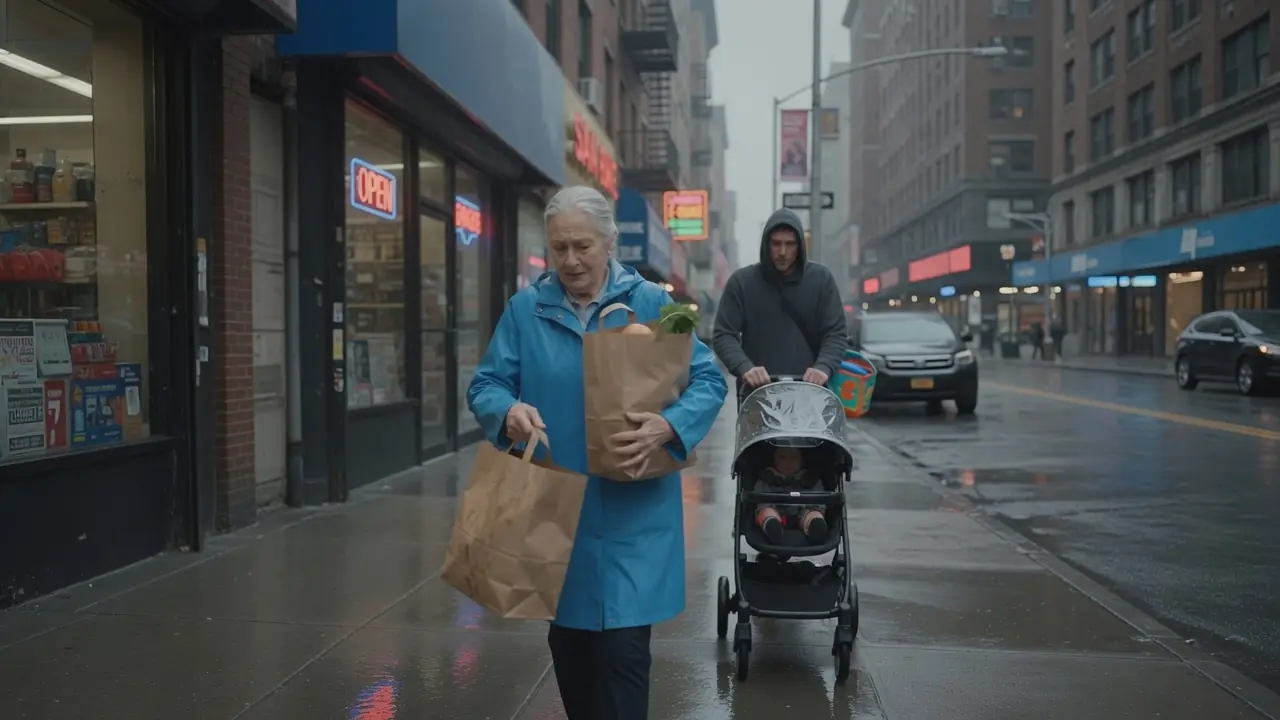
“Come by my office tomorrow,” Margaret said.
Ryan stared at the card. “Your office?”
“Yes.”
“I have work tomorrow.”
“What time?”
“Morning shift ends at eleven.”
“Then come at noon.”
Ryan looked from the card to her face. “Why?”
Margaret’s smile softened. “Because I would like to talk to the kind single father who stopped in the rain when everyone else kept walking.”
Ryan opened his mouth, but no words came out. The chauffeur closed the door after Margaret climbed into the car. A second later, the vehicle pulled away through the rainy traffic, leaving Ryan standing on the sidewalk with the card in his hand. He looked down at the gold letters.
Margaret Whitmore. Whitmore Foundation.
Ryan had heard that name before.
He ran the rest of the way to Lily’s school with the card tucked carefully inside his hoodie pocket. When he reached the gate, Lily stood beneath the awning with her backpack nearly as large as she was. Her dark curls stuck out from under her pink rain hat. She crossed her arms and gave him the serious look she used when pretending to be grown.
“You’re late, Daddy.”
“Four minutes,” Ryan said, catching his breath.
“Six.”
“Four and a half.”
Lily narrowed her eyes. “I counted.”
Ryan laughed and kissed the top of her hat. “Then I’m guilty.”
On the subway home, Lily noticed him touching his pocket again and again. “What’s in there?” she asked. Ryan pulled out the business card and showed her. She turned it in her small hands, impressed by the gold letters even though she could not understand why it mattered.
“A rich lady gave this to you?”
“Maybe.”
“Why?”
“I helped her carry groceries.”
Lily looked at him with complete seriousness. “That is very nice, Daddy.”
Ryan smiled. “You think I should go?”
Lily nodded immediately. “Yes. Maybe she gives cookies.”
Ryan laughed so hard that the woman sitting across from them smiled.
That night, after Lily went to sleep, Ryan sat at the small kitchen table and stared at the card. The apartment was quiet except for the hum of the refrigerator and the soft tapping of rain against the window. Bills lay in a pile beside the card, each one a reminder that kindness did not pay rent. Still, something about Margaret’s eyes had felt sincere.
At eleven-thirty the next morning, Ryan stood outside the Whitmore Foundation building in Midtown Manhattan. He had gone home after his shift, changed into his cleanest shirt, and combed his hair with water because he owned no styling gel. His jacket was old, but it was the best he had. He looked up at the glass tower and almost turned around.
People like him did not walk into places like that.
Then he thought of Lily.
He stepped inside.
The lobby was enormous, with marble floors, tall glass walls, and security guards who looked like they could see every mistake a person had ever made. Ryan approached the front desk and showed the card. The receptionist looked at it, then at him, and her expression changed from polite confusion to immediate attention.
“Mr. Cole,” she said, “Ms. Whitmore is expecting you.”
That sentence alone made Ryan feel like he had stepped into someone else’s life.
A woman in a navy suit escorted him to a private elevator. Ryan tried not to stare at the polished walls or the city view as the elevator climbed. His palms felt damp, and he wiped them on his jeans before remembering he should probably not do that here. The woman pretended not to notice.
Margaret’s office was on the top floor.
It had wide windows overlooking the city, shelves filled with books, and photographs of community centers, schools, gardens, and families. Margaret stood when he entered, wearing a cream blouse and a dark jacket. Without the raincoat, she looked even more powerful, but her smile was the same as it had been on the street.
“Ryan,” she said. “Thank you for coming.”
“Thank you for inviting me,” he replied, sitting carefully in the chair across from her desk.
Margaret studied him for a moment. “You look nervous.”
“I am.”
“Good. Nervous people are usually paying attention.”
That made him smile.
Margaret did not waste time. She asked about his daughter, his work, his education, and what he wanted for the future. Ryan answered honestly because he did not know how to impress people like her with fancy words. He told her he had dropped out of community college after Lily’s mother got sick. He told her he wanted stable work, better hours, and a way to give Lily a life where she did not have to worry about bills before she was old enough to understand them.
Margaret listened without interrupting.
That surprised him most.
Powerful people often waited only for their turn to speak. Margaret listened as though his life was a document worth reading carefully. When he finished, he felt exposed but strangely lighter. He had not said those things out loud in a long time.
“You remind me of my father,” Margaret said.
Ryan blinked. “I do?”
“He ran a small produce stand in Brooklyn. Worked twelve hours a day. Helped everyone, even when he had almost nothing himself.” She leaned back slightly. “People thought kindness made him weak. I learned it made him trustworthy.”
Ryan looked down. “I’m not special, Ms. Whitmore.”
“No,” she said gently. “You are responsible. There is a difference.”
Margaret opened a folder and slid it across the desk. Inside were several printed pages. Ryan looked at the first one and saw words like apprenticeship, housing stipend, childcare support, and training program. His throat tightened before he even understood all of it.
“What is this?”
“A program my foundation has been trying to build for single parents,” Margaret said. “Paid job training, stable placement, evening coursework, and childcare assistance.” She folded her hands. “We need someone in the pilot group who understands real struggle and still shows character under pressure.”
Ryan stared at her. “You want me?”
“I want to offer you a place.”
He shook his head slowly. “Because I carried groceries?”
“Because you were late to pick up your daughter and still stopped to help an old woman in the rain,” Margaret said. “That tells me more than a résumé.”
Ryan felt his eyes burn. He looked away quickly, embarrassed. Men like him learned to swallow emotion because there was always another problem to solve. But this was not a problem. This was a door opening where he had only expected another wall.
“I don’t know what to say.”
“Say you’ll think about it.”
Ryan looked at the folder again. “I don’t need to think.”
Margaret smiled. “Then say yes.”
Ryan swallowed hard. “Yes.”
The first months were not easy. Ryan worked through the foundation’s job-training program during the day and took evening classes twice a week. Lily attended a safe after-school center connected to the program, where she received homework help and dinner on class nights. For the first time in years, Ryan could breathe between responsibilities.
There were still hard days. He struggled with computer skills at first and felt embarrassed when younger trainees completed assignments faster than he did. He fell asleep once at the kitchen table with a textbook open under his cheek. He missed Lily during the long evenings, and guilt followed him like a second shadow.
But Lily was proud of him.
Every night, she asked what he learned. Ryan told her about business basics, communication, budgeting, and logistics. Lily took it very seriously and sometimes gave him gold star stickers from her school supplies. He kept them on the inside cover of his notebook.
Margaret checked in often, but never in a way that made Ryan feel small. She asked direct questions and expected honest answers. When he struggled, she did not pity him. She gave him resources, advice, and sometimes the kind of stern encouragement his mother used to give.
“Do not confuse difficulty with impossibility,” she told him one afternoon.
Ryan wrote that down.
After six months, Ryan was offered a full-time position managing community food distribution partnerships for the Whitmore Foundation. The job paid more than both his old jobs combined. It came with health insurance, predictable hours, and enough stability that Ryan cried quietly in the bathroom after signing the paperwork. Then he washed his face and picked up Lily from school like any ordinary day.
That night, he brought home pizza.
Lily knew immediately that something important had happened.
“Are we rich?” she asked.
Ryan laughed. “No.”
“Are we almost rich?”
“No.”
“Can we buy the good cereal?”
Ryan smiled. “Yes.”
Lily gasped like he had promised her a mansion.
Over the next year, Ryan changed. Not into someone different, but into someone less afraid. His shoulders relaxed. He slept more. He read bedtime stories without checking his phone for delivery orders. He bought Lily new shoes before the old ones completely gave out.
He also became good at his work.
He understood families who were one missed paycheck away from hunger because he had been one of them. He knew which neighborhoods had parents working double shifts, which schools needed weekend food bags, and which forms were too complicated for people already exhausted by survival. He helped redesign the foundation’s food assistance program so families could receive help without shame.
Margaret watched him grow with quiet pride.
One afternoon, almost two years after the rainy day, she invited Ryan and Lily to a foundation event. It was held in a community center in Brooklyn, where shelves of groceries lined one wall and children’s art covered another. Ryan spoke briefly about the program, his voice steady though his hands trembled around the microphone. Lily sat in the front row wearing a blue dress and beaming like he was the mayor.
Ryan told the audience about struggling as a single father. He told them about working too much, sleeping too little, and pretending he was not scared because his daughter needed him brave. Then he told them about the rainy afternoon when he helped an elderly woman carry groceries, not knowing who she was. He did not make himself sound heroic.
“I thought I was helping someone else,” Ryan said. “But that moment helped me too.”
Margaret sat quietly in the back, her eyes bright.
After the event, Lily ran to Margaret and hugged her. Margaret stiffened in surprise for one second, then softened and hugged the little girl back. Ryan saw it and felt something warm settle in his chest. Margaret had changed their lives, but Lily had also changed Margaret’s.
As years passed, Ryan continued rising within the foundation. He earned his degree part-time, became director of family support programs, and helped open new centers across the city. He never stopped carrying Margaret’s business card in his wallet. The gold letters faded slightly around the edges, but he refused to replace it.
To him, the card was not about power.
It was proof.
Proof that one kind act could be seen. Proof that a bad season did not mean a bad life. Proof that his daughter’s future could change because he had remembered his mother’s lesson on a rainy street.
Margaret grew older, but she remained sharp. She still visited food centers, still asked uncomfortable questions in meetings, and still refused to let anyone turn compassion into a public relations campaign. She often introduced Ryan as “the man who reminded me what real character looks like.” Ryan always shook his head when she said it.
But secretly, he carried those words carefully.
One rainy afternoon years later, Ryan walked through Manhattan with Lily, now a teenager. She was taller, confident, and wearing the kind of sneakers he once could not afford. They passed the same corner where he had first seen Margaret struggling with her groceries. Ryan slowed without meaning to.
Lily noticed. “This is the place, right?”
Ryan nodded. “Right here.”
She looked at the curb, then at him. “You almost didn’t stop?”
“I was late to pick you up.”
Lily smiled. “You’re always late.”
“I am not.”
“You are emotionally punctual.”
Ryan laughed. “What does that mean?”
“It means you show up when it matters.”
The words stopped him.
Rain tapped against their umbrella as taxis rushed past and strangers hurried along the sidewalk. Ryan looked at his daughter and saw the life that one small act had helped protect. She had grown up with more stability, more hope, and more chances than he had dared to imagine that day.
He squeezed her shoulder gently.
“You know,” he said, “I thought helping Margaret changed our future.”
Lily looked up at him. “It did.”
Ryan smiled. “Maybe. But I think it also showed us the kind of people we were supposed to become.”
Across the street, an elderly man struggled with a folded umbrella and a bag of books. Lily noticed first. Without waiting for Ryan, she stepped forward and called out to him. “Sir, do you need help?”
Ryan watched his daughter move through the rain.
And he smiled.
Because kindness had not ended with him.
It had been passed on.