Nolan Hayes paid $900 for an abandoned gas station that the whole town called a poisoned slab of concrete. People laughed when he signed the papers, and they laughed harder when his old pickup rolled to a stop in front of four rusted pumps. 3 days later, when the crew lifted the base of pump 4, the drill bit struck something that did not sound like a fuel tank. Under the concrete lay a thick steel door with a mechanical lock and a number scraped almost to nothing. Then a black SUV stopped outside the fence and stayed there.
Harrow Creek, Ohio, kept its history in the buildings nobody bothered to tear down. It had two stoplights, a diner that opened at 5 in the morning, and a grain elevator that had not moved a bushel since the late '90s. The old state route ran along its eastern edge, a road that once carried every truck heading toward the lake and now carried school buses. 4 miles north, the interstate interchange pulled the traffic away like a drain pulling water, and what it left behind sat rusting in the weeds. Cedar Line Service was the largest piece of that wreckage, and it had been closed for 17 years.
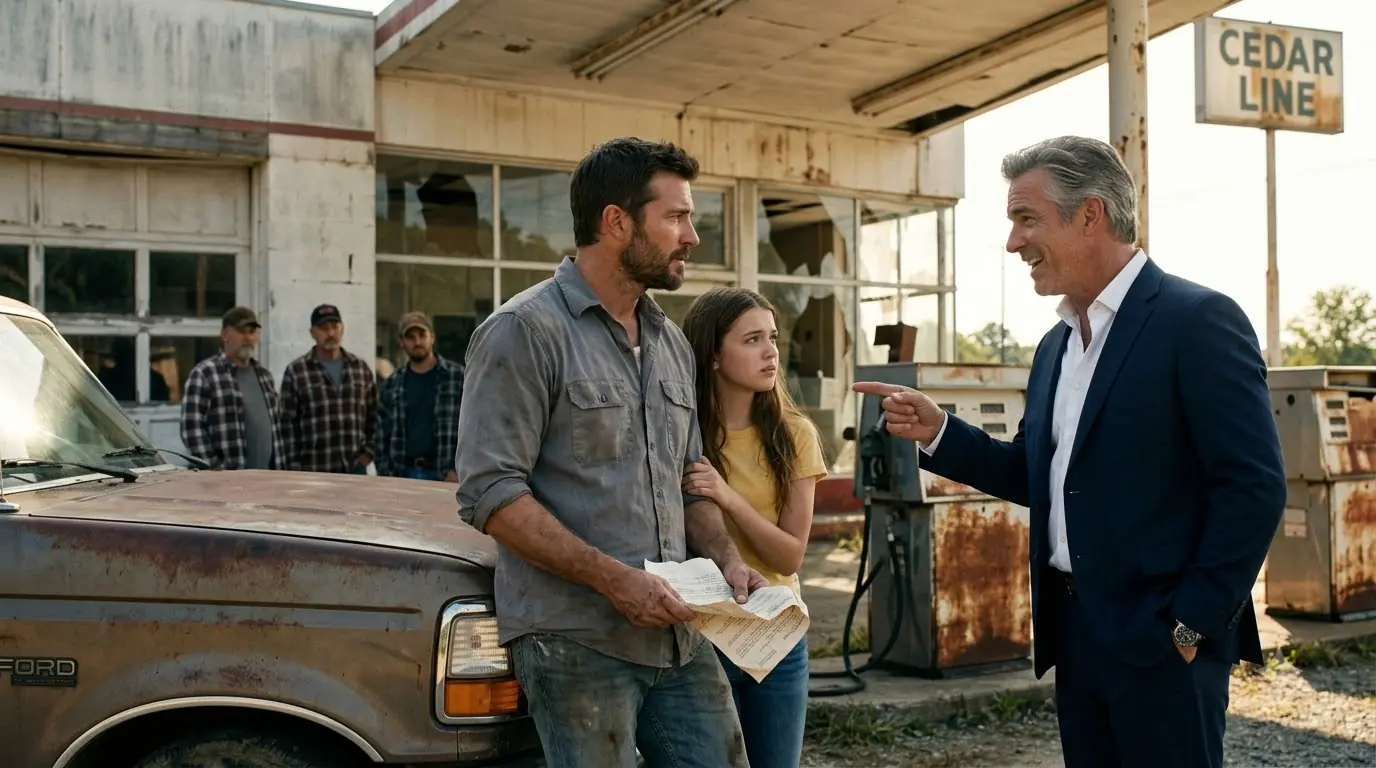
The station squatted on a corner lot where the old route met Milbank Road. Its sign had faded until the letters looked like a bruise, and the windows wore a film of dust thick enough to write in. Four pumps stood under a sagging canopy, their hoses long gone, their housings freckled with rust that ran down the concrete islands in brown streaks. The men at the diner called it the fuel graveyard, and they said it the way people say a thing they have repeated until they no longer hear it.
The county had taken it years earlier for unpaid taxes. It went to auction three separate times and nobody raised a hand. Not once, not even at the low end. Each failure dropped the minimum bid further and by the fourth attempt, the county listed it at $900, which was less than the cost of the legal notice they ran in the paper.
The clerk who prepared the file had stopped pretending anyone would buy it, and she put the folder at the bottom of the stack. The reasons were common knowledge, repeated so often they had hardened into fact. There was said to be an old fuel system still buried under the lot, and the building had a sagging roof and wiring that belonged in a museum. Any buyer would owe environmental testing, and testing meant paperwork, and paperwork meant lawyers.
Above all, there was the number, the one everybody in Harrow Creek could recite without knowing where they had first heard it. Cleaning that soil, people said, would cost $300,000. Nolan Hayes walked into the auction room in a work coat that had been washed so many times the canvas had gone soft. He was 42, built like a man who had spent 20 years lifting things that did not want to be lifted.
With grease worked permanently into two knuckles on his right hand, his career in industrial maintenance and heavy machinery had meant long stretches away from home on plant shutdowns and pipeline jobs. He sat in the third row and waited through two farm parcels in a flooded duplex. When the clerk read the description of Cedar Line Service, the room made a sound halfway between a cough and a laugh. Nolan raised his card and nobody raised one against him.