Lynette Sorrel did not cry when the Duke of Marchwood shouted her name across a room full of his own family. She stood with the ledger pressed to her chest like a shield, spine straight, chin level, and let the sound of his voice break over her and pass. It passed the way water passes over a stone it cannot move. They called her the girl from the counting house.
They called her nobody's daughter. They said behind gloved hands and half-turned shoulders that a duke's household had no business employing a maid who read numbers better than she curtsied. He was not shouting about numbers. He was shouting about a page.
“You will explain this,” he said, and slapped his palm flat against the open ledger on the sideboard so hard the crystal decanters shivered. “Every entry in my late wife's hand, altered, corrected in yours.” The room had gone very still. Aunt Cordelia's fan had stopped moving.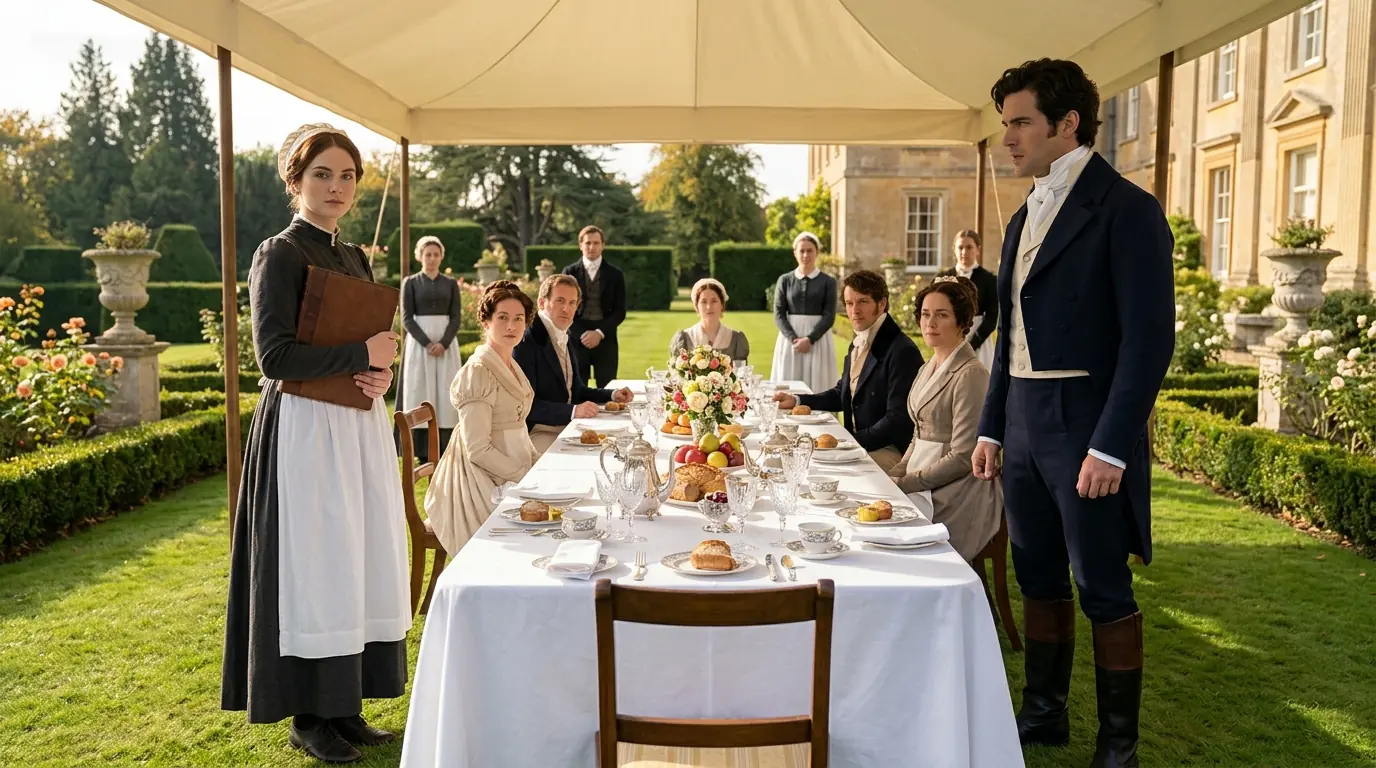
Even the footman at the door had the particular blankness of men trained to see nothing. Lynette set the second ledger down beside the first, quietly, the way she set down anything she meant to be believed. “I corrected an error, Your Grace,” she said. “I did not alter a memory.” “You will not speak to me of memory.”
“Then you will not shout at me about arithmetic.” Someone near the fire drew in a breath. His Grace, Gideon Ashworth, seventh Duke of Marchwood, was not a man accustomed to being answered. He was a man people agreed with quickly and then left the room. His jaw worked.
His hand, still flat on the ledger, did not move. “Shout at me again,” Lynette said, low enough that only the nearest half of the room heard it, and steady enough that every one of them would repeat it by morning. “And I will end you, Your Grace. Not with a blade—with the truth. You will not like which one of us the county believes.”
For three full seconds nobody in that drawing room breathed. Then something happened that none of them expected, least of all Lynette. The duke did not roar. He did not dismiss her on the spot, as any of them would have waged a year's wages that he would.
He went still instead, the way a man goes still when he has been struck somewhere he did not know he could still be struck. And he looked at her, really looked, the inventory gaze he turned on tenants and solicitors and disputed boundary lines. It was the gaze he had not turned on a living person in two years. “Say that again,” he said quietly this time.
The Duke of Marchwood picked up the ledger. He did not look at it. He looked at Lynette Sorrel a moment longer, the way a man looks at a locked door he has just realized he does not have the key to. And then he walked out of the room without another word. It was autumn 1819 in Wiltshire, England.
In a house that had not laughed in two years, something had just gone quiet in a new way. She had come to Marchwood Hall eleven months earlier with a trunk, a reference letter, and a set of keys she had earned rather than been given. Her father had kept books for half the merchants in Devizes before the fever took him, and he had taught her the only inheritance he had, how to make a column of numbers tell the truth, and how to notice when it had been taught to lie. When he died, the house went to a cousin, the money went to his creditors, and Lynette went into service. A woman who was very good at arithmetic and had no name to trade on had exactly one respectable door open to her: the servant's entrance.
She had not expected to like the work. She had not expected either to be good at more of it than anyone wanted her to be. The housekeeper who hired her had needed a still room girl. Within four months, Lynette was quietly correcting the linen inventory, then the wine cellar account. Then, when the previous underclerk left without notice, Mrs. Hale entrusted Lynette with the domestic accounts themselves.
Nobody above stairs knew her name until the night the wrong page was found in the wrong hand, and the Duke needed someone to shout at. He had not always been a man who shouted. Two years before he had been merely reserved, the kind of cold the county called breeding rather than grief, because grief was inconvenient in a duke, and breeding was not. Then his wife, Saraphina, had died in the spring, quickly and without warning. She had died of a fever the physicians never fully named.
And the man who was left behind had folded the house up around himself like a hand closing over a coal. Her rooms were shut. Her sitting desk was shut. Her household ledgers, the ones she had kept herself, in a fine, decisive hand, because she had been the sort of duchess who liked to know precisely what her house cost her, had been locked in a drawer, and not opened again, until three days before the shouting, when the Duke, alone at midnight, and unable to sleep, had gone looking for something of hers to hold, and found the drawer, and found the ledger. He found a column of figures that did not sum the way his wife's figures always summed.
He had not known that Lynette Sorrel had already found the same error weeks earlier and quietly corrected it because leaving a known falsehood standing in a dead woman's book felt to her like a small cruelty she was unwilling to commit. That was the trouble with truth. It so rarely announces itself as a kindness. She knew, though the household did not, that the discrepancy was not the Duchess's error at all. She had matched three years of tenant rent receipts against the estate agent's summaries the previous winter out of nothing more than habit and boredom on a wet Sunday and found a gap—small, deniable, and exactly the size a careful man leaves when he intends never to be caught.
Mr. Corbyn Quill, the estate agent, had managed Marchwood's accounts for eleven years since before the old Duke died. And no one, not the Duchess, who trusted his figures, not the Duke who had never once opened his own rent book, had thought to doubt a man so thoroughly, mildly, permanently present. Lynette had said nothing. Not yet. As a governess's daughter without a name to lean on, she could not accuse a duke's most trusted servant of theft on a hunch, however precise the hunch.
She had begun keeping her own copies instead. The morning after the shouting, she was summoned to the study. She went in expecting dismissal and carried the small case of her belongings in her mind already, folded and ready, the way she had learned to carry every ending before it arrived. The Duke was standing at the window with his back to the door. “Sit,” he said.
“I would rather stand, your grace, until I know whether I am being dismissed.” He turned. There were shadows under his eyes that had nothing to do with sleep lost over ledgers. You are not being dismissed. Then what am I being your grace?
Reconsidered, he said, and gestured at the chair again, and this time she sat, because it seemed, for the first time since she had come to this house, that someone above stairs was choosing his words as carefully as she chose hers. You corrected my wife's arithmetic, he said. I corrected an error in a column, your grace. Nothing else about her was in my power to correct, and nothing else would I have touched. Something moved behind his eyes, not softening, not yet, but a recalculation, the look of a man revising a sum.
Show me, he said, all of it. Every figure you believe is wrong in this house going back as far as you have looked. That is a great deal of arithmetic, your grace. I am aware of the size of my own estate. Mrs. Sorrel, Miss, she said, “And I would need 3 weeks, a locked room, and your word that no one dismisses me before I finish.”
For the second time in two days, something close to a smile crossed his mouth and did not quite arrive. “You have terms,” he said, as though the word itself surprised him. “I have always had terms, your grace. No one has troubled to ask for them before.” He studied her the way he studied a disputed boundary line, as if the ground itself might be lying to him, and only patience would tell him where. 3 weeks, he said.
The locked room is the library. You will report to no one but me. And my wages, your grace, doubled unnecessary, she said. My present wages are sufficient. I would rather have your signature on the terms than your money above them.
He looked for a moment as though no one had ever declined money from him before, which she would come to understand no one ever had. As you wish, he said, and something in his voice had gone very slightly warmer. The library at Marchwood Hall had not been properly opened since the Duchess's death, and it smelled of dust and cold hearth ash the first morning Lynette let herself in, with the key Mrs. Hale had pressed into her palm without a word of explanation because Mrs. Hale had decided sometime in the last two days that whatever was happening to the under housekeeper was worth quiet allegiance rather than open comment. Lynette worked from dawn. She laid the estate ledgers end to end across the long table like a battlefield map, and she read them the way her father had taught her to read anything that mattered, slowly, twice, and never trusting a total until she had rebuilt it from its parts.
By the second day, she had found the pattern she had suspected for a year. Tenant rents entered at one figure in the collection book and a lower figure in the estate summary. The difference small enough each time to explain as rounding a scribes fatigue an honest slip multiplied across eleven years and 40 tenencies. It was not small at all. She was copying the discrepancies into her own hand in her own private book when the door opened without a knock.
The Duke stood in the doorway, still in his riding coat, looking for once, uncertain of his welcome in his own library. “You said 3 weeks,” he said. “I have had two days, I am aware.” He came in anyway, and stood across the table from her and looked down at the ledgers spread like a hand of cards no one else at the table could read. “Show me what you have found so far.”
She turned the collection book toward him and set her finger on a column. Here and here. 31 entered as 28. It happens 40 times a year in 40 different tendencies. Always downward, never up. That could be an honest error.
One error is honest. Your grace. 40 in the same direction for eleven years is a system. He was quiet a long moment, reading the figures himself now, his own finger tracing the line she had drawn. She watched him do arithmetic properly for what she suspected was the first time in years, and something in her, some small closed thing, eased slightly to see it. “Who keeps this book?” He said finally.
“Not a question. He already knew. Mister, quill your grace. Eleven years, he said, more to himself than to her. Eleven years is a very long time to trust a man simply because you have always trusted him.”
“He looked up at that sharp, and for a moment she thought she had gone too far. A maid did not instruct a duke on the architecture of his own misplaced trust. But he did not rebuke her. He looked instead faintly almost against his will, amused. You have opinions about my household, Miss Sorrel.”
“I have arithmetic about your household, your grace. The opinions are free. That was the first time she saw it fully. Not the ghost at the corner of his mouth, but the thing itself, brief and startled, a real near smile that reached just barely his eyes. Continue,” he said, and left.
And she sat for a moment after the door closed, oddly unsteady, before she pressed her palm flat against the cool wood of the table to remind herself where she was standing. The weeks that followed built themselves out of that same rhythm. Mornings in the library, the Duke arriving later and later at her elbow, asking questions that grew less like tests and more like conversation. She showed him how to read a rent roll the way her father had shown her, how a column that always erred in one direction was not carelessness but design.
He showed her, without meaning to, that a man could be called cold by an entire county and still stand very quietly beside a woman's chair for an hour, saying almost nothing. Simply because the silence in that room was easier to bear than the silence in every other room in his house. “You are not cold,” she said to him once, without quite deciding to say it aloud. You are tired. There is a difference.
He did not answer for a long moment. Careful, Miss Surell, he said at last. You are beginning to know me. I make it my business to know arithmetic, your grace. You are simply what the arithmetic is attached to.
He laughed. It surprised them both. Short, low, almost rusty with disuse, and gone as quickly as it came, but misses. Hail, passing the library door with an armful of linen, stopped dead in the corridor, and did not move again until the sound of it had entirely faded, because she had not heard that particular sound in this house in two years, and had begun privately to believe she never would again. By the fourth week, Lynette had documented a pattern too precise to be accident and copied every page of it twice.
Once for the Duke's records, and once quietly for her own, folded into the lining of her trunk, because a woman with no name to trade on had learned early that evidence left in only one hand could vanish. She had not yet told him the whole of what she suspected, that Mr. Quill was not skimming alone, that the sums missing from the tenant accounts matched almost to the shilling. Sums that had lately appeared in the accounts of Mr. Silas Peveny, the duke's cousin and heir presumptive, a man whose visits to Marchwood had grown noticeably more frequent since the Duchess's death, and whose interest in the estate's affairs had grown with them. She was not ready to say his cousin's name aloud. Not yet.
A woman who accuses a duke's own blood needs more than arithmetic. She needs proof that cannot be argued away in a single evening. And she did not have it yet. What she had instead was a night in early November when the Duke found her still in the library long after the household had gone to bed. The fire burned to embers, her shawl slipping from her shoulders as she worked by a single candle.
“You will ruin your eyes,” he said from the doorway. “I will finish the Michaelmas accounts first.” He crossed the room, took the shawl from the back of her chair without asking, and settled it around her shoulders himself, his hands steady and brief, and entirely correct. Neither of them said anything about how long they stood there afterward, close enough that she could hear him breathe. “I have been thinking,” he said, “that you should have better wages, a proper title—housekeeper at the least—with the authority that comes with it.”
“I have terms, Your Grace, you may recall.” “I recall that your terms have cost you a great deal of unpaid labor on my behalf.” “It is not unpaid,” she said. “It is chosen.” “Those are different things.”
“I would still like to give you something.” “I did not come here to be given things,” Lynette said, and turned to face him fully, because this was a distinction she had learned to insist on before it could be blurred by kindness. “I am not a charity case, Your Grace, and I am not a rescue. I am here because the work wanted doing and I could do it. If you give me a title I have not earned, you will have made me exactly the decoration everyone in that drawing room already believes me to be.”
He was silent long enough that she thought she had offended him. Then he said quietly, “You are the least decorative person I have ever met, Miss Sorrel.” And it was from him she understood even then the plainest compliment he knew how to give. “Then let me earn the title instead of receiving it,” she said.
“Give me the season to finish what I have started. If I am right about what is happening in this house, you will not need to elevate me. The work will have done it for me. And if you are wrong, then you will have lost nothing but three weeks of a maid's time which you have already spent.”
He almost smiled again. She was beginning to count those smiles, though she would not have admitted it. “Terms again,” he said, and this time there was something almost fond in the word. The dinner that changed the county's opinion of Lynette Sorrel, happened three weeks later on the night Lady Cordelia Vain, the Duke's aunt, decided the household's new curiosity had gone on long enough without correction.
The table was set for eighteen. Lynette had been asked, instructed really, by the Duke himself over Mrs. Hale's quiet alarm to attend as a guest rather than serve. “In recognition,” he said simply, “of the work she has done for the estate.” It was, everyone at that table understood without being told, an announcement of a kind, and Lady Cordelia had come prepared for it.
“Tell me, Miss Sorrel,” she said over the second course, her voice pitched to carry the length of the table. “How does a woman with no name manage to find herself so thoroughly indispensable to a duke's household? It is quite a talent.” The table went quiet in the particular way rooms go quiet when they are hoping for blood.
Lynette set down her fork. “I found an error in the rent accounts, my lady, of roughly £400 a year sustained for eleven years. I found a drainage fault under the east tenant cottages that was costing the estate two harvests in five. I balanced the household ledger for the first time since the late duchess's death. That is not a talent, my lady.”
“That is arithmetic. Anyone with patience and a pencil could have done it. No one else troubled to try.” “How very useful of you,” Lady Cordelia said with a thin smile. “One might almost mistake you for a member of staff.”
“I am a member of staff, my lady. I have never claimed otherwise.” “And yet you dine with us.” “Because His Grace asked me to,” Lynette said, “And because I have found that a room fed on good food and bad manners is still in the end only a room. I do not require its good opinion to know the truth of my own work.”
Silas Peveny at the far end of the table laughed too loudly the laugh of a man trying to seem unbothered. “Very prettily said for a bookkeeper.” “Thank you,” Lynette said. “I find it easier to speak prettily when I am not also lying.” The Duke, who had said nothing through the entire exchange, set down his own glass with a small deliberate click.
“Miss Sorrel has saved this estate £400 a year and repaired a drainage system that has failed under three previous stewards,” he said into the silence that followed, his voice carrying without rising. “I would remind the table that competence is not improved by a title, and its absence is not excused by one.” Lady Cordelia's fan stopped midair, exactly as it had the night of the shouting. Nobody spoke for a long moment. Then old General Fitch, at the foot of the table, who cared for nothing in the world so much as a well-run estate, said, “Hear, hear,” into his wine glass, and the room slowly, uncertainly began to recalibrate around a woman it had decided, only that evening it did not yet fully understand.
Lynette did not smile at her small victory. She only picked her fork back up and finished her dinner and let the numbers speak for her the way they always had because that she had learned long ago was the only kind of speaking that could not be later denied. The weeks that carried them through winter were quieter and closer in the way that shared labor makes people close without either party choosing it outright. While going through a locked chest the Duke finally allowed her to open, she found a bundle of the late Duchess's working letters rather than romantic ones: notes to tenants and drafts of small kindnesses done and never announced. They included plans for a school for the tenant girls that Saraphina had never lived to build.
Lynette read them at the library table one December evening with the Duke sitting across from her watching her face rather than the letters. “She wanted a school,” Lynette said quietly. “For the girls in the village. She had already priced the building.” “I know,” he said.
“I could never bring myself to open that chest before now.” “Why now?” “Because you are in the room,” he said simply, and it cost him something to say it. She could see that in the set of his jaw, the way his hand tightened briefly on the arm of his chair, and she did not press him further, only reached across the table, and for the first time since she had come to this house, let her fingers rest lightly over his, not quite closing the distance, close enough that neither of them moved away. “I am not going to say the thing I am thinking,” he said after a while.
“I did not ask you to.” “I know,” he said. “That is why I nearly said it anyway.” She let the moment stand exactly where it was, unfinished, because she had learned from her father's ledgers and from her own long practice of composure that some sums were not meant to be closed too early. There would be time.
She believed that that December evening with a plainness that felt almost like faith. She did not yet know how little time was actually left before the ground under both of them would shift. The letter arrived on a gray morning in January, carried by a rider from London, who would not say who had sent him, only that it was urgent, and addressed to the county's commissioner of lunacy and estates, with a copy delivered, as courtesy or cruelty demanded, to Marchwood Hall itself. Lynette was in the library when Mrs. Hale, white-faced, brought it to her because the Duke himself had gone out to the east fields and would not be back before dusk. She read it twice before she understood what she was holding.
It was a petition drawn up in careful legal hand and signed by Mr. Silas Peveny alleging that the Duke of Marchwood in the two years since his wife's death had shown such derangement of grief and such gross mismanagement of his estate's finances. The petition cited, in precise and damning detail, the very discrepancies Lynette herself had documented, twisting them into evidence of the Duke's negligence rather than Mr. Quill's theft. It alleged that his fitness to hold guardianship of his young sister, Miss Beatatrix Ashworth, and control of the Marchwood estate ought to be examined by the court, with Mr. Peveny named as the suitable interim guardian and trustee. Attached to the petition as supporting evidence were copies of estate ledger pages Lynette recognized instantly because she had copied them herself in her own hand into her own private book weeks before. The pages had been altered subtly and cleverly to make the original discrepancies look like the Duke's own careless overspending rather than Mr. Quill's long theft.
Someone had taken her evidence and turned its edge around. Her hands, for the first time in eleven months at Marchwood Hall, were not entirely steady. She found Mrs. Hale still standing in the doorway waiting because Mrs. Hale had learned over the winter to trust Lynette Sorrel's face more than her own eyes. “They mean to take Beatatrix,” Lynette said, “and the estate, and they mean to use my own work to do it.” “Does His Grace know?”
“Not yet.” Lynette folded the petition carefully, her fingers finally steadying by an act of pure will. “I need my own copies, Mrs. Hale, all of them. Every page I copied since November, and I need them now before anyone else in this house has the chance to decide they never existed.” Mrs. Hale did not ask why.
She had stopped needing to ask why months ago. “The trunk in your room?” “The false bottom,” Lynette said. “My father taught me that trick before he taught me my letters.” She was down on her knees in her own small room within the quarter hour, prying up the panel she had fitted herself in September, drawing out the oilcloth-wrapped bundle of her private ledgers, dated, initialed, witnessed where she could manage it, every discrepancy recorded in her own hand before anyone had the chance to alter it.
It was, she understood now, looking at the careful stack of pages in her lap, the only thing standing between the Duke of Marchwood and the loss of everything he had left. The hearing was set for the second week of February before the county's commissioner of estates, a precise, unhurried man named Aldus Fen, who had built his career on not being impressed by titles. The Duke had wanted at first to forbid Lynette from attending at all to protect her, he said, from a room that would happily tear apart a maid's testimony for sport. She had refused so flatly that Mrs. Hale, listening at the study door, had laughed aloud despite herself. “You will need someone in that room who has actually seen the books, Your Grace,” Lynette said.
“I am the only person alive who has.” “They will call you a servant with a grudge.” “Then I will bring a servant's proof,” she said, “which is more than Mr. Peveny has brought. He has forged your ruin out of my honest work. I mean to unforge it.”
The commissioner's chamber in Devizes was smaller than she expected, wood-paneled and cold, filled past its comfortable capacity with solicitors, witnesses, and the particular hush of a room that knows it is about to decide something that cannot be undone. Mr. Fen read the petition aloud in a flat, unhurried voice, and Lynette watched Silas Peveny's face for the whole of it, and found it perfectly, professionally calm. “Mr. Quill,” Fen said when the reading was done, “you are named as the estate's agent of record. Do you stand behind these figures?”
Corbyn Quill, thin and gray and precise as a man who had spent eleven years being unremarkable on purpose, said that he did. “And you, Miss Sorrel,” Fen said, turning to her at last, “are named in this petition as the source of certain discrepancies now attributed to His Grace's negligence.” “What have you to say to that?” Lynette rose.
She had rehearsed nothing because her father had taught her that rehearsed truth sounds exactly like a lie, and she wanted above all things to sound like herself. “I have my own copies, sir,” she said, and set the oilcloth bundle on the table before him. “Every discrepancy in the petition is in my own hand, dated and initialed weeks before the petition was drawn. If you compare the ink and the dates against the pages Mr. Peveny has submitted, you will find his copies were altered after mine were made, not before.” “That is a serious accusation, Miss Sorrel.”
“It is an arithmetical one, sir.” “Mr. Peveny's submitted pages show the discrepancies running consistently against His Grace's spending. My original pages, made first, show them running consistently in favor of a single account, one that traces through four intermediary payments to a solicitor in London retained by Mr. Peveny himself. I have the receiving bank's confirmations here as well. I obtained them honestly, sir, and I obtained them before I knew what they would be needed for.”
The room had gone very still, the particular stillness Lynette had learned over the last winter to recognize as the sound of a truth finally landing where it could not be talked away. Mr. Fen examined the pages for a long silent while, his spectacles low on his nose, comparing ink and date and hand with the meticulous patience of a man who had built a career on exactly this kind of comparison. “Mr. Quill,” he said at last without looking up, “the ink on your ledger page dated the 14th of September does not match the ink in your own inkwell, submitted to this court as a sample this morning. Would you care to explain that?”
Corbyn Quill's composure, eleven years in the making, did not survive the question. He opened his mouth, closed it, and looked for the first time in the proceedings at Silas Peveny, who was very carefully looking at nothing at all. “I was told,” Quill said quietly, “that it would not come to a hearing. I was told the petition would settle quietly.” “By whom, Mr. Quill?”
The silence stretched long enough that Lynette thought he might refuse. Then he said the name flatly, without ceremony, and the room turned as one body towards Silas Peveny, whose calm at last cracked visibly down its center. “This is absurd,” Peveny said, rising. “I am a Peveny. I am the heir presumptive to this estate.”
“You are at present,” Fen said mildly, “a man who has submitted forged evidence to a court of law in an attempt to seize guardianship of a minor child and control of an estate that is not yet yours. I would consider your next words very carefully, Mr. Peveny.” He did not have many more words. Within the hour, faced with the ledgers, the bank confirmations, and Quill's own unraveling testimony, Silas Peveny withdrew the petition entirely through his solicitor in exchange for the commissioner's private assurance that no criminal charge would follow if he removed himself from Wiltshire within the month and relinquished in writing any claim on the Marchwood succession beyond what the law could not strip from him. It was not justice in its fullest, hardest form.
It was, Fen said afterward, justice exactly sufficient, enough to end the danger without making a spectacle the family would carry for a generation. Corbyn Quill was dismissed from the estate service that same afternoon, his eleven years of theft calculated to the shilling, and set against what remained of his own small savings. The difference was forgiven in exchange for a full written confession that cleared the Duke's name entirely. He left Marchwood on foot, an old man suddenly, and Lynette, watching from the study window, felt no triumph in it at all, only a kind of tired relief, the relief of a column that has finally, after eleven years, been made to balance. The Duke of Marchwood found her in the library that evening, the oilcloth bundle of her ledgers still spread across the long table where the whole of it had started five months before.
“You saved my sister,” he said. “You saved this estate. You saved my name, which I had very nearly stopped believing was worth saving.” “I kept good records, Your Grace. That is all it was.”
“That is not all it was,” he said, and crossed the room to stand across the table from her, close enough now that the distance between them had become its own kind of statement. “I have spent two years believing that grief was the only thing I had left to be faithful to. You have shown me since November that I was wrong. I would like to say something to you now, and I would like you to let me finish it before you tell me it is unnecessary.”
“I make no promises, Your Grace.” The ghost of the smile appeared again, fuller now than she had ever seen it. “I love you,” he said plainly, without ornament, the way he said everything that mattered to him. “Not for what you have done for this house, though I am grateful for every column of it. For what you are when no one is asking anything of you: steady, exact, entirely your own.”
“I would like to marry you, Lynette Sorrel, not as a rescue and not as a reward, but because I have not wanted anything for myself in two years, and I want this.” She was quiet a long moment, her hand resting flat on the table between them, steadying herself the way she always did, though for once it was not grief she was steadying against. “I did not come to this house to be rescued,” she said, “and I will not be married into safety I have not chosen for myself. But I have chosen you, Your Grace—not tonight for the first time, but some weeks ago, if I am honest, though I did not have the arithmetic to prove it to myself until now.”
“Gideon,” he said. “If you are choosing me, you may begin by using my name.” “Gideon,” she said, and it was the first time she had said it aloud, and something in his face at the sound of it came undone in the gentlest possible way. He took her hand, not the courtly brush of lips against knuckles she had seen him give a hundred other women at a hundred other dinners, but her whole hand in both of his, turning it over as though he meant to read it like a ledger of its own.
“There is a difference,” she said softly, “between being given everything and being finally, accurately seen. I have wanted the second my whole life. I did not know until this house that I could actually have it.” “Then have it,” he said, and their foreheads met briefly, chastely, two people who had learned every other kind of intimacy before they allowed themselves this one. Outside the library window, the last of the winter light went gold and then gray and then gone.
And neither of them moved to light a candle for a long while after. Ten years is a long time to a county with a short memory. By the time the tenth autumn came round, Marchwood had largely stopped speaking of the winter the old duke's cousin nearly ruined them. The incident survived only as a story told at harvest suppers, with the satisfaction of a wound that had healed cleanly, while the estate prospered. The drainage Lynette had first diagnosed in her early weeks at the hall had been properly laid the following spring, and the east fields, once the worst yielding acres in the county, had not failed a harvest since.
The tenant cottages Saraphina Ashworth had once dreamed of improving were improved at last, their rents recorded now in a ledger that balanced every quarter to the shilling, because the Duchess of Marchwood, for that was what Lynette had become, in a small private ceremony the spring after the hearing, with Mrs. Hale weeping openly in the second pew, and Beatatrix, twelve years old by then, insisting on carrying the flowers herself, kept the household books personally, and had never once in ten years allowed another hand to touch them unwatched. The school Saraphina had planned and never built stood now on the rise above the village, brick and plain and full every morning with the daughters of tenants and laborers. And it did not teach embroidery or deportment. It taught arithmetic. It taught a girl to read a column of figures and know in her own hand before anyone else could tell her whether the truth of it had been kept or broken.
Lynette had named it for no one but the work itself, the Marchwood School of Accounts, because she had decided long ago that her own name mattered less to her than the thing her name could build. Lady Cordelia Vain, older now and considerably quieter, had come to the school's opening with a stiff back and a stiffer apology, offered in private in the Duchess's own study for a dinner conversation ten years gone, that she had never quite managed to forget either. Lynette had accepted it plainly without theater because she had learned from Gideon over ten years of marriage that a person allowed to recalibrate was worth more in the end than a person merely defeated. Of Silas Peveny little was heard beyond occasional rumor from the continent where he was said to be living modestly and for the first time in his life honestly. Corbyn Quill had died three winters past in a small cottage near Bath and had left, of all things, a letter to the Duchess, thanking her for the mercy of the confession he had never expected and did not believe he deserved.
She had kept it in the false-bottomed trunk that no longer needed to hide anything at all, beside the very first ledger she had ever corrected, because some proofs she had come to believe were worth keeping even after the case was closed. Beatatrix Ashworth, twenty years old now and possessed of her late sister-in-law's exact unshakable calm, ran the school's advanced accounts herself, and had lately begun, to her brother's mild alarm and Lynette's quiet pride, discussing terms with a promising young solicitor from Bristol, on precisely the footing Lynette had once insisted on for herself. Nothing was given; everything was earned. On the evening of the school's tenth anniversary, Lynette stood at the library window where so much of it had begun, watching the last light go gold over the east fields, and Gideon came to stand beside her the way he always did now, without needing to be asked, his hand finding hers on the sill. “Do you ever think of that first night?” he asked.
“The shouting? Often,” she said. “It is not every day a woman ends a duke and gets a marriage out of it instead.” He laughed easily now, the sound entirely unrusted, the sound of a man who had spent ten years relearning how, and pressed his forehead briefly to her hair. “You did not end me,” he said.
“You began me.” “That was the whole of it,” Lynette said quietly, watching the field settle into evening, the ledger of her own life at last entirely balanced. And it was enough, and it was everything. She did not need a title to know who she was anymore. She had built that knowledge herself, one honest column at a time, and signed it finally in her own name.