By the time Evan “Switch” Mercer rolled his tired green 1969 Harley FLH into the industrial outskirts of Detroit, the morning had already turned the color of old steel. Smoke hung low between the brick buildings, welding flashes blinked behind dirty windows, and the pavement carried the black sheen of oil that never really washed away. Evan killed the motor outside BLACK IRON WORKS, swung one boot down, and listened to the bottom end tick itself quiet. The knock had started two states back, and he had ridden the last sixty miles with the patience of a man listening to a tooth crack.
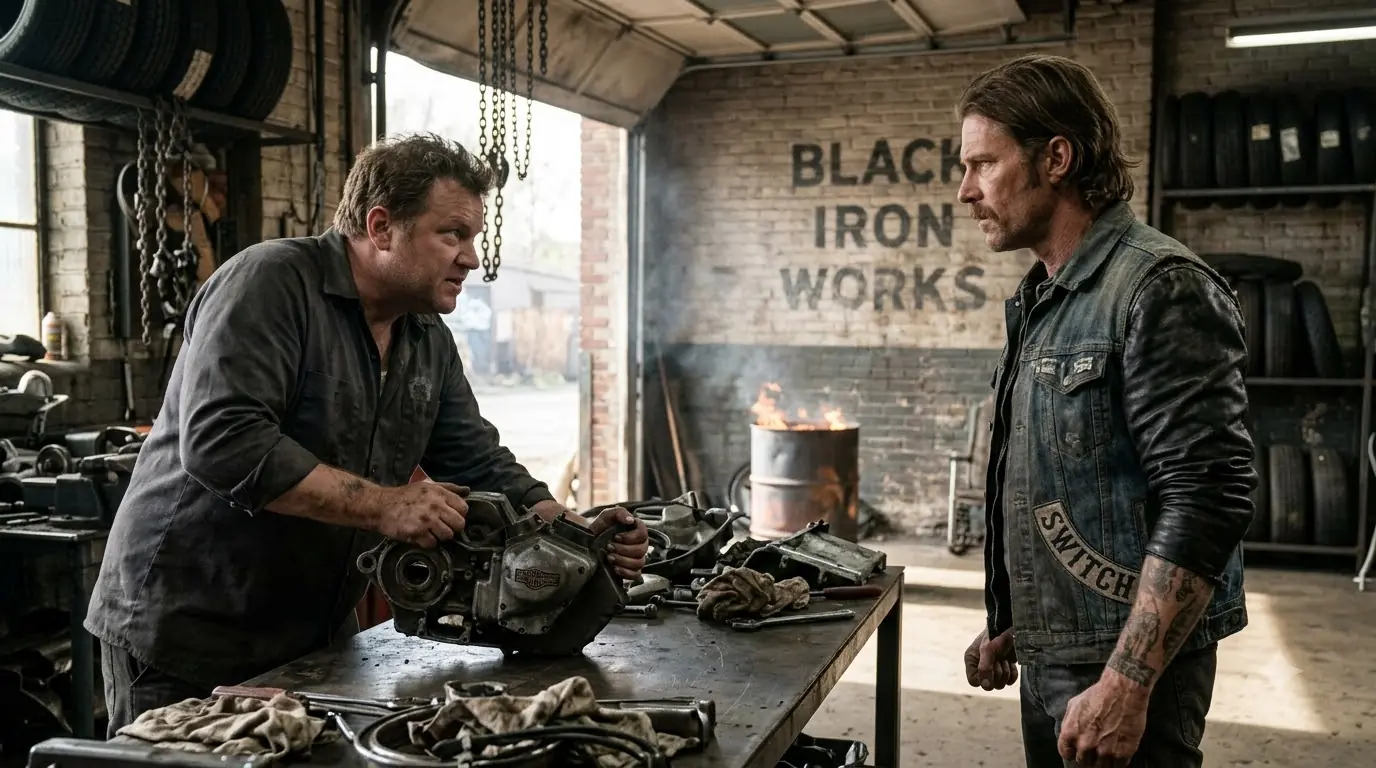
He was thirty-nine, short enough to disappear beside bigger men and lean enough that people often underestimated how much strength lived in his shoulders. His dark hair reached his collar, his moustache was uneven from being trimmed with shop scissors, and one front tooth was chipped from a bar fight he refused to discuss. A black snake tattoo wrapped his right forearm, half-hidden by grease, and the nails on both hands carried the permanent gray stain of a man who had worked around engines too long to pretend soap could fix everything. On his denim vest, the only patch that mattered said SWITCH.
Evan had no club colors, no road captain rocker, no territory to defend. He repaired motorcycles wherever work found him, traded labor for meals when money ran thin, slept behind shops when motel rooms cost too much, and knew the sound of bad bearings better than he knew most people’s birthdays. That made him invisible to men who measured importance by signage, trophies, and clean floors. It also made him dangerous to anyone who confused appearance with ignorance.
The FLH had belonged to his father, Earl Mercer, though very little of the motorcycle still matched the day Earl first brought it home. The cases were old, the frame had been straightened twice, the saddle had been patched with mismatched leather, and one side cover carried a dent from an Ohio guardrail twenty years earlier. Evan had torn the engine down behind a truck stop in Indiana when the oil pressure began falling, then carried the crankcases the rest of the way because he refused to keep running metal against metal. He needed one bearing seat machined correctly, nothing more.
BLACK IRON WORKS looked like the kind of place that could do it. The shop occupied a wide brick building with steel-framed windows, two lathes visible through the front bay, a drill press near the wall, and chain hoists hanging from heavy I-beams. Metal parts bins lined the back like filing cabinets for dead machines. A radio near the office played rock loud enough to compete with the grinders, while outside the side yard held wrecked motorcycles, stripped frames, scrap drums, and three old pickups parked nose-first in the mud.
Evan walked in carrying the crankcase halves wrapped in an oily wool blanket. He set them on the counter carefully, not because they looked expensive, but because he knew exactly where every casting scar and hand-cut passage had come from. Behind the counter stood Dale Voss, forty-six, broad in the middle and still carrying himself like the drag racer he had once been. A framed photograph on the wall showed a younger Dale beside a stretched race bike, holding a trophy under lights.