Nobody in Sweetwater Bend expected trouble from Mercy Doyle, and that was exactly why trouble chose her.
At twenty-six, Mercy had shoulders hardened by farm work, hands roughened by wire and winter, and a way of lowering her eyes when strangers spoke too quickly. Children called her Simple Mercy because children repeated what adults taught them. Grown men used the name too, usually with a grin and never where her father could hear it when he was alive. The name had nothing to do with her mind. It came from her tongue.
Mercy stammered.
Not always.
Alone in a pasture, she could sing to a sick calf without catching once. She could talk to her old mule Amos for half an hour while resetting a fence post. She could read aloud from her father’s Bible beside the stove when nobody else was there. But put three people in front of her, especially people already waiting to laugh, and the words crowded at the back of her throat until silence became easier.
Her father, Silas Doyle, used to say silence was not weakness.
“It’s a tool,” he told her once. “Just don’t let other people decide when you have to use it.”
Silas had been dead two years.
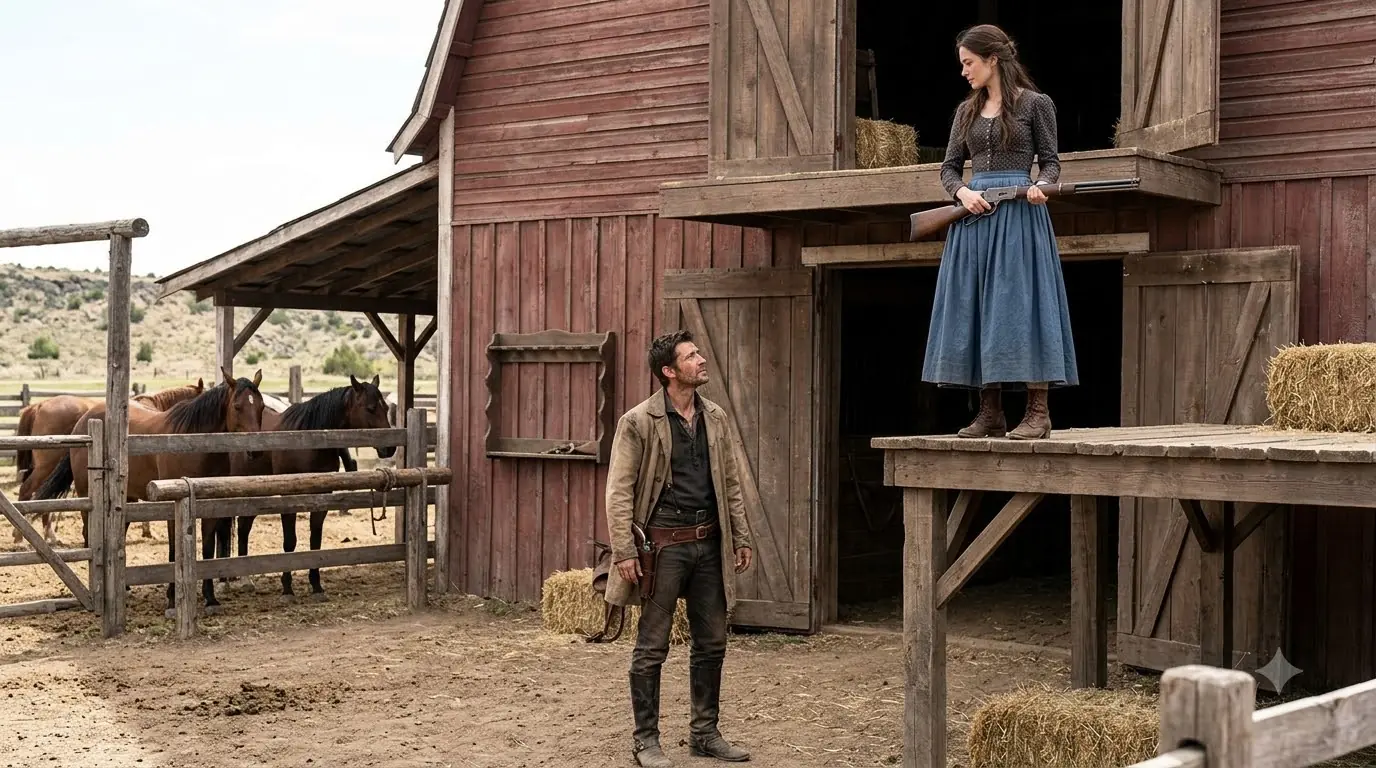
Since then, Mercy had learned just how many people preferred deciding for her.
Sweetwater Bend sat in southern Wyoming where the road widened around a general store, a blacksmith, a bank, a church, and a sheriff’s office with two cells that were empty more often than not. The town was small enough that everyone knew who owed money, whose roof leaked, which marriages were breaking, and whose daughter had come home crying after a dance. Mercy lived four miles west on forty acres her father had bought after the war.
The farm was not much by ranching standards.
One barn.
A windmill.
Three fenced fields.
A shallow creek.
Eight cattle, two milk cows, a mule, chickens, and an orchard that produced more windfall apples than good ones.
But it was hers.
Silas had left no fortune.
He left tools.
A rifle.
A ledger.
And land.
Mercy treated all four as sacred.
In the first winter after his death, she nearly lost a cow because she did not recognize birthing trouble early enough. The second winter, she did. In spring she repaired the north fence after a storm by copying the knot work Silas had taught her. In summer she learned which neighbors charged fair prices and which smelled grief on a woman alone like wolves smelled blood.
She also learned to shoot.
Not because she dreamed of gunfights.
Because a woman living beyond shouting distance of town could not build safety out of hope.
At first, the rifle bruised her shoulder badly enough that she slept on her other side. She missed bottles. Then fence posts. Then marks painted on old boards. She stopped trying to shoot quickly.
Silas had taught her the first rule before she was old enough to hold a rifle alone.
“Most bad shots happen before the trigger,” he had said. “People hurry because they’re afraid of looking slow.”
Mercy was already used to people thinking she was slow.
So she took her time.
By the end of her second year alone, she could knock a tin cup from a stump at seventy yards three times out of four.
No one in town knew.
Nobody had asked.
That was how Rafe Kessler made his first mistake.
The seven riders arrived on a Monday afternoon in August.
Mercy saw dust before she saw horses.
She was repairing a chicken coop when they came through the south gate without permission, seven men riding loose and tired, their saddles heavy with bedrolls and rifles. Their leader was lean, narrow-faced, with dark hair curling out beneath a sun-faded hat. His eyes were pale and watchful.
Rafe Kessler.
Mercy did not know the name yet.
She knew the kind.
Men who entered land as if ownership belonged to whoever looked least afraid of consequences.
Rafe stopped ten yards from the porch.
“You Doyle?”
Mercy set down the hammer.
“M-Mercy Doyle.”
He looked past her toward the barn.
“We’ll water horses here.”
She waited.
He smiled.
“And camp a spell.”
“How l-long?”
One of the men laughed.
Rafe did not.
“As long as suits us.”
Mercy looked at the seven horses, then at seven rifles.
“This is private land.”
“So I’ve been told.”
“You need to leave.”
Rafe leaned forward over the saddle horn.
“You alone?”
Mercy’s silence answered.
His smile changed.
Not cruel exactly.
Worse.
Certain.
“We won’t trouble you if you don’t trouble us.”
That sentence frightened her more than an open threat.
It was the language of men who planned to define trouble after the fact.
Mercy walked to the porch.
Rafe called after her.
“Smart girl.”
She stopped.
Not because of girl.
Because of the way he said smart.
Like obedience had confirmed his judgment.
Mercy went inside and locked the door.
For the next hour, she watched through the curtain.
The men unsaddled.
Built a fire.
Used her water trough.
One entered the barn without asking.
Another chased her chickens for amusement.
They behaved like men who had already converted temporary trespass into possession.
Before sunset, Mercy saddled Amos, the mule.
The riders laughed when they saw her leave.
One called, “Going for help?”
Mercy kept riding.
She reached Sweetwater Bend before dark.
Sheriff Otis Grant was sitting outside the general store with three men drinking coffee.
Otis was fifty-two, thick through the belly, with a sandy mustache and a badge polished brighter than his boots. His family had been in Sweetwater Bend longer than half the names on the cemetery stones, and he carried that history as if the county had inherited him instead of elected him.
Mercy dismounted.
Her pulse rose immediately.
Public speaking was hard.
Speaking to men already smiling was worse.
Otis looked her over.
“Well, Simple Mercy.”