Shelter Maine Coon Kept Pressing on Her Chest at 2:41 A.M. — Then a Heart Monitor Revealed Why
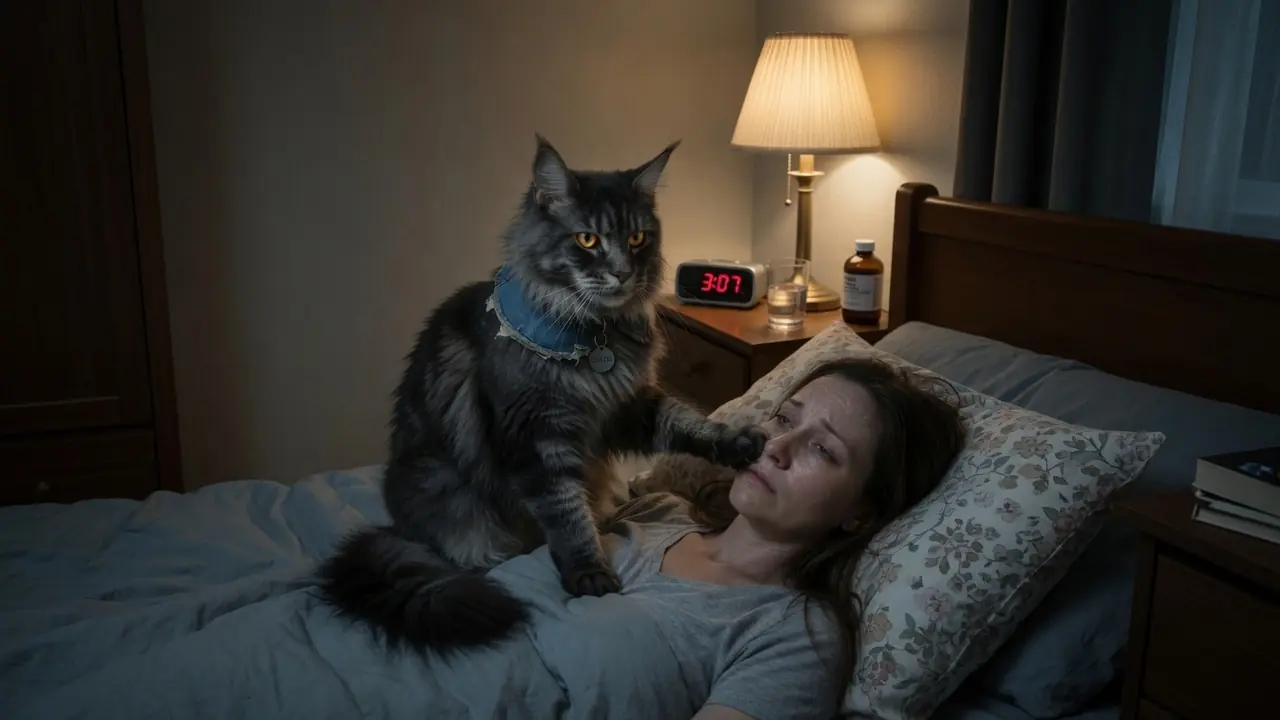
Every night at exactly 2:41 a.m., Atlas climbed onto Laura Mitchell’s chest and refused to move.
He was not a small cat.
Atlas was a seven-year-old Maine Coon with a thick smoke-gray coat, a white chest, enormous paws, and a long tail that looked too large for the rest of him. He weighed nearly eighteen pounds, and when he settled across Laura’s ribs, she felt as though someone had placed a warm sandbag over her heart.
The first night it happened, Laura woke with a gasp.
Atlas was staring down at her.
His green eyes reflected the blue numbers of the alarm clock.
2:41.
“Atlas,” she whispered. “You’re crushing me.”
The cat answered with a low, rough sound.
Not a normal meow.
It was a deep, vibrating chirp that seemed to come from somewhere inside his chest.
Laura pushed gently against his side.
Atlas dug his front paws into the blanket and leaned closer to her face.
“Move.”
He did not.
Instead, he pressed one enormous paw against the center of her chest.
Laura laughed despite herself.
“What are you doing?”
Atlas lowered his head and sniffed her mouth.
Then he touched her cheek with his nose.
When she sat up, he jumped down immediately.
He walked to the bedroom door, looked back at her, and released another deep cry.
Laura followed him into the hallway.
The apartment was quiet.
No smoke.
No open windows.
No strange sounds.
His food bowl still held dry food.
His water fountain was running.
The litter box was clean.
Atlas walked into the living room, circled once, then sat beside the sofa.
Laura stared at him.
“You woke me up because you wanted company?”
The cat blinked.
She returned to bed.
Atlas followed several minutes later and curled at her feet.
The next night, it happened again.
2:41 a.m.
The same heavy weight on her chest.
The same urgent stare.
The same paw pressing against her sternum.
By the fourth night, Laura stopped finding it amusing.
She worked as an elementary school librarian and needed to be awake by six every morning. Losing thirty or forty minutes of sleep each night left her irritable, unfocused, and increasingly exhausted.
She tried moving Atlas to the end of the bed.
He returned immediately.
She placed a pillow across her chest.
He sat on the pillow.
She shut him outside the bedroom.
At 2:41, he scratched the door with such force that the sound echoed through the apartment.
Then he began throwing his body against it.
Once.
Twice.
Three times.
Laura opened the door before he injured himself.
Atlas rushed past her and jumped onto the bed.
He placed both front paws on the exact spot over her heart.
Laura stared at him.
“You are being ridiculous.”
Atlas began to purr.
It was not a relaxed purr.
The sound was fast and uneven, almost like a motor struggling to start.
Laura sat up.
The cat calmed.
Within seconds, he lay beside her hip and closed his eyes.
That was the part she could not explain.
Atlas did not seem to want food.
He did not want to play.
He did not even want affection.
He wanted her awake.
Once she was sitting, speaking, and moving, he was satisfied.
Laura had adopted Atlas five months earlier from the Willow Creek Animal Rescue.
She had gone to the shelter looking for a quiet adult cat.
For two years, she had lived alone after her husband, Michael, died from complications following heart surgery. Their marriage had lasted eleven years. They had wanted children but never had them, and after Michael’s death the apartment became so silent that Laura sometimes left the television playing in rooms she was not using.
Her younger sister, Nicole, suggested a pet.
Laura resisted.
She did not want another living thing depending on her.
Dependence had begun to feel dangerous.
People could become ill.
People could leave.
People could die in hospital rooms while machines continued making ordinary sounds.
Then Laura saw Atlas.
He occupied the largest enclosure at the back of the shelter.
His card said:
ATLAS
MAINE COON MIX
SEVEN YEARS OLD
QUIET HOME PREFERRED
PREVIOUS OWNER ENTERED ASSISTED LIVING
While the other cats cried, reached through bars, and tried to attract attention, Atlas sat perfectly still.
He looked enormous.
His ears were tipped with long tufts of fur. His whiskers curved forward. His broad face carried an expression of permanent concern.
Laura crouched.
“Are you friendly?”
Atlas walked toward the door.
The shelter volunteer opened it.
The cat stepped out, placed both paws on Laura’s knees, and leaned his forehead against hers.
Laura began crying before she understood why.
Atlas did not move away.
She took him home that afternoon.
For the first five months, he was nearly perfect.
He followed Laura from room to room but rarely demanded attention. He slept beside the bathroom door while she showered, waited near the entrance when she returned from work, and sat on the kitchen chair while she cooked.
He had only one strange habit.
Whenever Laura lay flat on her back, Atlas watched her closely.
At first, she thought he wanted to lie on her.
Then the 2:41 wake-ups began.
After two weeks, Nicole came over for dinner.
Laura looked exhausted.
“You look terrible,” Nicole said.
“Thank you.”
“I mean tired.”
“My cat has appointed himself a nighttime prison guard.”
Nicole looked toward Atlas, who occupied half the sofa.
“What does he do?”
Laura explained.
Nicole laughed.
“Maybe he likes your chest.”
“He only does it at 2:41.”
“Cats are creatures of habit.”
“He doesn’t do it when I nap.”
“You nap?”
“I tried it as an experiment.”
Nicole lifted her eyebrows.
Laura continued.
“I slept from one to three in the afternoon. He stayed on the windowsill.”
“So he only wakes you at night.”
“Exactly.”
Nicole looked at the cat.
Atlas opened one eye.
“Maybe he hears something in the building.”
“Then why does he press on my chest?”
“He’s eighteen pounds. Wherever he stands feels like pressure.”
Laura shook her head.
“It’s deliberate.”
Nicole became more serious.
“Have you been feeling okay?”
“I’m tired because a forest creature sits on me every night.”
“Anything else?”
Laura hesitated.
There had been a few things.
She occasionally woke with a strange sensation in her chest.
Not pain.
More like emptiness.
As if her heart had paused for a moment and then restarted too forcefully.
Sometimes she felt dizzy when standing in the morning.
Twice, she had found herself sitting on the edge of the bed with no memory of waking.
She had blamed grief, stress, and poor sleep.
“I’m fine,” she said.
Nicole studied her.
“That sounded convincing.”
Laura took Atlas to a veterinarian first.
Dr. Helen Park examined him thoroughly.
Atlas’s heart was normal for his breed. His thyroid levels were healthy. He showed no signs of pain, cognitive decline, or anxiety.
Laura showed the veterinarian several videos from her phone.
In one, Atlas sat outside the bedroom door at 2:40.
One minute later, he began scratching.
In another, he climbed onto Laura’s chest and lowered his head until his nose nearly touched her lips.
Dr. Park watched the recording twice.
“Does he react to your alarm clock?”
“My alarm is set for six.”
“Any appliance programmed to turn on?”
“No.”
“Heat system?”
“It cycles all night.”
Dr. Park paused the video.
Atlas’s ears were angled forward.
His body was tense.
“He isn’t asking for anything,” she said.
“That’s what I keep telling everyone.”
“He appears to be checking you.”
Laura felt a chill.
“Checking me for what?”
“I don’t know.”
The veterinarian leaned back.
“Animals can notice changes in breathing, movement, temperature, and scent. Some respond to seizures before the person realizes one is coming. Others wake owners during low blood sugar or breathing problems.”
“I don’t have any of those.”
“Have you seen a doctor?”
“Not about my cat.”
Dr. Park smiled faintly.
“Do not tell your doctor the cat is diagnosing you.”
“What should I say?”
“Tell them exactly what happens when you wake.”
Laura made an appointment with Dr. Aaron Patel, her primary-care physician.
He listened while she described the episodes.
“Chest pain?” he asked.
“No.”
“Shortness of breath?”
“Sometimes I feel like I need to take one big breath.”
“Palpitations?”
“Occasionally.”
“Fainting?”
“No.”
“Family history of heart disease?”
“My father had high blood pressure. My husband had heart problems, but obviously that isn’t genetic.”
Dr. Patel nodded.
“Any medications?”
“Nothing except vitamins.”
He checked her blood pressure.
Normal.
Listened to her heart.
Normal.
An office electrocardiogram showed a steady rhythm.
He ordered blood tests for anemia, thyroid problems, and electrolyte abnormalities.
Everything came back within range.
“Your heart sounds healthy,” he told her. “The dizziness may be caused by poor sleep.”
Laura felt relieved.
Nicole was less convinced.
“An office test lasts what, ten seconds?”
“Longer than that.”
“But the problem happens at 2:41 in the morning.”
Laura looked toward Atlas.
He sat beside the bedroom door.
The wake-ups continued.
Then they changed.
One Tuesday night, Atlas woke Laura at 2:41 as usual.
She opened her eyes.
The cat stood with one paw against her chest.
Laura tried to tell him to move.
No sound came out.
For several seconds, she could not remember how to speak.
Her vision narrowed around the edges.
A high ringing filled her ears.
Then her heart struck once inside her chest with such force that her entire body jerked.
Laura inhaled sharply.
Atlas cried.
The room returned.
She sat up, shaking.
Her heart now raced as if she had been running.
Atlas remained beside her, pressing his head against her arm.
Laura called Nicole.
Her sister answered after three rings.
“Laura?”
“I think something’s wrong.”
Nicole heard the fear in her voice.
“I’m coming.”
By the time Nicole arrived, Laura’s pulse had slowed.
She wanted to stay home.
Nicole refused.
At the emergency room, tests again appeared normal.
The doctor suggested anxiety.
Laura felt embarrassed.
She had lost her husband to heart disease. Perhaps she was interpreting ordinary sensations as danger. Perhaps Atlas woke her, she panicked, and the panic caused the symptoms.
The emergency physician recommended a cardiology appointment.
Dr. Samuel Brennan saw her the following week.
He was in his late fifties, calm, and more interested in the timing than anyone else had been.
“You said it usually occurs while you are asleep?”
“Yes.”
“And the cat wakes you first?”
“Sometimes I feel strange before I fully wake. But usually Atlas is already on me.”
“What time?”
“2:41.”
“Every time?”
“Almost exactly.”
Dr. Brennan looked at the videos.
In the clearest recording, Atlas slept near Laura’s legs until 2:39.
Then his head lifted.
He stared at her chest.
At 2:40, he moved closer.
At 2:41, he stood over her and began pressing one paw against her sternum.
The cardiologist replayed the moment.
“Your cat reacts before you move.”
Laura leaned closer.
She had not noticed that.
“Could he hear my heartbeat?”
“Possibly. Cats have excellent hearing. He may also feel changes through the mattress.”
“What changes?”
“That is what we need to determine.”
Dr. Brennan ordered a forty-eight-hour Holter monitor.
Small electrodes were attached to Laura’s chest. Wires ran beneath her clothing to a recording device worn at her waist.
She was instructed to write down symptoms and the exact time they occurred.
The first night, nothing happened.
Atlas slept at her feet until morning.
Laura wondered whether the wires or adhesive smell confused him.
The second night, she woke to his paw.
She looked at the clock.
2:41.
Her chest felt hollow.
Then came a violent beat.
She pressed the event button on the monitor.
Atlas continued pawing her until she spoke.
“I’m awake.”
He lowered himself beside her.
The following afternoon, Dr. Brennan called.
His voice was different.
“Laura, I need you to come to the hospital.”
“Is it bad?”
“Do not drive yourself.”
Nicole took her.
Inside the cardiology office, Dr. Brennan placed the monitor report on the screen.
Most of the recording showed a normal heartbeat.
Then he enlarged the section from 2:41 a.m.
Laura saw a line of regular beats.
Then nothing.
A long empty space stretched across the screen.
“How long is that?” Nicole asked.
“Eight point four seconds.”
Laura stared at him.
“My heart stopped?”
“The electrical signal paused. Your heart did not produce an effective beat for more than eight seconds.”
Nicole covered her mouth.
Dr. Brennan pointed toward the next line.
After the pause, the heart produced a forceful escape beat, followed by a rapid rhythm.
“That was the hard thump you felt.”
Laura looked at the screen.
“What would cause this?”
“We believe you have intermittent high-grade heart block, possibly combined with sinus-node dysfunction.”
The medical words seemed to float without meaning.
He explained that electrical signals normally traveled through the heart in an organized pattern. During sleep, Laura’s signal occasionally failed to reach the lower chambers.
Her heart paused.
For several seconds, her brain received less blood.
That caused the dizziness, confusion, narrowed vision, and breathless sensation.
“How long has this been happening?” Laura asked.
“We cannot know.”
“Could I die from it?”
Dr. Brennan answered carefully.
“A pause of this length is dangerous. It could cause fainting, injury, or a more prolonged rhythm problem.”
Nicole looked at Laura.
“And the cat knew?”
The doctor turned toward the video still open on his computer.
“The cat reacted before Laura consciously woke.”
“How?”
“He may hear the change in rhythm. He may feel movement stop. He may notice breathing changes. We cannot say exactly.”
Laura thought of Atlas pressing against the center of her chest night after night.
Everyone believed he was demanding attention.
He had been listening for the beat to return.
Dr. Brennan recommended a pacemaker.
Laura began crying.
Not because the procedure was especially dangerous.
Because it brought her back to the final year of Michael’s life.
Hospitals.
Cardiology offices.
Consent forms.
Machines controlling rhythms the body could no longer maintain alone.
“I can’t,” she whispered.
Nicole took her hand.
Dr. Brennan waited.
Laura looked at him.
“My husband died after heart surgery.”
“I’m sorry.”
“He kept saying everything would be fine.”
“This is not the same operation.”
“I know.”
But emotionally, it was exactly the same room.
The same fear.
The same smell of disinfectant.
The same sound of a doctor explaining risk in a calm voice.
Dr. Brennan leaned forward.
“A pacemaker does not replace your heart. It watches the electrical signal. If your heart pauses, the device sends a small impulse to restore the rhythm.”
Laura wiped her eyes.
“Like Atlas.”
The doctor smiled softly.
“Yes.”
“Except Atlas weighs eighteen pounds.”
“And cannot be implanted.”
Nicole laughed through tears.
The procedure was scheduled for the following morning.
Laura spent the night in the hospital with continuous monitoring.
At 2:38, her heart rate slowed.
At 2:41, another pause appeared.
This one lasted six seconds.
A nurse entered before Laura fully woke.
For the first time in weeks, Atlas was not there.
Laura felt his absence more heavily than his body had ever felt on her chest.
The pacemaker was implanted beneath the skin near her left collarbone.
The surgery took less than two hours.
When Laura woke, Nicole sat beside the bed.
“How do you feel?”
“Sore.”
“Your doctor says it went well.”
Laura touched the bandage carefully.
“What time is it?”
“Four in the afternoon.”
“Did you feed Atlas?”
“Yes.”
“How is he?”
“Angry.”
Laura smiled weakly.
“Good.”
She returned home the next day.
Atlas waited behind the apartment door.
The moment Laura entered, he approached her, then stopped.
He smelled the hospital.
He sniffed the sling around her arm.
His eyes focused on the bandage beneath her collarbone.
Laura knelt carefully.
“I brought home competition.”
Atlas touched his nose to her chin.
That night, Laura was nervous about sleeping.
She positioned herself on her back with extra pillows supporting her left shoulder.
Atlas climbed onto the bed.
He moved toward her chest.
Laura raised one hand.
“Not there tonight.”
The cat stopped.
Then he curled beside her right arm.
At 2:41, Laura’s eyes opened.
Atlas was awake.
He sat beside her pillow, staring at her chest.
But he did not climb on top of her.
The room remained quiet.
Her heart continued beating steadily.
Atlas listened for nearly a minute.
Then he lowered his head and went back to sleep.
Laura cried silently.
For months, the Maine Coon had fought something inside her that no one else could see.
Now, for the first time, he heard nothing wrong.
Two weeks later, Dr. Brennan examined the pacemaker data.
The device had activated nine times during sleep.
Each event corresponded to a pause that would previously have lasted several seconds.
“Your rhythm problem was more frequent than the first monitor suggested,” he said.
Laura looked at the report.
“So Atlas had probably been waking me during other pauses.”
“Very likely.”
“He did it every night.”
“Then he may have noticed events too brief for you to remember.”
Nicole sat beside her.
“What would have happened if Laura hadn’t adopted him?”
Dr. Brennan did not speculate dramatically.
He only said, “The condition would probably have continued until she fainted or a longer pause occurred.”
Laura looked at the pacemaker image.
Atlas had been in the shelter for nearly five months.
People passed him because he was older.
Because he was too large.
Because kittens seemed easier.
The animal nobody selected had been the only one listening when Laura’s heart went silent.
Laura contacted Willow Creek Animal Rescue and told them what happened.
The shelter director remembered Atlas’s previous owner, an elderly woman named Margaret Ellis.
Margaret had entered assisted living after suffering a stroke. She could no longer care for the cat, but the shelter still had her son’s contact information.
With permission, Laura called him.
His name was Peter.
When she explained Atlas’s nighttime behavior, he became quiet.
“My mother had a heart condition,” he said.
Laura sat down.
“What kind?”
“Atrial fibrillation and a slow heart rate. She had a pacemaker.”
“Did Atlas react to it?”
“We thought he did.”
Peter explained that Atlas often slept beside Margaret’s pillow. Before her pacemaker was implanted, he sometimes woke her by standing on her chest or crying into her face.
After the procedure, the behavior stopped.
Years later, Margaret suffered a stroke unrelated to the pacemaker and moved into assisted living.
Peter’s apartment did not allow pets.
He surrendered Atlas with enormous guilt.
“My mother kept saying he was not an ordinary cat,” Peter said.
Laura looked at Atlas sleeping beneath the window.
“She was right.”
Margaret was eighty-six and lived forty miles away.
Laura asked whether she could visit.
The nursing facility allowed Atlas to enter as long as he remained in a carrier until they reached the private room.
When Laura opened the carrier, Atlas hesitated.
Margaret sat in a wheelchair beside the window.
Her white hair was neatly arranged, and one side of her body remained weaker after the stroke.
She looked toward the cat.
“Atlas?”
His ears lifted.
Margaret began crying.
The Maine Coon crossed the room slowly.
He placed both paws on her knees.
Then he stretched upward until his forehead touched her chest.
Margaret wrapped her working arm around him.
“My big boy.”
Atlas purred so loudly that Laura heard it from the doorway.
Peter stood beside her.
“He remembers.”
Laura nodded.
Margaret looked at the bandage scar beneath Laura’s collarbone.
“You have one too?”
“A pacemaker.”
Margaret stroked Atlas’s thick fur.
“He found another heart.”
Laura’s eyes filled.
“Yes.”
The two women spoke for more than an hour.
Margaret explained that Atlas began monitoring her after one frightening night when she collapsed beside the bed. After that, he seemed to recognize the earliest signs of her slow rhythm.
He would stare at her chest.
Paw at her.
Cry.
Sometimes he placed his entire body across her ribs.
“He was heavy enough to wake the dead,” Margaret said.
Laura smiled.
“He certainly tried.”
Margaret looked at her seriously.
“People think animals belong to us.”
Atlas rested his chin on her lap.
“Sometimes they are only passing through our lives because there is work for them to do.”
Laura continued bringing Atlas to visit Margaret once a month.
The cat divided his time naturally.
He slept beside Margaret’s wheelchair during visits.
Then he returned home with Laura and watched her every night.
The pacemaker gave Laura confidence, but recovery was not only physical.
For months, she remained afraid of falling asleep.
She checked her pulse repeatedly.
She downloaded the pacemaker application and stared at every reading.
Atlas helped with that too.
When Laura’s anxiety rose, he climbed beside her and purred.
His steady vibration reminded her that not every unusual sensation meant danger.
Dr. Brennan encouraged her to speak with a grief counselor.
Laura finally did.
She talked about Michael.
About the guilt she carried because she had not recognized how sick he was during the final weeks of his life.
About the terror of trusting doctors again.
About how she had mistaken avoiding attachment for avoiding loss.
The counselor asked what adopting Atlas had changed.
Laura thought for a moment.
“He made silence feel safe again.”
At Willow Creek, Laura began volunteering on Saturdays.
She focused on older animals.
The ones with medical histories.
The ones surrendered after owners died or entered nursing homes.
The ones people passed because they seemed too quiet, too large, or too complicated.
A photograph of Atlas was placed near the adoption desk.
Beneath it, the shelter printed:
SENIOR PETS DO NOT ARRIVE EMPTY.
THEY BRING EVERYTHING THEY HAVE LEARNED.
Atlas’s story spread through the town.
Reporters wanted to call him a medical-alert cat.
Laura resisted the label.
He had never been formally trained.
No one could prove precisely what he detected.
She agreed to one interview on the condition that the story include older shelter animals.
The reporter asked, “Do you believe Atlas knew your heart was stopping?”
Laura looked at him.
“I believe he knew something was wrong before I did.”
“How?”
“I don’t know.”
“Do you think he saved your life?”
Laura glanced toward Atlas, who occupied an entire chair beside her.
“He gave me enough warnings to find the problem before the worst one happened.”
The reporter smiled.
“So yes?”
Laura reached down and touched the cat’s head.
“Yes.”
One year after the pacemaker procedure, Laura returned to Dr. Brennan for a routine check.
The device was functioning normally.
Her heart had attempted to pause hundreds of times during sleep.
The pacemaker intervened each time.
Laura stared at the number.
“Hundreds?”
“Most were brief.”
“And I didn’t feel them?”
“No.”
“Did Atlas?”
Dr. Brennan smiled.
“You would have to ask him.”
That night, Laura sat on the bed with the report in her hands.
Atlas climbed beside her.
She looked at the clock.
2:36 a.m.
“You were right hundreds of times.”
The cat groomed one enormous paw.
“I called you dramatic.”
He continued washing.
“I closed the door.”
Atlas looked at her.
“I’m sorry.”
At 2:41, he lifted his head.
Laura’s pacemaker delivered a small electrical impulse she could not feel.
Atlas’s ears moved forward.
He listened.
Then he placed one paw gently against her chest.
Not urgently.
Not with fear.
Only for a moment.
Laura covered his paw with her hand.
The heartbeat beneath it remained steady.
Atlas withdrew and curled beside her.
His tail stretched across her legs like a thick gray blanket.
Laura turned off the lamp.
Before closing her eyes, she looked at the large cat who had spent months waking her from a danger she could neither hear nor understand.
Everyone had thought Atlas was disturbing her sleep.
In truth, he had been guarding the space between one heartbeat and the next.
Night after night, at exactly 2:41, the old shelter cat listened for Laura’s heart.
And whenever it fell silent, Atlas refused to be.