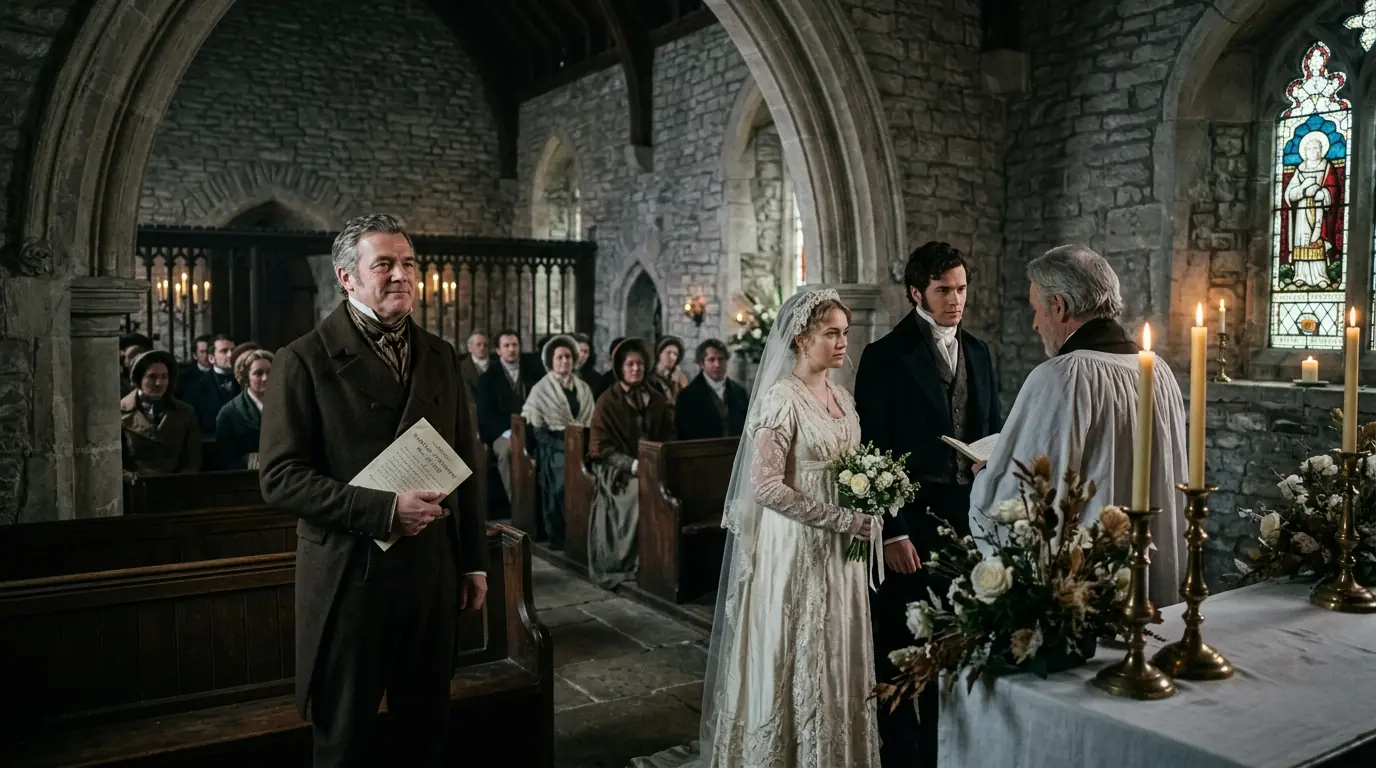
"£9,000 and the girl is yours," the man across the desk said.
Dalton, Duke of Cadaval, did not move so much as an eyelash, though something cold and old, turned over in his chest at the word yours. The banker’s man, for that was all Silas Lasker, was a lender who had risen no higher than the counting of other men's debts, leaned forward into the lamplight with the eager, damp look of one who believes he has cornered his better.
"You take the note against my brother's estate," he went on.
"And you take my niece with it, A clean settlement."
"She keeps a decent roof."
"You keep your money's worth, and I am rid of a burden I did not ask to carry."
The fire cracked in the grate of the study at Cadaval Hall. Outside, November rain came against the tall windows in long gray sweeps, and the candles guttered where a draft found them. Dalton let the silence run until it grew uncomfortable because he had learned long ago that silence was the cheapest and cruelest instrument a powerful man possessed, and he had used it on cleverer men than this. Silas Lasker began to sweat.
"You speak of your niece," Dalton said at last, and his voice was quiet, unhurried, the voice men in three counties had learned to dread, as though she were a horse thrown in to sweeten a bad sale.
"I speak plainly, Your Grace."
"A man in trade cannot afford to speak otherwise."
Lasker spread his soft hands.
"The debt is real. £12,000 owed, and the estate not worth £8,000."
"If you sold every stone of it, you could ruin the whole family with a word to your solicitors."
"And I would not blame you."
"I offer you a way to take what is owed and gain a wife into the bargain."
"A young wife, gently reared, quiet, no scandal to her name."
"You are, forgive me, not a young man."
"A gentleman of your years might want an heir before it is too late to think of one."
Dalton rose from the great chair behind the desk, and Lasker's mouth shut with an audible click. It was a thing Dalton had never quite grown used to, and had never once forbidden, the way men flinched when he stood to his full height, the way conversation died in a room when he entered it. At thirty-eight, he was in the hard prime of his strength, broad through the shoulder, black-haired, but for the first gray coming at the temple, with a face that had been called handsome by women who did not know him, and forbidding by men who did. He crossed to the window and stood with his back to his visitor, watching the rain drown the long avenue of limes. He was not, in fact, thinking of the girl.
He was thinking of Cadaval, of the roof of the West Wing that leaked into a bed chamber no one had slept in for six years, of the mortgages his own father had strung across the land like snares, of the tenants who called him hard and were not wrong. £9,000 recovered clean, without the ugliness of dragging a family through the courts, was a sum that would keep three farms from ruin. He had married once for love and buried her, and the marrying had cost him more than any debt ever could. He had sworn there would be no second wife. He had said as much coldly to every matchmaking mother who had tried him since. And yet here was a lender offering him a bride—a grosser offer than a joint of meat and the arithmetic of it lay clean and cold before him.
"What is her name?" Dalton asked still to the glass.
"Enid, Your Grace."
"Enid Lasker."
"Twenty-three or near it."
A pause and then wheedling.
"She will give you no trouble."
"She has learned to make herself small."
"Her father, my brother, God rest him, died owing more than he earned, and her mother followed him within the year, and she has kept my house since without wages and without complaint."
"You could search the county and not find a girl less likely to shame you."
Make herself small. Dalton turned the phrase over and found that he disliked it intensely, and disliked more that he could not say precisely why. He had known a great many people who made themselves large, who filled a room with their voices and their wants and their opinions of him, and he had cordially despised most of them. He should by rights have pleased to hear that this Enid Lasker had learned the opposite art. Instead, the words sat wrong in him, the way a false note sits wrong in music, and he stood a long moment listening to that wrongness before he mastered it.
"Bring her," he said.
Lasker blinked.
"You have offered me a bargain."
"I do not buy a horse I have not seen walk."
"Bring the girl here, Mr. Lasker, and I will tell you whether we have a settlement."
He turned then and let the full weight of his gaze fall on the man, with the small grim satisfaction of watching him shrink.
"And understand me."
"If I hear that you have frightened her or lied to her about what waits here or dressed this to her as as anything other than what it is, there will be no bargain, and I will have your brother's estate sold out from under you before Christmas."
"Do we understand one another?"
"Perfectly, Your Grace."
"Perfectly."
Lasker was on his feet, bowing, gathering his hat, retreating toward the door with the boneless haste of a man who cannot believe his luck and dares not stay to test it.
"You will not regret it."
"She is a good biddable girl."
"You shall see."
"Thursday," Dalton said.
He turned back to the rain and did not watch him go. When the door had closed, he stood a long while with one hand flat against the cold windowpane, and he was aware distantly of a feeling he had not permitted himself in years, and could not have named if pressed. It was not desire. He had felt nothing for the abstract girl, but the mild pity one feels for anything sold. It was something nearer to shame, the low, unwelcome sense that in agreeing even to look, he had stepped over a line that the better part of him still knew was there.
He put the feeling away, as he put away all such things in the locked and orderly place where he kept his grief and his conscience both, and he rang for his steward, and spoke of drainage until the hour grew late. Thursday came gray and bitter with a wind off the moors that stripped the last leaves from the limes. Dalton had told himself he would receive them in the great hall, formally and from a height, and settled the thing in ten minutes. Instead, some restlessness he refused to examine had carried him out early onto the front steps under the portico, coatless in the cold, so that he was standing there like a common man waiting on a coach when the hired chaise came grinding up the avenue and stopped and the door was flung open. And Silas Lasker climbed down first, all bows an unctuous greeting, and then the girl.
He saw her boots before he saw her face. They were a servant's boots cracked across the toe and mended at the heel with a darker leather that did not match, and someone she herself, he thought, blacked them carefully that morning, so that the mending would show as little as it could. Over them hung the hem of a gray woolen gown that had been good once, and turned three times since, let down at the bottom, where the old crease still marked it, a dark cloak, too thin for the wind. No jewels, no furs, no maid. She had come to be inspected by a duke wearing everything she owned, and everything she owned would not have furnished a lady's maid for a week.
Then she straightened from the step and lifted her face and looked at him. Dalton had expected. He was not sure what he had expected. Tears, perhaps. Terror, the trembling, downcast, biddable creature her uncle had promised, all lowered lashes and murmured your graces.
What he had not expected was to be looked at squarely by a pair of steady gray eyes in a pale, cold-pinched, unremarkable face, with an expression that was not fear at all, but something far more disconcerting, a clear, level, unhurried taking of his measure, as though she, and not he, would be deciding whether the goods were sound, it lasted only a moment. Then she remembered herself and dropped into a curtsy, neat and correct, and entirely without flourish. And when she rose, she had put the steadiness away behind a plain composure that gave nothing back. But he had seen it. He knew he had seen it.
And Dalton, who had not been surprised by another human being in longer than he cared to count, felt the ground shift very slightly beneath his feet.
"Your Grace," Silas Lasker said, hurrying forward.
"May I present my niece."
"Enid, make your curtsy," he began.
"I have made it," the girl said.
Her voice was low and even and entirely calm, and it stopped her uncle mid-sentence with more force than a shout could have done. She had not been rude. She had merely observed quite accurately that the curtsy was already given and needed no repeating, and she had said so, and the plain fact of it hung in the cold air and made Silas Lasker's ordering of her look suddenly small and foolish. A dull red climbed the man's neck. Dalton said nothing.
He was aware of an entirely unfamiliar sensation, and after a moment he identified it with some astonishment, as the wish to smile. He did not smile. He stood aside instead and gestured them within out of the wind and led them through the great cold hall where he saw her eyes go once and only once to the leak stain spreading brown across the plaster of the high ceiling and saw her note it and saw her say nothing and into the study where the fire was lit. He put Lasker in a chair and did not offer the girl one to see what she would do. And she did not sit and did not fidget, but stood quietly by the hearth, with her thin cloak still about her shoulders, warming her cracked hands at the flame, as unself-consciously as a child, watching him.
"Your uncle has proposed a settlement of your debts in exchange for your marriage to me," Dalton said to her.
"Has he told you so?"
"He has, Your Grace."
"And has he told you truthfully what manner of man you would be marrying?"
Something moved at the corner of her mouth. Not a smile. But the ghost to place a smile might have lived had circumstances been kinder.
"He told me you were very rich, your grace, and very old and very ill-tempered, and that I was fortunate beyond my deserving, and that I should be a fool and an ingrate to refuse."
She paused. He was wrong about one of those things.
"You are not old."
Across the room, Silas Lasker made a small strangled sound of protest. Dalton silenced him with a glance and looked back at the girl, and found her regarding him still with that clear, unafraid attention, waiting to see how the great and ill-tempered Duke would take being corrected by a pauper in mended boots.
"You are bold," he said.
"No, Your Grace," She said it without heat, as a simple matter of record.
"I am only tired of being spoken of as though I were furniture."
"And it seemed to me that if I am to be sold in this room, I would rather be sold as a person who can speak than as a table that cannot."
"If that is boldness, then I have been bowled once in my life, and I dare say I shall pay for it."
She looked into the fire.
"I usually do."
The room was very quiet. The rain had come on again and ticked against against the glass. Dalton stood by the desk with his arms folded and looked at this plain upright girl in her ruined gown who had walked into the house of a man three counties feared and told him he was not old and told him she was being sold and told him without one word of complaint or one glance for pity exactly what her life had been. And he understood with a cold clear certainty that the whole careful arithmetic he had done on Tuesday night, £9,000, three farms, a clean settlement, a biddable wife who made herself small, had just come apart in his hands, and he did not yet know what would take its place.
"Sit down," he said abruptly.
"You have come a long way, and you are cold."
Sit down, Miss Lasker. She looked at him, then with the first flicker of real surprise she had shown surprise. He understood not that he offered a chair, but that he had called her Miss Lasker, as though she were a lady, as though she had a name that was not simply the girl. And for the briefest instant, before she mastered it, something raw and young and terribly tired showed through the composure, and Dalton felt it go through him like the cold going through his boots on the step, and he had to turn away to the window to keep his face his own. Behind him, he heard the small sounds of her sitting, the creek of the chair, the settling of thin skirts.
He heard Silas Lasker begin again upon the terms, the estate, the figures, his voice sliding back into its greasy confidence now that the strange moment had passed. Dalton let him talk. He watched the rain drive down the avenue of limes, and he thought with the part of his mind that was still cold and still counting, that he had already decided that he would take the settlement and the girl both, that he would do it because it was sound, and because three farms wanted saving, and because a duke did not undo a bargain merely, because the goods had turned out to have gray eyes and a low, even voice, and a way of looking at a man as though she saw straight past the title to whatever poor thing was standing behind it. That's what he told himself. He was a man well practiced at telling himself things.
But there was another part of him, the part he had locked away 6 years ago beside a grave, and had sworn never to unlock again.
"And that part had woken at the sound of her saying, I would rather be sold as a person who can speak, and it was not counting anything at all."
It was simply awake after a long dark sleep, and it was afraid, and it would not go back down. Drop the papers. Dalton heard himself say still to the window in the flat hard voice that ended all discussion.
"The debt is forgiven in full not 9,000 Mr. Lasker the whole of it 12 so that no man may ever say the girl came to me owing anything or that you profited by a farthing beyond your brother's honor restored."
She will be married from this house in 3 weeks. She will have a maid and a modist and whatever else a duchess requires.
"And you will not set foot across my threshold again until the wedding day, and after it not at all, he turned."
"Those are my terms."
"There will be no others."
"Do you accept them?"
"Silas Lasker, who had come to sell a niece for £9,000, and had somehow been made £12,000 richer, and thrown out of the house in the same breath, opened and closed his mouth like a landed fish, and stammered that he did most gratefully, most humbly, your grace was generosity itself."
Dalton was not listening. He was watching Enid Lasaska, who had gone very still in her chair, and who was looking at him now with a wholly new expression, weary, unconvinced, bracing herself, he thought, against the certainty that so much unlooked for kindness must have a hook buried somewhere in it. Because everything in her life had taught her that it did, she did not thank him. He was fiercely, unaccountably glad that she did not thank him. She only held his eyes across the violet room, plain and cold and unbought, and asked him one quiet question, the only question, it seemed that mattered to her at all.
"Why?"
"Said any, you have not even asked whether I would have you."
And Dalton, Duke of Cadaval, who had an answer ready for every man who had ever tried to take something from him, found that he had no answer at all for this penalous girl who wanted only to be asked, and the silence that followed, stretching long and tort across the crackling fire, was the first honest thing that had passed between them, and neither of them looked away. Carriage that carried her to Cadaval arrived an hour past the appointed time and Dalton watched from the tall east window of the long gallery as it labored up the drive, its wheels black with the mud of three counties. He had told himself he would not come to the window. He had told himself a great many things in the fortnight since the papers were signed, since Bartram Lasaska had counted the settlement with fingers that trembled, not from grief, from greed. And since the girl herself had stood in her uncle's parlor with her hands folded and said nothing at all, while grown men bartered over the years of her life, Dalton had not wanted her.
He had wanted the matter closed, the debt to old Laskar's house discharged. The whole ugly transaction folded away where the world could not gossip over it. And yet here he stood at the window like a boy, watching a mud spattered carriage crawl toward his door. He made himself step back before the vehicle drew to a halt. A duke did not wait upon the step for anyone, least of all a bride he had purchased, as one purchased a horse or a mortgage.
He went instead to the library, where the fire had been built up, and the decounters set out, and he stood with his back to the flames, and his hands clasped behind him, and he arranged his face into the expression that the county had learned to fear, cold, closed. The face of the man they called the winter duke behind their fans, the man who had not smiled in company for 11 years, and did not intend to begin. Now, he heard her in the hall. Not her voice, for she made none, but the small sounds of arrival, the murmur of Mrs. Pifer, the housekeeper, the scrape of a trunk that was, he would learn, the only trunk she owned. Then the doors opened, and any Lasaska was shown into the library, and Dalton looked at her for the first time as his wife to be, and found that he had prepared himself for the wrong woman entirely.
He had expected fear. He was accustomed to fear. It was the currency in which most people paid him, and he had long ago ceased to mind it. He had expected, too, the other thing that sometimes came dressed as courage, the bright false brightness of a veterin to charm her way into comfort, the flutter and the flattery, the quick appraising glance that took the measure of his rooms and his rank and calculated its own advantage. He had seen that glance before.
He had married it once and buried it and sworn upon the grave that he would never again mistake a woman's ambition for a woman's regard. Enid did neither. She came to the center of the room and she curtsied correctly and without flourish. And when she rose, she looked at him directly, and what he saw in her face was not fear and not calculation, but a kind of steady, exhausted honesty, the look of a person who has already lost everything worth losing, and has therefore nothing left to perform. Her traveling gown was gray and much mended.
Her hair had come loose at the temple where the wind had pulled it.
"There was mud on the hem of her skirts and shadows beneath her eyes, and she stood in his library."
"That room built to make lesser men feel small, as though she had simply arrived somewhere and would now discover what was wanted of her."
"Your grace," she said.
"Only that."
Her voice was low and clear, and it did not shake, Miss Lasker. He inclined his head the precise degree that procol required and no more.
"You are late."
"The road above Harrowfield had washed away."
"We were turned back and made to go round by the mill."
She paused.
"I am sorry to have kept you waiting."
"Though I confess I did not think you would be waiting."
It was not insolence. That was what disarmed him in the first moment. He waited for the insolence to declare itself and it did not come. She had said the thing plainly because it was true. And she watched him now to see whether the truth had given offense.
He understood with a small cold jolt that she was not afraid of the answer. She had already been sold.
"There was her whole bearing seemed to say very little further that could be done to her."
"I was not waiting," Dalton said, which was a lie, and she knew it was a lie, and she did not say so.
She only lowered her eyes a degree and something at the corner of her mouth move that was not quite a smile and he felt the lie sit badly in the room as though she had held up a glass and shown him his own face in it. He turned to the decanters to be rid of the feeling.
"You will take some wine."
"You have traveled far."
"Thank you."
"No, I have not eaten since morning and it would go straight to my head and I should like to keep my head about me on the day I meet my husband."
A pause.
"You may have it if you wish."
"I did not mean to keep you from it."
"I do not drink before dinner," he said, and set the decanter down, and turned back to find her watching him with that same steady attention, as though he were a country whose customs she meant to learn honestly rather than a fortune she meant to flatter.
He was not accustomed to being looked at. So men looked at him with fear and women with appetite and servants with the careful blankness of the paid. And here was this mud hemmed girl in her mended gray looking at him as a person looks at another person and he found he did not know what to do with his hands. She said more roughly than he intended and gestured to the chair by the fire.
"You are swaying on your feet."
"I am a little tired."
She sat. She did not sink gratefully into the cushions as another woman might, arranging herself to advantage in the fire light. She sat upright at the edge of the seat with her ruined hands folded in her lap, and she looked into the flames rather than at him, giving him the mercy of a moment unobserved, and Dalton took it, and studied her, and disliked how much he wished to.
"You know the terms," he said at last.
"I know that my uncle owed your late father's estate a great deal of money," she answered, still to the fire, and that the debt has been forgiven in exchange for me.
"I know that I am to to be the Duchess of Cadaval, and that this is a thing most women in England would trade their teeth for, and that I would give it back tomorrow if giving it back would restore me one honest year of my own."
"Now, she did look at him, and her chin came up."
"I do not say that to wound you, your grace."
"You did not make my uncle a spenthrift, and you did not make the world one in which a girl is a coin to be paid over a table."
"I only think if we are to live beside one another, that you had better know I am not grateful."
"I will be dutiful."
"I will be honest, but I will not pretend to a gratitude I do not feel, and I think he would come to despise me if I did."
Dalton stood very still. In 11 years no one had spoken to him, so his stewards flattered him, his tenants feared him. The great ladies of the county laid their daughters before him like flowers upon an altar, and called it affection. And he had learned to see the ledger behind every soft word. The coronet reflected in every admiring eye.
He had married once for what he had believed was love, and discovered too late. Upon a stare in a conversation he had not been meant to hear, that his young wife had counted his years and his weak heart and his great fortune, and found the arithmetic agreeable, and had wept to her sister that she need only be patient, and the widowhood would be worth the waiting. Adela, he had never said the name aloud since. She had taken a fever that same winter, and gone to a grave, with the whole county, mourning the Duke's tender loss. And Dalton had stood at the graveside, dry-eyed and frozen, and had understood that he would never again believe a woman who told him he was dear to her, because the last one had, and had meant the strong box.
And now a girl he had bought was telling him she was not grateful, and it landed on him like clean water on a burn.
"You are very certain," he said slowly, that honesty will serve you better than gratitude.
"Most in your position would calculate the reverse."
"Most in my position have something to gain by calculating, said Enid."
"I have already been paid for."
"There is nothing further I can win from you by charm, your grace, and so I am spared the trouble of it."
"That is the one freedom your money has bought me, and I intend to keep it."
She looked down at her hands.
"Besides, I have watched people flatter and scheme and smile at tables where I was not thought worth the noticing, and I have seen what it makes of them."
"I would rather be poor and plain and my own than rich and false."
"I am to be rich now."
"It seems I should like to remain my own."
Dalton crossed to the window because he could not for the moment bear to keep looking at her. Outside the light was failing over the park, the great oaks going to shadow the lake a sheet of putter. He had built his whole cold life upon a single certainty that no one came near him without wanting something. And this girl in her mended gray had walked in from the mod and told him without art that she wanted nothing from him at all except to be left in possession of her own soul. It should have made him easy.
A wife who wanted nothing could not betray him.
"There was nothing she was working toward."
Instead, he felt the ground he had stood upon these 11 years shift very slightly beneath him, and he did not care for the sensation, and he could not make it stop. A knock came, and before he had answered it, the door opened, and Rosanna swept in without waiting for leave, as she always did. She was his late mother's godaughter, and the mistress of the neighboring park at Fenwald, and she had spent the better part of the last 3 years arranging herself in Dalton's path, with a patience he had found tolerable, chiefly, because it asked nothing of his heart. She was handsome in the hard, bright way of a well- cut jewel. And she came in now in a gone of clarret silk that had plainly been chosen for a duke's eye, and not for a wet evening in the country, and she stopped short at the sight of the gray figure by the fire.
Dalton, forgive me.
"I did not know you had company."
Her gaze went over Enid, over the mended hem, and the loosened hair and the ruined hands in a single practiced sweep, and Dalton watched the woman he had once thought merely tiresome arrange her face into a smile of such perfect polished cruelty that he felt something in him go quiet and cold.
"But of course, this is the little Oscar girl, my dear, how brave you to travel in such weather in, is it your own gown?"
How touching! One does so admire economy in the young. She turned to Dalton with a laugh like the ring of a dropped coin.
"You must let me send my woman to her, Dalton, before the wedding."
"We cannot have the county saying the Duchess of Cadaval came to her marriage in a maid's castoffs."
"Though I dare say the poor thing has never owned anything finer, and knows no better, which is a mercy."
He waited for the girl by the fire to crumple. He had seen Rosanna do this before to lesser rivals, and he had seen those rivals color and stammer and fold.
"He looked at Enid, and Enid rose from her chair, quite composed, and folded her hands and said, You are very kind to trouble over my gown, ma'am."
"It is my own, and it is old, and I mended it myself, and I am not ashamed of any of the three."
"I have found that a person's manners are worn nearer the bone than her silk, and that those are the harder to keep clean."
"She let that rest a moment gently in the firelet room, but I should be glad to learn from your woman what is proper in a great house."
"I have a great deal to learn, and I would rather be taught kindly than laughed at."
"I think you would rather teach me kindly than be laughed at yourself, ma'am, one day, by someone who had learned it from you."
The room was silent. Rosanna's smile had frozen upon her face like frost upon glass. Dalton, standing at the window with his hands behind his back, felt an entirely unfamiliar sensation move through his chest, and was appalled to recognize after a moment that it was the near approach of a laugh. He had not laughed in company in 11 years. He turned it with an effort into a cough.
"Rosanna," he said, and his voice was smooth and final and left no room.
"Miss Lasker has traveled since dawn and has not eaten."
"I will not have her wearied further this evening."
"Mrs. Pifer will see you out."
"You are good to have called."
He saw the color rise in Rosanna's throat, saw her understand that she had been dismissed in favor of a girl in a mended gray gown, and saw her master it because she was clever, and gather her clarret silk and her wounded pride, and drop a curtsy too deep, deep to be sincere.
"Of course, your grace."
"I only meant to be of use."
Her eyes went to Enid, and in them Dalton read something he filed away, and did not forget, a promise, cold and patient.
"We shall become great friends, I am sure, Miss Lasker."
In time, and she was gone, and the doors closed behind her, and the fire snapped in the gray, and Dalton found himself alone again with the girl he had purchased, who had just defended herself before his oldest ally with more grace than he had managed in a decade of trying.
"You have made an enemy," he said.
"I had one already, I think, said Enid."
"She only came tonight to see what manner of thing had been bought for you, and to be sure I understood my price."
"I understood it before she came, but I thank you for the wine you did not make me drink, and the chair you made me sit in, and for sending her away."
She looked at him, and the tiredness was back in her face, and beneath it something he had not expected, a kind of weary, reluctant warmth, as though she had come prepared to find a monster, and had found instead a man, and did not yet know what to do with the difference.
"You are not what I was told you were, your grace, and what were you told?"
"That you were called to the bone, and that no one had ever known you to be kind."
She held his gaze.
"I begin to think it is not that you cannot be kind."
"I think it is that you have decided kindness is is a debt someone will call in and so you keep it locked away where it can cost you nothing."
"I have known people like that."
They are not cold. They are only very much afraid. She curtsed correctly without flourish.
"Forgive me."
"I am too tired to be careful."
"And I have said far more than a bought wife ought."
"I will go up now if I may."
He should have let her go. He should have said something called to close the door she had opened. Some cutting thing to remind them both of the coin and the ledger and the terms. He opened his mouth to do it.
"Miss Lasker," he said instead, and she paused at the door and turned, and the fire light was on her tired, honest face, and Dalton discovered that he did not, in fact, wish her to go at all, and had no notion in the world of what to say to make her stay.
"Dinner is at 8, he finished absurdly uselessly."
"You will not go hungry in this house."
"Whatever else you have been told of me, you will not go hungry here."
"Something moved across her face that was almost not quite a smile."
"Thank you," she said, and this time he thought she meant it.
And then she was gone, and the doors closed, and the Duke of Cuddle stood alone before his fire in the failing light, and found that he could not, for the life of him, look away from the door through which she had passed. The ballroom at Cadaval House had not been lit so fully in 11 years, and Dalton felt the weight of every candle, as though each flame were an eye turned upon him. He had ordered the great chandeliers dressed, and the long mirrors uncovered, because the county expected it of a duke about to take a wife, and a duke who disappointed the county's expectations, was a duke who invited its questions. So he stood at the head of the room in his dark coat, spine straight as a drawn saber, and let them look. Let them murmur.
He had grown expert across those 11 silent years at being looked at and giving nothing back. But his own gaze would not obey him tonight. It kept slipping against every discipline he had built toward the far doorway where Enid stood in a gown that had plainly been made over from some older grander thing. The lace at its cuffs a shade too yellowed, the silk pressed until the wear scarcely showed. She had come without jewels.
Every other woman in the room glittered like a frost, and she stood among them plain as bread, and he could not, for the life of him, stop watching to see what she would do. She did nothing to draw notice, which was precisely the thing that held him. She did not lift her chin too high, nor let it drop. She did not scan the room for advantage, nor arrange herself near the powerful, nor laugh a beat too soon at some baron's jest. She simply entered and looked once about the great glittering room with a quiet, cleareyed attention, as if committing it honestly to memory, and then folded her gloved hands, and waited to be told where a woman such as she was permitted to stand.
She has the bearing of a governness who has wandered in from the schoolroom, said a voice at his elbow, pitched to carry no farther than himself, and yet somehow to carry to a dozen listening others. Rosanna Dorney had come to stand beside him without his marking it. Her fan moving in slow indolent sweeps her gown the exact silver of the mirrors so that she seemed a piece of the house's own splendor.
"Do you know Cadaval?"
"I keep expecting her to ask the footman whether she might have leaved to sit down."
"You keep expecting a great many things of my guests, Miss Dorney," he said.
It must be exhausting. She only smiled. Rosanna had been raised in a house 3 mi from his own, and had grown into her beauty the way a blade grows into its edge, and she had spent two full seasons arranging herself where his eye might fall, and had never once understood why it did not. He suppose she believed the Lasker match an accident, a debt settled, a bargain struck between his steward and her father over a mortgage, which, in truth, was very near what it had been. He watched her decide in the space of a breath that a plain girl bought cheaply could be unmade cheaply too, and that the unmaking might yet be arranged before witnesses to teach a duke his error.
"Come," Rosanna said, snapping the fan shut.
She ought to be introduced properly. It is unkind to leave her marooned by the door like an umbrella. He should have stopped it there. He knew even as she moved that he should. But 11 years had taught him that a man who intervened too readily only fixed the eyes of the room upon the very thing he wished them to overlook.
And so he did the thing he had trained himself to do, which was nothing, and followed at a measured distance to watch what could not now be prevented. Rosanna crossed the floor with three companions gathering in her wake like a tide Mrs. Peverell and a thin laughing young man named Cowles who fancied himself witty because cruelty came to him easily. They arranged themselves in a loose crescent about Enid so that she stood with the wall at her back and the whole bright company arrived before her and Dalton saw her understand the shape of it at once. He saw the small steadying breath she took. She did not look for him.
That too he marked.
"Miss Lasker," Rosanna began, warm as a hostess, loud as a herald.
"We are all of us so very curious."
"You must forgive us."
"It is not every day the county is given a new duchess, and from a family none of us has had the pleasure of knowing."
"Tell us, where does one place the Laskers?"
"I have consulted three people and a peerage, and come away none the wiser."
"You will not find us in the peerage, Miss Dorney," Enid said.
Her voice was low and even and carried no farther than it needed to.
"My father kept a draper's accounts in Whitcombe."
"We were placed, as you say, above the shop and below the notice of most, which I have always found a tolerably comfortable position from which to see people clearly."
A little ripple went through the crescent, the laugh they had wanted. Something warrior. A draper, Rosanna repeated, savoring it, turning it over for the room. How charming.
"Then you will know a great deal about cloth."
"Perhaps that is why your gown is so."
She let her eyes travel down it slow and appraising. So thoughtfully economized. One does admire economy in its place.
"I made it over myself," Enid said without a flicker.
"My mothers and her mothers before that."
Three women have been happy in this silk. Miss Dorney.
"I could not think of a richer thing to wear to a wedding than a gown that has already known so much of love."
She smoothed one worn cuff with a plain ungloved thumb, unhurried.
"But I see it troubles you."
"I am sorry for it."
It was never my intention that my dress should give you so much to think about. Cooh's laughed before he could stop himself a short, startled Bark and turned it hastily into a car. One of Mrs. Peverell had gone quite pink and found something urgent to study upon the ceiling. But Rosanna had not spent two seasons learning to wield a room, only to be turned aside by a draper's daughter with a ready tongue, and Dalton watched her gather herself and change her ground. She stepped a half pace nearer, and let her voice drop into the confiding wounded register that women of her sought kept for their unkindest work, the one that dressed a knife as sympathy, so that any man overhearing would think her the injured party.
"You mistake me, Miss Lasker," she said sweetly.
"I wish you nothing but joy."
"I only think of the Duke."
"He is a proud man and a private one, and he has borne a great deal more than you can know, coming so lately among us."
"There are those of us who have loved this family a long while, who remember what this house was before its griefs, and who cannot help but wonder what a man of such consequence can have been thinking to tie his ancient name to a girl with nothing to bring him but a needle and a set of madeover manners."
"It is not cruelty, my dear."
"It is concern."
"Surely you feel the difference."
"I feel it keenly, Miss Dorney," Enid answered.
And for the first time, something cool came into her level voice, a temper held on a short and disciplined Re. Concern is a kindness done quietly in a corner where the one concerned might hear it and no one else.
"What you are doing, you are doing before 40 people in the middle of the Duke's own floor, in the loudest voice you own."
"I know the difference very well."
"I had thought until this moment that perhaps you did not."
"I am relieved to find you do."
She inclined her head, gracious as any duchess born.
"It speaks well of your understanding, if not of your charity."
The silence that followed had a different quality altogether. Coohl's had stopped pretending to cough. Rosanna's fan had stilled entirely, and Dalton, standing four paces off with his hands clasped behind his back and his face arranged in its accustomed marble, felt something move in his chest that he had believed long since dead of disuse. It was not admiration only, though it was that. It was recognition.
"He knew none better what it was to stand in a bright room full of people who had decided the shape of you before you spoke and to have no weapon but your own quiet and to choose your one word and place it with care like a man setting down the last coin he owns."
Rosanna recovered. She was too wellm made not to.
"How droll you are," she said, the warmth gone thin now.
"I hope for the duke's sake that you are as clever with an estate as you are with a needle and a per answer, though I confess I pity him a little."
A man of his consequence, and he must spend his evenings explaining to his guests which fork that will do. Dalton had not intended to speak. He heard the words leave him with something like surprise, low and flat, and final. The voice he used on stewards who had cheated tenants, and on magistrates who had grown too fond of the sound of their own judgments, and the whole crescent turned to him as one, and the nearer half of the ballroom with it. He had spent 11 years being spoken about and never spoken for.
He had never once in all that time stepped between the county's malice and its chosen prey because he had learned that the prey was only made more conspicuous by the rescue. He knew all this. He stepped forward anyway.
"Miss Dorney," he said, You have been at some pains this quarter hour to instruct my future wife in the manners of her betters.
"I have listened with great attention, hoping to learn where these betters might be found, for I confess I have not yet seen one enter the room."
He let the silence sit a moment cold and complete.
"You will forgive me."
"I find I have kept Miss Lasker too long from the air."
The candles are oppressive tonight. He offered any his arm. It was a small thing and an enormous one. He felt the room understand it felt the recalculation run through it like a draw through a house. Every matron and every rival adjusting at once to the fact that the Duke of Cadaval, who had loved nothing in a decade, had just chosen a Draper's daughter over the loveliest woman in three counties, and had done it in front of them all, he did not care.
That was the thing that unsettled him most. Walking her the length of the floor with her light hand resting upon his sleeve, he found that he did not care what they made of it, and he had cared ceaselessly and exhaustingly what they made of everything for as long as he could remember. He took her out through the tall doors onto the stone terrace, where the night air came up cool off the dark lawns, and the noise of the ballroom fell away behind them to a muffled brightness. For a moment neither of them spoke, she drew her hand from his arm not sharply. But as a person returns, a borrowed thing once its use is passed, and went to the ballastrade, and rested her palms upon the cold stone, and looked out at the black shapes of the use, and let out a long, unsteady breath she had plainly been holding for the better part of an hour.
"You need not have done that," she said at last, not turning.
"It will cost you more than it cost me."
"I am used to Miss Dorney and her kind."
"They cannot say anything of me."
"I have not already survived being said."
"But you, they will talk of you now."
"They will say you are besotted or bewitched or gone soft, and a man in your position cannot afford any of the three."
"You presume to know a great deal about my position."
"I presume nothing."
"I only listen."
She turned then, and the light from the windows fell slantwise across her face, and he saw she was not frightened and not triumphant, only tired in the honest way of a person who has spent her courage and is counting what remains.
"You stood four paces off and watched them at me for a full minute before you spoke."
"I felt you there."
"I thought he will not trouble himself, and that is his right."
"I am a purchase, not a person, and one does not defend one's furniture from insult," She said it without bitterness, which was somehow worse than bitterness.
"And then you did trouble yourself, and I cannot for the life of me work out why, and has unsettled me more than anything Miss Dorney contrived."
No one had spoken to him so plainly in 11 years. He was so wholly unused to it that for a moment he could not find the shape of a reply. People flattered him, or feared him, or wanted things of him dressed up as devotion. His first wife had done all three by turns, and none of them truly, and when she died, he had resolved never again to mistake the courtier's warmth for the thing itself. He had built his whole guarded life upon the certainty that no one saw the man beneath the title, cuz Clarissa, who had married the title and worn it like a jewel, and mocked him softly in the dark for imagining she had wanted more, had taught him it could not be seen.
And here stood a girl he had bought for the price of her father's debts, telling him plainly that she could not work out why he had been kind, as though kindness in him were a genuine mystery and not a currency to be angled for.
"You did not thank me," he said.
"No."
"A faint rofal thing touched the corner of her mouth."
"Should I have?"
"I thought it would sound like the beginning of a bargain, and I would rather not begin one with you."
"You've already bought me once."
"I have no wish to be forever selling you small pieces of my gratitude to make up the balance."
She looked down at her own wor cuff, then up at him again, steady.
"I will keep your house honestly, and I will not shame you, and I will be a true wife to you in every duty the word carries, because I gave my word, and my word is the only thing I brought to this marriage that no one had already spent."
"But I will not fawn on you, your grace."
"I am sorry if you expected it."
"I have watched a great many people fawn, and it seems to me a wretched way to spend a life, and I have already so little of one left to me that I have decided to spend none of it that way at all."
The wind moved in the use below. Somewhere behind the tall glowing windows a quadril had struck up and the county was dancing and being talked about had never in his life mattered less to him than it did in this one moment on the cold terrace with a plain girl in a madeover gown telling him she would not flatter him and looking for all the world as though she expected to be sent back inside for the offense.
"Cadail," he said.
She blinked.
"Your grace, my name, when there is no one to hear it, and you have decided against fawning."
In any case, it is Dalton. He heard himself say it with the same low astonishment he had felt speaking against Rosanna, as though some other warmer man had commandeered his voice, while his own guarded self stood four paces off and watched, unable to prevent it.
"You are the first person to stand in my house in 11 years and ask me nothing."
"I find I do not know what to do with it."
"I find I do not want to go back inside where they will all begin asking again."
For a long moment she only looked at him, and he could not read what moved behind her clear gray eyes, and he discovered that he wanted to, that he was leaning minutely into the wanting to know, the way a man half frozen leans toward a fire before he has decided to.
"Then we will not go back inside," she said quietly, for a little while yet.
"The candles are oppressive."
"You said so yourself, your grace, a Bolton, and he stood on the terrace in the cold and the dark with the county ding behind him, and understood with the particular dread of a careful man feeling the ground give beneath his careful feet, that he did not want the conversation to end, that he would have stood there answering her plane, unbought questions until the candles guttered, and the last carriage rattled away down the drive."
And that this, more than any insult of Rosanna's, more than any whisper the ballroom could contrive, was the thing he had truly to fear. He did not sleep that night, and he was honest enough with himself to know the reason. The great house at Cadaval had long ago taught him to lie still in the dark, and feel nothing, to let the hours pass over him like water over stone, but the memory of her voice would not let him be. Twice he rose and stood at the tall window of his chamber, looking out over the black shapes of the U's, and both times he found he was listening, as if she might speak again from somewhere below, as if the whole silent park might give him back that one plain unflattering sentence she had left him within the corridor. He had commanded armies of servants and cowed men twice his cunning with a single lifted brow.
And now a woman with mended lace at her cuffs had unmade his rest simply by declining to be afraid of him. By morning he had resolved to keep his distance. It was the only same course. A man of his years and his rank did not permit himself to be turned about like a boy at his first assembly, least of all by the girl his own household had bought and paid for. As one buys a horse or a length of cloth.
That the bargain shamed him he had always known. He had signed it in cold blood, believing a wife of humble station would ask nothing of him but her keep, and would leave the frozen rooms of his heart exactly as she found them. He had wanted a wife who would not reach for him. He had not counted on wanting to reach for her, so he did not seek her at breakfast, and he told himself he was pleased not to. But at the hour when the low autumn sun came slanting gold across the terrace, he found his feet had carried him without any decision he could name down through the long gallery and out to the garden.
And there she was. She had not seen him yet. She stood at the edge of the walled kitchen garden where the last of the season's roses had gone leggy and blown, and she was not admiring them as a fine lady would at a careful distance. She was on her knees in the good dark earth with her sleeves pushed back, coaxing a fallen cane back onto its frame, binding it with a strip of cloth torn, he saw from her own pedicote.
"There was soil to her wrists."
A smudge of it lay along her cheek where she had pushed a loose curl away, and she was humming some small tuneless thing, contented, private, as though this corner of a stranger's estate were the one place in all the world she had any right to be. Dton stopped in the arch of the U hedge and did not announce himself. For a long moment he only watched, and something in his chest that had been clenched for the better part of a decade eased by a fraction it could not afford to admit.
"You will ruin your gone," he said at last.
She did not startle, which he noted with a strange warming pride, as though her composure were a thing he might take credit for. She sat back on her heels and regarded him, wiping her hands upon her apron with no more embarrassment than a gardener's girl. The gown is already ruined.
"Your grace."
It was ruined before I came here. The hem was turned twice, and the seams let out for a taller cousin.
"I only finish what others began."
She looked down at the bound cane.
"This at least I can mend properly."
"My gardeners are paid to tend the roses," he said.
"Then they should be ashamed of this one," she answered, for it was left to fall on its face in the mud, and it would have died of the neglect by Mike Elmer's.
"I could not walk past it, she rose, brushing the earth from her knees, and met his eye without a trace of the flutter he was accustomed to in women who found themselves alone with him."
"Forgive me, I did not think a duke would come this far from his fires to catch me at it."
"Neither did I," he said, and was surprised to hear the truth of it come out of him plainly.
He had meant to nod and go. Instead, he crossed the little garden and stood beside her, looking down at the mended rose, and the space between them was suddenly the whole of his awareness. The warmth of her nearness, the smell of turned earth and crushed leaf, the sunlight on the fine down of her forearm, where the sleeve was pushed back. He who had walked untouched through the coldest drawing rooms in England found he could not have said a clever word to save his life.
"You did not come out to speak of roses," she said.
It was not a challenge. It was only true and offered gently, the way one might set down a heavy thing so that another need not carry it.
"No," he admitted.
"Then say what you came to say, your grace, and I will not repeat it to a soul."
"I have no one to repeat it to."
"There was no self-pity in the words," She said them the way she might have named the weather.
He had not intended to ask, but the honesty of her drew the question out of him.
"You have no one truly."
"There is a family."
"There must be."
A man does not. He stopped for the plain vocabulary of the thing was ugly, and he found he could not lay it before her. An arrangement was made with people who had the right to make it.
"With my uncle," she said the right was his in-law.
"I was 11 when my father died and left more debts than acres."
"And my uncle took me into his house as one takes in a stray cat to be fed if it earns its feeding."
She turned the mended cane a little toward the sun, considering it rather than him, and he understood that she found it easier to speak.
"So I earned mine."
"I kept his books when his clerk drank, and I raised his daughters when their governnesses left unpaid."
"And I said nothing when the seat at the table meant for me was given to a guest, and I ate in the passage."
It was not cruelty precisely. It was economy.
"I was a cost he could not see the profit in, until, here, at last she looked up at him level and clear, until a duke of great fortune, let it be known he would take a bride of no fortune at all, and asked few questions, and paid the asking price."
"Then of a sudden I was worth a great deal to my uncle, more than I had ever been worth to him living under his roof."
Dalton dur still he had signed the settlement himself. He had read the sums and thought them trifling and been glad the business was concluded with so little fuss. He had never once let himself imagine the girl at the far end of those figures, that she had a name before she had his, that she had knelt in some other man's passage, eating cold supper, while her value was calculated to the shilling. Shame moved through him slow and thorough, and beneath the shame something fiercer and more dangerous, an anger on her behalf that he had no right to feel and could not put down.
"You say it without bitterness," he said.
"Lo, bitterness is a fire, your grace."
"It wants feeding, and I was never given fuel to spare."
She smiled then, and the smile undided him more than any tear could have, for it was not brave in the way that asks to be admired. It was simply kind, as though she had made her peace with the world's hard arithmetic long ago, and had decided, in spite of it, to be gentle. One learns to be glad of small things, or one learns to be always wretched.
"And I could not bear to be always wretched."
"So I taught myself to love a mended rose and a fair morning and a book got by candle end when the house was asleep."
"These cost nothing and no one can take them from you and they are enough to build a life on if you are careful with them."
"I do not tell you this to make you sorry for me."
"I would not have you sorry for me at all."
"I tell you because you asked plainly and I have learned that a plain question deserves a plain answer."
"Whatever it costs."
"There is little enough plain dealing between us as it is."
"We were sold to one another, you and I."
That is a poor foundation, but it need not be a false one. No one had spoken to him in his own house, so without fear, without flattery, without one eye upon his coronet, and the other upon his purse. The woman he had once meant to marry in the years before the world froze over had looked at him with that same warm directness. So he had believed until the day he learned that every warm word had been rehearsed before a glass, and that it was the title she had loved, and never once the man who bore it. That wound had made him what he was, a man who trusted nothing offered with a smile, who had chosen at last to purchase a wife precisely, because a thing bought could not pretend to be a thing freely given.
He had built his whole cold bargain upon the certainty that no woman would ever again make him believe she wanted him. And here stood Enid Lasker with soil on her cheek, wanting nothing from him, telling him the truth for no reward. And he believed her. That was the thing that frightened him past all reason. He believed her.
"You should not trust me so far."
"He heard himself say, Men have found me poor company."
"My own household walks softly when I pass."
"There are reasons a woman of sense would keep her distance."
"I have kept my distance from a great many people who deserved it more," she said.
"I find I do not wish to keep it from you."
Color came into her face as she said it, and she looked down quickly at her earthstained hands, and for the first time her composure faltered, not from fear of him, he understood, but from having said a true thing aloud that she had not meant to.
"There."
"Now you will think me forward, and I have spoiled it, for I meant only to mend a rose and be gone before you woke."
"I am not so easily spoiled," he said, and found, to his own astonishment, that he was near to smiling, a thing his face had grown so unused to that it felt like the breaking of thin ice.
The sun had dropped low enough now to gild the top of the wall and throw the garden into a soft, failing amber. A blackbird began somewhere in the use, and Dalton, who had not touched another living soul with any tenderness in longer than he could bear to recon, lifted his hand and drew the loose curl back from her cheek where the smudge of soil had marked her, his fingers barely grazing her skin. She went very still under the touch. She did not draw away. He felt the warmth of her, the small quick pulse of her breath, and the whole of the ruined garden narrowed to the half inch of air between his palm and her face.
Enid only her name. He had not called her by it before. It came out of him rough, as though it had cost him something to say, and it had.
"Your grace," she whispered.
"Dalton," he corrected, and the giving of his own name felt more naked than any confession.
"When we are alone, I would have you call me by it."
For a moment neither of them moved, and he was nearer to her than he had let himself be to anyone in 10 cold years, near enough to close the distance entirely, and every guarded instinct in him strained toward it. But he saw the trimmer in her, and he understood that whatever she felt, she was still a woman who had been bought and set down in a stranger's house, and that to reach for more now, when she had nowhere in all the world to flee to, would be to make of his own longing another cage, he would not. Whatever else he had done, whatever the settlement said, he would not have her come to him because she had no door to leave by. So he let his hand fall. He stepped back one pace, and the cool evening air moved into the space where his nearness had been, and he saw her breathe again.
"Forgive me," he said.
"There is nothing to forgive," she answered, and her voice was not quite steady.
"You did nothing."
"Then softer with the faintest curve of wonder at her own words, You did nothing, and I have not felt so, so seen in all my life."
They walked back together through the darkening garden, not touching, saying little, and it seemed to him the most companionable silence he had ever kept. At the terrace steps, she paused.
"You are not what they say of you," she said.
"In the servants hall, in the county, they speak of the cold Duke of Cadaval as though you were carved of the same stone as the house."
"I do not think they've ever come this far from your fires."
"Few have," he said.
"Fewer have wished to."
"I wished to," she said simply, and went in.
He stood alone on the terrace long after her candle had climbed the stair and glowed a moment in an upper window and gone dark. The certainty he had lived by, that no true feeling could survive a bargain struck in coin, had cracked clean through in the space of one hour, and he did not know how to mend it, nor whether he wished to. He had come out meaning to be prudent. He was going in undone. He might have stood there till the frost came, had a light footstep not sounded on the terrace behind him, and a voice he liked far less than the one still ringing in his memory.
"Such a picture of devotion, your grace, Rosanna Dorney came out of the long shadow of the doorway, wrapped in furs against a cold she seemed to carry with her, her smile as polished and as cool as the pearls at her throat."
She had been his late wife's cousin, and she had made herself indispensable in the running of Cadaval in the years since, and Dalton had long suffered her presence, the way one suffers a draw that cannot be traced to its window.
"Do forgive me."
"I could not help but observe the little scene in the garden, so very tender, so very unlike you."
"You forget yourself," he said, and the warmth went out of his voice as if it had never been.
"I never forget myself your grace."
"It is my chief accomplishment."
She came to the ballastrade and looked out where he had been looking at the dark park at nothing.
"I only wonder that a man of your discernment should be so quickly charmed by a creature dragged out of a debtor's passage."
"The county is already talking, you know, a duke who buys a bride and then is seen mooning after her among the cabbages like a curate."
"It does you no credit."
It does the name of Cadaval no credit. She let that settle and then gently, as though it grieved her to say it.
"I say this only because I have the honor of the house at heart, as her cousin would have wished."
"Some of us remember what this house was before."
"Some of us remember who was fit to grace it."
He looked at her then, and beneath her smooth concern he saw, or thought he saw the flat, cold, measuring look of a woman doing sums of her own.
"Say what you mean, madam."
"Only that you should be careful, Rosanna Dorney said sweetly."
Girls of that station are seldom what they seem. They have practiced so long at being pitable.
"It would grieve me, it would grieve us all if the Duke of Cadaval gave his heart and his name, and found too late that he had been most cleverly deceived."
She drew her furs closer and turned for the door.
"Sleep well your grace."
"I shall say nothing to anyone."
"Of course, you may depend upon my discretion entirely."
And she was gone, leaving her perfume and a poison hanging in the cold, and Dalton stood alone once more upon the terrace. He did not believe her, not for a moment did he believe that Enid Lasker was anything but what she plainly artlessly was. But he had lived long enough to know the sound of a threat wearing the gown of a warning, and he knew that Rosanna did not trouble to speak at all, unless she had already begun to act. Somewhere behind that smile, a wheel had begun to turn. He could feel it the way a man feels weather in an old wound.
For the first time in a decade the frozen rooms of his heart held something worth defending, and in the very same hour he understood someone had resolved to take it from him. The letter came to him before breakfast, and Dalton knew from the seal that it was meant to wound. It lay upon the silver salver among the ordinary correspondents of an ordinary morning. And yet the footman who bore it would not meet his master's eye, and that alone told the Duke of Cadaval that the house had already begun to whisper. He broke the wax with his thumb.
The hand was not one he knew a clerk's careful copy, disguised, the loops too even to be natural, but the words within were arranged with particular malice of someone who had studied him a long while, and found the softest place to press. He read it once then. Biz a man does not act upon poison at first swallow. He read it again.
"Your grace is deceived."
"The woman you have taken beneath your roof came to it with a purpose neither humble nor honest."
"Ask her of the sum she was promised."
"And by whom?"
"Ask her why the fenwick sapphires which have not left your family's keeping in 90 years were seen in her hands three nights past."
A bride who is bought may yet be selling. One who wishes the house of Cadaval spared a second grief, a second grief.
"There it was, the little blade slipped between the ribs of an old wound, and Dalton felt the cold of it spread through him exactly as its author had intended."
He set the letter down upon the cloth with a steadiness that cost him everything. Across the years he heard another woman's voice, Cassandra's, light and lovely and lying, telling him she had never cared a farthing for Cadaval or its rents, on the very morning he had learned she had counted both to the shilling before ever she consented to his name. He had been young then, and had believed that love and truth were the same coin. He had paid for the lesson with the better part of his heart, and had sworn, kneeling at a graveside that was not even hers, that no woman would ever again be given the key to that particular room in him. And yet these three weeks passed he had handed the key over so quietly he had scarcely felt it leave his fingers.
He rose. He did not ring for anyone. He walked the length of the long gallery where his forebears hung in their frames, and watched him with the flat patience of the dead. And he told himself that the letter was nothing the spite of a servant dismissed or a suitor scorned that he had only to lay it in the fire and forget it. But that the sapphires the letter had named the sapphires and no dismissed servant knew that the Fenwick stones existed still less where they were kept.
Whoever had written it had walked in his house and known its secrets. And so against the whole set of his will, the poison did what poison does. It did not persuade him. It merely made him look. He went to the strong room himself before the household stirred and drew back the panel and turned the small brass key that only he and his steward carried.
The velvet case lay where it had lain since his mother's death. He opened it. The sapphires were gone. For a long moment Dalton stood with the empty case in his two hands, and did not breathe. The morning light came gray through the high window and lay along the vacant velvet where the great blue stones should have burned.
"And his mind, which had governed regiments and estates, and the ruin of clever men, could produce nothing at all but the single unbearable thought that he had been made a fool of twice in one lifetime, and that the second time he had chosen it, he would not believe it of her," he said so aloud, to the empty room.
He would not. But belief, he was learning, is a fortress with a hundred small doors, and grief had already picked the lock on several. The morning had barely lengthened when Rosanna Dorney was announced, and she came in with her maid, and her wounded solicitude, and the particular grace of a woman arriving to comfort a man over a calamity she has herself arranged. She was gowned in dove gray, the very color of sympathy, and she crossed the room to him with her gloved hands already extended.
"Dalton," she said.
She had always claimed the Christian name as though intimacy were a thing one could seize by force.
"You have heard then."
"I see it in your face."
"Oh, I had prayed the letter would come to me first, that I might spare you."
"I could not sleep for it."
"I have not the heart to be the one to tell you, and yet I have not the cowardice to let you be deceived a moment longer."
"Tell me what you imagine, you know," Dalton said.
And his voice was the voice he used with men who had lied to him in business, flat and level and giving nothing. She had the grace or the cunning to lower her eyes.
"I did not credit it either."
"You will remember I received Miss Lasker with every kindness, whatever the world said of the match."
A soft untruth dropped like sugar. He remembered precisely how she had received Enid with smiles filed to points.
"But my woman saw her Dalton three nights ago at the ball when the rest of us were at the cards."
"Saw her at the door of the west stair where the family rooms lie and thought nothing of it until this dreadful business."
"And there is a man, a Mr. Targeter of no address anyone can name who has been seen upon the Cadaval road at dusk more than once and who was seen I can scarcely say it receiving something from Miss Lasker's own hand at the churchyard wall not 4 days since she produced from her reticule with the air of laying down a card she wished she need not play a folded paper this was pressed upon my maid to carry and she brought it to me instead God be thanked it is in Miss Laskar's hand you will know it better than I."
Dalton took it. He did know the hand, the upright and fashionable unhurrieded letters of a woman who had been taught to write by a country curate and had never learned to make them pretty.
"Come to the wall Thursday read."
"I will bring what I promised."
"Say nothing to him."
"You know what is at stake."
Eel. The floor of the world tilted very slightly beneath the Duke of Cadaval. He was aware of Rosanna Dorney watching him, watching for the exact moment the poison reached his heart, and some remnant of the man he had been before this morning made him give her nothing to feed upon. He folded the paper along its crease.
"You have been," he said, remarkably industrious in my defense.
"I have been your friend," she said, and let a single tear stand in her eye without falling when your kindness had made you blind.
"I ask nothing, Dalton, but that they protect your name."
"Send her back to the people who sold her before the whole county learns you were gulled."
Do it quietly, and in a 12-month no one will remember there was ever a Miss Lasker at all. Send her back to the people who sold her. The phrase turned in him like a key in a lock he did not wish opened, for it reminded him. Rosanna could not have known how sharply of the girl standing white and straight in her father's parlor on the day the bargain was struck 20 years his junior and sold across a table like a parcel of land, and of how she had lifted her chin and looked at him. Her purchaser, not with hatred, but with a terrible cleareyed courage, as though to say she might be bought, but she would not be made small.
He had married a transaction and found, God help him, a soul, and now he was being counseledled to hand the soul back and keep the transactions dignity.
"You may go, madam," he said.
"I will attend to my own house."
Something crossed Rosanna Dorney's face then, quick as a fish under ice. Not grief, not friendship, but the flat displeasure of a player who finds the game running slower than she reckoned. And Dalton saw it, and filed it away in the cold part of him that had not yet surrendered to the rest. But he was too full of his own ruin to weigh it as he ought. He let her leave.
He stood in the long room with the forged letter in one hand, and the empty sapphire case, which he had not set down in the other, and he was, for the first time in 20 years, entirely uncertain which of two women had lied to him. He sent for Enid at noon. She came to the library where he had first heard her laugh, and he saw at once that she already knew something had broken, for the household had grown loud with silence around her all the morning, and she was not a woman one could keep in ignorance for long. She was pale, but she was not trembling. She wore the plain gray stuff gown she had worn the day she arrived, and he understood, with a pain that surprised him by its keenness, that she had put it on deliberately, that she had dressed herself in her poverty to meet whatever was coming, so that no one could say she had hidden behind his silks.
"You wished to see me, your grace," she said.
"Not Dalton, not the name she had begun only this week, to use when they were alone, softly, as though it were a thing she was permitted to hold."
"Your grace."
She had heard the walls go up in him before he had spoken a word. He laid the letter and the case upon the table between them side by side, the accusation and the emptiness. He watched her face. He hated himself for watching her face, for weighing her as Rosanna had weighed him, and he watched it all the same. She looked at the case first.
He saw her understand what was missing. Then she looked at the letter and read it and he saw the color leave her entirely and hand rose to the base of her throat.
"This is my hand," she said quietly.
"Yes, but I did not write it."
She lifted her eyes to him, and there was no performance in them, no clever readiness, only a kind of grave astonishment as of one who has walked a familiar road and felt it open beneath her feet. Dalton, I did not write it.
"I have never in my life heard the name Parata."
"I have taken nothing from this house that was not put into my hands by you."
"There is a man on the Cadaval road," he said, and heard his own voice come from very far away.
"You were seen at the churchyard wall."
"I was at the churchyard wall."
She did not flinch from it. That was the terrible thing that she gave the truth up whole and unguarded as though truth were the only garment she owned and she would not be parted from it even to save herself.
"I go on Thursdays."
"There is a woman there, Mrs. Coyle, the Sexton's widow, who has three children and no bread, and I carry her what I can from the steel room, the ends of things, what would be thrown away."
"I asked no one because I did not think a duchess ought to require leave to give away yesterday's loaves."
"A small broken breath."
"If that is my crime, I am guilty of it every week of my life, and I will not repent of it."
"Not for you, not for anyone."
It was so nearly perfect. It was so exactly the answer that an honest woman would give, and that a very clever, dishonest one would also give, and Dalton stood in the ruin of his own judgment, and could not tell them apart. And the old wound roared in him like a fire in a chimney. And Cassandra's lovely lying face swam up between him and this pale girl in her gray gown until he could not have sworn which of them stood before him.
"The sapphires," he said, I have never seen your sapphires, said Enid Lasker.
"And I did not know until this hour that they were gone."
They were found, said a new voice from the doorway. Among her things, not one half hour since. It was his steward, Mr. Halloway, gray-faced and wretched, with two of the upper servants behind him, and cupped in his shaking hands upon a cloth, the great blue blaze of the Fenwick stones.
"In the lady's own chamber, your grace behind the loose board beneath the window, rolled in a stocking, I would to God I had not found them, but there were witnesses set to the search, and I could not I could not undo the finding."
Witnesses set to the search. Even in the black roar of that moment, some cold, clean part of the Duke's mind noted the words and did not let them go, that a search had been made, and witnesses set to it, before ever he had ordered, aboard lifted, or a chamber turned out, that the discovery had been arranged to be seen. But the noise in him was too great. The stones lay in Halloway's hands, blew his guilt, and the case upon the table gaped, and the letter lay in his own hand in her writing, and every door in the fortress stood open at once. He looked at Enid.
She had gone very still. She looked at the sapphires with an expression he would carry to his grave. Not the fear of the guilty, but the desolation of one who understands all at once and completely exactly how she has been trapped, and how neat the trap is, and how little the truth will weigh against it. She did not weep. She did not fling herself upon his mercy.
She drew herself up in her poor gray gown to the hole of her slight height, and Dton saw again the girl in her father's parlor who had been sold across a table and would not be made small.
"I understand," she said, that there is nothing I can say to this and no, it was gentle and it was final, and it stopped him as no anger could have.
"Do not."
"If you ask me again whether I did this thing, I will tell you again that I did not."
"And you will look at me the way you are looking at me now."
"And I find your grace that I have not the strength to be disbelieved by you twice in one hour."
Her voice did not break, though he saw what it cost her to keep it whole.
"You have been kind to me, kinder than the bargain required, kinder than I looked to be used by any man who had bought me."
"I have not the means to repay it, and I will not insult it by pleading."
"Only and here for one instant the whole steady front of her trembled one instant only before she mastered it."
"Only I had begun to think that you saw me truly saw me and it seems I was mistaken in that and the mistake is mine for I was warned often enough what your rank was worth and what mine was and I chose to forget it."
She turned to Halloway.
"Where am I to go?"
"Madam I that is for his grace too."
"I will not stay where I am a thief."
She said, on sufference to be talked of in the passages.
"Send my father if you will."
"He sold me once."
No doubt he will contrive to do it again, and be glad of the second fee. She said it without bitterness, which was somehow worse than any bitterness could have been. Then she looked back at Dalton one last time across the little table with its letter and its empty case, and she did not accuse him, and she did not beg, and that was the thing that would not let him sleep for a long while after.
"Goodbye, Dalton," she said, the name again once softly, as though she were giving it back to him.
And she walked from the room with her head up past the steward and the staring servants and the blue fire of the stones. And the sound of her plain shoes upon the marble grew fainter and fainter down the long gallery of his ancestors until it was gone. Dalton stood among the wreckage. Somewhere in the house a door closed. Somewhere beyond the windows a carriage would be sent for and horses put to and a woman in a gray gown driven out of Cadaval and out of his life back to the man who had sold her.
And the county would say the Duke had had a fortunate escape. And Rosanna Dorney would call in three days to condol and to stay. He looked at the sapphires in Halloway's hands. He looked at the letter in his own. He had won the whole engagement.
His name was safe. The thief was cast out. The wound was proved right after all to trust nothing and no one. He had lost nothing but the one thing he had not known until this morning that he possessed. The victory of the cruel is a quiet thing.
It makes no sound at all. It is only a case left open on a table, and an honest voice grown fainter down a hall, and a man standing alone in a great cold house he has spent 20 years making sure no one could ever leave him, in discovering far too late that he has done the leaving himself. The sapphires lay upon the long table like a verdict already read aloud, and the whole of the assembled house had gone so still that Dalton could hear the candle's gutter. They had been found sewn into the lining of Enid's traveling cloak, the great Cavale Peru that his grandmother had worn to a coronation, the stones cold and blue and damning against the dark wall that someone had slit open for all to see. Rosanna Dorney stood beside them with her gloved hands folded at her waist, and her chin lifted in the particular way of a woman who has waited a very long while for a single moment and means to taste every drop of it.
"I take no pleasure in it," she said in a voice pitched to reach the farthest doorway.
"Believe me, cousin, I would give a great deal to be wrong, but the girl came to this house with nothing, and now the jewels of your line are found stitched into her hems like a peddler's contraband."
One need not be cruel to see the shape of a thing. The room waited for him. 50 faces, powdered and jeweled and hungry, turned toward the head of the table where he stood, and Dalton felt the old cold come up in him like water rising in a well. He knew that cold. He had lived inside it for the better part of a decade, ever since a woman with a soft mouth and softer promises had married him for his coffers, and emptied a good deal of them before she was done, and had taught him in the doing that tenderness was a currency the clever spent on fools. He had built his whole guarded life upon that lesson.
And here it was again laid before him in blue fire the proof they would all say that he had been a fool a second time. That the quiet girl he had begun God help him to love had wanted only what the first one wanted and had simply been better at seeming otherwise. For the space of three heartbeats he wavered. He hated himself for it after. But he wavered and Enid saw it.
She stood at the end of the table with her hands loose at her sides and her spine very straight. And she watched the doubt move across his face the way one watches weather come over a field. And she did not flinch from it. That was the thing that undid him in the end, not the jewels, not Rosanna's silk wrapped triumph, but that Enid Lasker, accused before the whole county, and abandoned in the same breath by the man who ought to have defended her, did not weep, and did not plead and did not look away. She only lowered her eyes for a moment, as though sparing him the sight of what his hesitation cost her, and then lifted them again steady.
"I did not take them," she said, not loudly.
She did not need to be loud. The room had gone quiet enough to carry a whisper to the eaves.
"I have never so much as touched them, but I see that saying so changes nothing, and I will not stand here and begged to be be believed by people who decided the matter before the cloak was ever cut."
"If it is your wish, your grace, I will go tonight."
"I ask only that you send word to my father that his daughter did nothing to shame him."
He has little enough left. Let him keep that. And she turned to go. She had taken perhaps two steps toward the door, two only, when something in Dalton broke clean through the cold. And it was not doubt that came up through the crack, but fury, a white and cleansing fury at himself for the three heartbeats, and at every soul in the room who had made her say those words.
He had spent 10 years learning to nothing. He found in that instant that he trusted this one thing entire, that the woman walking away from him with her head high had never in her life reached for a thing that was not hers. Stop. His voice did not carry the way Rosanna's had. It did not need to.
It fell across the room like a dropped stone, and Enid stopped, though she did not turn.
"You will not leave this house tonight, madam."
"Not under this roof suspicion, and not under any others."
"Come back to the table."
Rosanna's smile thinned. Dalton. Mr. Beexley. He did not raise his voice for the steward either. The old man came forward from his place by the wall, where he had stood these 30 years watching the family's business with the discretion of a confessor.
"You keep the strong room."
"You keep the book of what enters it and what leaves."
"When did the sapphires last lie in their case?"
Beexley's answer was dry and exact. The answer of a man who had never in his life guessed at a date.
"My commas 12 month."
"Your grace."
They were shown to the appraiser from Bath and returned to the case the same afternoon, and the case was locked, and the room was locked, and neither has been opened since. Save once. Save Once. Dalton repeated.
"When on the night of your Grace's wedding, a murmur went round the room like wind in barley and Dalton let it."
He was watching Rosanna now, and he saw the first small crack appear in her, a flicker at the corner of her mouth, quickly stilled, the look of a player who has laid her cards, and only now begins to count the other hand.
"Tell them what left the strong room that night, Beexsley Dalton said."
"Tell them what I carried out of it with my own hands."
"The steward folded his own hands before him."
"A deed your grace drawn by your solicitors a week prior at your instruction and witnessed by myself and by Dr. Aldus the same evening."
A settlement upon the person of Enid, Duchess of Cadaval. He paused and dealt and saw the man understand all at once the size of what he was being asked to say aloud and rise to it. A settlement of £8,000, free of any trust or condition, made over to her grace, absolutely hers to keep, hers to spend, hers to carry away, should she choose to go, together with a paper signed by his grace, discharging the whole of the debt that Mr. Lasker had contracted, and a second granting her grace leave to quit this marriage and this house at any hour, with the settlement whole, and no man to hinder her or reproach her for it.
"Your grace bade me record that the lady was free."
"Those were your words."
"I entered them in the book."
The silence now was of a different quality altogether. It was the silence of 50 people rearranging in an instant everything they had thought they understood. Dalton kept his eyes on Rosanna, but he spoke to the room, and though he had never in his life spoken of the wedding night to a living soul, he found the words came to him plainly, because they were only the truth, and the truth had grown heavy in him from carrying it so long alone.
"You have all of you spent this season pitying my wife," he said, or scorning her, which in this company amounts to the same coin, the girl sold to the old duke, the nobody in the borrowed gown.
"You imagined our wedding night as you imagine everything."
A bargain paid, a purchase taken. Here is what happened instead.
"I came to her that night and I did not touch her."
"I gave her a candle and a deed and a fortune and an open door."
"And I told her she owed me nothing."
Not her body, not her gratitude, not her love, none of it. That a marriage got by her father's ruin was no marriage at all until she made it one of her own free will.
"And that if she never chose to, she might take the £8,000 and go home to her family in the morning a richer woman than the man who sold her, and I would trouble her no further to the end of my days."
He turned at last to look at Enid. She had come back to the table. She was very pale, and her eyes were bright, and he understood that she had never expected to hear this said in any room, least of all this one, before these people by him.
"She did not go," he said, more quietly.
"That is what none of you can account for and what I could not account for either, though I have thought of little else since."
"A woman who wanted my money had it that first night, free and clear, with my blessing in a carriage at the door."
She had £8,000 and her family's freedom in her own two hands before ever she had my name in truth.
"If she were what you say, what you his glance struck Rosanna and glanced off."
"What certain of you have labored all season to make her seem she would be in London now spending it?"
"Instead she stayed."
"She stayed in a house that despised her, married to a man twice made of stone, and she asked me for nothing, not a jewel, not one shilling of the 8,000 which sits to this hour untouched in Beexley's book where I put it."
He drew a breath.
"You will forgive me if I declined to believe that a woman who would not take a fortune I pressed upon her would creep down to a locked room to steal a necklace she could not sell without hanging for it sentiment Rosanna said but the word came out thin and she knew it a pretty tale cousin and prettily told it proves nothing of tonight the jewels were in her cloak a hundred witnesses saw them cut from the seam they saw them cut from a seam Dalton agreed they did not see who set them There he looked to the steward again."
"The strong room has not been opened since the wedding, you say?"
"Then how does a locked necklace come to be sorn into my wife's hem?"
Either the lock was forced, beexley, was the lock forced. It was not your grace.
"I examined it not an hour ago."
"It is sound, and it is mine, and the key has not left my chain."
"Then the perur in that cloak," Dalton said slowly, never lay in the strong room at all.
It is not the cut of sapphires. It cannot be for those a lot where they have lain a 12-month behind a lock no one has touched.
"It is a copy, a clever one, a costly one, good enough to fright a room full of guests by candle light, but paste and paint for all that, and set in the cloak by whoever bought it, and worn tonight by no hand but the one that meant to see my wife disgraced."
He watched the color leave Rosanna Dorney's face, and he felt no triumph in it, only a great and weary contempt.
"Open the case, Beexley," he said.
Fetch the room's key and open the case before them all so there can be no whisper after. And send a footman for the jeweler Hartnull from the town.
"Ras impay him what he asks, for I'll have an honest eye on both perus within the hour, and every soul in this room shall stay and see it done."
It did not take the hour. It took rather less for a woman came forward before the case was ever opened. A lady's maid in a gray gown, Rosanna's own woman, who had stood white and shaking against the wall through all of it, and could bear no more. She went down on her knees on the fine carpet and told them in a voice that broke apart at the edges how her mistress had bought the false stones from a man in cheapside in the spring and how she herself had been made to carry them up the servant's stare not two hours since and set them in the seam while the duchess was at dinner and how she had wept doing it and had meant to say nothing and could not could not God forgive her hold her tongue while an innocent lady was cast out into the dark for it. She had the receipt of the purchase yet, she said, folded in her stays where her mistress had bid her burn it, and she had not dared.
And she drew it out creased and warm, and laid it on the carpet. And Dalton saw Rosanna's name in a stranger's clerkly hand, and the price beside it, and did not need to lift it to know the maid told true. No one who lies goes to her knees for it. She wept as though a stone had been taken off her chest, and perhaps it had, for the small cruelties of a great house fall heaviest of all upon the ones who must carry them up the back stairs. After that there was very little for Rosanna to say, and she was wise enough at the last to say almost none of it.
Dalton watched her try, watched her reach for the old weapons, the lifted chin, the wounded voice, the appeal to blood, and to the memory of his mother who had loved her, and watched each one fail in her hand, as the room she had ruled all season turned its powdered face away from her, one guest after another, the way a field of flowers turns from a sun gone in. It was the cruelty she had dealt and he'd come home to her doubled, and if some small unworthy corner of him wished to savor it, the larger part only wanted her gone, and the doors shut, and the noise ended.
"You will leave Cadaval within the hour," he told her, and there was no heat left in it now, only the flat finality of a ledger closed.
"You will not return to it, nor to any house of mine, nor to any drawing room where my wife is received, which after tonight will be every drawing room in the county worth the entering."
"The debt you labored to make of her, madam, you have made instead of yourself."
"Beexley will see your boxes to the road."
Go and pack them, she went. He did not watch her to the door. He found that he had stopped caring where she went the moment she ceased to be a danger, and that all the care in him, all of it, every loss, starved, and hoarded measure of it, that he had spent 10 years learning to give to no one, had turned itself toward the end of the table where Enid stood, and would not turn back. The guests were talking now, a rising warm babble of vindication and delight. For there is nothing a great house loves so well as a wronged woman set right in a single stroke.
And already they were remaking her among themselves. The brave young duchess, they would say by mourning the girl who would not touch a fortune, the innocent the Duke had defended before them all. They pressed toward her with their apologies and their sudden admiration, and Dalton saw her receive it with the same steady grace she had given their scorn, neither warmed nor hardened by it, and he thought his heart would come apart in his chest for the wanting of her. He had nearly reached her. Three steps no more, through the crush of silk and congratulation.
Three steps as she had taken three to leave, and he had let three heartbeats pass in doubting her, and he meant now to close the distance, and never in his life to let open again. He had the words halfformed. He knew at last, with the whole of himself, what he had been too much a coward to know since the first night he stood in her doorway with a deed in his hand, and asked nothing, because he had been too afraid to ask everything. But when he came through the last of the crowd to the place where she had stood, she was not there. He turned and turned again.
The far door stood a jar upon the dark of the corridor, moving faintly on its hinge, as though a hand had passed through it only a moment before. She had slipped away from all of them, from the apologies, from the admiration, from the county's sudden generous love, and he understood with a plunging certainty that stopped his breath, that she had heard every word he said to the room, and had not stayed to hear whether he meant it for them or for her. She had not taken his money on the wedding night. She would not take the county's forgiveness now. And she would not, he saw, take him either, not like this, not claimed in a crowded hall as the last flourish of a triumph, not as a thing proved and awarded.
If he wanted her, truly wanted her, and not merely the winning of her, he would have to go out into the dark alone, and say so with no audience to hear it, and nothing left in his hands to offer but himself. Dalton did not stop for his hat, nor for the guests calling his name, nor for Beexley at his elbow, with some question about the road. He was already moving. He went through the Aar door into the cold corridor at something no Duke of Cadaval had permitted himself in 30 dignified years, and by the time he reached the great door, standing open on the night he was running. The gravel of the East Drive tore beneath his boots as Dalton crossed it without his coat, without his hat, without a single one of the thousand cautions that had governed him for 20 years.
He had left the great hall with its stunned faces and its scattered candle light and its Rosanna Dorney weeping into her ruined gloves, and he had not looked back at any of it. Because none of it mattered now beside the one plain fact that Enid Lasker had gathered her small trunk and gone out into the dark. He found her at the turn of the lime avenue where the carriage lamp of the hired chaise threw a single wavering coin of light upon the frost. She stood very straight beside it as she stood beside everything as though dignity were the last coin in her purse and she meant to spend it slowly. The driver had a hand on the trunk.
She had a hand on the trunk. Between them the little battered thing hung suspended, and Dalton understood with a lurch that stopped his breath, that if that trunk were once lifted onto the seat, he might spend the remainder of his life speaking to empty rooms.
"Leave it," he said.
His voice came out wrong. Not the cold instrument that had frozen half the peers of the realm, but something cracked down the middle. Enid, leave it.
"I beg you, she turned."
The lamp caught the wet line beneath her eyes, though she had not let it fall, and he thought that he had never in his life seen anything he wanted so much to protect and had so little right to.
"You should not have come out without your coat," she said.
"You will take a chill."
Even now, even now, with her whole world overturned, and the door of his house standing open at her back, she thought first of a chill on his shoulders, it undid the last knot in him. He came to the edge of the lamplight and stopped cuz he had learned tonight too late that a man might frighten a woman merely by wanting her too near.
"I have come to say a thing I ought to have said on the first night told her."
"And if when it is said you still wish to go, then I will hand you into that carriage myself, and I will not trouble you again, but you shall hear it first."
"You are owed that much, and a great deal more than that."
"The driver, sensible man, stepped back into the shadow of the horses."
"On our wedding night," Dalton said, I gave you a folded paper and I let you believe at a settlement.
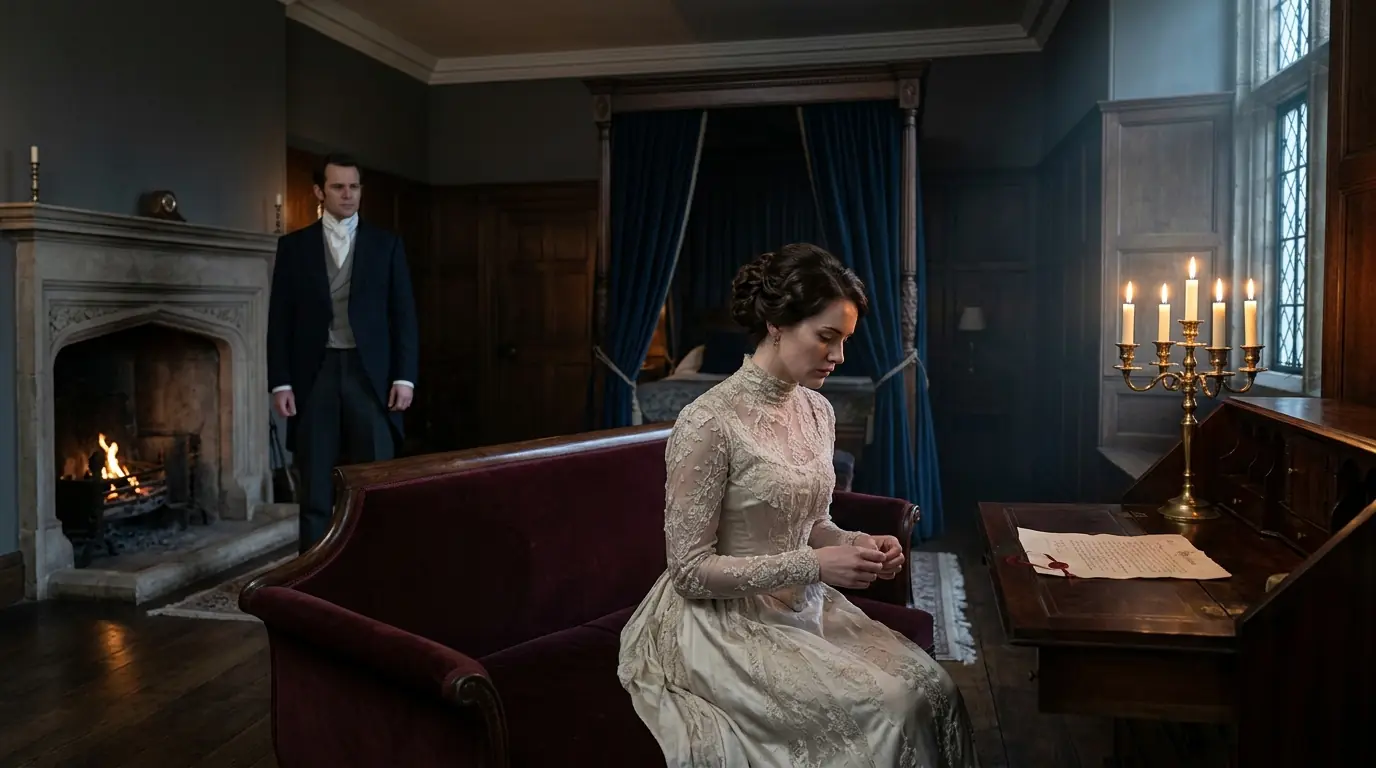
"You did not open it before me."
"You thanked me with that same steadiness you thanked everyone, and you went to your own chamber, and I sat the whole night through in the library like a coward, waiting to hear whether you had read it."
"I read it," she said quietly.
"Then you know what it was?"
He made himself say it plainly without the shield of grand words. It was your freedom.
"A deed of separate maintenance drawn in my own hand."
"An income settled on you for life."
"A house at Milbour that answers to no one but you."
"And the release of every farthing your father owed against you."
"I bought you Enid."
"Your family sold you to me across a table as though you were a length of cloth."
"And I let them because I told myself a duke does not haggle and a bargain is a bargain."
"And then I saw your face when the papers were signed, and I could not bear to be a man who owned another."
"So I gave you the means to leave me the very hour we were wed."
That was my gift. It was not kindness. It was penance. She said nothing. The horses shifted.
The harness rang.
"You never used it," He went on.
"Any morning these three months, you might have called for a carriage and gone to Milbour and lived free of me forever, and I would not have raised a hand to stop you."
"I told myself each day that your staying was habit, prudence, that you had nowhere gentler to go."
"I did not dare believe it might be choice, cuz I have spent my whole life being chosen for what I am, and never once for who I am, and I had made a fortress of never hoping otherwise."
Dalton, let me finish, or I shall lose my nerve. He drew a breath that shook.
"There was a woman before you a very long time ago, who was to have been my wife."
She was beautiful and she was clever and she wanted the coronet on my head with all her heart and not one inch of the head beneath it.
"When I understood that and I understood it the week before the wedding, I broke it off and I decided that I would never again be fool enough to mistake wanting my rank for wanting me."
"So I grew cold on purpose and I made myself feared because feared men are not deceived."
"And it answered very well for 20 years until a magistrate's clerk led a girl in a mended gri into my drawing ring room and that girl looked at the Duke of Cuddavail and was not the least bit afraid of him and did not flatter him and told him when he asked that his roses wanted pruning."
A sound broke from her that was half a sob and half a laugh. They did want pruning. They wanted pruning. His own mouth trembled toward a smile and lost the fight to something graver.
"Tonight in that hall, I nearly lost you, and it was my own doing."
"When Rosanna Dorney stood up before the whole county, and saw she had seen you take the Cadel diamonds, when she produced that wretched maid to lie beside her, for one instant, one instant I will be ashamed of until I die, the old wound spoken me, and I wondered."
"I looked at you and I wondered, and you saw me wonder."
"Do not tell me you did not."
"I saw it strike you."
Her chin came up.
"I saw it."
"That is why you are standing beside this carriage," He said it as a confession, not an accusation, not because of Rosanna's lie.
"You have borne a hundred lies from her sort with never a backward step."
"You are leaving because the one man whose faith you had earned looked at you across a crowded room, and for the space of a breath, doubted."
"And you were right to reach for your trunk."
A woman should not stay where she is doubted. The frost snapped somewhere in the limes. She had gone very still.
"But here the rest," he said, for the rest is the whole of it.
"The instant that doubt rose in me, it died."
"Do you understand?"
"It died of its own poison."
"Because I know you."
"I have watched you for 3 months feed the undergarder's children from your own plate and mend the linen you might have ordered burnt and sit with old misses."
"Peak the night she was dying, though no one asked it of you, and there was no soul of consequence to see."
"A woman who does those things when no one is looking does not steal diamonds."
"I did not need Harup to find the necklace sewn into Rosanna's own reticle to know the truth of you."
"I knew it before he opened the clasp."
"My doubt lasted one heartbeat and my certainty has lasted my whole life since and it will last it to the end."
"That is what I came out into the cold to tell you."
"That the wondering is gone and it will never come again."
"Though every liar in England swear against you, I would take your word over the evidence of my own eyes."
"That is not a thing I have ever said to a living creature."
Enid's hand had come away from the trunk. He saw it and dared not look at it too directly, as one does not look directly at a bird that might yet startle from the sill.
"You gave me my freedom on our wedding night," she said, and her voice was not steady now, not the burnished calm she wore like armor, but low and unguarded and near.
"Do you know what that paper did, Dalton?"
"You thought you had given me a door out."
"What you gave me was the only proof I had ever been given in my life, that I was worth something to a man beyond my use to him."
"My father valued me at £4,000 and a canceled debt."
"You valued me at my liberty and asked nothing back."
"I did not stay from habit."
"I did not stay because I had nowhere to go."
"I had Milbourne."
"I had an income."
"I had thanks to you, the whole world open before me for the first time in my 4 and 20 years."
"I stayed because in this cold, dreadful, beautiful house there was a man who pruned his own roses at dawn, so the gardeners would not see him doing a servant's work for the pleasure of it, and who thought no one knew."
"And I wanted to know that man for the rest of my days."
He could not have spoken then to save his soul.
"I do not want your rank," she said fiercely, stepping toward him now into the light, so that they stood a hands breath apart in the ring of the lamp.
"I never wanted it."
"Take the coronet and the diamonds and cut a veil itself, and give them to Rosanna Adorny, and let her choke on them."
"I want the man who came running down his own drive without his coat."
"If you had come to me tonight as the Duke offering to restore my name and reinstate my place and do the correct and honorable thing by his injured wife, I would have got into that carriage, Dalton, and you would never have seen me more."
"Do you understand me?"
"I will not be rescued."
"I will not be done right by."
"But if you have come as Dalton, who was afraid, and who doubted for a heartbeat and hated himself for it, and who cannot bear a house I am not in, then I am not going to Melbourne tonight, nor any night."
"I have come as Dalton," he said.
"It was scarcely above a whisper."
"God help me."
"There is nothing else of me left to come as."
"You have pulled the whole armor off."
"I stand here in front of my servants and a hired driver with no title on me at all."
"Only a man who loves his was sense or dignity, and would rather beg in this frost than sleep one hour in a house you have quit."
Her breath went out of her in a small white cloud. He lifted his hand slowly, giving her every moment to refuse it, and set it against her cold cheek, and she turned her face into his palm, the way a thing long in winter turns to the first true warmth. And for a while neither of them said anything at all, there in the lamplight. With the horses steaming and the great house glowing gold behind them, he did not kiss her. He found that he did not need to.
The wanting had become all at once a kind of peace, now that there was no more pretending on either side. He only held her face in his two hands, as though it were the one treasure the auctioneers had somehow overlooked, and pressed his lips to her brow, and felt her hands come up and close upon his wrists, holding him where she wanted him kept.
"Come in from the cold," he murmured against her hair.
"You were right about my chill, and you shall be right about a great many things for a for a very long time, and I intend to tell everyone so," She laughed wet and low.
Everyone, everyone. He drew back only far enough to look at her.
"I mean it more than you know."
Comb. He handed her trunk down himself, paid the astonished driver double for his patience, and led her back up the drive not by the servants's turn, but straight through the great doors, into the hall, where the hall of the county still stood in disarray among the guttering candles. Rosanna Dorney was there yet, penned near the cold hearth by two footmen and the magistrate's clerk, the diamonds, cut from the lining of her own reticule, not a quarter hour passed, glittering accusingly upon the salv where herup had laid them for all to see. Her allies had drawn back from her, as such people always draw back the instant the tide turns. The very ladies who had lost behind their fans at Inid's mended gown now studied the parket with great interest.
Dalton did not raise his voice. He had never needed to. He drew Enid forward by the hand into the full light, and the murmuring died as though a door had shut on it.
"You will attend me, for I shall say this once," he said to the room.
"This is Enid, Duchess of Cadaval, my wife, not by bargain."
"That bargain I have this night burned and glad of it."
"She is my wife by my own choosing, freely made, and twice over."
"And there is no woman living I hold in higher honor, or would sooner have at my side."
"Any person beneath this roof who cannot bring themselves to say as much may find their carriage at the door."
"It is a cold night, but I dare say the drive may cool other things besides your temper."
His eyes moved without haste to Rosanna.
"As for the charge laid against my wife, you have all seen where the diamonds slept and in whose keeping."
"Miss Dorney will answer for it to the magistrate, and I will not lift one finger to soften what is coming."
"She schemed to see an honest woman transported for theft rather than watch her rise."
"Look well at her, all of you, and then look at the Duchess, and understand which of the two of them any of you would be fortunate to resemble."
No one spoke for Rosanna. That was the whole of her sentence, really worse than any the magistrate would hand down, the silence of the very people whose good opinion had been the coin she spent her life amassing. She was led out weeping, and the great doors closed on the sound of it, and it seemed to Dalton that the house itself breathed easier for her going. But it was not to the room that he turned. Then it was to Enid, whose fingers were still laced with his, who was looking about the hall at all the faces that had scorned her, and finding, he saw that she no longer cared a straw for a single one of them.
That was her triumph, and it pleased him more than her vindication, not that she stood above them now, but that she stood free of them. He raised her hand and kissed it there before them all, and then he did what the Duke of Cadaval had not done in the memory of any soul present. He smiled fully and without guard, the years falling from his hard face like snow off a warming eave, so that the guests exchanged glances as though the sun had come up indoors. Spring came late that year, but it came and it found them out in the rose garden at the pale hour before the household woke. The Duke on his knees in the good dark earth with his sleeves turned back and a pruning knife in his ungloved hand, and his duchess beside him in an old shawl, holding the cut canes as he passed them back.
The two of them arguing in low, contented voices over which branch should stay and which should go. The papers of separate maintenance had long since been unfolded once more, not to be used, but to be added to. He had settled Milbourne on her outright, and doubled the income, and told her plainly that it was hers whether she stayed or went, precisely so that every day she stayed, he might know for a certainty that she had chosen him again. She had scolded him for the extravagance, and kept the deed in the drawer of her writing table, and never once called for the carriage.
"There," she said, as the last deadwood came away and the bush stood lightened and living against the pearl gray sky.
"You see, they only wanted someone to trust them enough to cut."
He sat back on his heels and looked at her at the earth on her knuckles, and the loose hair against her cheek, and the plain gladness in her that no drawing room had ever coaxed out of her. And this garden drew forth as easily as breath. And he thought that he had been a feared man and a cold man and a rich man and had counted himself in all those years tolerably wise he had known nothing. He had been sold a bride to close a debt and had meant only to do her no harm and instead she had walked in through his ruin and his armor and his careful guarded twenty-year winter and pruned him down to the living wood and he had bloomed again. He said nothing.
He took her earth-darkened hand and held it in both of his there in the waking garden with the first bird starting up in the limes and the great house gold at its windows behind them.
"Only that I should like to do this every morning for the rest of my life if you are willing."
She leaned her head against his shoulder and did not let go of his hand and the sun came up over the wall and warmed them both together.
"I am willing," she said.
"I always was."
"You were only the last to know."